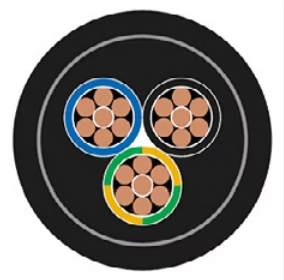
600/1000V cable

Marine & Port Drag Cable — High-Flexibility Saltwater-Resistant System A comprehensive engineering dissection of heavy-duty marine drag cables for port equipment, container terminals, and offshore platforms — from conductor architecture and EPR insulation to steel wire armour (M2) design rationale, galvanic corrosion protection mechanisms, environmental compliance, and validated performance benchmarking against Nexans Eproneo Port and Prysmian marine systems.

Безгалогенный огнестойкий PUR барабанный кабель 600/1000V для тяжёлых условий эксплуатации, горной техники, кранов и удлинительных линий

PUR reeling cable для тяжёлых применений — это механически прочный барабанный кабель с гибкими медными жилами класса 5, изоляцией XLPE, жёлтой наружной оболочкой PUR и anti-twist element. Кабель предназначен для тяжёлых условий эксплуатации, включая горную технику, краны, удлинительные кабели, барабанные системы и подвижное оборудование. Его ключевые свойства: хорошая механическая стойкость, безгалогенное исполнение, огнестойкость, хорошая маслостойкость, химическая стойкость, стойкость к UV, озону и воде, номинальное напряжение Uo/U 600/1000V и скорость намотки до 120 m/min.
LIFT-2S (European) vs. LIFT-1S UL (North American): LIFT-2S characteristics: Voltage: 300/500V (European standard, lower voltage) Temperature: −40°C to +70°C (moderate range) Standards: VDE 0482 part 265-2-1, EN 50265-2-1, IEC 60332-1-2 Design philosophy: Safety by material redundancy (2 steel cores) Steel cores: 2× cores provide mechanical backup Conductor: Class 6 (European, ~150–200 wires per mm²) Cost: Lower (proven European manufacturing) Market: Europe, Asia-Pacific, most of world LIFT-1S UL characteristics: Voltage: 600V (North American standard, higher voltage) Temperature: −25°C to +105°C (extreme range, high-temp optimized) Standards: UL 2562, UL 62, CSA C22.2 No.210.2 Design philosophy: Safety by certification (single core + redundant control) Steel core: 1× core (sufficient with nylon covering) Conductor: Class M (UL, extra fine ~300+ wires per mm²) Cost: Higher (UL testing, certification documentation) Market: North America (USA, Canada), Mexico UL 2562 specialty certification: UL 2562 scope: Elevator and Dumbwaiter Cables Specific requirements: 1. Pendant cable design (cable hangs freely, no duct support) 2. Vertical orientation (designed for gravity-loaded suspension) 3. Repeated flex cycles (cable moves up/down frequently) 4. Safety-critical function (failure = personnel risk) Consequence: More stringent than general-purpose cables Testing includes: Bend cycle fatigue, heat aging, compression resistance Test procedures (unique to UL 2562): Bend cycle test: 1,000+ cycles at minimum bending radius Cable must pass insulation resistance after cycling Heat aging: 500+ hours at 105°C continuous Tensile strength retention minimum 70% Compression: 1,000+ hours under sustained compression Cable cross-section must not exceed 5% permanent deformation LIFT-2S (no UL 2562): Tests per VDE are less stringent on fatigue/cycling Assumes cable mostly static, not repeated flex Adequate for European elevator duty (lower speed, fewer cycles) LIFT-1S UL: All UL 2562 tests passed (proven for North American elevators) Faster cycle times, more frequent motion → more fatigue stress Extra testing ensures reliability under North American elevator duty Market requirement (regulatory): Europe/International: CE mark required (European conformity) VDE/EN/IEC standards sufficient No UL certification needed (not recognized in EU) LIFT-2S is sufficient North America (USA, Canada): UL certification mandatory for elevators UL 2562 specifically for elevator cables CSA dual certification required in Canada LIFT-2S NOT acceptable (lacks UL 2562) LIFT-1S UL mandatory Cost implication: UL certification: ~$5,000–15,000 per product per region Testing duration: 3–6 months per model Documentation: Comprehensive test reports, technical files Result: LIFT-1S UL 20–30% higher cost than equivalent European cable

Безгалогенный огнестойкий PUR барабанный кабель 600/1000V для тяжёлых применений, горной техники, кранов и удлинительных линий

PUR reeling cable для тяжёлых применений — это механически прочный, безгалогенный и огнестойкий барабанный кабель с гибкими медными жилами класса 5, изоляцией XLPE и жёлтой наружной оболочкой PUR. Кабель предназначен для тяжёлых условий эксплуатации, например для горной техники, кранов, удлинительных кабелей, барабанных систем и подвижного оборудования, где требуются высокая механическая стойкость, хорошая маслостойкость, химическая стойкость, стойкость к UV, озону и воде.
The nominal outer diameter (OD) of a LAPP ÖLFLEX CLASSIC 100 4G16 flexible industrial power cable (Article number 00101123) is exactly 20.4 millimeters (0.804 inches), with a standard tolerance of ±0.3 millimeters, producing acceptable cables measuring 20.1 to 20.7 millimeters in outer diameter. This four-conductor cable configuration consists of three active power conductors (black, brown, and grey color-coded per VDE 0293-308) plus one green-yellow dual-color protective earth/ground conductor, each having a cross-sectional area of 16 square millimeters, providing a total copper conductor mass of approximately 614 kilograms per kilometer. The complete assembled cable, including PVC insulation around each conductor, tinned copper braid shielding (in shielded variants), and the grey RAL 7001 PVC outer protective sheath, weighs approximately 1,087 kilograms per kilometer under normal atmospheric conditions. When properly coiled on a standard industrial reel, a single 100-meter length of this cable weighs approximately 108.7 kilograms, a 500-meter drum weighs approximately 544 kilograms, and a full 1-kilometer supply spool weighs approximately 1,087 kilograms—specifications essential for facility material handling planning and equipment procurement. This cable is designed specifically for industrial power distribution, flexible machinery connections, HVAC system wiring, and wind turbine generator (WTG) applications where robust electrical performance, mechanical durability, and standards compliance are non-negotiable requirements.

Outer Diameter Specs: Dimensions and Weight for LAPP ÖLFLEX CLASSIC 100 4G16 Power Cable

The nominal outer diameter (OD) of a LAPP ÖLFLEX CLASSIC 100 4G16 flexible industrial power cable (Article number 00101123) is exactly 20.4 millimeters (0.804 inches), with a standard tolerance of ±0.3 millimeters, producing acceptable cables measuring 20.1 to 20.7 millimeters in outer diameter. This four-conductor cable configuration consists of three active power conductors (black, brown, and grey color-coded per VDE 0293-308) plus one green-yellow dual-color protective earth/ground conductor, each having a cross-sectional area of 16 square millimeters, providing a total copper conductor mass of approximately 614 kilograms per kilometer. The complete assembled cable, including PVC insulation around each conductor, tinned copper braid shielding (in shielded variants), and the grey RAL 7001 PVC outer protective sheath, weighs approximately 1,087 kilograms per kilometer under normal atmospheric conditions. When properly coiled on a standard industrial reel, a single 100-meter length of this cable weighs approximately 108.7 kilograms, a 500-meter drum weighs approximately 544 kilograms, and a full 1-kilometer supply spool weighs approximately 1,087 kilograms—specifications essential for facility material handling planning and equipment procurement. This cable is designed specifically for industrial power distribution, flexible machinery connections, HVAC system wiring, and wind turbine generator (WTG) applications where robust electrical performance, mechanical durability, and standards compliance are non-negotiable requirements.
Before we dive into the technical differences between Type 241 and Type 260 cables, let's take a moment to understand shuttle cars themselves and why cable selection matters so much for these critical mining vehicles. Think of shuttle cars as the workhorses of underground coal mining operations. These are large, heavy-duty battery-electric or trailing-cable powered vehicles designed to transport coal from the continuous miner working at the coal face to either feeder breakers, mine cars, or belt conveyor systems located some distance away. The shuttle car essentially acts as a mobile bridge between the mining equipment that's actively cutting coal and the permanent conveying infrastructure that will carry that coal to the surface. 在深入了解241型和260型电缆之间的技术差异之前,让我们花点时间了解穿梭车本身,以及为什么电缆选择对这些关键采矿车辆如此重要。可以将穿梭车视为地下煤矿作业的主力。这些是大型重型电池电动或拖缆供电车辆,设计用于将煤炭从在煤层工作面工作的连续采煤机运输到位于一定距离外的给料破碎机、矿车或带式输送机系统。穿梭车本质上充当正在切割煤炭的采矿设备与将煤炭运送到地面的永久输送基础设施之间的移动桥梁。

Type 241 vs. Type 260 Mining Cables: Understanding Construction Differences and Application Selection for Shuttle Car Operations

Before we dive into the technical differences between Type 241 and Type 260 cables, let’s take a moment to understand shuttle cars themselves and why cable selection matters so much for these critical mining vehicles. Think of shuttle cars as the workhorses of underground coal mining operations. These are large, heavy-duty battery-electric or trailing-cable powered vehicles designed to transport coal from the continuous miner working at the coal face to either feeder breakers, mine cars, or belt conveyor systems located some distance away. The shuttle car essentially acts as a mobile bridge between the mining equipment that’s actively cutting coal and the permanent conveying infrastructure that will carry that coal to the surface. 在深入了解241型和260型电缆之间的技术差异之前,让我们花点时间了解穿梭车本身,以及为什么电缆选择对这些关键采矿车辆如此重要。可以将穿梭车视为地下煤矿作业的主力。这些是大型重型电池电动或拖缆供电车辆,设计用于将煤炭从在煤层工作面工作的连续采煤机运输到位于一定距离外的给料破碎机、矿车或带式输送机系统。穿梭车本质上充当正在切割煤炭的采矿设备与将煤炭运送到地面的永久输送基础设施之间的移动桥梁。
NSSHÖU cables are designed for power supply applications in mining, quarrying, tunneling, and heavy industrial equipment where extreme mechanical stress and abrasion are expected. These cables can be installed in dry, damp, wet, and hazardous environments but are NOT suitable for drumming applications under tensile loads or for continuous robotic movement in energy chains where highly flexible cables with specific bend cycle ratings are required. NSSHÖU电缆设计用于采矿、采石、隧道和重型工业设备中的供电应用,其中预期会有极端的机械应力和磨损。这些电缆可以安装在干燥、潮湿、湿润和危险环境中,但不适合在拉力负载下的卷筒应用或需要具有特定弯曲周期额定值的高度柔性电缆的连续机器人运动的能量链中。

NSSHÖU Cable Ampacity Table: Current Rating & Correction Factors at 50°C Ambient Temperature

NSSHÖU cables are designed for power supply applications in mining, quarrying, tunneling, and heavy industrial equipment where extreme mechanical stress and abrasion are expected. These cables can be installed in dry, damp, wet, and hazardous environments but are NOT suitable for drumming applications under tensile loads or for continuous robotic movement in energy chains where highly flexible cables with specific bend cycle ratings are required. NSSHÖU电缆设计用于采矿、采石、隧道和重型工业设备中的供电应用,其中预期会有极端的机械应力和磨损。这些电缆可以安装在干燥、潮湿、湿润和危险环境中,但不适合在拉力负载下的卷筒应用或需要具有特定弯曲周期额定值的高度柔性电缆的连续机器人运动的能量链中。
The proper selection and installation of cable grips, particularly Kellem grips (also known as mesh grips or wire mesh grips), is critical for ensuring safe vertical suspension of heavy-duty cables in industrial environments. This is especially important for (N)SHTÖU cables, which are specifically designed for reeling applications in demanding conditions such as mining operations, port container handling equipment, and mobile industrial machinery. 正确选择和安装电缆夹具,特别是Kellem网套(也称为网状夹具或金属丝网夹具),对于确保工业环境中重型电缆的安全垂直悬挂至关重要。这对于(N)SHTÖU电缆尤其重要,这些电缆专为采矿作业、港口集装箱处理设备和移动工业机械等苛刻条件下的卷筒应用而设计。

Cable Grips: How to Select the Right Kellem Grip (Mesh Grip) for Vertical Suspension of (N)SHTÖU Cables

The proper selection and installation of cable grips, particularly Kellem grips (also known as mesh grips or wire mesh grips), is critical for ensuring safe vertical suspension of heavy-duty cables in industrial environments. This is especially important for (N)SHTÖU cables, which are specifically designed for reeling applications in demanding conditions such as mining operations, port container handling equipment, and mobile industrial machinery. 正确选择和安装电缆夹具,特别是Kellem网套(也称为网状夹具或金属丝网夹具),对于确保工业环境中重型电缆的安全垂直悬挂至关重要。这对于(N)SHTÖU电缆尤其重要,这些电缆专为采矿作业、港口集装箱处理设备和移动工业机械等苛刻条件下的卷筒应用而设计。
In industrial cable applications involving continuous reeling and unreeling operations, cable integrity under mechanical stress is paramount. One critical structural element that ensures operational reliability is the anti-torsion braid, also known as an embedded textile mesh, positioned within the cable sheath. This technical component plays a vital role in maintaining cable performance in demanding environments such as crane systems, hoists, conveyor belts, and mobile machinery. 在涉及连续收卷和放卷操作的工业电缆应用中,机械应力下的电缆完整性至关重要。确保操作可靠性的一个关键结构元件是反扭转编织层,也称为嵌入式纺织网,位于电缆护套内。该技术组件在起重机系统、提升机、传送带和移动机械等苛刻环境中维护电缆性能方面起着至关重要的作用。

How Does the Anti-Torsion Braid Prevent Cable Twisting During Reeling?

In industrial cable applications involving continuous reeling and unreeling operations, cable integrity under mechanical stress is paramount. One critical structural element that ensures operational reliability is the anti-torsion braid, also known as an embedded textile mesh, positioned within the cable sheath. This technical component plays a vital role in maintaining cable performance in demanding environments such as crane systems, hoists, conveyor belts, and mobile machinery. 在涉及连续收卷和放卷操作的工业电缆应用中,机械应力下的电缆完整性至关重要。确保操作可靠性的一个关键结构元件是反扭转编织层,也称为嵌入式纺织网,位于电缆护套内。该技术组件在起重机系统、提升机、传送带和移动机械等苛刻环境中维护电缆性能方面起着至关重要的作用。
Rolling stock cables are specialized electrical cables designed for use in railway vehicles, including trains, metros, trams, and underground rail systems. These cables form part of a comprehensive product range encompassing all cables used by moving vehicles across railway, metro, and underground rail infrastructures. According to international railway standards, rolling stock cables must meet stringent requirements for fire safety, mechanical durability, and electrical performance.

What is Rolling Stock Cable?

LFH Rail Rolling Stock Part 6 Type I Cable, LFH Rail Rolling Stock Part 6 Type II Cable, LFH Rail Rolling Stock Part 6 Type III Cable, LFH Rail Rolling Stock Part 6 Type IV Cable, LFH Rail Rolling Stock Part 6 Type V Cable, LFH Rail Rolling Stock Part 6 Type VI Cable, LFH Rail Rolling Stock Part 6 Type VII Cable, LFH Rail Rolling Stock Part 6 Type VIII Cable, LFH Rail Rolling Stock Part 6 Type IX Cable, LFH Rail Rolling Stock Part 6 Type XI Cable, LFH Rail Rolling Stock Part 6 Type XII Cable, LFH Rail Rolling Stock Part 6 Type XIII Cable
KEMA approval is recognised as the key independent Dutch third-party accreditation for electrical cables, particularly important when working on low voltage installation projects in the Netherlands and across Europe. KEMA approvals are issued by KEMA Labs, based in Arnhem, The Netherlands. KEMA Labs' parent company is CESI (Centro Elettrotecnico Sperimentale Italiano), the Italian independent testing and laboratories business, having acquired the testing division from DNV GL Energy in 2019.

What are KEMA Approved Cables?

KEMA approved cable, KEMA certification, KEMA Labs, KEMA certified, KEMA approval, Dutch cable certification, Netherlands cable standard, third-party certified cable, independent cable certification KEMA认证电缆, KEMA認證電纜, 荷兰标准电缆, 荷蘭標準電纜, 低烟无卤电缆, 低煙無鹵電纜, 数据中心电缆, 數據中心電纜, 荷兰认证, 荷蘭認證
UNE 21123 standard refers to the design and cross-sectional area specifications for cables used by utilities on power distribution circuits with voltage ratings up to and including 600/1000V (0.6/1kV). UNE standards are released by AENOR (Asociación Española de Normalización y Certificación), the Spanish Association for Standardisation and Certification. As AENOR is a member of ISO, IEC, and CENELEC, many of its standards are harmonized with European and international conventions.

What is UNE 21123 Cable?

UNE 21123 standard refers to the design and cross-sectional area specifications for cables used by utilities on power distribution circuits with voltage ratings up to and including 600/1000V (0.6/1kV). UNE standards are released by AENOR (Asociación Española de Normalización y Certificación), the Spanish Association for Standardisation and Certification. As AENOR is a member of ISO, IEC, and CENELEC, many of its standards are harmonized with European and international conventions.
NF C32-322 is a French national standard (Norme Française) that specifies requirements for armoured low voltage power cables. These cables, commonly designated as U-1000 RVFV (copper conductor) and U-1000 ARVFV (aluminium conductor), are widely used rigid industrial cables designed for installations requiring mechanical protection. They represent the armoured equivalent of the NF C32-321 unarmoured cables.

What is NF C32-322 Cable?

NF C32-322, U-1000 RVFV, U-1000 ARVFV, U-1000 XAV, NF C32 322, RVFV cable, ARVFV cable, French standard armoured cable, 0.6/1kV cable, 1kV armoured cable, 600/1000V cable, low voltage armoured cable, LV power cable, 1000V industrial cable, NF C32-322 standard, NF C32-070 C2, IEC 60502-1, IEC 60228, IEC 60332-1-2, French cable standard, Norme Française cable, AFNOR cable standard, flame retardant cable,低压电缆, 低壓電纜, 铠装电缆, 鎧裝電纜, 交联聚乙烯电缆, 交聯聚乙烯電纜, 钢带铠装, 鋼帶鎧裝, 法国标准电缆, 法國標準電纜, 工业电缆, 工業電纜, 直埋电缆, 直埋電纜
BS6724 is a British Standard specification for thermosetting insulated, armoured cables with rated voltages of 600/1000V and 1900/3300V, specifically designed to have low emission of smoke and corrosive gases when affected by fire. This standard is widely adopted in the UK and internationally for applications where fire safety is critical.

What is BS6724 Cable?

BS6724, BS 6724, BS6724 cable, BS6724 standard, BS 6724 cable specification, BS6724 LSZH cable, BS6724 SWA cable, BS6724 AWA cable, 600/1000V cable, 1900/3300V cable, 0.6/1kV cable, 1.9/3.3kV cable, low voltage cable BS6724,BS6724電纜, 低煙無鹵電纜, LSZH電纜, 低壓電纜, 鎧裝電纜, 鋼絲鎧裝電纜, 鋁絲鎧裝電纜, 阻燃電纜, 防火電纜, 公共建築電纜, 醫院電纜, 機場電纜, 隧道電纜, 數據中心電纜, 特種電纜, 電力電纜
NSHXAFÖ represents a specialized category of single conductor halogen-free flexible power cables engineered for demanding industrial applications, including wind turbine installations where exceptional flexibility, fire safety, and multi-voltage capability are critical requirements. This cable series spans three voltage classes from 0.6/1 kV through 3.6/6 kV, providing comprehensive solutions for both low and medium voltage power distribution within wind energy systems.

What is NSHXAFÖ 0.6/1 to 3.6/6 kV Wind Turbine Cable?

NSHXAFÖ represents a specialized category of single conductor halogen-free flexible power cables engineered for demanding industrial applications, including wind turbine installations where exceptional flexibility, fire safety, and multi-voltage capability are critical requirements. This cable series spans three voltage classes from 0.6/1 kV through 3.6/6 kV, providing comprehensive solutions for both low and medium voltage power distribution within wind energy systems.
SANS 1520 Feichun Cable

CU/XLPE/LSZH/SWA/LSZH-SANS 1507 0.6/1KVBlack Sheath with White Strip Cable

The CU/XLPE/LSZH/SWA/LSZH-SANS 1507 0.6/1KV cable with black sheath and white identification strip represents a significant advancement in industrial power transmission technology. This specialized cable combines the robust mechanical protection of steel wire armour (SWA) with the critical safety features of Low Smoke Zero Halogen (LSZH) materials, making it an optimal choice for demanding applications in mining operations, petrochemical facilities, and infrastructure projects across South Africa and internationally.