

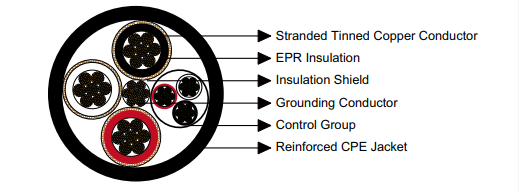
Premium 5kV SHD-PCG three-conductor round portable mining cable with integrated control circuits for surface mining equipment. Electric shovels, dragline excavators, mobile crushers, bucket wheel reclaimers. EPR insulation, shielded power conductors, ICEA S-75-381 certified. Six conductor sizes 3×2 AWG to 3×4/0 AWG, ampacity range 159-321A.
SHD-PCG Type Three-Conductor Round Portable Power Cable 5kV with Integrated Control Circuits
High-Voltage Power Distribution Solution Engineered for Surface Mining and Open-Pit Operations
Surface Mining Operations and Equipment Electrification Systems
Surface mining operations, alternatively designated as open-pit or open-cast mining, represent large-scale mineral extraction methodologies where overburden removal exposes valuable ore deposits for direct mechanical excavation. These operations require robust electrical infrastructure capable of delivering reliable power to mobile equipment operating across expansive mining sites under variable environmental conditions including temperature extremes, dust exposure, moisture ingress, and ultraviolet radiation.
The SHD-PCG 5kV cable series addresses the elevated voltage requirements characteristic of large-capacity surface mining machinery. Operating at 5000 volts nominal voltage rather than the 2000-volt systems typical in underground coal mining, these cables enable efficient power transmission to high-horsepower equipment motors while minimizing resistive losses across extended cable lengths. The 5kV voltage classification proves particularly advantageous for electric shovels with dipper capacities exceeding 40 cubic yards, dragline excavators with boom lengths surpassing 100 meters, and mobile crushing plants processing 3000+ tons per hour.
Beyond the elevated voltage rating, this cable integrates three independent control conductors within the primary power cable assembly, enabling consolidated installation of both power distribution and equipment control signaling through a single cable system. This integrated architecture reduces installation complexity, minimizes cable management infrastructure requirements, and decreases maintenance burden compared to deploying separate power and control cable systems across surface mining sites spanning multiple square kilometers.
Target Equipment Applications in Surface Mining Operations
Regulatory Standards and Certification Compliance Framework
- ICEA S-75-381 / NEMA WC 58: Joint industry standard from Insulated Cable Engineers Association and National Electrical Manufacturers Association establishing specifications for portable mining power cables rated through 8kV voltage classification
- ASTM B 172: American Society for Testing and Materials standard specification addressing rope-lay-stranded copper conductors incorporating bunch-stranded or concentric-stranded member construction methodologies
- ASTM B 33: Standard specification defining requirements for tinned soft or annealed copper wire manufactured for electrical conductor applications requiring enhanced corrosion resistance characteristics
- CAN/CSA C22.2 No. 96: Canadian Standards Association certification standard for portable power cables utilized in mining operations and heavy industrial environments requiring enhanced mechanical durability
Engineering Construction Methodology and Materials Technology
Primary Conductor Configuration
Power conductors manufactured using rope-lay stranded annealed copper with uniform tin plating applied to individual wire elements. The rope-lay construction provides superior flexibility compared to concentric stranding while maintaining equivalent current-carrying cross-sectional area. Tin plating prevents oxidation in outdoor environments and ensures reliable electrical connections at termination points.
Primary Insulation System
Ethylene Propylene Rubber (EPR) compound formulated specifically for 5kV voltage service. EPR demonstrates excellent electrical properties including high dielectric strength, low dissipation factor, and superior resistance to tracking and corona formation. The material maintains flexibility across temperature ranges from -40°C to +90°C continuous operation.
Conductor Shielding Architecture
Individual metallic shields constructed from tinned copper wire braided with reinforcing textile fibers encapsulate each power conductor. These shields function as electrostatic barriers reducing electromagnetic interference, provide supplementary grounding paths for fault current protection, and contribute mechanical reinforcement against external abrasion and impact damage common in mining environments.
Integrated Control Circuit Group
Three control conductors fabricated from tinned copper stranding with individual EPR insulation layers and collective thermosetting elastomeric jacket protection. Control conductor insulation utilizes color coding (black, white, red) facilitating circuit identification during installation and maintenance. These circuits transmit equipment positioning signals, operational status data, and remote control commands.
Central Equipment Grounding Conductor
Dedicated tinned copper grounding conductor positioned at the cable geometric center ensures reliable equipment grounding pathway regardless of cable twisting during reeling operations. The central location provides balanced mechanical characteristics and maintains grounding integrity throughout the cable service life in demanding surface mining applications.
Reinforced Protective Jacket
Extra-heavy-duty Chlorinated Polyethylene (CPE) outer jacket formulated for surface mining applications provides comprehensive protection against ultraviolet radiation, ozone exposure, petroleum hydrocarbon contamination, mineral abrasion, and temperature extremes. Black pigmentation offers superior UV resistance for outdoor cable exposure across decades of service.
Alternative Jacketing Materials for Specialized Applications
While CPE represents the standard jacketing material for general surface mining applications, alternative elastomeric compounds address specialized operational requirements. Chlorosulfonated Polyethylene (CSP) provides enhanced chemical resistance for environments with aggressive industrial contamination. Polychloroprene (PCP) offers improved low-temperature flexibility for mining operations in arctic or high-altitude locations experiencing freezing ambient conditions. Nitrile Butadiene Rubber (NBR) delivers superior resistance to petroleum products and hydraulic fluids prevalent around mobile equipment. Polyvinyl Chloride (PVC) serves cost-sensitive applications with reduced environmental exposure. Thermoplastic Polyurethane (TPU) provides exceptional abrasion resistance and maintains flexibility across extreme temperature ranges for the most demanding surface mining environments.
For installations requiring maximum mechanical protection against sharp rock fragments, equipment track damage, or repeated crushing forces, a reinforced dual-layer jacket construction incorporating high-tenacity textile fibers between inner and outer elastomeric layers substantially increases puncture resistance and extends cable service life in extreme-duty surface mining operations.
Thermal and Mechanical Performance Specifications
The 90°C maximum conductor operating temperature establishes the thermal limit for continuous current-carrying operation. Maintaining conductor temperatures below this threshold through appropriate ampacity derating based on ambient temperature, cable grouping, and installation method significantly extends insulation service life by reducing thermal aging acceleration. Surface mining operations in desert environments with 50°C ambient temperatures require substantial ampacity derating compared to operations in temperate climates.
The minimum bending radius specification prevents mechanical damage to conductor stranding, insulation compression, and shield integrity. Cable routing around equipment structures, through cable reels, and along festoon systems must accommodate this minimum radius. Violation of minimum bending radius specifications during installation or service induces premature cable failure through conductor strand breakage, insulation cracking, and shield discontinuity.
Comprehensive Technical Specifications and Dimensional Characteristics
| Cable Size (Cores × AWG/kcmil) | Conductor Stranding Count | Grounding Conductor (AWG/kcmil) | Control Conductors (AWG/kcmil) | Insulation Wall Thickness (inch / mm) | Jacket Wall Thickness (inch / mm) | Overall Cable Diameter (inch / mm) | Linear Mass (lbs/kft / kg/km) | Ampacity Rating (Amperes) |
|---|---|---|---|---|---|---|---|---|
| 3 × 2 AWG | 259 | 4 AWG | 8 AWG (×3) | 0.11 / 2.8 | 0.205 / 5.2 | 2.03 / 51.5 | 2769 / 4120 | 159 |
| 3 × 1 AWG | 259 | 4 AWG | 8 AWG (×3) | 0.11 / 2.8 | 0.220 / 5.6 | 2.12 / 53.8 | 2825 / 4205 | 184 |
| 3 × 1/0 AWG | 266 | 3 AWG | 8 AWG (×3) | 0.11 / 2.8 | 0.220 / 5.6 | 2.27 / 57.7 | 3571 / 5313 | 211 |
| 3 × 2/0 AWG | 329 | 2 AWG | 8 AWG (×3) | 0.11 / 2.8 | 0.220 / 5.6 | 2.45 / 62.2 | 3774 / 5615 | 243 |
| 3 × 3/0 AWG | 418 | 1 AWG | 8 AWG (×3) | 0.11 / 2.8 | 0.235 / 6.0 | 2.58 / 65.3 | 4752 / 7070 | 279 |
| 3 × 4/0 AWG | 532 | 1/0 AWG | 6 AWG (×3) | 0.11 / 2.8 | 0.250 / 6.4 | 2.76 / 69.9 | 6030 / 8971 | 321 |
Ampacity Calculation Methodology: Current-carrying capacity ratings represent calculations performed in accordance with ICEA S-75-381 standard procedures assuming 90°C maximum conductor operating temperature with 40°C ambient air temperature baseline. Actual field ampacity varies depending upon installation configuration (direct burial, cable tray, free air suspension), cable grouping density, solar radiation exposure, wind velocity, and duty cycle characteristics. Engineers must apply appropriate correction factors addressing site-specific conditions when specifying cable sizes for surface mining installations.
Voltage Rating Comparison: 5kV versus 2kV Cable Systems
Strategic Advantages of 5000-Volt Cable Systems for Surface Mining Equipment
The selection between 2kV and 5kV voltage classifications for surface mining power distribution systems involves comprehensive evaluation of equipment power requirements, cable length considerations, electrical system efficiency, and capital investment optimization. While 2kV systems prove adequate for smaller mining equipment and shorter cable runs typical in underground mining, 5kV systems deliver substantial advantages for large-capacity surface mining operations.
| Performance Parameter | 2kV System Characteristics | 5kV System Advantages |
|---|---|---|
| Conductor Current Magnitude | Higher current required for equivalent power (I = P/V) | 60% current reduction for same power transmission enables smaller conductor sizes |
| Resistive Power Losses | Losses proportional to current squared (P = I²R) | 64% reduction in resistive losses compared to 2kV at equivalent power level |
| Voltage Drop Characteristics | Significant voltage drop across long cable lengths requires conductor upsizing | Reduced voltage drop percentage enables extended cable runs without excessive conductor size |
| Cable Weight and Handling | Larger conductors increase cable weight and handling difficulty | Smaller conductors for equivalent power reduce cable mass and improve handling characteristics |
| Equipment Motor Efficiency | Standard efficiency at rated voltage | Higher voltage motors typically achieve improved efficiency and power factor |
| Insulation Requirements | Standard insulation wall thickness | Increased insulation thickness (2.8mm vs 2.0mm) ensures adequate dielectric strength |
| Optimal Application | Underground mining, compact equipment, cable runs under 150 meters | Surface mining, high-horsepower equipment, cable runs 150-500+ meters |
For large electric shovels with 3000+ horsepower motors, dragline excavators with 5000+ horsepower hoist systems, or mobile crushers processing 3000 tons per hour, the electrical power requirements exceed 2 megawatts. Transmitting this power at 2kV necessitates conductor current exceeding 1000 amperes, requiring extremely large conductor sizes with substantial cable weight and cost. Operating at 5kV reduces conductor current to approximately 400 amperes, enabling practical cable sizes with manageable weight and installation handling characteristics.
Application-Specific Model Selection and Performance Optimization
Engineering Selection Criteria for Surface Mining Cable Specifications
Specifying the appropriate conductor size for surface mining equipment requires systematic evaluation of multiple technical and operational factors. Electrical considerations include equipment motor horsepower ratings, starting current magnitude, cable length from power source to equipment, acceptable voltage drop percentage, and duty cycle characteristics. Mechanical considerations encompass cable handling during installation, reel diameter constraints, cable weight limitations for festoon systems, and environmental exposure severity.
3 × 2 AWG Specification
- Ampacity: 159A (minimum capacity)
- Conductor area: 33.6 mm² per phase
- Linear mass: 4120 kg/km
- Overall diameter: 51.5 mm
- Primary applications: Auxiliary surface mining equipment, small mobile conveyors under 500 ton/hour capacity, drilling rig accessory systems, cable reel supply cars, hopper discharge cars with electric drives under 200 horsepower
- Cable length recommendation: Optimize for runs under 100 meters to maintain acceptable voltage drop
- Cost efficiency: Lowest material cost and lightest weight for applications not requiring higher ampacity
3 × 1 AWG Specification
- Ampacity: 184A (+16% versus 2 AWG)
- Conductor area: 42.4 mm² per phase
- Linear mass: 4205 kg/km
- Overall diameter: 53.8 mm
- Primary applications: Medium-capacity mobile equipment, conveyor belt systems 500-1000 ton/hour, rotary drilling rigs with moderate power requirements, crawler-mounted spreaders for overburden placement
- Cable length recommendation: Suitable for installations 100-150 meters with acceptable efficiency
- Balanced specification: Incremental capacity improvement with minimal weight increase over 2 AWG
3 × 1/0 AWG Specification
- Ampacity: 211A (+33% versus 2 AWG)
- Conductor area: 53.5 mm² per phase
- Linear mass: 5313 kg/km
- Overall diameter: 57.7 mm
- Primary applications: Standard electric shovels 25-35 cubic yard capacity, mobile crusher primary systems, bridge reclaimers with moderate travel distances, bucket wheel excavators with wheel diameters under 15 meters
- Cable length recommendation: Effective for installations 150-200 meters maintaining good voltage regulation
- Industry standard: Most frequently specified size for general surface mining power distribution
3 × 2/0 AWG Specification
- Ampacity: 243A (+53% versus 2 AWG)
- Conductor area: 67.4 mm² per phase
- Linear mass: 5615 kg/km
- Overall diameter: 62.2 mm
- Primary applications: Large electric shovels 35-50 cubic yard dipper capacity, high-capacity mobile crushers processing 2000+ ton/hour, dragline excavators with boom lengths 80-100 meters, heavy-duty bucket wheel reclaimers
- Cable length recommendation: Suitable for 200-300 meter installations with acceptable losses
- Performance advantage: Enhanced thermal margin accommodates high ambient temperatures in desert mining operations
3 × 3/0 AWG Specification
- Ampacity: 279A (+75% versus 2 AWG)
- Conductor area: 85.0 mm² per phase
- Linear mass: 7070 kg/km
- Overall diameter: 65.3 mm
- Primary applications: Extra-large electric shovels exceeding 50 cubic yard capacity, ultra-high-capacity crushers 3000+ ton/hour, draglines with boom lengths 100-120 meters, massive bucket wheel excavators with wheel diameters exceeding 18 meters
- Cable length recommendation: Optimized for 300-400 meter installations maintaining efficient operation
- Heavy-duty capability: Maximum ampacity for demanding continuous operation with frequent starting cycles
3 × 4/0 AWG Specification
- Ampacity: 321A (+102% versus 2 AWG, maximum rating)
- Conductor area: 107.2 mm² per phase
- Linear mass: 8971 kg/km (heaviest configuration)
- Overall diameter: 69.9 mm (largest diameter)
- Control conductor upgrade: Utilizes 6 AWG control conductors (versus 8 AWG) for enhanced control circuit capacity
- Primary applications: Maximum-capacity dragline excavators with boom lengths exceeding 120 meters and bucket capacities 80+ cubic yards, primary power distribution for the largest surface mining equipment, installations requiring absolute maximum current-carrying capacity
- Cable length recommendation: Engineered for extreme-length installations 400-500+ meters where voltage drop must be minimized
- Premium capability: Highest ampacity accommodates future equipment power upgrades and provides maximum operational safety margin
Control Conductor Integration and Automation System Interface
The integrated control conductor assembly within the SHD-PCG cable enables sophisticated equipment automation capabilities essential for modern surface mining operations. These control circuits facilitate programmable logic controller (PLC) integration, transmit equipment positioning data from GPS or encoder systems, communicate operational status including dipper load, conveyor speed, and crusher throughput to central monitoring systems, relay safety interlock signals preventing equipment collision or overload conditions, and distribute remote control commands enabling operator-controlled equipment from enclosed control rooms.
In mobile crusher installations, control conductors transmit crusher gap adjustment commands, conveyor speed synchronization signals, and material flow rate data. For electric shovels, these circuits communicate dipper position, crowd force, and swing angle information enabling automated dig cycle optimization. Dragline excavators utilize control conductors for boom angle monitoring, hoist load measurement, and automated bucket positioning sequences improving operator efficiency and reducing fuel consumption.
The color-coded control conductor insulation (black, white, red) simplifies field wiring during equipment commissioning and troubleshooting during maintenance activities. The thermosetting jacket encapsulating the control group provides mechanical protection and electromagnetic shielding preventing industrial electrical noise from corrupting control signals transmitted over distances exceeding 300 meters in surface mining installations.


