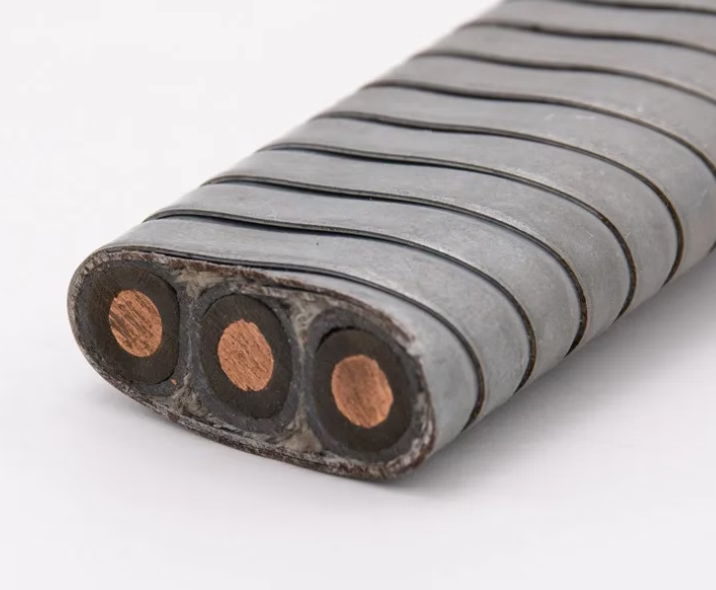
pump cable

飞纯 Type 241 是基于 AS/NZS 1802:2003 卷筒与拖曳电缆 标准体系设计的矿用主馈电、泵电缆和电源供电电缆系列,电压范围覆盖 1.1 至 11KV。根据产品资料,该电缆适用于多种用途,包括连续采煤机主馈电电缆、泵电缆和电源供电电缆。 Type 241 的关键安全特征是 总半导电屏蔽。该结构能够在任何物体穿透护套后、尚未接触动力导体之前,先形成保护性接地接触。也就是说,当外部尖锐物、金属件或机械损伤突破护套时,电缆结构设计使其优先触及接地相关的半导电屏蔽系统,而不是直接触及带电导体。这一设计对于矿山连续采煤机、泵站和移动电源供电场景具有重要安全意义。

飞纯 Type 241 1.1 至 11KV:基于 AS/NZS 1802:2003 的澳洲矿用主馈电、泵电缆与电源供电电缆技术解析

飞纯矿用电缆 Type 241 适用于多种矿山供电场景,包括连续采煤机主馈电电缆、泵电缆和电源供电电缆。其总半导电屏蔽结构能够在任何物体穿透护套后、接触动力导体前,先提供保护性接地接触,从而提升矿山移动供电系统的安全性。
Marine & Port Drag Cable — High-Flexibility Saltwater-Resistant System A comprehensive engineering dissection of heavy-duty marine drag cables for port equipment, container terminals, and offshore platforms — from conductor architecture and EPR insulation to steel wire armour (M2) design rationale, galvanic corrosion protection mechanisms, environmental compliance, and validated performance benchmarking against Nexans Eproneo Port and Prysmian marine systems.

Mining Cable Families at a Glance: An Engineering Guide to PROTOMONT, PROTOLON, TENAX, CORDAFLEX, NSSHOEU, TUNNELFLEX, MINEMASTER, SHD-GC, G-GC, MT 818 and Fibre Optic Cables

In mining, tunnelling and bulk material handling, the term mining cable does not describe one universal product. It describes an engineering map: reeling cables, trailing cables, feeder cables, fixed installation cables, tunnel cables, dredger and submersible pump cables, ground-check cables, fibre optic cables and custom OEM cable systems. A single mine may use low-voltage 0.6/1 kV reeling cables for LHD machines, medium-voltage trailing cables for excavators, TBM reeling cables from 6/10 to 18/30 kV, fixed feeder cables in tunnels and optical fibre networks for monitoring and automation. The correct selection starts not with a brand name, but with the application: how the cable moves, how it bends, how it is grounded, what voltage it carries, what regional standard applies and how the surrounding mine environment attacks the sheath.
FeiChun FLEXIDRUM® MEDIUM Water Cables: Advanced Waterproof Power Transmission Systems (1.8–18/30 kV) for Aquatic Infrastructure, Dredging Equipment & Submerged Power Applications: Comprehensive Technical Analysis of Specialized EPR Elastomer Waterproofing Chemistry Preventing Water Ingress in Continuous Submersion Conditions, Tinned Copper Conductor Systems Preventing Galvanic Corrosion in Freshwater/Saltwater/Brackish Water Environments, Hydrostatic Pressure Tolerance Supporting Underwater Deployment to 40°C Continuous Water Temperature, Advanced Water-Blocking Sheath Architecture (Special PCP 5GM3 Compound) Preventing Moisture Penetration Through Cable Core, Flexible Stranding Geometry Enabling Dynamic Deployment in Dredgers/Pumps Operating Under Continuous Mechanical Stress, Multiple Voltage Variants (1.8/3 kV through 18/30 kV) Addressing Diverse Aquatic Equipment Power Requirements, Low-Temperature Performance Supporting -45°C Arctic Water Operations, Comparative Analysis vs. Standard Industrial & Marine Cables, Field-Proven 15+ Year Submersion Durability Data from Dredging Operations/Pump Installations/Wastewater Treatment Systems, Complete Waterproofing Engineering Framework Preventing Water-Induced Electrical Failures, and Comprehensive Procurement Strategy for Aquatic Infrastructure Ensuring Equipment Reliability Across Multi-Decade Operating Cycles in Freshwater, Saltwater, Wastewater & Brackish Water Applications Aquatic infrastructure—dredging operations, water pumping systems, submerged equipment deployment, and wastewater handling—operates in environments fundamentally hostile to conventional electrical cables: continuous water contact creating moisture saturation pathways through standard insulation materials, hydrostatic pressure (0.1 bar per meter depth) mechanically stressing cable structure and potentially forcing water into conductor pathways, multi-water chemistry spanning pure freshwater through saltwater to aggressive wastewater environments each presenting distinct corrosion and degradation mechanisms, temperature gradients from -40°C arctic water through +40°C tropical submersion conditions challenging elastomer property maintenance. FeiChun's FLEXIDRUM® MEDIUM water cables address these unified environmental challenges through specialized EPR elastomer formulations engineered specifically for continuous water submersion (not adapted from industrial applications), tinned copper conductor systems preventing galvanic corrosion in saltwater-saturated environments, water-blocking sheath chemistry creating multiple redundant barriers preventing moisture penetration to power conductors, flexible stranding geometry maintaining mechanical compliance under dynamic dredger and pump loading, and comprehensive waterproofing architecture validated through 15+ years continuous submersion field performance.

FLEXIDRUM® MEDIUM (N)TSCGEWÖU WATER

FeiChun FLEXIDRUM® MEDIUM Water Cables: Advanced Waterproof Power Transmission Systems (1.8–18/30 kV) for Aquatic Infrastructure, Dredging Equipment & Submerged Power Applications: Comprehensive Technical Analysis of Specialized EPR Elastomer Waterproofing Chemistry Preventing Water Ingress in Continuous Submersion Conditions, Tinned Copper Conductor Systems Preventing Galvanic Corrosion in Freshwater/Saltwater/Brackish Water Environments, Hydrostatic Pressure Tolerance Supporting Underwater Deployment to 40°C Continuous Water Temperature, Advanced Water-Blocking Sheath Architecture (Special PCP 5GM3 Compound) Preventing Moisture Penetration Through Cable Core, Flexible Stranding Geometry Enabling Dynamic Deployment in Dredgers/Pumps Operating Under Continuous Mechanical Stress, Multiple Voltage Variants (1.8/3 kV through 18/30 kV) Addressing Diverse Aquatic Equipment Power Requirements, Low-Temperature Performance Supporting -45°C Arctic Water Operations, Comparative Analysis vs. Standard Industrial & Marine Cables, Field-Proven 15+ Year Submersion Durability Data from Dredging Operations/Pump Installations/Wastewater Treatment Systems, Complete Waterproofing Engineering Framework Preventing Water-Induced Electrical Failures, and Comprehensive Procurement Strategy for Aquatic Infrastructure Ensuring Equipment Reliability Across Multi-Decade Operating Cycles in Freshwater, Saltwater, Wastewater & Brackish Water Applications Aquatic infrastructure—dredging operations, water pumping systems, submerged equipment deployment, and wastewater handling—operates in environments fundamentally hostile to conventional electrical cables: continuous water contact creating moisture saturation pathways through standard insulation materials, hydrostatic pressure (0.1 bar per meter depth) mechanically stressing cable structure and potentially forcing water into conductor pathways, multi-water chemistry spanning pure freshwater through saltwater to aggressive wastewater environments each presenting distinct corrosion and degradation mechanisms, temperature gradients from -40°C arctic water through +40°C tropical submersion conditions challenging elastomer property maintenance. FeiChun’s FLEXIDRUM® MEDIUM water cables address these unified environmental challenges through specialized EPR elastomer formulations engineered specifically for continuous water submersion (not adapted from industrial applications), tinned copper conductor systems preventing galvanic corrosion in saltwater-saturated environments, water-blocking sheath chemistry creating multiple redundant barriers preventing moisture penetration to power conductors, flexible stranding geometry maintaining mechanical compliance under dynamic dredger and pump loading, and comprehensive waterproofing architecture validated through 15+ years continuous submersion field performance.
For New Zealand TBM (Tunnel Boring Machine) and underground infrastructure projects, specifying cables presents a critical engineering decision: use European VDE-standard cables (readily available from major suppliers like Prysmian, Nexans) or specify local AS/NZS-compliant equivalents. The (N)TSCGECEWÖU 3x50+3x25/3 6.6/6.6kV cable from German manufacturers represents excellent European engineering, but direct application in New Zealand requires technical translation to local regulatory standards. 对于新西兰盾构机(TBM)和地下基础设施项目,规范电缆规格呈现关键工程决策:使用欧洲VDE标准电缆(易从Prysmian、Nexans等主要供应商获得)或规范本地AS/NZS兼容等效品。德国制造商的(N)TSCGECEWÖU 3x50+3x25/3 6.6/6.6kV电缆代表卓越的欧洲工程,但在新西兰的直接应用需要技术转化为当地监管标准。

New Zealand TBMs: Equivalent Specs for (N)TSCGECEWÖU 3×50+3×25/3 6.6/6.6kV Tunneling Cable

For New Zealand TBM (Tunnel Boring Machine) and underground infrastructure projects, specifying cables presents a critical engineering decision: use European VDE-standard cables (readily available from major suppliers like Prysmian, Nexans) or specify local AS/NZS-compliant equivalents. The (N)TSCGECEWÖU 3×50+3×25/3 6.6/6.6kV cable from German manufacturers represents excellent European engineering, but direct application in New Zealand requires technical translation to local regulatory standards. 对于新西兰盾构机(TBM)和地下基础设施项目,规范电缆规格呈现关键工程决策:使用欧洲VDE标准电缆(易从Prysmian、Nexans等主要供应商获得)或规范本地AS/NZS兼容等效品。德国制造商的(N)TSCGECEWÖU 3×50+3×25/3 6.6/6.6kV电缆代表卓越的欧洲工程,但在新西兰的直接应用需要技术转化为当地监管标准。
Understanding the thermal short-circuit current limits of cable earth screens represents a critical aspect of mining cable design and electrical system safety. When a fault occurs in a mining electrical system, massive currents can flow through the cable's protective earth screen, generating intense heat that must be contained without damaging the cable's insulation or compromising its structural integrity. For Type 209 mining cables, which serve as flexible feeders to machinery in demanding underground coal mining environments, accurately calculating these thermal limits ensures that the composite earth screen can safely carry fault currents until protective devices clear the fault. 了解电缆地线屏蔽的热短路电流限制是矿用电缆设计和电气系统安全的关键方面。当矿山电气系统发生故障时,巨大的电流可能通过电缆的保护性地线屏蔽流动,产生必须在不损坏电缆绝缘或损害其结构完整性的情况下控制的强热。对于作为苛刻地下煤矿环境中机械柔性馈线的Type 209矿用电缆,准确计算这些热限制确保复合地线屏蔽能够安全承载故障电流,直到保护装置清除故障。

Short Circuit Rating: How to Calculate the Thermal Short-Circuit Limit for the Earth Screen of a Type 209 Cable

Understanding the thermal short-circuit current limits of cable earth screens represents a critical aspect of mining cable design and electrical system safety. When a fault occurs in a mining electrical system, massive currents can flow through the cable’s protective earth screen, generating intense heat that must be contained without damaging the cable’s insulation or compromising its structural integrity. For Type 209 mining cables, which serve as flexible feeders to machinery in demanding underground coal mining environments, accurately calculating these thermal limits ensures that the composite earth screen can safely carry fault currents until protective devices clear the fault. 了解电缆地线屏蔽的热短路电流限制是矿用电缆设计和电气系统安全的关键方面。当矿山电气系统发生故障时,巨大的电流可能通过电缆的保护性地线屏蔽流动,产生必须在不损坏电缆绝缘或损害其结构完整性的情况下控制的强热。对于作为苛刻地下煤矿环境中机械柔性馈线的Type 209矿用电缆,准确计算这些热限制确保复合地线屏蔽能够安全承载故障电流,直到保护装置清除故障。
Type 241 mining cables represent a specialized category of flexible power cables designed for demanding underground mining applications, continuous miner feeders, and pump supply systems operating at voltages from 1.1kV to 11kV. These cables are manufactured to comply with AS/NZS 1802:2003 standards and incorporate sophisticated screening systems that balance electrical performance, mechanical flexibility, and safety requirements.[1] (241型矿用电缆是专为严苛的地下采矿应用、连续采矿机馈线和泵供电系统设计的柔性电力电缆,工作电压为1.1kV至11kV)

Composite Screen: How does the copper/nylon braid screen in Type 241 cables handle fault currents compared to a full metallic screen?

Type 241 mining cables represent a specialized category of flexible power cables designed for demanding underground mining applications, continuous miner feeders, and pump supply systems operating at voltages from 1.1kV to 11kV. These cables are manufactured to comply with AS/NZS 1802:2003 standards and incorporate sophisticated screening systems that balance electrical performance, mechanical flexibility, and safety requirements.[1] (241型矿用电缆是专为严苛的地下采矿应用、连续采矿机馈线和泵供电系统设计的柔性电力电缆,工作电压为1.1kV至11kV)
When you look at a modern mining cable cross-section, you'll notice it contains more than just the power conductors that deliver electricity to mining equipment. Among these additional elements are one or more pilot cores—specialized conductors that serve critical safety and monitoring functions. While these pilot cores might seem like simple extra wires at first glance, they represent sophisticated monitoring infrastructure that enables mining operations to detect dangerous conditions before they cause injuries, equipment damage, or production interruptions.1 当您查看现代矿用电缆横截面时,您会注意到它包含的不仅仅是向采矿设备输送电力的电力导体。在这些附加元件中有一个或多个引导芯——服务于关键安全和监控功能的专用导体。

Digital Monitoring: Using Pilot Cores for Real-Time Temperature and Damage Detection

When you look at a modern mining cable cross-section, you’ll notice it contains more than just the power conductors that deliver electricity to mining equipment. Among these additional elements are one or more pilot cores—specialized conductors that serve critical safety and monitoring functions. While these pilot cores might seem like simple extra wires at first glance, they represent sophisticated monitoring infrastructure that enables mining operations to detect dangerous conditions before they cause injuries, equipment damage, or production interruptions.1 当您查看现代矿用电缆横截面时,您会注意到它包含的不仅仅是向采矿设备输送电力的电力导体。在这些附加元件中有一个或多个引导芯——服务于关键安全和监控功能的专用导体。
Submersible and pump cables are specialized electrical cables designed for permanent operation underwater, connecting electrical motor equipment in both process and potable water applications. According to IEC standards and VDE specifications, these cables must demonstrate exceptional water resistance, flexibility under pressure, and chemical compatibility with their operating environment. The cables support diverse industries from food processing to water treatment, mining, and aquatic installations.

What are Submersible & Pump Cables?

(N)SHÖU O/J 0.6/1kV, NSSHÖU O/J 0.6/1kV, NSSHÖU 3E 0.6/1kV, NSSHÖU 3E + ST 0.6/1kV, (N)SSCHÖU-J 0.6/1kV, (N)TSCGECEWÖU 3.6/6kV, (N)TSCGECEWÖU 6/10kV, (N)TSCGECEWÖU 8.7/15kV, (N)TSCGECEWÖU 12/20kV (N)TSCGEWÖU 3.6/6kV, (N)TSCGEWÖU 6/10kV, (N)TSCGEWÖU 8.7/15kV, (N)TSCGEWÖU 12/20kV, H07RN-8-F (10m), Pump Cable 300 (300m), Drincable 600 (600m), Drincable 600 Flat (600m), Drincable 800 (800m)
EN 50525 cable, H07V-K cable, H07RN-F cable, H05VV-F cable, 6491X cable, 6491B cable, tri-rated cable, H07V2-K, H05V2-K, 318Y cable, 2491X cable, 2192Y cable, H07Z1-K LSZH cable, H03VV-F cable, H05RR-F cable, H07BN4-F 6381TQ, H01N2-D welding cable, H05S-K silicone cable, EN 50525-2-11, EN 50525-2-21, EN 50525-2-31, EN 50525-3-31, BS6500 replacement, CENELEC harmonized cable, low voltage cable 450/750V, European cable standard, PVC insulated cable, LSZH cable specification, elastomeric cable industrial, flexible thermoplastic cable, cable para instalación fija, cable libre de halógenos, cable de silicona alta temperatura, cable soldadura EN 50525, norma europea cables, cable armonizado CENELEC, cable baja tensión 750V, especificación cable EN 50525, cable industrial pesado H07RN-F, cable doméstico H05VV-F, cable tri-rated automotriz, EN 50525電纜, 歐洲統一電纜標準, 低壓電纜450/750V, LSZH無鹵電纜, 矽膠高溫電纜, 工業用橡膠電纜

¿Qué es el Cable EN 50525?

EN 50525 cable, H07V-K cable, H07RN-F cable, H05VV-F cable, 6491X cable, 6491B cable, tri-rated cable, H07V2-K, H05V2-K, 318Y cable, 2491X cable, 2192Y cable, H07Z1-K LSZH cable, H03VV-F cable, H05RR-F cable, H07BN4-F 6381TQ, H01N2-D welding cable, H05S-K silicone cable, EN 50525-2-11, EN 50525-2-21, EN 50525-2-31, EN 50525-3-31, BS6500 replacement, CENELEC harmonized cable, low voltage cable 450/750V, European cable standard, PVC insulated cable, LSZH cable specification, elastomeric cable industrial, flexible thermoplastic cable, cable para instalación fija, cable libre de halógenos, cable de silicona alta temperatura, cable soldadura EN 50525, norma europea cables, cable armonizado CENELEC, cable baja tensión 750V, especificación cable EN 50525, cable industrial pesado H07RN-F, cable doméstico H05VV-F, cable tri-rated automotriz, EN 50525電纜, 歐洲統一電纜標準, 低壓電纜450/750V, LSZH無鹵電纜, 矽膠高溫電纜, 工業用橡膠電纜
Type 7 Mining Cable to BS 6708

What is Type 7 Mining Cable to BS 6708?

Type 7 mining cables represent a critical category of flexible trailing cables designed specifically for the demanding conditions encountered in underground coal mining operations. These cables conform to the rigorous requirements established by British Standard BS 6708, which has become an internationally recognized benchmark for mining cable safety and performance. The standard was developed through decades of mining industry experience and addresses the unique electrical and mechanical challenges present in potentially explosive underground environments. According to BSI Knowledge, BS 6708 specifications establish comprehensive requirements for flexible cables used at mines and quarries, ensuring that these critical power transmission components meet stringent safety and performance criteria. The Type 7 designation specifically identifies non-armoured cables with individually metallic screened cores rated at 640/1100V, engineered for both fixed installation and flexible operation in coal face cutting equipment.