DIN VDE 0250

Reelkab MSFO® (N)TSCGEWOEU представляет собой революционное решение для портовых контейнерных кранов, стейкеров и аналогичного высокотехнологичного переносного оборудования, которое требует одновременной подачи электроэнергии среднего напряжения, передачи управляющих сигналов и надежной высокоскоростной передачи данных в реальном времени. В отличие от традиционного подхода, при котором используются отдельные силовые кабели, кабели управления и оптические волокна, кабель Reelkab MSFO объединяет все необходимые элементы — трехфазное питание, управление и оптическую коммуникацию — в одной гибкой конструкции, специально оптимизированной для портовой среды. Аббревиатура MSFO расшифровывается как "Multi-Strand Fiber-Optic" (многопроводный с оптическим волокном), что указывает на комбинированную архитектуру, которая объединяет электромагнитные проводники с оптической передачей данных. TSCGEWOEU обозначает общую конструкцию типа для гибких кабелей среднего напряжения: "Trennung, Schirm, Control, Erdung, Werkstoffe, Öl-Resistenz, Universell" (разделение, экранирование, управление, заземление, материалы, устойчивость к маслам, универсальность). Эта конструкция разработана для работы при максимальных скоростях развертывания до 240 метров в минуту при полной рабочей нагрузке, что обеспечивает оптимальную производительность контейнерных терминалов. Встроенная система оптических волокон (до 24 жил) обеспечивает полностью независимый канал передачи данных, полностью невосприимчивый к электромагнитным помехам, характерным для портовой среды с интенсивным использованием электрооборудования, высокомощных приводов переменной частоты и радиопередатчиков. Это позволяет портальному оборудованию передавать критические данные о нагрузке, позиции, диагностике и безопасности без каких-либо помех, обеспечивая надежное автоматизированное управление контейнерными операциями.

Reelkab MSFO® (N)TSCGEWOEU

Reelkab MSFO® (N)TSCGEWOEU представляет собой революционное решение для портовых контейнерных кранов, стейкеров и аналогичного высокотехнологичного переносного оборудования, которое требует одновременной подачи электроэнергии среднего напряжения, передачи управляющих сигналов и надежной высокоскоростной передачи данных в реальном времени. В отличие от традиционного подхода, при котором используются отдельные силовые кабели, кабели управления и оптические волокна, кабель Reelkab MSFO объединяет все необходимые элементы — трехфазное питание, управление и оптическую коммуникацию — в одной гибкой конструкции, специально оптимизированной для портовой среды. Аббревиатура MSFO расшифровывается как “Multi-Strand Fiber-Optic” (многопроводный с оптическим волокном), что указывает на комбинированную архитектуру, которая объединяет электромагнитные проводники с оптической передачей данных. TSCGEWOEU обозначает общую конструкцию типа для гибких кабелей среднего напряжения: “Trennung, Schirm, Control, Erdung, Werkstoffe, Öl-Resistenz, Universell” (разделение, экранирование, управление, заземление, материалы, устойчивость к маслам, универсальность). Эта конструкция разработана для работы при максимальных скоростях развертывания до 240 метров в минуту при полной рабочей нагрузке, что обеспечивает оптимальную производительность контейнерных терминалов. Встроенная система оптических волокон (до 24 жил) обеспечивает полностью независимый канал передачи данных, полностью невосприимчивый к электромагнитным помехам, характерным для портовой среды с интенсивным использованием электрооборудования, высокомощных приводов переменной частоты и радиопередатчиков. Это позволяет портальному оборудованию передавать критические данные о нагрузке, позиции, диагностике и безопасности без каких-либо помех, обеспечивая надежное автоматизированное управление контейнерными операциями.
FLEXIDRUM® MEDIUM (N)TSCGEWÖU представляет собой специализированное решение для трёхфазного питания мобильного и портативного оборудования высокого напряжения. В отличие от традиционных силовых кабелей среднего напряжения, которые предназначены для фиксированной подземной или надземной прокладки, (N)TSCGEWÖU разработана для множественных циклов развертывания, переноски и переконфигурации. Кабель содержит три фазных проводника плюс три защитных провода заземления, что позволяет обеспечить полную трёхфазную систему питания в одном кабеле. Термин "TSCGEWÖU" в обозначении кабеля описывает его конструктивные особенности. Буквы обозначают тип конструкции (трёхжильный, с экранированием, с полупроводящими слоями), систему компоновки (фазные проводники расположены радиально вокруг центра, проводники заземления расположены в интерстициях между фазными проводниками), материалы компонентов, и специальные характеристики, такие как защита от скручивания. Это унифицированное обозначение помогает инженерам и закупщикам быстро понять основные особенности конструкции на основе обозначения артикула. Интегрированная защита от скручивания отличает эту конструкцию от других трёхжильных кабелей. Мобильное оборудование, которое часто перемещается, может испытывать скручивающие нагрузки при развертывании кабеля со шпули, перемещении оборудования во время работы или наматывании кабеля при транспортировке. Специальная плетеная оплетка из синтетических волокон, интегрированная в конструкцию кабеля, предотвращает эти скручивающие нагрузки от передачи во внутренние слои кабеля, сохраняя целостность изоляции и экранирования.

FLEXIDRUM® MEDIUM (N)TSCGEWÖU

FLEXIDRUM® MEDIUM (N)TSCGEWÖU представляет собой специализированное решение для трёхфазного питания мобильного и портативного оборудования высокого напряжения. В отличие от традиционных силовых кабелей среднего напряжения, которые предназначены для фиксированной подземной или надземной прокладки, (N)TSCGEWÖU разработана для множественных циклов развертывания, переноски и переконфигурации. Кабель содержит три фазных проводника плюс три защитных провода заземления, что позволяет обеспечить полную трёхфазную систему питания в одном кабеле. Термин “TSCGEWÖU” в обозначении кабеля описывает его конструктивные особенности. Буквы обозначают тип конструкции (трёхжильный, с экранированием, с полупроводящими слоями), систему компоновки (фазные проводники расположены радиально вокруг центра, проводники заземления расположены в интерстициях между фазными проводниками), материалы компонентов, и специальные характеристики, такие как защита от скручивания. Это унифицированное обозначение помогает инженерам и закупщикам быстро понять основные особенности конструкции на основе обозначения артикула. Интегрированная защита от скручивания отличает эту конструкцию от других трёхжильных кабелей. Мобильное оборудование, которое часто перемещается, может испытывать скручивающие нагрузки при развертывании кабеля со шпули, перемещении оборудования во время работы или наматывании кабеля при транспортировке. Специальная плетеная оплетка из синтетических волокон, интегрированная в конструкцию кабеля, предотвращает эти скручивающие нагрузки от передачи во внутренние слои кабеля, сохраняя целостность изоляции и экранирования.
FLEXIDRUM® MEDIUM R 902 OPTICAL FIBER представляет собой революционный подход к проектированию кабельных систем, который преодолевает традиционное разделение между силовыми кабелями и кабелями телекоммуникаций. На протяжении десятилетий энергетические компании прокладывали две отдельные системы: мощные кабели для передачи электроэнергии и отдельные оптические кабели для систем управления, мониторинга и связи. Это требовало вдвое большего количества кабельных каналов, увеличивало затраты на монтаж и создавало техническую сложность при необходимости синхронизации и координации двух независимых систем. FLEXIDRUM MEDIUM R 902 OPTICAL FIBER решает эту проблему, интегрируя оптический элемент, содержащий 6 волокон, прямо внутри конструкции высоковольтного кабеля. Это означает, что инженеры теперь могут спроектировать и установить одну унифицированную систему, которая одновременно передает электроэнергию и обеспечивает высокоскоростную оптическую связь для систем управления, мониторинга и телеметрии. Оптоволокна защищены всеми теми же механическими и электрическими защитными слоями, что и электрические проводники, обеспечивая им одинаковый уровень надежности и долговечности. Эта интеграция отражает понимание того, что современные энергосистемы становятся все более интеллектуальными. Системы SCADA (Supervisory Control and Data Acquisition — диспетчерское управление и сбор данных) требуют надежного канала связи для передачи информации о состоянии оборудования, измерений напряжения и тока, температуры и других параметров. Встроенные оптические волокна обеспечивают этот канал связи с полной гальванической развязкой от электрической системы, что является критически важным для безопасности и надежности.

FLEXIDRUM® MEDIUM R 902 OPTICAL FIBER

FLEXIDRUM® MEDIUM R 902 OPTICAL FIBER представляет собой революционный подход к проектированию кабельных систем, который преодолевает традиционное разделение между силовыми кабелями и кабелями телекоммуникаций. На протяжении десятилетий энергетические компании прокладывали две отдельные системы: мощные кабели для передачи электроэнергии и отдельные оптические кабели для систем управления, мониторинга и связи. Это требовало вдвое большего количества кабельных каналов, увеличивало затраты на монтаж и создавало техническую сложность при необходимости синхронизации и координации двух независимых систем. FLEXIDRUM MEDIUM R 902 OPTICAL FIBER решает эту проблему, интегрируя оптический элемент, содержащий 6 волокон, прямо внутри конструкции высоковольтного кабеля. Это означает, что инженеры теперь могут спроектировать и установить одну унифицированную систему, которая одновременно передает электроэнергию и обеспечивает высокоскоростную оптическую связь для систем управления, мониторинга и телеметрии. Оптоволокна защищены всеми теми же механическими и электрическими защитными слоями, что и электрические проводники, обеспечивая им одинаковый уровень надежности и долговечности. Эта интеграция отражает понимание того, что современные энергосистемы становятся все более интеллектуальными. Системы SCADA (Supervisory Control and Data Acquisition — диспетчерское управление и сбор данных) требуют надежного канала связи для передачи информации о состоянии оборудования, измерений напряжения и тока, температуры и других параметров. Встроенные оптические волокна обеспечивают этот канал связи с полной гальванической развязкой от электрической системы, что является критически важным для безопасности и надежности.
FLEXIDRUM® R 702 представляет собой значительный технический скачок в истории разработки кабелей FLEXIDRUM, потому что это первый кабель в этой линейке, который использует Kevlar в качестве центрального структурного элемента. Kevlar — это материал с научно-фантастическими свойствами, впервые разработанный компанией DuPont в 1965 году, и сегодня известный как материал, используемый в бронежилетах и шлемах. Его исключительная прочность при растяжении, низкая плотность и стабильность при высоких температурах делают его идеальным материалом для структурной поддержки электрического кабеля, когда цель состоит в минимизации диаметра и веса кабеля, но максимизации его прочности. Когда вы сравниваете спецификации R 702 с предыдущим FLEXIDRUM R 700, вы заметите, что R 702 часто имеет меньший наружный диаметр для того же или даже большего количества проводников. Например, конфигурация 49G1 (49 жилы по 1 мм²) имеет наружный диаметр всего 25 мм. Это является явным результатом использования Kevlar в качестве центрального элемента, который обеспечивает структурную поддержку более эффективно, чем традиционный текстиль, позволяя проводникам быть упакованными плотнее без их просадки под их собственным весом или механическим напряжением. R 702 является особенно ценным для применений, где пространство критично. В современных зданиях, кораблях и промышленных установках, электрические каналы и пути кабелей часто переполнены. Способность использовать один кабель меньшего диаметра, который доставляет то же количество проводников, что и традиционный кабель большего диаметра, может означать разницу между возможностью прокладки кабеля в доступный путь и необходимостью переделки инфраструктуры для размещения кабеля большего размера.

FLEXIDRUM® R 702

FLEXIDRUM® R 702 представляет собой значительный технический скачок в истории разработки кабелей FLEXIDRUM, потому что это первый кабель в этой линейке, который использует Kevlar в качестве центрального структурного элемента. Kevlar — это материал с научно-фантастическими свойствами, впервые разработанный компанией DuPont в 1965 году, и сегодня известный как материал, используемый в бронежилетах и шлемах. Его исключительная прочность при растяжении, низкая плотность и стабильность при высоких температурах делают его идеальным материалом для структурной поддержки электрического кабеля, когда цель состоит в минимизации диаметра и веса кабеля, но максимизации его прочности. Когда вы сравниваете спецификации R 702 с предыдущим FLEXIDRUM R 700, вы заметите, что R 702 часто имеет меньший наружный диаметр для того же или даже большего количества проводников. Например, конфигурация 49G1 (49 жилы по 1 мм²) имеет наружный диаметр всего 25 мм. Это является явным результатом использования Kevlar в качестве центрального элемента, который обеспечивает структурную поддержку более эффективно, чем традиционный текстиль, позволяя проводникам быть упакованными плотнее без их просадки под их собственным весом или механическим напряжением. R 702 является особенно ценным для применений, где пространство критично. В современных зданиях, кораблях и промышленных установках, электрические каналы и пути кабелей часто переполнены. Способность использовать один кабель меньшего диаметра, который доставляет то же количество проводников, что и традиционный кабель большего диаметра, может означать разницу между возможностью прокладки кабеля в доступный путь и необходимостью переделки инфраструктуры для размещения кабеля большего размера.
FLEXIDRUM® R 500 представляет собой особый вариант в линейке FLEXIDRUM, предназначенный для клиентов, которым нужна высокая производительность, но не требуется максимальная скорость развертывания или Kevlar технология более дорогих моделей. Буква "R" в названии указывает на использование красной меди вместо луженой меди, что является важным техническим выбором, который мы объясним подробно. Название "500" указывает на компактность конструкции и оптимизацию для эффективности стоимости. Этот кабель предназначен для рынка, который ценит надежность и долговечность, но где стоимость является существенным фактором. Это не означает, что качество ниже. Напротив, использование красной меди, инновационной изоляции GAALTHERM® и полиуретанового покрытия создает кабель, который может выходить на поле в тяжелых условиях и доказывать свою надежность день за днем. Во многих отношениях FLEXIDRUM R 500 является идеальным компромиссом между производительностью и экономичностью для среднего строительного проекта или промышленного приложения.

FLEXIDRUM® R 500

FLEXIDRUM® R 500 представляет собой особый вариант в линейке FLEXIDRUM, предназначенный для клиентов, которым нужна высокая производительность, но не требуется максимальная скорость развертывания или Kevlar технология более дорогих моделей. Буква “R” в названии указывает на использование красной меди вместо луженой меди, что является важным техническим выбором, который мы объясним подробно. Название “500” указывает на компактность конструкции и оптимизацию для эффективности стоимости. Этот кабель предназначен для рынка, который ценит надежность и долговечность, но где стоимость является существенным фактором. Это не означает, что качество ниже. Напротив, использование красной меди, инновационной изоляции GAALTHERM® и полиуретанового покрытия создает кабель, который может выходить на поле в тяжелых условиях и доказывать свою надежность день за днем. Во многих отношениях FLEXIDRUM R 500 является идеальным компромиссом между производительностью и экономичностью для среднего строительного проекта или промышленного приложения.
Кабель FLEXIDRUM® NSHTÖU представляет собой современное решение в области гибких электрических кабелей на катушках, специально разработанное для применений, где требуется максимальная гибкость, простота развертывания и надежность. Основное назначение FLEXIDRUM — обеспечение временного или мобильного электроснабжения на строительных площадках, промышленных объектах, в портовых сооружениях, при проведении аварийных работ и в других условиях, где стационарную проводку невозможно использовать. Кабель на катушках существенно отличается от кабелей, используемых в стационарных установках. Во-первых, они должны быть легко переносимыми и быстро развертываемыми, что требует высокой гибкости. Во-вторых, они подвергаются частым механическим воздействиям, включая изгибы, скручивания и работу на высоких скоростях размотки. В-третьих, они часто находятся в условиях с высокой влажностью, воздействием масел, химических веществ и ультрафиолетового излучения. FLEXIDRUM кабель разработан с учетом всех этих требований, предоставляя надежное и безопасное решение для мобильного электроснабжения. Компания Anhui Feichun Special Cable Co., Ltd. производит данный кабель в полном соответствии с немецким стандартом DIN VDE 0250 часть 814, что гарантирует его высокое качество и надежность.

FLEXIDRUM® NSHTÖU

Кабель FLEXIDRUM® NSHTÖU представляет собой современное решение в области гибких электрических кабелей на катушках, специально разработанное для применений, где требуется максимальная гибкость, простота развертывания и надежность. Основное назначение FLEXIDRUM — обеспечение временного или мобильного электроснабжения на строительных площадках, промышленных объектах, в портовых сооружениях, при проведении аварийных работ и в других условиях, где стационарную проводку невозможно использовать. Кабель на катушках существенно отличается от кабелей, используемых в стационарных установках. Во-первых, они должны быть легко переносимыми и быстро развертываемыми, что требует высокой гибкости. Во-вторых, они подвергаются частым механическим воздействиям, включая изгибы, скручивания и работу на высоких скоростях размотки. В-третьих, они часто находятся в условиях с высокой влажностью, воздействием масел, химических веществ и ультрафиолетового излучения. FLEXIDRUM кабель разработан с учетом всех этих требований, предоставляя надежное и безопасное решение для мобильного электроснабжения. Компания Anhui Feichun Special Cable Co., Ltd. производит данный кабель в полном соответствии с немецким стандартом DIN VDE 0250 часть 814, что гарантирует его высокое качество и надежность.
Кабель RHEYFIRM®(SI) NTMCGCWOEUS представляет собой современное решение в области гибких однопроводных кабелей высокого напряжения. Данный кабель разработан специально для применений, требующих гибкости, надежности и стойкости к внешним воздействиям. Основная область применения — коротких соединений между высоковольтными выключателями и мобильными трансформаторами в энергетических системах, промышленных установках и распределительных сетях. Исторически кабели этого класса использовались в европейской электроэнергетике и зарекомендовали себя как надежные системы, способные обеспечить безопасность при передаче высокого напряжения. RHEYFIRM кабель продолжает эту традицию, добавляя инновационные материалы и конструкции, которые повышают производительность и безопасность. Компания Anhui Feichun Special Cable Co., Ltd. предлагает данный кабель в соответствии со всеми международными и немецкими стандартами DIN VDE, обеспечивая высокое качество и надежность каждого производимого изделия.

RHEYFIRM®(SI) NTMCGCWOEUS

Кабель RHEYFIRM®(SI) NTMCGCWOEUS представляет собой современное решение в области гибких однопроводных кабелей высокого напряжения. Данный кабель разработан специально для применений, требующих гибкости, надежности и стойкости к внешним воздействиям. Основная область применения — коротких соединений между высоковольтными выключателями и мобильными трансформаторами в энергетических системах, промышленных установках и распределительных сетях. Исторически кабели этого класса использовались в европейской электроэнергетике и зарекомендовали себя как надежные системы, способные обеспечить безопасность при передаче высокого напряжения. RHEYFIRM кабель продолжает эту традицию, добавляя инновационные материалы и конструкции, которые повышают производительность и безопасность. Компания Anhui Feichun Special Cable Co., Ltd. предлагает данный кабель в соответствии со всеми международными и немецкими стандартами DIN VDE, обеспечивая высокое качество и надежность каждого производимого изделия.
K 60227 IEC 02 (KIV) single-core flexible vinyl insulated wire represents the professional-grade approach to electrical building wiring and power distribution—engineered for flexibility, color-coded identification, extended conductor range, and reliability in indoor electrical installations. The KIV designation (Korean standard KS C designation for vinyl insulated flexible wire) indicates specific construction combining Class 5 flexible stranded copper conductors with polyvinyl chloride (PVC) insulation optimized for professional electrical work. Fundamental Design Philosophy: Unlike multi-core cords which consolidate multiple circuits into single assemblies, KIV single-core wires are designed as individual conductors enabling flexible circuit design in building electrical distribution systems. Electricians can select individual wires in appropriate colors and sizes, combining them according to specific installation requirements. This modular approach enables optimal cost and performance optimization for each application. Core Voltage Rating: 450/750V: The 450/750V rating indicates higher voltage capacity than consumer cords (300/500V)—appropriate for professional building wiring where 380–415V three-phase distribution or 230V single-phase supplies are standard. The 750V maximum overvoltage tolerance provides safety margin against transient surges and switching transients characteristic of professional electrical systems. Extended Conductor Range: KIV wires are available in conductor sizes 1.5–240 sq mm—substantially broader range than consumer cords. This extended sizing enables optimal specification from small auxiliary circuits (1.5 sq mm) through large primary power feeders (240 sq mm) within single product family.

KIV Single-Core Flexible Vinyl Insulated Wire

K 60227 IEC 02 (KIV) single-core flexible vinyl insulated wire represents the professional-grade approach to electrical building wiring and power distribution—engineered for flexibility, color-coded identification, extended conductor range, and reliability in indoor electrical installations. The KIV designation (Korean standard KS C designation for vinyl insulated flexible wire) indicates specific construction combining Class 5 flexible stranded copper conductors with polyvinyl chloride (PVC) insulation optimized for professional electrical work. Fundamental Design Philosophy: Unlike multi-core cords which consolidate multiple circuits into single assemblies, KIV single-core wires are designed as individual conductors enabling flexible circuit design in building electrical distribution systems. Electricians can select individual wires in appropriate colors and sizes, combining them according to specific installation requirements. This modular approach enables optimal cost and performance optimization for each application. Core Voltage Rating: 450/750V: The 450/750V rating indicates higher voltage capacity than consumer cords (300/500V)—appropriate for professional building wiring where 380–415V three-phase distribution or 230V single-phase supplies are standard. The 750V maximum overvoltage tolerance provides safety margin against transient surges and switching transients characteristic of professional electrical systems. Extended Conductor Range: KIV wires are available in conductor sizes 1.5–240 sq mm—substantially broader range than consumer cords. This extended sizing enables optimal specification from small auxiliary circuits (1.5 sq mm) through large primary power feeders (240 sq mm) within single product family.
PNCT-R high-voltage reel cables represent an advanced evolution in portable power distribution—engineered specifically for container cranes, ship unloaders, cargo handling systems, and bulk terminal equipment where electrical power must be delivered dynamically through mechanically spooled cable reels. Unlike stationary cable installations with fixed routing and stress patterns, reel-deployed cables experience continuous repetitive flex-cycling, abrupt acceleration/deceleration forces, and environmental exposure across multiple geographic locations and climate conditions. Fundamental Design Challenge: Traditional high-voltage cables designed for fixed installations fail catastrophically when deployed on mechanical reels. The repetitive flex-cycling—where individual cable cross-sections bend and straighten thousands of times per shift—creates progressive internal stress concentration and insulation degradation. External mechanical stresses from reel spooling, retraction, equipment vibration, and wind loading accelerate conductor separation and sheath cracking. Standard copper braiding provides insufficient tensile support for repeated dynamic loads. Engineering Solution — Kevlar-Reinforced Architecture: PNCT-R cables integrate specialized Kevlar aramid fiber reinforcement layers—a material system engineered to absorb mechanical stress and prevent internal conductor displacement during dynamic cycling. Rather than relying solely on copper or aluminum tensile components, Kevlar fibers provide sustained tensile support through tens of thousands of flex cycles, maintaining conductor geometry integrity and preventing the progressive insulation failure characteristic of standard high-voltage cables deployed on reels. Feichun engineers have developed proprietary Kevlar weaving methodologies that integrate the reinforcement material within the cable architecture—not as external wrapping (which adds excessive weight), but as strategically positioned internal tensile layers coordinated with specialized sheath formulations. This integrated architecture enables PNCT-R cables to withstand 2+ million repetitive flex cycles at full operational stress without performance degradation.

PNCT-R High-Voltage Reel Cable Family

PNCT-R high-voltage reel cables represent an advanced evolution in portable power distribution—engineered specifically for container cranes, ship unloaders, cargo handling systems, and bulk terminal equipment where electrical power must be delivered dynamically through mechanically spooled cable reels. Unlike stationary cable installations with fixed routing and stress patterns, reel-deployed cables experience continuous repetitive flex-cycling, abrupt acceleration/deceleration forces, and environmental exposure across multiple geographic locations and climate conditions. Fundamental Design Challenge: Traditional high-voltage cables designed for fixed installations fail catastrophically when deployed on mechanical reels. The repetitive flex-cycling—where individual cable cross-sections bend and straighten thousands of times per shift—creates progressive internal stress concentration and insulation degradation. External mechanical stresses from reel spooling, retraction, equipment vibration, and wind loading accelerate conductor separation and sheath cracking. Standard copper braiding provides insufficient tensile support for repeated dynamic loads. Engineering Solution — Kevlar-Reinforced Architecture: PNCT-R cables integrate specialized Kevlar aramid fiber reinforcement layers—a material system engineered to absorb mechanical stress and prevent internal conductor displacement during dynamic cycling. Rather than relying solely on copper or aluminum tensile components, Kevlar fibers provide sustained tensile support through tens of thousands of flex cycles, maintaining conductor geometry integrity and preventing the progressive insulation failure characteristic of standard high-voltage cables deployed on reels. Feichun engineers have developed proprietary Kevlar weaving methodologies that integrate the reinforcement material within the cable architecture—not as external wrapping (which adds excessive weight), but as strategically positioned internal tensile layers coordinated with specialized sheath formulations. This integrated architecture enables PNCT-R cables to withstand 2+ million repetitive flex cycles at full operational stress without performance degradation.
PNCT-R designation represents the advanced evolution of the standard PNCT cable. The suffix -R stands for Reinforced—indicating the presence of an integrated aramid reinforcement layer built into the cable structure between the insulation and sheath. While standard PNCT cables rely entirely on copper conductor tensile strength to support catenary loads, PNCT-R cables distribute mechanical loads across both the copper conductors AND a dedicated load-bearing reinforcement layer. This fundamental design difference transforms the cable's performance envelope: PNCT-R cables achieve 10–12 year service life in high-utilization port terminals, compared to 4–6 years for standard PNCT. The reinforcement layer is not a luxury add-on; it is an engineering necessity for any port crane cable expected to operate continuously for a contract period exceeding 5 years. From a standards perspective, PNCT-R cables conform fully to KSC IEC 60502-1, meeting all electrical, mechanical, and environmental requirements. The reinforcement layer is an enhancement above the base standard—it does not replace or circumvent the standard; it exceeds it.

PNCT-R: Reinforced Port Crane Cables with Advanced Kevlar® Weaving

PNCT-R designation represents the advanced evolution of the standard PNCT cable. The suffix -R stands for Reinforced—indicating the presence of an integrated aramid reinforcement layer built into the cable structure between the insulation and sheath. While standard PNCT cables rely entirely on copper conductor tensile strength to support catenary loads, PNCT-R cables distribute mechanical loads across both the copper conductors AND a dedicated load-bearing reinforcement layer. This fundamental design difference transforms the cable’s performance envelope: PNCT-R cables achieve 10–12 year service life in high-utilization port terminals, compared to 4–6 years for standard PNCT. The reinforcement layer is not a luxury add-on; it is an engineering necessity for any port crane cable expected to operate continuously for a contract period exceeding 5 years. From a standards perspective, PNCT-R cables conform fully to KSC IEC 60502-1, meeting all electrical, mechanical, and environmental requirements. The reinforcement layer is an enhancement above the base standard—it does not replace or circumvent the standard; it exceeds it.
600V 2TC-RB is the TRACAB® product line cable designed to perform reliably across all three transport methods: curtain (festoon), carrier drum (reeling), and cableveyor (enclosed track). Manufactured to JIS C 3327 Class 2, this cable combines the proven EP rubber insulation and polychloroprene rubber sheathing platform with Class 2 conductor construction optimised for the specific bending profiles and fatigue modes encountered in each transport architecture. The Kevlar® para-aramid fibre braided tensile reinforcement provides the mechanical backbone that enables a single cable design to absorb the dynamic loads generated by catenary suspension, drum winding, and track-guided travel without transferring stress to the conductors or insulation system.

600V 2TC-RB TRACAB® Kevlar®-Reinforced Crane Cable

600V 2TC-RB is the TRACAB® product line cable designed to perform reliably across all three transport methods: curtain (festoon), carrier drum (reeling), and cableveyor (enclosed track). Manufactured to JIS C 3327 Class 2, this cable combines the proven EP rubber insulation and polychloroprene rubber sheathing platform with Class 2 conductor construction optimised for the specific bending profiles and fatigue modes encountered in each transport architecture. The Kevlar® para-aramid fibre braided tensile reinforcement provides the mechanical backbone that enables a single cable design to absorb the dynamic loads generated by catenary suspension, drum winding, and track-guided travel without transferring stress to the conductors or insulation system.
600V 2TC Light-SB (600V 2PNCT-SB) cable solves this problem. Built on the same proven JIS C 3327 platform as the unshielded 2TC Light, it adds a critical engineering layer: a tinned copper wire braided combined with cotton yarn shielding that surrounds the insulated conductor bundle. This hybrid metallic/textile braid provides effective EMI containment across the full VFD emission spectrum, preventing radiated noise from escaping power cables and protecting control cables from external interference. Combined with the Kevlar® para-aramid fibre braided tensile reinforcement for mechanical load bearing, the 2TC Light-SB delivers both electromagnetic cleanliness and structural durability in a single cable design purpose-built for the electrical and mechanical demands of modern VFD-controlled port cranes.

600V 2TC Light-SB (2PNCT-SB) Shielded Crane Cable

600V 2TC Light-SB (600V 2PNCT-SB) cable solves this problem. Built on the same proven JIS C 3327 platform as the unshielded 2TC Light, it adds a critical engineering layer: a tinned copper wire braided combined with cotton yarn shielding that surrounds the insulated conductor bundle. This hybrid metallic/textile braid provides effective EMI containment across the full VFD emission spectrum, preventing radiated noise from escaping power cables and protecting control cables from external interference. Combined with the Kevlar® para-aramid fibre braided tensile reinforcement for mechanical load bearing, the 2TC Light-SB delivers both electromagnetic cleanliness and structural durability in a single cable design purpose-built for the electrical and mechanical demands of modern VFD-controlled port cranes.
The 600V 2TC Light (600V 2PNCT) cable, manufactured to the Japanese Industrial Standard JIS C 3327, represents one of the most proven and widely deployed cable designs for port crane and ship unloader applications worldwide. This cable combines ethylene propylene (EP) rubber insulation for superior dielectric performance, polychloroprene rubber sheathing for environmental protection, and—critically—a Kevlar® para-aramid fibre braided tensile reinforcement layer that transforms the cable from a simple electrical conductor into a load-bearing mechanical component capable of supporting its own weight and absorbing the extreme dynamic forces generated by crane operation.

600V 2TC Light (2PNCT) Kevlar®-Reinforced Crane Cable

The 600V 2TC Light (600V 2PNCT) cable, manufactured to the Japanese Industrial Standard JIS C 3327, represents one of the most proven and widely deployed cable designs for port crane and ship unloader applications worldwide. This cable combines ethylene propylene (EP) rubber insulation for superior dielectric performance, polychloroprene rubber sheathing for environmental protection, and—critically—a Kevlar® para-aramid fibre braided tensile reinforcement layer that transforms the cable from a simple electrical conductor into a load-bearing mechanical component capable of supporting its own weight and absorbing the extreme dynamic forces generated by crane operation.
H01N2-D/-E® is the professional-grade welding cable engineered specifically for the extreme mechanical and thermal demands of portable welding equipment: MIG/MAG (metal inert gas) welders delivering hundreds of amperes in a compact handheld torch, TIG (tungsten inert gas) systems requiring ultraprecise current control, stick (arc) welders generating intense heat at the electrode, and plasma cutting equipment operating at extreme power levels. Unlike general-purpose industrial cables, the H01N2-D/-E features ultra-flexible bare copper conductors enabling unlimited coiling without fatigue, EM5 oil-resistant rubber sheath tolerating workshop fluids and solvents, and comprehensive duty-cycle current derating enabling proper sizing for periodic welding operations where cables are not continuously carrying rated current.

H01N2-D/-E® Welding Cable

H01N2-D/-E® is the professional-grade welding cable engineered specifically for the extreme mechanical and thermal demands of portable welding equipment: MIG/MAG (metal inert gas) welders delivering hundreds of amperes in a compact handheld torch, TIG (tungsten inert gas) systems requiring ultraprecise current control, stick (arc) welders generating intense heat at the electrode, and plasma cutting equipment operating at extreme power levels. Unlike general-purpose industrial cables, the H01N2-D/-E features ultra-flexible bare copper conductors enabling unlimited coiling without fatigue, EM5 oil-resistant rubber sheath tolerating workshop fluids and solvents, and comprehensive duty-cycle current derating enabling proper sizing for periodic welding operations where cables are not continuously carrying rated current.
H07ZZ-F® is the premium safety-critical flexible cable engineered specifically for applications where fire risk mitigation and occupant protection are non-negotiable priorities: data centres with mission-critical servers and power distribution infrastructure, hospitals and healthcare facilities where patient safety depends on reliable systems, schools and universities with dense occupancy, hospitality venues with premium safety requirements, and all building installations where minimizing fire risk and toxic gas exposure is mandated by building codes and regulatory authorities. Unlike standard cables that release deadly toxic halogenated gases when exposed to fire, the H07ZZ-F features halogen-free FRNC insulation and sheath, minimal smoke production, and EI8 heat-resistant rubber construction designed to limit fire spread, minimize smoke evacuation hazards, and provide maximum time for occupant escape in fire emergencies

H07ZZ-F® Premium Flexible Cable

H07ZZ-F® is the premium safety-critical flexible cable engineered specifically for applications where fire risk mitigation and occupant protection are non-negotiable priorities: data centres with mission-critical servers and power distribution infrastructure, hospitals and healthcare facilities where patient safety depends on reliable systems, schools and universities with dense occupancy, hospitality venues with premium safety requirements, and all building installations where minimizing fire risk and toxic gas exposure is mandated by building codes and regulatory authorities. Unlike standard cables that release deadly toxic halogenated gases when exposed to fire, the H07ZZ-F features halogen-free FRNC insulation and sheath, minimal smoke production, and EI8 heat-resistant rubber construction designed to limit fire spread, minimize smoke evacuation hazards, and provide maximum time for occupant escape in fire emergencies
H07BN4-F® is the heavy-duty industrial rubber cable engineered specifically for power distribution in the harshest real-world environments: wind turbine installations at exposed high-altitude and coastal sites, temporary construction power systems on job sites, outdoor industrial machinery exposed to sun and weather, renewable energy systems requiring rugged reliability, and portable equipment power circuits subject to continuous flexing and mechanical stress. Unlike standard commercial cables that degrade or fail within months under industrial abuse, the H07BN4-F features EI7 heat-resistant rubber insulation, EM7 oil-resistant rubber sheath, and Class 5 very flexible bare copper conductors designed to deliver uninterrupted power through decades of real-world industrial operations.

H07BN4-F® Industrial Cable

H07BN4-F® is the heavy-duty industrial rubber cable engineered specifically for power distribution in the harshest real-world environments: wind turbine installations at exposed high-altitude and coastal sites, temporary construction power systems on job sites, outdoor industrial machinery exposed to sun and weather, renewable energy systems requiring rugged reliability, and portable equipment power circuits subject to continuous flexing and mechanical stress. Unlike standard commercial cables that degrade or fail within months under industrial abuse, the H07BN4-F features EI7 heat-resistant rubber insulation, EM7 oil-resistant rubber sheath, and Class 5 very flexible bare copper conductors designed to deliver uninterrupted power through decades of real-world industrial operations.
FRNC® is the premium-grade, safety-focused motorized blind and awning cable engineered for architects, specifiers, and facility managers who demand the highest standards of fire safety, environmental resilience, and operational reliability in building automation systems. Unlike standard blind cables that release toxic halogenated gases if exposed to fire, the FRNC cable features halogen-free FRNC insulation, halogen-free inner sheath, and polyurethane outer sheath designed to maintain electrical integrity during decades of extreme outdoor and indoor exposure while meeting the most stringent fire safety codes worldwide. This cable was engineered in direct response to evolving building safety regulations and the architectural demand for "smart" buildings with integrated environmental control. Modern building codes—particularly in Europe, North America, and Asia-Pacific—increasingly mandate halogen-free cabling in occupied spaces (residential, commercial, hospitality, institutional facilities) because halogenated materials release extremely toxic gases (hydrogen chloride, hydrogen bromide, dioxins) when exposed to fire. These gases are more deadly than the fire itself, causing rapid fatality in occupants attempting evacuation. The FRNC cable eliminates this risk entirely through halogen-free material selection, while maintaining superior electrical properties through advanced FRNC insulation technology. Combined with the polyurethane sheath's chemical and abrasion resistance, the FRNC cable delivers 20+ years of maintenance-free operation in the most demanding building automation environments.

FRNC® Roller Blind & Awning Cable

FRNC® is the premium-grade, safety-focused motorized blind and awning cable engineered for architects, specifiers, and facility managers who demand the highest standards of fire safety, environmental resilience, and operational reliability in building automation systems. Unlike standard blind cables that release toxic halogenated gases if exposed to fire, the FRNC cable features halogen-free FRNC insulation, halogen-free inner sheath, and polyurethane outer sheath designed to maintain electrical integrity during decades of extreme outdoor and indoor exposure while meeting the most stringent fire safety codes worldwide. This cable was engineered in direct response to evolving building safety regulations and the architectural demand for “smart” buildings with integrated environmental control. Modern building codes—particularly in Europe, North America, and Asia-Pacific—increasingly mandate halogen-free cabling in occupied spaces (residential, commercial, hospitality, institutional facilities) because halogenated materials release extremely toxic gases (hydrogen chloride, hydrogen bromide, dioxins) when exposed to fire. These gases are more deadly than the fire itself, causing rapid fatality in occupants attempting evacuation. The FRNC cable eliminates this risk entirely through halogen-free material selection, while maintaining superior electrical properties through advanced FRNC insulation technology. Combined with the polyurethane sheath’s chemical and abrasion resistance, the FRNC cable delivers 20+ years of maintenance-free operation in the most demanding building automation environments.
FABER® A05RN-F roller blind cable is the specialized control cable engineered specifically for motorized roller blind drives, Venetian blind automation systems, jalousie window controls, and building facade shade management. Unlike general-purpose motor control cables that degrade when exposed to continuous UV sunlight and ozone in outdoor environments, the A05RN-F features UV and ozone-resistant rubber sheathing, EPR thermoset insulation, and flame-retardant construction that maintains electrical and mechanical integrity through decades of permanent outdoor exposure.

FABER® A05RN-F Roller Blind Cable

FABER® A05RN-F roller blind cable is the specialized control cable engineered specifically for motorized roller blind drives, Venetian blind automation systems, jalousie window controls, and building facade shade management. Unlike general-purpose motor control cables that degrade when exposed to continuous UV sunlight and ozone in outdoor environments, the A05RN-F features UV and ozone-resistant rubber sheathing, EPR thermoset insulation, and flame-retardant construction that maintains electrical and mechanical integrity through decades of permanent outdoor exposure.
The H07RN-F cable represents the pinnacle of industrial-grade rubber insulated cable design, engineered for demanding applications where extreme flexibility, superior environmental resistance, and uncompromising reliability are non-negotiable. Developed per DIN EN 50525-2-21 (VDE 0285-525-2-21), the H07RN-F combines advanced vulcanization technology with chloroprene (CR) EM2 elastomer sheath composition to deliver exceptional performance across construction sites, industrial machinery, marine installations, and professional electrical systems.

TRIFLEX Plus H07RN-F®

The H07RN-F cable represents the pinnacle of industrial-grade rubber insulated cable design, engineered for demanding applications where extreme flexibility, superior environmental resistance, and uncompromising reliability are non-negotiable. Developed per DIN EN 50525-2-21 (VDE 0285-525-2-21), the H07RN-F combines advanced vulcanization technology with chloroprene (CR) EM2 elastomer sheath composition to deliver exceptional performance across construction sites, industrial machinery, marine installations, and professional electrical systems.
The H07RN-F cable represents the pinnacle of DIN EN 50525-2-21 industrial cable performance—engineered specifically for applications where household cables fail. Unlike H05-series cables limited to 60°C conductor temperature and 500V operating voltage, the H07RN-F operates at 85°C continuous conductor temperature and 750V nominal voltage, with complete environmental resistance to UV radiation, oils, and ozone degradation.

H07RN-F®

The H07RN-F cable represents the pinnacle of DIN EN 50525-2-21 industrial cable performance—engineered specifically for applications where household cables fail. Unlike H05-series cables limited to 60°C conductor temperature and 500V operating voltage, the H07RN-F operates at 85°C continuous conductor temperature and 750V nominal voltage, with complete environmental resistance to UV radiation, oils, and ozone degradation.
Premium Rubber Insulated Flexible Cable with Advanced Vulcanization Technology, EPR Cross-Linked Insulation, CR Sheath, Class 5 Tongling Copper Conductors, and Superior Oil & Corrosion Resistance — The Proven Standard for Household Appliances, Kitchen Equipment, and Office Electrical Systems

H05RN-F DIN EN 50525-2-21 Rubber Insulated Cable: Class 5 Flexible Copper, EPR Insulation, Advanced Vulcanization, Oil & Corrosion Resistant, -25°C to +60°C | FeiChun Cable

Premium Rubber Insulated Flexible Cable with Advanced Vulcanization Technology, EPR Cross-Linked Insulation, CR Sheath, Class 5 Tongling Copper Conductors, and Superior Oil & Corrosion Resistance — The Proven Standard for Household Appliances, Kitchen Equipment, and Office Electrical Systems
Protomont(S)® (N)SSHCGEOEU is the most mechanically extreme reeling cable in the Feichun mining cable portfolio—a 0.6/1 kV underground mining reeling cable engineered per VDE 0250-812 specifically for the application that no other reeling cable is designed to survive: simultaneous tensile and torsional loading under frequently changing dynamic conditions.

Protomont(S)® (N)SSHCGEOEU

Protomont(S)® (N)SSHCGEOEU is the most mechanically extreme reeling cable in the Feichun mining cable portfolio—a 0.6/1 kV underground mining reeling cable engineered per VDE 0250-812 specifically for the application that no other reeling cable is designed to survive: simultaneous tensile and torsional loading under frequently changing dynamic conditions.
FABER® Reelingflex Premium is a 0.6/1 kV polyurethane-sheathed, XLPE-insulated, aramid self-supporting mining reeling cable engineered by Anhui Feichun Special Cable Co., Ltd. for the most mechanically violent cable application in all of industrial engineering: powering mobile mining equipment through monospiral cable reels in underground tunnels, open-cast pits, quarries, and large-scale civil engineering operations.

FABER® Reelingflex Premium

FABER® Reelingflex Premium is a 0.6/1 kV polyurethane-sheathed, XLPE-insulated, aramid self-supporting mining reeling cable engineered by Anhui Feichun Special Cable Co., Ltd. for the most mechanically violent cable application in all of industrial engineering: powering mobile mining equipment through monospiral cable reels in underground tunnels, open-cast pits, quarries, and large-scale civil engineering operations.
Modern container ports operate Ship-to-Shore (STS) cranes and massive gantry systems that demand unprecedented electrical power delivery. A typical STS trolley requires 18 kV to 30 kV of main power to lift 65-ton containers at speeds exceeding 600 meters per minute. This power must flow through a festoon cable system—a continuous loop of cable that unwinds and rewinds thousands of times per day as the trolley travels back and forth along the boom. Traditional round cables cannot solve this problem efficiently. A round medium voltage cable, rated for 18/30 kV, becomes rigid and difficult to bend. It occupies excessive space in the festoon track, requiring long parking lengths and increasing the footprint of the crane's electrical infrastructure. By contrast, a flat cable lays its massive phase cores side-by-side in a single plane, allowing for an incredibly tight bending radius—sometimes as small as 10 to 15 centimeters—while maintaining full electrical power delivery. This single geometric advantage reduces festoon track length by up to 40 percent, enabling faster crane acceleration and dramatically improving container terminal throughput.

FABER® Reelingflex

When you examine the spectrum of industrial reeling cables available in the market today, you encounter a clear categorization. On one side, there are cables designed for permanent outdoor installation—like the TROMMELFLEX NSHTÖU-J with its heavy neoprene sheath and decade-long lifespan. On the other side, there are cables designed for protected indoor environments where fire safety is paramount, such as the TROMMELFLEX PUR-HF. But there exists a third category of application that neither pure outdoor nor pure indoor cables are optimally suited for, and this is where the FABER Reelingflex finds its purpose.
Engineered for Robotic Drag Chains (E-Chains), Spring-Operated and Motorized Reels, Transfer Cars, CNC Machine Tools, Gantry Robots, AGVs/AMRs, Automated Warehouses, Packaging Lines, and Every High-Speed Industrial Automation System Where Conductor Fatigue and Jacket Abrasion Destroy Ordinary Cables

RHEYCORD®-PUR R

Engineered for Robotic Drag Chains (E-Chains), Spring-Operated and Motorized Reels, Transfer Cars, CNC Machine Tools, Gantry Robots, AGVs/AMRs, Automated Warehouses, Packaging Lines, and Every High-Speed Industrial Automation System Where Conductor Fatigue and Jacket Abrasion Destroy Ordinary Cables
Engineered for Ship-to-Shore Cranes, RTG/RMG Gantry Cranes, Grab Unloaders, Tunnel Boring Machines, and Smart Port Electrification Systems Demanding Maximum Power and Data Density in the Smallest Possible Cable Diameter

BUFLEX® SEM OFE

Engineered for Ship-to-Shore Cranes, RTG/RMG Gantry Cranes, Grab Unloaders, Tunnel Boring Machines, and Smart Port Electrification Systems Demanding Maximum Power and Data Density in the Smallest Possible Cable Diameter
A comprehensive technical guide to the engineering, mechanical properties, material science, and real-world deployment of Feichun's industrial-grade RHEYFIRM® flexible reeling cable system across the 3–30 kV voltage spectrum.

RHEYFIRM® (RTS) (N)TSCGEWTOEUS Reeling Cables 3–30 kV: Premium Flexible Energy Supply for Industrial Container Cranes and Heavy Mobile Equipment

A comprehensive technical guide to the engineering, mechanical properties, material science, and real-world deployment of Feichun’s industrial-grade RHEYFIRM® flexible reeling cable system across the 3–30 kV voltage spectrum.
Full technical breakdown of Nexans (Rheydt) RHEYFIRM®(SI) NTMCGCWOEUS series — the benchmark flexible single-core medium voltage cable for movable connections between circuit breakers and mobile transformers at open-pit mines, underground mines, and industrial power installations. VDE marking NTMCGCWOEUS, voltages 6/10 kV and 12/20 kV, cross-sections 16–240 mm². Conductor: flexible tinned copper class 5 per IEC 60228. Insulation: proprietary RHEYCLEAN compound based on EPDM, exceeding DIN VDE 0207-20. Outer semiconducting screen RHEYSTRIP with easy-strip design. Screen: close-spinning tinned copper wires/strands. Outer sheath: heavy-duty abrasion & notch-resistant rubber compound 5GM5 per DIN VDE 0207-21, red colour. Max conductor temp +90°C (service) / +200°C (short circuit). OD 20–45 mm. Weight 690–3,660 kg/km. Oil, UV, ozone, moisture resistant. Flame retardant IEC 60332-1. Indoor/outdoor. Standards: DIN VDE 0250-813, DIN VDE 0298, DIN VDE 0298-4. Anhui Feichun offers certified drop-in replacement FC-RHEYFIRM with identical layer construction, EPDM insulation, copper screen, and 5GM5 sheath per VDE — import substitution for Russian mines, energy, and industry.

Аналог RHEYFIRM®(SI) NTMCGCWOEUS: гибкий одножильный кабель 6/10 кВ – 12/20 кВ в России — медный экран, EPDM-изоляция, оболочка 5GM5, замена FeiChun Cable

Full technical breakdown of Nexans (Rheydt) RHEYFIRM®(SI) NTMCGCWOEUS series — the benchmark flexible single-core medium voltage cable for movable connections between circuit breakers and mobile transformers at open-pit mines, underground mines, and industrial power installations. VDE marking NTMCGCWOEUS, voltages 6/10 kV and 12/20 kV, cross-sections 16–240 mm². Conductor: flexible tinned copper class 5 per IEC 60228. Insulation: proprietary RHEYCLEAN compound based on EPDM, exceeding DIN VDE 0207-20. Outer semiconducting screen RHEYSTRIP with easy-strip design. Screen: close-spinning tinned copper wires/strands. Outer sheath: heavy-duty abrasion & notch-resistant rubber compound 5GM5 per DIN VDE 0207-21, red colour. Max conductor temp +90°C (service) / +200°C (short circuit). OD 20–45 mm. Weight 690–3,660 kg/km. Oil, UV, ozone, moisture resistant. Flame retardant IEC 60332-1. Indoor/outdoor. Standards: DIN VDE 0250-813, DIN VDE 0298, DIN VDE 0298-4. Anhui Feichun offers certified drop-in replacement FC-RHEYFIRM with identical layer construction, EPDM insulation, copper screen, and 5GM5 sheath per VDE — import substitution for Russian mines, energy, and industry.
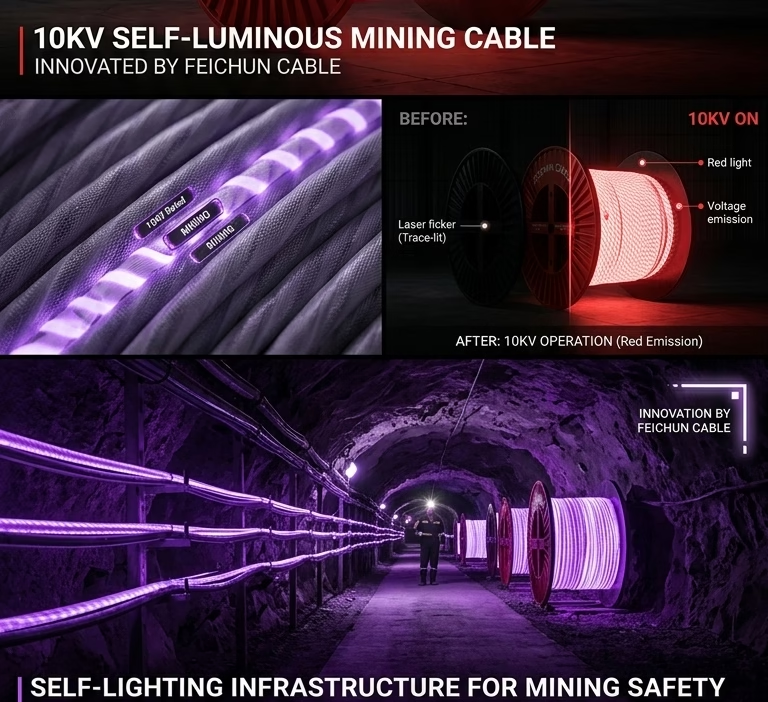
Manufacturer's technical guide: PROTOLON (SB) NTSCGEWOEU-LED, FeiChun's VDE 0250-813 and MSHA P-189-4 certified MV trailing cable with integrated self-powered LED illumination rated for −50 °C. Split earth three-core design. SHD-GC type. Shovel visibility. Dragline tail-rope illumination. Zero external DC supply. Direct factory manufacturer.

TENAX-CORD (RTS) NSHTOEU-LED 0,6/1 kV: Self-Powered LED Spreader Reeling Cable for High-Speed Container Crane Systems

TENAX-CORD (RTS) NSHTOEU-LED | 0,6/1 kV | FC-TPU™ P-Series Translucent Sheath | 7 Constructions 36×2.5–72×2.5 mm | Up to 3,300 A (44×2.5 core) | Port, Container Terminal, Automated Handling Applications | 240 m/min Vertical Reeling Speed