armoured cable

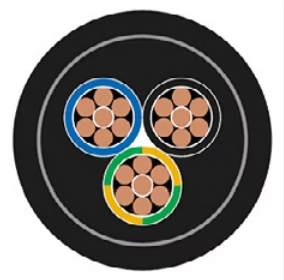
GAALFLEX® VFD 1300 A: BS 5467-Compliant Armoured Variable Frequency Drive Inverter Connection Cable for Harsh Industrial Environments, Outdoor Deployment, and Applications Requiring Mechanical Protection (0.6/1 kV Nominal Voltage, 4 kV Test Voltage, Comprehensive Dual-Configuration Portfolio [4-Core and 3+3 Earth Conductor Versions], 1.5–300 mm² Conductor Range Enabling Complete VFD Specification in Mechanical Hazard Zones, Flexible Class 5 Red Copper per IEC 60228, GAALTHERM® 580 Special Polyurethane Insulation Providing Superior Thermal Stability and Mechanical Robustness Compared to PE Standard Insulation, Aluminum Tape + PETP Foil + Tinned Copper Braid Triple-Layer Shielding Providing Effective EMI Suppression for Frequency Converter Signal Integrity, Steel Wire Armour Providing Comprehensive Mechanical Protection Against Puncture, Crushing, and Environmental Hazards Enabling Direct Burial and Outdoor Installation, Low Mutual Capacitance [70–410 nF/km Depending on Configuration] Minimizing Cross-Talk, Low Coupling Resistance [Max 250 Ω/km] Supporting Low-Impedance Control Circuits, Inner Black RAL 9005 PVC Sheath Protecting Armour from Conductor Contact, Outer Black UV-Resistant PVC Compound Sheath Enabling Outdoor Industrial Installation Without Additional Protection, Temperature Range −40 to +70°C [Fixed Laying] or −5 to +70°C [Flexible Application] with +90°C Conductor and +250°C Short-Circuit Capability, 12×D Minimum Bending Radius Supporting Field Routing in Armoured Configurations, BS 5467 Compliance Enabling UK and Commonwealth Market Acceptance, UV-Resistant Outdoor Use per DIN VDE 0250, Electromagnetic Compatibility per EN 55011 / DIN VDE 0875 / EN 61800-3, Self-Extinguishing and Flame-Retardant per DIN VDE 0482-265-2-1, Insulation Resistance 200+ MΩ·km, Radiation Resistance to 80×10⁶ cJ/kg, RoHS and CE Approved, and Complete International VFD Infrastructure Compliance Enabling OEM Integration and Process Automation Acceptance in Mechanically Hazardous Environments)

BS 5467 GAALFLEX® VFD 1300 A

GAALFLEX® VFD 1300 A: BS 5467-Compliant Armoured Variable Frequency Drive Inverter Connection Cable for Harsh Industrial Environments, Outdoor Deployment, and Applications Requiring Mechanical Protection (0.6/1 kV Nominal Voltage, 4 kV Test Voltage, Comprehensive Dual-Configuration Portfolio [4-Core and 3+3 Earth Conductor Versions], 1.5–300 mm² Conductor Range Enabling Complete VFD Specification in Mechanical Hazard Zones, Flexible Class 5 Red Copper per IEC 60228, GAALTHERM® 580 Special Polyurethane Insulation Providing Superior Thermal Stability and Mechanical Robustness Compared to PE Standard Insulation, Aluminum Tape + PETP Foil + Tinned Copper Braid Triple-Layer Shielding Providing Effective EMI Suppression for Frequency Converter Signal Integrity, Steel Wire Armour Providing Comprehensive Mechanical Protection Against Puncture, Crushing, and Environmental Hazards Enabling Direct Burial and Outdoor Installation, Low Mutual Capacitance [70–410 nF/km Depending on Configuration] Minimizing Cross-Talk, Low Coupling Resistance [Max 250 Ω/km] Supporting Low-Impedance Control Circuits, Inner Black RAL 9005 PVC Sheath Protecting Armour from Conductor Contact, Outer Black UV-Resistant PVC Compound Sheath Enabling Outdoor Industrial Installation Without Additional Protection, Temperature Range −40 to +70°C [Fixed Laying] or −5 to +70°C [Flexible Application] with +90°C Conductor and +250°C Short-Circuit Capability, 12×D Minimum Bending Radius Supporting Field Routing in Armoured Configurations, BS 5467 Compliance Enabling UK and Commonwealth Market Acceptance, UV-Resistant Outdoor Use per DIN VDE 0250, Electromagnetic Compatibility per EN 55011 / DIN VDE 0875 / EN 61800-3, Self-Extinguishing and Flame-Retardant per DIN VDE 0482-265-2-1, Insulation Resistance 200+ MΩ·km, Radiation Resistance to 80×10⁶ cJ/kg, RoHS and CE Approved, and Complete International VFD Infrastructure Compliance Enabling OEM Integration and Process Automation Acceptance in Mechanically Hazardous Environments)
Two major cable standards dominate the offshore drilling, marine platform and demanding industrial environments: NEK 606 RFOU and IEEE 1580 Type P. Understanding which standard suits your application is critical for equipment reliability and operational safety. NEK 606 represents the European approach to zero-halogen, low-smoke construction with rigorous mud resistance requirements, while IEEE 1580 Type P emphasises extreme flexibility, mechanical durability and elevated temperature tolerance favoured in North American operations.

NEK 606 RFOU vs IEEE 1580 Type P: Which Mud Resistant Cable is Best for Top Drives?

Two major cable standards dominate the offshore drilling, marine platform and demanding industrial environments: NEK 606 RFOU and IEEE 1580 Type P. Understanding which standard suits your application is critical for equipment reliability and operational safety. NEK 606 represents the European approach to zero-halogen, low-smoke construction with rigorous mud resistance requirements, while IEEE 1580 Type P emphasises extreme flexibility, mechanical durability and elevated temperature tolerance favoured in North American operations.
(N)TSKCGEWÖU specifications. This protective layer serves multiple critical functions within the cable assembly, with mechanical stress redistribution being among its most important roles. According to research published by Sibelco, the bedding compound is defined as the material applied around insulated conductors to maintain their position and provide bedding for protective armoring.[1] This layer functions as an intermediary component positioned between the laid-up cores and the metallic armor, creating what cable engineers describe as a separation sheath that fundamentally alters how mechanical forces are distributed throughout the cable structure.

Inner Sheath Function: Mechanical Stress Redistribution in (N)TSKCGEWÖU Cables

(N)TSKCGEWÖU specifications. This protective layer serves multiple critical functions within the cable assembly, with mechanical stress redistribution being among its most important roles. According to research published by Sibelco, the bedding compound is defined as the material applied around insulated conductors to maintain their position and provide bedding for protective armoring.[1] This layer functions as an intermediary component positioned between the laid-up cores and the metallic armor, creating what cable engineers describe as a separation sheath that fundamentally alters how mechanical forces are distributed throughout the cable structure.
The international nature of power infrastructure means that MV cables are specified using various national nomenclatures and standards. While the German DIN VDE nomenclature (such as N2XSY, NA2XSH) has become widely recognized across Europe, British Standards (BS6622, BS7835, BS7870), French (NF C 33-226), Spanish (RHZ1), Portuguese (XHIOE, LXHIOV), and other national specifications remain essential for projects in their respective regions.

What is Medium Voltage Cable?

(N)TSCGEWÖU cable, (N)TMCGEWÖU cable, (N)TSCGECECWÖU cable, (N)3GHSSHCH cable, (N)3GHSSYCY cable, N2XSY cable, N2XSH cable, NA2XSY cable, NA2XSH cable, N2XS2Y cable, N2XS(F)2Y cable, N2XS(FL)2Y cable, NA2XS2Y cable, NA2XS(F)2Y cable, NA2XS(FL)2Y cable, N2XSEY cable, NA2XSEY cable, N2XS(F)H cable, N2XS(FL)H cable, NA2XS(F)H cable, NA2XS(FL)H cable
Armoured cables, commonly referred to as SWA (Steel Wire Armoured) or AWA (Aluminium Wire Armoured) cables, are robust power cables designed with metallic armour protection for demanding installation environments. The armour provides mechanical protection where physical stress could damage the cable, such as direct burial underground, outdoor installations, or industrial environments. These cables are manufactured in accordance with British, European, and International standards including BS 5467, BS 6724, BS 6622, BS 7835, and IEC 60502.

What are Armoured Cables SWA & AWA?

SWA cable, AWA cable, armoured cable, steel wire armoured, aluminium wire armoured, BS 5467, BS 6724, BS 6622, BS 7835, IEC 60502, BASEC approved, XLPE cable, LSZH cable, underground cable, 0.6/1kV, 11kV cable, 33kV cable, N2XRY, NYFGBY, power cable, industrial cable, direct burial, 鎧裝電纜, 鋼絲鎧裝, cable blindado
UNE 21123 standard refers to the design and cross-sectional area specifications for cables used by utilities on power distribution circuits with voltage ratings up to and including 600/1000V (0.6/1kV). UNE standards are released by AENOR (Asociación Española de Normalización y Certificación), the Spanish Association for Standardisation and Certification. As AENOR is a member of ISO, IEC, and CENELEC, many of its standards are harmonized with European and international conventions.

What is UNE 21123 Cable?

UNE 21123 standard refers to the design and cross-sectional area specifications for cables used by utilities on power distribution circuits with voltage ratings up to and including 600/1000V (0.6/1kV). UNE standards are released by AENOR (Asociación Española de Normalización y Certificación), the Spanish Association for Standardisation and Certification. As AENOR is a member of ISO, IEC, and CENELEC, many of its standards are harmonized with European and international conventions.
NF C32-322 is a French national standard (Norme Française) that specifies requirements for armoured low voltage power cables. These cables, commonly designated as U-1000 RVFV (copper conductor) and U-1000 ARVFV (aluminium conductor), are widely used rigid industrial cables designed for installations requiring mechanical protection. They represent the armoured equivalent of the NF C32-321 unarmoured cables.

What is NF C32-322 Cable?

NF C32-322, U-1000 RVFV, U-1000 ARVFV, U-1000 XAV, NF C32 322, RVFV cable, ARVFV cable, French standard armoured cable, 0.6/1kV cable, 1kV armoured cable, 600/1000V cable, low voltage armoured cable, LV power cable, 1000V industrial cable, NF C32-322 standard, NF C32-070 C2, IEC 60502-1, IEC 60228, IEC 60332-1-2, French cable standard, Norme Française cable, AFNOR cable standard, flame retardant cable,低压电缆, 低壓電纜, 铠装电缆, 鎧裝電纜, 交联聚乙烯电缆, 交聯聚乙烯電纜, 钢带铠装, 鋼帶鎧裝, 法国标准电缆, 法國標準電纜, 工业电缆, 工業電纜, 直埋电缆, 直埋電纜
Whilst low voltage generally refers to cables under 1kV voltage, the 1.9/3.3kV cables are often classified within this banding too. These cables represent the upper boundary of the "extended low voltage" classification and are primarily manufactured in accordance with British Standards BS5467 and BS6724. The 1.9/3.3kV rating indicates cables designed for systems where the phase-to-earth voltage is 1.9kV and phase-to-phase voltage is 3.3kV, with a maximum system voltage (Um) of 3.6kV.

What is 1.9/3.3kV Cable?

1.9/3.3kV cable, 3.3kV cable, BS5467, BS6724, LSZH cable, SWA cable, armoured cable, XLPE cable, low voltage cable, SANS Type 63, mining trailing cable, steel wire armour, aluminium wire armour, copper conductor, PVC sheath, low smoke zero halogen, flame retardant, direct burial cable, industrial wiring, mains distribution, current rating, IEE Wiring Regulations, thermosetting insulated, BASEC approved, CPR compliant, 3.6/6kV comparison, IEC 60502-1, 1.9/3.3kV cable, 3.3kV cable, 3300V cable, BS5467 cable, BS6724 cable, LSZH cable, SWA cable, armoured cable, XLPE cable, low voltage armoured cable, 3.3kV power cable
The International Electrotechnical Commission (IEC) is the world's leading independent non-profit international standard-setting organization for electrical, electronic, and related technologies. Founded in 1906 with British Scientist Lord Kelvin as its first president, the IEC has over a century of expertise in developing international standards that form the basis for national and international standardization. All IEC standards are consensus-based and represent the needs of key stakeholders, with every member country having an equal vote.

What is IEC Cable?

IEC cable, IEC standard cable, IEC power cable, International Electrotechnical Commission cable, IEC 60228, IEC 60502, IEC 60331, IEC 60332, IEC cable standards, IEC compliant cable, international standard cable, IEC certified cable, IEC 60228, IEC 60228:2023, IEC 60228 conductor, IEC 60228 class 1, IEC 60228 class 2, IEC 60228 class 5, IEC 60228 class 6, IEC 60502, IEC 60502-1, IEC 60502-2, IEC 60502-4, IEC 60502-1:2021, IEC 60331, IEC 60331-1, IEC 60331-2, IEC 60331-21, IEC 60331-31, IEC 60332, IEC 60332-1, IEC 60332-1-2, IEC 60332-2, IEC 60332-3, IEC 60332-3-22, IEC 60332-3-23, IEC 60332-3-24, IEC 60332-3-25, IEC 61034, IEC 60754, IEC 60754-1, IEC 60754-2, IEC 60092, IEC 60702, IEC 60811, IEC 61158, IEC 60840
DIN VDE cable, VDE standard cable, German cable standard, VDE certified cable, VDE approved cable, DIN cable, VDE certification, German electrical standard, DKE standard, VDE mark, VDE testing, German power cable

What is DIN VDE Standard Cable?

VDE 0100, VDE 0105, VDE 0207, VDE 0245, VDE 0250, VDE 0253, VDE 0262, VDE 0265, VDE 0266, VDE 0267, VDE 0271, VDE 0276, VDE 0277, VDE 0281, VDE 0282, VDE 0284, VDE 0289, VDE 0292, VDE 0293, VDE 0295, VDE 0298, VDE 0472, VDE 0473, VDE 0482, VDE 0800, VDE 0811, VDE 0812, VDE 0815, VDE 0816, VDE 0839, VDE 0881, VDE 0891, VDE 0899, NYY cable, NYY-J cable, NYY-O cable, NYM cable, NYM-J cable, NYCY cable, NYCWY cable, NAYY cable, N2XY cable, NA2XY cable, N2XSY cable, N2XSEY cable, NA2XSY cable, NA2XS2Y cable, N2XH cable, N2XCH cable, NSHTOU cable, NSHTÖU cable, NSSHÖU cable, NSGAFÖU cable, NHXMH cable, NHMH cable, H03VV-F cable, H05VV-F cable, H07VV-F cable, H05V-K cable, H07V-K cable, H05V-U cable, H07V-U cable, H05V-R cable, H07V-R cable, H05RN-F cable, H07RN-F cable, H05RR-F cable, H07BN4-F cable, H05BN4-F cable, H07ZZ-F cable, H05Z-K cable, H07Z-K cable, H07Z-R cable, H05Z1Z1-F cable, H05VVH2-F cable, H05VVH6-F cable, H07V2-K cable, H05V2-K cable, H01N2-D cable, H01N2-E cable,300/500V cable, 450/750V cable, 0.6/1kV cable, 600/1000V cable, 3.6/6kV cable, 6/10kV cable, 12/20kV cable, 18/30kV cable, low voltage cable, medium voltage cable, high voltage cable,
DIN VDE 0276 is the widely used German standard for cables with extruded insulation used in power distribution systems. Developed by the VDE (Verband der Elektrotechnik, Elektronik und Informationstechnik e.V.), this comprehensive standard covers a significant percentage of power cables used across the European continent, establishing construction requirements, dimensional specifications, and test methods for both low voltage (0.6/1 kV) and medium voltage (up to 18/30 kV) power cables.

What is DIN VDE 0276 Cable?

VDE 0276 電纜的技術規格對於正確選擇和安裝至關重要。XLPE 絕緣電纜允許的連續工作溫度高達 90°C,短路溫度可達 250°C,優於 PVC 絕緣電纜的 70°C 和 160°C。導體採用符合 IEC 60228 第 2 類標準的絞合壓縮圓形銅或鋁導體。導體屏蔽層為擠出的半導電材料,最小厚度 0.3mm,在 90°C 時體積電阻率不超過 500 Ω·m。彎曲半徑要求根據電纜類型不同而變化:無金屬護套電纜為 15 倍外徑,帶鋁護套電纜為 30 倍外徑。
TYPE 260 Heavy-Duty Mining Cable: Comprehensive Technical Analysis

TYPE 260 Heavy-Duty Mining Cable: Comprehensive Technical Analysis

TYPE 260 mining cable represents a pinnacle of engineering excellence in the domain of heavy-duty electrical power transmission for mining operations. This pliable armoured cable, designed in strict accordance with Australian and New Zealand standards AS/NZS 1802:2003 and AS/NZS 2802:2000, serves as a critical feeder cable in demanding mining environments where exceptional impact resistance and mechanical durability are paramount operational requirements.
CEI 20-27 CENELEC HD361 Cable

What is CEI 20-27 CENELEC HD361 Cable?

CEI 20-27 CENELEC HD361 represents a standardized cable designation system developed by the European Committee for Electrotechnical Standardisation (CENELEC) to provide uniform identification and classification of harmonized power cables and cords across European markets. This systematic coding methodology enables engineers, procurement specialists, and electrical contractors to precisely identify cable specifications including voltage ratings, insulation materials, conductor types, and sheathing compounds through a structured alphanumeric designation format.