Common Problems Encountered in Cable Applications

SC-PNCT/SC-PNCT(S) multi-core cables represent the ultimate expression of flexible cable engineering—enabling single-cable power distribution for equipment with multiple independent motor systems, control circuits, and auxiliary equipment. Rather than requiring parallel single-core or dual-core cables with associated routing complexity and installation challenges, multi-core cables consolidate entire power distribution systems into a single, managed cable assembly. Fundamental Design Challenge: Multi-core cable design requires balancing multiple competing objectives. Maximum conductor count (10+ independent cores) demands significant outer diameter. Compact outer diameter (compatible with standard equipment hookups) limits conductor count. Electromagnetic shielding protects against interference but adds weight and cost. Each design decision trades off against others. Engineering Solution — 36 Configuration Matrix: Rather than offering a single "universal" multi-core cable, Feichun engineers 36 distinct configurations addressing different optimization priorities. Equipment designers can select from: • Simple configurations (3×1, 4×1, 5×1): Single conductor cores for basic multi-circuit distribution with minimal outer diameter • Intermediate configurations (2×3, 2×4, 3×3, 2×5, 3×4, 4×4): Multi-core groups for moderate circuit complexity • Advanced configurations (3×8, 3×9, 3×10): Maximum conductor counts for extremely complex equipment requiring 24–30 independent circuits This matrix approach enables optimal cable specification for each unique application—not compromising on weight, size, or cost for equipment that doesn't require ultimate complexity.

SC-PNCT/SC-PNCT(S) Multi-Core Cable Family

SC-PNCT/SC-PNCT(S) multi-core cables represent the ultimate expression of flexible cable engineering—enabling single-cable power distribution for equipment with multiple independent motor systems, control circuits, and auxiliary equipment. Rather than requiring parallel single-core or dual-core cables with associated routing complexity and installation challenges, multi-core cables consolidate entire power distribution systems into a single, managed cable assembly. Fundamental Design Challenge: Multi-core cable design requires balancing multiple competing objectives. Maximum conductor count (10+ independent cores) demands significant outer diameter. Compact outer diameter (compatible with standard equipment hookups) limits conductor count. Electromagnetic shielding protects against interference but adds weight and cost. Each design decision trades off against others. Engineering Solution — 36 Configuration Matrix: Rather than offering a single “universal” multi-core cable, Feichun engineers 36 distinct configurations addressing different optimization priorities. Equipment designers can select from: • Simple configurations (3×1, 4×1, 5×1): Single conductor cores for basic multi-circuit distribution with minimal outer diameter • Intermediate configurations (2×3, 2×4, 3×3, 2×5, 3×4, 4×4): Multi-core groups for moderate circuit complexity • Advanced configurations (3×8, 3×9, 3×10): Maximum conductor counts for extremely complex equipment requiring 24–30 independent circuits This matrix approach enables optimal cable specification for each unique application—not compromising on weight, size, or cost for equipment that doesn’t require ultimate complexity.
Feichun's comprehensive port equipment cable portfolio encompasses two primary cable family streams engineered for fundamentally different equipment operating environments, each with multiple reinforcement, shielding, and configuration variants optimized for specific applications. Design Philosophy: Rather than attempting to create a single universal cable for all port applications, Feichun engineers cables within two distinct families, each optimized for its operational environment. High-tension cables prioritize tensile strength and mechanical robustness for reel-mounted applications. Festoon cables prioritize bending flexibility and environmental durability for suspended overhead systems. Within each family, reinforcement, shielding, and configuration options address specialized requirements. Two Core Cable Families: 1. High-Tension Reel Cables (HT-PNCT Family) — Engineered for equipment where cables wind onto rotating reels including ship unloaders, stackers, reclaimers, and mobile cranes. Optimized for extreme tensile stress, intensive bending cycles, and long unsupported spans. 2. Festoon Suspended Cables (FC-PNCT Family) — Engineered for equipment with suspended overhead power distribution including container cranes, gantry cranes, and overhead bridge systems. Optimized for gentle bending, environmental durability, and multi-circuit power distribution. Within each family, variants address specialized requirements through reinforcement (enhanced tensile strength and service life), electromagnetic shielding (protection for VFD systems and automation electronics), and flexible configuration options (3–30 conductor cores, three conductor sizes).

Feichun Port Equipment Cable Portfolio

Feichun’s comprehensive port equipment cable portfolio encompasses two primary cable family streams engineered for fundamentally different equipment operating environments, each with multiple reinforcement, shielding, and configuration variants optimized for specific applications. Design Philosophy: Rather than attempting to create a single universal cable for all port applications, Feichun engineers cables within two distinct families, each optimized for its operational environment. High-tension cables prioritize tensile strength and mechanical robustness for reel-mounted applications. Festoon cables prioritize bending flexibility and environmental durability for suspended overhead systems. Within each family, reinforcement, shielding, and configuration options address specialized requirements. Two Core Cable Families: 1. High-Tension Reel Cables (HT-PNCT Family) — Engineered for equipment where cables wind onto rotating reels including ship unloaders, stackers, reclaimers, and mobile cranes. Optimized for extreme tensile stress, intensive bending cycles, and long unsupported spans. 2. Festoon Suspended Cables (FC-PNCT Family) — Engineered for equipment with suspended overhead power distribution including container cranes, gantry cranes, and overhead bridge systems. Optimized for gentle bending, environmental durability, and multi-circuit power distribution. Within each family, variants address specialized requirements through reinforcement (enhanced tensile strength and service life), electromagnetic shielding (protection for VFD systems and automation electronics), and flexible configuration options (3–30 conductor cores, three conductor sizes).
FC-PNCT-R and FC-PNCT(S)-R reinforced festoon cables represent the premium tier of overhead power distribution technology, engineered for next-generation crane systems demanding superior electrical performance, extended service life, electromagnetic compatibility, and multi-circuit power distribution capabilities. Reinforced festoon cables incorporate a fundamentally different architecture compared to standard festoon cables—adding mechanical reinforcement (braid-tape structure), overall electromagnetic shielding (in the shielded variant), and optimized multi-core configurations supporting independent circuit distribution. These enhancements address the operational requirements of modern automated port equipment, VFD-driven crane systems, and advanced cargo handling machinery. Key Design Innovations: • Integrated Reinforcement Layer: A tape-braid composite structure carrying a portion of mechanical stress, extending insulation life and reducing temperature rise during operation • Overall Screen Shielding: Tinned copper braid surrounding the entire cable assembly (in FC-PNCT(S)-R variant) providing complete electromagnetic protection • Multi-Core Architecture: 3–30 independent conductor cores enabling single-cable distribution for complex equipment with multiple independent motor systems • Size Flexibility: Three conductor size options (1.5, 2.5, 4.0) scaled to specific application requirements and current demands These innovations enable reinforced festoon cables to deliver 7–10 year service intervals in demanding applications—approximately 40–60% longer than standard festoon cables. For terminal operators prioritizing equipment reliability and minimizing replacement downtime, the premium investment in reinforced cables delivers outstanding value.

FC-PNCT-R/FC-PNCT(S)-R Reinforced Festoon Cables

FC-PNCT-R and FC-PNCT(S)-R reinforced festoon cables represent the premium tier of overhead power distribution technology, engineered for next-generation crane systems demanding superior electrical performance, extended service life, electromagnetic compatibility, and multi-circuit power distribution capabilities. Reinforced festoon cables incorporate a fundamentally different architecture compared to standard festoon cables—adding mechanical reinforcement (braid-tape structure), overall electromagnetic shielding (in the shielded variant), and optimized multi-core configurations supporting independent circuit distribution. These enhancements address the operational requirements of modern automated port equipment, VFD-driven crane systems, and advanced cargo handling machinery. Key Design Innovations: • Integrated Reinforcement Layer: A tape-braid composite structure carrying a portion of mechanical stress, extending insulation life and reducing temperature rise during operation • Overall Screen Shielding: Tinned copper braid surrounding the entire cable assembly (in FC-PNCT(S)-R variant) providing complete electromagnetic protection • Multi-Core Architecture: 3–30 independent conductor cores enabling single-cable distribution for complex equipment with multiple independent motor systems • Size Flexibility: Three conductor size options (1.5, 2.5, 4.0) scaled to specific application requirements and current demands These innovations enable reinforced festoon cables to deliver 7–10 year service intervals in demanding applications—approximately 40–60% longer than standard festoon cables. For terminal operators prioritizing equipment reliability and minimizing replacement downtime, the premium investment in reinforced cables delivers outstanding value.
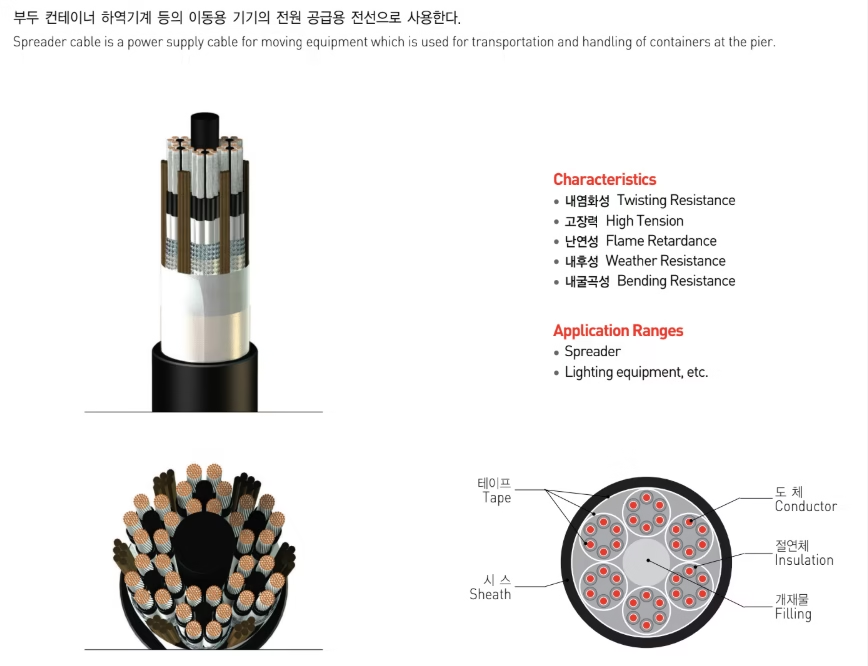
Festoon cables (also called curtain cables or loop cables) are specialized power distribution cables designed for overhead, suspended installations where the cable hangs in loops from fixed support points while a moving trolley or crane pulls the cable along beneath it. The term "festoon" derives from the architectural practice of hanging decorative swags between fixed points—a metaphor that accurately describes how these cables are installed in crane systems. FC-PNCT festoon cables serve as the primary power supply for overhead equipment including container cranes, gantry cranes, overhead bridge cranes, and related port equipment. The cable hangs in a series of gentle loops from fixed hanger points spaced approximately 5–10 meters apart. As the crane moves along the runway, the moving trolley pulls the cable along with it, creating a smooth, coordinated motion that maintains electrical contact between fixed shore power and the moving equipment. Festoon cables experience fundamentally different stresses compared to reel-mounted high-tension cables: • Repetitive bending cycles as the cable forms and reforms loops—but at a slower rate than reel cables • Lower tensile stress because the cable hangs relatively stationary between support points • Environmental exposure to saltwater spray, UV radiation, and thermal cycling—same as reel cables • Gentle, predictable bending geometry with consistent bend radii determined by hanger spacing • Lower operational temperature due to reduced mechanical stress and typically lower current demands These differences necessitate a distinctly different cable design optimized specifically for festoon applications. Festoon cables prioritize superior bending flexibility, excellent environmental resistance, and long-term durability under repetitive but gentle mechanical stress.

FC-PNCT Korean Standard Festoon Cables

Festoon cables (also called curtain cables or loop cables) are specialized power distribution cables designed for overhead, suspended installations where the cable hangs in loops from fixed support points while a moving trolley or crane pulls the cable along beneath it. The term “festoon” derives from the architectural practice of hanging decorative swags between fixed points—a metaphor that accurately describes how these cables are installed in crane systems. FC-PNCT festoon cables serve as the primary power supply for overhead equipment including container cranes, gantry cranes, overhead bridge cranes, and related port equipment. The cable hangs in a series of gentle loops from fixed hanger points spaced approximately 5–10 meters apart. As the crane moves along the runway, the moving trolley pulls the cable along with it, creating a smooth, coordinated motion that maintains electrical contact between fixed shore power and the moving equipment. Festoon cables experience fundamentally different stresses compared to reel-mounted high-tension cables: • Repetitive bending cycles as the cable forms and reforms loops—but at a slower rate than reel cables • Lower tensile stress because the cable hangs relatively stationary between support points • Environmental exposure to saltwater spray, UV radiation, and thermal cycling—same as reel cables • Gentle, predictable bending geometry with consistent bend radii determined by hanger spacing • Lower operational temperature due to reduced mechanical stress and typically lower current demands These differences necessitate a distinctly different cable design optimized specifically for festoon applications. Festoon cables prioritize superior bending flexibility, excellent environmental resistance, and long-term durability under repetitive but gentle mechanical stress.
HT-PNCT cable family represents a comprehensive, professional ecosystem of high-tension power distribution cables engineered to serve the complete spectrum of port equipment applications. Rather than a single cable type, HT-PNCT encompasses a carefully developed family of variants, each optimized for specific application requirements, electrical loads, environmental conditions, and operational constraints. The family architecture is organized around five core cable types: 1. HT-PNCT-RF — Reinforced Festoon variant with large conductor sizes (240–300 sq mm) and flexible sheath options (1.5, 2.5, 4.0 mm). Optimized for extended-span festoon applications with demanding tensile and environmental requirements. 2. HT-PNCT (Standard) — Non-shielded multi-core configuration (3–30 conductor cores) with optimized conductor size and sheath thickness combinations. Base specification for equipment without sensitive electronics or electromagnetic sensitivity. 3. HT-PNCT(S) — Shielded variant of standard cable featuring tinned copper braid shield. Engineered for equipment with variable frequency drive (VFD) motors, crane controls, and sensitive automation electronics requiring electromagnetic interference (EMI) attenuation. 4. HT-PNCT-R — Reinforced non-shielded variant with enhanced mechanical strength and extended tensile capacity. For applications requiring maximum tensile strength without electromagnetic protection needs. 5. HT-PNCT(S)-R — Premium reinforced-shielded variant combining maximum tensile strength with full electromagnetic protection. For next-generation high-power equipment with VFD systems and extreme service life requirements. This family structure enables terminal operators to select the optimal cable for each specific application—balancing performance, cost, environmental requirements, and operational constraints. The shared engineering platform across family members ensures interoperability and simplifies spare cable management.

Complete HT-PNCT High Tension Cable Family

HT-PNCT cable family represents a comprehensive, professional ecosystem of high-tension power distribution cables engineered to serve the complete spectrum of port equipment applications. Rather than a single cable type, HT-PNCT encompasses a carefully developed family of variants, each optimized for specific application requirements, electrical loads, environmental conditions, and operational constraints. The family architecture is organized around five core cable types: 1. HT-PNCT-RF — Reinforced Festoon variant with large conductor sizes (240–300 sq mm) and flexible sheath options (1.5, 2.5, 4.0 mm). Optimized for extended-span festoon applications with demanding tensile and environmental requirements. 2. HT-PNCT (Standard) — Non-shielded multi-core configuration (3–30 conductor cores) with optimized conductor size and sheath thickness combinations. Base specification for equipment without sensitive electronics or electromagnetic sensitivity. 3. HT-PNCT(S) — Shielded variant of standard cable featuring tinned copper braid shield. Engineered for equipment with variable frequency drive (VFD) motors, crane controls, and sensitive automation electronics requiring electromagnetic interference (EMI) attenuation. 4. HT-PNCT-R — Reinforced non-shielded variant with enhanced mechanical strength and extended tensile capacity. For applications requiring maximum tensile strength without electromagnetic protection needs. 5. HT-PNCT(S)-R — Premium reinforced-shielded variant combining maximum tensile strength with full electromagnetic protection. For next-generation high-power equipment with VFD systems and extreme service life requirements. This family structure enables terminal operators to select the optimal cable for each specific application—balancing performance, cost, environmental requirements, and operational constraints. The shared engineering platform across family members ensures interoperability and simplifies spare cable management.
Japanese Standard High Tension (HT) cables with Kevlar® reinforcement represent the pinnacle of specialized power distribution technology for demanding marine port applications. Engineered to conform to Japanese Industrial Standards (JIS C 3317, JIS C 3350), these cables incorporate integrated aramid reinforced layers that dramatically enhance tensile strength while maintaining the flexibility required for reel-mounted equipment operation. The term "high tension" in Japanese maritime engineering refers specifically to the mechanical tension and longitudinal stress experienced by cables subjected to extreme operational demands—including extended unsupported spans, repetitive reel cycling, heavy dynamic loading, and sustained exposure to marine environments. Unlike standard port cables, Japanese Standard HT cables with Kevlar® reinforcement are engineered for applications where: • Unsupported cable spans exceed 40–60 meters between ship and shore equipment or between reel stations • Combined electrical load and mechanical tension create dual stress conditions requiring advanced material science • Long service life expectancy (7–10+ years) justifies premium reinforcement material investment • Environmental exposure to saltwater aerosol, UV radiation, and thermal cycling demands superior polymer formulation • High-availability terminal operations cannot tolerate premature cable failure and operational downtime The integration of Kevlar® aramid reinforcement layers represents a fundamental departure from conventional cable design. Rather than relying solely on rubber insulation and polymer sheathing to provide mechanical strength, Kevlar-reinforced cables employ a specialized tension layer that carries a portion of the cable's weight and operational stress, thereby reducing stress on the insulation and extending overall cable service life by 40–60% compared to unreinforced designs.

Japanese Standard High Tension Cables with Kevlar® Reinforcement

Japanese Standard High Tension (HT) cables with Kevlar® reinforcement represent the pinnacle of specialized power distribution technology for demanding marine port applications. Engineered to conform to Japanese Industrial Standards (JIS C 3317, JIS C 3350), these cables incorporate integrated aramid reinforced layers that dramatically enhance tensile strength while maintaining the flexibility required for reel-mounted equipment operation. The term “high tension” in Japanese maritime engineering refers specifically to the mechanical tension and longitudinal stress experienced by cables subjected to extreme operational demands—including extended unsupported spans, repetitive reel cycling, heavy dynamic loading, and sustained exposure to marine environments. Unlike standard port cables, Japanese Standard HT cables with Kevlar® reinforcement are engineered for applications where: • Unsupported cable spans exceed 40–60 meters between ship and shore equipment or between reel stations • Combined electrical load and mechanical tension create dual stress conditions requiring advanced material science • Long service life expectancy (7–10+ years) justifies premium reinforcement material investment • Environmental exposure to saltwater aerosol, UV radiation, and thermal cycling demands superior polymer formulation • High-availability terminal operations cannot tolerate premature cable failure and operational downtime The integration of Kevlar® aramid reinforcement layers represents a fundamental departure from conventional cable design. Rather than relying solely on rubber insulation and polymer sheathing to provide mechanical strength, Kevlar-reinforced cables employ a specialized tension layer that carries a portion of the cable’s weight and operational stress, thereby reducing stress on the insulation and extending overall cable service life by 40–60% compared to unreinforced designs.
High Tension (HT) cables are specialized power distribution cables designed for reel-mounted applications in port equipment—primarily unloaders, stackers, reclaimers, and gantry cranes. The term "high tension" does not refer to electrical voltage (HT cables are 0.6/1 kV, standard port equipment voltage); instead, it refers to the mechanical tension and stress that these cables experience when wound on reels and unwound during equipment operation. HT-PNCT cables serve as the primary power supply line running from the equipment's fixed power source (shore power or generator) to the reel-mounted slip ring assembly on moving equipment. During operation, these cables are repeatedly wound onto and unwound from rotating reels, experiencing: • Tensile stress from the cable's own weight as it hangs from the reel to the equipment • Bending stress each time the cable wraps around the reel drum • Mechanical abrasion from friction against the reel surface and cable guides • Environmental exposure to saltwater spray, UV radiation, and thermal cycling Standard festoon cables (like FC-PNCT) are optimized for relatively stationary installations. HT-PNCT cables are engineered specifically for reel-wound, dynamic applications where these mechanical stresses dominate the cable's service life.

HT-PNCT High Tension Cables

High Tension (HT) cables are specialized power distribution cables designed for reel-mounted applications in port equipment—primarily unloaders, stackers, reclaimers, and gantry cranes. The term “high tension” does not refer to electrical voltage (HT cables are 0.6/1 kV, standard port equipment voltage); instead, it refers to the mechanical tension and stress that these cables experience when wound on reels and unwound during equipment operation. HT-PNCT cables serve as the primary power supply line running from the equipment’s fixed power source (shore power or generator) to the reel-mounted slip ring assembly on moving equipment. During operation, these cables are repeatedly wound onto and unwound from rotating reels, experiencing: • Tensile stress from the cable’s own weight as it hangs from the reel to the equipment • Bending stress each time the cable wraps around the reel drum • Mechanical abrasion from friction against the reel surface and cable guides • Environmental exposure to saltwater spray, UV radiation, and thermal cycling Standard festoon cables (like FC-PNCT) are optimized for relatively stationary installations. HT-PNCT cables are engineered specifically for reel-wound, dynamic applications where these mechanical stresses dominate the cable’s service life.
PNCT-F designation identifies cables with a flat profile cross-section, as opposed to the standard round profile. While round cables are universal and flexible, flat cables offer specific advantages for certain port crane applications: Compact Storage and Handling: Flat cables pack more efficiently on drums and spools. A flat cable occupies approximately 15–20% less volume than a round cable of equivalent conductor area, reducing storage footprint and shipping volume. Improved Thermal Dissipation: The flat geometry increases surface area relative to volume, enabling better heat dissipation from the conductor. In high-current applications (large hoist motors), flat cables run cooler than round cables, reducing insulation aging and extending service life. Easier Cable Management: Flat cables lay flatter in cable troughs and festoon routes, reducing twisting and tangling. This property is particularly valuable in complex multi-cable installations where space is constrained. Lower Profile Aesthetics: For applications where cable profile affects equipment appearance or port terminal aesthetics, flat cables provide a lower-profile alternative.

PNCT-F Flat Type Cables & Cable Specification System

PNCT-F designation identifies cables with a flat profile cross-section, as opposed to the standard round profile. While round cables are universal and flexible, flat cables offer specific advantages for certain port crane applications: Compact Storage and Handling: Flat cables pack more efficiently on drums and spools. A flat cable occupies approximately 15–20% less volume than a round cable of equivalent conductor area, reducing storage footprint and shipping volume. Improved Thermal Dissipation: The flat geometry increases surface area relative to volume, enabling better heat dissipation from the conductor. In high-current applications (large hoist motors), flat cables run cooler than round cables, reducing insulation aging and extending service life. Easier Cable Management: Flat cables lay flatter in cable troughs and festoon routes, reducing twisting and tangling. This property is particularly valuable in complex multi-cable installations where space is constrained. Lower Profile Aesthetics: For applications where cable profile affects equipment appearance or port terminal aesthetics, flat cables provide a lower-profile alternative.
PNCT-R designation represents the advanced evolution of the standard PNCT cable. The suffix -R stands for Reinforced—indicating the presence of an integrated aramid reinforcement layer built into the cable structure between the insulation and sheath. While standard PNCT cables rely entirely on copper conductor tensile strength to support catenary loads, PNCT-R cables distribute mechanical loads across both the copper conductors AND a dedicated load-bearing reinforcement layer. This fundamental design difference transforms the cable's performance envelope: PNCT-R cables achieve 10–12 year service life in high-utilization port terminals, compared to 4–6 years for standard PNCT. The reinforcement layer is not a luxury add-on; it is an engineering necessity for any port crane cable expected to operate continuously for a contract period exceeding 5 years. From a standards perspective, PNCT-R cables conform fully to KSC IEC 60502-1, meeting all electrical, mechanical, and environmental requirements. The reinforcement layer is an enhancement above the base standard—it does not replace or circumvent the standard; it exceeds it.

PNCT-R: Reinforced Port Crane Cables with Advanced Kevlar® Weaving

PNCT-R designation represents the advanced evolution of the standard PNCT cable. The suffix -R stands for Reinforced—indicating the presence of an integrated aramid reinforcement layer built into the cable structure between the insulation and sheath. While standard PNCT cables rely entirely on copper conductor tensile strength to support catenary loads, PNCT-R cables distribute mechanical loads across both the copper conductors AND a dedicated load-bearing reinforcement layer. This fundamental design difference transforms the cable’s performance envelope: PNCT-R cables achieve 10–12 year service life in high-utilization port terminals, compared to 4–6 years for standard PNCT. The reinforcement layer is not a luxury add-on; it is an engineering necessity for any port crane cable expected to operate continuously for a contract period exceeding 5 years. From a standards perspective, PNCT-R cables conform fully to KSC IEC 60502-1, meeting all electrical, mechanical, and environmental requirements. The reinforcement layer is an enhancement above the base standard—it does not replace or circumvent the standard; it exceeds it.
Port crane festoon cables endure conditions that few other industrial cables ever face. A single cable suspended in a festoon system supporting an STS (Ship-To-Shore) crane—or running through a cableveyor transport mechanism—must simultaneously: Support its own weight across spans of 50–100+ meters. Flex continuously as the crane trolley or transport carriage moves back and forth, experiencing tens of thousands of bend cycles per year. Resist mechanical abrasion from guide rollers, sheaves, fairleads, and cable troughs. Survive saltwater spray and UV exposure common to marine terminal environments. Conduct electrical power reliably while maintaining dielectric integrity under all dynamic stress conditions. This multi-hazard environment creates a specific failure mode that conventional cables struggle to handle: self-weight mechanical fatigue. As the cable hangs under its own weight, the copper conductors experience a catenary load distribution. The top of the cable bears the cumulative weight of the entire cable length below it. When the crane moves and the cable flexes, this catenary load creates internal mechanical stress—tension applied directly to the copper strands without a mechanism to distribute or absorb the force. Over time, typically 3–5 years, the copper conductors begin to work-harden and fracture. Electrical resistance increases. Localized corrosion begins. Eventually, the cable fails not because of insulation breakdown or sheath perforation, but because the mechanical integrity of the conductor system has been compromised by repeated tension and flexure cycles.

Kevlar®-Reinforced Port Crane & Ship Unloader Cables

Port crane festoon cables endure conditions that few other industrial cables ever face. A single cable suspended in a festoon system supporting an STS (Ship-To-Shore) crane—or running through a cableveyor transport mechanism—must simultaneously: Support its own weight across spans of 50–100+ meters. Flex continuously as the crane trolley or transport carriage moves back and forth, experiencing tens of thousands of bend cycles per year. Resist mechanical abrasion from guide rollers, sheaves, fairleads, and cable troughs. Survive saltwater spray and UV exposure common to marine terminal environments. Conduct electrical power reliably while maintaining dielectric integrity under all dynamic stress conditions. This multi-hazard environment creates a specific failure mode that conventional cables struggle to handle: self-weight mechanical fatigue. As the cable hangs under its own weight, the copper conductors experience a catenary load distribution. The top of the cable bears the cumulative weight of the entire cable length below it. When the crane moves and the cable flexes, this catenary load creates internal mechanical stress—tension applied directly to the copper strands without a mechanism to distribute or absorb the force. Over time, typically 3–5 years, the copper conductors begin to work-harden and fracture. Electrical resistance increases. Localized corrosion begins. Eventually, the cable fails not because of insulation breakdown or sheath perforation, but because the mechanical integrity of the conductor system has been compromised by repeated tension and flexure cycles.
JIS C 3327 designation system is elegant in its logic. Every cable name follows a predictable, parseable structure where each character or character group carries a specific, unambiguous meaning. Once you understand the five material symbols and the four flexibility classes, you can decode any of the 15 cable types defined by the standard—and immediately know what the cable is made of, how flexible it is, and what applications it is suited for.

JIS C 3327 Cable Code Designation

JIS C 3327 designation system is elegant in its logic. Every cable name follows a predictable, parseable structure where each character or character group carries a specific, unambiguous meaning. Once you understand the five material symbols and the four flexibility classes, you can decode any of the 15 cable types defined by the standard—and immediately know what the cable is made of, how flexible it is, and what applications it is suited for.
600V 2TC-RB is the TRACAB® product line cable designed to perform reliably across all three transport methods: curtain (festoon), carrier drum (reeling), and cableveyor (enclosed track). Manufactured to JIS C 3327 Class 2, this cable combines the proven EP rubber insulation and polychloroprene rubber sheathing platform with Class 2 conductor construction optimised for the specific bending profiles and fatigue modes encountered in each transport architecture. The Kevlar® para-aramid fibre braided tensile reinforcement provides the mechanical backbone that enables a single cable design to absorb the dynamic loads generated by catenary suspension, drum winding, and track-guided travel without transferring stress to the conductors or insulation system.

600V 2TC-RB TRACAB® Kevlar®-Reinforced Crane Cable

600V 2TC-RB is the TRACAB® product line cable designed to perform reliably across all three transport methods: curtain (festoon), carrier drum (reeling), and cableveyor (enclosed track). Manufactured to JIS C 3327 Class 2, this cable combines the proven EP rubber insulation and polychloroprene rubber sheathing platform with Class 2 conductor construction optimised for the specific bending profiles and fatigue modes encountered in each transport architecture. The Kevlar® para-aramid fibre braided tensile reinforcement provides the mechanical backbone that enables a single cable design to absorb the dynamic loads generated by catenary suspension, drum winding, and track-guided travel without transferring stress to the conductors or insulation system.
6600V 3PNCT cable, manufactured to the Japanese Industrial Standard JIS C 4353 Class 3, is the purpose-built high voltage cable solution for these demanding applications. It combines the same fundamental material technologies proven in the 600V 2PNCT family—EP rubber insulation, polychloroprene rubber sheathing, tinned copper conductors, tinned copper/cotton yarn braid shielding, and Kevlar® para-aramid fibre braided tensile reinforcement—but with substantially enhanced insulation systems and construction techniques required for safe, reliable operation at 6,600V. The cable features a semiconductive stress-grading layer at the conductor/insulation interface, 5.0–5.5 mm thick EP rubber insulation (compared to 0.8–2.5 mm in 600V cables), a metallic braid shield for electric field containment, and a dual-layer polychloroprene sheath with an intermediate reinforcement layer for maximum mechanical protection.

6600V 3PNCT Kevlar®-Reinforced High Voltage Crane Cable

6600V 3PNCT cable, manufactured to the Japanese Industrial Standard JIS C 4353 Class 3, is the purpose-built high voltage cable solution for these demanding applications. It combines the same fundamental material technologies proven in the 600V 2PNCT family—EP rubber insulation, polychloroprene rubber sheathing, tinned copper conductors, tinned copper/cotton yarn braid shielding, and Kevlar® para-aramid fibre braided tensile reinforcement—but with substantially enhanced insulation systems and construction techniques required for safe, reliable operation at 6,600V. The cable features a semiconductive stress-grading layer at the conductor/insulation interface, 5.0–5.5 mm thick EP rubber insulation (compared to 0.8–2.5 mm in 600V cables), a metallic braid shield for electric field containment, and a dual-layer polychloroprene sheath with an intermediate reinforcement layer for maximum mechanical protection.
600V 2TC Light-SB (600V 2PNCT-SB) cable solves this problem. Built on the same proven JIS C 3327 platform as the unshielded 2TC Light, it adds a critical engineering layer: a tinned copper wire braided combined with cotton yarn shielding that surrounds the insulated conductor bundle. This hybrid metallic/textile braid provides effective EMI containment across the full VFD emission spectrum, preventing radiated noise from escaping power cables and protecting control cables from external interference. Combined with the Kevlar® para-aramid fibre braided tensile reinforcement for mechanical load bearing, the 2TC Light-SB delivers both electromagnetic cleanliness and structural durability in a single cable design purpose-built for the electrical and mechanical demands of modern VFD-controlled port cranes.

600V 2TC Light-SB (2PNCT-SB) Shielded Crane Cable

600V 2TC Light-SB (600V 2PNCT-SB) cable solves this problem. Built on the same proven JIS C 3327 platform as the unshielded 2TC Light, it adds a critical engineering layer: a tinned copper wire braided combined with cotton yarn shielding that surrounds the insulated conductor bundle. This hybrid metallic/textile braid provides effective EMI containment across the full VFD emission spectrum, preventing radiated noise from escaping power cables and protecting control cables from external interference. Combined with the Kevlar® para-aramid fibre braided tensile reinforcement for mechanical load bearing, the 2TC Light-SB delivers both electromagnetic cleanliness and structural durability in a single cable design purpose-built for the electrical and mechanical demands of modern VFD-controlled port cranes.
The 600V 2TC Light (600V 2PNCT) cable, manufactured to the Japanese Industrial Standard JIS C 3327, represents one of the most proven and widely deployed cable designs for port crane and ship unloader applications worldwide. This cable combines ethylene propylene (EP) rubber insulation for superior dielectric performance, polychloroprene rubber sheathing for environmental protection, and—critically—a Kevlar® para-aramid fibre braided tensile reinforcement layer that transforms the cable from a simple electrical conductor into a load-bearing mechanical component capable of supporting its own weight and absorbing the extreme dynamic forces generated by crane operation.

600V 2TC Light (2PNCT) Kevlar®-Reinforced Crane Cable

The 600V 2TC Light (600V 2PNCT) cable, manufactured to the Japanese Industrial Standard JIS C 3327, represents one of the most proven and widely deployed cable designs for port crane and ship unloader applications worldwide. This cable combines ethylene propylene (EP) rubber insulation for superior dielectric performance, polychloroprene rubber sheathing for environmental protection, and—critically—a Kevlar® para-aramid fibre braided tensile reinforcement layer that transforms the cable from a simple electrical conductor into a load-bearing mechanical component capable of supporting its own weight and absorbing the extreme dynamic forces generated by crane operation.
crane cable range is a complete family of six specialised cable types engineered to cover every electrical and data connection on modern port cranes — from the simplest yard crane spreader circuit to the most complex automated STS crane with integrated fibre optic networking. The family is divided into two series: the WS-RLIN series for motorised cable reel systems, and the WS-SPRD series for gravity collector basket (festoon basket) systems. Every cable in the range shares a common engineering foundation: JIS C 3327 compliance for rubber-insulated machinery cables, chloroprene rubber (CR) sheathing for oil/ozone/UV resistance, EPR insulation rated to 90°C, and an ambient temperature range of −40°C to +90°C that covers every port environment on earth from arctic to tropical. Within this shared foundation, each cable type is differentiated by its reinforcement system, voltage class, conductor range, and application-specific optimisations.

WALSREEN® Complete Port Crane Cable Range

crane cable range is a complete family of six specialised cable types engineered to cover every electrical and data connection on modern port cranes — from the simplest yard crane spreader circuit to the most complex automated STS crane with integrated fibre optic networking. The family is divided into two series: the WS-RLIN series for motorised cable reel systems, and the WS-SPRD series for gravity collector basket (festoon basket) systems. Every cable in the range shares a common engineering foundation: JIS C 3327 compliance for rubber-insulated machinery cables, chloroprene rubber (CR) sheathing for oil/ozone/UV resistance, EPR insulation rated to 90°C, and an ambient temperature range of −40°C to +90°C that covers every port environment on earth from arctic to tropical. Within this shared foundation, each cable type is differentiated by its reinforcement system, voltage class, conductor range, and application-specific optimisations.
WS-SPRD-HEXNCT was engineered specifically for this extreme duty class. Its defining characteristic is the HEXNCT enhanced chloroprene rubber sheath — a heavy-duty outer layer with thickness ranging from 4.5 mm to 5.1 mm, representing a 36–38% increase over the standard WS-SPRD-2PNCT's 3.3–3.7 mm sheath. This enhanced sheath provides a dramatically larger abrasion wear allowance at basket carrier contact points, greater resistance to mechanical impact from falling debris, and a more robust barrier against the chemical and environmental hazards of the container crane operating environment.

WALSREEN® WS-SPRD-HEXNCT Spreader Basket System Flexible Cable

WS-SPRD-HEXNCT was engineered specifically for this extreme duty class. Its defining characteristic is the HEXNCT enhanced chloroprene rubber sheath — a heavy-duty outer layer with thickness ranging from 4.5 mm to 5.1 mm, representing a 36–38% increase over the standard WS-SPRD-2PNCT’s 3.3–3.7 mm sheath. This enhanced sheath provides a dramatically larger abrasion wear allowance at basket carrier contact points, greater resistance to mechanical impact from falling debris, and a more robust barrier against the chemical and environmental hazards of the container crane operating environment.
WS-RLIN-3PNCT-OF is the engineering answer to this convergence challenge. It integrates three-phase medium-voltage power conductors (3 × 38–60 mm² at AC 6,600 V) with a dedicated neutral/earth return conductor and six optical fibres housed in individually colour-coded ETFE protective tubes — all within a single Kevlar®-reinforced, chloroprene-sheathed cable construction. This hybrid design eliminates the need for separate power and fibre optic cables on the reel system, reducing reel complexity, installation time, maintenance burden, and total cable weight, while ensuring perfect synchronisation between power and data paths — because both travel through the same physical cable at all times.

WALSREEN® WS-RLIN-3PNCT-OF Hybrid Power & Fibre Optic Reel System Flexible Cable

WS-RLIN-3PNCT-OF is the engineering answer to this convergence challenge. It integrates three-phase medium-voltage power conductors (3 × 38–60 mm² at AC 6,600 V) with a dedicated neutral/earth return conductor and six optical fibres housed in individually colour-coded ETFE protective tubes — all within a single Kevlar®-reinforced, chloroprene-sheathed cable construction. This hybrid design eliminates the need for separate power and fibre optic cables on the reel system, reducing reel complexity, installation time, maintenance burden, and total cable weight, while ensuring perfect synchronisation between power and data paths — because both travel through the same physical cable at all times.
Modern port logistics infrastructure demands electrical cables that can withstand punishing mechanical conditions no ordinary flexible cable is designed to endure. A travelling cable reel system on a ship-to-shore container crane, bulk ship unloader, or harbour gantry crane repeatedly spools and unspools the cable as the trolley, grab, or spreader traverses its operating range — subjecting the cable to continuous tensile loading, cyclical bending around the reel drum, torsional forces from crane slew motion, and environmental assault from coastal salt spray, UV radiation, hydraulic oil contamination, and extreme temperature swings. The cable must survive hundreds of thousands of these combined loading cycles across a service life measured in years, not months.

WALSREEN® WS-RLIN-2PNCT / WS-RLIN-3PNCT Reel System Flexible Cable

Modern port logistics infrastructure demands electrical cables that can withstand punishing mechanical conditions no ordinary flexible cable is designed to endure. A travelling cable reel system on a ship-to-shore container crane, bulk ship unloader, or harbour gantry crane repeatedly spools and unspools the cable as the trolley, grab, or spreader traverses its operating range — subjecting the cable to continuous tensile loading, cyclical bending around the reel drum, torsional forces from crane slew motion, and environmental assault from coastal salt spray, UV radiation, hydraulic oil contamination, and extreme temperature swings. The cable must survive hundreds of thousands of these combined loading cycles across a service life measured in years, not months.
FSTN-OFNCT is a high-performance optical fiber flexible cable designed specifically for signal and data transmission on port cranes, ship unloaders, container gantry cranes, and heavy-duty material handling equipment. Unlike conventional industrial fibre optic cables that rely on standard polymer or steel-wire tensile members, the WS-FSTN-OFNCT incorporates a Kevlar® (para-aramid) fibre reinforcement layer—the same ballistic-grade material used in bulletproof vests and military-grade protective equipment—braided in a proprietary pattern that delivers exceptional tensile strength while preserving the cable's full flexibility under continuous reeling and festoon operation.

Kevlar® Aramid Fibre Reinforced Optical Fiber Flexible Cable with Specially Braided Tensile Layer for Signal and Data Transmission on Port Cranes, Ship Unloaders, Container Gantry Cranes, and Heavy-Duty Material Handling Equipment — Engineered for Cable Reel Systems, Festoon Systems, and Continuous Flexing Applications with Graded Index 50/125, 62.5/125, and Singlemode E9/125 Fibre Options

FSTN-OFNCT is a high-performance optical fiber flexible cable designed specifically for signal and data transmission on port cranes, ship unloaders, container gantry cranes, and heavy-duty material handling equipment. Unlike conventional industrial fibre optic cables that rely on standard polymer or steel-wire tensile members, the WS-FSTN-OFNCT incorporates a Kevlar® (para-aramid) fibre reinforcement layer—the same ballistic-grade material used in bulletproof vests and military-grade protective equipment—braided in a proprietary pattern that delivers exceptional tensile strength while preserving the cable’s full flexibility under continuous reeling and festoon operation.
EL-Min® self-luminous mining cable represents a breakthrough in industrial safety engineering. Unlike conventional industrial cables that require separate lighting infrastructure or external power systems to mark their locations and identify operational status, the EL-Min cable generates its own illumination continuously while transmitting electrical power. This dual-function capability—power transmission combined with self-powered luminescence—is achieved through advanced electromagnetic induction technology embedded directly into the cable's construction.

EL-Min® Self-Luminous Mining Cable

Revolutionary Self-Powered Cable Safety Innovation: Advanced Electromagnetic Induction Converts Transmitted Power into Real-Time LED Illumination Without External Power Supply, Integrated Multi-Fiber Optic Monitoring for Remote Diagnostics, Tinned Copper Corrosion-Resistant Conductors, Class 5 Very Flexible Stranding for Underground Installation, DIN VDE 0250-813 Compliance, Comprehensive Cable Route Visibility, Emergency Location Detection, Personnel Safety Enhancement in Darkness, and Universal Compatibility with Modern Mining Infrastructure and Hazardous Zone Applications
FABER® (N)3GHSSYCY cable solves the pit equipment power distribution challenge through two integrated innovations: Galvanized Steel Wire Braid Armor (75% minimum coverage): Resists puncture from sharp rocks, crushing from equipment treads (500+ tonne axle loads), and abrasion from rocky terrain. Service life extended 3–5× vs. unarmored cables in identical pit conditions. Integrated Monitoring Core: Continuously measures insulation resistance, detecting degradation 4–8 weeks before insulation failure becomes critical. This early warning enables planned maintenance before unexpected equipment shutdown.

FABER® (N)3GHSSYCY

(N)3GHSSYCY is the integrated copper wire monitoring core spun on the first inner sheath. This dedicated conductor continuously measures insulation resistance between phase conductors and ground reference, enabling early warning of insulation degradation. Three-Stage Insulation Degradation Detection Stage 1 – Incipient Degradation (4–8 weeks before failure): Insulation resistance drops from >1000 MΩ to 100–500 MΩ range. Monitoring systems alert maintenance teams; scheduled cable replacement planned during next equipment maintenance window. Stage 2 – Advanced Degradation (1–4 weeks before failure): Resistance drops to 10–50 MΩ. Equipment operations reduced; high-priority replacement initiated (completed within 1–7 days). Stage 3 – Critical Failure (imminent): Resistance drops below 1 MΩ. Equipment immediately shut down; emergency cable replacement executed (8–12 hours typical). Monitoring Core Measurement Technology The monitoring core interfaces to pit electrical control systems via standard 24 VDC measurement electronics. A precision insulation resistance tester (1000 V minimum) measures leakage current across the monitoring core at 30-minute intervals, recording continuous insulation resistance trending. This trending data provides quantitative assessment of cable aging, enabling predictive maintenance planning based on actual cable condition rather than calendar time.
Global maritime shipping produces ~3% of worldwide carbon emissions—more than aviation. A single large container ship or cruise ship operating continuously can emit as much CO2 as 50,000 cars. One of the quickest, most effective decarbonization strategies is cold ironing: the practice of supplying ships with electrical power from shore while docked at port, eliminating the need to run ship engines.

PROTOLON®(SC) (N)TSCGEWOEU

Global maritime shipping produces ~3% of worldwide carbon emissions—more than aviation. A single large container ship or cruise ship operating continuously can emit as much CO2 as 50,000 cars. One of the quickest, most effective decarbonization strategies is cold ironing: the practice of supplying ships with electrical power from shore while docked at port, eliminating the need to run ship engines.
FeiChun® BITFLEX® DC (N)TMCGCWOEU-W cable represents the engineering breakthrough enabling this DC transition. The cable addresses the single greatest technical challenge of DC power transmission: space charge accumulation—a phenomenon unique to direct current where electrons become permanently trapped within the insulation polymer under unidirectional electrical stress, causing insulation degradation and catastrophic failure within months if not prevented.

FeiChun® BITFLEX® DC Medium Voltage Direct Current Cable

Applications and Specifications. Comprehensive coverage of battery energy storage systems (BESS), offshore wind turbine integration, and marine propulsion power transmission. Complete technical specifications per DIN VDE 0250-813 standard. Installation best practices for renewable energy infrastructure. Safety certifications and field deployment guidance.
The BiTmining® (N)TMCGCWOEU single-core cable represents a specialized category of flexible medium-voltage power conductors designed for point-to-point connections in mining and industrial applications. Unlike three-phase trailing cables (such as the (N)3GHSSYCY), which bundle all three conductors plus grounding and monitoring wires into one integrated package, single-core cables deliver individual high-voltage conductors for use in short-length, targeted applications: switchgear cubicle connections, mobile transformer substations, power feeder distribution, and inter-equipment busbar connections.

FeiChun BiTmining® LED Self-Luminous Single-Core Cable

The BiTmining® (N)TMCGCWOEU single-core cable represents a specialized category of flexible medium-voltage power conductors designed for point-to-point connections in mining and industrial applications. Unlike three-phase trailing cables (such as the (N)3GHSSYCY), which bundle all three conductors plus grounding and monitoring wires into one integrated package, single-core cables deliver individual high-voltage conductors for use in short-length, targeted applications: switchgear cubicle connections, mobile transformer substations, power feeder distribution, and inter-equipment busbar connections.
The (N)3GHSSYCY-LED cable represents a revolutionary advancement in mining electrical infrastructure: a heavy-duty MV armored trailing cable enhanced with self-powered LED illumination. Unlike traditional approach es that treat cable visibility as an afterthought, the (N)3GHSSYCY-LED integrates electromagnetic induction energy harvesting directly into the cable's core construction, generating continuous warning-red LED illumination (620–630 nm) with zero external power supply, zero additional infrastructure modifications, and zero operational maintenance.

(N)3GHSSYCY-LED Cable

The (N)3GHSSYCY-LED cable represents a revolutionary advancement in mining electrical infrastructure: a heavy-duty MV armored trailing cable enhanced with self-powered LED illumination. Unlike traditional approach es that treat cable visibility as an afterthought, the (N)3GHSSYCY-LED integrates electromagnetic induction energy harvesting directly into the cable’s core construction, generating continuous warning-red LED illumination (620–630 nm) with zero external power supply, zero additional infrastructure modifications, and zero operational maintenance.
H01N2-D/-E® is the professional-grade welding cable engineered specifically for the extreme mechanical and thermal demands of portable welding equipment: MIG/MAG (metal inert gas) welders delivering hundreds of amperes in a compact handheld torch, TIG (tungsten inert gas) systems requiring ultraprecise current control, stick (arc) welders generating intense heat at the electrode, and plasma cutting equipment operating at extreme power levels. Unlike general-purpose industrial cables, the H01N2-D/-E features ultra-flexible bare copper conductors enabling unlimited coiling without fatigue, EM5 oil-resistant rubber sheath tolerating workshop fluids and solvents, and comprehensive duty-cycle current derating enabling proper sizing for periodic welding operations where cables are not continuously carrying rated current.

H01N2-D/-E® Welding Cable

H01N2-D/-E® is the professional-grade welding cable engineered specifically for the extreme mechanical and thermal demands of portable welding equipment: MIG/MAG (metal inert gas) welders delivering hundreds of amperes in a compact handheld torch, TIG (tungsten inert gas) systems requiring ultraprecise current control, stick (arc) welders generating intense heat at the electrode, and plasma cutting equipment operating at extreme power levels. Unlike general-purpose industrial cables, the H01N2-D/-E features ultra-flexible bare copper conductors enabling unlimited coiling without fatigue, EM5 oil-resistant rubber sheath tolerating workshop fluids and solvents, and comprehensive duty-cycle current derating enabling proper sizing for periodic welding operations where cables are not continuously carrying rated current.
H07BN4-F® is the heavy-duty industrial rubber cable engineered specifically for power distribution in the harshest real-world environments: wind turbine installations at exposed high-altitude and coastal sites, temporary construction power systems on job sites, outdoor industrial machinery exposed to sun and weather, renewable energy systems requiring rugged reliability, and portable equipment power circuits subject to continuous flexing and mechanical stress. Unlike standard commercial cables that degrade or fail within months under industrial abuse, the H07BN4-F features EI7 heat-resistant rubber insulation, EM7 oil-resistant rubber sheath, and Class 5 very flexible bare copper conductors designed to deliver uninterrupted power through decades of real-world industrial operations.

H07BN4-F® Industrial Cable

H07BN4-F® is the heavy-duty industrial rubber cable engineered specifically for power distribution in the harshest real-world environments: wind turbine installations at exposed high-altitude and coastal sites, temporary construction power systems on job sites, outdoor industrial machinery exposed to sun and weather, renewable energy systems requiring rugged reliability, and portable equipment power circuits subject to continuous flexing and mechanical stress. Unlike standard commercial cables that degrade or fail within months under industrial abuse, the H07BN4-F features EI7 heat-resistant rubber insulation, EM7 oil-resistant rubber sheath, and Class 5 very flexible bare copper conductors designed to deliver uninterrupted power through decades of real-world industrial operations.
FRNC® is the premium-grade, safety-focused motorized blind and awning cable engineered for architects, specifiers, and facility managers who demand the highest standards of fire safety, environmental resilience, and operational reliability in building automation systems. Unlike standard blind cables that release toxic halogenated gases if exposed to fire, the FRNC cable features halogen-free FRNC insulation, halogen-free inner sheath, and polyurethane outer sheath designed to maintain electrical integrity during decades of extreme outdoor and indoor exposure while meeting the most stringent fire safety codes worldwide. This cable was engineered in direct response to evolving building safety regulations and the architectural demand for "smart" buildings with integrated environmental control. Modern building codes—particularly in Europe, North America, and Asia-Pacific—increasingly mandate halogen-free cabling in occupied spaces (residential, commercial, hospitality, institutional facilities) because halogenated materials release extremely toxic gases (hydrogen chloride, hydrogen bromide, dioxins) when exposed to fire. These gases are more deadly than the fire itself, causing rapid fatality in occupants attempting evacuation. The FRNC cable eliminates this risk entirely through halogen-free material selection, while maintaining superior electrical properties through advanced FRNC insulation technology. Combined with the polyurethane sheath's chemical and abrasion resistance, the FRNC cable delivers 20+ years of maintenance-free operation in the most demanding building automation environments.

FRNC® Roller Blind & Awning Cable

FRNC® is the premium-grade, safety-focused motorized blind and awning cable engineered for architects, specifiers, and facility managers who demand the highest standards of fire safety, environmental resilience, and operational reliability in building automation systems. Unlike standard blind cables that release toxic halogenated gases if exposed to fire, the FRNC cable features halogen-free FRNC insulation, halogen-free inner sheath, and polyurethane outer sheath designed to maintain electrical integrity during decades of extreme outdoor and indoor exposure while meeting the most stringent fire safety codes worldwide. This cable was engineered in direct response to evolving building safety regulations and the architectural demand for “smart” buildings with integrated environmental control. Modern building codes—particularly in Europe, North America, and Asia-Pacific—increasingly mandate halogen-free cabling in occupied spaces (residential, commercial, hospitality, institutional facilities) because halogenated materials release extremely toxic gases (hydrogen chloride, hydrogen bromide, dioxins) when exposed to fire. These gases are more deadly than the fire itself, causing rapid fatality in occupants attempting evacuation. The FRNC cable eliminates this risk entirely through halogen-free material selection, while maintaining superior electrical properties through advanced FRNC insulation technology. Combined with the polyurethane sheath’s chemical and abrasion resistance, the FRNC cable delivers 20+ years of maintenance-free operation in the most demanding building automation environments.
FABER® A05RN-F roller blind cable is the specialized control cable engineered specifically for motorized roller blind drives, Venetian blind automation systems, jalousie window controls, and building facade shade management. Unlike general-purpose motor control cables that degrade when exposed to continuous UV sunlight and ozone in outdoor environments, the A05RN-F features UV and ozone-resistant rubber sheathing, EPR thermoset insulation, and flame-retardant construction that maintains electrical and mechanical integrity through decades of permanent outdoor exposure.

FABER® A05RN-F Roller Blind Cable

FABER® A05RN-F roller blind cable is the specialized control cable engineered specifically for motorized roller blind drives, Venetian blind automation systems, jalousie window controls, and building facade shade management. Unlike general-purpose motor control cables that degrade when exposed to continuous UV sunlight and ozone in outdoor environments, the A05RN-F features UV and ozone-resistant rubber sheathing, EPR thermoset insulation, and flame-retardant construction that maintains electrical and mechanical integrity through decades of permanent outdoor exposure.
TML® submersible pump cable is the professional-grade electrical solution designed specifically for permanent submersion in drinking water systems, deep well applications, underwater pump installations, and saltwater coastal environments. Unlike general-purpose control cables that degrade when exposed to continuous moisture, the TML cable family features tinned copper conductors, AD8 water-resistant rubber insulation, and robust rubber sheathing engineered to maintain electrical integrity even after months or years of 24/7 submersion.

TML® Submersible Pump Cable

TML® submersible pump cable is the professional-grade electrical solution designed specifically for permanent submersion in drinking water systems, deep well applications, underwater pump installations, and saltwater coastal environments. Unlike general-purpose control cables that degrade when exposed to continuous moisture, the TML cable family features tinned copper conductors, AD8 water-resistant rubber insulation, and robust rubber sheathing engineered to maintain electrical integrity even after months or years of 24/7 submersion.
The H07RN-F cable represents the pinnacle of industrial-grade rubber insulated cable design, engineered for demanding applications where extreme flexibility, superior environmental resistance, and uncompromising reliability are non-negotiable. Developed per DIN EN 50525-2-21 (VDE 0285-525-2-21), the H07RN-F combines advanced vulcanization technology with chloroprene (CR) EM2 elastomer sheath composition to deliver exceptional performance across construction sites, industrial machinery, marine installations, and professional electrical systems.

TRIFLEX Plus H07RN-F®

The H07RN-F cable represents the pinnacle of industrial-grade rubber insulated cable design, engineered for demanding applications where extreme flexibility, superior environmental resistance, and uncompromising reliability are non-negotiable. Developed per DIN EN 50525-2-21 (VDE 0285-525-2-21), the H07RN-F combines advanced vulcanization technology with chloroprene (CR) EM2 elastomer sheath composition to deliver exceptional performance across construction sites, industrial machinery, marine installations, and professional electrical systems.