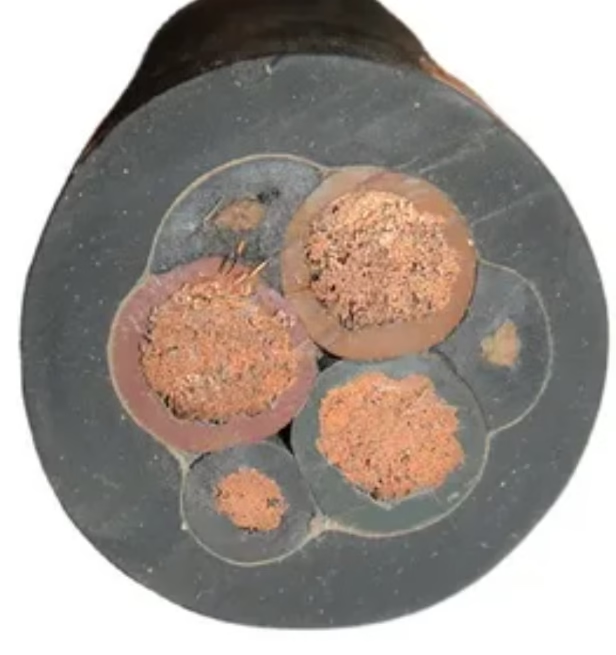
underground mining

飞纯 Type 209 是飞纯电缆基于 AS/NZS 1802:2003 卷筒与拖曳电缆 体系设计的矿用柔性馈电与拖曳电缆系列,电压范围覆盖 1.1 至 11KV。根据产品资料,Type 209 系列电缆主要作为矿山机械柔性馈电电缆使用,更适合作为拖曳电缆而不是高频卷筒电缆。较小规格适用于钻机、手持工具和移动设备。 这一定义是理解 Type 209 的关键。Type 209 不是普通工业橡套软电缆,也不只是单纯的矿山供电线。它的核心定位是 矿山机械柔性馈电电缆,也就是为矿山机械提供可移动、可拖曳、可适应复杂作业路径的供电系统。同时,它更适合作为 拖曳电缆,即跟随设备移动的电缆,而不是长期高频卷绕使用的卷筒电缆。

什么是 NTMTWOEU 0.6/1kV Mine Hoist Cables

NTMTWOEU 0.6/1kV Mine Hoist Cables 是 Feichun 面向地下矿山用户操作式矿井提升机、升降机和悬吊控制系统开发的专用矿山电缆。资料说明,该电缆用作 suspended cable,用于 underground mines 中 user-operated mine hoists 或 lifts 的 intrinsically safe control,并带 telephonic connection。其工程核心不是普通动力输送,而是将控制导体、电话型屏蔽 pilot、中心钢承力元件、抗扭纺织编织和 5GM5 外护套组合成一根适合垂直悬吊、人员操作、通信联络和安全控制的矿山提升机电缆。
飞纯 Type 245 是基于 AS/NZS 1802:2003 卷筒与拖曳电缆 标准体系设计的矿用非常柔性长壁采煤机电缆,电压范围覆盖 1.1 至 6.6KV。根据产品资料,该电缆主要用作长壁采煤机电缆,也可用于连续采煤机和长壁外围电缆。 Type 245 的关键结构特征是 三根中央可伸长 Pilot / 控制芯线。这三根中央 Pilot 芯线可用于 接地连续性监测 和 控制回路。对于长壁采煤机来说,电缆不仅要传输动力电能,还要承担设备控制、保护联锁、接地连续性确认和移动工况下的安全监测任务。

什么是 NTSWOEU 0.6/1kV E-Loader Cable:Feichun 极高机械负载地下矿山移动设备电缆工程解析

NTSWOEU 0.6/1kV E-Loader Cable 是 Feichun 面向地下矿山移动机械、电动装载机、LHD、导向滑轮系统和卷盘供电系统开发的极高机械负载橡套电缆。资料明确指出,该电缆用于连接承受极高机械负载的移动机器,主要应用于矿山环境,也可通过导向滑轮运行,或作为 LHD 卷盘电缆使用,适用于极端弯曲负载、高拉伸应力、冲击负载和压扁负载。其核心结构由 Class 6 柔性镀锡铜导体、EPR 绝缘、GM1b 橡胶内护套、铜钢复合丝编织铠装兼同心接地导体,以及 5GM5 氯化橡胶外护套组成。
飞纯 Type 209 是飞纯电缆基于 AS/NZS 1802:2003 卷筒与拖曳电缆 体系设计的矿用柔性馈电与拖曳电缆系列,电压范围覆盖 1.1 至 11KV。根据产品资料,Type 209 系列电缆主要作为矿山机械柔性馈电电缆使用,更适合作为拖曳电缆而不是高频卷筒电缆。较小规格适用于钻机、手持工具和移动设备。 这一定义是理解 Type 209 的关键。Type 209 不是普通工业橡套软电缆,也不只是单纯的矿山供电线。它的核心定位是 矿山机械柔性馈电电缆,也就是为矿山机械提供可移动、可拖曳、可适应复杂作业路径的供电系统。同时,它更适合作为 拖曳电缆,即跟随设备移动的电缆,而不是长期高频卷绕使用的卷筒电缆。

什么是 H07RN8-F 450/750V Harmonized Rubber Cables

H07RN8-F 450/750V Harmonized Rubber Cables 是一种用于潜水泵和类似工业水下应用的重型柔性橡套电缆。根据资料说明,该电缆可用于工业用水环境,适用水深最高可达 10 m,水温范围最高可达 40℃,同时也适用于干燥、潮湿和湿润应用。Feichun 将其定位于矿山排水、地下工程排涝、港口泵站、码头检修排水、工业水池和移动潜水泵供电等场景。它的工程价值不是单纯“能进水”,而是在水压、潮湿、移动、拉拽、磨损和低压动力传输同时存在时,仍能通过 Class 5 多股铜导体、EI4 橡胶绝缘、EM2/EM3 内护套与 EM2 外护套形成稳定的电气与机械防护系统。
飞纯 Type 209 是飞纯电缆基于 AS/NZS 1802:2003 卷筒与拖曳电缆 体系设计的矿用柔性馈电与拖曳电缆系列,电压范围覆盖 1.1 至 11KV。根据产品资料,Type 209 系列电缆主要作为矿山机械柔性馈电电缆使用,更适合作为拖曳电缆而不是高频卷筒电缆。较小规格适用于钻机、手持工具和移动设备。 这一定义是理解 Type 209 的关键。Type 209 不是普通工业橡套软电缆,也不只是单纯的矿山供电线。它的核心定位是 矿山机械柔性馈电电缆,也就是为矿山机械提供可移动、可拖曳、可适应复杂作业路径的供电系统。同时,它更适合作为 拖曳电缆,即跟随设备移动的电缆,而不是长期高频卷绕使用的卷筒电缆。

O que é o PROTOMONT (V) NTSKCGECWOEU 3,6/6KV: Análise de Engenharia Aprofundada do Cabo de Coal Cutter para Operação em Corrente Porta-Cabos

O PROTOMONT (V) NTSKCGECWOEU 3,6/6KV é um cabo de potência de média tensão, de borracha, projetado como cabo de alimentação para máquinas e equipamentos móveis na mineração subterrânea — em especial rafadeiras de carvão (coal cutting machines) e máquinas similares. A variante (V) é concebida para operação dentro de correntes de proteção de cabo (cable handler), arrastadas atrás da máquina, que absorvem os esforços de tração resultantes do movimento. Sua característica definidora não é apenas a potência: trata-se de um cabo de segurança monitorada, com condutores de terra concêntricos ao redor de cada núcleo de potência, condutores piloto/controle e um condutor de monitoramento dedicado (UELKON), de modo que qualquer dano mecânico ao cabo provoque o desligamento imediato da alimentação — um requisito de vida em minas de carvão sujeitas a atmosferas explosivas.
BASKET SPREADER 740 (YSLTOE) is engineered specifically for hoisting and control applications where mechanical flexibility and electrical reliability must coexist in marine environments. Unlike load-bearing structural cables (which prioritize tensile strength), control cables emphasize: Conductor flexibility – Repeated bending over pulleys without mechanical fatigue Insulation integrity – Voltage breakdown resistance under salt-fog corrosion Mechanical damping – Rope-like flexibility to drape naturally in spreader bar frames Environmental barrier – Outer sheath blocks salt, moisture, and UV penetration Core Design Elements: Component Material Specification Function Port Environment Benefit Conductor Flexible red copper Class 6 (IEC 60228) Carries 300/500V power; enables bending flexibility High purity copper resists galvanic corrosion Insulation PVC type YI2 (IEC 60811) Electrical isolation; voltage breakdown resistance (2 kV test) PVC with marine additives prevents salt-induced tracking Central Unit Aramide yarns (Kevlar™ equivalent) Mechanical load-bearing backup; structural integrity Aramide resists moisture & salt; absorbs vibration stress Outer Sheath PUR type 11YM1 (DIN 73377) Environmental barrier; UV/ozone/moisture protection Superior salt-fog resistance; 20+ year marine lifespan

O que é o PROTOMONT EMV-FC (N)SHXCÖEU 0,6/1KV: Análise de Engenharia Aprofundada do Cabo Flexível Blindado para Variadores e Conversores de Frequência na Mineração

O PROTOMONT EMV-FC (N)SHXCÖEU 0,6/1KV é um cabo de potência de borracha flexível, livre de halogênio e eletromagneticamente blindado, projetado como cabo de alimentação de motor para acionamentos controlados por Variadores de Frequência (VFD) e Conversores de Frequência (FC) na indústria de mineração, em frentes de obra e aplicações similares sob esforços mecânicos severos. Sua característica definidora é a combinação de três sistemas em um único corpo: condutores de cobre estanhado finamente trançados classe 5, uma blindagem de cobre estanhado trançada para compatibilidade eletromagnética (EMC) e um conjunto de borracha EPR/EVA, livre de halogênio, capaz de operar de forma flexível em equipamentos de manuseio de materiais em movimento contínuo — incluindo lanças de cabos (cable booms) e a conexão entre os carros superior e inferior — e de permanecer permanentemente submerso em água até 40°C a uma profundidade máxima de 500 metros.
UNE 22511, published and maintained by AENOR (Asociación Española de Normalización y Certificación), is the definitive Spanish standard for heavy-duty power cables connecting underground mobile mining equipment to fixed electrical distribution networks. Operating as a specialized overlay on IEC 60502-1, it extends that base standard's electrical requirements with stringent mechanical, safety, and flame-retardancy requirements specific to enclosed underground environments. Despite its Spanish origin, UNE 22511 enjoys adoption across the major Spanish-speaking mining economies: Chile, Peru, Colombia, Bolivia, and Mexico, where AENOR-certified cables are accepted by national mining safety regulators as the primary qualification pathway for underground mobile equipment power supply cables.

飞纯矿用电缆 MYP / MC 通过俄罗斯 FSC 和欧洲 ATEX 严苛测试与认证!

矿山是电缆应用中最严苛的环境之一。井下空间狭窄,设备移动频繁,煤尘和可燃气体可能形成爆炸性环境;露天矿则可能长期遭遇低温、雨雪、泥浆、紫外线、油污和机械拖拽。电缆一旦发生护套开裂、绝缘损伤、过热、燃烧或电弧风险,影响的不只是设备停机,还可能触发人员安全、消防安全和爆炸危险控制问题。 飞纯矿用电缆 MYP / MC 的价值,正是在这种高风险场景下体现出来:它不是为普通室内布线而设计,而是面向矿山动力连接、移动设备、采煤机、掘进机、输送系统、移动变电站和高机械应力供电系统而构建的安全电缆方案。
BASKET SPREADER 740 (YSLTOE) is engineered specifically for hoisting and control applications where mechanical flexibility and electrical reliability must coexist in marine environments. Unlike load-bearing structural cables (which prioritize tensile strength), control cables emphasize: Conductor flexibility – Repeated bending over pulleys without mechanical fatigue Insulation integrity – Voltage breakdown resistance under salt-fog corrosion Mechanical damping – Rope-like flexibility to drape naturally in spreader bar frames Environmental barrier – Outer sheath blocks salt, moisture, and UV penetration Core Design Elements: Component Material Specification Function Port Environment Benefit Conductor Flexible red copper Class 6 (IEC 60228) Carries 300/500V power; enables bending flexibility High purity copper resists galvanic corrosion Insulation PVC type YI2 (IEC 60811) Electrical isolation; voltage breakdown resistance (2 kV test) PVC with marine additives prevents salt-induced tracking Central Unit Aramide yarns (Kevlar™ equivalent) Mechanical load-bearing backup; structural integrity Aramide resists moisture & salt; absorbs vibration stress Outer Sheath PUR type 11YM1 (DIN 73377) Environmental barrier; UV/ozone/moisture protection Superior salt-fog resistance; 20+ year marine lifespan

NTSKCGECWÖU: тяжёлый trailing cable для mobile electrical equipment, coal cutting machines и экстремальных изгибов в steel / plastic track chains

NTSKCGECWÖU — это средневольтный эластомерный кабель для подключения мобильного электрического оборудования в шахтах и тоннелях. По предоставленным данным он особенно подходит для coal cutting machines, прежде всего при extreme bending loads внутри steel or plastic track chains. Конструкция включает лужёные медные жилы DIN VDE 0295 Class 5, 3GI3 EPR и semiconductive rubber, cradle separator с контрольной проволокой, electrical field control, ST KON / ÜL KON элементы, GM1b inner sheath, гибкую броню из лужёной меди и оцинкованной стали, а также красную наружную оболочку 5GM5.
Marine & Port Drag Cable — High-Flexibility Saltwater-Resistant System A comprehensive engineering dissection of heavy-duty marine drag cables for port equipment, container terminals, and offshore platforms — from conductor architecture and EPR insulation to steel wire armour (M2) design rationale, galvanic corrosion protection mechanisms, environmental compliance, and validated performance benchmarking against Nexans Eproneo Port and Prysmian marine systems.

Mining Cable Families at a Glance: An Engineering Guide to PROTOMONT, PROTOLON, TENAX, CORDAFLEX, NSSHOEU, TUNNELFLEX, MINEMASTER, SHD-GC, G-GC, MT 818 and Fibre Optic Cables

In mining, tunnelling and bulk material handling, the term mining cable does not describe one universal product. It describes an engineering map: reeling cables, trailing cables, feeder cables, fixed installation cables, tunnel cables, dredger and submersible pump cables, ground-check cables, fibre optic cables and custom OEM cable systems. A single mine may use low-voltage 0.6/1 kV reeling cables for LHD machines, medium-voltage trailing cables for excavators, TBM reeling cables from 6/10 to 18/30 kV, fixed feeder cables in tunnels and optical fibre networks for monitoring and automation. The correct selection starts not with a brand name, but with the application: how the cable moves, how it bends, how it is grounded, what voltage it carries, what regional standard applies and how the surrounding mine environment attacks the sheath.
LIFT-2S (European) vs. LIFT-1S UL (North American): LIFT-2S characteristics: Voltage: 300/500V (European standard, lower voltage) Temperature: −40°C to +70°C (moderate range) Standards: VDE 0482 part 265-2-1, EN 50265-2-1, IEC 60332-1-2 Design philosophy: Safety by material redundancy (2 steel cores) Steel cores: 2× cores provide mechanical backup Conductor: Class 6 (European, ~150–200 wires per mm²) Cost: Lower (proven European manufacturing) Market: Europe, Asia-Pacific, most of world LIFT-1S UL characteristics: Voltage: 600V (North American standard, higher voltage) Temperature: −25°C to +105°C (extreme range, high-temp optimized) Standards: UL 2562, UL 62, CSA C22.2 No.210.2 Design philosophy: Safety by certification (single core + redundant control) Steel core: 1× core (sufficient with nylon covering) Conductor: Class M (UL, extra fine ~300+ wires per mm²) Cost: Higher (UL testing, certification documentation) Market: North America (USA, Canada), Mexico UL 2562 specialty certification: UL 2562 scope: Elevator and Dumbwaiter Cables Specific requirements: 1. Pendant cable design (cable hangs freely, no duct support) 2. Vertical orientation (designed for gravity-loaded suspension) 3. Repeated flex cycles (cable moves up/down frequently) 4. Safety-critical function (failure = personnel risk) Consequence: More stringent than general-purpose cables Testing includes: Bend cycle fatigue, heat aging, compression resistance Test procedures (unique to UL 2562): Bend cycle test: 1,000+ cycles at minimum bending radius Cable must pass insulation resistance after cycling Heat aging: 500+ hours at 105°C continuous Tensile strength retention minimum 70% Compression: 1,000+ hours under sustained compression Cable cross-section must not exceed 5% permanent deformation LIFT-2S (no UL 2562): Tests per VDE are less stringent on fatigue/cycling Assumes cable mostly static, not repeated flex Adequate for European elevator duty (lower speed, fewer cycles) LIFT-1S UL: All UL 2562 tests passed (proven for North American elevators) Faster cycle times, more frequent motion → more fatigue stress Extra testing ensures reliability under North American elevator duty Market requirement (regulatory): Europe/International: CE mark required (European conformity) VDE/EN/IEC standards sufficient No UL certification needed (not recognized in EU) LIFT-2S is sufficient North America (USA, Canada): UL certification mandatory for elevators UL 2562 specifically for elevator cables CSA dual certification required in Canada LIFT-2S NOT acceptable (lacks UL 2562) LIFT-1S UL mandatory Cost implication: UL certification: ~$5,000–15,000 per product per region Testing duration: 3–6 months per model Documentation: Comprehensive test reports, technical files Result: LIFT-1S UL 20–30% higher cost than equivalent European cable

PROTOMONT(Z) NSSHKCGEOEU 0.6/1kV:用于地下采矿自由拖曳作业的钢丝编织增强煤机电缆深度解析

PROTOMONT(Z) NSSHKCGEOEU 0.6/1kV 是一款 coal cutter cables for trailing operations。 它用于 underground machine applications 中的移动设备供电连接,典型设备包括 coal shearer、roadheader、TBM、scoops / LHDs。 与 cable handler 链式运行电缆不同,(Z)-Coal-Cutter cables 专为 free trailing operation 设计,凭借特殊结构可在运行中被拖曳在机器后方相当长的距离
(N)GRDGÖU-J Nomenclature (VDE 0250 part 813): (N) = Nominal voltage prefix (0.6/1 kV implicit in designation) G = Gummiert (rubber-insulated) R = Rubber outer sheath D = Dynamisch (dynamic/flexing application) G = Gummiert inner sheath (intermediate layer) Ö = German standard designation (ö indicates European origin) U = Unarmoured (no metal sheath) J = Jacked (multi-sheath design: intermediate + outer) Full meaning: Rubber-insulated, rubber-sheathed, dynamic-rated, multi-sheath construction, unarmoured festoon cable VDE 0250 part 813 scope: Published by: VDE (Verband der Elektrotechnik, German standards body) Applies to: Flexible cables for crane installations (particularly festoon systems) Coverage: Voltage, temperature, mechanical properties, installation methods Festoon-specific requirements: - High bending flexibility (4×D minimum typical) - Fast rewind capability (240+ m/min rated speed) - Sustained torsion tolerance (±25°/1m continuous) - Extended temperature range (−50 to +80°C) - UV/ozone/moisture resistance (outdoor exposure) Alternate designations (similar cables): IEC 60811-1-1: International equivalent (less specific) DIN VDE 0298 part 3: German mechanical property standard DIN VDE 0482-265-2-1: German flame test standard EN 50265-2-1: European flame test equivalent GRDGÖU-J advantage: Combines all standards into single VDE designation Procurement simplified for European buyers

(N)TSCGEWÖU-FO Cable | DIN VDE 0250 | EAC Ex & GOST Fire Approved for Russia Export

An engineering-grade technical reference for mining electrical engineers, EPC contractors, OEM equipment manufacturers, and procurement specialists selecting high-flexibility trailing cables for underground and surface mining operations in Russia and CIS markets. This document presents the structural engineering, material science, and certification architecture of Feichun’s (N)TSCGEWÖU-FO mining trailing cable — a purpose-designed construction combining extreme tensile reinforcement, multi-layer abrasion resistance, integrated fibre-optic monitoring, and dual EAC Ex / GOST-R fire certification within a single cable assembly engineered for the most demanding dragline, continuous miner, shuttle car, and longwall shearer applications operating under Russian Federal mining safety regulations.
FLEXIDRUM® NSHTÖU (V): High-Flexibility Salt-Spray-Resistant Festoon Cable for Dynamic Port Terminal Applications Engineered for continuous rapid-deployment and high-cycling harbour equipment, FLEXIDRUM® NSHTÖU (V) combines tinned Class 5 flexible copper conductor, Kevlar central reinforcement, fire-resistant EPR insulation, and oil-resistant rubber outer sheath to deliver unmatched reliability in extreme salt-spray marine environments. Rated for 180 m/min maximum deployment speed, −25 to +90°C temperature stability, and 0.6/1 kV nominal specifications across 3–44 core configurations (0.5–10 mm² cross-section range), this advanced festoon solution provides comprehensive protection against corrosion, thermal cycling, mechanical flex-fatigue, and rapid-reeling stress for harbour cranes, container-handling spreader systems, dock-automation equipment, and specialized port terminal infrastructure.

How to Choose Between PUR and PCP Outer Sheaths for Mobile Mining Equipment

Polyurethane (PUR) is a synthetic polymer created by reacting isocyanates with polyols. The resulting material is elastomeric (rubber-like) but chemically distinct from traditional natural or synthetic rubbers. PUR’s unique chemistry confers exceptional performance characteristics that have made it the material of choice for premium industrial cables over the past two decades. The key distinguishing feature of polyurethane is its resistance to oil, fuel, and ozone. When exposed to diesel fuel, mineral oil, or synthetic hydraulic fluids, PUR remains stable — it does not swell, soften, or lose mechanical properties. This makes PUR ideal for cables operating near machinery that leaks or splashes fuel and hydraulic fluids, a common condition in mobile mining equipment operating in open-pit environments. Polyurethane also offers superior temperature stability. Modern mining-grade PUR is specified for continuous operation at 70–80°C (with short-term excursions to 90°C possible) and maintains acceptable mechanical properties down to -40°C (whereas PCP becomes brittle at such low temperatures). This wide temperature range is particularly valuable for open-pit mining operations in extreme climates: high-altitude copper mines in the Andes (where nighttime temperatures plunge to -20°C and daytime temperatures exceed 80°C) and arid desert mines where ground temperatures exceed 60°C. The historical development of PUR cables in the mining industry reflects a gradual transition from PCP-dominated specifications (1960s–1990s) toward PUR adoption (2000s onward) as mining operations became more mechanized and equipment became more temperature-sensitive. Modern variable frequency drives (VFDs) and sophisticated control systems tolerate less cable degradation than older mechanical equipment, making the superior temperature stability of PUR increasingly valuable.
UNE 22512 — formally titled "Cables flexibles para minería subterránea con tensiones de 1,8/3 kV y 0,6/1 kV con aislamiento de caucho, con armadura" (Flexible cables for underground mining, rubber-insulated, armoured) — exists as a parallel but fundamentally distinct standard from its unarmoured sibling UNE 22511. Where UNE 22511 is engineered as a torsion-optimized drag cable for mobile equipment, UNE 22512 is engineered as a crush-and-cut protected feeder cable for semi-fixed installations where mechanical damage from external forces (falling rock, equipment impact, floor pressure) is a documented operational risk, but the extreme torsional loading of continuously moving equipment is not. The addition of metallic armour — specifically, galvanized steel wire braid forming what the standard designates as M2 GSWB — is the defining structural choice that reshapes every downstream design decision in the cable. The armour is not merely a protective layer added to an otherwise standard cable; rather, it fundamentally alters the cable's mechanical behavior, installation requirements, cost structure, and applicable fatigue loading regimes. Understanding UNE 22512 therefore requires understanding not just what the armour is, but why its presence necessitates a completely different engineering philosophy compared to unarmoured cables. The standard was developed by AENOR (Asociación Española de Normalización y Certificación) to address a specific operational problem encountered in Spanish and Latin American underground mining installations. While drag cables experience cyclic torsional loading as the controlling mechanical stress, semi-fixed installation cables experience something categorically different: static or low-cycle crushing and cutting stresses from external impacts, combined with continuous exposure to abrasive underground surfaces and sharp rock edges. A cable optimized exclusively for torsional fatigue — such as UNE 22511 — when installed in a semi-fixed route subject to crushing and cutting, experiences mechanical failure not through fatigue mechanisms but through acute sheath penetration, insulation damage, and moisture ingress. Conversely, an armoured cable optimized for crush protection, if inappropriately installed in a drag duty application, fails not through crushing (which the armour prevents) but through torsional fatigue of the armour wires themselves — a more insidious failure mode that occurs entirely within the armour structure, invisible until complete armour failure exposes the underlying insulation.

DM2N 3×150+3×25+3×2,5 0,6/1 kV SW HD

UNE 22512 — formally titled “Cables flexibles para minería subterránea con tensiones de 1,8/3 kV y 0,6/1 kV con aislamiento de caucho, con armadura” (Flexible cables for underground mining, rubber-insulated, armoured) — exists as a parallel but fundamentally distinct standard from its unarmoured sibling UNE 22511. Where UNE 22511 is engineered as a torsion-optimized drag cable for mobile equipment, UNE 22512 is engineered as a crush-and-cut protected feeder cable for semi-fixed installations where mechanical damage from external forces (falling rock, equipment impact, floor pressure) is a documented operational risk, but the extreme torsional loading of continuously moving equipment is not. The addition of metallic armour — specifically, galvanized steel wire braid forming what the standard designates as M2 GSWB — is the defining structural choice that reshapes every downstream design decision in the cable. The armour is not merely a protective layer added to an otherwise standard cable; rather, it fundamentally alters the cable’s mechanical behavior, installation requirements, cost structure, and applicable fatigue loading regimes. Understanding UNE 22512 therefore requires understanding not just what the armour is, but why its presence necessitates a completely different engineering philosophy compared to unarmoured cables. The standard was developed by AENOR (Asociación Española de Normalización y Certificación) to address a specific operational problem encountered in Spanish and Latin American underground mining installations. While drag cables experience cyclic torsional loading as the controlling mechanical stress, semi-fixed installation cables experience something categorically different: static or low-cycle crushing and cutting stresses from external impacts, combined with continuous exposure to abrasive underground surfaces and sharp rock edges. A cable optimized exclusively for torsional fatigue — such as UNE 22511 — when installed in a semi-fixed route subject to crushing and cutting, experiences mechanical failure not through fatigue mechanisms but through acute sheath penetration, insulation damage, and moisture ingress. Conversely, an armoured cable optimized for crush protection, if inappropriately installed in a drag duty application, fails not through crushing (which the armour prevents) but through torsional fatigue of the armour wires themselves — a more insidious failure mode that occurs entirely within the armour structure, invisible until complete armour failure exposes the underlying insulation.
UNE 22511, published and maintained by AENOR (Asociación Española de Normalización y Certificación), is the definitive Spanish standard for heavy-duty power cables connecting underground mobile mining equipment to fixed electrical distribution networks. Operating as a specialized overlay on IEC 60502-1, it extends that base standard's electrical requirements with stringent mechanical, safety, and flame-retardancy requirements specific to enclosed underground environments. Despite its Spanish origin, UNE 22511 enjoys adoption across the major Spanish-speaking mining economies: Chile, Peru, Colombia, Bolivia, and Mexico, where AENOR-certified cables are accepted by national mining safety regulators as the primary qualification pathway for underground mobile equipment power supply cables.

UNE 22511

UNE 22511, published and maintained by AENOR (Asociación Española de Normalización y Certificación), is the definitive Spanish standard for heavy-duty power cables connecting underground mobile mining equipment to fixed electrical distribution networks. Operating as a specialized overlay on IEC 60502-1, it extends that base standard’s electrical requirements with stringent mechanical, safety, and flame-retardancy requirements specific to enclosed underground environments. Despite its Spanish origin, UNE 22511 enjoys adoption across the major Spanish-speaking mining economies: Chile, Peru, Colombia, Bolivia, and Mexico, where AENOR-certified cables are accepted by national mining safety regulators as the primary qualification pathway for underground mobile equipment power supply cables.
Permítame comenzar este documento con una reflexión que, aunque pueda parecer obvia al leerla, frecuentemente se pasa por alto en la gestión diaria de las operaciones mineras. El cable minero portátil es, probablemente, el componente eléctrico que más fácilmente puede iniciar un accidente serio en una operación minera, y al mismo tiempo, es el componente al que menos atención formal de ingeniería suele dedicársele durante el diseño de procedimientos operacionales. Esta asimetría entre el potencial de daño y la atención recibida es precisamente la brecha que este documento busca ayudar a cerrar. Piense un momento en los otros elementos del sistema eléctrico minero. Las subestaciones tienen diseño formal, protocolos de acceso restringido, planes de mantenimiento programado, personal especializado para intervenirlas y procedimientos de bloqueo estrictos. Los transformadores tienen placas de características visibles, procedimientos de muestreo de aceite, pruebas dieléctricas periódicas con frecuencia definida. Los interruptores de potencia tienen curvas de coordinación, pruebas de inyección de corriente secundaria, registros cronológicos de maniobras. Sin embargo, cuando llegamos al cable portátil —el elemento que el personal literalmente toca con las manos, que se arrastra por el piso de la mina, que se enrolla y desenrolla miles de veces, que es atropellado accidentalmente por equipos móviles— encontramos frecuentemente una ausencia notable de rigor sistemático comparable al que se aplica a los otros elementos.

Cable Minero Seguro: Prácticas Integrales de Seguridad, Manejo, Almacenamiento, Despliegue, Empalme y Mantenimiento de Cables Mineros de Potencia en Operaciones de Superficie y Subterráneas

Permítame comenzar este documento con una reflexión que, aunque pueda parecer obvia al leerla, frecuentemente se pasa por alto en la gestión diaria de las operaciones mineras. El cable minero portátil es, probablemente, el componente eléctrico que más fácilmente puede iniciar un accidente serio en una operación minera, y al mismo tiempo, es el componente al que menos atención formal de ingeniería suele dedicársele durante el diseño de procedimientos operacionales. Esta asimetría entre el potencial de daño y la atención recibida es precisamente la brecha que este documento busca ayudar a cerrar. Piense un momento en los otros elementos del sistema eléctrico minero. Las subestaciones tienen diseño formal, protocolos de acceso restringido, planes de mantenimiento programado, personal especializado para intervenirlas y procedimientos de bloqueo estrictos. Los transformadores tienen placas de características visibles, procedimientos de muestreo de aceite, pruebas dieléctricas periódicas con frecuencia definida. Los interruptores de potencia tienen curvas de coordinación, pruebas de inyección de corriente secundaria, registros cronológicos de maniobras. Sin embargo, cuando llegamos al cable portátil —el elemento que el personal literalmente toca con las manos, que se arrastra por el piso de la mina, que se enrolla y desenrolla miles de veces, que es atropellado accidentalmente por equipos móviles— encontramos frecuentemente una ausencia notable de rigor sistemático comparable al que se aplica a los otros elementos.
Type SHD-GC 3/C 4/0 AWG 8kV trailing cable, rated for 321 to 327 amperes continuous current at sea level (0 meters) assuming typical mining conditions with natural air cooling, experiences substantial reduction in current-carrying capacity when deployed at 4,000 meters elevation in the Andes Mountains. At 4,000 meters, the atmospheric pressure is only approximately 60 percent of sea-level pressure, and air density is reduced proportionally. This thin-air environment reduces the cable's cooling efficiency dramatically, resulting in derated ampacity of approximately 185 to 210 amperes—a reduction of 40 to 45 percent compared to sea-level capacity. This derating is not optional or conservative—it is physically necessary to prevent the cable conductor from exceeding the maximum allowable operating temperature of 90°C under continuous load. If a cable rated at 321A at sea level were operated at full sea-level ampacity while installed at 4,000 meters elevation, the conductor temperature would rise to approximately 120°C to 140°C or higher, severely accelerating insulation degradation and risking catastrophic failure within months. The derating magnitude is driven by fundamental thermodynamic principles: as altitude increases and air density decreases, the convective heat transfer coefficient that governs how efficiently the cable surface transfers heat to the surrounding air decreases proportionally. The relationship between air density and cooling efficiency is not linear—it follows approximately the 0.6 power relationship, meaning that reducing air density to 60 percent of sea-level value reduces cooling efficiency to approximately 70 percent. Additionally, in high-altitude Andes mining regions where ambient temperatures reach 25°C to 35°C in tropical regions or 40°C to 50°C in equipment enclosures, the combined effect of altitude derating plus temperature derating can reduce ampacity to values as low as 150 to 160 amperes—less than half the sea-level rating. Understanding and properly accounting for altitude derating in equipment selection, protection device settings, and operational procedures is essential for safe and reliable operation of power distribution systems at high-altitude mining facilities.

High-Altitude Ampacity Derating: How Does Operating at 4,000m in the Andes Mountains Affect Type SHD-GC 3/C 4/0 AWG 8kV Cable Current Capacity?

Type SHD-GC 3/C 4/0 AWG 8kV trailing cable, rated for 321 to 327 amperes continuous current at sea level (0 meters) assuming typical mining conditions with natural air cooling, experiences substantial reduction in current-carrying capacity when deployed at 4,000 meters elevation in the Andes Mountains. At 4,000 meters, the atmospheric pressure is only approximately 60 percent of sea-level pressure, and air density is reduced proportionally. This thin-air environment reduces the cable’s cooling efficiency dramatically, resulting in derated ampacity of approximately 185 to 210 amperes—a reduction of 40 to 45 percent compared to sea-level capacity. This derating is not optional or conservative—it is physically necessary to prevent the cable conductor from exceeding the maximum allowable operating temperature of 90°C under continuous load. If a cable rated at 321A at sea level were operated at full sea-level ampacity while installed at 4,000 meters elevation, the conductor temperature would rise to approximately 120°C to 140°C or higher, severely accelerating insulation degradation and risking catastrophic failure within months. The derating magnitude is driven by fundamental thermodynamic principles: as altitude increases and air density decreases, the convective heat transfer coefficient that governs how efficiently the cable surface transfers heat to the surrounding air decreases proportionally. The relationship between air density and cooling efficiency is not linear—it follows approximately the 0.6 power relationship, meaning that reducing air density to 60 percent of sea-level value reduces cooling efficiency to approximately 70 percent. Additionally, in high-altitude Andes mining regions where ambient temperatures reach 25°C to 35°C in tropical regions or 40°C to 50°C in equipment enclosures, the combined effect of altitude derating plus temperature derating can reduce ampacity to values as low as 150 to 160 amperes—less than half the sea-level rating. Understanding and properly accounting for altitude derating in equipment selection, protection device settings, and operational procedures is essential for safe and reliable operation of power distribution systems at high-altitude mining facilities.
Derating is one of the most important — and most frequently misunderstood — concepts in electrical cable engineering. Many engineers view derating as an administrative requirement imposed by standards, something to be looked up in a table and applied mechanically. In reality, derating exists because of a fundamental physical law: the rate at which a cable can dissipate heat is directly proportional to the surface area exposed to the surrounding air or cooling medium, and inversely proportional to the thermal resistance of the insulating materials surrounding the conductors.

Derating Factors: Calculating Ampacity for Multi-Layer Type 441 Cables

Derating is one of the most important — and most frequently misunderstood — concepts in electrical cable engineering. Many engineers view derating as an administrative requirement imposed by standards, something to be looked up in a table and applied mechanically. In reality, derating exists because of a fundamental physical law: the rate at which a cable can dissipate heat is directly proportional to the surface area exposed to the surrounding air or cooling medium, and inversely proportional to the thermal resistance of the insulating materials surrounding the conductors.
For the past several decades, industrial equipment operators have maintained strict separation between two completely different cable systems: power cables to deliver electrical energy, and data/communication cables to transmit control signals, telemetry, and monitoring information. A large mining excavator, for example, might require a 50 mm² power trailing cable and a separate, smaller-diameter communication cable running in parallel through the same cable tray. This separation imposed logistical inefficiencies, redundancy in installation labor, and increased complexity when coordinating maintenance or upgrades. Modern industrial automation, predictive maintenance systems, and real-time equipment monitoring have created a compelling case for convergence: combining power and high-speed data transmission within a single cable. This is precisely what (N)TSCGEWÖU-FO cables accomplish. The designation "-FO" (Fiber Optic) indicates that this cable carries not only the three-phase medium-voltage power (typically 6/10 kV or 12/20 kV) that the equipment needs to operate, but also 6, 12, or even 18 channels of high-speed optical fiber that can transmit control signals, sensor data, and video feeds from the excavator, stacker-reclaimer, or other equipment back to a central control station at the shore or mining office. 现代工业自动化推动了电力与数据传输的融合,(N)TSCGEWÖU-FO电缆在单一电缆中结合了中压电力和高速光纤通信。

(N)TSCGEWÖU-FO: Preventing Fiber Optic Breakage in High-Stress Reeling Environments

For the past several decades, industrial equipment operators have maintained strict separation between two completely different cable systems: power cables to deliver electrical energy, and data/communication cables to transmit control signals, telemetry, and monitoring information. A large mining excavator, for example, might require a 50 mm² power trailing cable and a separate, smaller-diameter communication cable running in parallel through the same cable tray. This separation imposed logistical inefficiencies, redundancy in installation labor, and increased complexity when coordinating maintenance or upgrades. Modern industrial automation, predictive maintenance systems, and real-time equipment monitoring have created a compelling case for convergence: combining power and high-speed data transmission within a single cable. This is precisely what (N)TSCGEWÖU-FO cables accomplish. The designation “-FO” (Fiber Optic) indicates that this cable carries not only the three-phase medium-voltage power (typically 6/10 kV or 12/20 kV) that the equipment needs to operate, but also 6, 12, or even 18 channels of high-speed optical fiber that can transmit control signals, sensor data, and video feeds from the excavator, stacker-reclaimer, or other equipment back to a central control station at the shore or mining office. 现代工业自动化推动了电力与数据传输的融合,(N)TSCGEWÖU-FO电缆在单一电缆中结合了中压电力和高速光纤通信。
In the standardized designation system for medium-voltage reeling cables, the letter "K" in (N)TSKCGEWÖU stands for the German word "Kombination," which in this context means that the cable's earth (grounding) conductors are intentionally split and symmetrically distributed throughout the cable's cross-section, rather than being concentrated in a single conductor or asymmetrically placed. This small designation change — from (N)TSCGEWÖU to (N)TSKCGEWÖU — signals a fundamental rethinking of how the cable responds to mechanical stress, how it manages electrical currents, and critically, how it performs over thousands of duty cycles on monospiral (single-spiral) reeling drums. "K"代表Kombination,意指地线被分裂并对称分布在电缆横截面各处,而非集中在单个导体中。

(N)TSKCGEWÖU vs. (N)TSCGEWÖU: Why Splittable Earth Design Is Mandatory for Monospiral Reeling Drums

In the standardized designation system for medium-voltage reeling cables, the letter “K” in (N)TSKCGEWÖU stands for the German word “Kombination,” which in this context means that the cable’s earth (grounding) conductors are intentionally split and symmetrically distributed throughout the cable’s cross-section, rather than being concentrated in a single conductor or asymmetrically placed. This small designation change — from (N)TSCGEWÖU to (N)TSKCGEWÖU — signals a fundamental rethinking of how the cable responds to mechanical stress, how it manages electrical currents, and critically, how it performs over thousands of duty cycles on monospiral (single-spiral) reeling drums. “K”代表Kombination,意指地线被分裂并对称分布在电缆横截面各处,而非集中在单个导体中。
(N)TSCGEWÖU 3x185+3x35/3 medium voltage flexible mining cable typically weighs between 8,500 and 10,200 kilograms per kilometer, depending on the specific construction variant, insulation thickness, sheathing materials, and whether additional features such as anti-torsion braiding or fiber optic cores are incorporated. This weight range represents the complete cable assembly including all conductors, insulation layers, screening, inner and outer sheaths, and structural elements required for demanding mining and industrial applications. (N)TSCGEWÖU 3x185+3x35/3中压柔性采矿电缆的重量通常在每公里8,500至10,200千克之间,具体取决于特定的结构变型、绝缘厚度、护套材料,以及是否包含防扭转编织或光纤芯等附加功能。

Weight Calculator: What is the Approximate Weight per Meter (kg/km) of (N)TSCGEWÖU 3×185+3×35/3?

(N)TSCGEWÖU 3×185+3×35/3 medium voltage flexible mining cable typically weighs between 8,500 and 10,200 kilograms per kilometer, depending on the specific construction variant, insulation thickness, sheathing materials, and whether additional features such as anti-torsion braiding or fiber optic cores are incorporated. This weight range represents the complete cable assembly including all conductors, insulation layers, screening, inner and outer sheaths, and structural elements required for demanding mining and industrial applications. (N)TSCGEWÖU 3×185+3×35/3中压柔性采矿电缆的重量通常在每公里8,500至10,200千克之间,具体取决于特定的结构变型、绝缘厚度、护套材料,以及是否包含防扭转编织或光纤芯等附加功能。
When working with Type G-GC portable power cables, one of the most frequently asked questions by installers and maintenance technicians concerns the proper connection of the ground check conductor, often called the pilot wire. This seemingly simple question touches on one of the most critical safety systems in mining and heavy industrial electrical installations. Understanding not just where this wire connects, but why it exists and how it functions as part of a comprehensive ground fault protection system, is essential for anyone working with mining equipment electrical systems. 在使用Type G-GC便携式电源电缆时,安装人员和维护技术人员最常问的问题之一是关于接地检查导体(通常称为导线)的正确连接。这个看似简单的问题涉及到采矿和重工业电气安装中最关键的安全系统之一。

Connection Guide: Wiring a Type G-GC Plug – Where Does the Ground Check Wire Go?

When working with Type G-GC portable power cables, one of the most frequently asked questions by installers and maintenance technicians concerns the proper connection of the ground check conductor, often called the pilot wire. This seemingly simple question touches on one of the most critical safety systems in mining and heavy industrial electrical installations. Understanding not just where this wire connects, but why it exists and how it functions as part of a comprehensive ground fault protection system, is essential for anyone working with mining equipment electrical systems. 在使用Type G-GC便携式电源电缆时,安装人员和维护技术人员最常问的问题之一是关于接地检查导体(通常称为导线)的正确连接。这个看似简单的问题涉及到采矿和重工业电气安装中最关键的安全系统之一。
The proper application of tightening torque to phase connectors in high-voltage cable terminations is one of the most critical yet frequently overlooked aspects of electrical installation work. When terminating Type 450 cables at 33kV, the connector torque directly determines the quality and reliability of the electrical connection, affecting both the immediate performance and long-term service life of the installation. Understanding the correct torque specifications and their underlying principles is essential for ensuring safe, code-compliant, and maintenance-free operation in demanding mining and industrial environments. 在高压电缆终端中对相连接器施加正确的紧固扭矩是电气安装工作中最关键但经常被忽视的方面之一。在33kV终接Type 450电缆时,连接器扭矩直接决定电气连接的质量和可靠性。

Torque Settings: What is the Recommended Tightening Torque for Phase Connectors in a Type 450 33kV Termination?

The proper application of tightening torque to phase connectors in high-voltage cable terminations is one of the most critical yet frequently overlooked aspects of electrical installation work. When terminating Type 450 cables at 33kV, the connector torque directly determines the quality and reliability of the electrical connection, affecting both the immediate performance and long-term service life of the installation. Understanding the correct torque specifications and their underlying principles is essential for ensuring safe, code-compliant, and maintenance-free operation in demanding mining and industrial environments. 在高压电缆终端中对相连接器施加正确的紧固扭矩是电气安装工作中最关键但经常被忽视的方面之一。在33kV终接Type 450电缆时,连接器扭矩直接决定电气连接的质量和可靠性。
When you look at a modern mining cable cross-section, you'll notice it contains more than just the power conductors that deliver electricity to mining equipment. Among these additional elements are one or more pilot cores—specialized conductors that serve critical safety and monitoring functions. While these pilot cores might seem like simple extra wires at first glance, they represent sophisticated monitoring infrastructure that enables mining operations to detect dangerous conditions before they cause injuries, equipment damage, or production interruptions.1 当您查看现代矿用电缆横截面时,您会注意到它包含的不仅仅是向采矿设备输送电力的电力导体。在这些附加元件中有一个或多个引导芯——服务于关键安全和监控功能的专用导体。

Digital Monitoring: Using Pilot Cores for Real-Time Temperature and Damage Detection

When you look at a modern mining cable cross-section, you’ll notice it contains more than just the power conductors that deliver electricity to mining equipment. Among these additional elements are one or more pilot cores—specialized conductors that serve critical safety and monitoring functions. While these pilot cores might seem like simple extra wires at first glance, they represent sophisticated monitoring infrastructure that enables mining operations to detect dangerous conditions before they cause injuries, equipment damage, or production interruptions.1 当您查看现代矿用电缆横截面时,您会注意到它包含的不仅仅是向采矿设备输送电力的电力导体。在这些附加元件中有一个或多个引导芯——服务于关键安全和监控功能的专用导体。
In modern underground mining operations, hybrid cables that combine high-voltage power conductors with fiber optic communication cores have become essential for safe and efficient operations. The proper termination of fiber optic cores within these high-voltage mining connectors requires specialized knowledge of both electrical ampacity derating principles and fiber optic handling techniques. This technical guide addresses the critical considerations for terminating fiber optic elements in MSHA-compliant mining cable systems. 在现代地下采矿作业中,将高压电力导体与光纤通信芯结合的混合电缆对于安全高效的作业已变得至关重要。在这些高压矿用连接器中正确端接光纤芯需要电气容量降额原理和光纤处理技术方面的专业知识。

Ampacity Derating: Fiber Optic Termination in High-Voltage Mining Connectors

In modern underground mining operations, hybrid cables that combine high-voltage power conductors with fiber optic communication cores have become essential for safe and efficient operations. The proper termination of fiber optic cores within these high-voltage mining connectors requires specialized knowledge of both electrical ampacity derating principles and fiber optic handling techniques. This technical guide addresses the critical considerations for terminating fiber optic elements in MSHA-compliant mining cable systems. 在现代地下采矿作业中,将高压电力导体与光纤通信芯结合的混合电缆对于安全高效的作业已变得至关重要。在这些高压矿用连接器中正确端接光纤芯需要电气容量降额原理和光纤处理技术方面的专业知识。
Overheating and insulation damage are among the most dangerous problems facing underground mining cables, potentially leading to catastrophic fires, costly production interruptions, and serious worker injuries. According to U.S. Mine Safety and Health Administration (MSHA) statistics, electrical cable failures are a leading cause of fires in underground mines, with over 200 incidents annually related to cable overheating. Mining cables face harsh operating conditions including high ambient temperatures (40-50°C), high humidity (>90% RH), continuously varying loads, and mechanical stress from pulling and bending. Maintaining cable integrity requires an integrated system of monitoring and preventive maintenance according to IEC 60502, IEEE 400.2, and NETA MTS standards. The thermal degradation of EPR and XLPE insulation follows the Arrhenius equation, where every 10°C increase above rated temperature approximately halves the insulation's service life. Understanding the root causes of overheating and implementing systematic diagnostic procedures is essential for preventing failures and ensuring safe, reliable power distribution in underground mining operations.

كيف يمكنك استكشاف أعطال السخونة الزائدة وتلف العزل في كابلات التعدين تحت الأرض؟

mining cable overheating, insulation damage, cable troubleshooting, partial discharge test, insulation resistance, thermal imaging, VLF testing, IEEE 400.2, IEC 60270, MSHA cable, underground mining, fault diagnosis, preventive maintenance, hot spot detection, electrical treeing, كابلات التعدين, 礦用電纜故障, infrared thermography, megger test, polarization index
Кабели марки КОГРВЭШ предназначены для присоединения шахтного бурильного электроинструмента на номинальное переменное напряжение 660В частоты 50 Гц с изолированной нейтралью. Кабели могут эксплуатироваться в подземных помещениях и шахтах с повышенной влажностью воздуха, в которых возможно длительное наличие воды или частая конденсация влаги. Электропроводящие экраны по изоляции жил обеспечивают опережающее отключение системы электроснабжения при повреждении кабеля, предупреждая возможный взрыв метана в шахтах.

КОГРВЭШ & КОГРВЭШ-Т

КОГРВЭШ, КОГРВЭШ-Т, KOGRVESH, KOGRVESH-T, кабель КОГРВЭШ, кабель КОГРВЭШ-Т, шахтный буровой кабель, mining drill cable, drilling equipment cable, гибкий шахтный кабель КОГРВЭШ, экранированный буровой кабель, шахтный электроинструмент кабель, 矿用钻机电缆, 礦用鑽機電纜, КОГРВЭШ 3×1.5, КОГРВЭШ 3×2.5, КОГРВЭШ 3×4, КОГРВЭШ 3×6
Mining, drilling, and tunnelling cables represent the most demanding category of industrial cables, designed to operate in some of the harshest environments on earth. These heavy-duty power, control, and instrumentation cables serve mine operators worldwide for both static infrastructure and dynamic equipment applications. Manufactured in accordance with international standards including IEC 60502, BS EN 60332, BS EN 60811, BS EN 60754, and VDE 0295, mining cables must withstand mechanical stress, oil and grease exposure, water immersion, and in underground applications, provide critical fire safety through reduced smoke and fume emissions.

What are Mining, Drilling & Tunnelling Cables?

NSSHÖU cable, NSSHOU cable, NSHÖU cable, NSHOU cable, NSSCHOU cable, NSHTÖU cable, NTSCGEWÖU cable, NTSCGEWOU cable, NTMCGEWÖU cable, N3GHSSYCY cable, N3GHSSHCH cable,Type 61 cable, Type 63 cable, Type 611 cable, Type 622 cable, Type 633 cable, Type 66 cable,Type 240 cable, Type 241 cable, Type 245 cable, Type 450 cable, Type 455 cable, Type 260 cable, Type 275 cable, Type 409 cable, Type 440 cable, Type 441 cable,
PROTOMONT(MSR) 2YSLGCGOEU 250/250V represents a specialized category of control, signaling, and bus cables engineered specifically for electrical and electronic equipment in mining installations. As documented in professional mining cable resources[1], these cables feature the transmission characteristics necessary for measured value processing, process data handling, and automation units in demanding open-cast mining applications.

What is PROTOMONT(MSR) 2YSLGCGOEU 250/250V Control & Signaling Cable?

PROTOMONT(MSR) 2YSLGCGOEU 250/250V represents a specialized category of control, signaling, and bus cables engineered specifically for electrical and electronic equipment in mining installations. As documented in professional mining cable resources[1], these cables feature the transmission characteristics necessary for measured value processing, process data handling, and automation units in demanding open-cast mining applications.
PROTOMONT (V) NSSHCGEOEU LWL series represents advanced power transmission solutions engineered specifically for the demanding underground mining environment. These cables serve as power supply connections for coal cutting machines, continuous miners, and other mobile equipment. The "(V)" designation indicates cables designed for use in cable protection chains (cable handlers) that trail behind machinery and absorb substantial tensile forces during operation.

PROTOMONT (V) NSSHCGEOEU LWL 0.6/1KV

PROTOMONT (V) NSSHCGEOEU LWL series represents advanced power transmission solutions engineered specifically for the demanding underground mining environment. These cables serve as power supply connections for coal cutting machines, continuous miners, and other mobile equipment. The “(V)” designation indicates cables designed for use in cable protection chains (cable handlers) that trail behind machinery and absorb substantial tensile forces during operation.