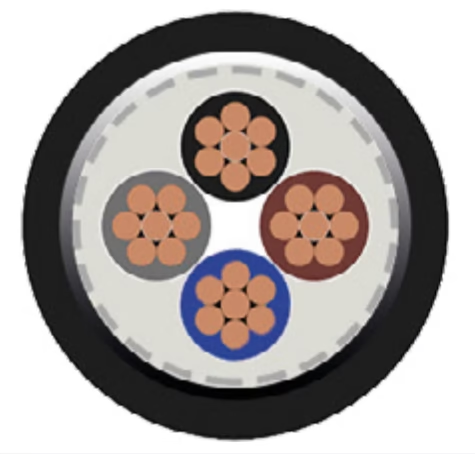
DM2N 3×150+3×25+3×2,5 0,6/1 kV SW HD
UNE 22512 — formally titled “Cables flexibles para minería subterránea con tensiones de 1,8/3 kV y 0,6/1 kV con aislamiento de caucho, con armadura” (Flexible cables for underground mining, rubber-insulated, armoured) — exists as a parallel but fundamentally distinct standard from its unarmoured sibling UNE 22511. Where UNE 22511 is engineered as a torsion-optimized drag cable for mobile equipment, UNE 22512 is engineered as a crush-and-cut protected feeder cable for semi-fixed installations where mechanical damage from external forces (falling rock, equipment impact, floor pressure) is a documented operational risk, but the extreme torsional loading of continuously moving equipment is not.
The addition of metallic armour — specifically, galvanized steel wire braid forming what the standard designates as M2 GSWB — is the defining structural choice that reshapes every downstream design decision in the cable. The armour is not merely a protective layer added to an otherwise standard cable; rather, it fundamentally alters the cable’s mechanical behavior, installation requirements, cost structure, and applicable fatigue loading regimes. Understanding UNE 22512 therefore requires understanding not just what the armour is, but why its presence necessitates a completely different engineering philosophy compared to unarmoured cables.
The standard was developed by AENOR (Asociación Española de Normalización y Certificación) to address a specific operational problem encountered in Spanish and Latin American underground mining installations. While drag cables experience cyclic torsional loading as the controlling mechanical stress, semi-fixed installation cables experience something categorically different: static or low-cycle crushing and cutting stresses from external impacts, combined with continuous exposure to abrasive underground surfaces and sharp rock edges. A cable optimized exclusively for torsional fatigue — such as UNE 22511 — when installed in a semi-fixed route subject to crushing and cutting, experiences mechanical failure not through fatigue mechanisms but through acute sheath penetration, insulation damage, and moisture ingress. Conversely, an armoured cable optimized for crush protection, if inappropriately installed in a drag duty application, fails not through crushing (which the armour prevents) but through torsional fatigue of the armour wires themselves — a more insidious failure mode that occurs entirely within the armour structure, invisible until complete armour failure exposes the underlying insulation.