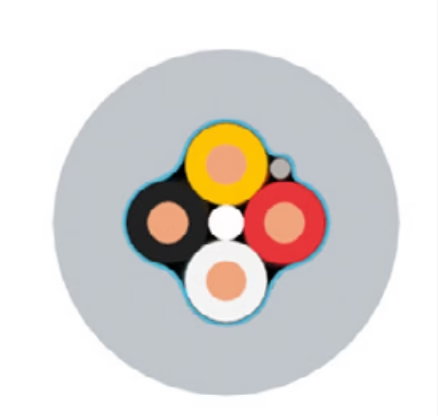
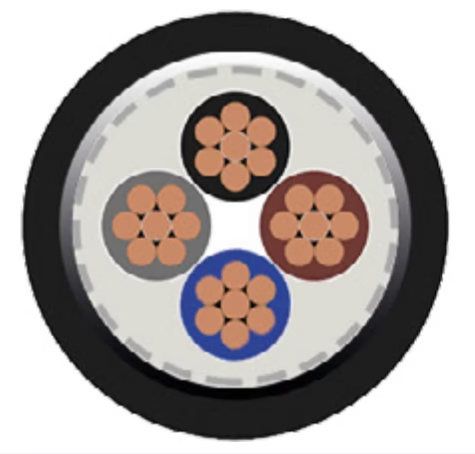
PVC insulation

C PUR Design Integration: FLEXIFESTOON PUR characteristics (inherited): Outer sheath: PUR (polyurethane, compact) Insulation: Special TPE (superior elongation) Central unit: Textile (mechanical support) Weight: 25–30% lighter than standard rubber Diameter: 15–20% smaller than rubber equivalent Cost: +15–25% premium over rubber Service life: 10–15 years (extended) Screened design addition (new): Screen: Tinned copper braid (EMC shielding) Coverage: 80–90% (good EMC performance) Diameter impact: +2–3 mm (screen adds ~3 mm to diameter) Weight impact: +500 kg/km (braid + outer sheath) Cost: Additional +10–15% for screen layer Combined C PUR result: vs. Unscreened PUR (FLEXIFESTOON PUR): FLEXIFESTOON PUR: Minimal diameter/weight, no EMC C PUR: Slightly larger (screen added), excellent EMC Choice: PUR for maximum compactness (non-EMI environments) C PUR for VFD motors, confined spaces with EMC requirements vs. Standard rubber screened (GRDGCGÖU-J): GRDGCGÖU-J: Standard diameter, heavy, rubber durability C PUR: Compact diameter, lightweight, superior oil/chemical resistance Choice: GRDGCGÖU-J for simple temporary festoon C PUR for permanent industrial machine tool installation Nomenclature: FLEXIFESTOON® = Product family (flexible cable) C = Screen (copper braid, "C" from German "Schirm") PUR = Material (polyurethane jacket) Result: "FLEXIFESTOON C PUR" = Screened compact polyurethane cable

Что такое ÖLFLEX® AUTO 8681 MC: гибкий PUR-кабель для автоматизации, кабельных цепей, подвижных машин и торсионных применений

ÖLFLEX® AUTO 8681 MC — это многожильный гибкий кабель 300/500 V для автоматизации, силовых цепей электрического оборудования, кабельных цепей, подвижных частей машин, станков, трансферных линий, сборочных и производственных линий. Его технический профиль основан на тонкопроволочной медной жиле VDE 0295 Class 6 / IEC 60228 Class 6, изоляции TPE, наружной оболочке PUR, высокой стойкости к маслам, истиранию и надрезам, низкоадгезионной поверхности, рабочем температурном диапазоне -40°C до +80°C, минимальном радиусе изгиба 5 × наружный диаметр при гибком применении и торсионной нагрузке до ±180°/м. Для инженеров автоматизации такой кабель важен не как обычный проводник питания, а как механически стойкий элемент машины, который должен переживать циклы движения, ускорения, скольжение в цепи, влажную среду, контакт с маслами и периодическую торсию.
FLEXIFESTOON® SEOOW YELLOW represents FeiChun's entry into the low-voltage festoon and temporary power market. The nomenclature requires careful explanation to distinguish this product from the high-voltage FLEXIDRUM series: FLEXIFESTOON Product Nomenclature: FLEXIFESTOON® = Product family name Flex = Flexible (emphasis on bending & handling) Festoon = Strung overhead in continuous runs (typical festoon lighting application) SEOOW = Industry-standard designation S = Service cord (temporary, not permanent installation) E = Elastomer jacket (flexible sheath) OO = Oil-resistant conductor insulation (TPE qualifies as oil-resistant) W = Weather-resistant sheath (water, ozone, UV resistant) SEOOW is defined in: UL 62 (Standard for Flexible Cords and Cables) CSA 22.2 No. 49 (Canadian equivalent) NFPA 70 National Electrical Code (NEC) Article 400 YELLOW designation: Color: RAL 1021 (traffic yellow, high visibility) Safety significance: Yellow cords attract attention in job sites Practical purpose: Easy to identify, prevent trips/entanglement Contrast with FLEXIDRUM series: FLEXIDRUM (High-Voltage MV Cable): Voltage: 3.6 kV to 20/35 kV (power distribution) Temperature: −40 to +80°C (standard industrial) Application: Mobile mining/tunneling equipment (capital-intensive) Size: Large diameter, heavy (3–12 kg/km) FLEXIFESTOON (Low-Voltage Service Cord): Voltage: 600V (light/power temporary use) Temperature: −60 to +105°C (extreme environmental range) Application: Festoon lighting, temporary site power, outdoor events Size: Small diameter, lightweight (0.05–0.3 kg/m) Cost: Consumer/contractor-grade (not specialty industrial)

Что такое ÖLFLEX® CLEANROOM FD 8110: инженерный анализ кабеля для CLEANROOM и moving chain applications

ÖLFLEX® CLEANROOM FD 8110 — это low voltage power and control cable for CLEANROOM. Кабель имеет unarmoured construction, PVC insulation and PVC outer sheath, stranded copper conductor according to IEC 60228 Class 6 and предназначен для power chains, moving machine parts, measuring, control and regulating circuits, assembly lines, production lines and all kinds of machines. В предоставленных данных указаны CLEANROOM classification for IPA Class 1, zero particle emission at moved chain application, low-adhesive surface and easy installation due to small cable diameter.
FLEXIFESTOON® SEOOW YELLOW represents FeiChun's entry into the low-voltage festoon and temporary power market. The nomenclature requires careful explanation to distinguish this product from the high-voltage FLEXIDRUM series: FLEXIFESTOON Product Nomenclature: FLEXIFESTOON® = Product family name Flex = Flexible (emphasis on bending & handling) Festoon = Strung overhead in continuous runs (typical festoon lighting application) SEOOW = Industry-standard designation S = Service cord (temporary, not permanent installation) E = Elastomer jacket (flexible sheath) OO = Oil-resistant conductor insulation (TPE qualifies as oil-resistant) W = Weather-resistant sheath (water, ozone, UV resistant) SEOOW is defined in: UL 62 (Standard for Flexible Cords and Cables) CSA 22.2 No. 49 (Canadian equivalent) NFPA 70 National Electrical Code (NEC) Article 400 YELLOW designation: Color: RAL 1021 (traffic yellow, high visibility) Safety significance: Yellow cords attract attention in job sites Practical purpose: Easy to identify, prevent trips/entanglement Contrast with FLEXIDRUM series: FLEXIDRUM (High-Voltage MV Cable): Voltage: 3.6 kV to 20/35 kV (power distribution) Temperature: −40 to +80°C (standard industrial) Application: Mobile mining/tunneling equipment (capital-intensive) Size: Large diameter, heavy (3–12 kg/km) FLEXIFESTOON (Low-Voltage Service Cord): Voltage: 600V (light/power temporary use) Temperature: −60 to +105°C (extreme environmental range) Application: Festoon lighting, temporary site power, outdoor events Size: Small diameter, lightweight (0.05–0.3 kg/m) Cost: Consumer/contractor-grade (not specialty industrial)

Что такое ÖLFLEX® 100 I SY: цветовой PVC power and control cable со стальной проволочной оплёткой для зон с высокой механической нагрузкой

ÖLFLEX® 100 I SY — это цветовой PVC power and control cable со steel wire braiding, предназначенный для plant engineering, industrial machinery, power circuits for air-conditioning installations, main power circuits to individual apartments and fixed installations в зонах с повышенной механической нагрузкой. Его ключевая идея — не EMC-screening, а extra mechanical protection: стальная проволочная оплётка работает как защитный слой против внешнего механического воздействия, давления, случайных ударов и грубого промышленного обращения. Кабель имеет номинальное напряжение до 1100 V, испытательное напряжение 4 kV, flame retardant performance according to IEC 60332-1, bare copper fine wire class 5 conductors, PVC insulation, PVC inner sheath, steel wire braid and outer sheath in PVC or PVC FR-LSH version.
EMC Performance Classification: EMC rating scale (VDE/EN standards): Basic: No shielding (part 813 unscreened) Fair: Partial coverage, 30–40 mm spacing in braid Good: 80–90% coverage, 95% coverage, all gaps 30 dB attenuation @ 500 kHz: >40 dB attenuation @ 5 MHz: >35 dB attenuation (typical peak range) Expected: Tinned copper braid achieves 35–50 dB across frequency range Immunity to external interference: Motor variable frequency drive (VFD) nearby: VFD RF emission: Typically 50–200 mV/m at cable distance Unshielded cable susceptibility: 100–500 mV induced noise Shielded cable (good EMC): 1–10 mV induced noise (50–100× reduction) Consequence: VFD-driven crane motor doesn't interfere with control signals No false triggering of safety systems Data integrity in digital control systems maintained Radiated immunity testing (per EN 61000-4-3): Test standard: Cable exposed to RF field 50 MHz–1 GHz Test field strength: 10 V/m typical Acceptance: No malfunction, signal corruption

Что такое ÖLFLEX® 191K CY: экранированный гибкий многожильный AWM approval cable — инженерный анализ для шкафов управления, промышленного оборудования и тяжёлых машин

ÖLFLEX® 191K CY — это экранированный гибкий многожильный кабель с AWM approval, рассчитанный на AC 600 V, испытательное напряжение AC 4000 V, широкий температурный диапазон до +90°C, тонкопроволочные медные жилы по VDE 0295 class 5 / IEC 60228 class 5, PVC insulation, PVC inner sheath, tinned-copper braiding и PVC outer sheath grey or black. Его основная инженерная область — control cabinets, plant engineering, industrial machinery, air-conditioning systems и EMC-sensitive environments, где требуется монтажная гибкость, высокий уровень экранирования и надёжная работа в условиях общей механической прочности. Для портовых кранов, горнодобывающей техники и тяжёлых подвижных машин Feichun рассматривает такую конструкцию как полезную базу, но дополняет её анализом растягивающих нагрузок, абразивного износа, динамического изгиба, вибрации и фактической кабельной трассы.
(N)GRDGÖU-J Nomenclature (VDE 0250 part 813): (N) = Nominal voltage prefix (0.6/1 kV implicit in designation) G = Gummiert (rubber-insulated) R = Rubber outer sheath D = Dynamisch (dynamic/flexing application) G = Gummiert inner sheath (intermediate layer) Ö = German standard designation (ö indicates European origin) U = Unarmoured (no metal sheath) J = Jacked (multi-sheath design: intermediate + outer) Full meaning: Rubber-insulated, rubber-sheathed, dynamic-rated, multi-sheath construction, unarmoured festoon cable VDE 0250 part 813 scope: Published by: VDE (Verband der Elektrotechnik, German standards body) Applies to: Flexible cables for crane installations (particularly festoon systems) Coverage: Voltage, temperature, mechanical properties, installation methods Festoon-specific requirements: - High bending flexibility (4×D minimum typical) - Fast rewind capability (240+ m/min rated speed) - Sustained torsion tolerance (±25°/1m continuous) - Extended temperature range (−50 to +80°C) - UV/ozone/moisture resistance (outdoor exposure) Alternate designations (similar cables): IEC 60811-1-1: International equivalent (less specific) DIN VDE 0298 part 3: German mechanical property standard DIN VDE 0482-265-2-1: German flame test standard EN 50265-2-1: European flame test equivalent GRDGÖU-J advantage: Combines all standards into single VDE designation Procurement simplified for European buyers

Что такое ÖLFLEX CONTROL 610T: PVC Control Cable for a Wide Range of Applications — инженерный анализ и сравнение с высокогибкими кабелями Feichun для горной техники, портовых кранов и тяжёлого мобильного оборудования

ÖLFLEX CONTROL 610T — это компактный PVC-кабель управления для измерительных, мониторинговых и управляющих цепей, применяемый в промышленном оборудовании, системах отопления и кондиционирования, офисной технике и других установках со средними механическими нагрузками. Его ключевая идея — уменьшенный наружный диаметр, проводники тонкопроволочной конструкции по IEC 60228 class 5, негорючее поведение по IEC 60332-1-2 и рабочая гибкость для периодических, не непрерывно повторяющихся перемещений без растягивающей нагрузки. Для инженеров портов, карьеров и тяжёлой техники этот кабель полезен как эталон компактного промышленного control cable, но не как полный ответ на задачи рудников, кабельных барабанов, тяговых нагрузок, абразивного износа и ударного воздействия. Именно здесь инженерная логика Feichun делает шаг дальше: от компактного PVC control cable к высокогибкому специальному кабелю с усиленной стойкостью к растяжению, истиранию и динамическим нагрузкам.
C PUR Design Integration: FLEXIFESTOON PUR characteristics (inherited): Outer sheath: PUR (polyurethane, compact) Insulation: Special TPE (superior elongation) Central unit: Textile (mechanical support) Weight: 25–30% lighter than standard rubber Diameter: 15–20% smaller than rubber equivalent Cost: +15–25% premium over rubber Service life: 10–15 years (extended) Screened design addition (new): Screen: Tinned copper braid (EMC shielding) Coverage: 80–90% (good EMC performance) Diameter impact: +2–3 mm (screen adds ~3 mm to diameter) Weight impact: +500 kg/km (braid + outer sheath) Cost: Additional +10–15% for screen layer Combined C PUR result: vs. Unscreened PUR (FLEXIFESTOON PUR): FLEXIFESTOON PUR: Minimal diameter/weight, no EMC C PUR: Slightly larger (screen added), excellent EMC Choice: PUR for maximum compactness (non-EMI environments) C PUR for VFD motors, confined spaces with EMC requirements vs. Standard rubber screened (GRDGCGÖU-J): GRDGCGÖU-J: Standard diameter, heavy, rubber durability C PUR: Compact diameter, lightweight, superior oil/chemical resistance Choice: GRDGCGÖU-J for simple temporary festoon C PUR for permanent industrial machine tool installation Nomenclature: FLEXIFESTOON® = Product family (flexible cable) C = Screen (copper braid, "C" from German "Schirm") PUR = Material (polyurethane jacket) Result: "FLEXIFESTOON C PUR" = Screened compact polyurethane cable

什么是 ККГР, ККГРТ, ККГРВ, ККГВ, ККГПВ, ККПЭВ:转子综合体与挖掘机用柔性电缆工程解析

ККГР、ККГРТ、ККГРВ、ККГВ、ККГПВ、ККПЭВ 是一组用于 роторные комплексы 转子综合体和 одноковшовые экскаваторы 单斗挖掘机的柔性电缆。资料标题定义为“Кабели гибкие для роторных комплексов и экскаваторов”,按 ТУ 16.К73-027-91 制造,并符合 ГОСТ 31945-2012 要求。该系列覆盖电力连接、控制设备、通信、照明、机上电能分配,以及 ККПЭВ 的挖掘机计算系统信息传输
UNE 22511 Design Philosophy: Ultimate Flexibility for Underground Mobile Equipment Within the taxonomy of mining cables, the distinction between the UNE 22511 and UNE 22512 standards represents a fundamental divergence in design philosophy — not merely a difference in specification parameters. Understanding this divergence is essential for engineers procuring replacement cables for underground coal mines in Spain, Chile, Colombia, and other markets operating under the AENOR (Asociación Española de Normalización y Certificación) regulatory framework. The UNE 22511 standard governs cables for flexible connection of mobile underground mining machinery — the specific class of heavy-duty cable designed for equipment that moves continuously during operation: continuous miners, longwall shearers, shuttle cars, and cable reel systems. The engineering DNA of a UNE 22511 cable can be summarized in a single phrase: engineered for mechanical endurance, not for static installation security. This philosophy manifests in every structural element of the cable: the conductor class, the insulation compound, the earth core arrangement, the absence of metallic armor, and the sheath compound selection. Each element is chosen not to maximize any single parameter but to achieve an optimal balance of torsional resilience, bending flexibility, and sheath durability under the combined mechanical loading of continuous dragging, occasional running-over by shuttle car wheels, and periodic full-tension pulling by cable reel drum systems.

YSLCY Shielded Control Cable | Anti-Interference | VDE 0250 | EAC & GOST Fire | Russia Factory

An engineering-grade technical reference for industrial electrical control installations across Russian Federation manufacturing facilities, automation systems, programmable logic controllers (PLCs), and distributed industrial infrastructure. This document explains the comprehensive electromagnetic shielding architecture that protects sensitive control signals from external noise sources in high-voltage industrial environments, establishes the twisted-pair core construction that provides signal integrity over extended cable runs, documents compliance with VDE 0250 mining and industrial cable standards, and provides performance specifications and field integration guidance for seamless deployment into automation networks operating in Russian factory and heavy industrial settings.
What Are UNE 22560 and UNE 22561? Scope, Definitions, and Core Purpose The UNE 22560 and UNE 22561 standards represent the final and often most underestimated element of the Spanish and Latin American underground mining cable ecosystem. Where UNE 22511 and UNE 22512 govern the power distribution cables that energize mining equipment, the 22560 and 22561 standards govern the signal, control, and interlock cables that command and protect that equipment. These are the "nervous system" cables of a mine — the communication network that tells a continuous miner when to advance and when to halt, that triggers emergency stops, that monitors hoisting rope tension on shaft equipment, that controls conveyor sequencing, and that enables the protective interlocking that prevents a piece of equipment from operating unless all safety preconditions are met. UNE 22560 formally defines flexible multi-core cables for underground mining with voltage ratings up to 500 V or 0.6/1 kV, with no metallic armour protection — designed for installation within equipment enclosures, along protected cable trays in main gate roads, or in areas where mechanical damage risk is minimal. UNE 22561 is its armoured sister standard, incorporating steel wire braid or steel tape protection, specified for installation in rough terrain areas where mechanical damage from rock fall, equipment collision, or floor contact is a credible risk. Both standards mandate that the cable be designed as a multi-core concentric stranded bundle — not the parallel-laid three or four conductors common in power cables, but rather seven, twelve, nineteen, or more individually insulated cores twisted concentrically around a central axis, allowing compact packaging of numerous independent control circuits within a single cable jacket. The distinction between these standards is not merely mechanical armour presence or absence. Control cables are tested against an entirely different set of safety criteria than power cables because their failure mode is fundamentally different. A power cable failure results in loss of energy to equipment — dangerous but localized. A control cable failure can disable the interlock system that prevents a continuous miner from advancing into unsafe ground, or can disable the emergency stop circuit that should halt a conveyor if a worker falls into it. A control cable fire, burning in a tightly bundled cable tray with other control cables, must not spread flame between cables because control cables are typically routed in shared ducts and cable carriers where one cable's ignition could cascade to adjacent circuits. Therefore, control cables are tested for bundle flame propagation (EN 60332-3) rather than single-cable flame propagation tests — a more stringent requirement that demands careful attention to outer sheath formulation and cable spacing in bundle installation.

UNE 22560

What Are UNE 22560 and UNE 22561? Scope, Definitions, and Core Purpose The UNE 22560 and UNE 22561 standards represent the final and often most underestimated element of the Spanish and Latin American underground mining cable ecosystem. Where UNE 22511 and UNE 22512 govern the power distribution cables that energize mining equipment, the 22560 and 22561 standards govern the signal, control, and interlock cables that command and protect that equipment. These are the “nervous system” cables of a mine — the communication network that tells a continuous miner when to advance and when to halt, that triggers emergency stops, that monitors hoisting rope tension on shaft equipment, that controls conveyor sequencing, and that enables the protective interlocking that prevents a piece of equipment from operating unless all safety preconditions are met. UNE 22560 formally defines flexible multi-core cables for underground mining with voltage ratings up to 500 V or 0.6/1 kV, with no metallic armour protection — designed for installation within equipment enclosures, along protected cable trays in main gate roads, or in areas where mechanical damage risk is minimal. UNE 22561 is its armoured sister standard, incorporating steel wire braid or steel tape protection, specified for installation in rough terrain areas where mechanical damage from rock fall, equipment collision, or floor contact is a credible risk. Both standards mandate that the cable be designed as a multi-core concentric stranded bundle — not the parallel-laid three or four conductors common in power cables, but rather seven, twelve, nineteen, or more individually insulated cores twisted concentrically around a central axis, allowing compact packaging of numerous independent control circuits within a single cable jacket. The distinction between these standards is not merely mechanical armour presence or absence. Control cables are tested against an entirely different set of safety criteria than power cables because their failure mode is fundamentally different. A power cable failure results in loss of energy to equipment — dangerous but localized. A control cable failure can disable the interlock system that prevents a continuous miner from advancing into unsafe ground, or can disable the emergency stop circuit that should halt a conveyor if a worker falls into it. A control cable fire, burning in a tightly bundled cable tray with other control cables, must not spread flame between cables because control cables are typically routed in shared ducts and cable carriers where one cable’s ignition could cascade to adjacent circuits. Therefore, control cables are tested for bundle flame propagation (EN 60332-3) rather than single-cable flame propagation tests — a more stringent requirement that demands careful attention to outer sheath formulation and cable spacing in bundle installation.
GAALFLEX® Complete 53-Product Cable Selection Guide: Deep Comparison Across 7 Product Families for Industrial, Marine, Mining, Automation, and VFD Applications A comprehensive engineering reference comparing all 53 GAALFLEX® cable products across voltage rating, insulation technology, shielding architecture, temperature range, certification standards, application environment, and core configuration — enabling engineers to select the optimal cable for any industrial scenario from a single unified portfolio.

Deep Comparison Across 7 Cables Families for Industrial, Marine, Mining, Automation, and VFD Applications

GAALFLEX® Complete 53-Product Cable Selection Guide: Deep Comparison Across 7 Product Families for Industrial, Marine, Mining, Automation, and VFD Applications A comprehensive engineering reference comparing all 53 GAALFLEX® cable products across voltage rating, insulation technology, shielding architecture, temperature range, certification standards, application environment, and core configuration — enabling engineers to select the optimal cable for any industrial scenario from a single unified portfolio.
Feichun GAALFLEX® CONTROL H05V-K/H07V-K: European Harmonized Industrial Control Cable (H05V-K 300/500 V & H07V-K 450/750 V, Single-Conductor PVC Insulation Type TI1, Class 5 Flexible Red Copper Conductor per IEC 60228, −10 to +70°C Temperature Range Fixed Laying & Portable Installation, Variable Bending Radius Design (3–4×D Depending on Conductor Size), Flame-Retardant & Self-Extinguishing per IEC 60332-1-2, RoHS & CE Certification, Harmonized European Standards Compliance (EN 50525-2-31, CEI 20-107, IEC 60811, BS 6004), Cost-Effective Standard Cable for Non-Specialized Industrial Applications, Comprehensive 18+ SKU Portfolio (H05V-K: 0.5–1 mm², H07V-K: 1.5–240 mm²) Covering Entry-Level Control Circuits Through High-Capacity Industrial Feeders): Comprehensive European Standards Analysis & General Industrial Control System Integration Engineering for Standardized Facility Wiring, Machine Tool Control, Fixed Installation Power Distribution, and Cost-Optimized Reliability Across Diverse Industrial Environments

GAALFLEX® CONTROL – H05V-K & H07V-K

Feichun GAALFLEX® CONTROL H05V-K/H07V-K: European Harmonized Industrial Control Cable (H05V-K 300/500 V & H07V-K 450/750 V, Single-Conductor PVC Insulation Type TI1, Class 5 Flexible Red Copper Conductor per IEC 60228, −10 to +70°C Temperature Range Fixed Laying & Portable Installation, Variable Bending Radius Design (3–4×D Depending on Conductor Size), Flame-Retardant & Self-Extinguishing per IEC 60332-1-2, RoHS & CE Certification, Harmonized European Standards Compliance (EN 50525-2-31, CEI 20-107, IEC 60811, BS 6004), Cost-Effective Standard Cable for Non-Specialized Industrial Applications, Comprehensive 18+ SKU Portfolio (H05V-K: 0.5–1 mm², H07V-K: 1.5–240 mm²) Covering Entry-Level Control Circuits Through High-Capacity Industrial Feeders): Comprehensive European Standards Analysis & General Industrial Control System Integration Engineering for Standardized Facility Wiring, Machine Tool Control, Fixed Installation Power Distribution, and Cost-Optimized Reliability Across Diverse Industrial Environments
KIV Wire Architecture & Building Wiring Design Philosophy Purpose & Application Scope: KIV (Korean Industrial Vinyl) flexible single-core building wire represents the engineered solution for residential and commercial indoor electrical wiring requiring simplified installation, practical flexibility, and reliable performance throughout decades of building service. Unlike power distribution cables designed for specialized applications (underground, portable, equipment), KIV wires are specifically engineered for standardized building electrical systems where simplicity, compatibility with standard conduit systems, and proven reliability across diverse building types create essential requirements. Core Engineering Philosophy: KIV wire design emphasizes practical flexibility enabling easy routing through building conduit systems, standard interface with residential and commercial electrical infrastructure, proven long-term reliability, and economy of installation. Class 5 flexible stranding enables routing through conduit bends, simplified pulling during installation, and practical handling without specialized equipment. Standard PVC insulation provides proven performance across indoor building environments, standard electrical interfaces, and cost-effective manufacturing enabling competitive pricing for high-volume residential and commercial construction markets. Market Position & Regulatory Compliance: KIV wires comply with KS C IEC 60227-3 international standard specifications—the recognized standard for flexible building wiring worldwide. The 450/750V rating addresses standard 400V three-phase (230V single-phase) building power distributions universal across modern residential and commercial infrastructure. Building electrical codes in most jurisdictions specifically reference KS C IEC 60227-3 or equivalent standards, making KIV wires the standard choice for compliant building installation.

K 60227 IEC 02 (KIV) 450/750V Flexible Building Wiring Wire

KIV Wire Architecture & Building Wiring Design Philosophy Purpose & Application Scope: KIV (Korean Industrial Vinyl) flexible single-core building wire represents the engineered solution for residential and commercial indoor electrical wiring requiring simplified installation, practical flexibility, and reliable performance throughout decades of building service. Unlike power distribution cables designed for specialized applications (underground, portable, equipment), KIV wires are specifically engineered for standardized building electrical systems where simplicity, compatibility with standard conduit systems, and proven reliability across diverse building types create essential requirements. Core Engineering Philosophy: KIV wire design emphasizes practical flexibility enabling easy routing through building conduit systems, standard interface with residential and commercial electrical infrastructure, proven long-term reliability, and economy of installation. Class 5 flexible stranding enables routing through conduit bends, simplified pulling during installation, and practical handling without specialized equipment. Standard PVC insulation provides proven performance across indoor building environments, standard electrical interfaces, and cost-effective manufacturing enabling competitive pricing for high-volume residential and commercial construction markets. Market Position & Regulatory Compliance: KIV wires comply with KS C IEC 60227-3 international standard specifications—the recognized standard for flexible building wiring worldwide. The 450/750V rating addresses standard 400V three-phase (230V single-phase) building power distributions universal across modern residential and commercial infrastructure. Building electrical codes in most jurisdictions specifically reference KS C IEC 60227-3 or equivalent standards, making KIV wires the standard choice for compliant building installation.
VCT Cabtyre Cable Architecture & Design Philosophy Purpose & Application Scope: VCT (Vinyl Insulated Vinyl Sheathed Cabtyre) cables represent engineered solutions for mobile electrical equipment requiring robust, flexible power distribution without permanent installation infrastructure. Unlike fixed installation cables designed for long-term underground or indoor wiring, VCT cables are specifically engineered for portable applications where cables experience frequent movement, mechanical stress, temporary disconnection/reconnection, and harsh operational environments typical of factories, mines, farms, construction sites, and emergency power systems. Core Engineering Philosophy: VCT cable design emphasizes mechanical durability and flexibility rather than thermal optimization or fire safety specifications. Heavy-duty PVC outer sheathing provides superior abrasion resistance, oil and solvent resistance, and mechanical toughness compared to conventional power cable sheaths. Class 5 extra-flexible stranding enables tight coiling, frequent movement through conduits and restrictive spaces, and repetitive bending cycles without insulation cracking or conductor breaking. This engineering approach prioritizes cable longevity in dynamic, portable applications over size optimization or thermal performance. Market Position & Regulatory Compliance: VCT cables comply with KS C IEC 60502-1 international standards and equivalent national specifications. The 0.6/1kV rating addresses portable equipment operating under 400V three-phase (approximately 230V single-phase) typical of industrial facilities worldwide. Portable power distribution standards in most jurisdictions permit VCT cables for temporary installations and mobile equipment connections where fixed infrastructure does not exist. The cabtyre cable design—with flexible stranding and durable sheathing—satisfies regulatory requirements for equipment that requires frequent electrical connection changes and mechanical movement.

0.6/1kV VCT Vinyl Insulated Vinyl Sheathed Cabtyre Cable

VCT Cabtyre Cable Architecture & Design Philosophy Purpose & Application Scope: VCT (Vinyl Insulated Vinyl Sheathed Cabtyre) cables represent engineered solutions for mobile electrical equipment requiring robust, flexible power distribution without permanent installation infrastructure. Unlike fixed installation cables designed for long-term underground or indoor wiring, VCT cables are specifically engineered for portable applications where cables experience frequent movement, mechanical stress, temporary disconnection/reconnection, and harsh operational environments typical of factories, mines, farms, construction sites, and emergency power systems. Core Engineering Philosophy: VCT cable design emphasizes mechanical durability and flexibility rather than thermal optimization or fire safety specifications. Heavy-duty PVC outer sheathing provides superior abrasion resistance, oil and solvent resistance, and mechanical toughness compared to conventional power cable sheaths. Class 5 extra-flexible stranding enables tight coiling, frequent movement through conduits and restrictive spaces, and repetitive bending cycles without insulation cracking or conductor breaking. This engineering approach prioritizes cable longevity in dynamic, portable applications over size optimization or thermal performance. Market Position & Regulatory Compliance: VCT cables comply with KS C IEC 60502-1 international standards and equivalent national specifications. The 0.6/1kV rating addresses portable equipment operating under 400V three-phase (approximately 230V single-phase) typical of industrial facilities worldwide. Portable power distribution standards in most jurisdictions permit VCT cables for temporary installations and mobile equipment connections where fixed infrastructure does not exist. The cabtyre cable design—with flexible stranding and durable sheathing—satisfies regulatory requirements for equipment that requires frequent electrical connection changes and mechanical movement.
N3GHSSYCY — это экранированный высоковольтный гибкий кабель промышленного класса, специально разработанный для подключения мобильного оборудования в шахтах и подземных выработках со взрывоопасной средой. Кабель соответствует международному стандарту DIN VDE 0250, часть 605 и выпускается в двух номинальных напряжениях: 3.6/6 кВ и 6/10 кВ. Особенностью конструкции является наличие фазоконцентрического заземляющего проводника и общего концентрического экрана мониторинга, которые в сочетании со схемой высоковольтной защиты позволяют контролировать кабель на наличие дефектов изоляции и повреждений от внешних воздействий.

Tinned Copper Conductors in Rubber Cables vs. Bare Copper in PVC Cables: A Technical Analysis of VDE Standards and Material Chemistry

In the specialized world of industrial cable manufacturing, the choice between tinned copper and bare copper conductors represents a critical engineering decision driven by material chemistry, environmental conditions, and international standards. The German VDE (Verband der Elektrotechnik, Elektronik und Informationstechnik) standards provide particularly stringent requirements for cable construction, and understanding why these standards mandate tinned copper conductors for rubber-insulated cables while permitting bare copper for PVC-insulated cables reveals fundamental principles of cable engineering and materials science.
Armoured cables, commonly referred to as SWA (Steel Wire Armoured) or AWA (Aluminium Wire Armoured) cables, are robust power cables designed with metallic armour protection for demanding installation environments. The armour provides mechanical protection where physical stress could damage the cable, such as direct burial underground, outdoor installations, or industrial environments. These cables are manufactured in accordance with British, European, and International standards including BS 5467, BS 6724, BS 6622, BS 7835, and IEC 60502.

What are Armoured Cables SWA & AWA?

SWA cable, AWA cable, armoured cable, steel wire armoured, aluminium wire armoured, BS 5467, BS 6724, BS 6622, BS 7835, IEC 60502, BASEC approved, XLPE cable, LSZH cable, underground cable, 0.6/1kV, 11kV cable, 33kV cable, N2XRY, NYFGBY, power cable, industrial cable, direct burial, 鎧裝電纜, 鋼絲鎧裝, cable blindado
KEMA approval is recognised as the key independent Dutch third-party accreditation for electrical cables, particularly important when working on low voltage installation projects in the Netherlands and across Europe. KEMA approvals are issued by KEMA Labs, based in Arnhem, The Netherlands. KEMA Labs' parent company is CESI (Centro Elettrotecnico Sperimentale Italiano), the Italian independent testing and laboratories business, having acquired the testing division from DNV GL Energy in 2019.

What are KEMA Approved Cables?

KEMA approved cable, KEMA certification, KEMA Labs, KEMA certified, KEMA approval, Dutch cable certification, Netherlands cable standard, third-party certified cable, independent cable certification KEMA认证电缆, KEMA認證電纜, 荷兰标准电缆, 荷蘭標準電纜, 低烟无卤电缆, 低煙無鹵電纜, 数据中心电缆, 數據中心電纜, 荷兰认证, 荷蘭認證
UNE 21123 standard refers to the design and cross-sectional area specifications for cables used by utilities on power distribution circuits with voltage ratings up to and including 600/1000V (0.6/1kV). UNE standards are released by AENOR (Asociación Española de Normalización y Certificación), the Spanish Association for Standardisation and Certification. As AENOR is a member of ISO, IEC, and CENELEC, many of its standards are harmonized with European and international conventions.

What is UNE 21123 Cable?

UNE 21123 standard refers to the design and cross-sectional area specifications for cables used by utilities on power distribution circuits with voltage ratings up to and including 600/1000V (0.6/1kV). UNE standards are released by AENOR (Asociación Española de Normalización y Certificación), the Spanish Association for Standardisation and Certification. As AENOR is a member of ISO, IEC, and CENELEC, many of its standards are harmonized with European and international conventions.
SANS 1507 standard, published by the South African Bureau of Standards (SABS), specifies requirements for electrical cables with extruded solid dielectric insulation designed for fixed installation. This comprehensive standard covers cables with voltage ratings from 300/500V to 1.9/3.3kV, encompassing wiring cables, distribution cables, and service cables used throughout South Africa and many other African nations.

What is SANS 1507 Cable?

南非标准电缆, 南非標準電纜, SANS电缆, SANS電纜, 配电电缆, 配電電纜, 钢丝铠装电缆, 鋼絲鎧裝電纜, 交联聚乙烯电缆, 交聯聚乙烯電纜, 矿用电缆, 礦用電纜, mining cable, industrial distribution cable, commercial building cable, power utility cable, substation cable, switchgear cable, infrastructure cable, SANS 1507, SANS 1507-3, SANS 1507-4, SANS Type 41, SANS Type 61a, 640/1100V cable, 1kV distribution cable, XLPE insulation, PVC insulation, steel wire armour, SWA cable, SABS cable, South African standard, direct burial cable, mining cable, industrial cable, copper conductor, aluminium conductor, armoured distribution cable, XLPE-SWA-PVC, PVC-SWA-PVC, IEC 60502-1, IEC 60228, African power cable, underground cable, service cable, Class 2 conductor, 90°C cable, halogen-free cable, SANS 1520, Eskom, cable manufacturer China, 南非標準電纜, 配電電纜, 鋼絲鎧裝, cable de distribución, cable blindado
Germany's DIN VDE 0815 standard contains specifications for wiring cables designed for telecommunications and data processing systems in indoor residential and commercial telecommunications installations. It is issued by the certification bodies VDE and DIN under the banner of the DKE (Deutsche Kommission Elektrotechnik), the German Commission for Electrical, Electronic and Information Technologies.

What is DIN VDE 0815 Cable?

DIN VDE 0815, VDE 0815 cable, J-Y(St)Y cable, telephone cable, telecommunications cable, twisted pair cable, indoor telephone cable, data transmission cable, signal cable, German telecom cable, screened telephone cable, foil screen cable, DIN VDE 0815, DIN 57815, VDE 0815, VDE 0295, IEC 60228, DIN VDE 0207-2, DKE standard, German telecom standard, VDE certified cable, DIN certified cable, European telecom standard
The Canadian Standards Association (CSA) sets out the requirements for the Canadian Electrical Code (Part 2) including flexible cords, elevator cables, and hoistway cables with a maximum voltage rating of 600V in the standard CSA 22.2. Standard CSA 22.2 Part 210-11 is designated for Appliance Wiring Material (AWM) Products such as heavy-duty cables with an increased voltage rating and a higher temperature rating than ordinary panel wires. The standard applies to both single conductor and multi-core cables, either round, flat, or coiled, which includes the range holding CSA, UL, and British Standard approvals.

What is CSA 22.2 No. 210-11 Cable?

CSA 22.2 No. 210-11 cable, tri-rated cable, H05V2-K cable, H07V2-K cable, BS 6231 cable, UL1015 cable, UL 758 cable, panel wire, switchgear cable, control panel wire, AWM cable, appliance wiring material, Class 5 flexible copper, PVC insulation, 600V cable, 1000V cable, 105°C cable, heat resistant cable, flame retardant cable, motor starter cable, rectifier wiring, electrical cabinet wire, equipment export cable, harmonised cable, BASEC approved, triple certified cable, EN 50525-2-31, IEC 60228, controlgear wiring, Feichun cable
IEC 60502 is an international standard published by the International Electrotechnical Commission (IEC) that sets out the specification for power cables with extruded insulation. The standard covers cables with voltage ratings from 1 kV (Um = 1.2 kV) up to 30 kV (Um = 36 kV), designed for fixed installations such as distribution networks and industrial installations. This widely recognized standard serves as a primary reference for cable manufacturers worldwide and forms the basis for numerous national and regional cable standards.

What is IEC 60502 Cable?

IEC 60502 對導體類型、絕緣材料和護套化合物提供了詳細規格。絕緣材料包括 PVC(最高溫度 70°C)、XLPE、EPR 和 HEPR(均為最高 90°C)。導體類別包括第 1 類(實心)、第 2 類(絞合)和第 5 類(柔性),尺寸範圍從 1.5 mm² 到 1600 mm²。護套化合物包括 PVC、PE 和用於防火敏感區域的無鹵素材料。XLPE 絕緣的標稱厚度從 0.6/1 kV 的 1.0 mm 到 18/30 kV 的 8.0 mm 不等。