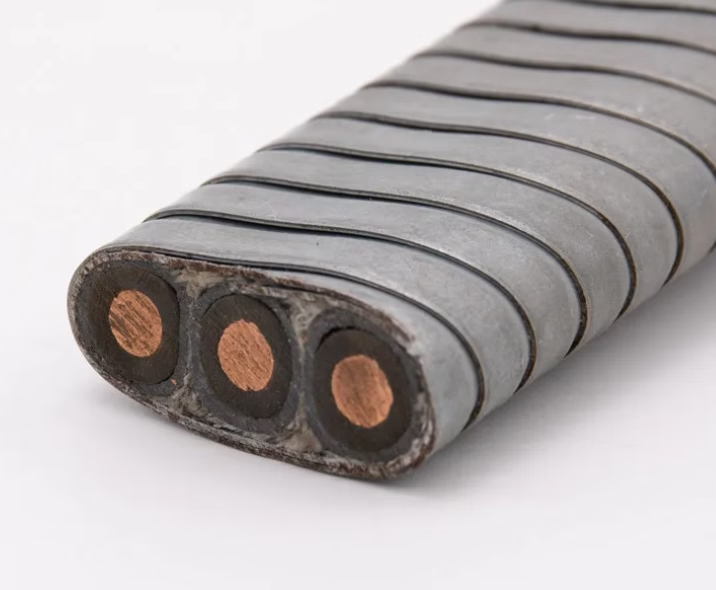
NSSHOU cable

Российская Федерация эксплуатирует ~200 действующих угольных шахт с подземной добычей, расположенных в пяти основных угольных бассейнах: Кузбасс (Кемеровская область, ~50% подземной добычи), Печорский бассейн (Республика Коми, ~15%), Донбасс (Луганская и Донецкая области, контролируемая часть), Южно-Якутский бассейн (Сахалин, малая доля), и экспортно-ориентированные шахты Сахалина. Суммарное потребление гибких электрических кабелей среднего напряжения 1.14–6.3kV в подземных выработках оценивается в 800–1 200 отрезков в год — производство сосредоточено на трёх заводах: Кольчугинский завод (Владимирская область), Камкабель (Пермь), и ЗАО «Уралкабель» (Екатеринбург). Логистическое плечо от центральных заводов до шахт Кузбасса составляет 3 500–4 500 км по железной дороге, добавляя 10–14 дней к сроку поставки. В критические периоды (предоплановые ремонты, аварийные замены) срок ожидания кабеля КГЭШ 1.14kV достигает 18–26 недель.

VDE 0250 Part 812 vs ГОСТ: Может ли (N)SSHÖU 1.14kV заменить российский КГЭШ 1.14kV в подземных угольных шахтах?Полное инженерно-закупочное руководство

Российская Федерация эксплуатирует ~200 действующих угольных шахт с подземной добычей, расположенных в пяти основных угольных бассейнах: Кузбасс (Кемеровская область, ~50% подземной добычи), Печорский бассейн (Республика Коми, ~15%), Донбасс (Луганская и Донецкая области, контролируемая часть), Южно-Якутский бассейн (Сахалин, малая доля), и экспортно-ориентированные шахты Сахалина. Суммарное потребление гибких электрических кабелей среднего напряжения 1.14–6.3kV в подземных выработках оценивается в 800–1 200 отрезков в год — производство сосредоточено на трёх заводах: Кольчугинский завод (Владимирская область), Камкабель (Пермь), и ЗАО «Уралкабель» (Екатеринбург). Логистическое плечо от центральных заводов до шахт Кузбасса составляет 3 500–4 500 км по железной дороге, добавляя 10–14 дней к сроку поставки. В критические периоды (предоплановые ремонты, аварийные замены) срок ожидания кабеля КГЭШ 1.14kV достигает 18–26 недель.
The (N)SSHÖU designation represents a family of European rubber-insulated cables designed and manufactured to German VDE standards, specifically VDE 0250-812. The designation encodes the cable's fundamental characteristics: flexible power transmission cable suitable for mining and industrial applications. The baseline European design is optimized for 0.6/1kV operation, representing the standard voltage rating for TN earthing systems prevalent throughout Europe and North America. (N)SSHÖU代表一系列欧洲橡胶绝缘电缆,按照德国VDE标准(特别是VDE 0250-812)设计和制造。该名称编码了电缆的基本特征:适合采矿和工业应用的灵活电力传输电缆。欧洲基线设计针对0.6/1kV运行进行了优化,代表了欧洲和北美普遍存在的TN接地系统的标准电压额定值。

Insulation Thickness Differences: How AS/NZS 1.1/1.1kV Modifies (N)SSHÖU Cable Structure

The (N)SSHÖU designation represents a family of European rubber-insulated cables designed and manufactured to German VDE standards, specifically VDE 0250-812. The designation encodes the cable’s fundamental characteristics: flexible power transmission cable suitable for mining and industrial applications. The baseline European design is optimized for 0.6/1kV operation, representing the standard voltage rating for TN earthing systems prevalent throughout Europe and North America. (N)SSHÖU代表一系列欧洲橡胶绝缘电缆,按照德国VDE标准(特别是VDE 0250-812)设计和制造。该名称编码了电缆的基本特征:适合采矿和工业应用的灵活电力传输电缆。欧洲基线设计针对0.6/1kV运行进行了优化,代表了欧洲和北美普遍存在的TN接地系统的标准电压额定值。
The (N)SSHÖU 3x50+3x25/3 1.1/1.1kV trailing cable represents far more than a simple voltage specification change from the standard European 0.6/1kV industrial flexible cable. When you examine New Zealand's mining, quarrying, and port operations, the environment is fundamentally different from European industrial applications. The country's open-cast mining sites experience extreme weather variations, high UV radiation, exposure to harsh corrosive mining chemicals, and require continuous mechanical durability in equipment that cannot afford operational downtime. New Zealand's electrical safety standards reflect this demanding reality through three core requirements. First, the nation's IT earthing system (isolated or high-resistance grounding) demands insulation rated for phase-to-earth voltage equal to phase-to-phase voltage (Uo = U), which necessitates the 1.1/1.1kV rating instead of 0.6/1kV. Second, the split symmetrical earth design with three individual 25mm² earth conductors placed symmetrically around the three 50mm² phase conductors provides unprecedented protection against unbalanced fault conditions that could otherwise result in lethal contact voltage hazards for equipment operators. Third, New Zealand's mining operations often involve long-distance power transmission—sometimes exceeding 800 meters from the surface substation to the underground working face—which creates severe voltage drop problems that cannot be adequately addressed by 0.6/1kV systems but are managed effectively by the higher 1.1/1.1kV rating. The (N)SSHÖU 3x50+3x25/3 1.1/1.1kV cable delivers a total weight of approximately 3550 kilograms per kilometer, carries a copper content of 1680 kg/km, maintains an ampacity of 182 amperes in free air at 30°C, features an outer diameter in the range of 42.0 to 47.0 millimeters, and is constructed from EPR rubber insulation with a heavy-duty CPE outer sheath specifically formulated to resist the abrasion, tearing, oil penetration, and ultraviolet degradation characteristic of New Zealand's unforgiving mining and quarry environments.

Voltage Upgrade: Why Replace Standard 0.6/1kV with (N)SSHÖU 3×50+3×25/3 1.1/1.1kV in New Zealand?

The (N)SSHÖU 3×50+3×25/3 1.1/1.1kV trailing cable represents far more than a simple voltage specification change from the standard European 0.6/1kV industrial flexible cable. When you examine New Zealand’s mining, quarrying, and port operations, the environment is fundamentally different from European industrial applications. The country’s open-cast mining sites experience extreme weather variations, high UV radiation, exposure to harsh corrosive mining chemicals, and require continuous mechanical durability in equipment that cannot afford operational downtime. New Zealand’s electrical safety standards reflect this demanding reality through three core requirements. First, the nation’s IT earthing system (isolated or high-resistance grounding) demands insulation rated for phase-to-earth voltage equal to phase-to-phase voltage (Uo = U), which necessitates the 1.1/1.1kV rating instead of 0.6/1kV. Second, the split symmetrical earth design with three individual 25mm² earth conductors placed symmetrically around the three 50mm² phase conductors provides unprecedented protection against unbalanced fault conditions that could otherwise result in lethal contact voltage hazards for equipment operators. Third, New Zealand’s mining operations often involve long-distance power transmission—sometimes exceeding 800 meters from the surface substation to the underground working face—which creates severe voltage drop problems that cannot be adequately addressed by 0.6/1kV systems but are managed effectively by the higher 1.1/1.1kV rating. The (N)SSHÖU 3×50+3×25/3 1.1/1.1kV cable delivers a total weight of approximately 3550 kilograms per kilometer, carries a copper content of 1680 kg/km, maintains an ampacity of 182 amperes in free air at 30°C, features an outer diameter in the range of 42.0 to 47.0 millimeters, and is constructed from EPR rubber insulation with a heavy-duty CPE outer sheath specifically formulated to resist the abrasion, tearing, oil penetration, and ultraviolet degradation characteristic of New Zealand’s unforgiving mining and quarry environments.
The German national standard DIN VDE 0250 covers cables, wires, and flexible cords for power installations. This standard has achieved global recognition as the definitive benchmark for tough rubber-sheathed flexible cables. Germany remains the only country to have issued specialized design regulations for flexible electrical cables covering cranes, material handling equipment, and mining machinery, which explains why DIN VDE 0250 is widely accepted internationally for demanding industrial applications. (德国国家标准DIN VDE 0250涵盖电力设施用电缆、电线和软线。该标准已成为坚固橡胶护套柔性电缆的全球公认基准。德国是唯一一个为起重机、物料搬运设备和采矿机械的柔性电缆发布专门设计规范的国家,这解释了为什么DIN VDE 0250在要求苛刻的工业应用中被国际广泛接受。)

DIN VDE 0250: Part 812 (Mobile Equipment) vs Part 813 (Mining & Industry)

The German national standard DIN VDE 0250 covers cables, wires, and flexible cords for power installations. This standard has achieved global recognition as the definitive benchmark for tough rubber-sheathed flexible cables. Germany remains the only country to have issued specialized design regulations for flexible electrical cables covering cranes, material handling equipment, and mining machinery, which explains why DIN VDE 0250 is widely accepted internationally for demanding industrial applications. (德国国家标准DIN VDE 0250涵盖电力设施用电缆、电线和软线。该标准已成为坚固橡胶护套柔性电缆的全球公认基准。德国是唯一一个为起重机、物料搬运设备和采矿机械的柔性电缆发布专门设计规范的国家,这解释了为什么DIN VDE 0250在要求苛刻的工业应用中被国际广泛接受。)
Abrasion resistance and tear strength are among the most critical mechanical properties to evaluate when selecting tunnelling cables and tunnel boring machine (TBM) cables. These cables are exposed to extremely harsh conditions including continuous friction with rocks and debris, repeated dynamic movement, and high mechanical stress, requiring sheath materials with superior abrasion and tear resistance. According to international testing standards such as ISO 34-1 for tear strength and DIN 53516 for abrasion resistance, proper assessment ensures that cables will perform reliably throughout their service life in demanding underground environments. The selection of appropriate sheath materials—whether TPU (Thermoplastic Polyurethane), PUR (Polyurethane Rubber), CPE (Chlorinated Polyethylene), or EPR (Ethylene Propylene Rubber)—directly impacts cable longevity, safety, and operational efficiency.

كيف تُقيّم مقاومة التآكل وقوة التمزق لاختيار كابلات الأنفاق؟

TPU cable sheath, thermoplastic polyurethane cable, PUR cable jacket, polyurethane rubber sheath, CPE cable jacket, chlorinated polyethylene sheath, EPR insulation cable, EPDM rubber cable, neoprene cable sheath, chloroprene rubber cable, XLPE insulated cable, rubber sheathed flexible cable, halogen free cable sheath, LSZH mining cable
Submersible and pump cables are specialized electrical cables designed for permanent operation underwater, connecting electrical motor equipment in both process and potable water applications. According to IEC standards and VDE specifications, these cables must demonstrate exceptional water resistance, flexibility under pressure, and chemical compatibility with their operating environment. The cables support diverse industries from food processing to water treatment, mining, and aquatic installations.

What are Submersible & Pump Cables?

(N)SHÖU O/J 0.6/1kV, NSSHÖU O/J 0.6/1kV, NSSHÖU 3E 0.6/1kV, NSSHÖU 3E + ST 0.6/1kV, (N)SSCHÖU-J 0.6/1kV, (N)TSCGECEWÖU 3.6/6kV, (N)TSCGECEWÖU 6/10kV, (N)TSCGECEWÖU 8.7/15kV, (N)TSCGECEWÖU 12/20kV (N)TSCGEWÖU 3.6/6kV, (N)TSCGEWÖU 6/10kV, (N)TSCGEWÖU 8.7/15kV, (N)TSCGEWÖU 12/20kV, H07RN-8-F (10m), Pump Cable 300 (300m), Drincable 600 (600m), Drincable 600 Flat (600m), Drincable 800 (800m)
Mining, drilling, and tunnelling cables represent the most demanding category of industrial cables, designed to operate in some of the harshest environments on earth. These heavy-duty power, control, and instrumentation cables serve mine operators worldwide for both static infrastructure and dynamic equipment applications. Manufactured in accordance with international standards including IEC 60502, BS EN 60332, BS EN 60811, BS EN 60754, and VDE 0295, mining cables must withstand mechanical stress, oil and grease exposure, water immersion, and in underground applications, provide critical fire safety through reduced smoke and fume emissions.

What are Mining, Drilling & Tunnelling Cables?

NSSHÖU cable, NSSHOU cable, NSHÖU cable, NSHOU cable, NSSCHOU cable, NSHTÖU cable, NTSCGEWÖU cable, NTSCGEWOU cable, NTMCGEWÖU cable, N3GHSSYCY cable, N3GHSSHCH cable,Type 61 cable, Type 63 cable, Type 611 cable, Type 622 cable, Type 633 cable, Type 66 cable,Type 240 cable, Type 241 cable, Type 245 cable, Type 450 cable, Type 455 cable, Type 260 cable, Type 275 cable, Type 409 cable, Type 440 cable, Type 441 cable,
H05RR-F Cable

What is H05RR-F Cable?

H05RR-F cables excel in underground mining environments where they serve as power supply conductors for mobile equipment and fixed installations. The constant movement of mining equipment creates significant abrasion challenges for trailing cables, requiring advanced polymer compounds with high abrasion indices and specialized insulation materials with superior flex memory[24]. These cables are specifically designed for coal cutters operating in cable chains (cable handlers) and similar face equipment, where they must withstand continuous flexing, mechanical stress, and exposure to moisture and dust.
R(N)TSCGEWOU

Mining Cable Applications: Extra Heavy Duty Solutions for Extreme Global Mining Conditions

Mining operations worldwide demand the most reliable and durable electrical cable solutions available. Extra heavy duty mining cables with specialized outer jackets have consistently exceeded performance expectations in the most severe mining conditions across Europe, North America, South America, Australia, and Asia, establishing themselves as the industry standard for stringent mining applications. These cables represent critical infrastructure components that power essential mining equipment from underground continuous miners to massive surface draglines, operating reliably in environments characterized by extreme mechanical stress, chemical exposure, moisture, and temperature variations.