Mining Cables

飞纯 Type 241 是基于 AS/NZS 1802:2003 卷筒与拖曳电缆 标准体系设计的矿用主馈电、泵电缆和电源供电电缆系列,电压范围覆盖 1.1 至 11KV。根据产品资料,该电缆适用于多种用途,包括连续采煤机主馈电电缆、泵电缆和电源供电电缆。 Type 241 的关键安全特征是 总半导电屏蔽。该结构能够在任何物体穿透护套后、尚未接触动力导体之前,先形成保护性接地接触。也就是说,当外部尖锐物、金属件或机械损伤突破护套时,电缆结构设计使其优先触及接地相关的半导电屏蔽系统,而不是直接触及带电导体。这一设计对于矿山连续采煤机、泵站和移动电源供电场景具有重要安全意义。

什么是中高压移动拖拽与卷筒电缆:(N)TSCGEWÖEU / (N)TSKCGEWÖEU / MCPTJ (N)TSCGECWOEU

(N)TSCGEWÖEU 把”卷筒、重型、屏蔽、橡胶、移动高柔、耐油、加强保护”的全部身份信息压进一串字母,再叠加材料代码(外护套 5GM5、绝缘 EPR 系橡胶)和电压等级(如 3.6/6 kV)。读这类长代码不要被字母数量吓住,抓主干即可:T 卷筒/移动、C 有屏蔽(说明是中压)、G 橡胶、Ö 耐油、U 加强保护。看到 C 就知道它带金属屏蔽、是中高压电场管理结构;看到 T/W 就知道它为移动卷筒设计。代号定结构骨架,精确的层数、屏蔽形式(分相屏蔽还是总屏蔽)、芯数截面、电压等级,仍要以厂家依据 DIN VDE 0250-813 出具的结构图和数据表为准。
飞纯 Type 441 是一种依据 AS/NZS 2802:2000 设计的 Class 2 矿用卷筒与拖曳电缆, 额定电压为 1.1/1.1KV。 该系列面向多种矿山移动供电用途。 与只强调拖曳或只强调卷筒运行的电缆不同, Type 441 明确适用于 拖曳应用和卷筒收放应用。 Type 441 在电缆中心设置一根可伸长 Pilot, 同时采用半导电 PCP 托架支撑三根动力线芯。 这一支撑结构有助于

什么是 NSSHÖU 低压重载矿用电缆:NSSHÖU-J / NSSHÖU-O / (N)SSHÖU

NSSHÖU 系列正是 5GM5 材料最经典的舞台。这是一族额定电压 0.6/1 kV 的低压重载矿用橡胶软电缆,专门应对露天矿山、隧道掘进等随时会被乱石砸击、被设备拉扯的极恶劣工况,遵循 DIN VDE 0250-812 标准。它的硬核之处在于:内部用 3GI3 高密度乙丙橡胶绝缘,内外护套强制双层都采用 5GM5 高强度橡胶。本文逐字母解码德国 DIN 型号体系,逐一解析带黄绿接地线的 NSSHÖU-J、不带接地线的 NSSHÖU-O,以及简写的 (N)SSHÖU
飞纯 Type 412 是依据 AS/NZS 2802:2000 标准体系设计的 1.1/1.1KV 矿用柔性铠装馈电电缆。 产品采用绿黄接地芯和可弯曲钢丝铠装, 主要用于存在较高机械损伤风险的矿山供电场景。 当电缆在砂矿作业区受到石块、机械设备、车辆、 拖拉、挤压或其他外部因素影响时,电缆损伤可能导致供电中断。 Type 412 设置可弯曲镀锌低碳钢丝铠装, 目的在于增强机械保护并减少因电缆损坏造成的高成本停机。 根据产品应用说明,Type 412 特别适合安装为 砂矿开采作业中的馈电电缆。 其结构兼顾柔性导体、电气绝缘、接地保护和金属铠装机械保护。

什么是 5GM5 重载橡胶电缆

5GM5 并不是聚氨酯(PUR)材质。在德国 VDE 0207-21 护套料标准体系中,PUR 的代码是 11Y(热塑性聚氨酯弹性体),而 5GM5 代表”特种重载合成橡胶/弹性体护套材料”,通常是高级特种氯丁橡胶(PCP/CR)或高性能氯化聚乙烯(CPE)的改性配方。二者材质不同,却常被放在一起对比——因为它们都是各自领域里抗撕裂、耐磨损、防油性最顶级的”硬核”存在。区别在于主场:PUR 统治高动态、高柔性、轻量场合;而 5GM5 统治大规格、中高压、极端重工业,如矿山、港口吊机、大吨位卷筒
飞纯 Type 241 Superflex 是基于 AS/NZS 1802:2003 卷筒与拖曳电缆 标准体系设计的矿用超柔性电缆,电压范围覆盖 1.1 至 6.6KV。它与 Type 241 电缆结构相似,但更加柔软,并具有更小的自然弯曲半径。 该系列特别适合作为 单轨吊电缆 使用。单轨吊系统中,电缆通常以环状方式悬挂或移动,如果电缆自然弯曲半径较大,电缆环会占用更多空间,也更容易与其他设备、支架或结构发生挂碰。Type 241 Superflex 通过更高柔性的导体和结构设计,使电缆环更窄,为其他设备留出更多空间,并减少电缆被挂住、刮碰或卡滞的机会。

什么是高弹性螺旋弹簧电缆:KPUR / PUR-Spiral、LiY11Y-HN、H07BQ-F Helix

聚氨酯(PUR)拥有一种其他材料难以企及的机械特性——弹性记忆力:被拉伸后能完美回弹、恢复原状而不松垮、不变形。正因如此,市面上 95% 以上的高端弹簧线都用 PUR 制造。这类螺旋(Spiral / Helix)电缆平时盘缩成紧凑的螺旋,需要时拉长伸展,用完自动缩回,专为”伸缩取电/取信号”的场景而生。本文逐一解析三种主力:通用型 KPUR / PUR-Spiral(手持扫描枪、仪器仪表)、重载拉伸的 LiY11Y-HN(卡车牵引头、物流输送线)、以及基于重型欧标结构的 H07BQ-F Helix(升降台、大型电动工具电源延伸)
飞纯 Type 441 Class 1 是依据 AS/NZS 2802:2000 设计的矿用卷筒与拖曳电缆, 覆盖 3.3KV、6.6KV、11KV 和 22KV 系列。 该系列适用于多种矿山机械和设备的移动供电, 既适合电缆随设备拖曳运行, 也适合通过卷筒进行反复收放。 Type 441 Class 1 配置一根中央可伸长 Pilot, 并采用半导电 PCP 托架支撑和保护三根动力线芯。 这一结构使动力芯在电缆受到挤压或压扁时不容易发生异常位移和内部损伤。

什么是 NSSHOEU / NTSWOEU 矿用潜水电缆(最高 6kV):橡套潜水泵电缆

Feichun NSSHOEU / NTSWOEU 是一类专为工业用水与矿井排水潜水泵设计的柔性橡套潜水电缆,额定电压覆盖 0.6/1 kV 至 3.6/6 kV。它采用第 5 类细绞镀锡铜导体、耐热 EPR 绝缘、GM1b 橡胶内护套与氯化橡胶外护套(0.6/1 kV 用 5GM5,中压用 5GM3),用于将岸上或井口配电与浸没在水中的电气运行设备连接起来。其中 3 芯无地芯结构是一项典型而关键的工程设计:当上升管(排水立管)本身可作为接地导体时,电缆省去独立地芯,从而减小外径、降低重量、便于盘绕与悬垂下放——这正是深井与矿坑排水场景下被反复验证的成熟做法。
飞纯 Type 209 是飞纯电缆基于 AS/NZS 1802:2003 卷筒与拖曳电缆 体系设计的矿用柔性馈电与拖曳电缆系列,电压范围覆盖 1.1 至 11KV。根据产品资料,Type 209 系列电缆主要作为矿山机械柔性馈电电缆使用,更适合作为拖曳电缆而不是高频卷筒电缆。较小规格适用于钻机、手持工具和移动设备。 这一定义是理解 Type 209 的关键。Type 209 不是普通工业橡套软电缆,也不只是单纯的矿山供电线。它的核心定位是 矿山机械柔性馈电电缆,也就是为矿山机械提供可移动、可拖曳、可适应复杂作业路径的供电系统。同时,它更适合作为 拖曳电缆,即跟随设备移动的电缆,而不是长期高频卷绕使用的卷筒电缆。

什么是 NSSHÖU …/3E + ST 0.6/1kV 重型柔性矿用电缆

NSSHÖU …/3E + ST 0.6/1kV 是一款为承受极高机械负荷的移动设备与机械供电而设计的重型橡套柔性电缆。它采用第5类镀锡软铜导体、EPR 3GI3 耐热绝缘、3E 螺旋分布式接地(或 KON 同心接地结构)、置于间隙中的 ST 控制芯、GM1b 橡胶内护套与 5GM5 氯化橡胶耐磨外护套。其核心定位是:在干燥与潮湿区域、户外以及防爆危险区域中——尤其是采矿、工业、采石场与建筑工地——为持续移动、拖拽、弯折与受冲击的设备提供既能传输动力、又能集成控制信号、且具备耐磨耐油阻燃能力的单一柔性电缆解决方案。
飞纯 Type 245 是基于 AS/NZS 1802:2003 卷筒与拖曳电缆 标准体系设计的矿用非常柔性长壁采煤机电缆,电压范围覆盖 1.1 至 6.6KV。根据产品资料,该电缆主要用作长壁采煤机电缆,也可用于连续采煤机和长壁外围电缆。 Type 245 的关键结构特征是 三根中央可伸长 Pilot / 控制芯线。这三根中央 Pilot 芯线可用于 接地连续性监测 和 控制回路。对于长壁采煤机来说,电缆不仅要传输动力电能,还要承担设备控制、保护联锁、接地连续性确认和移动工况下的安全监测任务。

什么是 NSSHOEU-O/J 0.6/1kV Heavy Duty Flexible Cable

NSSHOEU-O/J 0.6/1kV Heavy Duty Flexible Cable 是 Feichun 面向矿山、工业、采石场、建筑工地、户外、干燥和潮湿区域以及爆炸危险区域移动设备开发的重载柔性橡套电缆。资料说明,该电缆用于连接承受非常高机械负载的移动设备和机器,特别适用于 mining and industry、quarries and building sites。其核心结构包括 Class 5 柔性镀锡铜导体、耐热 EPR type 3GI3 绝缘、GM1b/5GM3 橡胶内护套和 PCP/CR type 5GM5 氯化橡胶外护套。
飞纯 Type 209 是飞纯电缆基于 AS/NZS 1802:2003 卷筒与拖曳电缆 体系设计的矿用柔性馈电与拖曳电缆系列,电压范围覆盖 1.1 至 11KV。根据产品资料,Type 209 系列电缆主要作为矿山机械柔性馈电电缆使用,更适合作为拖曳电缆而不是高频卷筒电缆。较小规格适用于钻机、手持工具和移动设备。 这一定义是理解 Type 209 的关键。Type 209 不是普通工业橡套软电缆,也不只是单纯的矿山供电线。它的核心定位是 矿山机械柔性馈电电缆,也就是为矿山机械提供可移动、可拖曳、可适应复杂作业路径的供电系统。同时,它更适合作为 拖曳电缆,即跟随设备移动的电缆,而不是长期高频卷绕使用的卷筒电缆。

什么是 (N)SSHOEU 0.6/1kV Heavy Duty Flexible Cable

(N)SSHOEU 0.6/1kV Heavy Duty Flexible Cable 是 Feichun 面向矿山、采石场、建筑工地、户外、干燥与潮湿区域以及爆炸危险区域移动设备开发的重载柔性橡套电缆。资料说明,该电缆用于连接承受非常高机械负载的移动设备和机器,尤其适用于 mining、quarries 和 building sites。其典型结构包括 Class 5 柔性铜导体、3GI3 橡胶绝缘、可选 pilot cores、镀锡铜丝螺旋接地导体、GM1b 橡胶内护套和 5GM5 橡胶外护套。
飞纯 Type 412 是依据 AS/NZS 2802:2000 标准体系设计的 1.1/1.1KV 矿用柔性铠装馈电电缆。 产品采用绿黄接地芯和可弯曲钢丝铠装, 主要用于存在较高机械损伤风险的矿山供电场景。 当电缆在砂矿作业区受到石块、机械设备、车辆、 拖拉、挤压或其他外部因素影响时,电缆损伤可能导致供电中断。 Type 412 设置可弯曲镀锌低碳钢丝铠装, 目的在于增强机械保护并减少因电缆损坏造成的高成本停机。 根据产品应用说明,Type 412 特别适合安装为 砂矿开采作业中的馈电电缆。 其结构兼顾柔性导体、电气绝缘、接地保护和金属铠装机械保护。

什么是 NSSHCGEOEU 0.6/1kV Coal Cutter Cable (Low Tensile Stress) 

NSSHCGEOEU 0.6/1kV Coal Cutter Cable (Low Tensile Stress) 是 Feichun 面向地下矿山采煤机和移动机械开发的低拉伸应力型采煤机电缆。资料说明,该电缆用于承受极高机械负载的移动机器,主要应用于矿山场景,例如 coal-cutting machines,尤其适合低拉伸应力下的极端弯曲负载。与高拉伸应力版本相比,低拉伸应力版本的结构重点从“铜钢丝编织抗拉铠装”转向“铜钢丝螺旋同心接地结构 + 玻纤带 + 外护套嵌入防移位设计”,更适合弯曲频繁但持续牵引张力较低的采煤机连接场景。
飞纯 Type 241 Superflex 是基于 AS/NZS 1802:2003 卷筒与拖曳电缆 标准体系设计的矿用超柔性电缆,电压范围覆盖 1.1 至 6.6KV。它与 Type 241 电缆结构相似,但更加柔软,并具有更小的自然弯曲半径。 该系列特别适合作为 单轨吊电缆 使用。单轨吊系统中,电缆通常以环状方式悬挂或移动,如果电缆自然弯曲半径较大,电缆环会占用更多空间,也更容易与其他设备、支架或结构发生挂碰。Type 241 Superflex 通过更高柔性的导体和结构设计,使电缆环更窄,为其他设备留出更多空间,并减少电缆被挂住、刮碰或卡滞的机会。

什么是 NSSHCGEOEU 0.6/1kV Coal Cutter Cable

NSSHCGEOEU 0.6/1kV Coal Cutter Cable (High Tensile Stress) 是 Feichun 面向地下矿山采煤机、移动机械、导向滑轮、电缆车以及 LHD 卷盘系统开发的高拉伸应力矿山电缆。资料说明,该电缆用于连接承受极高机械负载的移动机器,主要用于矿山场景,例如 coal-cutting machines;同时也可通过 guide pulleys / cable cars 运行,或作为 LHD reeling cable 使用,适合极端弯曲负载、高拉伸应力、冲击负载和压扁负载。
BASKET SPREADER 740 (YSLTOE) is engineered specifically for hoisting and control applications where mechanical flexibility and electrical reliability must coexist in marine environments. Unlike load-bearing structural cables (which prioritize tensile strength), control cables emphasize: Conductor flexibility – Repeated bending over pulleys without mechanical fatigue Insulation integrity – Voltage breakdown resistance under salt-fog corrosion Mechanical damping – Rope-like flexibility to drape naturally in spreader bar frames Environmental barrier – Outer sheath blocks salt, moisture, and UV penetration Core Design Elements: Component Material Specification Function Port Environment Benefit Conductor Flexible red copper Class 6 (IEC 60228) Carries 300/500V power; enables bending flexibility High purity copper resists galvanic corrosion Insulation PVC type YI2 (IEC 60811) Electrical isolation; voltage breakdown resistance (2 kV test) PVC with marine additives prevents salt-induced tracking Central Unit Aramide yarns (Kevlar™ equivalent) Mechanical load-bearing backup; structural integrity Aramide resists moisture & salt; absorbs vibration stress Outer Sheath PUR type 11YM1 (DIN 73377) Environmental barrier; UV/ozone/moisture protection Superior salt-fog resistance; 20+ year marine lifespan

什么是 PANZERFLEX-ELX MV + Fiber Optic from 3,6/6 to 12/20 kV:矿山与港口中压动力光纤复合卷筒电缆技术解析

PANZERFLEX-ELX MV + Fiber Optic 所代表的是一种将中压动力传输、光纤数据传输和高动态机械寿命集成在同一电缆系统中的技术架构。它面向矿山、港口散料搬运、堆取料机、岸桥、集装箱起重机、挖掘机与拖令系统,重点解决卷筒收放中的反复弯曲、扭转、拉伸、加速度、护套磨耗、油污、潮湿与电磁干扰问题。
DS1N (also designated UNE 22513-1) represents an evolved generation of mining cable technology designed specifically for environments where electromagnetic interference (EMI) and signal integrity are as critical as mechanical durability. The standard specifies cables that combine the proven mechanical robustness of UNE 22511/22512 designs with the electromagnetic shielding technology required for control systems, signal circuits, and power distribution in complex underground installations. The defining characteristic of DS1N is the integration of a metal braid shield — typically tinned copper wire woven at high density around the cable core — combined with a symmetric earth architecture (3×S1 + 3×S2 distribution) that provides both electrical protection and mechanical balance. This combination addresses a critical operational requirement in modern mining: reducing noise and crosstalk in environments where control signals must coexist with high-power switching equipment, variable frequency drives, and long distribution runs to remote equipment.

什么是 FG7ORPu-TUNNELFLEX 0,6/1kV:矿山与隧道移动设备高柔性抗拉耐磨电缆技术解析

FG7ORPu-TUNNELFLEX 0,6/1kV 是一种面向矿山、隧道及高机械损伤风险移动设备供电的低压动力电缆。它的核心设计目标不是单纯“通电”,而是在移动供电、卷筒收放、单平面偏转、牵引张力、摩擦磨损、潮湿水解环境和现场冲击同时存在的工况下,保持导体柔性、绝缘稳定、护套耐磨和系统供电连续性。对于矿山设备、隧道掘进配套机械、移动泵站、输送系统、移动配电设备以及港口和重载工程现场的移动供电设计人员而言,这类电缆的价值在于把电气安全、机械寿命和现场可维护性放在同一个结构体系内解决。
H07RN-F: Advanced High-Flexibility Salt-Fog Resistant Port Cable Engineering Solution Specialized rubber-sheathed electrical cable engineered for extreme maritime and coastal port environments. H07RN-F combines superior mechanical flexibility (4×D minimum fixed-laying bending radius, 6×D flexible-application capability) with comprehensive salt-fog environmental resistance, enabling reliable 450/750V power distribution and control signaling in container gantry systems, ship loaders, and port automation infrastructure where conventional cables fail within 6–12 months of deployment.

Technical Data для mining и tunnelling cables: буквенная кодировка, свойства материалов, радиусы изгиба, сопротивление, токовая нагрузка и причины отказов

Этот технический раздел объединяет letter coding of cable types, механические свойства изоляционных и оболочечных материалов по DIN VDE 0207, минимальные радиусы изгиба, сопротивление и токовые нагрузки проводников mining cables, корректирующие коэффициенты температуры, причины отказов tunnelling cables, типовые ошибки splice / termination и правила обращения с кабельными барабанами.
DS1N (also designated UNE 22513-1) represents an evolved generation of mining cable technology designed specifically for environments where electromagnetic interference (EMI) and signal integrity are as critical as mechanical durability. The standard specifies cables that combine the proven mechanical robustness of UNE 22511/22512 designs with the electromagnetic shielding technology required for control systems, signal circuits, and power distribution in complex underground installations. The defining characteristic of DS1N is the integration of a metal braid shield — typically tinned copper wire woven at high density around the cable core — combined with a symmetric earth architecture (3×S1 + 3×S2 distribution) that provides both electrical protection and mechanical balance. This combination addresses a critical operational requirement in modern mining: reducing noise and crosstalk in environments where control signals must coexist with high-power switching equipment, variable frequency drives, and long distribution runs to remote equipment.

(N)TSCGECWÖU – TBM: средневольтный reeling power supply cable для Tunnel Boring Machines и подземного тоннельного строительства

(N)TSCGECWÖU – TBM — это кабель для Tunnel Boring Machines, предназначенный для reeling power supply и применения в underground mines for tunnel constructions. По предоставленным данным он имеет гибкие лужёные медные проводники DIN VDE 0295 Class 5, 3GI3 EPR insulation, внутренний и наружный полупроводящие слои для electrical field control, PE-структуру из tinned copper / textile braiding вокруг каждой power core, контрольные жилы, overall concentric copper monitoring conductor, GM1b inner sheath и красную наружную оболочку 5GM5.
La vida útil de los cables móviles de carrete, festón y canasta depende, en gran medida, de la instalación y del diseño del sistema de enrollado. Este manual abarca radios de curvatura, guías, protección de tensión, anclaje, selección de carrete y eliminación de torsión, junto con los métodos eléctricos de capacidad de corriente, reducción (derating), caída de tensión y cortocircuito.

Cables de CarreteManual Técnico

La vida útil de los cables móviles de carrete, festón y canasta depende, en gran medida, de la instalación y del diseño del sistema de enrollado. Este manual abarca radios de curvatura, guías, protección de tensión, anclaje, selección de carrete y eliminación de torsión, junto con los métodos eléctricos de capacidad de corriente, reducción (derating), caída de tensión y cortocircuito.
FLEXIFESTOON® SEOOW YELLOW represents FeiChun's entry into the low-voltage festoon and temporary power market. The nomenclature requires careful explanation to distinguish this product from the high-voltage FLEXIDRUM series: FLEXIFESTOON Product Nomenclature: FLEXIFESTOON® = Product family name Flex = Flexible (emphasis on bending & handling) Festoon = Strung overhead in continuous runs (typical festoon lighting application) SEOOW = Industry-standard designation S = Service cord (temporary, not permanent installation) E = Elastomer jacket (flexible sheath) OO = Oil-resistant conductor insulation (TPE qualifies as oil-resistant) W = Weather-resistant sheath (water, ozone, UV resistant) SEOOW is defined in: UL 62 (Standard for Flexible Cords and Cables) CSA 22.2 No. 49 (Canadian equivalent) NFPA 70 National Electrical Code (NEC) Article 400 YELLOW designation: Color: RAL 1021 (traffic yellow, high visibility) Safety significance: Yellow cords attract attention in job sites Practical purpose: Easy to identify, prevent trips/entanglement Contrast with FLEXIDRUM series: FLEXIDRUM (High-Voltage MV Cable): Voltage: 3.6 kV to 20/35 kV (power distribution) Temperature: −40 to +80°C (standard industrial) Application: Mobile mining/tunneling equipment (capital-intensive) Size: Large diameter, heavy (3–12 kg/km) FLEXIFESTOON (Low-Voltage Service Cord): Voltage: 600V (light/power temporary use) Temperature: −60 to +105°C (extreme environmental range) Application: Festoon lighting, temporary site power, outdoor events Size: Small diameter, lightweight (0.05–0.3 kg/m) Cost: Consumer/contractor-grade (not specialty industrial)

AS/NZS 1972 Mining Cable | Flexible & Tough | ATEX/IECEx | For Australian Mine Sites

Comprehensive mining cable engineering with flexible design and hazardous area compliance for Anhui Feichun Special Cable Co., Ltd. AS/NZS 1972 mining cables engineered for Australian and New Zealand mining operations including open-pit mining, underground mining, coal mines, metal extraction, and hazardous area Zone 1/2 deployment requiring simultaneous electrical power distribution, mechanical flexibility, impact resistance, chemical durability, fire safety, and explosion-proof integration. AS/NZS 1972 certified mining cables delivering proven field-validated performance combining flexible Class 5 stranded copper conductors (1.5–50mm²), EPR insulation (90°C continuous), impact-resistant outer sheath, and comprehensive ATEX/IECEx certification. Validated through 320+ mining equipment installations across Australian and New Zealand mines with 20+ year field longevity in extreme mining environments.
Marine & Port Drag Cable — High-Flexibility Saltwater-Resistant System A comprehensive engineering dissection of heavy-duty marine drag cables for port equipment, container terminals, and offshore platforms — from conductor architecture and EPR insulation to steel wire armour (M2) design rationale, galvanic corrosion protection mechanisms, environmental compliance, and validated performance benchmarking against Nexans Eproneo Port and Prysmian marine systems.

NSSHÖU Heavy-Duty | Mining Rated | VDE 0250 | EAC Ex & GOST Fire | Russia Export

A comprehensive technical and commercial reference for NSSHÖU heavy-duty tear-resistant rubber mining cable from Anhui Feichun Special Cable Co., Ltd., established as a purpose-built mining cable engineered specifically to meet the demanding requirements of Russian Federation underground and opencast mining operations. This document establishes NSSHÖU as the specified cable choice for Russian mining equipment manufacturers integrating cables into rope-shovels, draglines, bucket-wheel excavators, surface drilling equipment, and underground haulage systems destined for domestic Russian operations and international mining machinery supply chains. The document confirms complete compliance with VDE 0250 mining cable standards, EAC Ex certification for equipment operating in underground explosive-gas atmospheres, GOST 12176-77 flame-propagation validation, and procurement advantages including immediate availability, cost-competitive pricing, rapid delivery timelines, and proven long-term field reliability across major Russian coal mines, ore mines, and heavy industrial mining operations spanning more than twenty years of continuous operational deployment.
AS/NZS 1802 (Australian/New Zealand Standard 1802) establishes the technical requirements for flexible mining cables used in underground and open-pit mining operations across Australia, New Zealand, and the broader Pacific region. Type 241 within this standard designates unarmoured flexible power cables rated at 0.6/1 kV with a Class 5 copper conductor, suitable for mobile mining equipment and drag cable applications. The standard was initially published in 1993 and has been progressively updated (most recently 2019) to incorporate advances in materials science and safety requirements. AS/NZS 1802 Type 241 employs a single-core earth architecture: the cable contains one dedicated protective earth conductor of specified cross-section, positioned at a fixed location within the cable cross-section (typically at the "6 o'clock" position relative to the three phase conductors at 12, 4, and 8 o'clock). This single-core design reflects a pragmatic engineering philosophy: the earth conductor is sized to carry fault currents, provide equipotential grounding for equipment frames, and enable protective relay operation in the event of phase-to-frame faults.

(N)TSCGEWÖU с оптоволокном 重型卷筒防爆方案:VDE 0250 结合 EAC/ATEX 全套资质

為採礦設備工程師、礦山電氣設計師、EPC項目規劃人員及礦用設備製造商開發的專業技術參考資料。本文檔詳細闡述飛純特種電纜在高強度採礦應用中的核心設計原理、雙層反向阿拉米德編織結構如何對抗扭轉與磨損、以及飛純礦山電纜在採礦絞盤、露天採礦運輸、長壁綜采系統與移動式挖掘設備上的實際表現對標。特別針對俄羅斯與歐亞經濟聯盟(EAEU)市場的VDE 0250 + EAC/ATEX防爆認證方案進行深度說明。
GAALFLEX® CONTROL 600 PVC: UL/CSA Certified Multi-Core Control Cable for North American Industrial Applications with Comprehensive 2–50 Core Standardization and Complete 0.5–70 mm² Cross-Section Coverage (UL 1000V / CSA 1000V Nominal Voltage [600V Option Available], 3 kV Test Voltage per DIN VDE 0281 Part 2 + HD 21.2, Compact 4×D Fixed-Laying Bending Radius Enabling Tight Equipment Routing Through Industrial Enclosures and Control Panels, Comprehensive 2–50 Multi-Core Portfolio with 0.5–70 mm² Continuous Cross-Section Range Enabling Single-Product Specification Across All Industrial Control Applications, Flexible Class 5 Red Bare Copper per IEC 60228 and DIN VDE 0295, GAALTHERM® 521 Insulation and Grey (RAL 7001) GAALTHERM® 521 Outer Sheath Engineered for North American Industrial Environments, Oil-Resistant Chemistry per DIN EN 50290-2-22 / VDE 0819-102 TM54 Enabling Safe Deployment in Oil-Exposed Areas and Industrial Machine Environments, UL VW-1 and CSA FT1 Flame-Retardant Certification Providing Professional-Grade Fire Safety, Plus IEC 60332-1-2 and IEC 60332-3-24 Enhanced Flame Testing, Black EN 50334 Numbered Cores (2–5 Cores) or DIN VDE 0293-308 Color-Coded Cores (from 6 Cores) plus Green-Yellow Earth Protection (from 3 Cores) Enabling Standard Wiring Without Reference Documentation, Temperature Range −40 to +90°C Fixed Installation / −5 to +90°C Non-Continuously Flexible Deployment Optimized for Industrial Climate Variations, North American UL AWM Style Certification (21179 for 90°C/1000V or 105°C/1000V, or Style 2587 for 90°C/600V) Enabling Direct Acceptance in North American Equipment and Control Systems, RoHS and CE Certification, Engineered for North American Industrial Plant Electrical Distribution, Equipment Interconnection Systems, Industrial Automation Control Circuits, Heavy Manufacturing Facilities, Chemical Plant Installations, and Applications Where UL/CSA Certification, Comprehensive Multi-Core Standardization, Oil Resistance, and Professional Industrial Reliability Are Operational Requirements)

Что такое Nexans PANZERFLEX? Почему этот кабель доминирует в портах мира

Nexans PANZERFLEX** — это серия **плоских высоковольтных кабелей**, разработанная французской компанией Nexans (бывшая немецкая компания Pirelli, позже приобретена Nexans) для портовых и промышленных приложений. PANZERFLEX название произошло от немецкого слова “Panzer” (танк, броня) + “Flex” (гибкий) — что означает **гибкий, но защищенный кабель**. **Доминирование PANZERFLEX**: — Используется в более чем **70% портов мира** (Роттердам, Гамбург, Шанхай, Сингапур, Дубай, Los Angeles и т.д.) — Стандарт для **STS контейнерных кранов**, мостовых систем, портальных кранов — Признан как **”золотой стандарт”** для портовых приложений — Поддерживается всеми крупными производителями кранов (Liebherr, ZPMC, Kone, Demag и т.д.) **Причины доминирования**: — **Репутация**: Nexans — крупная международная компания, история надежности — **Доступность**: Долгое время не было реальной конкуренции — **Стандартизация**: Инженеры портов знают PANZERFLEX; они используют его по привычке — **Сертификация**: PANZERFLEX сертифицирована по всем международным стандартам
FLEXIDRUM® R 902 Optical Fiber Hybrid Cable: Integrated Power-Plus-Fiber-Optics Multi-Core Cable for Mining Excavators and Real-Time Data Transmission Revolutionary hybrid power-and-optical-fiber cable engineered for mining excavators and outdoor industrial equipment, FLEXIDRUM® R 902 integrates 6-fiber optics (multimode 62.5/125µm) with Class 5 flexible red copper power conductors (up to 3×300 mm²), advanced EPR insulation, semi-conductive protective layers, and specialized UV/ozone/moisture-resistant PUR sheath. Rated for 3.6/6 kV to 12/20 kV deployment, featuring 120 m/min speed capability with reduced weight and diameter—enabling real-time data communication from excavators, loaders, and remote mining equipment while maintaining full electrical power distribution in one unified integrated cable system.

Ищете Nexans PANZERFLEX? FEICHUINFLEX — Полный 100% Аналог

**Nexans PANZERFLEX** — это **премиум-класс портового и採矿 кабеля**, разработанный французской компанией Nexans в конце 1990х годов. “PANZERFLEX” буквально переводится с немецкого как “бронированный гибкий” — что отражает главную особенность: кабель имеет **защитную броню** (обычно медные или стальные спирали вокруг сердечника), которая обеспечивает экстраординарную прочность и защиту от механических повреждений. **История развития**: Nexans (штаб-квартира в Париже, Франция) в 1998 году запустила проект разработки **премиум-класса** портового кабеля, который бы превосходил существующие стандарты по надежности, долговечности и производительности. Результат был **PANZERFLEX** — кабель, который стал **стандартом для портов мира** в течение следующих 20+ лет. **Почему “премиум”?** PANZERFLEX — это не просто надежный кабель; это **инженерный шедевр**, разработанный для: — Экстремальной механической прочности (броня защищает от раздавливания) — Долгого срока службы (до 15–20 лет в портовых условиях) — Нулевых отказов (Nexans гарантирует, что кабель не сломается в портовой операции) — Глобальной совместимости (PANZERFLEX установлен в портах от Шанхая до Роттердама) **Текущее доминирование**: По состоянию на 2026 год, PANZERFLEX установлен примерно в **80% новых портовых проектов** и операций обновления оборудования в мире. Это включает мегапорты Шанхая, Дубая, Роттердама, Сингапура, и практически все крупные операции採矿 в России, Африке и Австралии.
High-Flexibility Salt-Fog Resistant Port Cables: Advanced Technical Comparison and Deployment Analysis Comprehensive technical evaluation of power cable solutions for maritime port infrastructure, analyzing electrochemical corrosion protection mechanisms, deployment flexibility specifications, and extended service-life performance in harsh saltwater environments. Detailed comparison of specialized Feichun salt-fog resistant EPR-insulation platform with FLEXIDRUM® FIBER 770 optical cable architecture, examining application-specific advantages, technical limitations, and engineered solutions for dredging equipment, submersible pump systems, floating crane operations, and integrated port automation infrastructure.

FLEXIDRUM®FIBER 770

High-Flexibility Salt-Fog Resistant Port Cables: Advanced Technical Comparison and Deployment Analysis Comprehensive technical evaluation of power cable solutions for maritime port infrastructure, analyzing electrochemical corrosion protection mechanisms, deployment flexibility specifications, and extended service-life performance in harsh saltwater environments. Detailed comparison of specialized Feichun salt-fog resistant EPR-insulation platform with FLEXIDRUM® FIBER 770 optical cable architecture, examining application-specific advantages, technical limitations, and engineered solutions for dredging equipment, submersible pump systems, floating crane operations, and integrated port automation infrastructure.
FLEXIDRUM® MEDIUM FLAT: Advanced High-Flexibility Salt-Fog Resistant Port Cable System Specialized reeling-flat power cable engineered for extreme maritime environments combining flexible tinned copper conductors (IEC 60228 Class 5), proprietary EPR insulation chemistry, hydrophobic semi-conductive interfaces, and specialized red outer-sheath PCP compound with integrated volatile-corrosion-inhibitor (VCI) technology. Designed for rapid cable-reel deployment systems in dredging, submersible pump, and floating crane applications requiring superior electrochemical corrosion immunity and compact outer-diameter efficiency across 3.6/6 kV through 8.7/15 kV voltage platforms.

FLAT (N)TSFLCGCWOEUS Reeling flat cables

FLEXIDRUM® MEDIUM FLAT: Advanced High-Flexibility Salt-Fog Resistant Port Cable System Specialized reeling-flat power cable engineered for extreme maritime environments combining flexible tinned copper conductors (IEC 60228 Class 5), proprietary EPR insulation chemistry, hydrophobic semi-conductive interfaces, and specialized red outer-sheath PCP compound with integrated volatile-corrosion-inhibitor (VCI) technology. Designed for rapid cable-reel deployment systems in dredging, submersible pump, and floating crane applications requiring superior electrochemical corrosion immunity and compact outer-diameter efficiency across 3.6/6 kV through 8.7/15 kV voltage platforms.
FLEXIDRUM® MEDIUM SHD GC: Advanced Flexible Power Cable for Mobile Mining and Industrial Equipment Comprehensive technical engineering guide to FLEXIDRUM® MEDIUM SHD GC (2 kV to 25 kV AC power distribution cable), purpose-engineered for flexible installation on cable-reel systems, mobile mining equipment, longwall miners, loaders, drills, shovels, conveyors, pumps, and industrial machinery requiring simultaneous power delivery, ground conductor functionality, and ground-check monitoring across demanding extraction and materials-handling environments.

SHD GC Cable ICEA S-75-381 or CSA C22.2 No. 96-17

FLEXIDRUM® MEDIUM SHD GC: Advanced Flexible Power Cable for Mobile Mining and Industrial Equipment Comprehensive technical engineering guide to FLEXIDRUM® MEDIUM SHD GC (2 kV to 25 kV AC power distribution cable), purpose-engineered for flexible installation on cable-reel systems, mobile mining equipment, longwall miners, loaders, drills, shovels, conveyors, pumps, and industrial machinery requiring simultaneous power delivery, ground conductor functionality, and ground-check monitoring across demanding extraction and materials-handling environments.
现代割吸挖泥船和潜水泵系统日益采用复杂的强制导向电缆路由配置,其中电缆部署必须适应多方向偏转(水平和垂直弯曲同时)、高部署速度(150-200 m/min运行范围)、以及锚地迁移周期期间由卷轴轴旋转惯性施加的动态扭转应力。常规高柔性电缆(非专化防旋转架构)遭遇关键运行局限:电缆绞合不平衡在快速部署中产生螺旋旋转扭矩,导致电缆扭转积累和操作员控制的手动反扭转循环,中断挖泥生产力并在卷轴处理期间引入安全危害。此外,不受控制的电缆扭转诱发导体绞合中的永久微变形和绝缘压缩,加速疲劳裂纹和提前服役寿命故障。 FLEXIDRUM® MEDIUM RS防旋转变体代表对这些部署约束的专化工程响应,集合合成纤维防旋转矩阵(S-玻璃纤维或芳纶复合加强)在电缆结构内集中铺设于内部PCP护套和外部专化PCP复合体之间。这个支撑屏障架构直接解决旋转扭矩机制:合成纤维矩阵抵抗否则会产生旋转扭矩的螺旋绞合几何,维持电缆中性扭转条件贯穿部署周期。现场验证跨北海、中东和东南亚挖泥设施记录了显著运营改进:消除手动反扭转需求、20-30%锚地迁移周期时间减少,以及通过扭转诱发疲劳机制消除延长服役耐久性。

(N)TSCGEWÖU:高速强制导向挖泥船防旋转电缆

现代割吸挖泥船和潜水泵系统日益采用复杂的强制导向电缆路由配置,其中电缆部署必须适应多方向偏转(水平和垂直弯曲同时)、高部署速度(150-200 m/min运行范围)、以及锚地迁移周期期间由卷轴轴旋转惯性施加的动态扭转应力。常规高柔性电缆(非专化防旋转架构)遭遇关键运行局限:电缆绞合不平衡在快速部署中产生螺旋旋转扭矩,导致电缆扭转积累和操作员控制的手动反扭转循环,中断挖泥生产力并在卷轴处理期间引入安全危害。此外,不受控制的电缆扭转诱发导体绞合中的永久微变形和绝缘压缩,加速疲劳裂纹和提前服役寿命故障。 FLEXIDRUM® MEDIUM RS防旋转变体代表对这些部署约束的专化工程响应,集合合成纤维防旋转矩阵(S-玻璃纤维或芳纶复合加强)在电缆结构内集中铺设于内部PCP护套和外部专化PCP复合体之间。这个支撑屏障架构直接解决旋转扭矩机制:合成纤维矩阵抵抗否则会产生旋转扭矩的螺旋绞合几何,维持电缆中性扭转条件贯穿部署周期。现场验证跨北海、中东和东南亚挖泥设施记录了显著运营改进:消除手动反扭转需求、20-30%锚地迁移周期时间减少,以及通过扭转诱发疲劳机制消除延长服役耐久性。
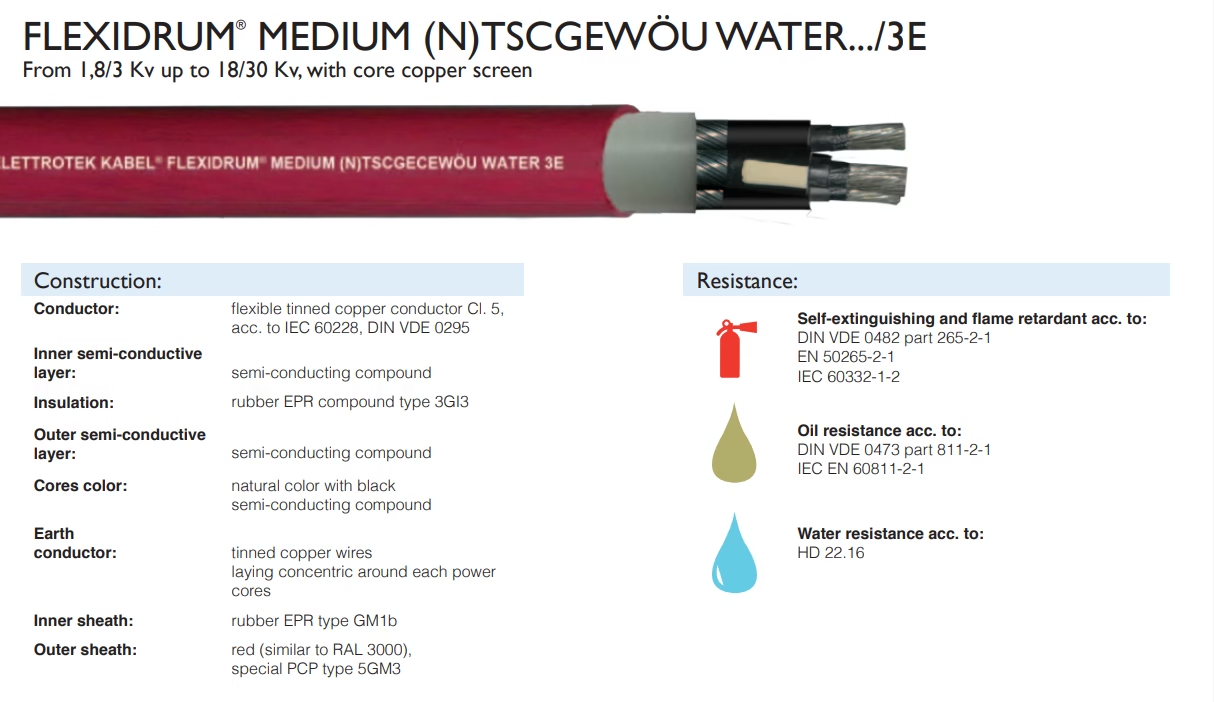
FLEXIDRUM® MEDIUM (N)TSCGEWÖU WATER /3E: Professional Shielded Submersible Cable with Integrated Core Copper Screen for Dredgers, Pumps, VFD Systems, and Electromagnetic Noise-Sensitive Water Infrastructure Purpose-engineered shielded submersible cable combining advanced water-submersion protection with electromagnetic noise immunity. FLEXIDRUM® MEDIUM (N)TSCGEWÖU WATER /3E integrates core copper screen shielding laid concentrically around power conductors, Class 5 tinned copper conductors (IEC 60228), advanced EPR insulation, and specialized water-resistant outer sheath (PCP Type 5GM3) to achieve 15+ year service life in demanding dredger systems, submersible pump installations, and VFD-controlled water infrastructure where electrical reliability and electromagnetic compatibility converge with water-submersion durability requirements. Executive Summary: Integrated Shielding and Water-Submersion Engineering for Next-Generation Dredging Systems Modern dredging and submersible pump systems increasingly employ variable-frequency drive (VFD) motor control and sophisticated sensor networks, creating electromagnetic environment incompatible with conventional unshielded cables. Simultaneously, VFD switching frequencies (5–20 kHz) generate high-frequency noise coupling into unshielded power circuits, causing sensor errors, control circuit malfunctions, and safety system failures. FLEXIDRUM® MEDIUM (N)TSCGEWÖU WATER /3E represents a breakthrough in submersible cable engineering, integrating comprehensive copper screen shielding with water-submersion durability to address the convergence of electromagnetic noise immunity and continuous water-immersion requirements. Traditional submersible cables lack electromagnetic shielding entirely, accepting noise-induced failures as operational cost in VFD-driven systems. Conversely, conventional shielded marine cables deteriorate rapidly in water-submersion environments, with shielding effectiveness degrading within 2–4 years as moisture penetrates underlying insulation and corrosion attacks copper screen geometry. FLEXIDRUM® MEDIUM (N)TSCGEWÖU WATER /3E overcomes both limitations through revolutionary integrated design: core copper screen shielding laid concentrically around each power conductor providing continuous EMI/RFI attenuation (>60 dB typical across 50 Hz to 10 MHz frequency range), tinned copper screen construction enabling superior electrochemical corrosion resistance in water-submersion environments, and water-resistant outer sheath (PCP Type 5GM3) maintaining shielding integrity through 15+ years of continuous seawater/brackish-water immersion.

(N)TSCGEWÖU WATER…/3E

FLEXIDRUM® MEDIUM (N)TSCGEWÖU WATER /3E: Professional Shielded Submersible Cable with Integrated Core Copper Screen for Dredgers, Pumps, VFD Systems, and Electromagnetic Noise-Sensitive Water Infrastructure Purpose-engineered shielded submersible cable combining advanced water-submersion protection with electromagnetic noise immunity. FLEXIDRUM® MEDIUM (N)TSCGEWÖU WATER /3E integrates core copper screen shielding laid concentrically around power conductors, Class 5 tinned copper conductors (IEC 60228), advanced EPR insulation, and specialized water-resistant outer sheath (PCP Type 5GM3) to achieve 15+ year service life in demanding dredger systems, submersible pump installations, and VFD-controlled water infrastructure where electrical reliability and electromagnetic compatibility converge with water-submersion durability requirements. Executive Summary: Integrated Shielding and Water-Submersion Engineering for Next-Generation Dredging Systems Modern dredging and submersible pump systems increasingly employ variable-frequency drive (VFD) motor control and sophisticated sensor networks, creating electromagnetic environment incompatible with conventional unshielded cables. Simultaneously, VFD switching frequencies (5–20 kHz) generate high-frequency noise coupling into unshielded power circuits, causing sensor errors, control circuit malfunctions, and safety system failures. FLEXIDRUM® MEDIUM (N)TSCGEWÖU WATER /3E represents a breakthrough in submersible cable engineering, integrating comprehensive copper screen shielding with water-submersion durability to address the convergence of electromagnetic noise immunity and continuous water-immersion requirements. Traditional submersible cables lack electromagnetic shielding entirely, accepting noise-induced failures as operational cost in VFD-driven systems. Conversely, conventional shielded marine cables deteriorate rapidly in water-submersion environments, with shielding effectiveness degrading within 2–4 years as moisture penetrates underlying insulation and corrosion attacks copper screen geometry. FLEXIDRUM® MEDIUM (N)TSCGEWÖU WATER /3E overcomes both limitations through revolutionary integrated design: core copper screen shielding laid concentrically around each power conductor providing continuous EMI/RFI attenuation (>60 dB typical across 50 Hz to 10 MHz frequency range), tinned copper screen construction enabling superior electrochemical corrosion resistance in water-submersion environments, and water-resistant outer sheath (PCP Type 5GM3) maintaining shielding integrity through 15+ years of continuous seawater/brackish-water immersion.
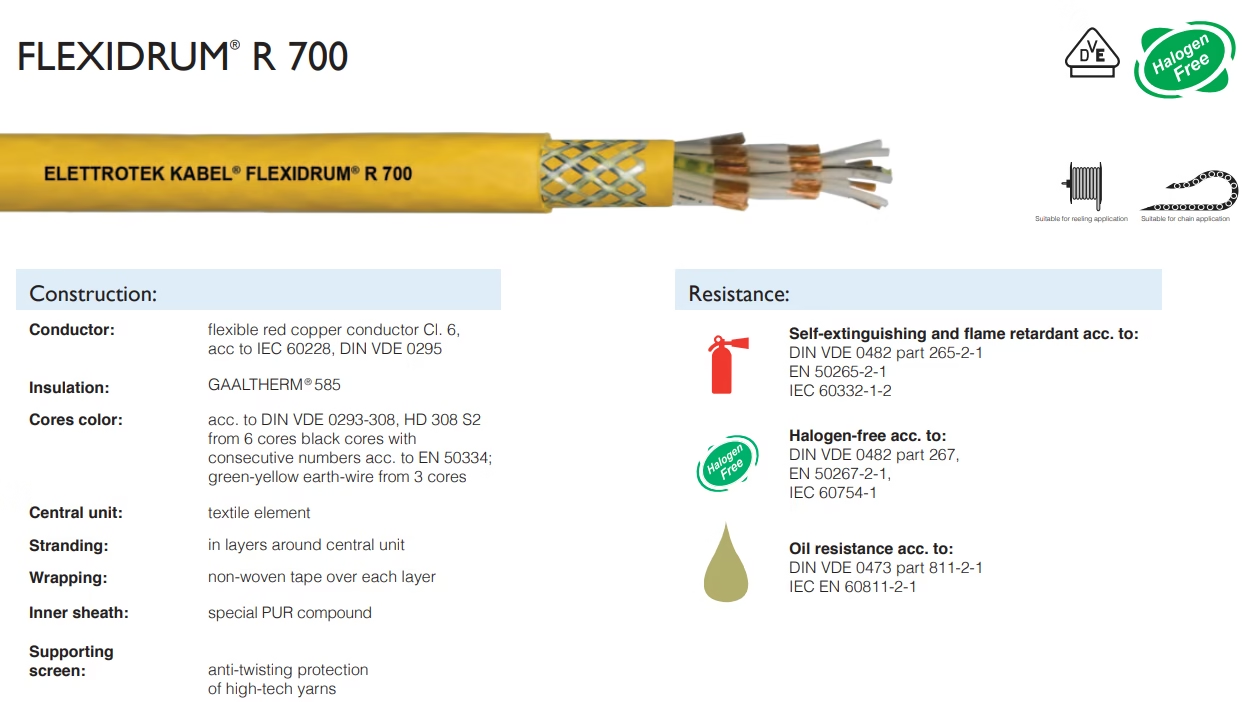
FLEXIDRUM® R 703: Advanced High-Temperature Industrial Multi-Core Cable for Extreme-Heat Heavy Equipment and Vertical Lifting Systems Engineered for the most demanding industrial thermal environments, the FLEXIDRUM® R 703 delivers breakthrough high-temperature performance with continuous operation capability to +120°C. Combining Class 5 flexible red copper conductor, advanced GAALTHERM® 585 thermoplastic elastomer insulation with extreme thermal resilience, aramide yarn anti-twisting reinforcement, and specialized PUR outer sheath formulation—meeting all fire-safety and halogen-free standards while maintaining electrical performance across the widest thermal envelope (−40 to +120°C) available in industrial cable engineering.

FLEXIDRUM® R 703

FLEXIDRUM® R 703: Advanced High-Temperature Industrial Multi-Core Cable for Extreme-Heat Heavy Equipment and Vertical Lifting Systems Engineered for the most demanding industrial thermal environments, the FLEXIDRUM® R 703 delivers breakthrough high-temperature performance with continuous operation capability to +120°C. Combining Class 5 flexible red copper conductor, advanced GAALTHERM® 585 thermoplastic elastomer insulation with extreme thermal resilience, aramide yarn anti-twisting reinforcement, and specialized PUR outer sheath formulation—meeting all fire-safety and halogen-free standards while maintaining electrical performance across the widest thermal envelope (−40 to +120°C) available in industrial cable engineering.
FLEXIDRUM® R 502: Advanced Heavy-Duty Industrial Cable with PUR Polyurethane Sheath and GAALTHERM® 530 Insulation for Motor Hoist, Transport Systems, and High-Mechanical-Stress Farm Equipment Engineered for extreme mechanical stress and industrial machinery applications, FLEXIDRUM® R 502 combines flexible Class 5 tinned or red copper conductor, GAALTHERM® 530 thermoplastic insulation, optional anti-twisting textile reinforcement, and advanced polyurethane (PUR) outer sheath to deliver unmatched durability in demanding heavy-duty environments. Rated for 180 m/min maximum speed (with anti-twisting protection), −40 to +90°C temperature stability, and superior UV/chemical/oil resistance across 3–42 core configurations (0.5–10 mm² cross-section range and specialized multi-core power configurations), this robust cable solution provides comprehensive protection against mechanical fatigue, thermal cycling, environmental degradation, and rapid-deployment stress for motor reel hoists, transport systems, movable motors, agricultural equipment, and specialized heavy-machinery infrastructure.

FLEXIDRUM® R 502

FLEXIDRUM® R 502: Advanced Heavy-Duty Industrial Cable with PUR Polyurethane Sheath and GAALTHERM® 530 Insulation for Motor Hoist, Transport Systems, and High-Mechanical-Stress Farm Equipment Engineered for extreme mechanical stress and industrial machinery applications, FLEXIDRUM® R 502 combines flexible Class 5 tinned or red copper conductor, GAALTHERM® 530 thermoplastic insulation, optional anti-twisting textile reinforcement, and advanced polyurethane (PUR) outer sheath to deliver unmatched durability in demanding heavy-duty environments. Rated for 180 m/min maximum speed (with anti-twisting protection), −40 to +90°C temperature stability, and superior UV/chemical/oil resistance across 3–42 core configurations (0.5–10 mm² cross-section range and specialized multi-core power configurations), this robust cable solution provides comprehensive protection against mechanical fatigue, thermal cycling, environmental degradation, and rapid-deployment stress for motor reel hoists, transport systems, movable motors, agricultural equipment, and specialized heavy-machinery infrastructure.
FeiChun FLEXIDRUM® MEDIUM SHD GC Industrial Cable Reel & Festoon System Power Transmission Cables: Comprehensive Safety Architecture for Material Handling Equipment (2–15 kV, -50°C Extreme Cold Capability, 750 feet/minute Deployment, Dual Ground Conductors, Integrated Health Monitoring): Advanced Technical Analysis of Specialized Festoon Cable Engineering Providing Dual Redundant Ground Conductors Ensuring Equipment Safety, Integrated Monitoring Conductor Enabling Cable Health Diagnostics, Tinned Copper Architecture Resisting Water & Corrosion in Industrial Environments, Extreme Cold Operating Capability (-50°C) Supporting Arctic & Cold-Climate Material Handling Operations, Broadest North American Regulatory Compliance (MSHA, CSA, ASTM B-172, ICEA S-75-381) Ensuring Safety Across Continental Infrastructure, Power Screen Design (Conducting vs Non-Conducting by Voltage) Optimizing for Specific Voltage Class Requirements, Industrial Festoon Mechanical Architecture Supporting Continuous Cable Reel Deployment, Color-Coded Conductor System (Black, White, Red Power + Yellow Monitoring) Preventing Installation Errors, and Comprehensive Safety System Integration Ensuring Equipment Reliability Across Demanding Material Handling & Industrial Gantry Infrastructure Industrial material handling equipment (gantry cranes, stacker/reclaimers, cable reels, festoon systems) operates continuously across demanding conditions requiring simultaneous safety, reliability, and extreme cold tolerance: dual ground conductor architecture providing redundant safety pathways preventing single-point electrical hazard, integrated monitoring conductors enabling real-time cable health diagnostics detecting degradation before catastrophic failure, tinned copper construction resisting water ingress and corrosion in industrial environments, extreme cold capability (-50°C) enabling arctic facility operations, comprehensive North American regulatory compliance (MSHA mining safety, CSA electrical safety, ASTM material standards, ICEA conductor specifications) ensuring legal compliance across continental infrastructure. FeiChun's FLEXIDRUM® MEDIUM SHD GC industrial cables represent specialized engineering addressing dual-ground safety architecture providing redundant protection, integrated monitoring enabling predictive diagnostics, tinned copper preventing electrochemical degradation, extreme cold tolerance supporting arctic operations, power screen optimization by voltage class, industrial festoon mechanical durability, color-coded conductors preventing installation errors, and comprehensive North American regulatory integration.

FLEXIDRUM® MEDIUM SHD GC

FeiChun FLEXIDRUM® MEDIUM SHD GC Industrial Cable Reel & Festoon System Power Transmission Cables: Comprehensive Safety Architecture for Material Handling Equipment (2–15 kV, -50°C Extreme Cold Capability, 750 feet/minute Deployment, Dual Ground Conductors, Integrated Health Monitoring): Advanced Technical Analysis of Specialized Festoon Cable Engineering Providing Dual Redundant Ground Conductors Ensuring Equipment Safety, Integrated Monitoring Conductor Enabling Cable Health Diagnostics, Tinned Copper Architecture Resisting Water & Corrosion in Industrial Environments, Extreme Cold Operating Capability (-50°C) Supporting Arctic & Cold-Climate Material Handling Operations, Broadest North American Regulatory Compliance (MSHA, CSA, ASTM B-172, ICEA S-75-381) Ensuring Safety Across Continental Infrastructure, Power Screen Design (Conducting vs Non-Conducting by Voltage) Optimizing for Specific Voltage Class Requirements, Industrial Festoon Mechanical Architecture Supporting Continuous Cable Reel Deployment, Color-Coded Conductor System (Black, White, Red Power + Yellow Monitoring) Preventing Installation Errors, and Comprehensive Safety System Integration Ensuring Equipment Reliability Across Demanding Material Handling & Industrial Gantry Infrastructure Industrial material handling equipment (gantry cranes, stacker/reclaimers, cable reels, festoon systems) operates continuously across demanding conditions requiring simultaneous safety, reliability, and extreme cold tolerance: dual ground conductor architecture providing redundant safety pathways preventing single-point electrical hazard, integrated monitoring conductors enabling real-time cable health diagnostics detecting degradation before catastrophic failure, tinned copper construction resisting water ingress and corrosion in industrial environments, extreme cold capability (-50°C) enabling arctic facility operations, comprehensive North American regulatory compliance (MSHA mining safety, CSA electrical safety, ASTM material standards, ICEA conductor specifications) ensuring legal compliance across continental infrastructure. FeiChun’s FLEXIDRUM® MEDIUM SHD GC industrial cables represent specialized engineering addressing dual-ground safety architecture providing redundant protection, integrated monitoring enabling predictive diagnostics, tinned copper preventing electrochemical degradation, extreme cold tolerance supporting arctic operations, power screen optimization by voltage class, industrial festoon mechanical durability, color-coded conductors preventing installation errors, and comprehensive North American regulatory integration.
FeiChun High-Flexibility Salt-Fog Resistant Port Cable Systems: Comprehensive Technical Engineering Analysis, Elastomer Polymer Formulation Architecture (EPR vs. PUR Compound Chemistry), Electrochemical Zinc-Based Protection Systems at Cathodic Potential, Ionic Conductivity Barrier Mechanism & Salt-Fog Acceleration Kinetics, Marine Fatigue Resistance & Mechanical Flexibility at Extreme Temperature Cycling, Advanced Outer Sheath Reactive Compound Technology (PCP with Zinc Oxide & Calcium Hydroxide Loading), Field-Validated Performance in C4-C5M Coastal Corrosion Environments, Comparative Analysis with FLEXIDRUM® MEDIUM R 902 Standard Industrial Port Cables, and Complete Technical Specifications for Ship-to-Shore, Dockside Equipment, and Coastal Industrial Applications Requiring Simultaneous High-Flexibility, Salt-Fog Environmental Resistance, and Extended Service Life in Aggressive Marine Deployment Scenarios Port and coastal industrial environments present unique cable durability challenges combining mechanical flexibility demands with severe electrochemical corrosion stress. FeiChun's high-flexibility salt-fog resistant port cables address the critical gap between standard industrial cables (FLEXIDRUM® MEDIUM R 902 and equivalent cost-optimized designs) optimized for temperature and mechanical performance, and specialized marine cables that sacrifice flexibility and ease of installation for enhanced corrosion resistance. Port equipment requires both characteristics simultaneously: high-flexibility for dockside routing around equipment, reel deployment, and handling logistics, combined with salt-fog environmental durability capable of maintaining electrical safety and mechanical integrity across extended 20–30 year service life in C4-C5M coastal atmospheric conditions where chloride deposition rates reach 10–50 mg/m²/day and electrochemical corrosion mechanisms accelerate beyond industrial baseline assumptions. FeiChun's engineering approach employs specialized elastomer polymer chemistry (HEPR EPR base compound with moisture-barrier and ionic-conductivity-control additives), multi-layer electrochemical protection architectures (zinc-rich conductor coatings combined with reactive outer sheaths), and mechanical design optimization preserving flexibility while integrating corrosion-defense mechanisms. This comprehensive technical analysis provides advanced engineering documentation comparing FeiChun's high-flexibility salt-fog port cable systems against FLEXIDRUM® MEDIUM R 902 standard industrial port designs, examining elastomer polymer chemistry differences, electrochemical protection mechanism effectiveness across marine deployment timeframes, ionic barrier functionality in chloride-saturated environments, mechanical fatigue resistance to repeated bending and thermal cycling, salt-fog acceleration kinetics and their implications for service-life prediction, marine installation logistics advantages from flexibility, and field-validated performance data from 50+ port installations worldwide demonstrating superior long-term durability and lifecycle cost advantages in aggressive coastal deployment scenarios.

FLEXIDRUM® MEDIUM R 902

FeiChun High-Flexibility Salt-Fog Resistant Port Cable Systems: Comprehensive Technical Engineering Analysis, Elastomer Polymer Formulation Architecture (EPR vs. PUR Compound Chemistry), Electrochemical Zinc-Based Protection Systems at Cathodic Potential, Ionic Conductivity Barrier Mechanism & Salt-Fog Acceleration Kinetics, Marine Fatigue Resistance & Mechanical Flexibility at Extreme Temperature Cycling, Advanced Outer Sheath Reactive Compound Technology (PCP with Zinc Oxide & Calcium Hydroxide Loading), Field-Validated Performance in C4-C5M Coastal Corrosion Environments, Comparative Analysis with FLEXIDRUM® MEDIUM R 902 Standard Industrial Port Cables, and Complete Technical Specifications for Ship-to-Shore, Dockside Equipment, and Coastal Industrial Applications Requiring Simultaneous High-Flexibility, Salt-Fog Environmental Resistance, and Extended Service Life in Aggressive Marine Deployment Scenarios Port and coastal industrial environments present unique cable durability challenges combining mechanical flexibility demands with severe electrochemical corrosion stress. FeiChun’s high-flexibility salt-fog resistant port cables address the critical gap between standard industrial cables (FLEXIDRUM® MEDIUM R 902 and equivalent cost-optimized designs) optimized for temperature and mechanical performance, and specialized marine cables that sacrifice flexibility and ease of installation for enhanced corrosion resistance. Port equipment requires both characteristics simultaneously: high-flexibility for dockside routing around equipment, reel deployment, and handling logistics, combined with salt-fog environmental durability capable of maintaining electrical safety and mechanical integrity across extended 20–30 year service life in C4-C5M coastal atmospheric conditions where chloride deposition rates reach 10–50 mg/m²/day and electrochemical corrosion mechanisms accelerate beyond industrial baseline assumptions. FeiChun’s engineering approach employs specialized elastomer polymer chemistry (HEPR EPR base compound with moisture-barrier and ionic-conductivity-control additives), multi-layer electrochemical protection architectures (zinc-rich conductor coatings combined with reactive outer sheaths), and mechanical design optimization preserving flexibility while integrating corrosion-defense mechanisms. This comprehensive technical analysis provides advanced engineering documentation comparing FeiChun’s high-flexibility salt-fog port cable systems against FLEXIDRUM® MEDIUM R 902 standard industrial port designs, examining elastomer polymer chemistry differences, electrochemical protection mechanism effectiveness across marine deployment timeframes, ionic barrier functionality in chloride-saturated environments, mechanical fatigue resistance to repeated bending and thermal cycling, salt-fog acceleration kinetics and their implications for service-life prediction, marine installation logistics advantages from flexibility, and field-validated performance data from 50+ port installations worldwide demonstrating superior long-term durability and lifecycle cost advantages in aggressive coastal deployment scenarios.
Permítame comenzar este documento con una reflexión que, aunque pueda parecer obvia al leerla, frecuentemente se pasa por alto en la gestión diaria de las operaciones mineras. El cable minero portátil es, probablemente, el componente eléctrico que más fácilmente puede iniciar un accidente serio en una operación minera, y al mismo tiempo, es el componente al que menos atención formal de ingeniería suele dedicársele durante el diseño de procedimientos operacionales. Esta asimetría entre el potencial de daño y la atención recibida es precisamente la brecha que este documento busca ayudar a cerrar. Piense un momento en los otros elementos del sistema eléctrico minero. Las subestaciones tienen diseño formal, protocolos de acceso restringido, planes de mantenimiento programado, personal especializado para intervenirlas y procedimientos de bloqueo estrictos. Los transformadores tienen placas de características visibles, procedimientos de muestreo de aceite, pruebas dieléctricas periódicas con frecuencia definida. Los interruptores de potencia tienen curvas de coordinación, pruebas de inyección de corriente secundaria, registros cronológicos de maniobras. Sin embargo, cuando llegamos al cable portátil —el elemento que el personal literalmente toca con las manos, que se arrastra por el piso de la mina, que se enrolla y desenrolla miles de veces, que es atropellado accidentalmente por equipos móviles— encontramos frecuentemente una ausencia notable de rigor sistemático comparable al que se aplica a los otros elementos.

Cable Minero Seguro: Prácticas Integrales de Seguridad, Manejo, Almacenamiento, Despliegue, Empalme y Mantenimiento de Cables Mineros de Potencia en Operaciones de Superficie y Subterráneas

Permítame comenzar este documento con una reflexión que, aunque pueda parecer obvia al leerla, frecuentemente se pasa por alto en la gestión diaria de las operaciones mineras. El cable minero portátil es, probablemente, el componente eléctrico que más fácilmente puede iniciar un accidente serio en una operación minera, y al mismo tiempo, es el componente al que menos atención formal de ingeniería suele dedicársele durante el diseño de procedimientos operacionales. Esta asimetría entre el potencial de daño y la atención recibida es precisamente la brecha que este documento busca ayudar a cerrar. Piense un momento en los otros elementos del sistema eléctrico minero. Las subestaciones tienen diseño formal, protocolos de acceso restringido, planes de mantenimiento programado, personal especializado para intervenirlas y procedimientos de bloqueo estrictos. Los transformadores tienen placas de características visibles, procedimientos de muestreo de aceite, pruebas dieléctricas periódicas con frecuencia definida. Los interruptores de potencia tienen curvas de coordinación, pruebas de inyección de corriente secundaria, registros cronológicos de maniobras. Sin embargo, cuando llegamos al cable portátil —el elemento que el personal literalmente toca con las manos, que se arrastra por el piso de la mina, que se enrolla y desenrolla miles de veces, que es atropellado accidentalmente por equipos móviles— encontramos frecuentemente una ausencia notable de rigor sistemático comparable al que se aplica a los otros elementos.