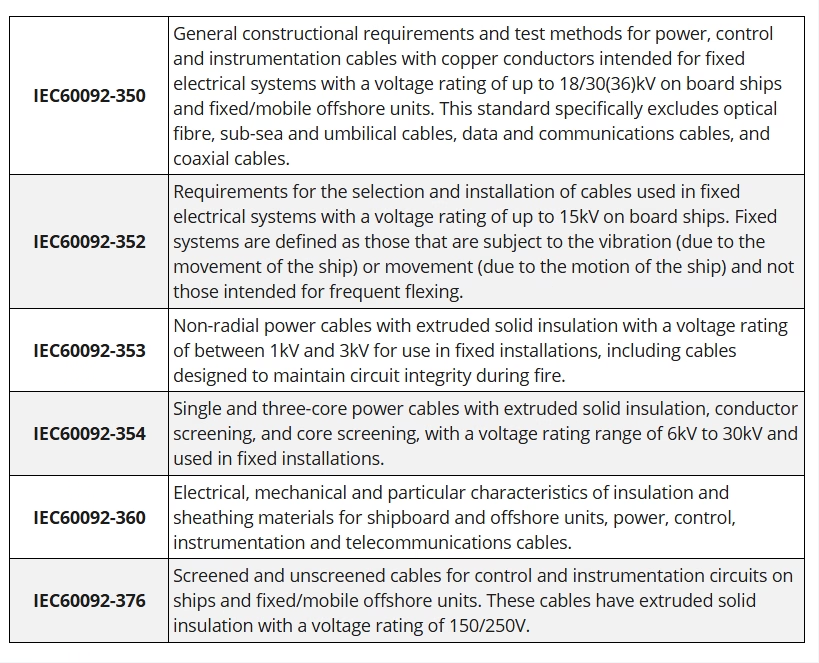
IEC 60092-376

The designation BFOU(c) is not arbitrary—it is a highly structured labeling system derived from the NEK 606 Norwegian marine standard that encodes critical information about the cable's construction, safety properties, and intended application. By understanding what each letter represents, you gain immediate insight into the cable's fundamental characteristics and whether it is suitable for your specific marine environment. BFOU(c) 代号是从 NEK 606 挪威海洋标准派生的高度结构化标签系统,编码了电缆的关键安全特性和预期应用。

Datasheet & Specs: Technical Specifications for BFOU(c) 150/250V S4/S8 4x2x1.5 mm² Marine Instrumentation Cable

The designation BFOU(c) is not arbitrary—it is a highly structured labeling system derived from the NEK 606 Norwegian marine standard that encodes critical information about the cable’s construction, safety properties, and intended application. By understanding what each letter represents, you gain immediate insight into the cable’s fundamental characteristics and whether it is suitable for your specific marine environment. BFOU(c) 代号是从 NEK 606 挪威海洋标准派生的高度结构化标签系统,编码了电缆的关键安全特性和预期应用。
The European and American approaches to cable engineering reflect fundamentally different environmental threat models. BFOU cables manufactured to NEK 606 specifications incorporate halogen-free insulation, SHF2 H-M compound sheathing, and mica glass tape (MGT) as a fire barrier, enabling uninterrupted power delivery during fire situations in accordance with IEC 60331-21. This design prioritizes survival of critical systems during extreme thermal events—a recognized hazard in confined spaces such as engine rooms and living quarters aboard offshore vessels.

Why Your BFOU Cable Needs a Type N Jacket Upgrade?

The European and American approaches to cable engineering reflect fundamentally different environmental threat models. BFOU cables manufactured to NEK 606 specifications incorporate halogen-free insulation, SHF2 H-M compound sheathing, and mica glass tape (MGT) as a fire barrier, enabling uninterrupted power delivery during fire situations in accordance with IEC 60331-21. This design prioritizes survival of critical systems during extreme thermal events—a recognized hazard in confined spaces such as engine rooms and living quarters aboard offshore vessels.
Shipwiring and offshore platform cables represent a specialized category of marine cables designed to perform reliably in the most demanding environments on earth—at sea. These cables must withstand extreme temperature variations (from Arctic cold to engine room heat), constant exposure to humidity, salt water, oils, acids, and drilling muds, while maintaining electrical integrity for power, control, signal, instrumentation, and communication applications. The primary international standards governing these cables include NEK 606 (Norwegian standard for offshore floating platforms), IEC 60092 (electrical installations in ships), BS 6883 (fixed wiring in offshore units), and BS 7917 (fire resistant cables for offshore applications).

What are Shipwiring & Offshore Platform Cables?

NEK 606 cable, BFOU cable, RFOU cable, NEK 606 BFOU, NEK 606 RFOU, offshore platform cable, MUD resistant cable, Norwegian offshore cable, floating platform cable, FPSO cable, marine cable, offshore cable, shipwiring cable, ship cable, offshore platform cable, marine power cable, ship electrical cable, naval cable, maritime cable, at-sea cable,RFOU P101, BFOU P105, RFOU S101, RFOU S102, BFOU S103, BFOU S104, UX P108, RFOU P102, RFOU P103, RFOU P104, RFOU P112, RFOU P113
NEK TS 606 is the Norwegian offshore industry technical specification (TS) covering a range of power, instrumentation and earth cables that are halogen free and/or MUD resistant, protecting them against the type of hydrocarbon-laden drilling liquid used in drilling operations which can have an adverse effect on cable sheathing materials. Originally published in 1993 by the Norwegian Electrotechnical Committee (NEK) as a successor to the 'Recommended Practice for Specification of Cables' of the Norwegian Oil Industry Association, NEK 606 has evolved to become an internationally accepted standard for offshore cable applications.

What is NEK 606 Cable?

NEK 606, NEK TS 606, NEK 606 cable, offshore cable, BFOU cable, RFOU cable, Norwegian offshore standard, oil gas cable, mud resistant cable, fire resistant cable, halogen free cable, offshore power cable, offshore instrumentation cable, marine cable
IEC 60092 is the international standard for electrical installations in ships and fixed/mobile marine applications. Ship wiring is covered by various national standards such as BS 6883 (British) and NEK 606 (Norwegian), and subject to third-party accreditations including Lloyd's Register, DNV (Det Norske Veritas), and ABS (American Bureau of Shipping). As an international standard, IEC 60092 covers power and instrumentation cables for use on ships and in mobile marine environments.

What is IEC 60092 Cable?

IEC 60092 cable, marine cable, shipboard cable, offshore cable, BS 6883 cable, NEK 606 cable, BFOU cable, RFOU cable, 657TQ cable, 658TQ cable, fire resistant marine cable, flame retardant cable, ship wiring, offshore platform cable, Lloyd’s Register approved, DNV certified, halogen free cable, LSZH marine cable, MUD resistant cable, IEC 60092-353, IEC 60092-354, IEC 60092-376, SW4 cable, EPR insulated, TCWB armoured, instrumentation cable, control cable, emergency power cable, oil rig cable, Feichun cable
DNV (Det Norske Veritas) is an international accredited registrar and classification society headquartered in Høvik, Norway. As one of the world's leading classification societies, DNV provides certification, verification, and risk management services for the maritime, oil & gas, renewable energy, and other industries. DNV approved cables are electrical cables that have been tested, verified, and certified by DNV to meet stringent safety, quality, and performance standards for use in marine and offshore applications.

What is DNV Approved Cable?

offshore platform cable, drilling platform cable, oil rig cable, FPSO cable, jackup rig cable, semi-submersible cable, drillship cable, offshore wind farm cable, wind turbine cable, subsea cable, underwater cable, shipboard wiring cable, ship electrical cable, naval vessel cable, cruise ship cable, ferry cable, offshore substation cable, offshore power distribution, marine electrical installation
DIN VDE 0250 German Standard Flexible Power Reeling Cable

What is DIN VDE 0250 Reeling Cables?

DIN VDE 0250 represents the globally recognized German standard for flexible electrical cables designed specifically for cranes, material handling equipment, and mobile machinery applications. As Germany remains the only country to have issued special design regulations for flexible electrical cables covering cranes and material handling equipment, this standard has achieved worldwide acceptance as the ultimate benchmark for tough rubber-sheathed flexible reeling cables.
JIS C 3410 Standard Marine Cables

What is JIS C 3410 Standard Marine Cables?

JIS C 3410 standard, formally titled “Cables and Flexible Cords for Electrical Equipment of Ships,” represents the Japanese Industrial Standard for marine electrical cables used in shipboard installations. Established and maintained by the Japanese Standards Association, this comprehensive specification was last updated in 2018 and incorporates technical requirements from multiple international standards including IEC 60092-353, IEC 60092-354, IEC 60092-360, and IEC 60092-376.
VG 95218 German Military-Grade Marine Cables

What is VG 95218 Cable?

VG 95218 represents a comprehensive German military specification governing cables and wires designed specifically for naval vessels operated by the Bundeswehr and other military organizations. Developed and maintained by the Federal Office of Bundeswehr Equipment, Information Technology and In-Service Support (Bundesamt für Ausrüstung, Informationstechnik und Nutzung der Bundeswehr, abbreviated as BAAINBw), this standard establishes stringent requirements for cable performance in the demanding maritime military environment. The specification encompasses multiple parts addressing various cable types, voltage ranges, and specialized applications, all unified by common principles of safety, reliability, and environmental resistance.