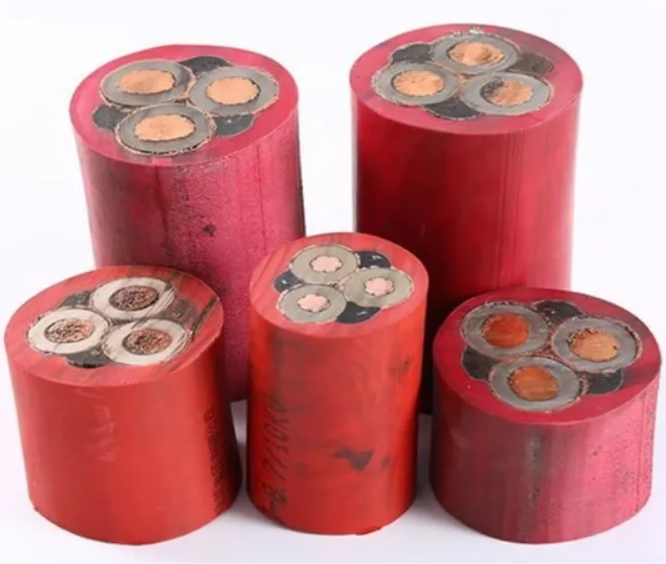
Feichun cable

La minería moderna sudamericana opera en una escala que habría sido impensable hace apenas dos décadas. En Chile, la mina Escondida mueve diariamente más de un millón de toneladas de material; en Perú, Cerro Verde y Antamina procesan caudales similares; en Colombia, las operaciones de carbón de El Cerrejón despachan trenes continuos hacia puertos de exportación. Esta escala masiva requiere equipos eléctricos de potencias que frecuentemente superan los 2,000 voltios nominales del cable portátil tradicional, entrando al dominio de la media tensión de 5,000 voltios. El cable 36-515 TIPO SHD-GC 3/C, diseñado específicamente para este rango de voltaje, es el estándar industrial para alimentación de equipo longwall, palas eléctricas de gran porte, continuous miners de alta potencia y perforadoras de producción en operaciones de clase mundial. La versión especial 36-515-LED de Feichun lleva esta solución consolidada al siguiente nivel tecnológico mediante la incorporación del sistema patentado de autoiluminación LED por inducción electromagnética—la misma tecnología innovadora demostrada en el cable de 2,000 voltios pero, como veremos en secciones posteriores, significativamente más eficaz a 5 kV debido a los campos electromagnéticos más intensos generados por operaciones de mayor potencia. Esta correspondencia natural entre mayor voltaje operacional y mayor disponibilidad energética para el sistema LED es uno de los descubrimientos más interesantes del desarrollo de esta tecnología: el cable de mayor criticidad operacional es también aquel donde la autoiluminación funciona con mayor robustez y luminosidad. Para entender por qué esta mejora importa tanto, consideremos el contexto operacional. Un cable portátil de 5 kV alimentando una pala eléctrica de 2 megavatios transporta corrientes de 200 a 350 amperios durante turnos operacionales continuos. Un daño a este cable, una falla eléctrica no detectada, o simplemente la confusión operacional sobre qué cable está energizado no son meras inconveniencias—son incidentes que pueden costar cientos de miles de dólares por hora de inactividad en pozo mina, además de los riesgos evidentes de seguridad personal. Según datos publicados por el Servicio Nacional de Geología y Minería de Chile (SERNAGEOMIN), más del 22% de los incidentes eléctricos graves en operaciones mineras de media tensión entre 2019 y 2024 involucraron procedimientos donde la verificación visual del estado energético del cable habría sido determinante para prevenir el evento. El cable 36-515-LED aborda directamente esta problemática. Adicionalmente al sistema LED, el cable 36-515-LED mantiene todas las características premium del cable SHD-GC tradicional de media tensión: blindaje semiconductor individual por fase para control del campo eléctrico (crítico a 5 kV), núcleo encintado armado para integridad mecánica bajo estrés operacional continuo, aislamiento EPR reforzado de 110 a 120 mils, cubierta reforzada curada en molde disponible en CPE translúcido estándar o TPU para ambientes extremadamente abrasivos, y opciones Tiger Stripe con franjas reflectivas para visibilidad complementaria. La conformidad con certificaciones MSHA P-184, ICEA S-75-381/NEMA WC-58, CSA Archivo 82346 (incluyendo validación a −50°C) y RETIE (Reglamento Técnico de Instalaciones Eléctricas de Colombia) proporciona aceptación regulatoria en todas las principales jurisdicciones mineras sudamericanas.

Cable 36-515-LED TIPO SHD-GC® de 5000 Voltios con Sistema Patentado de Autoiluminación LED por Inducción Electromagnética

La minería moderna sudamericana opera en una escala que habría sido impensable hace apenas dos décadas. En Chile, la mina Escondida mueve diariamente más de un millón de toneladas de material; en Perú, Cerro Verde y Antamina procesan caudales similares; en Colombia, las operaciones de carbón de El Cerrejón despachan trenes continuos hacia puertos de exportación. Esta escala masiva requiere equipos eléctricos de potencias que frecuentemente superan los 2,000 voltios nominales del cable portátil tradicional, entrando al dominio de la media tensión de 5,000 voltios. El cable 36-515 TIPO SHD-GC 3/C, diseñado específicamente para este rango de voltaje, es el estándar industrial para alimentación de equipo longwall, palas eléctricas de gran porte, continuous miners de alta potencia y perforadoras de producción en operaciones de clase mundial. La versión especial 36-515-LED de Feichun lleva esta solución consolidada al siguiente nivel tecnológico mediante la incorporación del sistema patentado de autoiluminación LED por inducción electromagnética—la misma tecnología innovadora demostrada en el cable de 2,000 voltios pero, como veremos en secciones posteriores, significativamente más eficaz a 5 kV debido a los campos electromagnéticos más intensos generados por operaciones de mayor potencia. Esta correspondencia natural entre mayor voltaje operacional y mayor disponibilidad energética para el sistema LED es uno de los descubrimientos más interesantes del desarrollo de esta tecnología: el cable de mayor criticidad operacional es también aquel donde la autoiluminación funciona con mayor robustez y luminosidad. Para entender por qué esta mejora importa tanto, consideremos el contexto operacional. Un cable portátil de 5 kV alimentando una pala eléctrica de 2 megavatios transporta corrientes de 200 a 350 amperios durante turnos operacionales continuos. Un daño a este cable, una falla eléctrica no detectada, o simplemente la confusión operacional sobre qué cable está energizado no son meras inconveniencias—son incidentes que pueden costar cientos de miles de dólares por hora de inactividad en pozo mina, además de los riesgos evidentes de seguridad personal. Según datos publicados por el Servicio Nacional de Geología y Minería de Chile (SERNAGEOMIN), más del 22% de los incidentes eléctricos graves en operaciones mineras de media tensión entre 2019 y 2024 involucraron procedimientos donde la verificación visual del estado energético del cable habría sido determinante para prevenir el evento. El cable 36-515-LED aborda directamente esta problemática. Adicionalmente al sistema LED, el cable 36-515-LED mantiene todas las características premium del cable SHD-GC tradicional de media tensión: blindaje semiconductor individual por fase para control del campo eléctrico (crítico a 5 kV), núcleo encintado armado para integridad mecánica bajo estrés operacional continuo, aislamiento EPR reforzado de 110 a 120 mils, cubierta reforzada curada en molde disponible en CPE translúcido estándar o TPU para ambientes extremadamente abrasivos, y opciones Tiger Stripe con franjas reflectivas para visibilidad complementaria. La conformidad con certificaciones MSHA P-184, ICEA S-75-381/NEMA WC-58, CSA Archivo 82346 (incluyendo validación a −50°C) y RETIE (Reglamento Técnico de Instalaciones Eléctricas de Colombia) proporciona aceptación regulatoria en todas las principales jurisdicciones mineras sudamericanas.
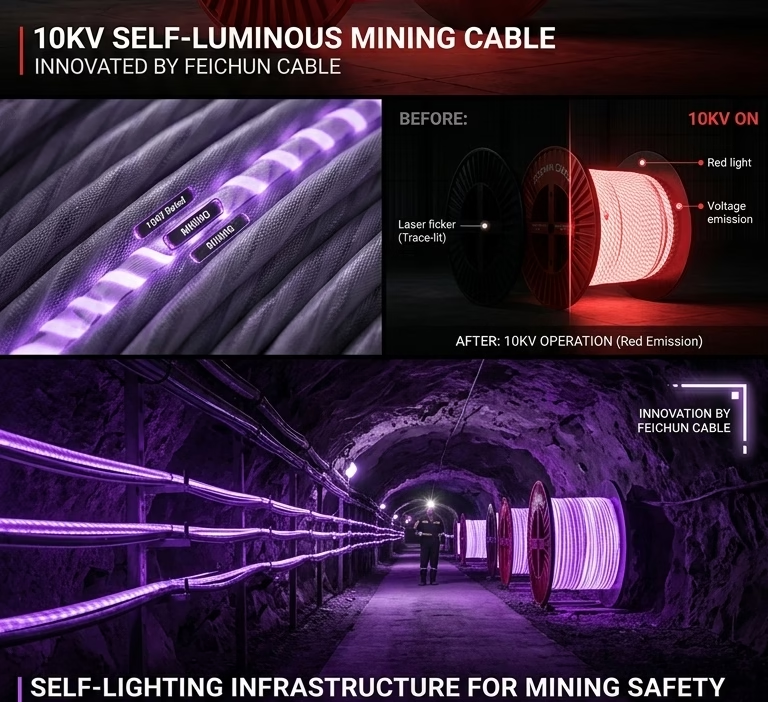
La industria minera sudamericana enfrenta un desafío persistente que ha resistido décadas de avance tecnológico: la verificación visual en tiempo real del estado energizado de cables portátiles de media tensión en ambientes subterráneos de baja iluminación. Según datos del Servicio Nacional de Geología y Minería de Chile (SERNAGEOMIN), más del 18% de los incidentes eléctricos documentados en minería subterránea entre 2018 y 2024 involucraron confusión operacional sobre el estado energético de cables portátiles, resultando en contactos accidentales, daños a equipos y, en casos graves, electrocuciones fatales. El cable 36-503-LED TIPO SHD-GC de Feichun representa una evolución radical en esta problemática mediante la incorporación de un sistema de autoiluminación LED alimentado exclusivamente por inducción electromagnética del propio cable en operación, sin requerir baterías, alimentación externa o cableado adicional. A diferencia de soluciones convencionales que dependen de indicadores luminosos discretos en tableros o señalización externa de advertencia, el cable 36-503-LED integra una matriz distribuida de micro-LEDs de alta luminosidad empotrados dentro de la cubierta CPE translúcida reforzada, espaciados cada 1.2 a 2.0 metros a lo largo de toda la longitud del cable. Cuando el cable transporta corriente operacional, el campo magnético generado por los conductores induce corriente en bobinas toroidales miniaturizadas integradas estratégicamente en la arquitectura del cable, proporcionando energía suficiente para alimentar la matriz LED de forma continua, sostenida y sin intervención humana. Esta innovación, protegida por múltiples patentes de Feichun, transforma el cable de un componente pasivo a un indicador visual activo de estado operacional. La base de este cable especial es el robusto modelo 36-503 TIPO SHD-GC 3/C de 2,000 voltios, reconocido en la industria minera mundial como estándar de oro para aplicaciones portátiles de media tensión: continuous miners, equipo longwall, bombas de drenaje, taladros de perforación y cargadores frontales. La versión LED mantiene íntegramente las especificaciones eléctricas, mecánicas y ambientales del cable original—incluyendo la certificación MSHA P-184, conformidad con normas ICEA S-75-381/NEMA WC-58, aislamiento EPR de 90°C, cubierta CPE reforzada y conductores de cobre estañado flexible—mientras añade la capa tecnológica de autoiluminación como una extensión funcional integrada, no sustitutiva.

Cable 36-503-LED TIPO SHD-GC® con Tecnología de Autoiluminación por Inducción Electromagnética

La industria minera sudamericana enfrenta un desafío persistente que ha resistido décadas de avance tecnológico: la verificación visual en tiempo real del estado energizado de cables portátiles de media tensión en ambientes subterráneos de baja iluminación. Según datos del Servicio Nacional de Geología y Minería de Chile (SERNAGEOMIN), más del 18% de los incidentes eléctricos documentados en minería subterránea entre 2018 y 2024 involucraron confusión operacional sobre el estado energético de cables portátiles, resultando en contactos accidentales, daños a equipos y, en casos graves, electrocuciones fatales. El cable 36-503-LED TIPO SHD-GC de Feichun representa una evolución radical en esta problemática mediante la incorporación de un sistema de autoiluminación LED alimentado exclusivamente por inducción electromagnética del propio cable en operación, sin requerir baterías, alimentación externa o cableado adicional. A diferencia de soluciones convencionales que dependen de indicadores luminosos discretos en tableros o señalización externa de advertencia, el cable 36-503-LED integra una matriz distribuida de micro-LEDs de alta luminosidad empotrados dentro de la cubierta CPE translúcida reforzada, espaciados cada 1.2 a 2.0 metros a lo largo de toda la longitud del cable. Cuando el cable transporta corriente operacional, el campo magnético generado por los conductores induce corriente en bobinas toroidales miniaturizadas integradas estratégicamente en la arquitectura del cable, proporcionando energía suficiente para alimentar la matriz LED de forma continua, sostenida y sin intervención humana. Esta innovación, protegida por múltiples patentes de Feichun, transforma el cable de un componente pasivo a un indicador visual activo de estado operacional. La base de este cable especial es el robusto modelo 36-503 TIPO SHD-GC 3/C de 2,000 voltios, reconocido en la industria minera mundial como estándar de oro para aplicaciones portátiles de media tensión: continuous miners, equipo longwall, bombas de drenaje, taladros de perforación y cargadores frontales. La versión LED mantiene íntegramente las especificaciones eléctricas, mecánicas y ambientales del cable original—incluyendo la certificación MSHA P-184, conformidad con normas ICEA S-75-381/NEMA WC-58, aislamiento EPR de 90°C, cubierta CPE reforzada y conductores de cobre estañado flexible—mientras añade la capa tecnológica de autoiluminación como una extensión funcional integrada, no sustitutiva.
(N)TSCGEWÖU® - FO представляет собой специализированное решение для горнодобывающей промышленности, туннелестроения и экскаваторов, которые требуют одновременной подачи электроэнергии среднего напряжения, передачи управляющих сигналов и высокоскоростной передачи данных через оптические каналы. В отличие от традиционного подхода, при котором используются отдельные силовые кабели, кабели управления и оптические волокна, монтируемые параллельно на системе кабельного барабана, кабель (N)TSCGEWÖU - FO объединяет все необходимые элементы в одном гибком кабеле с интегрированной оптической подсистемой. Аббревиатура TSCGEWÖU расшифровывается как "Trennung, Schirm, Control, Erdung, Werkstoffe, Öl-Resistenz, Universell" (разделение, экранирование, управление, заземление, материалы, устойчивость к маслам, универсальность), что указывает на комплексный дизайн, охватывающий все аспекты гибкого кабеля среднего напряжения для мобильного оборудования. Аббревиатура FO обозначает "Faseroptik" (оптическое волокно), подчеркивая уникальную особенность этого кабеля — встроенную систему передачи данных по оптическому волокну. Интегрированный подход (N)TSCGEWÖU - FO позволяет горнодобывающему оборудованию, такому как экскаваторы, краны и погрузчики, функционировать с улучшенной системой контроля и мониторинга в реальном времени. Оптические волокна невосприимчивы к электромагнитным помехам, что делает их идеальными для использования в условиях высокого электромагнитного загрязнения, характерных для портов и промышленных объектов с интенсивным электрооборудованием. Это позволяет передавать критические данные с гарантированной целостностью даже в самых сложных электромагнитных условиях.

(N)TSCGEWÖU® – FO

(N)TSCGEWÖU® – FO представляет собой специализированное решение для горнодобывающей промышленности, туннелестроения и экскаваторов, которые требуют одновременной подачи электроэнергии среднего напряжения, передачи управляющих сигналов и высокоскоростной передачи данных через оптические каналы. В отличие от традиционного подхода, при котором используются отдельные силовые кабели, кабели управления и оптические волокна, монтируемые параллельно на системе кабельного барабана, кабель (N)TSCGEWÖU – FO объединяет все необходимые элементы в одном гибком кабеле с интегрированной оптической подсистемой. Аббревиатура TSCGEWÖU расшифровывается как “Trennung, Schirm, Control, Erdung, Werkstoffe, Öl-Resistenz, Universell” (разделение, экранирование, управление, заземление, материалы, устойчивость к маслам, универсальность), что указывает на комплексный дизайн, охватывающий все аспекты гибкого кабеля среднего напряжения для мобильного оборудования. Аббревиатура FO обозначает “Faseroptik” (оптическое волокно), подчеркивая уникальную особенность этого кабеля — встроенную систему передачи данных по оптическому волокну. Интегрированный подход (N)TSCGEWÖU – FO позволяет горнодобывающему оборудованию, такому как экскаваторы, краны и погрузчики, функционировать с улучшенной системой контроля и мониторинга в реальном времени. Оптические волокна невосприимчивы к электромагнитным помехам, что делает их идеальными для использования в условиях высокого электромагнитного загрязнения, характерных для портов и промышленных объектов с интенсивным электрооборудованием. Это позволяет передавать критические данные с гарантированной целостностью даже в самых сложных электромагнитных условиях.
FLEXIDRUM® R 702 представляет собой значительный технический скачок в истории разработки кабелей FLEXIDRUM, потому что это первый кабель в этой линейке, который использует Kevlar в качестве центрального структурного элемента. Kevlar — это материал с научно-фантастическими свойствами, впервые разработанный компанией DuPont в 1965 году, и сегодня известный как материал, используемый в бронежилетах и шлемах. Его исключительная прочность при растяжении, низкая плотность и стабильность при высоких температурах делают его идеальным материалом для структурной поддержки электрического кабеля, когда цель состоит в минимизации диаметра и веса кабеля, но максимизации его прочности. Когда вы сравниваете спецификации R 702 с предыдущим FLEXIDRUM R 700, вы заметите, что R 702 часто имеет меньший наружный диаметр для того же или даже большего количества проводников. Например, конфигурация 49G1 (49 жилы по 1 мм²) имеет наружный диаметр всего 25 мм. Это является явным результатом использования Kevlar в качестве центрального элемента, который обеспечивает структурную поддержку более эффективно, чем традиционный текстиль, позволяя проводникам быть упакованными плотнее без их просадки под их собственным весом или механическим напряжением. R 702 является особенно ценным для применений, где пространство критично. В современных зданиях, кораблях и промышленных установках, электрические каналы и пути кабелей часто переполнены. Способность использовать один кабель меньшего диаметра, который доставляет то же количество проводников, что и традиционный кабель большего диаметра, может означать разницу между возможностью прокладки кабеля в доступный путь и необходимостью переделки инфраструктуры для размещения кабеля большего размера.

FLEXIDRUM® R 702

FLEXIDRUM® R 702 представляет собой значительный технический скачок в истории разработки кабелей FLEXIDRUM, потому что это первый кабель в этой линейке, который использует Kevlar в качестве центрального структурного элемента. Kevlar — это материал с научно-фантастическими свойствами, впервые разработанный компанией DuPont в 1965 году, и сегодня известный как материал, используемый в бронежилетах и шлемах. Его исключительная прочность при растяжении, низкая плотность и стабильность при высоких температурах делают его идеальным материалом для структурной поддержки электрического кабеля, когда цель состоит в минимизации диаметра и веса кабеля, но максимизации его прочности. Когда вы сравниваете спецификации R 702 с предыдущим FLEXIDRUM R 700, вы заметите, что R 702 часто имеет меньший наружный диаметр для того же или даже большего количества проводников. Например, конфигурация 49G1 (49 жилы по 1 мм²) имеет наружный диаметр всего 25 мм. Это является явным результатом использования Kevlar в качестве центрального элемента, который обеспечивает структурную поддержку более эффективно, чем традиционный текстиль, позволяя проводникам быть упакованными плотнее без их просадки под их собственным весом или механическим напряжением. R 702 является особенно ценным для применений, где пространство критично. В современных зданиях, кораблях и промышленных установках, электрические каналы и пути кабелей часто переполнены. Способность использовать один кабель меньшего диаметра, который доставляет то же количество проводников, что и традиционный кабель большего диаметра, может означать разницу между возможностью прокладки кабеля в доступный путь и необходимостью переделки инфраструктуры для размещения кабеля большего размера.
FLEXIDRUM® R 501 представляет собой кульминацию инженерных разработок, предназначенных специально для одного из самых требовательных окружений в электротехнике — подземных горных и туннельных операций. Когда вы работаете на глубине сотен метров под землей, окружены острыми камнями, абразивной пылью и потенциально взрывоопасными газами, обычные кабели просто не выживают. R 501 был разработан с пониманием того, что в горной добыче и туннелировании безопасность и надежность не являются роскошью, они буквально являются вопросом жизни и смерти. Характерной чертой FLEXIDRUM R 501 является его инновационная двойная система изоляции, которая отличает его от всех других кабелей в линейке FLEXIDRUM. Вместо использования единой изолирующей системы для всех проводников, R 501 использует специализированное резиновое соединение EPR для фазных проводников, которые несут основную нагрузку мощности, и сшитый полиэтилен XLPE для заземляющих проводников. Эта дифференцированная архитектура основана на том принципе, что различные функции требуют различных материалов. Чтобы понять, почему это важно, нужно понимать условия в горных и туннельных операциях. Мобильное оборудование в этих окружениях постоянно подвергается механическому напряжению. Буровые установки применяют извилистые движения, вентиляционные системы работают при вибрации, кабели протягиваются через острые края оборудования. Одновременно температуры могут быть экстремальными, варьируясь от холода в верхних выработках до потенциального тепла вблизи некоторого оборудования. Влажность подземных окружений и химическая агрессивность различных веществ также создают стрессы, которые обычный кабель не может выдержать длительный период. Двойная система изоляции: EPR и XLPE

FLEXIDRUM® R 501

FLEXIDRUM® R 501 представляет собой кульминацию инженерных разработок, предназначенных специально для одного из самых требовательных окружений в электротехнике — подземных горных и туннельных операций. Когда вы работаете на глубине сотен метров под землей, окружены острыми камнями, абразивной пылью и потенциально взрывоопасными газами, обычные кабели просто не выживают. R 501 был разработан с пониманием того, что в горной добыче и туннелировании безопасность и надежность не являются роскошью, они буквально являются вопросом жизни и смерти. Характерной чертой FLEXIDRUM R 501 является его инновационная двойная система изоляции, которая отличает его от всех других кабелей в линейке FLEXIDRUM. Вместо использования единой изолирующей системы для всех проводников, R 501 использует специализированное резиновое соединение EPR для фазных проводников, которые несут основную нагрузку мощности, и сшитый полиэтилен XLPE для заземляющих проводников. Эта дифференцированная архитектура основана на том принципе, что различные функции требуют различных материалов. Чтобы понять, почему это важно, нужно понимать условия в горных и туннельных операциях. Мобильное оборудование в этих окружениях постоянно подвергается механическому напряжению. Буровые установки применяют извилистые движения, вентиляционные системы работают при вибрации, кабели протягиваются через острые края оборудования. Одновременно температуры могут быть экстремальными, варьируясь от холода в верхних выработках до потенциального тепла вблизи некоторого оборудования. Влажность подземных окружений и химическая агрессивность различных веществ также создают стрессы, которые обычный кабель не может выдержать длительный период. Двойная система изоляции: EPR и XLPE
FLEXIDRUM® R 500 представляет собой особый вариант в линейке FLEXIDRUM, предназначенный для клиентов, которым нужна высокая производительность, но не требуется максимальная скорость развертывания или Kevlar технология более дорогих моделей. Буква "R" в названии указывает на использование красной меди вместо луженой меди, что является важным техническим выбором, который мы объясним подробно. Название "500" указывает на компактность конструкции и оптимизацию для эффективности стоимости. Этот кабель предназначен для рынка, который ценит надежность и долговечность, но где стоимость является существенным фактором. Это не означает, что качество ниже. Напротив, использование красной меди, инновационной изоляции GAALTHERM® и полиуретанового покрытия создает кабель, который может выходить на поле в тяжелых условиях и доказывать свою надежность день за днем. Во многих отношениях FLEXIDRUM R 500 является идеальным компромиссом между производительностью и экономичностью для среднего строительного проекта или промышленного приложения.

FLEXIDRUM® R 500

FLEXIDRUM® R 500 представляет собой особый вариант в линейке FLEXIDRUM, предназначенный для клиентов, которым нужна высокая производительность, но не требуется максимальная скорость развертывания или Kevlar технология более дорогих моделей. Буква “R” в названии указывает на использование красной меди вместо луженой меди, что является важным техническим выбором, который мы объясним подробно. Название “500” указывает на компактность конструкции и оптимизацию для эффективности стоимости. Этот кабель предназначен для рынка, который ценит надежность и долговечность, но где стоимость является существенным фактором. Это не означает, что качество ниже. Напротив, использование красной меди, инновационной изоляции GAALTHERM® и полиуретанового покрытия создает кабель, который может выходить на поле в тяжелых условиях и доказывать свою надежность день за днем. Во многих отношениях FLEXIDRUM R 500 является идеальным компромиссом между производительностью и экономичностью для среднего строительного проекта или промышленного приложения.
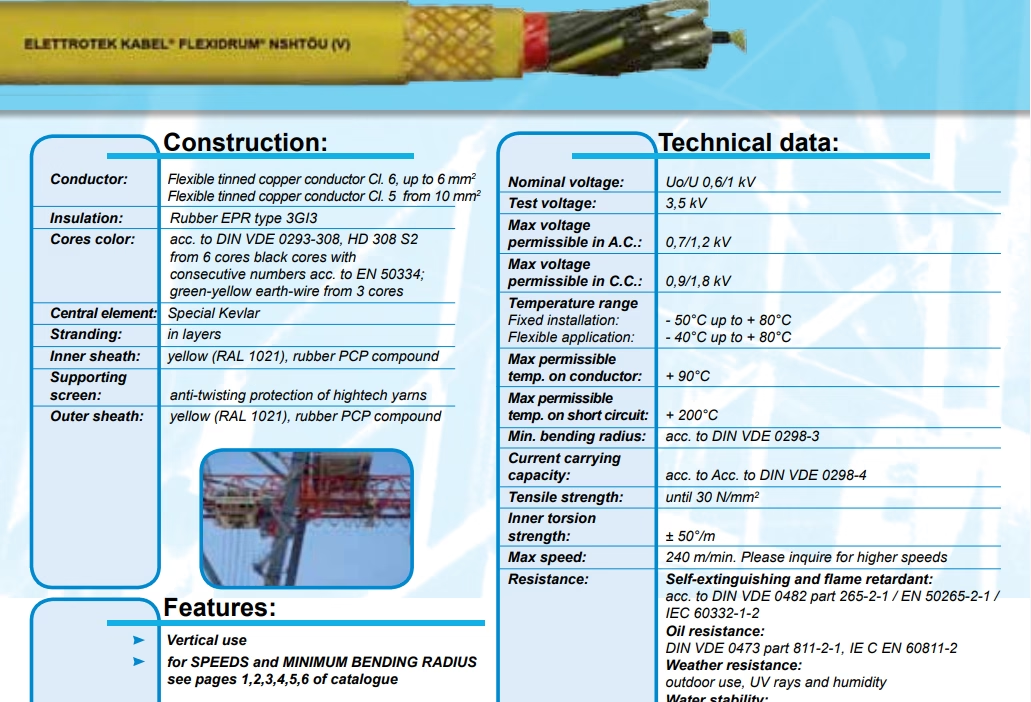
FLEXIDRUM® NSHTÖU (V) представляет собой новое поколение гибких кабелей на катушках, специально разработанное для самых требовательных приложений, где обычные кабели не справляются. Буква "V" в названии обозначает версию повышенной производительности, которая превосходит стандартную линию FLEXIDRUM по нескольким ключевым параметрам. Главное инновационное решение в этом кабеле — использование Kevlar центрального элемента, усиленного волокна, которое известно своей исключительной прочностью и долговечностью. Применение Kevlar в центре кабеля решает одну из наиболее острых проблем, с которой сталкиваются пользователи мобильных кабелей на катушках: повреждение при частом скручивании, перекручивании и механическом напряжении. Kevlar обеспечивает дополнительную жесткость, которая помогает предотвратить внутренние скручивания кабеля, даже при очень высоких скоростях развертывания. Это означает, что кабель FLEXIDRUM (V) может работать на скоростях до 240 м/мин без риска повреждения, что на треть выше, чем у стандартной версии. Кроме того, желтый цвет покрытия (RAL 1021) не является просто эстетическим выбором. Яркий желтый цвет значительно повышает видимость кабеля на строительных площадках и в промышленных условиях, что улучшает безопасность работ и снижает риск несчастных случаев, связанных с спотыканием о кабель.

FLEXIDRUM® NSHTÖU (V)

FLEXIDRUM® NSHTÖU (V) представляет собой новое поколение гибких кабелей на катушках, специально разработанное для самых требовательных приложений, где обычные кабели не справляются. Буква “V” в названии обозначает версию повышенной производительности, которая превосходит стандартную линию FLEXIDRUM по нескольким ключевым параметрам. Главное инновационное решение в этом кабеле — использование Kevlar центрального элемента, усиленного волокна, которое известно своей исключительной прочностью и долговечностью. Применение Kevlar в центре кабеля решает одну из наиболее острых проблем, с которой сталкиваются пользователи мобильных кабелей на катушках: повреждение при частом скручивании, перекручивании и механическом напряжении. Kevlar обеспечивает дополнительную жесткость, которая помогает предотвратить внутренние скручивания кабеля, даже при очень высоких скоростях развертывания. Это означает, что кабель FLEXIDRUM (V) может работать на скоростях до 240 м/мин без риска повреждения, что на треть выше, чем у стандартной версии. Кроме того, желтый цвет покрытия (RAL 1021) не является просто эстетическим выбором. Яркий желтый цвет значительно повышает видимость кабеля на строительных площадках и в промышленных условиях, что улучшает безопасность работ и снижает риск несчастных случаев, связанных с спотыканием о кабель.
Кабель FLEXIDRUM® NSHTÖU представляет собой современное решение в области гибких электрических кабелей на катушках, специально разработанное для применений, где требуется максимальная гибкость, простота развертывания и надежность. Основное назначение FLEXIDRUM — обеспечение временного или мобильного электроснабжения на строительных площадках, промышленных объектах, в портовых сооружениях, при проведении аварийных работ и в других условиях, где стационарную проводку невозможно использовать. Кабель на катушках существенно отличается от кабелей, используемых в стационарных установках. Во-первых, они должны быть легко переносимыми и быстро развертываемыми, что требует высокой гибкости. Во-вторых, они подвергаются частым механическим воздействиям, включая изгибы, скручивания и работу на высоких скоростях размотки. В-третьих, они часто находятся в условиях с высокой влажностью, воздействием масел, химических веществ и ультрафиолетового излучения. FLEXIDRUM кабель разработан с учетом всех этих требований, предоставляя надежное и безопасное решение для мобильного электроснабжения. Компания Anhui Feichun Special Cable Co., Ltd. производит данный кабель в полном соответствии с немецким стандартом DIN VDE 0250 часть 814, что гарантирует его высокое качество и надежность.

FLEXIDRUM® NSHTÖU

Кабель FLEXIDRUM® NSHTÖU представляет собой современное решение в области гибких электрических кабелей на катушках, специально разработанное для применений, где требуется максимальная гибкость, простота развертывания и надежность. Основное назначение FLEXIDRUM — обеспечение временного или мобильного электроснабжения на строительных площадках, промышленных объектах, в портовых сооружениях, при проведении аварийных работ и в других условиях, где стационарную проводку невозможно использовать. Кабель на катушках существенно отличается от кабелей, используемых в стационарных установках. Во-первых, они должны быть легко переносимыми и быстро развертываемыми, что требует высокой гибкости. Во-вторых, они подвергаются частым механическим воздействиям, включая изгибы, скручивания и работу на высоких скоростях размотки. В-третьих, они часто находятся в условиях с высокой влажностью, воздействием масел, химических веществ и ультрафиолетового излучения. FLEXIDRUM кабель разработан с учетом всех этих требований, предоставляя надежное и безопасное решение для мобильного электроснабжения. Компания Anhui Feichun Special Cable Co., Ltd. производит данный кабель в полном соответствии с немецким стандартом DIN VDE 0250 часть 814, что гарантирует его высокое качество и надежность.
Кабель RHEYFIRM®(SI) NTMCGCWOEUS представляет собой современное решение в области гибких однопроводных кабелей высокого напряжения. Данный кабель разработан специально для применений, требующих гибкости, надежности и стойкости к внешним воздействиям. Основная область применения — коротких соединений между высоковольтными выключателями и мобильными трансформаторами в энергетических системах, промышленных установках и распределительных сетях. Исторически кабели этого класса использовались в европейской электроэнергетике и зарекомендовали себя как надежные системы, способные обеспечить безопасность при передаче высокого напряжения. RHEYFIRM кабель продолжает эту традицию, добавляя инновационные материалы и конструкции, которые повышают производительность и безопасность. Компания Anhui Feichun Special Cable Co., Ltd. предлагает данный кабель в соответствии со всеми международными и немецкими стандартами DIN VDE, обеспечивая высокое качество и надежность каждого производимого изделия.

RHEYFIRM®(SI) NTMCGCWOEUS

Кабель RHEYFIRM®(SI) NTMCGCWOEUS представляет собой современное решение в области гибких однопроводных кабелей высокого напряжения. Данный кабель разработан специально для применений, требующих гибкости, надежности и стойкости к внешним воздействиям. Основная область применения — коротких соединений между высоковольтными выключателями и мобильными трансформаторами в энергетических системах, промышленных установках и распределительных сетях. Исторически кабели этого класса использовались в европейской электроэнергетике и зарекомендовали себя как надежные системы, способные обеспечить безопасность при передаче высокого напряжения. RHEYFIRM кабель продолжает эту традицию, добавляя инновационные материалы и конструкции, которые повышают производительность и безопасность. Компания Anhui Feichun Special Cable Co., Ltd. предлагает данный кабель в соответствии со всеми международными и немецкими стандартами DIN VDE, обеспечивая высокое качество и надежность каждого производимого изделия.
KIV Wire Architecture & Building Wiring Design Philosophy Purpose & Application Scope: KIV (Korean Industrial Vinyl) flexible single-core building wire represents the engineered solution for residential and commercial indoor electrical wiring requiring simplified installation, practical flexibility, and reliable performance throughout decades of building service. Unlike power distribution cables designed for specialized applications (underground, portable, equipment), KIV wires are specifically engineered for standardized building electrical systems where simplicity, compatibility with standard conduit systems, and proven reliability across diverse building types create essential requirements. Core Engineering Philosophy: KIV wire design emphasizes practical flexibility enabling easy routing through building conduit systems, standard interface with residential and commercial electrical infrastructure, proven long-term reliability, and economy of installation. Class 5 flexible stranding enables routing through conduit bends, simplified pulling during installation, and practical handling without specialized equipment. Standard PVC insulation provides proven performance across indoor building environments, standard electrical interfaces, and cost-effective manufacturing enabling competitive pricing for high-volume residential and commercial construction markets. Market Position & Regulatory Compliance: KIV wires comply with KS C IEC 60227-3 international standard specifications—the recognized standard for flexible building wiring worldwide. The 450/750V rating addresses standard 400V three-phase (230V single-phase) building power distributions universal across modern residential and commercial infrastructure. Building electrical codes in most jurisdictions specifically reference KS C IEC 60227-3 or equivalent standards, making KIV wires the standard choice for compliant building installation.

K 60227 IEC 02 (KIV) 450/750V Flexible Building Wiring Wire

KIV Wire Architecture & Building Wiring Design Philosophy Purpose & Application Scope: KIV (Korean Industrial Vinyl) flexible single-core building wire represents the engineered solution for residential and commercial indoor electrical wiring requiring simplified installation, practical flexibility, and reliable performance throughout decades of building service. Unlike power distribution cables designed for specialized applications (underground, portable, equipment), KIV wires are specifically engineered for standardized building electrical systems where simplicity, compatibility with standard conduit systems, and proven reliability across diverse building types create essential requirements. Core Engineering Philosophy: KIV wire design emphasizes practical flexibility enabling easy routing through building conduit systems, standard interface with residential and commercial electrical infrastructure, proven long-term reliability, and economy of installation. Class 5 flexible stranding enables routing through conduit bends, simplified pulling during installation, and practical handling without specialized equipment. Standard PVC insulation provides proven performance across indoor building environments, standard electrical interfaces, and cost-effective manufacturing enabling competitive pricing for high-volume residential and commercial construction markets. Market Position & Regulatory Compliance: KIV wires comply with KS C IEC 60227-3 international standard specifications—the recognized standard for flexible building wiring worldwide. The 450/750V rating addresses standard 400V three-phase (230V single-phase) building power distributions universal across modern residential and commercial infrastructure. Building electrical codes in most jurisdictions specifically reference KS C IEC 60227-3 or equivalent standards, making KIV wires the standard choice for compliant building installation.
VCT Cabtyre Cable Architecture & Design Philosophy Purpose & Application Scope: VCT (Vinyl Insulated Vinyl Sheathed Cabtyre) cables represent engineered solutions for mobile electrical equipment requiring robust, flexible power distribution without permanent installation infrastructure. Unlike fixed installation cables designed for long-term underground or indoor wiring, VCT cables are specifically engineered for portable applications where cables experience frequent movement, mechanical stress, temporary disconnection/reconnection, and harsh operational environments typical of factories, mines, farms, construction sites, and emergency power systems. Core Engineering Philosophy: VCT cable design emphasizes mechanical durability and flexibility rather than thermal optimization or fire safety specifications. Heavy-duty PVC outer sheathing provides superior abrasion resistance, oil and solvent resistance, and mechanical toughness compared to conventional power cable sheaths. Class 5 extra-flexible stranding enables tight coiling, frequent movement through conduits and restrictive spaces, and repetitive bending cycles without insulation cracking or conductor breaking. This engineering approach prioritizes cable longevity in dynamic, portable applications over size optimization or thermal performance. Market Position & Regulatory Compliance: VCT cables comply with KS C IEC 60502-1 international standards and equivalent national specifications. The 0.6/1kV rating addresses portable equipment operating under 400V three-phase (approximately 230V single-phase) typical of industrial facilities worldwide. Portable power distribution standards in most jurisdictions permit VCT cables for temporary installations and mobile equipment connections where fixed infrastructure does not exist. The cabtyre cable design—with flexible stranding and durable sheathing—satisfies regulatory requirements for equipment that requires frequent electrical connection changes and mechanical movement.

0.6/1kV VCT Vinyl Insulated Vinyl Sheathed Cabtyre Cable

VCT Cabtyre Cable Architecture & Design Philosophy Purpose & Application Scope: VCT (Vinyl Insulated Vinyl Sheathed Cabtyre) cables represent engineered solutions for mobile electrical equipment requiring robust, flexible power distribution without permanent installation infrastructure. Unlike fixed installation cables designed for long-term underground or indoor wiring, VCT cables are specifically engineered for portable applications where cables experience frequent movement, mechanical stress, temporary disconnection/reconnection, and harsh operational environments typical of factories, mines, farms, construction sites, and emergency power systems. Core Engineering Philosophy: VCT cable design emphasizes mechanical durability and flexibility rather than thermal optimization or fire safety specifications. Heavy-duty PVC outer sheathing provides superior abrasion resistance, oil and solvent resistance, and mechanical toughness compared to conventional power cable sheaths. Class 5 extra-flexible stranding enables tight coiling, frequent movement through conduits and restrictive spaces, and repetitive bending cycles without insulation cracking or conductor breaking. This engineering approach prioritizes cable longevity in dynamic, portable applications over size optimization or thermal performance. Market Position & Regulatory Compliance: VCT cables comply with KS C IEC 60502-1 international standards and equivalent national specifications. The 0.6/1kV rating addresses portable equipment operating under 400V three-phase (approximately 230V single-phase) typical of industrial facilities worldwide. Portable power distribution standards in most jurisdictions permit VCT cables for temporary installations and mobile equipment connections where fixed infrastructure does not exist. The cabtyre cable design—with flexible stranding and durable sheathing—satisfies regulatory requirements for equipment that requires frequent electrical connection changes and mechanical movement.
SWA Cable Architecture & Engineering Design Strategy Purpose & Application Scope: Steel Wire Armored (SWA) cables represent the engineering solution for power distribution where mechanical protection, fire safety, and environmental resistance create absolute requirements. Unlike conventional cables relying solely on conduit or external protection, SWA cables integrate mechanical armoring as an integral structural component, offering permanent protection against physical damage, burrowing animals, excavation equipment, and external mechanical stress. Core Engineering Philosophy: SWA cable design employs multi-layer engineering architecture combining XLPE insulation excellence with steel wire mechanical protection and halogen-free outer sheathing. This integrated approach eliminates the need for external conduit in most underground, outdoor, and hazardous-area applications—reducing installation cost, complexity, and maintenance requirements while providing superior long-term reliability. Market Position & Regulatory Compliance: SWA cables comply with IEC 60502-1 international standards and equivalent national specifications including KS C specifications. These cables specifically address the requirements of the EN 50288 and equivalent standards covering cables with protective conductors and armored configurations. The combination of XLPE insulation with halogen-free sheathing provides automatic compliance with fire safety codes adopted across Europe, Asia, and industrial facilities worldwide where smoke emission and toxic fume generation create liability concerns.

0.6/1kV XLPE Insulated Halogen-Free Steel Wire Armored Cable

SWA Cable Architecture & Engineering Design Strategy Purpose & Application Scope: Steel Wire Armored (SWA) cables represent the engineering solution for power distribution where mechanical protection, fire safety, and environmental resistance create absolute requirements. Unlike conventional cables relying solely on conduit or external protection, SWA cables integrate mechanical armoring as an integral structural component, offering permanent protection against physical damage, burrowing animals, excavation equipment, and external mechanical stress. Core Engineering Philosophy: SWA cable design employs multi-layer engineering architecture combining XLPE insulation excellence with steel wire mechanical protection and halogen-free outer sheathing. This integrated approach eliminates the need for external conduit in most underground, outdoor, and hazardous-area applications—reducing installation cost, complexity, and maintenance requirements while providing superior long-term reliability. Market Position & Regulatory Compliance: SWA cables comply with IEC 60502-1 international standards and equivalent national specifications including KS C specifications. These cables specifically address the requirements of the EN 50288 and equivalent standards covering cables with protective conductors and armored configurations. The combination of XLPE insulation with halogen-free sheathing provides automatic compliance with fire safety codes adopted across Europe, Asia, and industrial facilities worldwide where smoke emission and toxic fume generation create liability concerns.
60227 KS IEC 53 (VCTF) vinyl sheath cords represent the industry-standard approach to consumer and commercial electrical power distribution—cords engineered for flexibility, durability, and cost-effectiveness in indoor applications. The VCTF designation (Vinyl Cord Twist Flexible) indicates the specific construction standard combining polyvinyl chloride (PVC) insulation with PVC sheath, multi-strand flexible conductors, and optimized designs for appliances, commercial equipment, audio systems, and lighting fixtures. Fundamental Design Philosophy: VCTF cords prioritize flexibility, ease of use, and cost-effectiveness for consumer and commercial markets. Unlike fixed-installation cables optimized for stationary deployment, VCTF cords must accommodate frequent coiling, uncoiling, movement, and mechanical stress inherent in portable and temporary equipment. The PVC material system provides excellent balance of electrical performance, mechanical flexibility, environmental resistance, and manufacturing economy. Core Voltage Rating: 300/500V: The 300/500V rating indicates nominal 300V continuous operating voltage (typical single-phase consumer power supply) with 500V maximum transient overvoltage tolerance. This moderate voltage rating optimizes cost and safety for consumer applications—substantially lower than industrial cables, yet providing adequate safety margin for typical household and commercial electrical systems. Temperature Operating Limit: 70°C: Maximum continuous conductor temperature limited to 70°C (158°F), appropriate for consumer appliances and indoor commercial equipment where elevated temperature operation is not anticipated. This 70°C rating represents industry-standard performance for general-purpose indoor cords—higher temperature ratings available for specialized applications through engineered variants.

VCTF Vinyl Sheath Cord Family (300/500V)

60227 KS IEC 53 (VCTF) vinyl sheath cords represent the industry-standard approach to consumer and commercial electrical power distribution—cords engineered for flexibility, durability, and cost-effectiveness in indoor applications. The VCTF designation (Vinyl Cord Twist Flexible) indicates the specific construction standard combining polyvinyl chloride (PVC) insulation with PVC sheath, multi-strand flexible conductors, and optimized designs for appliances, commercial equipment, audio systems, and lighting fixtures. Fundamental Design Philosophy: VCTF cords prioritize flexibility, ease of use, and cost-effectiveness for consumer and commercial markets. Unlike fixed-installation cables optimized for stationary deployment, VCTF cords must accommodate frequent coiling, uncoiling, movement, and mechanical stress inherent in portable and temporary equipment. The PVC material system provides excellent balance of electrical performance, mechanical flexibility, environmental resistance, and manufacturing economy. Core Voltage Rating: 300/500V: The 300/500V rating indicates nominal 300V continuous operating voltage (typical single-phase consumer power supply) with 500V maximum transient overvoltage tolerance. This moderate voltage rating optimizes cost and safety for consumer applications—substantially lower than industrial cables, yet providing adequate safety margin for typical household and commercial electrical systems. Temperature Operating Limit: 70°C: Maximum continuous conductor temperature limited to 70°C (158°F), appropriate for consumer appliances and indoor commercial equipment where elevated temperature operation is not anticipated. This 70°C rating represents industry-standard performance for general-purpose indoor cords—higher temperature ratings available for specialized applications through engineered variants.
Ethylene Propylene Rubber (EPR) insulated cables represent the professional approach to flexible electrical distribution—cables engineered to accommodate dynamic deployment, repetitive coiling/uncoiling, temperature variation, and mechanical stress inherent in portable and industrial equipment applications. Unlike fixed-installation cables optimized for stationary performance, EPR cables balance electrical performance, mechanical flexibility, environmental durability, and cost-effectiveness required for equipment requiring frequent relocation or deployment flexibility. Fundamental Design Philosophy: EPR cables employ elastomeric insulation material (ethylene propylene rubber) selected specifically for flexibility maintenance across wide temperature range. This material provides sustained flexibility even at cold temperatures (−40°C minimum), maintains electrical properties across elevated temperature range (continuous operation to +100°C), and demonstrates superior resistance to ozone, UV radiation, and environmental contamination characteristic of portable equipment deployment. Conductor Architecture for Flexibility: Rather than single-strand conductors (rigid, prone to breaking under flex stress), EPR cables employ multi-strand conductor design—typically 7, 19, 37, or 61 individual wires woven together. This multi-strand architecture enables smooth bending without conductor fracture, distributes mechanical stress across multiple strands preventing single-point failure, and maintains consistent electrical performance through tens of thousands of flex cycles. Voltage Rating & Safety Margin: Standard 0.6/1KV rating provides nominal 600V operating margin with 1000V safety ceiling—appropriate for most industrial equipment, portable power systems, and temporary installations. The dual rating nomenclature indicates 0.6KV continuous operating voltage with 1KV maximum transient voltage tolerance, providing balanced safety margin against impulse transients and surge events.

Ethylene Propylene Rubber (EPR) Insulated Cable Family

Ethylene Propylene Rubber (EPR) insulated cables represent the professional approach to flexible electrical distribution—cables engineered to accommodate dynamic deployment, repetitive coiling/uncoiling, temperature variation, and mechanical stress inherent in portable and industrial equipment applications. Unlike fixed-installation cables optimized for stationary performance, EPR cables balance electrical performance, mechanical flexibility, environmental durability, and cost-effectiveness required for equipment requiring frequent relocation or deployment flexibility. Fundamental Design Philosophy: EPR cables employ elastomeric insulation material (ethylene propylene rubber) selected specifically for flexibility maintenance across wide temperature range. This material provides sustained flexibility even at cold temperatures (−40°C minimum), maintains electrical properties across elevated temperature range (continuous operation to +100°C), and demonstrates superior resistance to ozone, UV radiation, and environmental contamination characteristic of portable equipment deployment. Conductor Architecture for Flexibility: Rather than single-strand conductors (rigid, prone to breaking under flex stress), EPR cables employ multi-strand conductor design—typically 7, 19, 37, or 61 individual wires woven together. This multi-strand architecture enables smooth bending without conductor fracture, distributes mechanical stress across multiple strands preventing single-point failure, and maintains consistent electrical performance through tens of thousands of flex cycles. Voltage Rating & Safety Margin: Standard 0.6/1KV rating provides nominal 600V operating margin with 1000V safety ceiling—appropriate for most industrial equipment, portable power systems, and temporary installations. The dual rating nomenclature indicates 0.6KV continuous operating voltage with 1KV maximum transient voltage tolerance, providing balanced safety margin against impulse transients and surge events.
PNCT-R high-voltage reel cables represent an advanced evolution in portable power distribution—engineered specifically for container cranes, ship unloaders, cargo handling systems, and bulk terminal equipment where electrical power must be delivered dynamically through mechanically spooled cable reels. Unlike stationary cable installations with fixed routing and stress patterns, reel-deployed cables experience continuous repetitive flex-cycling, abrupt acceleration/deceleration forces, and environmental exposure across multiple geographic locations and climate conditions. Fundamental Design Challenge: Traditional high-voltage cables designed for fixed installations fail catastrophically when deployed on mechanical reels. The repetitive flex-cycling—where individual cable cross-sections bend and straighten thousands of times per shift—creates progressive internal stress concentration and insulation degradation. External mechanical stresses from reel spooling, retraction, equipment vibration, and wind loading accelerate conductor separation and sheath cracking. Standard copper braiding provides insufficient tensile support for repeated dynamic loads. Engineering Solution — Kevlar-Reinforced Architecture: PNCT-R cables integrate specialized Kevlar aramid fiber reinforcement layers—a material system engineered to absorb mechanical stress and prevent internal conductor displacement during dynamic cycling. Rather than relying solely on copper or aluminum tensile components, Kevlar fibers provide sustained tensile support through tens of thousands of flex cycles, maintaining conductor geometry integrity and preventing the progressive insulation failure characteristic of standard high-voltage cables deployed on reels. Feichun engineers have developed proprietary Kevlar weaving methodologies that integrate the reinforcement material within the cable architecture—not as external wrapping (which adds excessive weight), but as strategically positioned internal tensile layers coordinated with specialized sheath formulations. This integrated architecture enables PNCT-R cables to withstand 2+ million repetitive flex cycles at full operational stress without performance degradation.

PNCT-R High-Voltage Reel Cable Family

PNCT-R high-voltage reel cables represent an advanced evolution in portable power distribution—engineered specifically for container cranes, ship unloaders, cargo handling systems, and bulk terminal equipment where electrical power must be delivered dynamically through mechanically spooled cable reels. Unlike stationary cable installations with fixed routing and stress patterns, reel-deployed cables experience continuous repetitive flex-cycling, abrupt acceleration/deceleration forces, and environmental exposure across multiple geographic locations and climate conditions. Fundamental Design Challenge: Traditional high-voltage cables designed for fixed installations fail catastrophically when deployed on mechanical reels. The repetitive flex-cycling—where individual cable cross-sections bend and straighten thousands of times per shift—creates progressive internal stress concentration and insulation degradation. External mechanical stresses from reel spooling, retraction, equipment vibration, and wind loading accelerate conductor separation and sheath cracking. Standard copper braiding provides insufficient tensile support for repeated dynamic loads. Engineering Solution — Kevlar-Reinforced Architecture: PNCT-R cables integrate specialized Kevlar aramid fiber reinforcement layers—a material system engineered to absorb mechanical stress and prevent internal conductor displacement during dynamic cycling. Rather than relying solely on copper or aluminum tensile components, Kevlar fibers provide sustained tensile support through tens of thousands of flex cycles, maintaining conductor geometry integrity and preventing the progressive insulation failure characteristic of standard high-voltage cables deployed on reels. Feichun engineers have developed proprietary Kevlar weaving methodologies that integrate the reinforcement material within the cable architecture—not as external wrapping (which adds excessive weight), but as strategically positioned internal tensile layers coordinated with specialized sheath formulations. This integrated architecture enables PNCT-R cables to withstand 2+ million repetitive flex cycles at full operational stress without performance degradation.
High Tension (HT) cables are specialized power distribution cables designed for reel-mounted applications in port equipment—primarily unloaders, stackers, reclaimers, and gantry cranes. The term "high tension" does not refer to electrical voltage (HT cables are 0.6/1 kV, standard port equipment voltage); instead, it refers to the mechanical tension and stress that these cables experience when wound on reels and unwound during equipment operation. HT-PNCT cables serve as the primary power supply line running from the equipment's fixed power source (shore power or generator) to the reel-mounted slip ring assembly on moving equipment. During operation, these cables are repeatedly wound onto and unwound from rotating reels, experiencing: • Tensile stress from the cable's own weight as it hangs from the reel to the equipment • Bending stress each time the cable wraps around the reel drum • Mechanical abrasion from friction against the reel surface and cable guides • Environmental exposure to saltwater spray, UV radiation, and thermal cycling Standard festoon cables (like FC-PNCT) are optimized for relatively stationary installations. HT-PNCT cables are engineered specifically for reel-wound, dynamic applications where these mechanical stresses dominate the cable's service life.

HT-PNCT High Tension Cables

High Tension (HT) cables are specialized power distribution cables designed for reel-mounted applications in port equipment—primarily unloaders, stackers, reclaimers, and gantry cranes. The term “high tension” does not refer to electrical voltage (HT cables are 0.6/1 kV, standard port equipment voltage); instead, it refers to the mechanical tension and stress that these cables experience when wound on reels and unwound during equipment operation. HT-PNCT cables serve as the primary power supply line running from the equipment’s fixed power source (shore power or generator) to the reel-mounted slip ring assembly on moving equipment. During operation, these cables are repeatedly wound onto and unwound from rotating reels, experiencing: • Tensile stress from the cable’s own weight as it hangs from the reel to the equipment • Bending stress each time the cable wraps around the reel drum • Mechanical abrasion from friction against the reel surface and cable guides • Environmental exposure to saltwater spray, UV radiation, and thermal cycling Standard festoon cables (like FC-PNCT) are optimized for relatively stationary installations. HT-PNCT cables are engineered specifically for reel-wound, dynamic applications where these mechanical stresses dominate the cable’s service life.
PNCT-F designation identifies cables with a flat profile cross-section, as opposed to the standard round profile. While round cables are universal and flexible, flat cables offer specific advantages for certain port crane applications: Compact Storage and Handling: Flat cables pack more efficiently on drums and spools. A flat cable occupies approximately 15–20% less volume than a round cable of equivalent conductor area, reducing storage footprint and shipping volume. Improved Thermal Dissipation: The flat geometry increases surface area relative to volume, enabling better heat dissipation from the conductor. In high-current applications (large hoist motors), flat cables run cooler than round cables, reducing insulation aging and extending service life. Easier Cable Management: Flat cables lay flatter in cable troughs and festoon routes, reducing twisting and tangling. This property is particularly valuable in complex multi-cable installations where space is constrained. Lower Profile Aesthetics: For applications where cable profile affects equipment appearance or port terminal aesthetics, flat cables provide a lower-profile alternative.

PNCT-F Flat Type Cables & Cable Specification System

PNCT-F designation identifies cables with a flat profile cross-section, as opposed to the standard round profile. While round cables are universal and flexible, flat cables offer specific advantages for certain port crane applications: Compact Storage and Handling: Flat cables pack more efficiently on drums and spools. A flat cable occupies approximately 15–20% less volume than a round cable of equivalent conductor area, reducing storage footprint and shipping volume. Improved Thermal Dissipation: The flat geometry increases surface area relative to volume, enabling better heat dissipation from the conductor. In high-current applications (large hoist motors), flat cables run cooler than round cables, reducing insulation aging and extending service life. Easier Cable Management: Flat cables lay flatter in cable troughs and festoon routes, reducing twisting and tangling. This property is particularly valuable in complex multi-cable installations where space is constrained. Lower Profile Aesthetics: For applications where cable profile affects equipment appearance or port terminal aesthetics, flat cables provide a lower-profile alternative.
KSC 3317 Standard (Korean Industrial Standard C 3317: "Rubber Insulated Flexible Cables — 0.6/1kV") is the authoritative technical specification for cabtyre and flexible power cables used throughout industrial Korea and the international markets where Korean engineering standards are recognized. Adopted as a modification of IEC 60502-1, the KSC 3317 standard defines comprehensive requirements for: Conductor materials and stranding patterns • Insulation thickness and composition • Sheath material and durability requirements • Electrical performance at rated voltage • Mechanical properties including tensile strength and elongation • Temperature operating ranges and chemical resistance • Test methods for verification and certification For port crane and ship unloader applications, cables manufactured to KSC 3317 represent the consensus engineering standard across Asia-Pacific maritime terminals. Korean container terminal operators in Busan, Incheon, and Gwangyang port complexes universally specify KSC 3317-compliant cables for all festoon, cableveyor, and hoist systems. The standard's adoption by major STS crane manufacturers (including Liebherr, Konecranes, and Kalmar) has made KSC 3317 the de facto global specification for Japanese-compatible port crane cables.

KSC 3317 Port Crane & Ship Unloader Cables

KSC 3317 Standard (Korean Industrial Standard C 3317: “Rubber Insulated Flexible Cables — 0.6/1kV”) is the authoritative technical specification for cabtyre and flexible power cables used throughout industrial Korea and the international markets where Korean engineering standards are recognized. Adopted as a modification of IEC 60502-1, the KSC 3317 standard defines comprehensive requirements for: Conductor materials and stranding patterns • Insulation thickness and composition • Sheath material and durability requirements • Electrical performance at rated voltage • Mechanical properties including tensile strength and elongation • Temperature operating ranges and chemical resistance • Test methods for verification and certification For port crane and ship unloader applications, cables manufactured to KSC 3317 represent the consensus engineering standard across Asia-Pacific maritime terminals. Korean container terminal operators in Busan, Incheon, and Gwangyang port complexes universally specify KSC 3317-compliant cables for all festoon, cableveyor, and hoist systems. The standard’s adoption by major STS crane manufacturers (including Liebherr, Konecranes, and Kalmar) has made KSC 3317 the de facto global specification for Japanese-compatible port crane cables.
600V 2TC Light-SB (600V 2PNCT-SB) cable solves this problem. Built on the same proven JIS C 3327 platform as the unshielded 2TC Light, it adds a critical engineering layer: a tinned copper wire braided combined with cotton yarn shielding that surrounds the insulated conductor bundle. This hybrid metallic/textile braid provides effective EMI containment across the full VFD emission spectrum, preventing radiated noise from escaping power cables and protecting control cables from external interference. Combined with the Kevlar® para-aramid fibre braided tensile reinforcement for mechanical load bearing, the 2TC Light-SB delivers both electromagnetic cleanliness and structural durability in a single cable design purpose-built for the electrical and mechanical demands of modern VFD-controlled port cranes.

600V 2TC Light-SB (2PNCT-SB) Shielded Crane Cable

600V 2TC Light-SB (600V 2PNCT-SB) cable solves this problem. Built on the same proven JIS C 3327 platform as the unshielded 2TC Light, it adds a critical engineering layer: a tinned copper wire braided combined with cotton yarn shielding that surrounds the insulated conductor bundle. This hybrid metallic/textile braid provides effective EMI containment across the full VFD emission spectrum, preventing radiated noise from escaping power cables and protecting control cables from external interference. Combined with the Kevlar® para-aramid fibre braided tensile reinforcement for mechanical load bearing, the 2TC Light-SB delivers both electromagnetic cleanliness and structural durability in a single cable design purpose-built for the electrical and mechanical demands of modern VFD-controlled port cranes.
The 600V 2TC Light (600V 2PNCT) cable, manufactured to the Japanese Industrial Standard JIS C 3327, represents one of the most proven and widely deployed cable designs for port crane and ship unloader applications worldwide. This cable combines ethylene propylene (EP) rubber insulation for superior dielectric performance, polychloroprene rubber sheathing for environmental protection, and—critically—a Kevlar® para-aramid fibre braided tensile reinforcement layer that transforms the cable from a simple electrical conductor into a load-bearing mechanical component capable of supporting its own weight and absorbing the extreme dynamic forces generated by crane operation.

600V 2TC Light (2PNCT) Kevlar®-Reinforced Crane Cable

The 600V 2TC Light (600V 2PNCT) cable, manufactured to the Japanese Industrial Standard JIS C 3327, represents one of the most proven and widely deployed cable designs for port crane and ship unloader applications worldwide. This cable combines ethylene propylene (EP) rubber insulation for superior dielectric performance, polychloroprene rubber sheathing for environmental protection, and—critically—a Kevlar® para-aramid fibre braided tensile reinforcement layer that transforms the cable from a simple electrical conductor into a load-bearing mechanical component capable of supporting its own weight and absorbing the extreme dynamic forces generated by crane operation.
Full technical breakdown Aristoncavi PANZERFLEX-VS 3×95+3×16/3 6/10 kV: premium Italian trailing cable for heavy mining excavators (200–800 tons), designed for constant dragging over sharp rock. "VS" (Very Special / reinforced) denotes super-tough red outer sheath with enhanced tear/abrasion resistance — Aristoncavi signature. Construction: 3×95 mm² tinned copper class 5 + split earth 3×16 mm² (48 mm² total, standard earthing for 95 mm² phases), symmetrically placed in interphase space for 6/10 kV EM field suppression. Insulation: special micro-filtered EPR compound (no micro-inclusions, dielectric strength >22 kV/mm). Screening: extruded semiconducting layers (inner + outer). OD 55–59.5 mm. Weight ~5,300–5,650 kg/km. Current ~296 A (30°C open air). SC ~13.5 kA (1s). Min bend radius 10× OD (dynamic/trailing). Temp -35°C to +80°C (versions to -40°C). Two replacement paths: (1) Anhui Feichun — drop-in FC-PANZERFLEX-VS with CCV vulcanization and red abrasion-resistant sheath; (2) Russian КГЭ-ХЛ 3×95+1×25+1×10 6 kV — GOST equivalent with non-split earth and cold rating to -60°C (engineering compromise).

Замена кабеля PANZERFLEX-VS: 6/10kV 3×95+3×16/3 для тяжёлых карьерных экскаваторов — импортозамещение FeiChun Cable и КГЭ-ХЛ

Full technical breakdown Aristoncavi PANZERFLEX-VS 3×95+3×16/3 6/10 kV: premium Italian trailing cable for heavy mining excavators (200–800 tons), designed for constant dragging over sharp rock. “VS” (Very Special / reinforced) denotes super-tough red outer sheath with enhanced tear/abrasion resistance — Aristoncavi signature. Construction: 3×95 mm² tinned copper class 5 + split earth 3×16 mm² (48 mm² total, standard earthing for 95 mm² phases), symmetrically placed in interphase space for 6/10 kV EM field suppression. Insulation: special micro-filtered EPR compound (no micro-inclusions, dielectric strength >22 kV/mm). Screening: extruded semiconducting layers (inner + outer). OD 55–59.5 mm. Weight ~5,300–5,650 kg/km. Current ~296 A (30°C open air). SC ~13.5 kA (1s). Min bend radius 10× OD (dynamic/trailing). Temp -35°C to +80°C (versions to -40°C). Two replacement paths: (1) Anhui Feichun — drop-in FC-PANZERFLEX-VS with CCV vulcanization and red abrasion-resistant sheath; (2) Russian КГЭ-ХЛ 3×95+1×25+1×10 6 kV — GOST equivalent with non-split earth and cold rating to -60°C (engineering compromise).
The critical difference between NSHTÖU-J and NSHTÖU-O is whether this safety pathway is provided within the cable itself. Understanding this distinction is not merely an academic exercise in cable naming conventions — it is a matter of worker safety that requires proper engineering knowledge to implement correctly.

NSHTÖU-O vs. NSHTÖU-J: The Green/Yellow Earth Conductor in Mining Hoists

The critical difference between NSHTÖU-J and NSHTÖU-O is whether this safety pathway is provided within the cable itself. Understanding this distinction is not merely an academic exercise in cable naming conventions — it is a matter of worker safety that requires proper engineering knowledge to implement correctly.
Australia's iron ore ports operate under some of the world's most challenging environmental conditions for electrical equipment. Along the western coast where iron ore handling facilities concentrate — particularly in the Pilbara region and ports such as Port Hedland and Port Dampier — outdoor equipment is exposed to intense ultraviolet (UV) radiation, salt spray, high humidity, and atmospheric ozone generated by photochemical reactions in the air. Unlike mechanical damage, which operators can see and immediately respond to, UV and ozone degradation of cable outer sheaths occurs invisibly and progressively, weakening the insulation and mechanical integrity of trailing and reeling cables over months or years until catastrophic failure occurs. A 22 kV reeling cable serving a quayside crane, electric rope shovel, or dragline in an Australian iron ore port may spend 80 to 100 percent of its operational life outdoors, unshaded, with only brief periods of protection during maintenance shutdowns or storage. Prysmian Group and other leading cable manufacturers have documented that in tropical and subtropical coastal environments, conventional black polychloroprene (PCP) or chlorinated polyethylene (CPE) sheaths can lose 30 to 50 percent of their original tensile strength within 12 to 24 months of continuous outdoor exposure, while tearing energy and elongation-at-break characteristics degrade even more rapidly. This degradation directly translates to increased risk of cable cracking, puncture, and sheath failure during flexing, dragging, or impact — precisely the stresses experienced by reeling cables on active port machinery. 在澳洲铁矿港口,传统PCP或CPE护套的抗拉强度可在12至24个月内下降30至50%。

Protolon® (SM) vs. Type 450: Which 22kV Reeling Cable Offers Superior UV and Ozone Resistance for Australian Iron Ore Ports?

Australia’s iron ore ports operate under some of the world’s most challenging environmental conditions for electrical equipment. Along the western coast where iron ore handling facilities concentrate — particularly in the Pilbara region and ports such as Port Hedland and Port Dampier — outdoor equipment is exposed to intense ultraviolet (UV) radiation, salt spray, high humidity, and atmospheric ozone generated by photochemical reactions in the air. Unlike mechanical damage, which operators can see and immediately respond to, UV and ozone degradation of cable outer sheaths occurs invisibly and progressively, weakening the insulation and mechanical integrity of trailing and reeling cables over months or years until catastrophic failure occurs. A 22 kV reeling cable serving a quayside crane, electric rope shovel, or dragline in an Australian iron ore port may spend 80 to 100 percent of its operational life outdoors, unshaded, with only brief periods of protection during maintenance shutdowns or storage. Prysmian Group and other leading cable manufacturers have documented that in tropical and subtropical coastal environments, conventional black polychloroprene (PCP) or chlorinated polyethylene (CPE) sheaths can lose 30 to 50 percent of their original tensile strength within 12 to 24 months of continuous outdoor exposure, while tearing energy and elongation-at-break characteristics degrade even more rapidly. This degradation directly translates to increased risk of cable cracking, puncture, and sheath failure during flexing, dragging, or impact — precisely the stresses experienced by reeling cables on active port machinery. 在澳洲铁矿港口,传统PCP或CPE护套的抗拉强度可在12至24个月内下降30至50%。
In the standardized designation system for medium-voltage reeling cables, the letter "K" in (N)TSKCGEWÖU stands for the German word "Kombination," which in this context means that the cable's earth (grounding) conductors are intentionally split and symmetrically distributed throughout the cable's cross-section, rather than being concentrated in a single conductor or asymmetrically placed. This small designation change — from (N)TSCGEWÖU to (N)TSKCGEWÖU — signals a fundamental rethinking of how the cable responds to mechanical stress, how it manages electrical currents, and critically, how it performs over thousands of duty cycles on monospiral (single-spiral) reeling drums. "K"代表Kombination,意指地线被分裂并对称分布在电缆横截面各处,而非集中在单个导体中。

(N)TSKCGEWÖU vs. (N)TSCGEWÖU: Why Splittable Earth Design Is Mandatory for Monospiral Reeling Drums

In the standardized designation system for medium-voltage reeling cables, the letter “K” in (N)TSKCGEWÖU stands for the German word “Kombination,” which in this context means that the cable’s earth (grounding) conductors are intentionally split and symmetrically distributed throughout the cable’s cross-section, rather than being concentrated in a single conductor or asymmetrically placed. This small designation change — from (N)TSCGEWÖU to (N)TSKCGEWÖU — signals a fundamental rethinking of how the cable responds to mechanical stress, how it manages electrical currents, and critically, how it performs over thousands of duty cycles on monospiral (single-spiral) reeling drums. “K”代表Kombination,意指地线被分裂并对称分布在电缆横截面各处,而非集中在单个导体中。
Consider a medium-voltage mining trailing cable — for instance, an (N)TMCGEH3S rated 6/10 kV — carrying hundreds of amperes of alternating current through its three power cores to an electric rope shovel in an open-pit mine. Somewhere inside the same cable, a tiny LED glows steadily, making the cable visible to operators in darkness. Yet that LED has no wire, no contact, no physical electrical connection to the power cores. How is this possible? 设想一根中压矿用拖拽电缆——例如额定 6/10 kV 的 (N)TMCGEH3S——通过三根动力线芯向露天矿的电铲输送数百安培的交流电。在同一根电缆内部某处,一颗微小的 LED 稳定发光,使电缆在黑暗中对操作人员可见。但该 LED 与动力线芯之间没有导线、没有触点、没有任何物理电气连接。这是如何做到的?

Inductive Harvesting: How Does the Magnetic Field of the Power Cores Induce Current to Light Up LEDs Without Physical Electrical Connection?

Consider a medium-voltage mining trailing cable — for instance, an (N)TMCGEH3S rated 6/10 kV — carrying hundreds of amperes of alternating current through its three power cores to an electric rope shovel in an open-pit mine. Somewhere inside the same cable, a tiny LED glows steadily, making the cable visible to operators in darkness. Yet that LED has no wire, no contact, no physical electrical connection to the power cores. How is this possible? 设想一根中压矿用拖拽电缆——例如额定 6/10 kV 的 (N)TMCGEH3S——通过三根动力线芯向露天矿的电铲输送数百安培的交流电。在同一根电缆内部某处,一颗微小的 LED 稳定发光,使电缆在黑暗中对操作人员可见。但该 LED 与动力线芯之间没有导线、没有触点、没有任何物理电气连接。这是如何做到的?
Open-pit mining operations run around the clock, often in low-light conditions where trailing cables — the lifelines of mobile equipment — become nearly invisible on the ground. When heavy machinery such as draglines, shovels, or belt-wagon systems traverse active pit areas, undetected cables are at risk of being crushed or severed. The consequences extend beyond costly cable replacement: unplanned downtime, arc-flash hazards, and direct threats to personnel safety all stem from a single visibility failure. 露天矿山全天候运营,常在低光照条件下作业。此时拖拽电缆——移动设备的生命线——几乎不可见。重型机械(如拉铲、电铲或皮带车系统)经过作业区域时,未被发现的电缆面临被碾压或切断的风险。后果不仅是高昂的电缆更换费用,还包括计划外停机、电弧闪光危险以及对人员安全的直接威胁。

TENAX-LUMEN Alternative: High-Visibility (N)TMCGEH3S Cables for Safer Mines

Open-pit mining operations run around the clock, often in low-light conditions where trailing cables — the lifelines of mobile equipment — become nearly invisible on the ground. When heavy machinery such as draglines, shovels, or belt-wagon systems traverse active pit areas, undetected cables are at risk of being crushed or severed. The consequences extend beyond costly cable replacement: unplanned downtime, arc-flash hazards, and direct threats to personnel safety all stem from a single visibility failure. 露天矿山全天候运营,常在低光照条件下作业。此时拖拽电缆——移动设备的生命线——几乎不可见。重型机械(如拉铲、电铲或皮带车系统)经过作业区域时,未被发现的电缆面临被碾压或切断的风险。后果不仅是高昂的电缆更换费用,还包括计划外停机、电弧闪光危险以及对人员安全的直接威胁。
NSSHCGEOEU кабель, Schräm-TENAX кабель, кабель для угольных комбайнов, кабель угольного комбайна, кабель для шрам-машины, кабель экстремального изгиба, кабель 1.5D радиус изгиба, кабель 2.5D радиус изгиба, гибкий горнодобывающий кабель, особо гибкий кабель, кабель DIN VDE 0250-812, кабель 0.6/1 кВ угольный комбайн, горнодобывающий кабель для комбайнов, кабель для подземной добычи угля, кабель с мониторингом изоляции, экранированный кабель с мониторингом, кабель EPR изоляция высокой прочности, термостойкий резиновый кабель, кабель с медно-стальным проводником, кабель с лужёной медью, кабель усиленного заземления, маслостойкий кабель угольный, огнестойкий гибкий кабель, кабель устойчивый к истиранию, жёлтый кабель 5GM5, хлоропреновая оболочка кабель, кабель низкого растягивающего напряжения, кабель высокой механической прочности, кабель особо тонкопроволочный, фазоконцентрический экран мониторинга, общеконцентрический заземляющий проводник, кабель 3x16/16 KON, кабель 3x25/16 KON, кабель 3x35/16 KON, кабель 3x50/25 KON, кабель 3x70/35 KON, кабель 3x95/50 KON, кабель 2 ST + ÜL, кабель 3 ST + 3 ÜL, контрольные жилы растяжение сжатие, индуктивно сбалансированный мониторинг, кабель для очистных комбайнов, кабель для проходческих комбайнов, кабель СНГ Россия угольный, кабель Казахстан угольный, кабель Беларусь, китайский производитель кабеля комбайн, Anhui Feichun кабель угольный, кабель ГОСТ угольный комбайн

NSSHCGEOEU — Кабель для Угольных Комбайнов Schräm-TENAX®-V

NSSHCGEOEU кабель, Schräm-TENAX кабель, кабель для угольных комбайнов, кабель угольного комбайна, кабель для шрам-машины, кабель экстремального изгиба, кабель 1.5D радиус изгиба, кабель 2.5D радиус изгиба, гибкий горнодобывающий кабель, особо гибкий кабель, кабель DIN VDE 0250-812, кабель 0.6/1 кВ угольный комбайн, горнодобывающий кабель для комбайнов, кабель для подземной добычи угля, кабель с мониторингом изоляции, экранированный кабель с мониторингом, кабель EPR изоляция высокой прочности, термостойкий резиновый кабель, кабель с медно-стальным проводником, кабель с лужёной медью, кабель усиленного заземления, маслостойкий кабель угольный, огнестойкий гибкий кабель, кабель устойчивый к истиранию, жёлтый кабель 5GM5, хлоропреновая оболочка кабель, кабель низкого растягивающего напряжения, кабель высокой механической прочности, кабель особо тонкопроволочный, фазоконцентрический экран мониторинга, общеконцентрический заземляющий проводник, кабель 3×16/16 KON, кабель 3×25/16 KON, кабель 3×35/16 KON, кабель 3×50/25 KON, кабель 3×70/35 KON, кабель 3×95/50 KON, кабель 2 ST + ÜL, кабель 3 ST + 3 ÜL, контрольные жилы растяжение сжатие, индуктивно сбалансированный мониторинг, кабель для очистных комбайнов, кабель для проходческих комбайнов, кабель СНГ Россия угольный, кабель Казахстан угольный, кабель Беларусь, китайский производитель кабеля комбайн, Anhui Feichun кабель угольный, кабель ГОСТ угольный комбайн
Кабели марки КОГРВЭШ предназначены для присоединения шахтного бурильного электроинструмента на номинальное переменное напряжение 660В частоты 50 Гц с изолированной нейтралью. Кабели могут эксплуатироваться в подземных помещениях и шахтах с повышенной влажностью воздуха, в которых возможно длительное наличие воды или частая конденсация влаги. Электропроводящие экраны по изоляции жил обеспечивают опережающее отключение системы электроснабжения при повреждении кабеля, предупреждая возможный взрыв метана в шахтах.

КОГРВЭШ & КОГРВЭШ-Т

КОГРВЭШ, КОГРВЭШ-Т, KOGRVESH, KOGRVESH-T, кабель КОГРВЭШ, кабель КОГРВЭШ-Т, шахтный буровой кабель, mining drill cable, drilling equipment cable, гибкий шахтный кабель КОГРВЭШ, экранированный буровой кабель, шахтный электроинструмент кабель, 矿用钻机电缆, 礦用鑽機電纜, КОГРВЭШ 3×1.5, КОГРВЭШ 3×2.5, КОГРВЭШ 3×4, КОГРВЭШ 3×6
Кабель силовой шахтный и экскаваторный необходим для подключения горнодобывающего оборудования, экскаваторов и другого землеройного оборудования, электроинструментов, а также для проведения горных взрывных работ. Шахтные кабели используют для всех типов шахт: угольные, соляные, сланцевые, а также подходят для открытых карьерных разработок. Кабели эксплуатируются на напряжении переменного тока 660, 1140, 6000 В.

What is Кабель для шахт?

КГЭШ, КГЭШ-1140, КГЭ, КГЭ-6, КГЭ-Т, КГЭ-ХЛ, КГЭ-ХЛ-6, КГЭС, КГЭТ, КГВШ, КГРШ, КШВГТ, ЭВБВ, ЭВБВ-6, ЭВТ-1140, ЭВТ-6000, кабель КГЭШ, кабель КГЭ, кабель ЭВБВ, шахтный кабель КГЭШ, экскаваторный кабель, mining cable KGESH, excavator cable KGE, KGESH cable, KGE cable, EVBV cable
Кабели марки КГЭШ предназначены для присоединения угольных комбайнов, передвижных машин и механизмов при подземных горных работах к электрическим сетям на номинальное напряжение переменного тока до 1140 В частотой 50 Гц на основных жилах и до 220 В на вспомогательной жиле. Кабели могут эксплуатироваться в подземных помещениях и шахтах с повышенной влажностью воздуха, в которых возможно длительное наличие воды или частая конденсация влаги.

Кабель КГЭШ 3х4+1х2,5+3х1,5, 1 кВ

КГЭШ, КГЭШ 3х4+1х2.5+3х1.5, КГЭШ 1кВ, кабель КГЭШ, КГЭШ cable, mining cable КГЭШ, KGESH cable, KGESH 3×4, flexible mining cable КГЭШ, shielded mining cable, экранированный кабель КГЭШ, гибкий шахтный кабель, 矿用电缆КГЭШ, 礦用電纜КГЭШ, КГЭШ 3х4 цена, КГЭШ характеристики
The RHEYFIRM(RTS) R-(N)TSCGEWTOEUS represents the pinnacle of medium-voltage reeling cable technology, engineered specifically for demanding industrial applications where power transmission, control signals, and fiber optic communication must be integrated into a single, highly flexible cable assembly. Manufactured in strict compliance with DIN VDE 0250 Part 813, this cable series delivers reliable performance at voltage ratings from 8.7/15 kV up to 18/30 kV, with travel speeds reaching 180 m/min on modern cable reeling systems. The designation follows the German VDE nomenclature where "RHEYFIRM" indicates the manufacturer's product line, "(RTS)" denotes the reinforced tensile system, and the alphanumeric string describes the complete cable construction including screening, insulation type, and special features.

What is RHEYFIRM(RTS) R-(N)TSCGEWTOEUS Cable?

The RHEYFIRM(RTS) R-(N)TSCGEWTOEUS represents the pinnacle of medium-voltage reeling cable technology, engineered specifically for demanding industrial applications where power transmission, control signals, and fiber optic communication must be integrated into a single, highly flexible cable assembly. Manufactured in strict compliance with DIN VDE 0250 Part 813, this cable series delivers reliable performance at voltage ratings from 8.7/15 kV up to 18/30 kV, with travel speeds reaching 180 m/min on modern cable reeling systems. The designation follows the German VDE nomenclature where “RHEYFIRM” indicates the manufacturer’s product line, “(RTS)” denotes the reinforced tensile system, and the alphanumeric string describes the complete cable construction including screening, insulation type, and special features.
Rolling stock cables are specialized electrical cables designed for use in railway vehicles, including trains, metros, trams, and underground rail systems. These cables form part of a comprehensive product range encompassing all cables used by moving vehicles across railway, metro, and underground rail infrastructures. According to international railway standards, rolling stock cables must meet stringent requirements for fire safety, mechanical durability, and electrical performance.

What is Rolling Stock Cable?

LFH Rail Rolling Stock Part 6 Type I Cable, LFH Rail Rolling Stock Part 6 Type II Cable, LFH Rail Rolling Stock Part 6 Type III Cable, LFH Rail Rolling Stock Part 6 Type IV Cable, LFH Rail Rolling Stock Part 6 Type V Cable, LFH Rail Rolling Stock Part 6 Type VI Cable, LFH Rail Rolling Stock Part 6 Type VII Cable, LFH Rail Rolling Stock Part 6 Type VIII Cable, LFH Rail Rolling Stock Part 6 Type IX Cable, LFH Rail Rolling Stock Part 6 Type XI Cable, LFH Rail Rolling Stock Part 6 Type XII Cable, LFH Rail Rolling Stock Part 6 Type XIII Cable