Reeling Cable

FLEXIDRUM® MEDIUM FLAT: Advanced High-Flexibility Salt-Fog Resistant Port Cable System Specialized reeling-flat power cable engineered for extreme maritime environments combining flexible tinned copper conductors (IEC 60228 Class 5), proprietary EPR insulation chemistry, hydrophobic semi-conductive interfaces, and specialized red outer-sheath PCP compound with integrated volatile-corrosion-inhibitor (VCI) technology. Designed for rapid cable-reel deployment systems in dredging, submersible pump, and floating crane applications requiring superior electrochemical corrosion immunity and compact outer-diameter efficiency across 3.6/6 kV through 8.7/15 kV voltage platforms.

PROTOLON XPRT -50°C: Портовые Кабели для Арктических Условий

Стандартные электрические кабели, такие как обычный PROTOLON XPRT (рассчитанный на -35°C минимум), содержат материалы, которые становятся **хрупкими и ломкими** при температуре ниже -40°C. Проблемы начинаются на молекулярном уровне: **(1) Стеклование Полимеров**: При температурах ниже определенной точки (называемой температурой стеклования, Tg) полимеры, такие как ЭПР, переходят из гибкого состояния в твердое, хрупкое состояние. Стандартная ЭПР имеет Tg примерно -35 до -40°C. При -50°C она становится **как пластик при комнатной температуре, помещенный в морозилку** — она трескается при малейшем сгибании.
Large three-phase AC motors drove continuous-duty equipment (conveyor systems, pump stations, ventilation fans) with straightforward on/off control via contactor switches. The control circuits were simple, the equipment was robust and forgiving of electrical noise, and cable specifications focused purely on mechanical durability and basic electrical protection. Modern underground mining operations operate in a fundamentally different electrical environment. Variable frequency drives (VFDs) regulate motor speeds to match load requirements, reducing energy consumption and extending equipment life. Programmable logic controllers (PLCs) and distributed control systems (DCS) automate equipment sequencing and mine ventilation. Wireless monitoring systems track equipment health, environmental conditions, and safety parameters. The mine's electrical environment has become as electrically complex as an industrial manufacturing facility, except that everything must operate underground in the presence of conductive dust, moisture, and metallic ore particles that create unintended current paths and electromagnetic noise sources.

Understanding UNE 22513-1 (DS1N) Requirements for Underground Mines

Large three-phase AC motors drove continuous-duty equipment (conveyor systems, pump stations, ventilation fans) with straightforward on/off control via contactor switches. The control circuits were simple, the equipment was robust and forgiving of electrical noise, and cable specifications focused purely on mechanical durability and basic electrical protection. Modern underground mining operations operate in a fundamentally different electrical environment. Variable frequency drives (VFDs) regulate motor speeds to match load requirements, reducing energy consumption and extending equipment life. Programmable logic controllers (PLCs) and distributed control systems (DCS) automate equipment sequencing and mine ventilation. Wireless monitoring systems track equipment health, environmental conditions, and safety parameters. The mine’s electrical environment has become as electrically complex as an industrial manufacturing facility, except that everything must operate underground in the presence of conductive dust, moisture, and metallic ore particles that create unintended current paths and electromagnetic noise sources.
Nexans PANZERFLEX is the commercial product designation for high-flexibility mining reeling cables manufactured to German (VDE 0250-813) and international (IEC 60502-1) specifications. The product line is aimed specifically at European and Latin American underground mining operations, where it commands the market leadership position for continuous miner, shearer, and shuttle car drag cables. PANZERFLEX is not a single cable specification but rather a family of products: PANZERFLEX-R for rubber-insulated designs, PANZERFLEX-P for PUR-sheathed designs, and variants distinguished by voltage rating (0.6/1 kV, 1.8/3 kV) and core configuration. (N)TSCGEWÖU is the German VDE cable designation that describes the same functional class: a 0.6/1 kV, Class 5 flexible copper conductor, EPR insulation, unarmoured cable suitable for mobile mining equipment. The "(N)" prefix indicates "new" or "current" specification, distinguishing it from obsolete predecessors. This designation is widely used in German, Austrian, and Central European mining specifications, particularly in coal mining where German equipment vendors historically dominated the market. Technically, PANZERFLEX and (N)TSCGEWÖU are designed to satisfy identical functional requirements and electrical performance levels. Both must pass IEC 60502-1 qualification testing, both are specified for 0.6/1 kV operation, both support Class 5 conductor architecture for maximum torsional flexibility, and both employ EPR insulation for mining durability. The designations differ only in nomenclature: one is a commercial product name from a multinational manufacturer, the other is a German standards designation used in technical specifications and procurement documents.

Nexans PANZERFLEX vs. (N)TSCGEWÖU: A Comprehensive Equivalent Guide

Nexans PANZERFLEX is the commercial product designation for high-flexibility mining reeling cables manufactured to German (VDE 0250-813) and international (IEC 60502-1) specifications. The product line is aimed specifically at European and Latin American underground mining operations, where it commands the market leadership position for continuous miner, shearer, and shuttle car drag cables. PANZERFLEX is not a single cable specification but rather a family of products: PANZERFLEX-R for rubber-insulated designs, PANZERFLEX-P for PUR-sheathed designs, and variants distinguished by voltage rating (0.6/1 kV, 1.8/3 kV) and core configuration. (N)TSCGEWÖU is the German VDE cable designation that describes the same functional class: a 0.6/1 kV, Class 5 flexible copper conductor, EPR insulation, unarmoured cable suitable for mobile mining equipment. The “(N)” prefix indicates “new” or “current” specification, distinguishing it from obsolete predecessors. This designation is widely used in German, Austrian, and Central European mining specifications, particularly in coal mining where German equipment vendors historically dominated the market. Technically, PANZERFLEX and (N)TSCGEWÖU are designed to satisfy identical functional requirements and electrical performance levels. Both must pass IEC 60502-1 qualification testing, both are specified for 0.6/1 kV operation, both support Class 5 conductor architecture for maximum torsional flexibility, and both employ EPR insulation for mining durability. The designations differ only in nomenclature: one is a commercial product name from a multinational manufacturer, the other is a German standards designation used in technical specifications and procurement documents.
UNE 22512 — formally titled "Cables flexibles para minería subterránea con tensiones de 1,8/3 kV y 0,6/1 kV con aislamiento de caucho, con armadura" (Flexible cables for underground mining, rubber-insulated, armoured) — exists as a parallel but fundamentally distinct standard from its unarmoured sibling UNE 22511. Where UNE 22511 is engineered as a torsion-optimized drag cable for mobile equipment, UNE 22512 is engineered as a crush-and-cut protected feeder cable for semi-fixed installations where mechanical damage from external forces (falling rock, equipment impact, floor pressure) is a documented operational risk, but the extreme torsional loading of continuously moving equipment is not. The addition of metallic armour — specifically, galvanized steel wire braid forming what the standard designates as M2 GSWB — is the defining structural choice that reshapes every downstream design decision in the cable. The armour is not merely a protective layer added to an otherwise standard cable; rather, it fundamentally alters the cable's mechanical behavior, installation requirements, cost structure, and applicable fatigue loading regimes. Understanding UNE 22512 therefore requires understanding not just what the armour is, but why its presence necessitates a completely different engineering philosophy compared to unarmoured cables. The standard was developed by AENOR (Asociación Española de Normalización y Certificación) to address a specific operational problem encountered in Spanish and Latin American underground mining installations. While drag cables experience cyclic torsional loading as the controlling mechanical stress, semi-fixed installation cables experience something categorically different: static or low-cycle crushing and cutting stresses from external impacts, combined with continuous exposure to abrasive underground surfaces and sharp rock edges. A cable optimized exclusively for torsional fatigue — such as UNE 22511 — when installed in a semi-fixed route subject to crushing and cutting, experiences mechanical failure not through fatigue mechanisms but through acute sheath penetration, insulation damage, and moisture ingress. Conversely, an armoured cable optimized for crush protection, if inappropriately installed in a drag duty application, fails not through crushing (which the armour prevents) but through torsional fatigue of the armour wires themselves — a more insidious failure mode that occurs entirely within the armour structure, invisible until complete armour failure exposes the underlying insulation.

DM2N 3×150+3×25+3×2,5 0,6/1 kV SW HD

UNE 22512 — formally titled “Cables flexibles para minería subterránea con tensiones de 1,8/3 kV y 0,6/1 kV con aislamiento de caucho, con armadura” (Flexible cables for underground mining, rubber-insulated, armoured) — exists as a parallel but fundamentally distinct standard from its unarmoured sibling UNE 22511. Where UNE 22511 is engineered as a torsion-optimized drag cable for mobile equipment, UNE 22512 is engineered as a crush-and-cut protected feeder cable for semi-fixed installations where mechanical damage from external forces (falling rock, equipment impact, floor pressure) is a documented operational risk, but the extreme torsional loading of continuously moving equipment is not. The addition of metallic armour — specifically, galvanized steel wire braid forming what the standard designates as M2 GSWB — is the defining structural choice that reshapes every downstream design decision in the cable. The armour is not merely a protective layer added to an otherwise standard cable; rather, it fundamentally alters the cable’s mechanical behavior, installation requirements, cost structure, and applicable fatigue loading regimes. Understanding UNE 22512 therefore requires understanding not just what the armour is, but why its presence necessitates a completely different engineering philosophy compared to unarmoured cables. The standard was developed by AENOR (Asociación Española de Normalización y Certificación) to address a specific operational problem encountered in Spanish and Latin American underground mining installations. While drag cables experience cyclic torsional loading as the controlling mechanical stress, semi-fixed installation cables experience something categorically different: static or low-cycle crushing and cutting stresses from external impacts, combined with continuous exposure to abrasive underground surfaces and sharp rock edges. A cable optimized exclusively for torsional fatigue — such as UNE 22511 — when installed in a semi-fixed route subject to crushing and cutting, experiences mechanical failure not through fatigue mechanisms but through acute sheath penetration, insulation damage, and moisture ingress. Conversely, an armoured cable optimized for crush protection, if inappropriately installed in a drag duty application, fails not through crushing (which the armour prevents) but through torsional fatigue of the armour wires themselves — a more insidious failure mode that occurs entirely within the armour structure, invisible until complete armour failure exposes the underlying insulation.
What Are UNE 22560 and UNE 22561? Scope, Definitions, and Core Purpose The UNE 22560 and UNE 22561 standards represent the final and often most underestimated element of the Spanish and Latin American underground mining cable ecosystem. Where UNE 22511 and UNE 22512 govern the power distribution cables that energize mining equipment, the 22560 and 22561 standards govern the signal, control, and interlock cables that command and protect that equipment. These are the "nervous system" cables of a mine — the communication network that tells a continuous miner when to advance and when to halt, that triggers emergency stops, that monitors hoisting rope tension on shaft equipment, that controls conveyor sequencing, and that enables the protective interlocking that prevents a piece of equipment from operating unless all safety preconditions are met. UNE 22560 formally defines flexible multi-core cables for underground mining with voltage ratings up to 500 V or 0.6/1 kV, with no metallic armour protection — designed for installation within equipment enclosures, along protected cable trays in main gate roads, or in areas where mechanical damage risk is minimal. UNE 22561 is its armoured sister standard, incorporating steel wire braid or steel tape protection, specified for installation in rough terrain areas where mechanical damage from rock fall, equipment collision, or floor contact is a credible risk. Both standards mandate that the cable be designed as a multi-core concentric stranded bundle — not the parallel-laid three or four conductors common in power cables, but rather seven, twelve, nineteen, or more individually insulated cores twisted concentrically around a central axis, allowing compact packaging of numerous independent control circuits within a single cable jacket. The distinction between these standards is not merely mechanical armour presence or absence. Control cables are tested against an entirely different set of safety criteria than power cables because their failure mode is fundamentally different. A power cable failure results in loss of energy to equipment — dangerous but localized. A control cable failure can disable the interlock system that prevents a continuous miner from advancing into unsafe ground, or can disable the emergency stop circuit that should halt a conveyor if a worker falls into it. A control cable fire, burning in a tightly bundled cable tray with other control cables, must not spread flame between cables because control cables are typically routed in shared ducts and cable carriers where one cable's ignition could cascade to adjacent circuits. Therefore, control cables are tested for bundle flame propagation (EN 60332-3) rather than single-cable flame propagation tests — a more stringent requirement that demands careful attention to outer sheath formulation and cable spacing in bundle installation.

UNE 22560

What Are UNE 22560 and UNE 22561? Scope, Definitions, and Core Purpose The UNE 22560 and UNE 22561 standards represent the final and often most underestimated element of the Spanish and Latin American underground mining cable ecosystem. Where UNE 22511 and UNE 22512 govern the power distribution cables that energize mining equipment, the 22560 and 22561 standards govern the signal, control, and interlock cables that command and protect that equipment. These are the “nervous system” cables of a mine — the communication network that tells a continuous miner when to advance and when to halt, that triggers emergency stops, that monitors hoisting rope tension on shaft equipment, that controls conveyor sequencing, and that enables the protective interlocking that prevents a piece of equipment from operating unless all safety preconditions are met. UNE 22560 formally defines flexible multi-core cables for underground mining with voltage ratings up to 500 V or 0.6/1 kV, with no metallic armour protection — designed for installation within equipment enclosures, along protected cable trays in main gate roads, or in areas where mechanical damage risk is minimal. UNE 22561 is its armoured sister standard, incorporating steel wire braid or steel tape protection, specified for installation in rough terrain areas where mechanical damage from rock fall, equipment collision, or floor contact is a credible risk. Both standards mandate that the cable be designed as a multi-core concentric stranded bundle — not the parallel-laid three or four conductors common in power cables, but rather seven, twelve, nineteen, or more individually insulated cores twisted concentrically around a central axis, allowing compact packaging of numerous independent control circuits within a single cable jacket. The distinction between these standards is not merely mechanical armour presence or absence. Control cables are tested against an entirely different set of safety criteria than power cables because their failure mode is fundamentally different. A power cable failure results in loss of energy to equipment — dangerous but localized. A control cable failure can disable the interlock system that prevents a continuous miner from advancing into unsafe ground, or can disable the emergency stop circuit that should halt a conveyor if a worker falls into it. A control cable fire, burning in a tightly bundled cable tray with other control cables, must not spread flame between cables because control cables are typically routed in shared ducts and cable carriers where one cable’s ignition could cascade to adjacent circuits. Therefore, control cables are tested for bundle flame propagation (EN 60332-3) rather than single-cable flame propagation tests — a more stringent requirement that demands careful attention to outer sheath formulation and cable spacing in bundle installation.
Marine & Port Drag Cable — High-Flexibility Saltwater-Resistant System A comprehensive engineering dissection of heavy-duty marine drag cables for port equipment, container terminals, and offshore platforms — from conductor architecture and EPR insulation to steel wire armour (M2) design rationale, galvanic corrosion protection mechanisms, environmental compliance, and validated performance benchmarking against Nexans Eproneo Port and Prysmian marine systems.

UNE 22512

Marine & Port Drag Cable — High-Flexibility Saltwater-Resistant System A comprehensive engineering dissection of heavy-duty marine drag cables for port equipment, container terminals, and offshore platforms — from conductor architecture and EPR insulation to steel wire armour (M2) design rationale, galvanic corrosion protection mechanisms, environmental compliance, and validated performance benchmarking against Nexans Eproneo Port and Prysmian marine systems.
C PUR Design Integration: FLEXIFESTOON PUR characteristics (inherited): Outer sheath: PUR (polyurethane, compact) Insulation: Special TPE (superior elongation) Central unit: Textile (mechanical support) Weight: 25–30% lighter than standard rubber Diameter: 15–20% smaller than rubber equivalent Cost: +15–25% premium over rubber Service life: 10–15 years (extended) Screened design addition (new): Screen: Tinned copper braid (EMC shielding) Coverage: 80–90% (good EMC performance) Diameter impact: +2–3 mm (screen adds ~3 mm to diameter) Weight impact: +500 kg/km (braid + outer sheath) Cost: Additional +10–15% for screen layer Combined C PUR result: vs. Unscreened PUR (FLEXIFESTOON PUR): FLEXIFESTOON PUR: Minimal diameter/weight, no EMC C PUR: Slightly larger (screen added), excellent EMC Choice: PUR for maximum compactness (non-EMI environments) C PUR for VFD motors, confined spaces with EMC requirements vs. Standard rubber screened (GRDGCGÖU-J): GRDGCGÖU-J: Standard diameter, heavy, rubber durability C PUR: Compact diameter, lightweight, superior oil/chemical resistance Choice: GRDGCGÖU-J for simple temporary festoon C PUR for permanent industrial machine tool installation Nomenclature: FLEXIFESTOON® = Product family (flexible cable) C = Screen (copper braid, "C" from German "Schirm") PUR = Material (polyurethane jacket) Result: "FLEXIFESTOON C PUR" = Screened compact polyurethane cable

FLEXIFESTOON® C PUR

C PUR Design Integration: FLEXIFESTOON PUR characteristics (inherited): Outer sheath: PUR (polyurethane, compact) Insulation: Special TPE (superior elongation) Central unit: Textile (mechanical support) Weight: 25–30% lighter than standard rubber Diameter: 15–20% smaller than rubber equivalent Cost: +15–25% premium over rubber Service life: 10–15 years (extended) Screened design addition (new): Screen: Tinned copper braid (EMC shielding) Coverage: 80–90% (good EMC performance) Diameter impact: +2–3 mm (screen adds ~3 mm to diameter) Weight impact: +500 kg/km (braid + outer sheath) Cost: Additional +10–15% for screen layer Combined C PUR result: vs. Unscreened PUR (FLEXIFESTOON PUR): FLEXIFESTOON PUR: Minimal diameter/weight, no EMC C PUR: Slightly larger (screen added), excellent EMC Choice: PUR for maximum compactness (non-EMI environments) C PUR for VFD motors, confined spaces with EMC requirements vs. Standard rubber screened (GRDGCGÖU-J): GRDGCGÖU-J: Standard diameter, heavy, rubber durability C PUR: Compact diameter, lightweight, superior oil/chemical resistance Choice: GRDGCGÖU-J for simple temporary festoon C PUR for permanent industrial machine tool installation Nomenclature: FLEXIFESTOON® = Product family (flexible cable) C = Screen (copper braid, “C” from German “Schirm”) PUR = Material (polyurethane jacket) Result: “FLEXIFESTOON C PUR” = Screened compact polyurethane cable
PUR vs. Rubber Sheath Comparison: EPR/PCP rubber (traditional festoon): Base polymer: Ethylene-propylene or chloroprene rubber Density: ~1.2 g/cm³ (light) Young's modulus: ~2–8 MPa (soft, flexible) Tear strength: 15–30 kN/m (adequate) Tensile strength: 8–12 MPa (moderate) Oil resistance: Fair (EPR), Good (CPE) Cost: Low (commodity material) Typical life: 5–10 years PUR (polyurethane, FLEXIFESTOON PUR): Base polymer: Polyol + isocyanate urethane linkage Density: ~1.25 g/cm³ (slightly heavier per unit volume, but better properties) Young's modulus: ~10–15 MPa (stiffer, stronger) Tear strength: 30–50 kN/m (2–3× better than rubber) Tensile strength: 12–18 MPa (much stronger) Oil resistance: Excellent (far superior to rubber) Cost: Medium (specialty material) Typical life: 10–15 years (50–100% longer) PUR performance advantages: (1) Tear resistance: Mechanism: Urethane linkages form strong hydrogen bonds More rigid polymer network, resists crack propagation Consequence: Cable survives snagging on sharp edges Abrasion resistance 2–3× better than rubber Application: Machine tool environments (sharp metal edges, high speed) (2) Oil immersion durability: Rubber swelling in oil: 8–15% volume increase PUR swelling in oil: 2–5% volume increase (excellent stability) Result: Cable diameter remains stable, connections don't loosen No electrical performance degradation from oil ingress (3) Ozone & UV resistance: Rubber degradation rate: 10–20% strength loss per 5 years outdoor PUR degradation rate: 5–10% strength loss per 5 years outdoor Application: Outdoor machine tools, conveying systems in sunlight (4) Mechanical stress recovery: Rubber behavior: After bending, slow recovery (viscoelastic) PUR behavior: Rapid recovery, lower hysteresis loss Benefit: Lower heating during high-speed cycling 240 m/min reeling applications tolerate higher duty cycles Cost-benefit trade-off: PUR premium cost: +15–25% vs. standard rubber festoon cable Justification for premium: - 2× longer service life (10–15 years vs. 5–10 years) - Reduced maintenance/replacement downtime in industrial operations - Superior performance in aggressive environments (oil, chemicals) - Better value when cost-of-downtime is high (machine tools, production lines)

FLEXIFESTOON® PUR

PUR vs. Rubber Sheath Comparison: EPR/PCP rubber (traditional festoon): Base polymer: Ethylene-propylene or chloroprene rubber Density: ~1.2 g/cm³ (light) Young’s modulus: ~2–8 MPa (soft, flexible) Tear strength: 15–30 kN/m (adequate) Tensile strength: 8–12 MPa (moderate) Oil resistance: Fair (EPR), Good (CPE) Cost: Low (commodity material) Typical life: 5–10 years PUR (polyurethane, FLEXIFESTOON PUR): Base polymer: Polyol + isocyanate urethane linkage Density: ~1.25 g/cm³ (slightly heavier per unit volume, but better properties) Young’s modulus: ~10–15 MPa (stiffer, stronger) Tear strength: 30–50 kN/m (2–3× better than rubber) Tensile strength: 12–18 MPa (much stronger) Oil resistance: Excellent (far superior to rubber) Cost: Medium (specialty material) Typical life: 10–15 years (50–100% longer) PUR performance advantages: (1) Tear resistance: Mechanism: Urethane linkages form strong hydrogen bonds More rigid polymer network, resists crack propagation Consequence: Cable survives snagging on sharp edges Abrasion resistance 2–3× better than rubber Application: Machine tool environments (sharp metal edges, high speed) (2) Oil immersion durability: Rubber swelling in oil: 8–15% volume increase PUR swelling in oil: 2–5% volume increase (excellent stability) Result: Cable diameter remains stable, connections don’t loosen No electrical performance degradation from oil ingress (3) Ozone & UV resistance: Rubber degradation rate: 10–20% strength loss per 5 years outdoor PUR degradation rate: 5–10% strength loss per 5 years outdoor Application: Outdoor machine tools, conveying systems in sunlight (4) Mechanical stress recovery: Rubber behavior: After bending, slow recovery (viscoelastic) PUR behavior: Rapid recovery, lower hysteresis loss Benefit: Lower heating during high-speed cycling 240 m/min reeling applications tolerate higher duty cycles Cost-benefit trade-off: PUR premium cost: +15–25% vs. standard rubber festoon cable Justification for premium: – 2× longer service life (10–15 years vs. 5–10 years) – Reduced maintenance/replacement downtime in industrial operations – Superior performance in aggressive environments (oil, chemicals) – Better value when cost-of-downtime is high (machine tools, production lines)
FLEXIFESTOON® NE FLAT M(StD)HÖU-J/O UL: Advanced UL-Certified Screened Flat Cable for Medical Devices, Industrial Control, and Radiation-Hardened Applications Feichun's FLEXIFESTOON® NE FLAT M(StD)HÖU-J/O UL represents the highest standard in certified industrial control cables: comprehensive electromagnetic shielding (tinned copper + aluminum tape), UL-listed safety certification (AWM Style 4540, FT-1 600V), radiation hardening to 50 Mrad, and dual-pair twisted-core architecture engineered for medical equipment, aerospace systems, and mission-critical industrial control applications requiring uncompromising reliability standards. 1. Executive Overview: UL-Certified Reliability Standards for Mission-Critical Applications Global medical device manufacturers, aerospace system integrators, and industrial automation specialists face unprecedented reliability requirements. Patient safety regulations (FDA 510(k), CE-Mark MDR), aerospace qualification standards (AS9100, MIL-DTL specifications), and nuclear facility protocols mandate cable systems meeting multiple independent certification frameworks: electrical safety (UL 1581 listing), electromagnetic compatibility (EMI shielding effectiveness), radiation immunity (up to 50 Mrad exposure), and mechanical reliability across extreme environmental conditions (-40°C to +90°C operational bandwidth). FLEXIFESTOON® NE FLAT M(StD)HÖU-J/O UL consolidates these demanding requirements into a single optimized platform combining UL safety approval, comprehensive electromagnetic shielding architecture, demonstrated 50 Mrad radiation hardening, and mechanical flexibility enabling deployment in compact aerospace/medical equipment installations requiring minimal installation footprint.

M(StD)HÖU-J/O

FLEXIFESTOON® NE FLAT M(StD)HÖU-J/O UL: Advanced UL-Certified Screened Flat Cable for Medical Devices, Industrial Control, and Radiation-Hardened Applications Feichun’s FLEXIFESTOON® NE FLAT M(StD)HÖU-J/O UL represents the highest standard in certified industrial control cables: comprehensive electromagnetic shielding (tinned copper + aluminum tape), UL-listed safety certification (AWM Style 4540, FT-1 600V), radiation hardening to 50 Mrad, and dual-pair twisted-core architecture engineered for medical equipment, aerospace systems, and mission-critical industrial control applications requiring uncompromising reliability standards. 1. Executive Overview: UL-Certified Reliability Standards for Mission-Critical Applications Global medical device manufacturers, aerospace system integrators, and industrial automation specialists face unprecedented reliability requirements. Patient safety regulations (FDA 510(k), CE-Mark MDR), aerospace qualification standards (AS9100, MIL-DTL specifications), and nuclear facility protocols mandate cable systems meeting multiple independent certification frameworks: electrical safety (UL 1581 listing), electromagnetic compatibility (EMI shielding effectiveness), radiation immunity (up to 50 Mrad exposure), and mechanical reliability across extreme environmental conditions (-40°C to +90°C operational bandwidth). FLEXIFESTOON® NE FLAT M(StD)HÖU-J/O UL consolidates these demanding requirements into a single optimized platform combining UL safety approval, comprehensive electromagnetic shielding architecture, demonstrated 50 Mrad radiation hardening, and mechanical flexibility enabling deployment in compact aerospace/medical equipment installations requiring minimal installation footprint.
FLEXIFESTOON® NE-FLAT NGFLGÖU-J: Advanced Salt-Fog Resistant High-Flexibility Port Cable for Harbor Engineering and Coastal Equipment Systems Comprehensive technical resource detailing Feichun's proprietary salt-fog resistant port cable technology engineered for maritime harbor environments, coastal loading equipment, and container terminal automation systems. Advanced EPR rubber insulation chemistry combined with enhanced corrosion protection architecture delivers superior electrical performance under aggressive saltwater exposure conditions, maintaining mechanical flexibility (10× bending radius compliance) across extended operating temperature ranges (-40°C to +80°C) while eliminating performance degradation characteristic of standard industrial cables in marine environments.

(N)GFLGÖU-J

FLEXIFESTOON® NE-FLAT NGFLGÖU-J: Advanced Salt-Fog Resistant High-Flexibility Port Cable for Harbor Engineering and Coastal Equipment Systems Comprehensive technical resource detailing Feichun’s proprietary salt-fog resistant port cable technology engineered for maritime harbor environments, coastal loading equipment, and container terminal automation systems. Advanced EPR rubber insulation chemistry combined with enhanced corrosion protection architecture delivers superior electrical performance under aggressive saltwater exposure conditions, maintaining mechanical flexibility (10× bending radius compliance) across extended operating temperature ranges (-40°C to +80°C) while eliminating performance degradation characteristic of standard industrial cables in marine environments.
FLEXIDRUM® MEDIUM FLAT: Advanced High-Flexibility Salt-Fog Resistant Port Cable System Specialized reeling-flat power cable engineered for extreme maritime environments combining flexible tinned copper conductors (IEC 60228 Class 5), proprietary EPR insulation chemistry, hydrophobic semi-conductive interfaces, and specialized red outer-sheath PCP compound with integrated volatile-corrosion-inhibitor (VCI) technology. Designed for rapid cable-reel deployment systems in dredging, submersible pump, and floating crane applications requiring superior electrochemical corrosion immunity and compact outer-diameter efficiency across 3.6/6 kV through 8.7/15 kV voltage platforms.

FLAT (N)TSFLCGCWOEUS Reeling flat cables

FLEXIDRUM® MEDIUM FLAT: Advanced High-Flexibility Salt-Fog Resistant Port Cable System Specialized reeling-flat power cable engineered for extreme maritime environments combining flexible tinned copper conductors (IEC 60228 Class 5), proprietary EPR insulation chemistry, hydrophobic semi-conductive interfaces, and specialized red outer-sheath PCP compound with integrated volatile-corrosion-inhibitor (VCI) technology. Designed for rapid cable-reel deployment systems in dredging, submersible pump, and floating crane applications requiring superior electrochemical corrosion immunity and compact outer-diameter efficiency across 3.6/6 kV through 8.7/15 kV voltage platforms.
FLEXIDRUM® MEDIUM SHD GC: Advanced Flexible Power Cable for Mobile Mining and Industrial Equipment Comprehensive technical engineering guide to FLEXIDRUM® MEDIUM SHD GC (2 kV to 25 kV AC power distribution cable), purpose-engineered for flexible installation on cable-reel systems, mobile mining equipment, longwall miners, loaders, drills, shovels, conveyors, pumps, and industrial machinery requiring simultaneous power delivery, ground conductor functionality, and ground-check monitoring across demanding extraction and materials-handling environments.

SHD GC Cable ICEA S-75-381 or CSA C22.2 No. 96-17

FLEXIDRUM® MEDIUM SHD GC: Advanced Flexible Power Cable for Mobile Mining and Industrial Equipment Comprehensive technical engineering guide to FLEXIDRUM® MEDIUM SHD GC (2 kV to 25 kV AC power distribution cable), purpose-engineered for flexible installation on cable-reel systems, mobile mining equipment, longwall miners, loaders, drills, shovels, conveyors, pumps, and industrial machinery requiring simultaneous power delivery, ground conductor functionality, and ground-check monitoring across demanding extraction and materials-handling environments.
Advanced High-Flexibility Salt-Fog Resistant Port Cable: Engineering Excellence for Extreme Maritime Environments A comprehensive technical deep-dive into Feichun's purpose-engineered high-flexibility port cable platform combining advanced electrochemical conductor protection, specialized EPR insulation, proprietary hydrophobic semi-conductive interfaces, and innovative outer-sheath chemistry—delivering extended service-life durability (12–15+ years field-validated) for demanding dredging, pumping, and floating-crane applications operating in harsh tropical and subtropical saltwater port facilities worldwide.

FLEXIDRUM® MEDIUM RS (N)TSCGEWÖU

Advanced High-Flexibility Salt-Fog Resistant Port Cable: Engineering Excellence for Extreme Maritime Environments A comprehensive technical deep-dive into Feichun’s purpose-engineered high-flexibility port cable platform combining advanced electrochemical conductor protection, specialized EPR insulation, proprietary hydrophobic semi-conductive interfaces, and innovative outer-sheath chemistry—delivering extended service-life durability (12–15+ years field-validated) for demanding dredging, pumping, and floating-crane applications operating in harsh tropical and subtropical saltwater port facilities worldwide.
FLEXIDRUM® MEDIUM RS (N)TSCGEWÖU: Advanced High-Flexibility Salt-Fog Resistant Port Cable Professional-grade high-flexibility submersible and overhead power cable engineered for extreme saltwater port environments, combining minimized bending radius (12×D drum deployment), superior salt-fog corrosion resistance, and UV/ozone/moisture immunity across 3.6/6 kV to 12/20 kV voltage platforms. Purpose-designed for dredgers, marine pumps, port cranes, and harbor equipment requiring proven long-service-life durability in corrosive maritime climates. Port Infrastructure Cable Evolution: Specialized Anti-Corrosion Engineering for Harsh Maritime Environments Conventional power distribution cables deployed in salt-fog maritime environments encounter accelerated degradation mechanisms: halide-induced electrochemical corrosion of copper conductor-surface oxidation states, osmotic water ingress through outer-sheath micro-fractures, photochemical UV-degradation of polymer matrix structures, and ozone-oxidation polymer cross-linking embrittlement. Standard FLEXIDRUM® cables (unspecialized polymeric sheathing) experience ~35–50% loss of mechanical tensile strength within 7–10 years of continuous port-operation exposure, necessitating premature replacement cycles and unanticipated maintenance disruptions in mission-critical dredging and port-equipment installations. The FLEXIDRUM® MEDIUM RS (N)TSCGEWÖU represents a materials-chemistry and sheath-architecture breakthrough, integrating: (1) specialized PCP outer-sheath compound incorporating proprietary salt-fog-inhibition chemistry (sodium-chloride penetration resistance rated 2× superior to standard PCP formulations per IEC testing protocols), (2) advanced multi-layer semi-conductive screen interfaces with hydrophobic molecular structure preventing electrochemical corrosion pathways on tinned copper conductors, (3) integrated UV/ozone absorption additives reducing polymer chain-scission degradation by ~60% over 15+ year service intervals, and (4) optimized flexibility architecture enabling 12×D drum deployment radius (vs. 15×D and higher for conventional specialized cables) critical for mobile dredging equipment requiring frequent redeployment across geographically distributed port facilities.

RS (N)TSCGEWÖU

FLEXIDRUM® MEDIUM RS (N)TSCGEWÖU: Advanced High-Flexibility Salt-Fog Resistant Port Cable Professional-grade high-flexibility submersible and overhead power cable engineered for extreme saltwater port environments, combining minimized bending radius (12×D drum deployment), superior salt-fog corrosion resistance, and UV/ozone/moisture immunity across 3.6/6 kV to 12/20 kV voltage platforms. Purpose-designed for dredgers, marine pumps, port cranes, and harbor equipment requiring proven long-service-life durability in corrosive maritime climates. Port Infrastructure Cable Evolution: Specialized Anti-Corrosion Engineering for Harsh Maritime Environments Conventional power distribution cables deployed in salt-fog maritime environments encounter accelerated degradation mechanisms: halide-induced electrochemical corrosion of copper conductor-surface oxidation states, osmotic water ingress through outer-sheath micro-fractures, photochemical UV-degradation of polymer matrix structures, and ozone-oxidation polymer cross-linking embrittlement. Standard FLEXIDRUM® cables (unspecialized polymeric sheathing) experience ~35–50% loss of mechanical tensile strength within 7–10 years of continuous port-operation exposure, necessitating premature replacement cycles and unanticipated maintenance disruptions in mission-critical dredging and port-equipment installations. The FLEXIDRUM® MEDIUM RS (N)TSCGEWÖU represents a materials-chemistry and sheath-architecture breakthrough, integrating: (1) specialized PCP outer-sheath compound incorporating proprietary salt-fog-inhibition chemistry (sodium-chloride penetration resistance rated 2× superior to standard PCP formulations per IEC testing protocols), (2) advanced multi-layer semi-conductive screen interfaces with hydrophobic molecular structure preventing electrochemical corrosion pathways on tinned copper conductors, (3) integrated UV/ozone absorption additives reducing polymer chain-scission degradation by ~60% over 15+ year service intervals, and (4) optimized flexibility architecture enabling 12×D drum deployment radius (vs. 15×D and higher for conventional specialized cables) critical for mobile dredging equipment requiring frequent redeployment across geographically distributed port facilities.
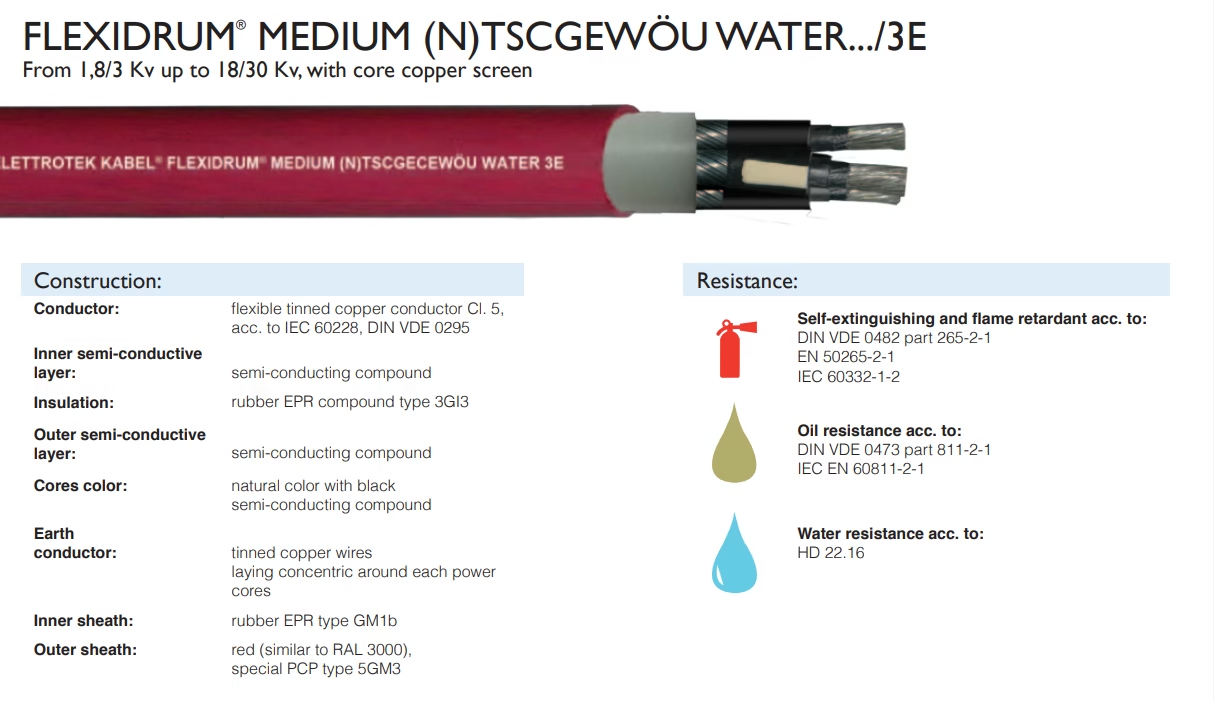
FLEXIDRUM® MEDIUM (N)TSCGEWÖU WATER /3E: Professional Shielded Submersible Cable with Integrated Core Copper Screen for Dredgers, Pumps, VFD Systems, and Electromagnetic Noise-Sensitive Water Infrastructure Purpose-engineered shielded submersible cable combining advanced water-submersion protection with electromagnetic noise immunity. FLEXIDRUM® MEDIUM (N)TSCGEWÖU WATER /3E integrates core copper screen shielding laid concentrically around power conductors, Class 5 tinned copper conductors (IEC 60228), advanced EPR insulation, and specialized water-resistant outer sheath (PCP Type 5GM3) to achieve 15+ year service life in demanding dredger systems, submersible pump installations, and VFD-controlled water infrastructure where electrical reliability and electromagnetic compatibility converge with water-submersion durability requirements. Executive Summary: Integrated Shielding and Water-Submersion Engineering for Next-Generation Dredging Systems Modern dredging and submersible pump systems increasingly employ variable-frequency drive (VFD) motor control and sophisticated sensor networks, creating electromagnetic environment incompatible with conventional unshielded cables. Simultaneously, VFD switching frequencies (5–20 kHz) generate high-frequency noise coupling into unshielded power circuits, causing sensor errors, control circuit malfunctions, and safety system failures. FLEXIDRUM® MEDIUM (N)TSCGEWÖU WATER /3E represents a breakthrough in submersible cable engineering, integrating comprehensive copper screen shielding with water-submersion durability to address the convergence of electromagnetic noise immunity and continuous water-immersion requirements. Traditional submersible cables lack electromagnetic shielding entirely, accepting noise-induced failures as operational cost in VFD-driven systems. Conversely, conventional shielded marine cables deteriorate rapidly in water-submersion environments, with shielding effectiveness degrading within 2–4 years as moisture penetrates underlying insulation and corrosion attacks copper screen geometry. FLEXIDRUM® MEDIUM (N)TSCGEWÖU WATER /3E overcomes both limitations through revolutionary integrated design: core copper screen shielding laid concentrically around each power conductor providing continuous EMI/RFI attenuation (>60 dB typical across 50 Hz to 10 MHz frequency range), tinned copper screen construction enabling superior electrochemical corrosion resistance in water-submersion environments, and water-resistant outer sheath (PCP Type 5GM3) maintaining shielding integrity through 15+ years of continuous seawater/brackish-water immersion.

(N)TSCGEWÖU WATER…/3E

FLEXIDRUM® MEDIUM (N)TSCGEWÖU WATER /3E: Professional Shielded Submersible Cable with Integrated Core Copper Screen for Dredgers, Pumps, VFD Systems, and Electromagnetic Noise-Sensitive Water Infrastructure Purpose-engineered shielded submersible cable combining advanced water-submersion protection with electromagnetic noise immunity. FLEXIDRUM® MEDIUM (N)TSCGEWÖU WATER /3E integrates core copper screen shielding laid concentrically around power conductors, Class 5 tinned copper conductors (IEC 60228), advanced EPR insulation, and specialized water-resistant outer sheath (PCP Type 5GM3) to achieve 15+ year service life in demanding dredger systems, submersible pump installations, and VFD-controlled water infrastructure where electrical reliability and electromagnetic compatibility converge with water-submersion durability requirements. Executive Summary: Integrated Shielding and Water-Submersion Engineering for Next-Generation Dredging Systems Modern dredging and submersible pump systems increasingly employ variable-frequency drive (VFD) motor control and sophisticated sensor networks, creating electromagnetic environment incompatible with conventional unshielded cables. Simultaneously, VFD switching frequencies (5–20 kHz) generate high-frequency noise coupling into unshielded power circuits, causing sensor errors, control circuit malfunctions, and safety system failures. FLEXIDRUM® MEDIUM (N)TSCGEWÖU WATER /3E represents a breakthrough in submersible cable engineering, integrating comprehensive copper screen shielding with water-submersion durability to address the convergence of electromagnetic noise immunity and continuous water-immersion requirements. Traditional submersible cables lack electromagnetic shielding entirely, accepting noise-induced failures as operational cost in VFD-driven systems. Conversely, conventional shielded marine cables deteriorate rapidly in water-submersion environments, with shielding effectiveness degrading within 2–4 years as moisture penetrates underlying insulation and corrosion attacks copper screen geometry. FLEXIDRUM® MEDIUM (N)TSCGEWÖU WATER /3E overcomes both limitations through revolutionary integrated design: core copper screen shielding laid concentrically around each power conductor providing continuous EMI/RFI attenuation (>60 dB typical across 50 Hz to 10 MHz frequency range), tinned copper screen construction enabling superior electrochemical corrosion resistance in water-submersion environments, and water-resistant outer sheath (PCP Type 5GM3) maintaining shielding integrity through 15+ years of continuous seawater/brackish-water immersion.
FLEXIDRUM® MEDIUM R 903: Professional Marine-Grade High-Flexibility Port Cable with Advanced Salt-Fog Resistance for Harbor Infrastructure and Offshore Lifting Applications Purpose-engineered marine cable delivering exceptional durability and electrical performance in aggressive port environments. FLEXIDRUM® MEDIUM R 903 combines Class 5 ultra-flexible red copper conductors (IEC 60228), advanced EPR insulation technology, and specialized salt-fog resistant outer sheath to achieve 15+ year service life in demanding harbor infrastructure including gantry cranes, container terminals, offshore lifting equipment, and inter-terminal transport systems. Nominal voltage range 3.6 kV to 12/20 kV accommodates complete port electrical hierarchies with unified cable platform.

FLEXIDRUM® MEDIUM R 903

FLEXIDRUM® MEDIUM R 903: Professional Marine-Grade High-Flexibility Port Cable with Advanced Salt-Fog Resistance for Harbor Infrastructure and Offshore Lifting Applications Purpose-engineered marine cable delivering exceptional durability and electrical performance in aggressive port environments. FLEXIDRUM® MEDIUM R 903 combines Class 5 ultra-flexible red copper conductors (IEC 60228), advanced EPR insulation technology, and specialized salt-fog resistant outer sheath to achieve 15+ year service life in demanding harbor infrastructure including gantry cranes, container terminals, offshore lifting equipment, and inter-terminal transport systems. Nominal voltage range 3.6 kV to 12/20 kV accommodates complete port electrical hierarchies with unified cable platform.
FLEXIDRUM® MEDIUM PLUS (N)TSCGEWÖU: Revolutionary Ultra-High-Speed Extended-Voltage Hybrid Power-Signal-Optical Cable for Next-Generation Mega-Port Automation, Offshore Mobile Lifting, and Advanced Forced-Guidance Systems Breakthrough next-generation hybrid electrical-optical cable engineered for the extreme-speed, extended-voltage, and real-time-telemetry requirements of modern mega-port gantry cranes, offshore mobile lifting platforms, and next-generation automated container-handling infrastructure. FLEXIDRUM® MEDIUM PLUS combines Class 5 ultra-flexible red copper conductors, EPR type 3GI3 thermoplastic rubber insulation, integrated 12–24 fiber-optic elements, advanced anti-twisting synthetic yarn reinforcement, and specialized salt-fog-resistant PCP outer sheath to deliver unified electrical power-signal-optical distribution at unprecedented 300 m/min maximum deployment speed (highest industry capability) across extended voltage range 3.6 kV to 18/30 kV, with proven reliability across −35 to +80°C operational envelope and comprehensive DIN VDE / EN / IEC marine and port automation certification.

FLEXIDRUM® MEDIUM PLUS (N)TSCGEWÖU OPTICAL FIBER

FLEXIDRUM® MEDIUM PLUS (N)TSCGEWÖU: Revolutionary Ultra-High-Speed Extended-Voltage Hybrid Power-Signal-Optical Cable for Next-Generation Mega-Port Automation, Offshore Mobile Lifting, and Advanced Forced-Guidance Systems Breakthrough next-generation hybrid electrical-optical cable engineered for the extreme-speed, extended-voltage, and real-time-telemetry requirements of modern mega-port gantry cranes, offshore mobile lifting platforms, and next-generation automated container-handling infrastructure. FLEXIDRUM® MEDIUM PLUS combines Class 5 ultra-flexible red copper conductors, EPR type 3GI3 thermoplastic rubber insulation, integrated 12–24 fiber-optic elements, advanced anti-twisting synthetic yarn reinforcement, and specialized salt-fog-resistant PCP outer sheath to deliver unified electrical power-signal-optical distribution at unprecedented 300 m/min maximum deployment speed (highest industry capability) across extended voltage range 3.6 kV to 18/30 kV, with proven reliability across −35 to +80°C operational envelope and comprehensive DIN VDE / EN / IEC marine and port automation certification.
(N)TSCGEWÖU Nomenclature Breakdown: (N) = "Nennspannung" (Nominal voltage designation) Indicates multi-voltage family (3.6/6 kV baseline, expandable to 20/35 kV) T = "Drei" implicitly (Three-phase implied in TSC configuration) SC = "S" (Stromleiter? Schirmung? Sheath-related) "C" (Conductor classification, typically Class 5 flexibility) Together: Three-core conductor family designation GE = "Gummi Elastomer" (Rubber Elastomer) Explicitly denotes EPR insulation (not polyethylene, not XLPE) German standard preference: EPR for MV reeling (vs. XLPE for fixed cables) WÖU = "Werkstoff/Öl/Umlauf" (Material/Oil/Circulation?) OR historically: VDE/UL approval markers? Likely: W = Werkstoff (special material formulation) Ö = Öl-resistenz (oil resistance capability) U = Universal or Umlauf (circulation/reeling capability) Combined meaning: (N)TSCGEWÖU = "Nominal-voltage Three-phase Single-conductor-core family, Gummi Elastomer insulation, Werkstoff-spezial (special material), Oil-resistant, Universal reeling" Design Philosophy Encoded: - Modular voltage architecture (one design, 3.6–20/35 kV options) - Three-phase power + distributed earth (TSC = not symmetric 3+3, but mixed) - EPR elastomer base (not synthetic XLPE) - Enhanced material formulation (not commodity grade) - Mobile/reeling-centric (forced guidance compatible) - Multi-environment tolerance (oil, moisture, temperature extremes)

(N)TSCGEWÖU Mining Trailing Cable

(N)TSCGEWÖU Nomenclature Breakdown: (N) = “Nennspannung” (Nominal voltage designation) Indicates multi-voltage family (3.6/6 kV baseline, expandable to 20/35 kV) T = “Drei” implicitly (Three-phase implied in TSC configuration) SC = “S” (Stromleiter? Schirmung? Sheath-related) “C” (Conductor classification, typically Class 5 flexibility) Together: Three-core conductor family designation GE = “Gummi Elastomer” (Rubber Elastomer) Explicitly denotes EPR insulation (not polyethylene, not XLPE) German standard preference: EPR for MV reeling (vs. XLPE for fixed cables) WÖU = “Werkstoff/Öl/Umlauf” (Material/Oil/Circulation?) OR historically: VDE/UL approval markers? Likely: W = Werkstoff (special material formulation) Ö = Öl-resistenz (oil resistance capability) U = Universal or Umlauf (circulation/reeling capability) Combined meaning: (N)TSCGEWÖU = “Nominal-voltage Three-phase Single-conductor-core family, Gummi Elastomer insulation, Werkstoff-spezial (special material), Oil-resistant, Universal reeling” Design Philosophy Encoded: – Modular voltage architecture (one design, 3.6–20/35 kV options) – Three-phase power + distributed earth (TSC = not symmetric 3+3, but mixed) – EPR elastomer base (not synthetic XLPE) – Enhanced material formulation (not commodity grade) – Mobile/reeling-centric (forced guidance compatible) – Multi-environment tolerance (oil, moisture, temperature extremes)
FLEXIDRUM® R 902 Optical Fiber Hybrid Cable: Integrated Power-Plus-Fiber-Optics Multi-Core Cable for Mining Excavators and Real-Time Data Transmission Revolutionary hybrid power-and-optical-fiber cable engineered for mining excavators and outdoor industrial equipment, FLEXIDRUM® R 902 integrates 6-fiber optics (multimode 62.5/125µm) with Class 5 flexible red copper power conductors (up to 3×300 mm²), advanced EPR insulation, semi-conductive protective layers, and specialized UV/ozone/moisture-resistant PUR sheath. Rated for 3.6/6 kV to 12/20 kV deployment, featuring 120 m/min speed capability with reduced weight and diameter—enabling real-time data communication from excavators, loaders, and remote mining equipment while maintaining full electrical power distribution in one unified integrated cable system.

FLEXIDRUM® MEDIUM R 902 OPTICAL FIBER

FLEXIDRUM® R 902 Optical Fiber Hybrid Cable: Integrated Power-Plus-Fiber-Optics Multi-Core Cable for Mining Excavators and Real-Time Data Transmission Revolutionary hybrid power-and-optical-fiber cable engineered for mining excavators and outdoor industrial equipment, FLEXIDRUM® R 902 integrates 6-fiber optics (multimode 62.5/125µm) with Class 5 flexible red copper power conductors (up to 3×300 mm²), advanced EPR insulation, semi-conductive protective layers, and specialized UV/ozone/moisture-resistant PUR sheath. Rated for 3.6/6 kV to 12/20 kV deployment, featuring 120 m/min speed capability with reduced weight and diameter—enabling real-time data communication from excavators, loaders, and remote mining equipment while maintaining full electrical power distribution in one unified integrated cable system.
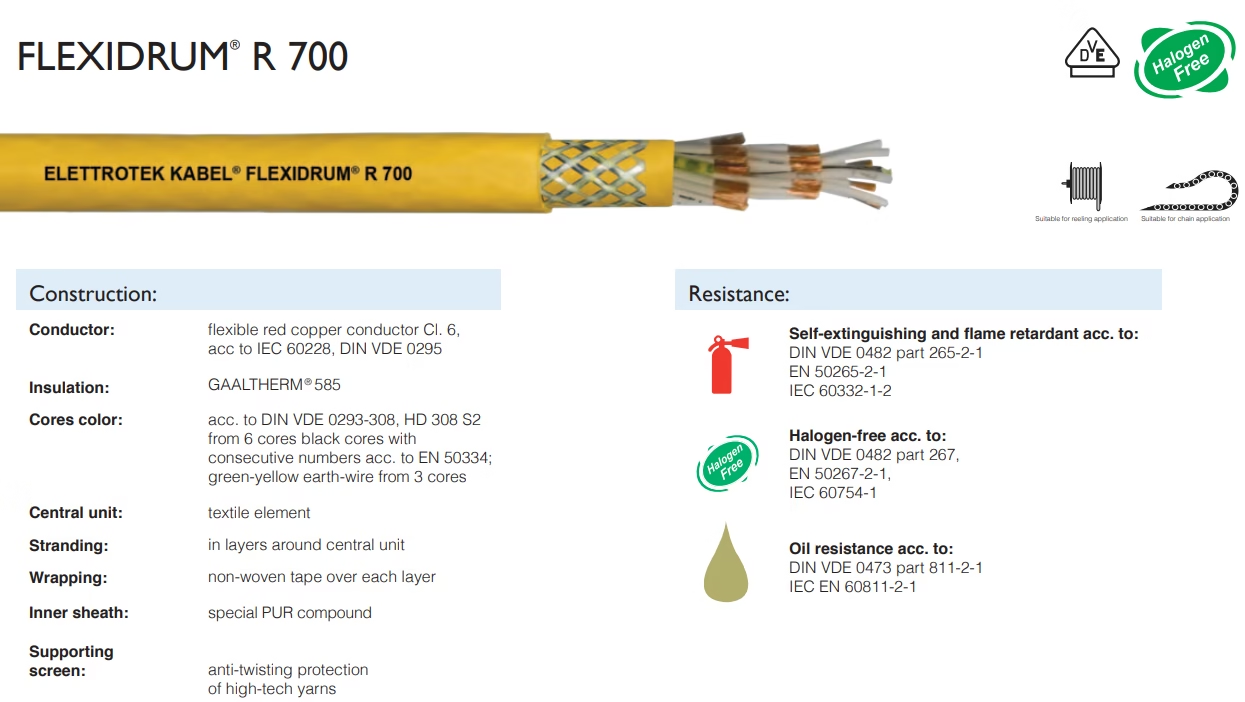
FLEXIDRUM® R 703: Advanced High-Temperature Industrial Multi-Core Cable for Extreme-Heat Heavy Equipment and Vertical Lifting Systems Engineered for the most demanding industrial thermal environments, the FLEXIDRUM® R 703 delivers breakthrough high-temperature performance with continuous operation capability to +120°C. Combining Class 5 flexible red copper conductor, advanced GAALTHERM® 585 thermoplastic elastomer insulation with extreme thermal resilience, aramide yarn anti-twisting reinforcement, and specialized PUR outer sheath formulation—meeting all fire-safety and halogen-free standards while maintaining electrical performance across the widest thermal envelope (−40 to +120°C) available in industrial cable engineering.

FLEXIDRUM® R 703

FLEXIDRUM® R 703: Advanced High-Temperature Industrial Multi-Core Cable for Extreme-Heat Heavy Equipment and Vertical Lifting Systems Engineered for the most demanding industrial thermal environments, the FLEXIDRUM® R 703 delivers breakthrough high-temperature performance with continuous operation capability to +120°C. Combining Class 5 flexible red copper conductor, advanced GAALTHERM® 585 thermoplastic elastomer insulation with extreme thermal resilience, aramide yarn anti-twisting reinforcement, and specialized PUR outer sheath formulation—meeting all fire-safety and halogen-free standards while maintaining electrical performance across the widest thermal envelope (−40 to +120°C) available in industrial cable engineering.
Multi-Purpose Industrial Cable FLEXIDRUM® SPECIAL R 702 Highly Flexible, Customizable Cable for Heavy Appliances & Vertical Use ⚡ Voltage: 0.6/1 kV OR 300/500 V 🔧 Speed: 120 m/min max 🎯 Configurations: 40+ SKUs, fully customizable 🌡️ Temperature: −50 to +90°C Nominal Voltage 0.6/1 kV OR 300/500 V (customer selection) Test Voltage 4 kV / 2 kV Depending on voltage class Max Speed 120 m/min Moderate-speed reeling applications Operating Temp −50 to +90°C Fixed & flexible laying (highest in class) Bending Radius 3×d to 7.5×D Depends on application mode & cable size Configurations 40+ Power, control, signal, fiber-optic integration

FLEXIDRUM® SPECIAL R 702

Multi-Purpose Industrial Cable FLEXIDRUM® SPECIAL R 702 Highly Flexible, Customizable Cable for Heavy Appliances & Vertical Use ⚡ Voltage: 0.6/1 kV OR 300/500 V 🔧 Speed: 120 m/min max 🎯 Configurations: 40+ SKUs, fully customizable 🌡️ Temperature: −50 to +90°C Nominal Voltage 0.6/1 kV OR 300/500 V (customer selection) Test Voltage 4 kV / 2 kV Depending on voltage class Max Speed 120 m/min Moderate-speed reeling applications Operating Temp −50 to +90°C Fixed & flexible laying (highest in class) Bending Radius 3×d to 7.5×D Depends on application mode & cable size Configurations 40+ Power, control, signal, fiber-optic integration
FLEXIDRUM® R 702: Advanced Salt-Spray Resistant Multi-Core Cable for Maritime Port Infrastructure and Container Handling Systems Engineered for extreme corrosive marine environments, the FLEXIDRUM® R 702 delivers proven salt-fog resistance combined with Class 5 flexible conductor technology, GAALTHERM® 630 thermoplastic insulation, and advanced anti-twisting textile reinforcement. Designed for automated container spreader bars, vertical lifting platforms, and offshore equipment exposed to continuous salt-spray cycles—meeting DIN VDE, EN, and IEC standards with reduced weight and diameter for enhanced installation flexibility in modern port automation infrastructure.

FLEXIDRUM® R 702

FLEXIDRUM® R 702: Advanced Salt-Spray Resistant Multi-Core Cable for Maritime Port Infrastructure and Container Handling Systems Engineered for extreme corrosive marine environments, the FLEXIDRUM® R 702 delivers proven salt-fog resistance combined with Class 5 flexible conductor technology, GAALTHERM® 630 thermoplastic insulation, and advanced anti-twisting textile reinforcement. Designed for automated container spreader bars, vertical lifting platforms, and offshore equipment exposed to continuous salt-spray cycles—meeting DIN VDE, EN, and IEC standards with reduced weight and diameter for enhanced installation flexibility in modern port automation infrastructure.
FLEXIDRUM® R 502: Advanced Heavy-Duty Industrial Cable with PUR Polyurethane Sheath and GAALTHERM® 530 Insulation for Motor Hoist, Transport Systems, and High-Mechanical-Stress Farm Equipment Engineered for extreme mechanical stress and industrial machinery applications, FLEXIDRUM® R 502 combines flexible Class 5 tinned or red copper conductor, GAALTHERM® 530 thermoplastic insulation, optional anti-twisting textile reinforcement, and advanced polyurethane (PUR) outer sheath to deliver unmatched durability in demanding heavy-duty environments. Rated for 180 m/min maximum speed (with anti-twisting protection), −40 to +90°C temperature stability, and superior UV/chemical/oil resistance across 3–42 core configurations (0.5–10 mm² cross-section range and specialized multi-core power configurations), this robust cable solution provides comprehensive protection against mechanical fatigue, thermal cycling, environmental degradation, and rapid-deployment stress for motor reel hoists, transport systems, movable motors, agricultural equipment, and specialized heavy-machinery infrastructure.

FLEXIDRUM® R 502

FLEXIDRUM® R 502: Advanced Heavy-Duty Industrial Cable with PUR Polyurethane Sheath and GAALTHERM® 530 Insulation for Motor Hoist, Transport Systems, and High-Mechanical-Stress Farm Equipment Engineered for extreme mechanical stress and industrial machinery applications, FLEXIDRUM® R 502 combines flexible Class 5 tinned or red copper conductor, GAALTHERM® 530 thermoplastic insulation, optional anti-twisting textile reinforcement, and advanced polyurethane (PUR) outer sheath to deliver unmatched durability in demanding heavy-duty environments. Rated for 180 m/min maximum speed (with anti-twisting protection), −40 to +90°C temperature stability, and superior UV/chemical/oil resistance across 3–42 core configurations (0.5–10 mm² cross-section range and specialized multi-core power configurations), this robust cable solution provides comprehensive protection against mechanical fatigue, thermal cycling, environmental degradation, and rapid-deployment stress for motor reel hoists, transport systems, movable motors, agricultural equipment, and specialized heavy-machinery infrastructure.
FLEXIDRUM® NSHTÖU (V): High-Flexibility Salt-Spray-Resistant Festoon Cable for Dynamic Port Terminal Applications Engineered for continuous rapid-deployment and high-cycling harbour equipment, FLEXIDRUM® NSHTÖU (V) combines tinned Class 5 flexible copper conductor, Kevlar central reinforcement, fire-resistant EPR insulation, and oil-resistant rubber outer sheath to deliver unmatched reliability in extreme salt-spray marine environments. Rated for 180 m/min maximum deployment speed, −25 to +90°C temperature stability, and 0.6/1 kV nominal specifications across 3–44 core configurations (0.5–10 mm² cross-section range), this advanced festoon solution provides comprehensive protection against corrosion, thermal cycling, mechanical flex-fatigue, and rapid-reeling stress for harbour cranes, container-handling spreader systems, dock-automation equipment, and specialized port terminal infrastructure.

NSHTÖU (V)

FLEXIDRUM® NSHTÖU (V): High-Flexibility Salt-Spray-Resistant Festoon Cable for Dynamic Port Terminal Applications Engineered for continuous rapid-deployment and high-cycling harbour equipment, FLEXIDRUM® NSHTÖU (V) combines tinned Class 5 flexible copper conductor, Kevlar central reinforcement, fire-resistant EPR insulation, and oil-resistant rubber outer sheath to deliver unmatched reliability in extreme salt-spray marine environments. Rated for 180 m/min maximum deployment speed, −25 to +90°C temperature stability, and 0.6/1 kV nominal specifications across 3–44 core configurations (0.5–10 mm² cross-section range), this advanced festoon solution provides comprehensive protection against corrosion, thermal cycling, mechanical flex-fatigue, and rapid-reeling stress for harbour cranes, container-handling spreader systems, dock-automation equipment, and specialized port terminal infrastructure.
GAALFLEX® CONTROL 600 PVC: UL/CSA Certified Multi-Core Control Cable for North American Industrial Applications with Comprehensive 2–50 Core Standardization and Complete 0.5–70 mm² Cross-Section Coverage (UL 1000V / CSA 1000V Nominal Voltage [600V Option Available], 3 kV Test Voltage per DIN VDE 0281 Part 2 + HD 21.2, Compact 4×D Fixed-Laying Bending Radius Enabling Tight Equipment Routing Through Industrial Enclosures and Control Panels, Comprehensive 2–50 Multi-Core Portfolio with 0.5–70 mm² Continuous Cross-Section Range Enabling Single-Product Specification Across All Industrial Control Applications, Flexible Class 5 Red Bare Copper per IEC 60228 and DIN VDE 0295, GAALTHERM® 521 Insulation and Grey (RAL 7001) GAALTHERM® 521 Outer Sheath Engineered for North American Industrial Environments, Oil-Resistant Chemistry per DIN EN 50290-2-22 / VDE 0819-102 TM54 Enabling Safe Deployment in Oil-Exposed Areas and Industrial Machine Environments, UL VW-1 and CSA FT1 Flame-Retardant Certification Providing Professional-Grade Fire Safety, Plus IEC 60332-1-2 and IEC 60332-3-24 Enhanced Flame Testing, Black EN 50334 Numbered Cores (2–5 Cores) or DIN VDE 0293-308 Color-Coded Cores (from 6 Cores) plus Green-Yellow Earth Protection (from 3 Cores) Enabling Standard Wiring Without Reference Documentation, Temperature Range −40 to +90°C Fixed Installation / −5 to +90°C Non-Continuously Flexible Deployment Optimized for Industrial Climate Variations, North American UL AWM Style Certification (21179 for 90°C/1000V or 105°C/1000V, or Style 2587 for 90°C/600V) Enabling Direct Acceptance in North American Equipment and Control Systems, RoHS and CE Certification, Engineered for North American Industrial Plant Electrical Distribution, Equipment Interconnection Systems, Industrial Automation Control Circuits, Heavy Manufacturing Facilities, Chemical Plant Installations, and Applications Where UL/CSA Certification, Comprehensive Multi-Core Standardization, Oil Resistance, and Professional Industrial Reliability Are Operational Requirements)

GAALFLEX® CONTROL 600 CY Lean

GAALFLEX® CONTROL 600 PVC: UL/CSA Certified Multi-Core Control Cable for North American Industrial Applications with Comprehensive 2–50 Core Standardization and Complete 0.5–70 mm² Cross-Section Coverage (UL 1000V / CSA 1000V Nominal Voltage [600V Option Available], 3 kV Test Voltage per DIN VDE 0281 Part 2 + HD 21.2, Compact 4×D Fixed-Laying Bending Radius Enabling Tight Equipment Routing Through Industrial Enclosures and Control Panels, Comprehensive 2–50 Multi-Core Portfolio with 0.5–70 mm² Continuous Cross-Section Range Enabling Single-Product Specification Across All Industrial Control Applications, Flexible Class 5 Red Bare Copper per IEC 60228 and DIN VDE 0295, GAALTHERM® 521 Insulation and Grey (RAL 7001) GAALTHERM® 521 Outer Sheath Engineered for North American Industrial Environments, Oil-Resistant Chemistry per DIN EN 50290-2-22 / VDE 0819-102 TM54 Enabling Safe Deployment in Oil-Exposed Areas and Industrial Machine Environments, UL VW-1 and CSA FT1 Flame-Retardant Certification Providing Professional-Grade Fire Safety, Plus IEC 60332-1-2 and IEC 60332-3-24 Enhanced Flame Testing, Black EN 50334 Numbered Cores (2–5 Cores) or DIN VDE 0293-308 Color-Coded Cores (from 6 Cores) plus Green-Yellow Earth Protection (from 3 Cores) Enabling Standard Wiring Without Reference Documentation, Temperature Range −40 to +90°C Fixed Installation / −5 to +90°C Non-Continuously Flexible Deployment Optimized for Industrial Climate Variations, North American UL AWM Style Certification (21179 for 90°C/1000V or 105°C/1000V, or Style 2587 for 90°C/600V) Enabling Direct Acceptance in North American Equipment and Control Systems, RoHS and CE Certification, Engineered for North American Industrial Plant Electrical Distribution, Equipment Interconnection Systems, Industrial Automation Control Circuits, Heavy Manufacturing Facilities, Chemical Plant Installations, and Applications Where UL/CSA Certification, Comprehensive Multi-Core Standardization, Oil Resistance, and Professional Industrial Reliability Are Operational Requirements)
GAALFLEX® CONTROL (H)07BQ-F PUR: Professional-Grade Multi-Core Industrial Power Tool Cable with Ultra-Flexible 4×D Architecture and Comprehensive 2–5 Core / 1.5–95 mm² Coverage (450/750V Nominal Voltage, 2.5 kV Test Voltage per DIN VDE 0281, Designed Specifically for High-Power Hand-Held Electric Equipment and Industrial Portable Systems Including Rotary Power Drills, Heavy Angle Grinders, Industrial Impact Drivers, and Temporary Construction Power Distribution, Ultra-Flexible 4×D Bending Radius Enabling 360° Continuous Tool Rotation and Aggressive Hand-Held Motion Without Insulation Fatigue or Conductor Breakage, Complete Multi-Core 2–5 Core / 1.5–95 mm² Portfolio Enabling Unified Industrial Power Tool Specification Across All Hand-Held and Temporary Equipment Applications, Class 5 Flexible Red Bare Copper per IEC 60228 and DIN VDE 0295, Rubber-Compound Insulation Optimized for Continuous Rotation and Industrial Durability, Orange (RAL 2003) PUR Outer Sheath with DIN VDE 0293-308 Color-Coded Cores (from 6 Cores) or EN 50334 Black Numbered Cores (2–5 Cores) plus Green-Yellow Earth Protection (from 3 Cores) Enabling Instant Circuit Identification Without Reference Documentation, Comprehensive Chemical, UV, and Abrasion Resistance per HD 22.10.S1 and DIN VDE 0282 T10 Enabling Robust Job-Site Routing Through Rough Terrain, Chemical Spill Areas, and Equipment Integration Without Insulation Degradation, Suitable for Dry, Humid, and Wet Environments Enabling Deployment in Rainy Conditions and Damp Construction Sites, Outdoor Use Support Within Temperature Range (−40 to +90°C Both Fixed and Flexible) Enabling Year-Round Industrial Equipment Operations, Layered Stranding Architecture Optimizing Flexibility and Copper Density Across Complete 1.5–95 mm² Range, RoHS and CE Certified, Not Suitable for Underground Laying, Engineered for Construction Sites, Industrial Job Sites, Temporary Power Distribution Systems, Heavy-Duty Portable Equipment Operations, Industrial Power Tool Operations, and Applications Where Simultaneous Ultra-Flexible 360° Rotation, Comprehensive Multi-Core Coverage, Environmental Durability, and Professional Industrial Reliability Are Operational Requirements)

GAALFLEX® CONTROL (H)07BQ-F

GAALFLEX® CONTROL (H)07BQ-F PUR: Professional-Grade Multi-Core Industrial Power Tool Cable with Ultra-Flexible 4×D Architecture and Comprehensive 2–5 Core / 1.5–95 mm² Coverage (450/750V Nominal Voltage, 2.5 kV Test Voltage per DIN VDE 0281, Designed Specifically for High-Power Hand-Held Electric Equipment and Industrial Portable Systems Including Rotary Power Drills, Heavy Angle Grinders, Industrial Impact Drivers, and Temporary Construction Power Distribution, Ultra-Flexible 4×D Bending Radius Enabling 360° Continuous Tool Rotation and Aggressive Hand-Held Motion Without Insulation Fatigue or Conductor Breakage, Complete Multi-Core 2–5 Core / 1.5–95 mm² Portfolio Enabling Unified Industrial Power Tool Specification Across All Hand-Held and Temporary Equipment Applications, Class 5 Flexible Red Bare Copper per IEC 60228 and DIN VDE 0295, Rubber-Compound Insulation Optimized for Continuous Rotation and Industrial Durability, Orange (RAL 2003) PUR Outer Sheath with DIN VDE 0293-308 Color-Coded Cores (from 6 Cores) or EN 50334 Black Numbered Cores (2–5 Cores) plus Green-Yellow Earth Protection (from 3 Cores) Enabling Instant Circuit Identification Without Reference Documentation, Comprehensive Chemical, UV, and Abrasion Resistance per HD 22.10.S1 and DIN VDE 0282 T10 Enabling Robust Job-Site Routing Through Rough Terrain, Chemical Spill Areas, and Equipment Integration Without Insulation Degradation, Suitable for Dry, Humid, and Wet Environments Enabling Deployment in Rainy Conditions and Damp Construction Sites, Outdoor Use Support Within Temperature Range (−40 to +90°C Both Fixed and Flexible) Enabling Year-Round Industrial Equipment Operations, Layered Stranding Architecture Optimizing Flexibility and Copper Density Across Complete 1.5–95 mm² Range, RoHS and CE Certified, Not Suitable for Underground Laying, Engineered for Construction Sites, Industrial Job Sites, Temporary Power Distribution Systems, Heavy-Duty Portable Equipment Operations, Industrial Power Tool Operations, and Applications Where Simultaneous Ultra-Flexible 360° Rotation, Comprehensive Multi-Core Coverage, Environmental Durability, and Professional Industrial Reliability Are Operational Requirements)
GAALFLEX® CONTROL 07BQ-F PUR: Professional-Grade Single-Core Heavy-Load Power Tool Cable with Comprehensive 16–300 mm² Continuous Range and Industrial-Strength Job-Site Durability (450/750V Nominal Voltage, 2.5 kV Test Voltage per DIN VDE 0281, Designed Specifically for High-Power Hand-Held Electric Equipment and Industrial Portable Systems Including Concrete Breakers, Heavy-Duty Angle Grinders, Industrial Drills, and Temporary Construction Power Distribution, Flexible 10×D Bending Radius Enabling Professional Job-Site Routing Through Complex Terrain and Equipment Integration Without Space Constraints, Complete Single-Core 16–300 mm² Portfolio Enabling Unified Heavy-Load Application Specification from Substation-Scale Feeders Through Heavy Portable Equipment, Class 5 Flexible Red Bare Copper per IEC 60228 and DIN VDE 0295, Rubber-Compound Insulation Optimized for Heavy-Load Durability and Electrical Safety, Orange (RAL 2003) PUR Outer Sheath with Selectable Black (L) or Green-Yellow (PE) Core Identification Enabling Instant Phase/Ground Identification Without Reference Documentation, Comprehensive Chemical, UV, and Abrasion Resistance Enabling Robust Job-Site Routing Through Chemical Spill Areas, Extended Sun Exposure, and Pipe Clamp Integration Without Insulation Degradation, Suitable for Dry, Humid, and Wet Environments Enabling Deployment in Rainy Conditions and Damp Construction Sites, Outdoor Use Support Within Temperature Range (−40 to +90°C Both Fixed and Flexible) Enabling Year-Round Heavy-Load Job-Site Operations, Layered Stranding Architecture Optimizing Flexibility and Copper Density for Large-Diameter Single Cores, RoHS and CE Certified, Not Suitable for Underground Laying, Engineered for Heavy-Load Construction Sites, Industrial Job Sites, Temporary Power Distribution Systems, Heavy-Duty Portable Equipment Operations, Concrete and Heavy Equipment Contractor Applications, and Applications Where Comprehensive Single-Core Coverage, High-Current Capacity, Environmental Durability, and Professional Heavy-Load Reliability Are Operational Requirements)

GAALFLEX® CONTROL 07BQ-F

GAALFLEX® CONTROL 07BQ-F PUR: Professional-Grade Single-Core Heavy-Load Power Tool Cable with Comprehensive 16–300 mm² Continuous Range and Industrial-Strength Job-Site Durability (450/750V Nominal Voltage, 2.5 kV Test Voltage per DIN VDE 0281, Designed Specifically for High-Power Hand-Held Electric Equipment and Industrial Portable Systems Including Concrete Breakers, Heavy-Duty Angle Grinders, Industrial Drills, and Temporary Construction Power Distribution, Flexible 10×D Bending Radius Enabling Professional Job-Site Routing Through Complex Terrain and Equipment Integration Without Space Constraints, Complete Single-Core 16–300 mm² Portfolio Enabling Unified Heavy-Load Application Specification from Substation-Scale Feeders Through Heavy Portable Equipment, Class 5 Flexible Red Bare Copper per IEC 60228 and DIN VDE 0295, Rubber-Compound Insulation Optimized for Heavy-Load Durability and Electrical Safety, Orange (RAL 2003) PUR Outer Sheath with Selectable Black (L) or Green-Yellow (PE) Core Identification Enabling Instant Phase/Ground Identification Without Reference Documentation, Comprehensive Chemical, UV, and Abrasion Resistance Enabling Robust Job-Site Routing Through Chemical Spill Areas, Extended Sun Exposure, and Pipe Clamp Integration Without Insulation Degradation, Suitable for Dry, Humid, and Wet Environments Enabling Deployment in Rainy Conditions and Damp Construction Sites, Outdoor Use Support Within Temperature Range (−40 to +90°C Both Fixed and Flexible) Enabling Year-Round Heavy-Load Job-Site Operations, Layered Stranding Architecture Optimizing Flexibility and Copper Density for Large-Diameter Single Cores, RoHS and CE Certified, Not Suitable for Underground Laying, Engineered for Heavy-Load Construction Sites, Industrial Job Sites, Temporary Power Distribution Systems, Heavy-Duty Portable Equipment Operations, Concrete and Heavy Equipment Contractor Applications, and Applications Where Comprehensive Single-Core Coverage, High-Current Capacity, Environmental Durability, and Professional Heavy-Load Reliability Are Operational Requirements)
GAALFLEX® CONTROL 1000 CH: Fire-Safe Halogen-Free Multi-Core Shielded Control Cable with Triple-Layer Zero-Halogen Architecture (Halogen-Free Type TI6 Insulation + Tinned-Copper-Braid Overall Screen + Halogen-Free Type TM7 Outer Sheath) for Medical Facilities, Data Centers, and Fire-Code-Compliant Installations (0.6/1 kV Nominal Voltage, 4 kV Test Voltage per DIN VDE 0281, Class 5 Flexible Red Bare Copper per IEC 60228, Triple-Layer Zero-Halogen Architecture Combining Halogen-Free Type TI6 Insulation Protecting Conductor Bundles, Tinned-Copper-Braid Overall Screen Achieving ≥75 dB EMI Attenuation, Halogen-Free Type TM7 Outer Sheath Providing Environmental Protection Without Acid-Gas Release During Fire Conditions, IEC 60332-3-24 Enhanced Flame Test Certification Exceeding Standard IEC 60332-1-2 Baseline and Achieving European Building Code Fire-Safety Requirements, Zero-Halogenated-Acid-Gas Release per IEC 60754-1 (

GAALFLEX® CONTROL 1000 CH

GAALFLEX® CONTROL 1000 CH: Fire-Safe Halogen-Free Multi-Core Shielded Control Cable with Triple-Layer Zero-Halogen Architecture (Halogen-Free Type TI6 Insulation + Tinned-Copper-Braid Overall Screen + Halogen-Free Type TM7 Outer Sheath) for Medical Facilities, Data Centers, and Fire-Code-Compliant Installations (0.6/1 kV Nominal Voltage, 4 kV Test Voltage per DIN VDE 0281, Class 5 Flexible Red Bare Copper per IEC 60228, Triple-Layer Zero-Halogen Architecture Combining Halogen-Free Type TI6 Insulation Protecting Conductor Bundles, Tinned-Copper-Braid Overall Screen Achieving ≥75 dB EMI Attenuation, Halogen-Free Type TM7 Outer Sheath Providing Environmental Protection Without Acid-Gas Release During Fire Conditions, IEC 60332-3-24 Enhanced Flame Test Certification Exceeding Standard IEC 60332-1-2 Baseline and Achieving European Building Code Fire-Safety Requirements, Zero-Halogenated-Acid-Gas Release per IEC 60754-1 (
GAALFLEX® CONTROL 1000 CY: Industrial-Grade Multi-Core Shielded Control Cable with Inner Sheath and Triple-Layer Architecture (Inner PVC Sheath + Tinned-Copper-Braid Overall Screen + Black Outer Sheath) for Signal and Control Distribution in Industrial Facilities, Factory Automation, Machine Control, and Instrumentation Integration (0.6/1 kV Nominal Voltage, 4 kV Test Voltage per DIN VDE 0281, Class 5 Flexible Red Bare Copper per IEC 60228, Comprehensive Triple-Layer Shielding Architecture Combining Inner PVC Sheath (Type TM2) to Protect Conductor Bundles, Tinned-Copper-Braid Overall Screen Achieving ≥75 dB EMI Attenuation Across Industrial Frequency Spectrum (50 Hz–100 MHz Covering AC Drives, PLC Instrumentation, and Fieldbus Communications), Black (RAL 9005) PVC Type TM2 Outer Sheath, Flexible 20×D Bending Radius Enabling Ultra-Flexible Routing Within Compact Panel Enclosures and Tight Conduits Reducing Installation Time by 30–50% Compared to Standard 6×D Cables, Ultra-Flexible Class 5 Construction Enabling Repeated Flexing During Machine Operation Without Fatigue, Standardized 2–7 Core Portfolio with Continuous 0.5–35 mm² Cross-Section Range Including Dual-Pair Configurations and Special Color-Coded or Numbered-Core Options, Black EN 50334 Numbered Cores Enabling Zero-Documentation Installation, Green-Yellow Earth Protection Cores Available from 3-Core Configurations, UV Resistance Enabling Outdoor Facility Perimeter Routing, Flame-Retardant and Self-Extinguishing per EN 60332, Temperature Range −40 to +80°C Fixed Installation / −5 to +70°C Flexible Deployment, Layered Stranding Architecture Optimizing Flexibility and Shielding Effectiveness, RoHS and CE Certified, Engineered for Industrial Signal and Control Distribution, Factory Automation PLC and Drive Integration, Machine Tool Instrumentation, Motor Control Circuits, and Fieldbus Signal Distribution Where Simultaneous EMI Protection, Ultra-Flexible Routing, Triple-Layer Durability, and Compact Installation Are Critical Requirements)

GAALFLEX® CONTROL 1000 CY

GAALFLEX® CONTROL 1000 CY: Industrial-Grade Multi-Core Shielded Control Cable with Inner Sheath and Triple-Layer Architecture (Inner PVC Sheath + Tinned-Copper-Braid Overall Screen + Black Outer Sheath) for Signal and Control Distribution in Industrial Facilities, Factory Automation, Machine Control, and Instrumentation Integration (0.6/1 kV Nominal Voltage, 4 kV Test Voltage per DIN VDE 0281, Class 5 Flexible Red Bare Copper per IEC 60228, Comprehensive Triple-Layer Shielding Architecture Combining Inner PVC Sheath (Type TM2) to Protect Conductor Bundles, Tinned-Copper-Braid Overall Screen Achieving ≥75 dB EMI Attenuation Across Industrial Frequency Spectrum (50 Hz–100 MHz Covering AC Drives, PLC Instrumentation, and Fieldbus Communications), Black (RAL 9005) PVC Type TM2 Outer Sheath, Flexible 20×D Bending Radius Enabling Ultra-Flexible Routing Within Compact Panel Enclosures and Tight Conduits Reducing Installation Time by 30–50% Compared to Standard 6×D Cables, Ultra-Flexible Class 5 Construction Enabling Repeated Flexing During Machine Operation Without Fatigue, Standardized 2–7 Core Portfolio with Continuous 0.5–35 mm² Cross-Section Range Including Dual-Pair Configurations and Special Color-Coded or Numbered-Core Options, Black EN 50334 Numbered Cores Enabling Zero-Documentation Installation, Green-Yellow Earth Protection Cores Available from 3-Core Configurations, UV Resistance Enabling Outdoor Facility Perimeter Routing, Flame-Retardant and Self-Extinguishing per EN 60332, Temperature Range −40 to +80°C Fixed Installation / −5 to +70°C Flexible Deployment, Layered Stranding Architecture Optimizing Flexibility and Shielding Effectiveness, RoHS and CE Certified, Engineered for Industrial Signal and Control Distribution, Factory Automation PLC and Drive Integration, Machine Tool Instrumentation, Motor Control Circuits, and Fieldbus Signal Distribution Where Simultaneous EMI Protection, Ultra-Flexible Routing, Triple-Layer Durability, and Compact Installation Are Critical Requirements)
GAALFLEX® CONTROL 1000 BH: CPR EU 305/11 Building-Regulation-Compliant Multi-Core Control Cable with Ultra-Compact Design and Eca Fire Classification for European Building Electrical Distribution Systems (0.6/1 kV Nominal Voltage, 4 kV Test Voltage per DIN VDE 0281, Class 5 Flexible Red Bare Copper per IEC 60228, Halogen-Free Thermoplastic Outer Sheath Grey (RAL 7001), Ultra-Compact 4×D Minimum Bending Radius Fixed Installation / 6×D Flexible Installation Enabling 50–70% Reduction in Conduit Cross-Section and Electrical Panel Size Compared to Standard 10–15×D Building Cables, Eca Fire-Classification Performance per EN 13501-6 CPR EU 305/11 Compliance Across All EU Member States, DIN VDE 0293-308 Color-Coded Cores (from 6 Cores) or EN 50334 Black Numbered Cores (for 2–5 Core Configurations) Enabling Standard Installation Without Separate Documentation, Specialized Three-Phase+Neutral+Earth Configurations (e.g., 3×35+25, 3×50+25 mm²) Optimized for Standard Building Three-Phase Distribution Architecture, Flame-Retardant and Self-Extinguishing per EN 50266-2-4 and CEI 20-22 III With Enhanced Performance per IEC 60332-3-24, Zero-Halogenated-Acid-Gas Release per IEC 60754-1, Low-Smoke-Density per IEC 61034, Low-Corrosive-Gas per IEC 60754-2, Temperature Range −15 to +90°C, Maximum Short-Circuit Temperature +250°C Enabling Safe Integration into Fault-Current Scenarios, Standardized Cross-Section Portfolio Spanning 2 to 30 Cores with 1.5 mm² to 300 mm² Continuous Cross-Section Range Including Standard and Specialized Configurations, RoHS and CE Certified, Engineered for European Building Electrical Installation Systems, Residential and Commercial Building Distribution, Three-Phase Building Main Feeders, Panel-to-Panel Branch Circuits, and CPR-Regulated Building Installations Where Fire-Safety Compliance and Space-Efficient Compact Routing Are Mandatory Requirements)

GAALFLEX® CONTROL 1000 BH

GAALFLEX® CONTROL 1000 BH: CPR EU 305/11 Building-Regulation-Compliant Multi-Core Control Cable with Ultra-Compact Design and Eca Fire Classification for European Building Electrical Distribution Systems (0.6/1 kV Nominal Voltage, 4 kV Test Voltage per DIN VDE 0281, Class 5 Flexible Red Bare Copper per IEC 60228, Halogen-Free Thermoplastic Outer Sheath Grey (RAL 7001), Ultra-Compact 4×D Minimum Bending Radius Fixed Installation / 6×D Flexible Installation Enabling 50–70% Reduction in Conduit Cross-Section and Electrical Panel Size Compared to Standard 10–15×D Building Cables, Eca Fire-Classification Performance per EN 13501-6 CPR EU 305/11 Compliance Across All EU Member States, DIN VDE 0293-308 Color-Coded Cores (from 6 Cores) or EN 50334 Black Numbered Cores (for 2–5 Core Configurations) Enabling Standard Installation Without Separate Documentation, Specialized Three-Phase+Neutral+Earth Configurations (e.g., 3×35+25, 3×50+25 mm²) Optimized for Standard Building Three-Phase Distribution Architecture, Flame-Retardant and Self-Extinguishing per EN 50266-2-4 and CEI 20-22 III With Enhanced Performance per IEC 60332-3-24, Zero-Halogenated-Acid-Gas Release per IEC 60754-1, Low-Smoke-Density per IEC 61034, Low-Corrosive-Gas per IEC 60754-2, Temperature Range −15 to +90°C, Maximum Short-Circuit Temperature +250°C Enabling Safe Integration into Fault-Current Scenarios, Standardized Cross-Section Portfolio Spanning 2 to 30 Cores with 1.5 mm² to 300 mm² Continuous Cross-Section Range Including Standard and Specialized Configurations, RoHS and CE Certified, Engineered for European Building Electrical Installation Systems, Residential and Commercial Building Distribution, Three-Phase Building Main Feeders, Panel-to-Panel Branch Circuits, and CPR-Regulated Building Installations Where Fire-Safety Compliance and Space-Efficient Compact Routing Are Mandatory Requirements)
GAALFLEX® CONTROL 1000: Cost-Optimized UV-Resistant Low-Voltage Industrial Multi-Core Control Cable for Outdoor and Building Electrical Distribution Systems (0.6/1 kV Nominal Voltage, 4 kV Test Voltage per DIN VDE 0281, Class 5 Flexible Red Bare Copper per IEC 60228 and DIN VDE 0295, PVC Type TI1 Core Insulation, Black (RAL 9005) UV-Resistant PVC Type TM2 Outer Sheath Enabling Indefinite Outdoor Exposure Without Ultraviolet-Induced Embrittlement or Color Degradation, Black Color-Numbered Cores per EN 50334 Standard with Green-Yellow Earth Protection Conductors from 3 Cores, Flame-Retardant and Self-Extinguishing per DIN VDE 0482 EN 50265-2-1 and IEC 60332-1-2, Oil and Chemical Resistant Properties Enabling Integration into Industrial Facilities with Mineral-Oil Exposure and Alkaline/Acidic Ambient Conditions, Temperature Range −40 to +80°C Fixed Installation / −5 to +70°C Flexible Deployment, 4×D Fixed Bending Radius / 15×D Flexible Installation, Unprecedented Standardized SKU Portfolio Spanning 2 to 61 Core Configurations with Cross-Section Range from 0.5 mm² to 150 mm² per Core Enabling Single-Product Standardization Across Complete Low-Voltage Electrical Distribution Systems, Building Wiring, Outdoor Lighting Distribution, Industrial Control Harnesses, and Cost-Sensitive Multi-Core Cable Applications, RoHS and CE Certified, Engineered for Building Electrical Systems, Outdoor Power and Control Distribution, Municipal and Street Lighting, Industrial Facility Electrical Harnesses, Cost-Sensitive Electrical Distribution, and Global Low-Voltage Installation Markets)

GAALFLEX® CONTROL 1000

GAALFLEX® CONTROL 1000: Cost-Optimized UV-Resistant Low-Voltage Industrial Multi-Core Control Cable for Outdoor and Building Electrical Distribution Systems (0.6/1 kV Nominal Voltage, 4 kV Test Voltage per DIN VDE 0281, Class 5 Flexible Red Bare Copper per IEC 60228 and DIN VDE 0295, PVC Type TI1 Core Insulation, Black (RAL 9005) UV-Resistant PVC Type TM2 Outer Sheath Enabling Indefinite Outdoor Exposure Without Ultraviolet-Induced Embrittlement or Color Degradation, Black Color-Numbered Cores per EN 50334 Standard with Green-Yellow Earth Protection Conductors from 3 Cores, Flame-Retardant and Self-Extinguishing per DIN VDE 0482 EN 50265-2-1 and IEC 60332-1-2, Oil and Chemical Resistant Properties Enabling Integration into Industrial Facilities with Mineral-Oil Exposure and Alkaline/Acidic Ambient Conditions, Temperature Range −40 to +80°C Fixed Installation / −5 to +70°C Flexible Deployment, 4×D Fixed Bending Radius / 15×D Flexible Installation, Unprecedented Standardized SKU Portfolio Spanning 2 to 61 Core Configurations with Cross-Section Range from 0.5 mm² to 150 mm² per Core Enabling Single-Product Standardization Across Complete Low-Voltage Electrical Distribution Systems, Building Wiring, Outdoor Lighting Distribution, Industrial Control Harnesses, and Cost-Sensitive Multi-Core Cable Applications, RoHS and CE Certified, Engineered for Building Electrical Systems, Outdoor Power and Control Distribution, Municipal and Street Lighting, Industrial Facility Electrical Harnesses, Cost-Sensitive Electrical Distribution, and Global Low-Voltage Installation Markets)