Flexible Cables With High Bending Life and Fatigue Resistance

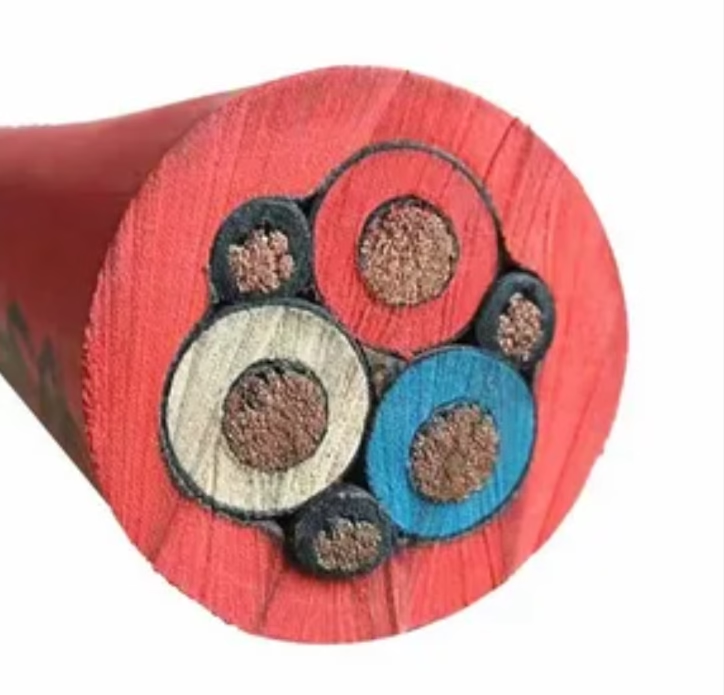
(N)TSKCGEWÖU 3x150+3x25/3 3.6/6kV cable with split three-part earth conductor is approximately 65 mm (2.56 inches), with a standard tolerance window of ±3.0 mm producing a permissible range of 62.0–68.0 mm. The inner jacket (the intermediate protective layer between the insulation and outer sheath) typically has a nominal thickness of approximately 0.8–1.0 mm, contributing to overall diameter build-up but not typically measured as a separate "inner diameter" in engineering specifications because the inner jacket is not a defined outer boundary—it is a layer embedded within the cable structure. The outer jacket (the final thermosetting rubber compound layer) has a nominal thickness of approximately 2.5–3.0 mm, providing the cable's mechanical interface with the environment. The approximate total weight of this cable is 8,200 kg/km (5,510 lbs/1000 ft), with copper content approximately 4,560 kg/km. It features three 150 mm² Class 5 tinned copper main phase conductors, three strategically distributed 25/3 mm² split earth conductors for electromagnetic symmetry, a 3GI3 high-dielectric EPR insulation system rated for continuous 90°C operation, an anti-torsion braid reinforcement layer, and a 5GM5 thermosetting halogen-free outer sheath providing extreme abrasion and tear resistance.

What is the Inner and Outer Jacket Diameter of (N)TSKCGEWÖU 3×150+3×25/3 3.6/6kV Splittable Earth Cable?

(N)TSKCGEWÖU 3×150+3×25/3 3.6/6kV cable with split three-part earth conductor is approximately 65 mm (2.56 inches), with a standard tolerance window of ±3.0 mm producing a permissible range of 62.0–68.0 mm. The inner jacket (the intermediate protective layer between the insulation and outer sheath) typically has a nominal thickness of approximately 0.8–1.0 mm, contributing to overall diameter build-up but not typically measured as a separate “inner diameter” in engineering specifications because the inner jacket is not a defined outer boundary—it is a layer embedded within the cable structure. The outer jacket (the final thermosetting rubber compound layer) has a nominal thickness of approximately 2.5–3.0 mm, providing the cable’s mechanical interface with the environment. The approximate total weight of this cable is 8,200 kg/km (5,510 lbs/1000 ft), with copper content approximately 4,560 kg/km. It features three 150 mm² Class 5 tinned copper main phase conductors, three strategically distributed 25/3 mm² split earth conductors for electromagnetic symmetry, a 3GI3 high-dielectric EPR insulation system rated for continuous 90°C operation, an anti-torsion braid reinforcement layer, and a 5GM5 thermosetting halogen-free outer sheath providing extreme abrasion and tear resistance.
The nominal width of a (N)TSFLCGEWÖU 4x120 0.6/1kV shielded flat trailing cable is approximately 91 mm (3.58 inches), with a tolerance window of ±3.5 mm producing a permissible range of 87.5–94.5 mm. The nominal thickness is approximately 27.5 mm (1.08 inches), with a tolerance window of ±1.5 mm producing a permissible range of 26.0–29.0 mm. The approximate total weight of this cable is 8,200 kg/km (5,500 lbs/1000 ft), with copper weight approximately 5,250 kg/km. It features four 120 mm² main power conductors rated for 321 amperes continuous operation at 30°C ambient, supplemented by individual copper braid shielding on each conductor for electromagnetic compatibility (EMC) with variable-frequency drives and other sensitive equipment. The distinction between width and thickness for flat cables differs fundamentally from round cable specifications because flat cables do not have a single outer diameter. Instead, engineers must manage two dimensions simultaneously, and these dimensions directly determine whether the cable will fit into festoon track systems, contact shoe assemblies, and guidance rail configurations commonly deployed in overhead crane systems and automated material handling equipment.

What is the Width and Thickness of (N)TSFLCGEWÖU 4×120 0.6/1kV Shielded Flat Cable?

The nominal width of a (N)TSFLCGEWÖU 4×120 0.6/1kV shielded flat trailing cable is approximately 91 mm (3.58 inches), with a tolerance window of ±3.5 mm producing a permissible range of 87.5–94.5 mm. The nominal thickness is approximately 27.5 mm (1.08 inches), with a tolerance window of ±1.5 mm producing a permissible range of 26.0–29.0 mm. The approximate total weight of this cable is 8,200 kg/km (5,500 lbs/1000 ft), with copper weight approximately 5,250 kg/km. It features four 120 mm² main power conductors rated for 321 amperes continuous operation at 30°C ambient, supplemented by individual copper braid shielding on each conductor for electromagnetic compatibility (EMC) with variable-frequency drives and other sensitive equipment. The distinction between width and thickness for flat cables differs fundamentally from round cable specifications because flat cables do not have a single outer diameter. Instead, engineers must manage two dimensions simultaneously, and these dimensions directly determine whether the cable will fit into festoon track systems, contact shoe assemblies, and guidance rail configurations commonly deployed in overhead crane systems and automated material handling equipment.
(N)TSCGEWÖU 3x185+3x35/3 6/10kV cables in large-scale mining operations, the outer diameter is not merely a specification number—it is a critical interface parameter determining whether the cable fits your reel system, passes through underground shaft collars, mates with terminal connectors, and allows proper tension management during deployment and retrieval.

What is the Exact Outer Diameter of (N)TSCGEWÖU 3×185+3×35/3 6/10kV Reeling Cable?

(N)TSCGEWÖU 3×185+3×35/3 6/10kV cables in large-scale mining operations, the outer diameter is not merely a specification number—it is a critical interface parameter determining whether the cable fits your reel system, passes through underground shaft collars, mates with terminal connectors, and allows proper tension management during deployment and retrieval.
LAPP ÖLFLEX CHAIN 896 P 4G16 is a premium-tier industrial drag chain power cable engineered for the most demanding continuous-flex applications in modern manufacturing automation. The cable's specialized design delivers 76 amperes continuously while withstanding millions of dynamic bending cycles in CNC machine tools, industrial robotic systems, automated storage and retrieval equipment, wind turbine yaw and pitch systems, and mobile material handling platforms. Every aspect of the cable—from the ultrafine Class 6 copper conductor stranding through the thermosetting halogen-free PUR outer jacket—reflects LAPP's commitment to reliability in environments where mechanical fatigue is the primary failure mode, not electrical stress.

Direct Replacement for LAPP ÖLFLEX CHAIN 896 P 4G16: High-Flex Drag Chain Cable Equivalents

LAPP ÖLFLEX CHAIN 896 P 4G16 is a premium-tier industrial drag chain power cable engineered for the most demanding continuous-flex applications in modern manufacturing automation. The cable’s specialized design delivers 76 amperes continuously while withstanding millions of dynamic bending cycles in CNC machine tools, industrial robotic systems, automated storage and retrieval equipment, wind turbine yaw and pitch systems, and mobile material handling platforms. Every aspect of the cable—from the ultrafine Class 6 copper conductor stranding through the thermosetting halogen-free PUR outer jacket—reflects LAPP’s commitment to reliability in environments where mechanical fatigue is the primary failure mode, not electrical stress.
Nexans RHEYFIRM (RS) 12/20kV is a premium-tier medium-voltage reeling cable specifically engineered for high-speed, high-stress port machinery and industrial heavy-load applications. The cable's design reflects Nexans' deep expertise in marine and dockside equipment, incorporating proprietary RHEYCLEAN insulation chemistry and reinforced anti-torsion braid architecture that together enable reliable operation in environments where cable flexing occurs thousands of times per day at speeds exceeding 200 meters per minute. However, RHEYFIRM cables command premium pricing that reflects both their proven field performance and Nexans' brand positioning. For procurement teams managing large cable quantities, facing extended supply lead times, or constrained by budget limitations, the search for a functionally equivalent alternative is not a search for a compromise. Rather, it is a systematic evaluation of competing engineering approaches that achieve the same electrical safety, mechanical durability, and environmental resilience through different manufacturing philosophies. This guide addresses the practical reality that excellent medium-voltage reeling cables are manufactured by multiple established European and global suppliers. Helukabel (Germany), SAB Kabel (Germany), Prysmian (Italy/France), Feichun (China), and other manufacturers produce cables that meet or exceed RHEYFIRM's performance specifications while offering cost savings between 15–35%, faster regional delivery, or better availability for Asia-Pacific projects.

Cost-Effective Replacement for Nexans RHEYFIRM (RS) 3×50+3×25/3 12/20kV

Nexans RHEYFIRM (RS) 12/20kV is a premium-tier medium-voltage reeling cable specifically engineered for high-speed, high-stress port machinery and industrial heavy-load applications. The cable’s design reflects Nexans’ deep expertise in marine and dockside equipment, incorporating proprietary RHEYCLEAN insulation chemistry and reinforced anti-torsion braid architecture that together enable reliable operation in environments where cable flexing occurs thousands of times per day at speeds exceeding 200 meters per minute. However, RHEYFIRM cables command premium pricing that reflects both their proven field performance and Nexans’ brand positioning. For procurement teams managing large cable quantities, facing extended supply lead times, or constrained by budget limitations, the search for a functionally equivalent alternative is not a search for a compromise. Rather, it is a systematic evaluation of competing engineering approaches that achieve the same electrical safety, mechanical durability, and environmental resilience through different manufacturing philosophies. This guide addresses the practical reality that excellent medium-voltage reeling cables are manufactured by multiple established European and global suppliers. Helukabel (Germany), SAB Kabel (Germany), Prysmian (Italy/France), Feichun (China), and other manufacturers produce cables that meet or exceed RHEYFIRM’s performance specifications while offering cost savings between 15–35%, faster regional delivery, or better availability for Asia-Pacific projects.
The minimum bending radius for the (N)TSKCGEWÖU 3x95+3x16/3 3.6/6kV cable ranges from a minimum of approximately 348 millimeters for fixed installations to a maximum of 1,160 millimeters for S-curve transitions and forced-bend applications, with the most common reeling drum application falling in the 725–870 millimeter range. However, these numbers are meaningful only if you understand what they represent, why different installation types require different radii, and what happens to your cable if you bend it tighter than the specified limit. 最小弯曲半径范围从固定敷设的 348 毫米到 S 型转弯的 1,160 毫米不等,卷筒应用通常为 725–870 毫米。

Minimum Bending Radius: How Tight Can You Bend a (N)TSKCGEWÖU 3×95+3×16/3 3.6/6kV Cable?

The minimum bending radius for the (N)TSKCGEWÖU 3×95+3×16/3 3.6/6kV cable ranges from a minimum of approximately 348 millimeters for fixed installations to a maximum of 1,160 millimeters for S-curve transitions and forced-bend applications, with the most common reeling drum application falling in the 725–870 millimeter range. However, these numbers are meaningful only if you understand what they represent, why different installation types require different radii, and what happens to your cable if you bend it tighter than the specified limit. 最小弯曲半径范围从固定敷设的 348 毫米到 S 型转弯的 1,160 毫米不等,卷筒应用通常为 725–870 毫米。
The corkscrew effect, also known as birdcaging or helical twist deformation, represents one of the most catastrophic failure modes in medium-voltage reeling cables. It occurs when a cable develops a permanent spiral distortion that resembles the twisted form of a corkscrew or the expanded form of a wire cage — hence the colorful industrial terminology. Unlike simple insulation cracking or conductor breakage, which may occur at a localized point, corkscrew deformation is a systemic problem that compromises the cable's structural integrity across its entire length or in extended sections. To understand what causes this failure, we must first recognize that a cable is not a monolithic object but rather a carefully engineered composite structure with multiple layers of conductors, insulation, and sheathing, all held in precise geometric alignment through precise manufacturing. When the cable is wound onto a reel and subjected to mechanical stress, that geometric alignment can be disrupted. The conductor strands, which are wound in a helical pattern, can slip out of position. The insulation layer, which must flex repeatedly without tearing, can separate from the conductors it insulates. The outer sheath, which protects everything inside, can develop stress cracks that accelerate moisture ingress and corrosion. The corkscrew effect amplifies all of these problems simultaneously.

Corkscrew Effect: Top 3 Installation Mistakes Causing (N)TSCGEWÖU Cable Failure

The corkscrew effect, also known as birdcaging or helical twist deformation, represents one of the most catastrophic failure modes in medium-voltage reeling cables. It occurs when a cable develops a permanent spiral distortion that resembles the twisted form of a corkscrew or the expanded form of a wire cage — hence the colorful industrial terminology. Unlike simple insulation cracking or conductor breakage, which may occur at a localized point, corkscrew deformation is a systemic problem that compromises the cable’s structural integrity across its entire length or in extended sections. To understand what causes this failure, we must first recognize that a cable is not a monolithic object but rather a carefully engineered composite structure with multiple layers of conductors, insulation, and sheathing, all held in precise geometric alignment through precise manufacturing. When the cable is wound onto a reel and subjected to mechanical stress, that geometric alignment can be disrupted. The conductor strands, which are wound in a helical pattern, can slip out of position. The insulation layer, which must flex repeatedly without tearing, can separate from the conductors it insulates. The outer sheath, which protects everything inside, can develop stress cracks that accelerate moisture ingress and corrosion. The corkscrew effect amplifies all of these problems simultaneously.
Slag transfer cars represent one of the most thermally demanding applications in modern industrial operations. In an integrated steel mill, molten slag—a byproduct of iron ore reduction and steel refining processes—emerges from the blast furnace or electric arc furnace at temperatures approaching 1,400 to 1,600°C. This extremely hot slag must be transported from the furnace area to cooling and processing areas, sometimes over distances of 50 to 200 meters. The slag pots or ladles are suspended from overhead cranes and transferred between station points via specialized transfer cars, which are essentially motorized flatbed vehicles that roll on rails beneath the suspended load. The reeling cable that powers the electromagnetic magnet holding the slag pot, or that supplies power to the transfer car's motor and control systems, is exposed to radiant heat from the slag pot itself, heated air rising from the slag, and ambient air that may be heated to 80 to 100°C by the nearby furnace operations. The cable must operate continuously—sometimes 18 to 24 hours per day—in this thermal environment without failure, while simultaneously handling the mechanical stresses of starting and stopping a 100+ ton load, acceleration forces, and repeated coiling and uncoiling on the transfer car's reel system. 渣罐转运设备代表现代工业运营中最具热挑战性的应用之一。在综合钢厂中,熔融渣(铁矿石还原和钢精炼工艺的副产品)从高炉或电弧炉产生的温度接近1,400至1,600°C。

Slag Transfer Cars: Heat-Resistant Reeling Cables (Up to 120°C) for Steel Mill Transfer Operations

Slag transfer cars represent one of the most thermally demanding applications in modern industrial operations. In an integrated steel mill, molten slag—a byproduct of iron ore reduction and steel refining processes—emerges from the blast furnace or electric arc furnace at temperatures approaching 1,400 to 1,600°C. This extremely hot slag must be transported from the furnace area to cooling and processing areas, sometimes over distances of 50 to 200 meters. The slag pots or ladles are suspended from overhead cranes and transferred between station points via specialized transfer cars, which are essentially motorized flatbed vehicles that roll on rails beneath the suspended load. The reeling cable that powers the electromagnetic magnet holding the slag pot, or that supplies power to the transfer car’s motor and control systems, is exposed to radiant heat from the slag pot itself, heated air rising from the slag, and ambient air that may be heated to 80 to 100°C by the nearby furnace operations. The cable must operate continuously—sometimes 18 to 24 hours per day—in this thermal environment without failure, while simultaneously handling the mechanical stresses of starting and stopping a 100+ ton load, acceleration forces, and repeated coiling and uncoiling on the transfer car’s reel system. 渣罐转运设备代表现代工业运营中最具热挑战性的应用之一。在综合钢厂中,熔融渣(铁矿石还原和钢精炼工艺的副产品)从高炉或电弧炉产生的温度接近1,400至1,600°C。
A bucket wheel excavator is a remarkable piece of mining equipment: a massive rotating wheel fitted with buckets that continuously scoops material from a mining face, lifts it high into the air, and deposits it onto a conveyor system. The electrical cables that power such equipment face challenges that are fundamentally different from the cables used in stationary equipment or even in traditional draglines and shovels. As the main bucket wheel rotates continuously — sometimes for 12 to 20 hours per day — the flexible power cables that deliver electricity to drive motors must rotate with the wheel while simultaneously being wound and unwound through the cable reel system that connects the mobile equipment to the fixed power supply. This simultaneous rotation and reeling creates torsional stress — twisting force — that attempts to spiral the cable around its own axis. A standard single-sheath cable, designed primarily to withstand tension and bending, will gradually degrade under this torsional loading, with internal conductors ultimately fracturing and failing. A properly designed double-sheath cable with an anti-torsion braid can withstand decades of this continuous torsional punishment without degradation. Understanding why this distinction matters is the key to extending cable life and preventing expensive equipment failures.

(N)TSKCGEWÖU Double-Sheath Design: Why Anti-Torsion Braid is Critical for Bucket Wheel Excavators

A bucket wheel excavator is a remarkable piece of mining equipment: a massive rotating wheel fitted with buckets that continuously scoops material from a mining face, lifts it high into the air, and deposits it onto a conveyor system. The electrical cables that power such equipment face challenges that are fundamentally different from the cables used in stationary equipment or even in traditional draglines and shovels. As the main bucket wheel rotates continuously — sometimes for 12 to 20 hours per day — the flexible power cables that deliver electricity to drive motors must rotate with the wheel while simultaneously being wound and unwound through the cable reel system that connects the mobile equipment to the fixed power supply. This simultaneous rotation and reeling creates torsional stress — twisting force — that attempts to spiral the cable around its own axis. A standard single-sheath cable, designed primarily to withstand tension and bending, will gradually degrade under this torsional loading, with internal conductors ultimately fracturing and failing. A properly designed double-sheath cable with an anti-torsion braid can withstand decades of this continuous torsional punishment without degradation. Understanding why this distinction matters is the key to extending cable life and preventing expensive equipment failures.
Deep underground mining operations depend on sophisticated systems for moving workers, equipment, and materials between the surface and mining zones that may be hundreds of meters below ground level. One of the most critical systems in these operations is the basket or cage suspension system that safely lowers and raises workers and cargo through vertical mine shafts. These systems rely on flexible (N)SHTÖU cables to deliver electrical power for lighting, ventilation, and communication equipment in the basket, while the mechanical support for the basket itself is provided by separate wire ropes or cables. The electrical cables must be suspended alongside the main support ropes, and this suspension relies on devices called mesh grips — specialized clamping devices that gently but firmly grip the cable without damaging its insulation or internal conductors.

(N)SHTÖU (Vertical): Selecting the Right Mesh Grip Size for Mine Shaft Basket Cables

Deep underground mining operations depend on sophisticated systems for moving workers, equipment, and materials between the surface and mining zones that may be hundreds of meters below ground level. One of the most critical systems in these operations is the basket or cage suspension system that safely lowers and raises workers and cargo through vertical mine shafts. These systems rely on flexible (N)SHTÖU cables to deliver electrical power for lighting, ventilation, and communication equipment in the basket, while the mechanical support for the basket itself is provided by separate wire ropes or cables. The electrical cables must be suspended alongside the main support ropes, and this suspension relies on devices called mesh grips — specialized clamping devices that gently but firmly grip the cable without damaging its insulation or internal conductors.
The critical difference between NSHTÖU-J and NSHTÖU-O is whether this safety pathway is provided within the cable itself. Understanding this distinction is not merely an academic exercise in cable naming conventions — it is a matter of worker safety that requires proper engineering knowledge to implement correctly.

NSHTÖU-O vs. NSHTÖU-J: The Green/Yellow Earth Conductor in Mining Hoists

The critical difference between NSHTÖU-J and NSHTÖU-O is whether this safety pathway is provided within the cable itself. Understanding this distinction is not merely an academic exercise in cable naming conventions — it is a matter of worker safety that requires proper engineering knowledge to implement correctly.
Reeling and trailing cables operating in Arctic mining sites, Scandinavian ports, Canadian open-pit mines, and high-altitude construction zones routinely face sustained ambient temperatures of −30 °C to −50 °C. At these temperatures, standard rubber compounds undergo a dramatic loss of flexibility — the polymer chains lose their segmental mobility as the material approaches its glass transition temperature (Tg). A cable that bends easily at +20 °C can become rigid enough to crack at −40 °C if its sheath and insulation compounds are not specifically formulated for cold service. (在北极矿区、斯堪的纳维亚港口、加拿大露天矿山和高海拔施工区域运行的卷筒和拖缆经常面对 −30 °C 至 −50 °C 的持续低温环境。在这些温度下,标准橡胶化合物会急剧丧失柔性——聚合物链在材料接近玻璃化转变温度(Tg)时失去链段运动能力。)

Cold Flexibility: Nexans RHEYCORD® (R) vs. (N)TSCGEWÖU Cold-Resistant — Performance Comparison at −40 °C

Reeling and trailing cables operating in Arctic mining sites, Scandinavian ports, Canadian open-pit mines, and high-altitude construction zones routinely face sustained ambient temperatures of −30 °C to −50 °C. At these temperatures, standard rubber compounds undergo a dramatic loss of flexibility — the polymer chains lose their segmental mobility as the material approaches its glass transition temperature (Tg). A cable that bends easily at +20 °C can become rigid enough to crack at −40 °C if its sheath and insulation compounds are not specifically formulated for cold service. (在北极矿区、斯堪的纳维亚港口、加拿大露天矿山和高海拔施工区域运行的卷筒和拖缆经常面对 −30 °C 至 −50 °C 的持续低温环境。在这些温度下,标准橡胶化合物会急剧丧失柔性——聚合物链在材料接近玻璃化转变温度(Tg)时失去链段运动能力。)
In modern port operations and heavy machinery applications, reeling cable performance at high speeds has become a critical factor for operational efficiency and equipment reliability. This technical analysis examines whether generic (N)TSCGEWÖU cables can achieve the same performance standards as Nexans RHEYFIRM® cables, particularly at the 240 meters per minute (m/min) reeling speed threshold. 在现代港口作业和重型机械应用中,高速卷取电缆性能已成为运行效率和设备可靠性的关键因素。本技术分析检验了通用(N)TSCGEWÖU电缆能否达到与Nexans RHEYFIRM®电缆相同的性能标准,特别是在240米/分钟(m/min)卷取速度阈值下。

Speed Rating: Can Generic (N)TSCGEWÖU Match the 240m/min Reeling Speed Capability of Nexans RHEYFIRM®?

In modern port operations and heavy machinery applications, reeling cable performance at high speeds has become a critical factor for operational efficiency and equipment reliability. This technical analysis examines whether generic (N)TSCGEWÖU cables can achieve the same performance standards as Nexans RHEYFIRM® cables, particularly at the 240 meters per minute (m/min) reeling speed threshold. 在现代港口作业和重型机械应用中,高速卷取电缆性能已成为运行效率和设备可靠性的关键因素。本技术分析检验了通用(N)TSCGEWÖU电缆能否达到与Nexans RHEYFIRM®电缆相同的性能标准,特别是在240米/分钟(m/min)卷取速度阈值下。
In heavy-duty industrial cable applications such as crane operations, mining equipment, and reeling systems, the outer sheath compound represents a critical factor determining cable service life and operational reliability. The cable sheath serves as the primary defense against mechanical wear, environmental exposure, and chemical attack. Among industry-standard materials, VDE 5GM5 heavy-duty rubber compound has established itself as a benchmark for demanding applications requiring superior abrasion resistance. (在起重机操作、采矿设备和卷筒系统等重型工业电缆应用中,外护套化合物是决定电缆使用寿命和运行可靠性的关键因素。)

Sheath Abrasion Resistance: How Nexans Premium Compounds Compare to Standard VDE 5GM5 Heavy-Duty Rubber

In heavy-duty industrial cable applications such as crane operations, mining equipment, and reeling systems, the outer sheath compound represents a critical factor determining cable service life and operational reliability. The cable sheath serves as the primary defense against mechanical wear, environmental exposure, and chemical attack. Among industry-standard materials, VDE 5GM5 heavy-duty rubber compound has established itself as a benchmark for demanding applications requiring superior abrasion resistance. (在起重机操作、采矿设备和卷筒系统等重型工业电缆应用中,外护套化合物是决定电缆使用寿命和运行可靠性的关键因素。)
question of whether offshore marine cables can be utilized in underground mining environments represents a complex technical challenge that requires systematic analysis of environmental conditions, safety standards, and performance requirements specific to each application domain. This question frequently arises in procurement scenarios where mining operations seek to leverage existing cable inventories, reduce costs through standardization, or accelerate project timelines by sourcing readily available marine-grade cables. To properly address this question, we must first understand that both marine and mining environments present extreme operating conditions, yet the specific nature of these challenges differs fundamentally in ways that impact cable design, material selection, and certification requirements. 海上船用电缆是否可以用于地下采矿环境的问题代表了一个复杂的技术挑战,需要系统分析特定于每个应用领域的环境条件、安全标准和性能要求。这个问题经常在采购场景中出现。

Helkama Marine vs. Mining Specs: Can Offshore Cables be Used in Underground Mines?

Question of whether offshore marine cables can be utilized in underground mining environments represents a complex technical challenge that requires systematic analysis of environmental conditions, safety standards, and performance requirements specific to each application domain. This question frequently arises in procurement scenarios where mining operations seek to leverage existing cable inventories, reduce costs through standardization, or accelerate project timelines by sourcing readily available marine-grade cables. To properly address this question, we must first understand that both marine and mining environments present extreme operating conditions, yet the specific nature of these challenges differs fundamentally in ways that impact cable design, material selection, and certification requirements. 海上船用电缆是否可以用于地下采矿环境的问题代表了一个复杂的技术挑战,需要系统分析特定于每个应用领域的环境条件、安全标准和性能要求。这个问题经常在采购场景中出现。
Sumitomo Electric Industries represents one of the world's most respected cable manufacturers, with a heritage spanning over 120 years since its founding in 1897. The company's origins trace back even further to the Sumitomo group's copper refining operations that began during the 17th century. According to historical records from Encyclopedia.com, Sumitomo's involvement in copper refining naturally led the company into cable and wire production when Japan's industrialization during the Meiji Restoration created urgent demand for electrical infrastructure. In 1897, Sumitomo purchased a facility near Osaka from the Japan Copper Manufacturing Company, retooling it to produce cable and wire using copper from the company's rich Besshi mine. This facility became the foundation of what would eventually become Sumitomo Electric Wire and Cable Works, incorporated as an independent company in 1920. 住友电气工业代表了世界上最受尊敬的电缆制造商之一,自1897年成立以来拥有超过120年的传统。该公司的起源可以追溯到住友集团在17世纪开始的铜精炼业务。

Sumitomo Mining Cables: Compatible Replacements for Japanese Specification Machinery

Sumitomo Electric Industries represents one of the world’s most respected cable manufacturers, with a heritage spanning over 120 years since its founding in 1897. The company’s origins trace back even further to the Sumitomo group’s copper refining operations that began during the 17th century. According to historical records from Encyclopedia.com, Sumitomo’s involvement in copper refining naturally led the company into cable and wire production when Japan’s industrialization during the Meiji Restoration created urgent demand for electrical infrastructure. In 1897, Sumitomo purchased a facility near Osaka from the Japan Copper Manufacturing Company, retooling it to produce cable and wire using copper from the company’s rich Besshi mine. This facility became the foundation of what would eventually become Sumitomo Electric Wire and Cable Works, incorporated as an independent company in 1920. 住友电气工业代表了世界上最受尊敬的电缆制造商之一,自1897年成立以来拥有超过120年的传统。该公司的起源可以追溯到住友集团在17世纪开始的铜精炼业务。
Underground mining operations demand exceptional reliability from every component, and the electrical cable powering Load-Haul-Dump (LHD) equipment is no exception. The Caterpillar R1700 (15-tonne capacity) and R2900 XE (18.5-tonne capacity) represent the latest generation of underground loaders, featuring advanced diesel-electric and battery-electric powertrains designed for maximum productivity and reduced emissions. Selecting the appropriate reeling cable—whether Type W or Type G-GC—directly impacts equipment uptime, operational safety, and total cost of ownership. 地下采矿作业对每个组件都要求极高的可靠性,为铲运机(LHD)设备供电的电缆也不例外。卡特彼勒R1700(15吨容量)和R2900 XE(18.5吨容量)代表了最新一代地下装载机,选择合适的卷筒电缆直接影响设备正常运行时间、操作安全性和总拥有成本。

Caterpillar R1700/R2900 Underground Loader: Selecting the Best Reeling Cable (Type W vs Type G-GC)

Underground mining operations demand exceptional reliability from every component, and the electrical cable powering Load-Haul-Dump (LHD) equipment is no exception. The Caterpillar R1700 (15-tonne capacity) and R2900 XE (18.5-tonne capacity) represent the latest generation of underground loaders, featuring advanced diesel-electric and battery-electric powertrains designed for maximum productivity and reduced emissions. Selecting the appropriate reeling cable—whether Type W or Type G-GC—directly impacts equipment uptime, operational safety, and total cost of ownership. 地下采矿作业对每个组件都要求极高的可靠性,为铲运机(LHD)设备供电的电缆也不例外。卡特彼勒R1700(15吨容量)和R2900 XE(18.5吨容量)代表了最新一代地下装载机,选择合适的卷筒电缆直接影响设备正常运行时间、操作安全性和总拥有成本。
Executive Summary: As global resource extraction expands into Arctic and subarctic regions, electrical infrastructure must withstand temperatures that regularly plunge below -40°C. The (N)TSCGEWÖU cable family represents specialized medium-voltage flexible cables engineered specifically for extreme mechanical and environmental stresses in mining, drilling, and tunneling operations. Understanding cold impact ratings and temperature performance specifications is critical for project engineers, procurement specialists, and operations managers working on Siberian oil and gas projects, Arctic mining operations, and other extreme cold installations. This comprehensive guide examines the technical requirements, testing standards, and material considerations essential for cable selection in environments where standard cables would fail catastrophically. 执行摘要:随着全球资源开采扩展到北极和亚北极地区,电气基础设施必须承受经常低于-40°C的温度。(N)TSCGEWÖU电缆系列代表专门为采矿、钻探和隧道作业中的极端机械和环境应力而设计的中压柔性电缆。了解冷冲击等级和温度性能规格对于从事西伯利亚油气项目、北极采矿作业和其他极冷装置的项目工程师、采购专家和运营管理人员至关重要。

Understanding “Cold Impact” Ratings: (N)TSCGEWÖU Cables for -40°C Siberian Projects

Executive Summary: As global resource extraction expands into Arctic and subarctic regions, electrical infrastructure must withstand temperatures that regularly plunge below -40°C. The (N)TSCGEWÖU cable family represents specialized medium-voltage flexible cables engineered specifically for extreme mechanical and environmental stresses in mining, drilling, and tunneling operations. Understanding cold impact ratings and temperature performance specifications is critical for project engineers, procurement specialists, and operations managers working on Siberian oil and gas projects, Arctic mining operations, and other extreme cold installations. This comprehensive guide examines the technical requirements, testing standards, and material considerations essential for cable selection in environments where standard cables would fail catastrophically. 执行摘要:随着全球资源开采扩展到北极和亚北极地区,电气基础设施必须承受经常低于-40°C的温度。(N)TSCGEWÖU电缆系列代表专门为采矿、钻探和隧道作业中的极端机械和环境应力而设计的中压柔性电缆。了解冷冲击等级和温度性能规格对于从事西伯利亚油气项目、北极采矿作业和其他极冷装置的项目工程师、采购专家和运营管理人员至关重要。
Variable frequency drives (VFDs) have revolutionized industrial motor control by enabling precise speed regulation and significant energy savings. However, these benefits come with a serious technical challenge that many facilities overlook until catastrophic failure occurs. When VFDs control AC motors through pulse width modulation (PWM), they create high-frequency electrical disturbances that can destroy motor bearings in a matter of months or even weeks, rather than the expected operational lifetime of years.

VFD Motor Bearing Damage: Why You Need (N)3GHSSYCY Screened Mining Cables?

Variable frequency drives (VFDs) have revolutionized industrial motor control by enabling precise speed regulation and significant energy savings. However, these benefits come with a serious technical challenge that many facilities overlook until catastrophic failure occurs. When VFDs control AC motors through pulse width modulation (PWM), they create high-frequency electrical disturbances that can destroy motor bearings in a matter of months or even weeks, rather than the expected operational lifetime of years.
Australia's mining industry operates under stringent safety regulations, particularly for underground coal operations where methane gas and coal dust present unique explosion hazards. The selection of appropriate electrical cables is not merely a technical decision but a critical safety requirement mandated by New South Wales Work Health and Safety regulations. According to the Work Health and Safety (Mines and Petroleum Sites) Regulation 2022, specific cable types must be used in hazardous zones of underground coal mines to prevent catastrophic incidents. 澳大利亚采矿业在严格的安全法规下运营,特别是在地下煤矿作业中,甲烷气体和煤尘呈现独特的爆炸危险。选择合适的电缆不仅是技术决策,更是新南威尔士州工作健康与安全法规规定的关键安全要求。

AS/NZS 1802 vs. AS/NZS 2802: Which Mining Cable Do You Need for NSW Coal Mines?

Australia’s mining industry operates under stringent safety regulations, particularly for underground coal operations where methane gas and coal dust present unique explosion hazards. The selection of appropriate electrical cables is not merely a technical decision but a critical safety requirement mandated by New South Wales Work Health and Safety regulations. According to the Work Health and Safety (Mines and Petroleum Sites) Regulation 2022, specific cable types must be used in hazardous zones of underground coal mines to prevent catastrophic incidents. 澳大利亚采矿业在严格的安全法规下运营,特别是在地下煤矿作业中,甲烷气体和煤尘呈现独特的爆炸危险。选择合适的电缆不仅是技术决策,更是新南威尔士州工作健康与安全法规规定的关键安全要求。
In deep-mine dewatering systems, the power cable connecting the submersible pump to its surface control panel is statistically the single most failure-prone component in the entire pumping assembly. According to repair-statistics analysis published by Tsurumi — one of the world's largest manufacturers of dewatering pumps — a defective power cable is the most frequent cause of pump failure. Their engineering team notes that the cable is the first link in the failure chain and therefore the most important element to consider first. (根据全球最大潜水泵制造商之一Tsurumi的维修数据统计,电缆故障是潜水泵失效最常见的单一原因。电缆是故障链中的第一环节。)

Submersible Pump Cable Failures: Switching from H07RN-F to NSSHÖU for Deep Mine Dewatering

In deep-mine dewatering systems, the power cable connecting the submersible pump to its surface control panel is statistically the single most failure-prone component in the entire pumping assembly. According to repair-statistics analysis published by Tsurumi — one of the world’s largest manufacturers of dewatering pumps — a defective power cable is the most frequent cause of pump failure. Their engineering team notes that the cable is the first link in the failure chain and therefore the most important element to consider first. (根据全球最大潜水泵制造商之一Tsurumi的维修数据统计,电缆故障是潜水泵失效最常见的单一原因。电缆是故障链中的第一环节。)
(N)TSFLCGEWÖU cable designation follows German DIN VDE standards and represents a specific type of flat flexible cable designed for festoon applications. Understanding the nomenclature and specifications is essential for selecting cables that will perform optimally within Conductix-Wampfler festoon systems.

Conductix-Wampfler Festoon Systems: Choosing the Right (N)TSFLCGEWÖU Flat Cable

(N)TSFLCGEWÖU cable designation follows German DIN VDE standards and represents a specific type of flat flexible cable designed for festoon applications. Understanding the nomenclature and specifications is essential for selecting cables that will perform optimally within Conductix-Wampfler festoon systems.
Type SHD-GC (Shielded, High-voltage, with a Grounding Conductor) cables represent the industry standard for high-voltage portable power distribution in surface and underground mining operations. These cables are manufactured according to ICEA S-75-381/NEMA WC 58 standards and must comply with MSHA 30 CFR Part 7 flame resistance requirements for use in mining environments. SHD-GC型(带接地导体的屏蔽高压)电缆代表了露天和地下采矿作业中高压便携式配电的行业标准。这些电缆根据ICEA S-75-381/NEMA WC 58标准制造,并必须符合MSHA 30 CFR第7部分的阻燃要求,方可用于采矿环境。

Coupler Compatibility: Matching Type SHD-GC Cables with Patton & Cooke 15kV Connectors

Type SHD-GC (Shielded, High-voltage, with a Grounding Conductor) cables represent the industry standard for high-voltage portable power distribution in surface and underground mining operations. These cables are manufactured according to ICEA S-75-381/NEMA WC 58 standards and must comply with MSHA 30 CFR Part 7 flame resistance requirements for use in mining environments. SHD-GC型(带接地导体的屏蔽高压)电缆代表了露天和地下采矿作业中高压便携式配电的行业标准。这些电缆根据ICEA S-75-381/NEMA WC 58标准制造,并必须符合MSHA 30 CFR第7部分的阻燃要求,方可用于采矿环境。
Type W portable power cables represent the gold standard for heavy-duty industrial applications, specifically engineered to meet the demanding requirements of mining, construction, and entertainment industries. The General Cable Anaconda brand has established itself as a benchmark product in this category, recognized for superior durability and electrical performance in extreme environments. W型便携式电力电缆代表了重型工业应用的最高标准,专门设计用于满足采矿、建筑和娱乐行业的苛刻要求。通用电缆Anaconda品牌已成为该类别的基准产品,以其在极端环境中的卓越耐久性和电气性能而闻名。

General Cable Anaconda Brand Cross-Reference: Finding the Right Type W Portable Cord

Type W portable power cables represent the gold standard for heavy-duty industrial applications, specifically engineered to meet the demanding requirements of mining, construction, and entertainment industries. The General Cable Anaconda brand has established itself as a benchmark product in this category, recognized for superior durability and electrical performance in extreme environments. W型便携式电力电缆代表了重型工业应用的最高标准,专门设计用于满足采矿、建筑和娱乐行业的苛刻要求。通用电缆Anaconda品牌已成为该类别的基准产品,以其在极端环境中的卓越耐久性和电气性能而闻名。
Festoon systems are critical components in industrial applications where power, control, and data cables must travel with moving equipment such as overhead cranes, gantry cranes, automated storage and retrieval systems (AS/RS), and material handling equipment. The selection of appropriate flat cables for these systems directly impacts operational reliability, maintenance costs, and system longevity.

Draka Buflex vs. (N)TSFLCGEWÖU: Which Flat Cable is Best for Festoon Systems?

Festoon systems are critical components in industrial applications where power, control, and data cables must travel with moving equipment such as overhead cranes, gantry cranes, automated storage and retrieval systems (AS/RS), and material handling equipment. The selection of appropriate flat cables for these systems directly impacts operational reliability, maintenance costs, and system longevity.
Prysmian Group's PROTOLON series represents a premium line of flexible reeling cables engineered specifically for demanding material handling applications, including port container cranes (RTGs, STS cranes), ship-to-shore systems, and heavy-duty industrial machinery. The PROTOLON (SB) variant is designed for steel drum reeling systems where cables undergo continuous bending cycles and mechanical stress during operation. 普睿司曼集团的PROTOLON系列是专为严苛物料搬运应用设计的高端柔性卷筒电缆,包括港口集装箱起重机(RTG、岸桥)、船岸系统及重型工业机械。PROTOLON (SB)型号专为钢制卷筒系统设计,电缆在运行过程中需承受连续弯曲循环和机械应力。

Prysmian PROTOLON: What is the Generic Equivalent to Prysmian PROTOLON (SB) Reeling Cable for Port Cranes?

Prysmian Group’s PROTOLON series represents a premium line of flexible reeling cables engineered specifically for demanding material handling applications, including port container cranes (RTGs, STS cranes), ship-to-shore systems, and heavy-duty industrial machinery. The PROTOLON (SB) variant is designed for steel drum reeling systems where cables undergo continuous bending cycles and mechanical stress during operation. 普睿司曼集团的PROTOLON系列是专为严苛物料搬运应用设计的高端柔性卷筒电缆,包括港口集装箱起重机(RTG、岸桥)、船岸系统及重型工业机械。PROTOLON (SB)型号专为钢制卷筒系统设计,电缆在运行过程中需承受连续弯曲循环和机械应力。
In demanding industrial environments such as ports, steel plants, mining facilities, and automated material handling systems, reeling cables must withstand extreme mechanical stress. Tensile strength—the maximum load a cable can bear before failure—is a critical specification when selecting cables for crane systems, spreaders, and mobile machinery. 在港口、钢铁厂、矿山及自动化物流系统等苛刻工业环境中,卷筒电缆必须承受极端机械应力。抗拉强度——电缆断裂前所能承受的最大载荷——是选择起重机、吊具及移动设备用电缆时的关键技术指标。 This technical comparison examines two industry-leading reeling cable types: the (N)TSCGEWÖU (a German-standard flexible reeling cable conforming to DIN VDE specifications) and the Nexans RHEYFIRM-RS (a premium heavy-duty cable from Nexans Germany). Both are engineered for motor-driven cable reels, but differ in construction philosophy and performance characteristics. 本文深入对比两种行业领先的卷筒电缆:符合DIN VDE规范的德国标准柔性卷筒电缆(N)TSCGEWÖU,以及来自Nexans德国的高端重载电缆RHEYFIRM-RS。两者均专为电动卷筒设计,但在结构理念和性能特性上各有差异。

Comparison: (N)TSCGEWÖU vs. Nexans RHEYFIRM-RS

In demanding industrial environments such as ports, steel plants, mining facilities, and automated material handling systems, reeling cables must withstand extreme mechanical stress. Tensile strength—the maximum load a cable can bear before failure—is a critical specification when selecting cables for crane systems, spreaders, and mobile machinery. 在港口、钢铁厂、矿山及自动化物流系统等苛刻工业环境中,卷筒电缆必须承受极端机械应力。抗拉强度——电缆断裂前所能承受的最大载荷——是选择起重机、吊具及移动设备用电缆时的关键技术指标。 This technical comparison examines two industry-leading reeling cable types: the (N)TSCGEWÖU (a German-standard flexible reeling cable conforming to DIN VDE specifications) and the Nexans RHEYFIRM-RS (a premium heavy-duty cable from Nexans Germany). Both are engineered for motor-driven cable reels, but differ in construction philosophy and performance characteristics. 本文深入对比两种行业领先的卷筒电缆:符合DIN VDE规范的德国标准柔性卷筒电缆(N)TSCGEWÖU,以及来自Nexans德国的高端重载电缆RHEYFIRM-RS。两者均专为电动卷筒设计,但在结构理念和性能特性上各有差异。
TSCGECEWÖU, NTSCGECEWÖU, TSKCGECWOEU, TSCGEWOEU, NSSHOEU, NTSCGEWOEU-CH, German mining cable, DIN cable, VDE cable, German cable standard, coal cutter cable CH, festoon cable FN, trailing cable W, screened cable designation, EPR mining cable

Joy Global (Komatsu) 7LS Longwall Shearer: (N)TSCGECEWÖU Drag Chain Cable Robustness Analysis

TSCGECEWÖU, NTSCGECEWÖU, TSKCGECWOEU, TSCGEWOEU, NSSHOEU, NTSCGEWOEU-CH, German mining cable, DIN cable, VDE cable, German cable standard, coal cutter cable CH, festoon cable FN, trailing cable W, screened cable designation, EPR mining cable
For a 500-meter length of Type 440 11kV mining cable, the required shipping drum dimensions are fundamentally determined by the cable's minimum bend radius and physical dimensions. Based on industry standards from AS/NZS 2802:2000 and IEC 60502-2, proper drum sizing ensures cable integrity during transportation and prevents damage to the cable's internal structure, particularly the semiconductive screens and EPR insulation critical for medium voltage applications. 对于500米长的Type 440 11kV矿用电缆,所需的运输卷筒尺寸主要由电缆的最小弯曲半径和物理尺寸决定。根据AS/NZS 2802:2000和IEC 60502-2的行业标准,正确的卷筒尺寸可确保运输过程中的电缆完整性,并防止损坏电缆的内部结构,特别是对中压应用至关重要的半导体屏蔽层和EPR绝缘层。

Drum Dimensions for Type 440 11kV Cable: Engineering Specification Guide

For a 500-meter length of Type 440 11kV mining cable, the required shipping drum dimensions are fundamentally determined by the cable’s minimum bend radius and physical dimensions. Based on industry standards from AS/NZS 2802:2000 and IEC 60502-2, proper drum sizing ensures cable integrity during transportation and prevents damage to the cable’s internal structure, particularly the semiconductive screens and EPR insulation critical for medium voltage applications. 对于500米长的Type 440 11kV矿用电缆,所需的运输卷筒尺寸主要由电缆的最小弯曲半径和物理尺寸决定。根据AS/NZS 2802:2000和IEC 60502-2的行业标准,正确的卷筒尺寸可确保运输过程中的电缆完整性,并防止损坏电缆的内部结构,特别是对中压应用至关重要的半导体屏蔽层和EPR绝缘层。
(N)TSCGEWÖU 3x185+3x35/3 medium voltage flexible mining cable typically weighs between 8,500 and 10,200 kilograms per kilometer, depending on the specific construction variant, insulation thickness, sheathing materials, and whether additional features such as anti-torsion braiding or fiber optic cores are incorporated. This weight range represents the complete cable assembly including all conductors, insulation layers, screening, inner and outer sheaths, and structural elements required for demanding mining and industrial applications. (N)TSCGEWÖU 3x185+3x35/3中压柔性采矿电缆的重量通常在每公里8,500至10,200千克之间,具体取决于特定的结构变型、绝缘厚度、护套材料,以及是否包含防扭转编织或光纤芯等附加功能。

Weight Calculator: What is the Approximate Weight per Meter (kg/km) of (N)TSCGEWÖU 3×185+3×35/3?

(N)TSCGEWÖU 3×185+3×35/3 medium voltage flexible mining cable typically weighs between 8,500 and 10,200 kilograms per kilometer, depending on the specific construction variant, insulation thickness, sheathing materials, and whether additional features such as anti-torsion braiding or fiber optic cores are incorporated. This weight range represents the complete cable assembly including all conductors, insulation layers, screening, inner and outer sheaths, and structural elements required for demanding mining and industrial applications. (N)TSCGEWÖU 3×185+3×35/3中压柔性采矿电缆的重量通常在每公里8,500至10,200千克之间,具体取决于特定的结构变型、绝缘厚度、护套材料,以及是否包含防扭转编织或光纤芯等附加功能。
Before we dive deeply into techniques for removing the bonded semiconductive layer from (N)TSCGEWÖU cables, I need to address something important about the question itself. The title asks about comparing shaving tool methods versus heat methods. This comparison suggests that both approaches might be viable alternatives that professionals choose between based on preference or circumstances. However, after extensive review of industry practices, manufacturer guidelines, and professional standards from organizations including utility companies, cable accessory manufacturers, and electrical standards bodies, I must be clear: heat is not a standard or recommended method for removing bonded semiconductive screens from medium voltage cables.

How to strip the bonded semi-con layer on (N)TSCGEWÖU cables without damaging the insulation (Shaving Tool vs. Heat)?

Before we dive deeply into techniques for removing the bonded semiconductive layer from (N)TSCGEWÖU cables, I need to address something important about the question itself. The title asks about comparing shaving tool methods versus heat methods. This comparison suggests that both approaches might be viable alternatives that professionals choose between based on preference or circumstances. However, after extensive review of industry practices, manufacturer guidelines, and professional standards from organizations including utility companies, cable accessory manufacturers, and electrical standards bodies, I must be clear: heat is not a standard or recommended method for removing bonded semiconductive screens from medium voltage cables.
Before we can properly discuss earthing techniques, we need to build a solid understanding of what (N)TSCGECEWÖU cables are and why their semiconductive screens require such careful attention. These cables represent one of the most sophisticated designs in medium voltage flexible power transmission, and understanding their construction will help you see why proper earthing is not just important but absolutely critical for safe operation.

How to properly earth the semiconductive screen of an (N)TSCGECEWÖU cable to prevent arcing?

Before we can properly discuss earthing techniques, we need to build a solid understanding of what (N)TSCGECEWÖU cables are and why their semiconductive screens require such careful attention. These cables represent one of the most sophisticated designs in medium voltage flexible power transmission, and understanding their construction will help you see why proper earthing is not just important but absolutely critical for safe operation.
Type SHD-GC cables represent a specialized category of shielded medium voltage mining cables designed for the most demanding industrial applications. These cables are specifically engineered for use in mining operations where they must withstand extensive abrasion, impact, vibration, tension, and cut-through conditions that commonly cause standard cable failures. The designation "SHD-GC" indicates Super Heavy Duty with Ground Check capability, making them essential for applications such as continuous mining machines, longwall systems, blast hole drillers, shovels, draglines, and other mobile mining equipment.

What is the correct Pothead compound filling procedure for Type SHD-GC medium voltage couplers?

Type SHD-GC cables represent a specialized category of shielded medium voltage mining cables designed for the most demanding industrial applications. These cables are specifically engineered for use in mining operations where they must withstand extensive abrasion, impact, vibration, tension, and cut-through conditions that commonly cause standard cable failures. The designation “SHD-GC” indicates Super Heavy Duty with Ground Check capability, making them essential for applications such as continuous mining machines, longwall systems, blast hole drillers, shovels, draglines, and other mobile mining equipment.