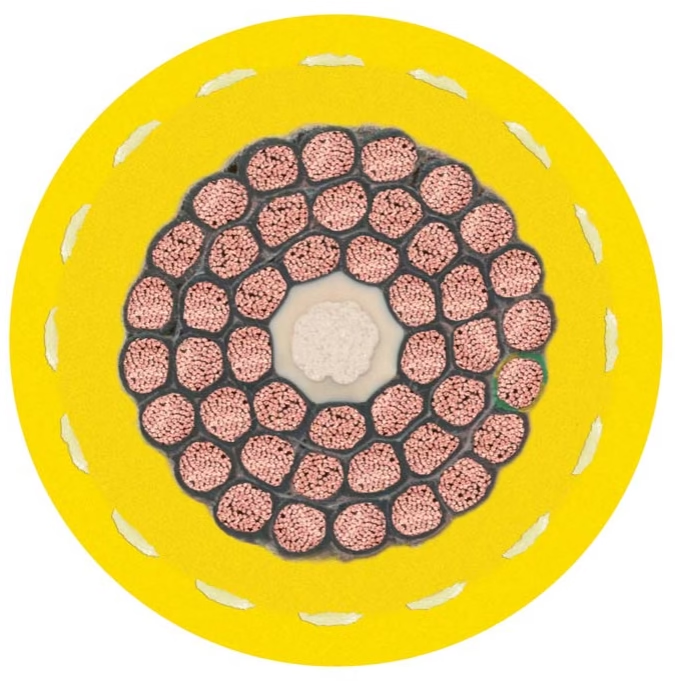
AS/NZS 1802 – Reeling cables for underground mining

600V 3TC-RB (600V 3PNCT) Crane Cable Class 3 600V Ethylene Propylene Rubber-Insulated Polychloroprene Rubber Sheath Cable

600V 3TC-RB (600V 3PNCT) Crane Cable

The 600V 3TC-RB cable, also known as 600V 3PNCT, represents a specialized class of flexible power cables engineered specifically for demanding industrial applications. This cable system is designed for mobile machinery operations where continuous flexing, environmental resistance, and electrical reliability are paramount. The designation “3TC-RB” indicates a Class 3 stranded conductor configuration with ethylene propylene rubber insulation and polychloroprene rubber sheath construction.
Feichun_Reeling_Cables_for_Reeling_Systems

RELCT (LV) JIS C 3327 Reeling Cables for Container Cranes

RELCT (LV) cable represents a specialized category of low-voltage flexible power cables engineered specifically for dynamic reeling applications in container handling operations within international port facilities. Operating under standard designation JIS C 3327, these cables serve as the critical power delivery conduits for automated rubber-tired gantry cranes (RTGs), ship-to-shore cranes (STS), and other containerized cargo handling equipment that operate continuously in demanding maritime environments.
FEICHUN Reeling cable

What is RELCT (MV) Reeling Cables for Container Cranes?

RELCT (MV) reeling cables serve a critical function in container crane electrification systems. Specifically, these cables are deployed to deliver electrical power from fixed power supply systems to the rotating reel mechanisms and traveling components of container handling cranes. The cable must accommodate continuous mechanical stressing from repetitive coiling and uncoiling operations while maintaining electrical integrity and safety performance.
What is Electrical Cables for Container Cranes?

What is Electrical Cables for Container Cranes?

Container cranes represent the backbone of modern port operations, handling millions of containers annually at ports worldwide. The reliable operation of these massive machines depends fundamentally on their electrical cable systems, which must endure extreme mechanical stresses, environmental challenges, and continuous operation cycles. According to industry data compiled by PEMA (Port Equipment Manufacturers Association), electrical cable failures account for approximately 15-20% of container crane downtime, representing significant operational and financial costs to port operators.
SANS 1520 Feichun Cable

What is SANS 1520 Cable Part 1-2-3 Mining Cable?

The South African National Standard (SANS) 1520 represents one of the most comprehensive and rigorous cable standards for mining operations globally, specifically addressing the unique challenges faced in underground and surface mining environments. Issued by the South African Bureau of Standards (SABS), this standard has become the benchmark for flexible electrical trailing cables used in mines worldwide, ensuring both operational efficiency and worker safety in some of the most demanding industrial conditions.
MSHA Mining Cable: Comprehensive Technical Guide Professional Mining Power Cables Complying with US Mine Safety & Health Administration Standards

MSHA Mining Cable: Comprehensive Technical Guide

MSHA mining cables represent a specialized category of industrial power cables specifically designed, tested, and approved for use in mining operations under regulations established by the United States Mine Safety and Health Administration (MSHA). These cables serve critical functions in both underground and surface mining environments, delivering electrical power to mobile equipment, continuous miners, draglines, shuttle cars, and various other mining machinery while maintaining the highest standards of safety in potentially hazardous atmospheres.
AS/NZS 3008 Cable

AS/NZS 3008 Cable: Comprehensive Technical Guide

AS/NZS 3008 represents the Australian and New Zealand standard for electrical installations and cable selection, specifically addressing cables for alternating voltages up to and including 0.6/1 kV at 50 Hz alternating current. This comprehensive standard establishes the methodology for selecting appropriate cable sizes based on current-carrying capacity, voltage drop limitations, and short-circuit temperature rise considerations.
Polish Mining Cable

What is YHKGXSekyn, YHKGXSekFtZnyn, YHKGXSekFtyn, YHKGXSekFitlyn, YHKGXSekFoyn, and YHKGXSekFpyn Polish Mining Cable ?

Polish Mining Cable Code Designation System represents a comprehensive nomenclature standard used extensively throughout European mining operations, particularly in Poland’s extensive coal, copper, and mineral extraction industries. This systematic coding methodology enables engineers and procurement specialists to precisely specify cable configurations through alphanumeric designations that encode critical construction parameters, material specifications, and performance characteristics.
DIN VDE 0250 German Standard Flexible Power Reeling Cable

What is DIN VDE 0250 Reeling Cables?

DIN VDE 0250 represents the globally recognized German standard for flexible electrical cables designed specifically for cranes, material handling equipment, and mobile machinery applications. As Germany remains the only country to have issued special design regulations for flexible electrical cables covering cranes and material handling equipment, this standard has achieved worldwide acceptance as the ultimate benchmark for tough rubber-sheathed flexible reeling cables.
DIN VDE Standard Cable

What is DIN VDE 0271/0272/0273/0276 Standard Cable?

DIN VDE standard series represents a comprehensive framework of German technical specifications for electrical cables and power distribution systems. Developed jointly by the German Institute for Standardization (Deutsches Institut für Normung, DIN) and the Association for Electrical, Electronic and Information Technologies (Verband der Elektrotechnik, Elektronik und Informationstechnik, VDE), these standards ensure safety, reliability, and compatibility across electrical installations throughout Europe and internationally.
Feichun Cable

What is Cable DIN VDE 0815/816 Code Designation?

The DIN VDE 0815 and DIN VDE 0816 standards represent critical specifications for telecommunication and data processing cables developed by the German Commission for Electrical, Electronic and Information Technologies (DKE). These comprehensive standards define the construction, performance characteristics, and designation systems for cables used in demanding environments including mining operations, industrial facilities, and telecommunications infrastructure. According to authoritative industry sources, DIN VDE 0815 specifically covers indoor wiring cables for telecommunications systems, while DIN VDE 0816 addresses outdoor cables for telecommunications systems including signal and measuring cables designed for mining applications. These standards are widely recognized throughout Europe and increasingly adopted in global mining operations due to their rigorous safety requirements and detailed specification system.
Mining Cable

Mining Cable: Comprehensive Glossary of Cable Terms

Mining cables represent one of the most demanding applications in the electrical cable industry, requiring exceptional durability, flexibility, and safety features to withstand the harsh conditions found in underground and surface mining operations. This comprehensive glossary provides essential technical terminology and specifications for mining cable professionals, engineers, and procurement specialists. According to Feichun Cable, mining operations worldwide depend on specialized cables that meet stringent international standards including MSHA (Mine Safety and Health Administration), IEC (International Electrotechnical Commission), and CSA (Canadian Standards Association) certifications to ensure worker safety and operational reliability in extreme environments.
N/(N)TSCGEWOEU-W(FO)

N/(N)TSCGEWOEU-W(FO) vs NSSHOEU-J/O

Type N/(N)TSCGEWOEU-W(FO), a medium-voltage flexible trailing cable operating at 3.6/6 kV to 8.7/15 kV with optional integrated optical fiber elements, and the Type NSSHOEU-J/O, a heavy-duty low-voltage rubber sheathed cable rated at 0.6/1 kV specifically engineered for extreme mechanical stress in mining operations.
(N)TSKCGECWOEU

(N)TSKCGECWOEU-CH vs (N)TSKCGECWOEU-FN: Comprehensive Technical Analysis of High-Flexibility Crane Cable Reels for Underground Mining

In underground mining operations, the selection between cable chain systems and festoon systems represents a critical decision that directly impacts operational efficiency, safety parameters, and lifecycle costs. This comprehensive technical analysis examines two specialized medium voltage flexible power supply cables designed for underground mining facilities: the Type (N)TSKCGECWOEU-CH optimized for cable chain operations and the Type (N)TSKCGECWOEU-FN engineered for festoon system applications. Both cable types operate at a voltage range of 3.6/6 kV and comply with DIN VDE 0250 Part 813 standards, which specifically addresses trailing cables for mining applications.
NSSHOEU-J/O

Heavy-Duty Mining Cables: Technical Comparison Analysis

Type NSSHOEU-J/O cable and the Type N/(N)SSHCOEU-J/O cable. While both cable types conform to DIN VDE 0250-812 standards and share fundamental construction principles, they serve distinctly different operational requirements. The NSSHOEU-J/O represents a robust, general-purpose heavy-duty cable suitable for conventional motor power supply applications, whereas the N/(N)SSHCOEU-J/O incorporates advanced electromagnetic shielding technology specifically engineered for deployment in conjunction with variable frequency drive systems, addressing the increasingly prevalent challenge of electromagnetic interference in modern mining automation.
reeling cable

Understanding Minimum Bending Radius: A Complete Guide According to VDE 0298-3

Imagine bending a garden hose too sharply. What happens? The water flow stops because the hose kinks, potentially causing permanent damage to the hose walls. The same principle applies to electrical cables, but with far more serious consequences. When we bend a cable beyond its safe limits, we risk damaging the conductors inside, cracking the insulation, and creating safety hazards that could lead to equipment failure or even fire.
FG7H1OAR

What is a Type FG7H1OAR Flexible Cable for Underground Mining

Type FG7H1OAR MT TUNNEL I PLUS represents a cutting-edge solution in medium voltage flexible cable technology specifically engineered for the demanding environments of underground mining and tunneling operations. This specialized cable combines advanced LSOH (Low Smoke Zero Halogen) technology with robust HEPR insulation, meeting the stringent requirements of IEC 60502-2 international standards for medium voltage power transmission.
(N)3GHSSHCH LSOH Cable

What is a Type (N)3GHSSHCH Low Smoke Zero Halogen LSOH Mining Cable?

Type (N)3GHSSHCH flexible cable, designated as MT TUNNEL V ATOX PLUS and engineered with Low Smoke Zero Halogen technology conforming to stringent DIN VDE 0250 Part 605 requirements, represents a fundamental advancement in underground mining fire safety. This comprehensive technical guide examines how LSOH cable technology fundamentally changes fire safety outcomes in underground environments, explores the sophisticated material science enabling zero-halogen performance, analyzes the complete cable construction and standards compliance framework, and provides essential guidance for proper installation and operation of these life-safety-critical cable systems. Understanding the engineering principles and operational characteristics of LSOH mining cables is essential for mining engineers, safety professionals, electrical contractors, and regulatory personnel responsible for protecting underground workers and ensuring operational continuity in mining and tunneling operations.
(N)3GHSSYCY

What is a Type (N)3GHSSYCY for Underground Mining?

Type (N)3GHSSYCY flexible cable, designated as MT TUNNEL V PLUS and designed according to the stringent requirements of DIN VDE 0250 Part 605, represents a specialized engineering solution addressing these critical safety and operational demands. This comprehensive technical guide examines the purpose, construction methodology, standards compliance, safety characteristics, and operational considerations for this medium-voltage cable system designed exclusively for energy supply to mobile and stationary equipment in underground mining and tunneling applications. Understanding the intricate engineering principles and safety features embedded within this cable design is essential for mining engineers, electrical contractors, safety professionals, and project managers responsible for underground infrastructure and mining operations.
(N)TSCGECECWÖU TBM CABLE

What is a Type (N)TSCGECECWÖU

Type (N)TSCGECECWÖU cable serves multiple critical functions within tunnel boring operations. The primary application involves supplying medium-voltage electrical power to the TBM’s main drive systems, hydraulic pumps, and auxiliary equipment. The cable’s flexible construction enables it to wrap and unwrap continuously on reeling drums as the machine advances through the tunnel, which may involve movements of 40 to 60 feet per day during active boring operations.
(N)TSCGECEWÖU Mining Reeling Cable

What is a Type (N)TSCGECEWÖU MINING REELING Cable

Type (N)TSCGECEWÖU Mining Reeling Cable represents a specialized category of medium voltage flexible power cables engineered specifically for the demanding conditions found in underground mining operations and material handling equipment. This cable designation, while complex in nomenclature, follows the systematic German cable naming convention established by DIN VDE standards.
(N)TSCGEWÖU Mining Reeling Cable

What is a Type (N)TSCGEWÖU Cable?

The (N)TSCGEWÖU Mining Reeling Cable MT MIN F PLUS represents a pinnacle of engineering excellence in medium voltage power transmission for the most demanding industrial applications. Engineered specifically for mining operations and material handling equipment, this cable type is designed to withstand extreme mechanical stresses while maintaining reliable electrical performance in harsh environmental conditions.
(N)TSCGEWÖU Mining Cable for Heavy Equipment

What is (N)TSCGEWÖU Mining Cable for Heavy Equipment?

(N)TSCGEWÖU Mining Cables represent a specialized variant of three-core medium voltage flexible cables specifically engineered for the most demanding opencast mining applications. This cable combines proven (N)TSCGEWÖU electrical and mechanical performance with a special abrasion-resistant yellow outer sheath designed for heavy mobile mining equipment including draglines, power shovels, dredges, and drills operating under extreme mechanical stresses and continuous abrasion during trailing operations.
NTSCGEWÖU Hybrid MV Cable with Fiber Optics

What is NTSCGEWÖU Hybrid MV Cable with Fiber Optics?

NTSCGEWÖU cables represent the cutting edge of industrial cable technology—a hybrid system that integrates medium voltage power transmission with high-performance fiber optic data communication in a single, mechanically robust package. Building on the proven (N)TSCGEWÖU three-core MV cable design, the NTSCGEWÖU variant adds integrated fiber optic cables, enabling simultaneous transmission of electrical power and high-bandwidth data in applications requiring extreme mechanical stress resistance.
Complete Professional Guide: Transform Diesel Cranes into Efficient Electric Systems with Feichun Cable & Cavotec Technologies

What is (N)TSCGEWÖU Three-Core MV Flexible Cable?

(N)TSCGEWÖU cables represent the most advanced category of medium voltage flexible power cables, specifically engineered for extreme mechanical stress conditions including torsional loading, multi-plane deflection, and high-speed reeling operations. Unlike standard medium voltage cables, this three-core design incorporates an innovative anti-twisting construction with reduced weight and dimensions, making it ideal for the most demanding cable reel applications in mining, heavy industry, and mobile equipment.
(N)TMCGEWÖU Medium Voltage Flexible Cable

What is (N)TMCGEWÖU Medium Voltage Flexible Cable?

(N)TMCGEWÖU cables represent specialized medium voltage (MV) flexible power cables engineered to DIN VDE 0250 Part 813 standards. The designation indicates a single-core, tinned copper conductor cable with high-quality rubber insulation (3GI3), semiconductive field control layers, and a 5GM5 quality rubber outer sheath. These cables are designed for voltage ratings from 3.6/6 kV up to 18/30 kV.
EPR/PUR 0.6/1kV Highly Flexible Crane Festoon Cable

What is EPR/PUR 0.6/1kV Highly Flexible Crane Festoon Cable?

EPR/PUR 0.6/1kV highly flexible crane festoon cables, also known as PURFLEX HF (C), represent a specialized category of industrial power cables engineered for demanding environments requiring exceptional flexibility, durability, and resistance to mechanical stress. These cables are specifically designed for cable reel systems, crane applications, and mobile equipment where continuous flexing, abrasion resistance, and reliable power transmission are critical. This comprehensive guide explores the technical specifications, applications, safety standards, and best practices for EPR/PUR highly flexible cables, providing essential information for engineers, procurement specialists, and maintenance professionals in industrial settings.
(N)SSCHÖU-J Round Reeling Cable

What is a (N)SSCHÖU-J Round Reeling Cable?

The (N)SSCHÖU-J designation represents a specialized category of round reeling cables engineered for extreme durability in dynamic industrial applications. These highly flexible crane festoon cables, manufactured in accordance with DIN VDE 0250 Part 812 standards, are specifically designed to withstand the rigorous mechanical stresses encountered in cable reel systems, particularly in mining operations, heavy industry, port facilities, and mobile equipment installations.
(N)TSCGEWOEU

What is a NSSHÖU O/J …../3E…..+ST 0,6/1kV DIN VDE 0250 Part 812 approved Round Reeling Highly Flexible Cables for Cable Reels

NSSHÖU O/J represents the pinnacle of heavy-duty flexible cable engineering. Manufactured in strict accordance with DIN VDE 0250 Part 812 standards, this submersible-rated cable features advanced tinned copper conductors and optional individual earth screening for ultimate protection in the most demanding industrial applications. With the ability to operate permanently submersed to 100 meters depth and withstand extreme mechanical abuse, SNAKEFLEX sets the industry standard for reliability in harsh environments.
MINING CABLE

(N)SHÖU O/J Cable: Complete Technical Guide

(N)SHÖU O/J cable represents a pinnacle of German engineering excellence in flexible power transmission technology. Manufactured in strict accordance with DIN VDE 0250 Part 812 standards, this highly flexible round reeling cable is specifically engineered for demanding industrial applications where extreme mechanical stress, continuous movement, and harsh environmental conditions are the norm.
SHTOEU-J Cable

Understanding the (N)SHTÖU (SMK) Cable

The (N)SHTÖU (SMK) cable, branded as Cordaflex SMK-V and designated as RXG-8, represents the pinnacle of engineering excellence for extreme vertical reeling applications. This premium cable features 20kN aramid reinforcement, polychloroprene (PCP) rubber sheathing, and a sophisticated protective braid constructed of polyester fibers vulcanized during manufacture to provide maximum torsional rigidity. Specifically designed for spreader operations on ship-to-shore container cranes where cables may be freely suspended up to 70 meters and subjected to extreme wind forces, high acceleration, and combined tensile and torsional stresses.
Reeling & Trailing Cables for Cranes & Mining — Feichun Special Cable Blogs

DIN VDE 0250 vs BS 6708-6116 BCS 295: Comprehensive Mining Cable Standards Comparison

Mining operations worldwide demand electrical cables that can withstand extreme conditions, mechanical stress, and potentially explosive atmospheres. Two primary international standards govern flexible mining cable specifications: the German DIN VDE 0250 and the British BS 6708 series (including BS 6116 and BCS 295 specifications). Understanding the differences and correspondences between these standards is crucial for mining engineers, procurement specialists, and electrical contractors working on international projects. This comprehensive guide analyzes both standards to help you make informed decisions about cable selection for mining applications.