VDE

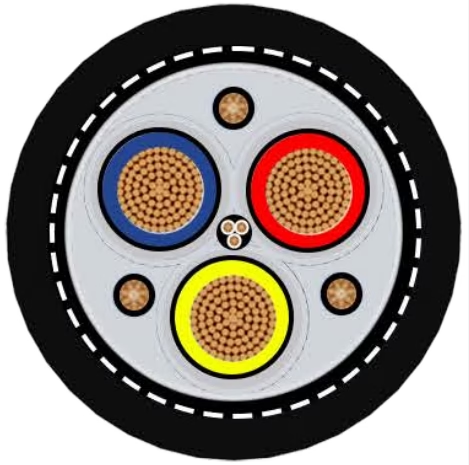
飞纯 Type 209 是飞纯电缆基于 AS/NZS 1802:2003 卷筒与拖曳电缆 体系设计的矿用柔性馈电与拖曳电缆系列,电压范围覆盖 1.1 至 11KV。根据产品资料,Type 209 系列电缆主要作为矿山机械柔性馈电电缆使用,更适合作为拖曳电缆而不是高频卷筒电缆。较小规格适用于钻机、手持工具和移动设备。 这一定义是理解 Type 209 的关键。Type 209 不是普通工业橡套软电缆,也不只是单纯的矿山供电线。它的核心定位是 矿山机械柔性馈电电缆,也就是为矿山机械提供可移动、可拖曳、可适应复杂作业路径的供电系统。同时,它更适合作为 拖曳电缆,即跟随设备移动的电缆,而不是长期高频卷绕使用的卷筒电缆。

什么是 NTMTWOEU 0.6/1kV Mine Hoist Cables

NTMTWOEU 0.6/1kV Mine Hoist Cables 是 Feichun 面向地下矿山用户操作式矿井提升机、升降机和悬吊控制系统开发的专用矿山电缆。资料说明,该电缆用作 suspended cable,用于 underground mines 中 user-operated mine hoists 或 lifts 的 intrinsically safe control,并带 telephonic connection。其工程核心不是普通动力输送,而是将控制导体、电话型屏蔽 pilot、中心钢承力元件、抗扭纺织编织和 5GM5 外护套组合成一根适合垂直悬吊、人员操作、通信联络和安全控制的矿山提升机电缆。
飞纯 Type 245 是基于 AS/NZS 1802:2003 卷筒与拖曳电缆 标准体系设计的矿用非常柔性长壁采煤机电缆,电压范围覆盖 1.1 至 6.6KV。根据产品资料,该电缆主要用作长壁采煤机电缆,也可用于连续采煤机和长壁外围电缆。 Type 245 的关键结构特征是 三根中央可伸长 Pilot / 控制芯线。这三根中央 Pilot 芯线可用于 接地连续性监测 和 控制回路。对于长壁采煤机来说,电缆不仅要传输动力电能,还要承担设备控制、保护联锁、接地连续性确认和移动工况下的安全监测任务。

什么是 NTSWOEU 0.6/1kV E-Loader Cable:Feichun 极高机械负载地下矿山移动设备电缆工程解析

NTSWOEU 0.6/1kV E-Loader Cable 是 Feichun 面向地下矿山移动机械、电动装载机、LHD、导向滑轮系统和卷盘供电系统开发的极高机械负载橡套电缆。资料明确指出,该电缆用于连接承受极高机械负载的移动机器,主要应用于矿山环境,也可通过导向滑轮运行,或作为 LHD 卷盘电缆使用,适用于极端弯曲负载、高拉伸应力、冲击负载和压扁负载。其核心结构由 Class 6 柔性镀锡铜导体、EPR 绝缘、GM1b 橡胶内护套、铜钢复合丝编织铠装兼同心接地导体,以及 5GM5 氯化橡胶外护套组成。
Type 210 1.1/1.1KV 是一种面向矿山移动供电场景的高柔性拖曳电缆。资料明确指出其主要应用于 hand-held boring machines and drills,即手持式凿岩机、钻机以及类似高机械应力移动设备。与普通低压橡套软电缆相比,Type 210 的技术边界从一开始就包含了移动、拖曳、弯曲、振动、磨损、接地连续性和 Pilot 控制/保护功能。 在澳洲矿山、地下煤矿、露天矿、采石场、矿石码头、散货码头和重载移动设备现场,电缆的失效往往不是单一电气问题,而是导体疲劳、护套磨耗、内部结构位移、接地中断、Pilot 回路异常和设备振动共同作用的结果。飞纯 Type 210 通过柔性镀锡退火铜导体、EPR 绝缘、半导电弹性体绝缘屏蔽、复合屏蔽接地导体、半导电 PCP cradle separator、中央可伸长 Pilot 芯线和重型 PCP 护套,形成一个完整的矿用移动供电结构。

O que é o TUNNELFLEX-TTX: Análise de Engenharia Aprofundada do Cabo de Média Tensão 3,6/6 a 12/20 kV COM Proteção Anti-Torção

O TUNNELFLEX-TTX RS-(N)TSCGEWOEU é a versão de média tensão da família TUNNELFLEX equipada com proteção anti-torção — uma trança de malha aberta de fios sintéticos aplicada entre a manta interna e a bainha externa de PCP. Ele alimenta equipamentos móveis com alto risco de dano mecânico em tunelamento, nas mesmas quatro classes de tensão do TUNNELFLEX-TX (3,6/6 a 12/20 kV), mas para sistemas em que o cabo não é apenas defletido em um plano, e sim torcido em torno do próprio eixo durante o serviço. O TTX completa a família: ele está para o TX assim como o R/PUR está para o PUR na baixa tensão — a mesma construção elétrica, acrescida do elemento que absorve o esforço torcional.
La vida útil de los cables móviles de carrete, festón y canasta depende, en gran medida, de la instalación y del diseño del sistema de enrollado. Este manual abarca radios de curvatura, guías, protección de tensión, anclaje, selección de carrete y eliminación de torsión, junto con los métodos eléctricos de capacidad de corriente, reducción (derating), caída de tensión y cortocircuito.

O que é a Família TUNNELFLEX: Análise de Engenharia Aprofundada dos Cabos Flexíveis de Baixa e Média Tensão para Mineração e Tunelamento

A família TUNNELFLEX é uma plataforma de cabos flexíveis para a alimentação de equipamentos móveis com alto risco de dano mecânico em mineração e tunelamento. Ela é organizada em torno de uma mesma filosofia — condutores de cobre classe 5 de construção especial para serviço móvel e bainhas de altíssima resistência mecânica — declinada em três respostas distintas: o TUNNELFLEX-PUR 0,6/1 kV, sem proteção anti-torção, para deflexão em um único plano; o TUNNELFLEX-R/PUR 0,6/1 kV, com uma malha sintética anti-torção que habilita o cabo a tolerar torção; e o TUNNELFLEX-TX RS-(N)TSCGEWOEU de média tensão, de 3,6/6 a 12/20 kV, com isolação HEPR-MV e blindagens semicondutoras para o controle de campo elétrico exigido pela média tensão. Em conjunto, a família cobre desde a alimentação de máquinas auxiliares até o acionamento de equipamentos pesados de escavação de túnel em 20 kV.
飞纯 Type 275 是基于 AS/NZS 1802:2003 卷筒与拖曳电缆 标准体系设计的矿用柔性馈电电缆,电压等级为 1.1/1.1KV。根据产品资料,该电缆主要作为梭车和泵的柔性馈电电缆使用。 Type 275 的关键工程特点是 接地芯线设计用于降低电缆在张力卷绕过程中发生断丝的风险。梭车电缆和泵用馈电电缆经常处于卷绕、拖曳、拉伸、反复弯曲和移动工况中,接地芯线如果在张力卷绕过程中发生断丝,将影响接地连续性和供电安全。Type 275 因此更强调接地芯线结构可靠性,而不是单纯的导体截面或外径参数。

飞纯 Type 275 1.1/1.1KV:基于 AS/NZS 1802:2003 的澳洲矿用梭车与泵用柔性馈电电缆技术解析

飞纯 Type 275 是基于 AS/NZS 1802:2003 卷筒与拖曳电缆 标准体系设计的矿用柔性馈电电缆,电压等级为 1.1/1.1KV。根据产品资料,该电缆主要作为梭车和泵的柔性馈电电缆使用。 Type 275 的关键工程特点是 接地芯线设计用于降低电缆在张力卷绕过程中发生断丝的风险。梭车电缆和泵用馈电电缆经常处于卷绕、拖曳、拉伸、反复弯曲和移动工况中,接地芯线如果在张力卷绕过程中发生断丝,将影响接地连续性和供电安全。Type 275 因此更强调接地芯线结构可靠性,而不是单纯的导体截面或外径参数。
飞纯 Type 260 是基于 AS/NZS 1802:2003 卷筒与拖曳电缆 标准体系设计的矿用铠装馈电电缆,电压范围覆盖 1.1 至 11KV。根据产品资料,该铠装电缆主要用于需要机械保护和强度的电源馈电场景,也可作为机械设备馈电电缆,例如可移动矿用变电站和砂矿开采供电。 Type 260 与非铠装矿用拖曳电缆相比,最大的差异在于 可弯曲镀锌低碳钢丝铠装。该结构位于内护套与外护套之间,使电缆在承受外部挤压、冲击、拖曳、石块磨损和设备边缘摩擦时,具备更强的机械保护能力。因此,Type 260 适合那些不仅要求供电可靠,还要求电缆具有更高物理防护强度的矿山馈电场景。

飞纯 Type 260 1.1 至 11KV:基于 AS/NZS 1802:2003 的澳洲矿用铠装馈电电缆技术解析

飞纯 Type 260 是基于 AS/NZS 1802:2003 卷筒与拖曳电缆 标准体系设计的矿用铠装馈电电缆,电压范围覆盖 1.1 至 11KV。根据产品资料,该铠装电缆主要用于需要机械保护和强度的电源馈电场景,也可作为机械设备馈电电缆,例如可移动矿用变电站和砂矿开采供电。 Type 260 与非铠装矿用拖曳电缆相比,最大的差异在于 可弯曲镀锌低碳钢丝铠装。该结构位于内护套与外护套之间,使电缆在承受外部挤压、冲击、拖曳、石块磨损和设备边缘摩擦时,具备更强的机械保护能力。因此,Type 260 适合那些不仅要求供电可靠,还要求电缆具有更高物理防护强度的矿山馈电场景。
飞纯 Type 245 是基于 AS/NZS 1802:2003 卷筒与拖曳电缆 标准体系设计的矿用非常柔性长壁采煤机电缆,电压范围覆盖 1.1 至 6.6KV。根据产品资料,该电缆主要用作长壁采煤机电缆,也可用于连续采煤机和长壁外围电缆。 Type 245 的关键结构特征是 三根中央可伸长 Pilot / 控制芯线。这三根中央 Pilot 芯线可用于 接地连续性监测 和 控制回路。对于长壁采煤机来说,电缆不仅要传输动力电能,还要承担设备控制、保护联锁、接地连续性确认和移动工况下的安全监测任务。

飞纯 Type 245 1.1 至 6.6KV:基于 AS/NZS 1802:2003 的澳洲矿用长壁采煤机电缆技术解析

飞纯矿用电缆 Type 245 是一种非常柔软的矿用电缆,主要用作长壁采煤机电缆,也适用于连续采煤机和长壁外围电缆。该电缆含有三根中央 Pilot 芯线,可用于接地连续性监测和控制回路,适合长壁采煤系统中对柔性、保护、监测和控制可靠性要求较高的移动供电场景。
UNE 22511 — formally titled "Cables flexibles para minería subterránea con tensiones de 1,8/3 kV con aislamiento de caucho, sin armadura" (Flexible cables for underground mining, 1.8/3 kV, rubber-insulated, unarmoured) — is the definitive Spanish standard for heavy-duty power cables connecting underground mobile mining equipment to fixed electrical distribution networks. Published and maintained by AENOR (Asociación Española de Normalización y Certificación), it operates as a specialized overlay on IEC 60502-1, extending that base standard's electrical requirements with the stringent mechanical, safety, and flame-retardancy requirements specific to enclosed underground environments. Despite its Spanish origin, UNE 22511 enjoys a geographic reach far exceeding Iberia. The standard has been adopted — formally or by reference — across the major Spanish-speaking mining economies: Chile, Peru, Colombia, Bolivia, and Mexico, where AENOR-certified cables are accepted by national mining safety regulators as the primary qualification pathway for underground mobile equipment power supply cables. In Chile alone, UNE 22511 cables are installed across dozens of operations including major copper and coal mines. The standard's engineering DNA can be described in a single imperative: extreme dynamic flexibility combined with superior resistance to combined torsional and bending fatigue. This is not merely a performance aspiration — it is a structural requirement that shapes every material choice and geometric decision in the cable's construction. The logic proceeds as follows: Underground mobile equipment (continuous miners, shearers, shuttle cars) moves continuously and repeatedly during operation, dragging its power cable behind it or winding and unwinding it from a cable reel. This motion imposes cyclic bending, axial tension, and torsional loads on the cable simultaneously — a multi-axis fatigue regime of a severity not encountered in any other industrial cable application. Standard fixed-installation cables, even those classified as "flexible," are not designed for this loading regime and will fail in fatigue within weeks to months when installed in drag duty. Therefore, every structural element of a UNE 22511 cable — conductor wire diameter, insulation compound, earth core geometry, armour exclusion, sheath specification — is selected to maximize multi-axis fatigue endurance, not any single performance parameter. ⛏ The Founding Engineering Principle UNE 22511 is an unarmoured drag cable standard. The deliberate absence of any metallic armour — which might superficially seem to reduce robustness — is in fact the defining engineering choice that makes the standard viable. Steel wire or tape armour in a continuously torsionally-loaded cable acts as a progressive-failure torsional spring: each twist cycle accumulates irreversible plastic strain in the armour wires, leading to wire fractures within 10,000–30,000 cycles. For a shuttle car cable experiencing 80,000+ torsional cycles per year, armour represents not additional protection but a built-in scheduled failure mechanism. The UNE 22511 design eliminates this failure mode at source.

PROTOMONT、PROTOLON、TENAX、CORDAFLEX、NSSHOEU、TUNNELFLEX、MINEMASTER、SHD-GC、G-GC、MT 818 与光纤电缆工程指南

在矿山、隧道和散料输送行业,mining cable 并不是一种单一产品,而是一张工程地图:卷筒电缆、拖曳电缆、馈电电缆、固定敷设电缆、隧道电缆、疏浚与潜水泵电缆、ground-check 电缆、光纤通信电缆以及 OEM 定制电缆系统都属于其中。一个矿山项目可能同时使用 LHD 低压 0.6/1 kV 卷筒电缆、露天挖掘机中压拖曳电缆、TBM 6/10 至 18/30 kV 中压卷筒电缆、隧道固定馈电电缆和矿山自动化光纤网络。因此,正确选型不是先问品牌名称,而是先问应用:电缆如何运动、如何弯曲、如何接地、承担什么电压、适用哪个区域标准、护套会受到什么环境攻击。
Marine & Port Drag Cable — High-Flexibility Saltwater-Resistant System A comprehensive engineering dissection of heavy-duty marine drag cables for port equipment, container terminals, and offshore platforms — from conductor architecture and EPR insulation to steel wire armour (M2) design rationale, galvanic corrosion protection mechanisms, environmental compliance, and validated performance benchmarking against Nexans Eproneo Port and Prysmian marine systems.

Mining Cable Families at a Glance: An Engineering Guide to PROTOMONT, PROTOLON, TENAX, CORDAFLEX, NSSHOEU, TUNNELFLEX, MINEMASTER, SHD-GC, G-GC, MT 818 and Fibre Optic Cables

In mining, tunnelling and bulk material handling, the term mining cable does not describe one universal product. It describes an engineering map: reeling cables, trailing cables, feeder cables, fixed installation cables, tunnel cables, dredger and submersible pump cables, ground-check cables, fibre optic cables and custom OEM cable systems. A single mine may use low-voltage 0.6/1 kV reeling cables for LHD machines, medium-voltage trailing cables for excavators, TBM reeling cables from 6/10 to 18/30 kV, fixed feeder cables in tunnels and optical fibre networks for monitoring and automation. The correct selection starts not with a brand name, but with the application: how the cable moves, how it bends, how it is grounded, what voltage it carries, what regional standard applies and how the surrounding mine environment attacks the sheath.
Mining, drilling, and tunnelling cables represent the most demanding category of industrial cables, designed to operate in some of the harshest environments on earth. These heavy-duty power, control, and instrumentation cables serve mine operators worldwide for both static infrastructure and dynamic equipment applications. Manufactured in accordance with international standards including IEC 60502, BS EN 60332, BS EN 60811, BS EN 60754, and VDE 0295, mining cables must withstand mechanical stress, oil and grease exposure, water immersion, and in underground applications, provide critical fire safety through reduced smoke and fume emissions.

What are Mining, Drilling & Tunnelling Cables?

NSSHÖU cable, NSSHOU cable, NSHÖU cable, NSHOU cable, NSSCHOU cable, NSHTÖU cable, NTSCGEWÖU cable, NTSCGEWOU cable, NTMCGEWÖU cable, N3GHSSYCY cable, N3GHSSHCH cable,Type 61 cable, Type 63 cable, Type 611 cable, Type 622 cable, Type 633 cable, Type 66 cable,Type 240 cable, Type 241 cable, Type 245 cable, Type 450 cable, Type 455 cable, Type 260 cable, Type 275 cable, Type 409 cable, Type 440 cable, Type 441 cable,