UV resistant outdoor cable

Scrap metal recycling yards represent one of the most mechanically punishing environments for industrial electrical cables. Unlike controlled manufacturing facilities or even mining operations where equipment operates within defined parameters and spaces, scrap yards combine continuous mechanical abuse, unpredictable sharp debris, contamination with oils and cutting fluids, and the psychological pressure of near-zero downtime expectations. An electromagnet suspended from a reeling cable must lift payloads of 20 to 40 metric tons repeatedly throughout the day, while the cable itself is dragged across jagged metal shards, torn aluminum siding, concrete floors embedded with sharp steel fragments, and rusted edge conditions that would immediately puncture or notch a conventional rubber sheath. When a notch forms on a neoprene (CR) cable—which happens within weeks in aggressive scrap environments—the material's inherent brittleness means that continued mechanical flexing and abrasion at that point of weakness leads to catastrophic tearing and complete cable failure. Polyurethane (PUR) cables like LAPP ÖLFLEX® CRANE PUR were specifically engineered to resist this exact failure mode through fundamentally different material physics.
LAPP ÖLFLEX® CRANE PUR vs. Neoprene (CR): Is Polyurethane Really Superior for Scrap Yard Lifting Magnet Cables?

Scrap metal recycling yards represent one of the most mechanically punishing environments for industrial electrical cables. Unlike controlled manufacturing facilities or even mining operations where equipment operates within defined parameters and spaces, scrap yards combine continuous mechanical abuse, unpredictable sharp debris, contamination with oils and cutting fluids, and the psychological pressure of near-zero downtime expectations. An electromagnet suspended from a reeling cable must lift payloads of 20 to 40 metric tons repeatedly throughout the day, while the cable itself is dragged across jagged metal shards, torn aluminum siding, concrete floors embedded with sharp steel fragments, and rusted edge conditions that would immediately puncture or notch a conventional rubber sheath. When a notch forms on a neoprene (CR) cable—which happens within weeks in aggressive scrap environments—the material’s inherent brittleness means that continued mechanical flexing and abrasion at that point of weakness leads to catastrophic tearing and complete cable failure. Polyurethane (PUR) cables like LAPP ÖLFLEX® CRANE PUR were specifically engineered to resist this exact failure mode through fundamentally different material physics.
RONDOFLEX CHAIN (N)GRDG(CG)OEU 0.6/1KV is a low voltage cable specifically engineered for energy chain systems, suitable for all chain applications including container cranes, stacking cranes, indoor cranes, and material handling equipment. Featuring finely stranded Class 5 copper conductors, EPR rubber insulation (PROTOLON MS), tinned copper braid shielding (coverage >80%), and EVA rubber outer sheath, this cable provides excellent EMC compatibility, oil resistance, UV resistance, and ozone resistance. Especially suitable for outdoor installations, long travel distances, or high travel speeds where high cable performance is demanded.

كابل RONDOFLEX CHAIN (N)GRDG(CG)OEU 0,6/1KVكابلات منخفضة الجهد لسلاسل الطاقة مع توافق EMC

Applicable in all chain systems (e.g., container cranes, stacking cranes, indoor cranes, material handling equipment). Especially suitable in applications where, due to outdoor installation, long travel distances or high travel speed, high performances are expected from the cable (such as long lifetime, full reliability, resistance to abrasion, etc.).
(N)TSCGEWOEU es un cable de enrollado de media tensión especializado, diseñado para equipos móviles que operan bajo estrés mecánico alto a extremo. Este cable está diseñado para soportar las exigentes condiciones operativas encontradas en maquinaria portuaria, equipos de minería y aplicaciones industriales a gran escala.

Reelkab MS (N)TSCGEWOEU

Reelkab MS NTSCGEWOEU, Reelkab MS (N)TSCGEWOEU cable, NTSCGEWOEU medium voltage cable, Reelkab reeling cable, MS NTSCGEWOEU specifications, Reelkab cable datasheet, Reelkab 6/10 kV cable, Reelkab 12/20 kV cable
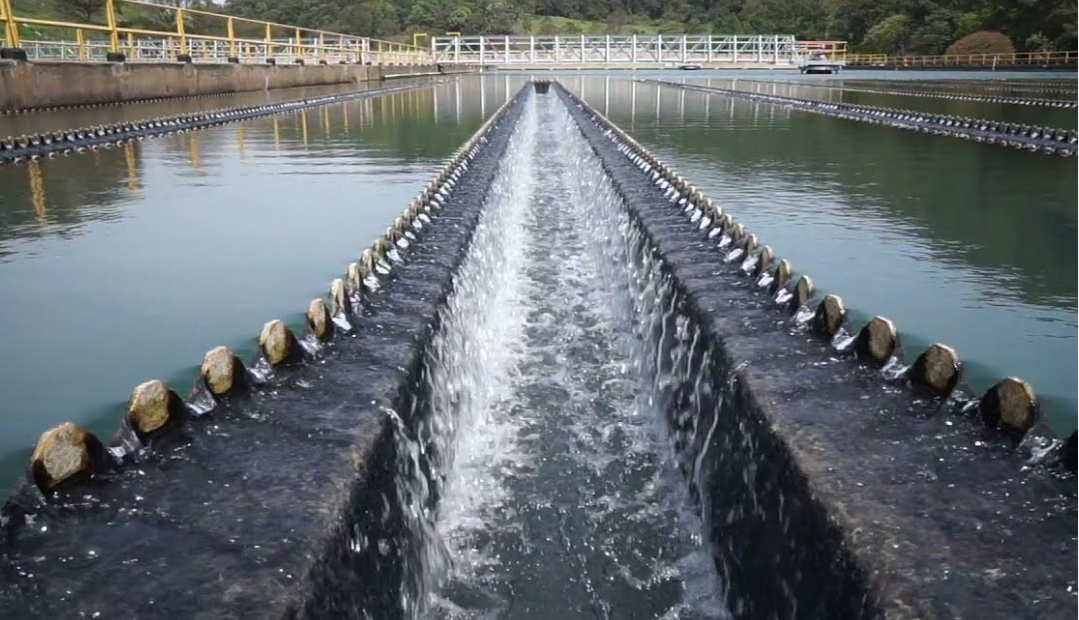
The global water treatment industry represents one of the most critical infrastructure sectors, serving both municipal drinking water systems and industrial wastewater processing facilities. According to the World Bank, approximately 2.2 billion people worldwide lack access to safely managed drinking water services, driving unprecedented investment in water treatment infrastructure. The U.S. Environmental Protection Agency (EPA) estimates that water utilities in the United States alone require over $470 billion in infrastructure investment over the next two decades.

Water Treatment Cables

H07RN-F rubber flexible cable, H07RN-8-F submersible pump cable, H05RR-F light duty cable, 318-TRS rubber cable, NTSCGECEWOU 3.6/6kV submersible cable, NTSCGECEWOU 6/10kV screened cable, NTSCGECEWOU 8.7/15kV medium voltage cable, NTSCGECEWOU 12/20kV deep well cable, NTSCGEWOU 3.6/6kV unscreened cable, NTSCGEWOU 6/10kV armoured cable, NTSCGEWOU 8.7/15kV submersible, NTSCGEWOU 12/20kV pump cable, Drincable 600 WRAS approved, Drincable 800 potable water cable, Drincable 600 Flat borehole cable
The oil, gas, and petrochemical industries operate in some of the most demanding environments on Earth. From deep-sea drilling platforms exposed to corrosive saltwater and extreme pressures, to onshore refineries processing volatile hydrocarbons at elevated temperatures, the cables connecting these critical systems must deliver unwavering reliability. According to the International Energy Agency (IEA), global oil demand reached approximately 101.7 million barrels per day in 2023, with petrochemical feedstock demand driving significant growth in downstream processing infrastructure.

Oil, Gas & Petrochemical Cables

BS5308 Part 1 Type 1 cable, BS5308 Part 1 Type 2 SWA cable, BS5308 Part 2 instrumentation cable, EN 50288-7 RE-2X(st)H cable, RE-2X(st)Y PVC instrumentation cable, RE-2X(st)H SWAH LSZH armoured cable, RE-T2X(st)H mica fire resistant cable, NF M 87-202 EGFA cable, NF M 87-202 EGSF cable, NF M 87-202 EIFA stainless steel armour, NF M 87-202 EISF cable, THHN THWN-2 600V cable, TFN screened cable, RZ1-K 0.6/1kV cable, RZ1-K (AS) 1.8/3kV cable, RZ1MZ1-K fire resistant cable, U-1000 R2V cable, U-1000 RVFV armoured cable, BS 6883 657TQ Type SW4 cable, BS 6883 658TQ armoured cable, SiHF-J silicone cable, SiF silicone 180 cable, SIAF-GL glass fiber cable, SANS 1507-3 PVC SWA cable, SANS 1507-4 XLPE SWA cable, 石油天然氣電纜, 石化電纜, 海上平台電纜, 煉油廠儀表電纜, 低煙無鹵電纜, 鋼絲鎧裝電纜, 耐火電纜, 防爆電纜, 本質安全電纜, 熱電偶延長電纜, 高溫矽膠電纜, 儀表控制電纜, 安徽飛純特種電纜
heavy-duty rubber cables represent a critical category for applications requiring exceptional mechanical strength, flexibility, and environmental resistance. This comprehensive technical guide examines three closely related cable types that dominate international markets for portable power transmission: the Chinese standard GB/T 5013 YC (Heavy-Duty General Rubber Cable) rated at 450/750V, the enhanced YCW variant with oil and weather resistance, and the European harmonized H07RN-F cable that serves as the international equivalent.

GB/T 5013 YC & YCW Heavy-Duty Rubber Cables and H07RN-F: Comprehensive Technical Analysis

heavy-duty rubber cables represent a critical category for applications requiring exceptional mechanical strength, flexibility, and environmental resistance. This comprehensive technical guide examines three closely related cable types that dominate international markets for portable power transmission: the Chinese standard GB/T 5013 YC (Heavy-Duty General Rubber Cable) rated at 450/750V, the enhanced YCW variant with oil and weather resistance, and the European harmonized H07RN-F cable that serves as the international equivalent.
What is PROTOMONT NSSHOEU 1 kV Low Voltage Flexible Rubber Cable? A Comprehensive Technical Guide to Heavy-Duty Mining and Industrial Flexible Cables with EPR Insulation for Extreme Environments

What is PROTOMONT NSSHOEU 1 kV Low Voltage Flexible Rubber Cable?

PROTOMONT NSSHOEU series represents a category of heavy-duty, low voltage flexible rubber cables engineered specifically for demanding industrial environments. These cables are designed to provide reliable power transmission in applications where conventional cables would fail due to extreme mechanical stress, environmental exposure, or chemical contact. The designation NSSHOEU follows German cable nomenclature standards where each letter indicates specific construction characteristics. The cables are manufactured according to DIN VDE 0250-812 specifications, which define requirements for rubber-insulated flexible cables used in power installations. According to industry standards, these cables are engineered for environments where high levels of mechanical stress and abrasion are expected, making them essential for modern mining, construction, and industrial operations.
PROTOLON(M) R-(N)TSCGEWOEU

What is PROTOLON(M) R-(N)TSCGEWOEU 6 kV – 35 kV Reeling Cable?

PROTOLON(M) R-(N)TSCGEWOEU represents a highly engineered family of medium voltage flexible reeling cables specifically designed for demanding applications in open-cast mining, heavy industrial operations, and material handling equipment. Manufactured according to DIN VDE 0250-813 standards and certified by multiple international regulatory bodies including GOST-R and Fire Certificates of Russian Federation, these cables deliver exceptional performance under extreme mechanical stresses characteristic of mining environments. These cables are engineered for connection of large material handling machines such as excavators, dumpers, and mobile crushers in open-cast mines, where equipment must maintain continuous power supply while subjected to high mechanical stresses, extreme temperature variations, and harsh environmental conditions. The cable construction features a three-core design with split earth conductors positioned in the interstices, providing enhanced safety and grounding performance critical for mining operations.
NEC Article 400, Table 400.4 Cable

Understanding NEC Article 400, Table 400.4: Complete Technical Guide to Flexible Cord and Cable Specifications

National Electrical Code (NEC) Article 400 establishes comprehensive requirements for flexible cords and flexible cables used in electrical installations throughout North America. According to the National Fire Protection Association (NFPA), Article 400 specifically covers general requirements, applications, and construction specifications for flexible cords and flexible cables rated up to 600 volts maximum, with special provisions for electric vehicle cables rated up to 1000 volts maximum.