rubber sheathed mining cable

(N)GRDGÖU-J Nomenclature (VDE 0250 part 813): (N) = Nominal voltage prefix (0.6/1 kV implicit in designation) G = Gummiert (rubber-insulated) R = Rubber outer sheath D = Dynamisch (dynamic/flexing application) G = Gummiert inner sheath (intermediate layer) Ö = German standard designation (ö indicates European origin) U = Unarmoured (no metal sheath) J = Jacked (multi-sheath design: intermediate + outer) Full meaning: Rubber-insulated, rubber-sheathed, dynamic-rated, multi-sheath construction, unarmoured festoon cable VDE 0250 part 813 scope: Published by: VDE (Verband der Elektrotechnik, German standards body) Applies to: Flexible cables for crane installations (particularly festoon systems) Coverage: Voltage, temperature, mechanical properties, installation methods Festoon-specific requirements: - High bending flexibility (4×D minimum typical) - Fast rewind capability (240+ m/min rated speed) - Sustained torsion tolerance (±25°/1m continuous) - Extended temperature range (−50 to +80°C) - UV/ozone/moisture resistance (outdoor exposure) Alternate designations (similar cables): IEC 60811-1-1: International equivalent (less specific) DIN VDE 0298 part 3: German mechanical property standard DIN VDE 0482-265-2-1: German flame test standard EN 50265-2-1: European flame test equivalent GRDGÖU-J advantage: Combines all standards into single VDE designation Procurement simplified for European buyers

(N)TSCGEWÖU-FO Cable | DIN VDE 0250 | EAC Ex & GOST Fire Approved for Russia Export

An engineering-grade technical reference for mining electrical engineers, EPC contractors, OEM equipment manufacturers, and procurement specialists selecting high-flexibility trailing cables for underground and surface mining operations in Russia and CIS markets. This document presents the structural engineering, material science, and certification architecture of Feichun’s (N)TSCGEWÖU-FO mining trailing cable — a purpose-designed construction combining extreme tensile reinforcement, multi-layer abrasion resistance, integrated fibre-optic monitoring, and dual EAC Ex / GOST-R fire certification within a single cable assembly engineered for the most demanding dragline, continuous miner, shuttle car, and longwall shearer applications operating under Russian Federal mining safety regulations.
The continuous ampacity of (N)TSCGEWÖU 3x120+3x70/3 12/20kV flexible reeling cable is 360 amperes when operating as a single conductor run in free air at the reference condition of 30°C ambient temperature and 90°C conductor operating temperature according to VDE 0250-813 and DIN VDE 0298-4 standards. For tunnel boring machine cutterhead power supply applications where the cable is installed in the constrained environment of a TBM backup gantry system—bundled alongside control cables, communication lines, and other power feeders—and subjected to frequent mechanical stress from dragging and reeling operations, the practical safe ampacity derates to approximately 260–285 amperes depending on specific installation geometry, tunnel temperature profile, and frequency of mechanical cycling. These two ampacity values represent the boundary between theoretical maximum current capacity and the practical operating limit for reliable power delivery to a 2–3 megawatt main cutterhead drive motor in a hard-rock tunneling or soft-ground excavation system. Understanding where these values come from and how they apply to specific TBM configurations is essential for preventing unexpected power loss to the cutterhead, which could force a full machine shutdown and result in schedule delays of weeks or months in confined underground construction.

TBM Cutterhead Power Supply: How to correctly size (N)TSCGEWÖU 3×120+3×70/3 12/20kV flexible reeling cable for tunnel boring machine main drive systems 

The continuous ampacity of (N)TSCGEWÖU 3×120+3×70/3 12/20kV flexible reeling cable is 360 amperes when operating as a single conductor run in free air at the reference condition of 30°C ambient temperature and 90°C conductor operating temperature according to VDE 0250-813 and DIN VDE 0298-4 standards. For tunnel boring machine cutterhead power supply applications where the cable is installed in the constrained environment of a TBM backup gantry system—bundled alongside control cables, communication lines, and other power feeders—and subjected to frequent mechanical stress from dragging and reeling operations, the practical safe ampacity derates to approximately 260–285 amperes depending on specific installation geometry, tunnel temperature profile, and frequency of mechanical cycling. These two ampacity values represent the boundary between theoretical maximum current capacity and the practical operating limit for reliable power delivery to a 2–3 megawatt main cutterhead drive motor in a hard-rock tunneling or soft-ground excavation system. Understanding where these values come from and how they apply to specific TBM configurations is essential for preventing unexpected power loss to the cutterhead, which could force a full machine shutdown and result in schedule delays of weeks or months in confined underground construction.
A stacker-reclaimer at a Newcastle coal export facility began experiencing intermittent loss of load cell signals, causing the control system to alarm and sometimes force the equipment into manual operation. Initial inspection found no obvious cable damage, and preliminary multimeter continuity tests showed the pilot conductors intact. However, when the equipment was operated at full speed during testing, the pilot conductor resistance measurement jumped from approximately 8 ohms to 45 ohms, demonstrating clear intermittency. A TDR test located the fault at approximately 450 meters along a 600-meter cable run. Detailed microscopic analysis of a cable section removed from the fault location revealed fatigue-induced microfractures in multiple copper strands within the pilot core. The root cause was identified as excessive vibration from poorly lubricated reeling drum bearings. The cable was successfully spliced at the fault location using a mid-cable connector kit, and bearing maintenance was performed to address the underlying vibration problem. The repaired cable has since operated successfully for over three years without additional pilot core failures.

AS/NZS 1802 Type 440: Troubleshooting Pilot Core Continuity Failures on Long-Travel Stacker-Reclaimer Reeling Drums

A stacker-reclaimer at a Newcastle coal export facility began experiencing intermittent loss of load cell signals, causing the control system to alarm and sometimes force the equipment into manual operation. Initial inspection found no obvious cable damage, and preliminary multimeter continuity tests showed the pilot conductors intact. However, when the equipment was operated at full speed during testing, the pilot conductor resistance measurement jumped from approximately 8 ohms to 45 ohms, demonstrating clear intermittency. A TDR test located the fault at approximately 450 meters along a 600-meter cable run. Detailed microscopic analysis of a cable section removed from the fault location revealed fatigue-induced microfractures in multiple copper strands within the pilot core. The root cause was identified as excessive vibration from poorly lubricated reeling drum bearings. The cable was successfully spliced at the fault location using a mid-cable connector kit, and bearing maintenance was performed to address the underlying vibration problem. The repaired cable has since operated successfully for over three years without additional pilot core failures.
Mining and drilling cables are among the most critical components in underground operations and oil/gas fields. According to IEEE 525 and IEC 60502-1 standards, proper installation can extend cable life by up to 40%. Statistics from the Mine Safety and Health Administration (MSHA) indicate that approximately 60-70% of cable failures result from installation errors and improper handling.

ما هي أخطاء التركيب الشائعة التي تقلل من عمر كابلات التعدين والحفر؟

mining cable, mining cable installation, mining cable failure, drilling cable, ESP cable, electric submersible pump cable, underground mining cable, trailing cable, SHD-GC mining cable, Type W portable cable, mining power cable, coal mine cable, rubber sheathed mining cable, flexible mining cable, armored mining cable, mining cable bend radius, cable installation mistakes, cable life extension, mining cable maintenance, mining electrical cable
Mining, drilling, and tunnelling cables are specialized heavy-duty electrical cables engineered specifically for the harsh conditions found in underground mining operations, drilling sites, and tunnel construction facilities. These industrial-grade cables are designed to withstand extreme mechanical stress, chemical exposure, moisture, and temperature variations while maintaining reliable power transmission and ensuring safety in demanding underground environments. According to international standards including IEC 60502 and MSHA regulations, these cables form the electrical backbone of modern mining and underground construction operations.

ما هي كابلات التعدين والحفر والأنفاق؟ وأين تُستخدم تحت الأرض؟

Mining, drilling, and tunnelling cables are specialized heavy-duty electrical cables engineered specifically for the harsh conditions found in underground mining operations, drilling sites, and tunnel construction facilities. These industrial-grade cables are designed to withstand extreme mechanical stress, chemical exposure, moisture, and temperature variations while maintaining reliable power transmission and ensuring safety in demanding underground environments. According to international standards including IEC 60502 and MSHA regulations, these cables form the electrical backbone of modern mining and underground construction operations.
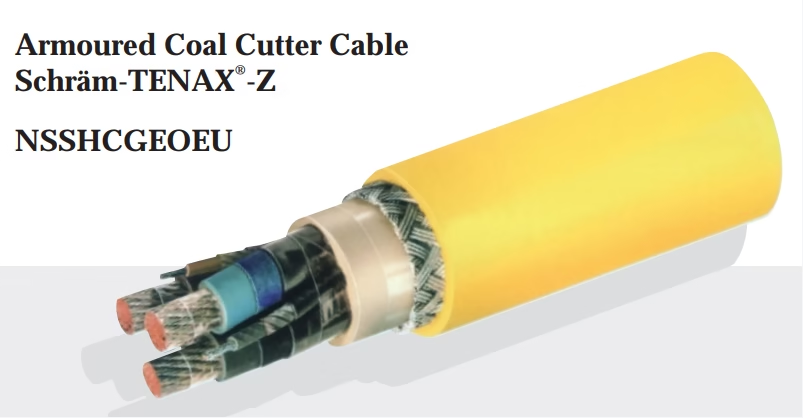
NSSHCGEOEU — это специализированный бронированный гибкий кабель, предназначенный для подключения мобильных машин, эксплуатируемых в условиях экстремальных механических нагрузок, преимущественно в горнодобывающей промышленности. Кабель разработан в соответствии с международным стандартом DIN VDE 0250, часть 812, который устанавливает требования к конструкции, электрическим характеристикам и механической прочности кабелей для угольных комбайнов.

Schräm-TENAX® -Z NSSHCGEOEU

бронированный кабель для угольных комбайнов, кабель NSSHCGEOEU, кабель для горнодобывающего оборудования, кабель для угольных шахт, гибкий шахтный кабель, кабель для комбайна, резиновый кабель для шахт, кабель EPR изоляция, кабель 0.6/1 kV горный, кабель для LHD погрузчика, кабель медно-стальная броня, кабель концентрический экран, силовой кабель для шахт
PROTOMONT (V) NTSKCGECWOEU series represents advanced rubber-sheathed flexible cables specifically engineered for power supply connections in mobile mining equipment. These cables are primarily deployed in underground mining applications where coal cutting machines operate in conjunction with cable protection chains (cable handlers) that trail behind the machinery. The cable handler system is designed to absorb the substantial tensile forces generated during machine movement, ensuring operational continuity and cable longevity.

PROTOMONT (V) NTSKCGECWOEU 1.8/3KV Coal Cutter Cables for Chain Operation

PROTOMONT (V) NTSKCGECWOEU series represents advanced rubber-sheathed flexible cables specifically engineered for power supply connections in mobile mining equipment. These cables are primarily deployed in underground mining applications where coal cutting machines operate in conjunction with cable protection chains (cable handlers) that trail behind the machinery. The cable handler system is designed to absorb the substantial tensile forces generated during machine movement, ensuring operational continuity and cable longevity.