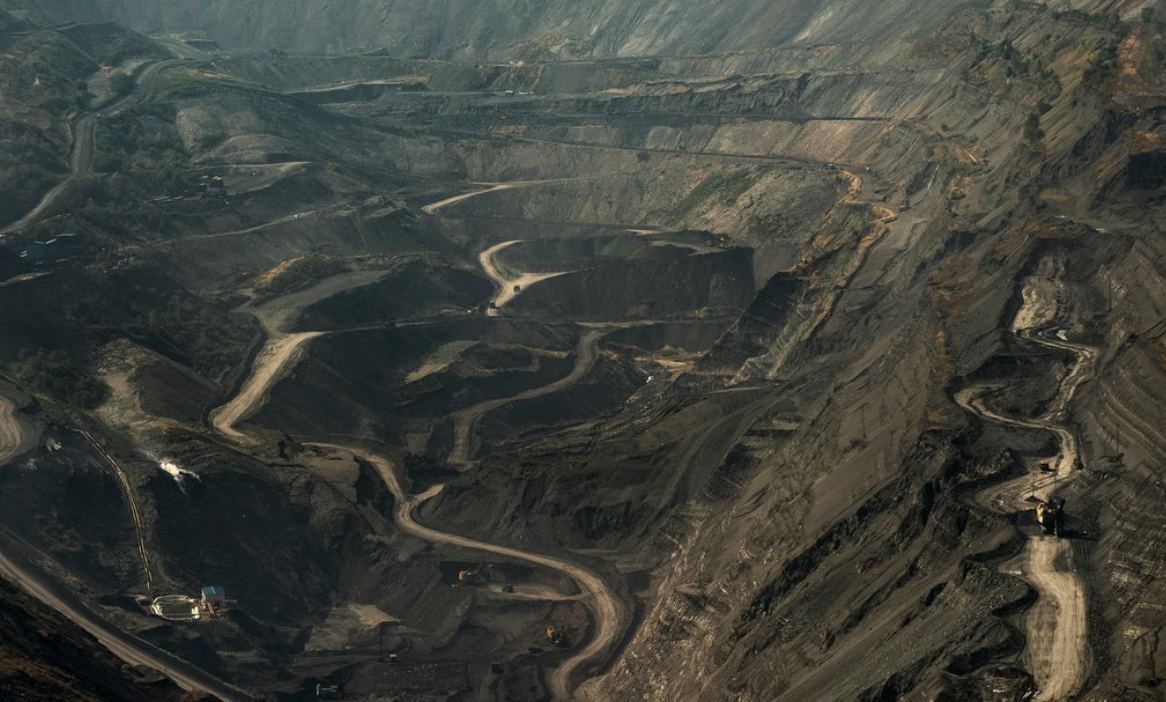
The NSSHÖU-J 4G95 0.6/1kV industrial mining cable is technically rated for temporary water immersion and is commonly used in open-pit and underground mining environments, but it is not specifically qualified for permanent submersion in acidic mine water and using it in this application is classified as beyond its design envelope. While the cable’s EPR insulation (3GI3) and CPE outer sheath (5GM5) provide adequate resistance to neutral water and brief acidic exposure, permanent submersion in acidic mine water with pH values of 2.0 to 4.0—typical of copper and gold mining operations—accelerates material degradation to the point where service life drops to approximately 18 to 36 months compared to 8 to 10 years in neutral water applications. The fundamental issue is not that the cable fails immediately when deployed in acidic water (it does not), but rather that the aggressive acidic environment causes progressive swelling of the jacket, penetration of H⁺ ions into the insulation layer, electrochemical corrosion of the tinned copper conductor, and cumulative electrical property loss that eventually results in insulation breakdown. This distinction between “survives temporary exposure” and “safe for permanent submersion” is critically important to understand: a cable can physically remain intact for months or even a year or more in acidic water, but the electrical properties are degrading silently, and catastrophic failure can occur suddenly when the insulation resistance drops below critical thresholds. For submersible pump applications in acidic mine water, engineers should specify cables explicitly designed for this service, such as H07RN8-F submersible pump cables with specialized halogen-free formulations, or upgrade to acidic-resistant variants of marine-grade cables rated for chemical exposure. The standard NSSHÖU-J cable can be used in acidic mine water applications only if the operational requirement is for temporary or seasonal service (less than 6 months per year), coupled with rigorous monitoring protocols and planned replacement intervals of 12 to 18 months rather than the standard 5 to 7 year intervals appropriate for neutral water service.
In the Nexans handling cable catalog, yellow outer sheaths are predominantly used for low-voltage (0.6/1 kV) RHEYCORD® series cables, while red outer sheaths identify medium-voltage (3–30 kV) RHEYFIRM® series cables. This color differentiation serves as a critical visual safety indicator for voltage level identification in industrial environments.
在耐克森搬运电缆目录中,黄色外护套主要用于低压(0.6/1 kV) RHEYCORD®系列电缆,而红色外护套用于标识中压(3–30 kV) RHEYFIRM®系列电缆。这种颜色区分是工业环境中电压等级识别的重要视觉安全指标。
Flexible rubber cables represent a critical category of industrial power transmission cables specifically engineered for demanding applications requiring exceptional mechanical flexibility combined with robust environmental protection. These cables utilize synthetic rubber insulation and sheathing materials to deliver superior performance in mobile equipment, submersible pumps, generators, and industrial machinery operating under harsh conditions. According to the International Electrotechnical Commission standard IEC 60245, rubber insulated cables are designed for use in power installations operating at nominal voltages up to and including 450/750V, with specialized constructions available for 0.6/1kV applications requiring enhanced durability.
柔性橡胶电缆代表了工业电力传输电缆的关键类别,专门设计用于需要卓越机械柔韧性与强大环境保护相结合的苛刻应用。这些电缆采用合成橡胶绝缘和护套材料,在移动设备、潜水泵、发电机和在恶劣条件下运行的工业机械中提供卓越性能。
The choice of conductor material in electrical cables represents a critical engineering decision that directly impacts cable longevity, performance, and safety. German VDE standards, particularly DIN VDE 0250, specify tinned copper conductors for rubber-insulated cables such as NSSHÖU, while PVC-insulated cables commonly utilize bare (plain) copper conductors. This technical distinction arises from fundamental differences in material chemistry and vulcanization processes.
电缆导体材料的选择是一项关键的工程决策,直接影响电缆的寿命、性能和安全性。德国VDE标准,特别是DIN VDE 0250,规定橡胶绝缘电缆(如NSSHÖU)必须使用镀锡铜导体,而PVC绝缘电缆通常使用裸铜导体。这一技术区别源于材料化学和硫化工艺的根本差异。
The NTSCGEWÖW cable (also written as NTSCGEWOEW when substituting the umlaut for ‘OE’) represents a specialized category of medium voltage power cables engineered specifically to withstand torsional stresses inherent in dynamic industrial applications. This cable designation follows the standardized German DIN VDE nomenclature system, with each letter indicating specific construction characteristics optimized for rotational stress environments.
The BS 6708 Type FS4 trailing cable represents a specialized category of non-armoured, individually metallic screened flexible cables engineered specifically for demanding mining and quarrying applications. This cable type is distinguished by its unique flat configuration design, where three phase cores and one pilot core—each equipped with composite individual screens—are laid up around an elastomeric cradle in contact with each other. This construction methodology provides optimal electrical performance while maintaining the flexibility essential for dynamic mining operations.
Key Identification: Type FS4 cables are specifically designated for overhead catenary systems and similar power supply applications in environments where explosive gases and dust may accumulate. The rated voltage of 640/1100V and test voltage of 3kV ensure reliable performance under the most challenging mining conditions.
The 600V 2TC Light (600V 2PNCT) crane cable represents a specialized category of flexible power cables designed specifically for low-voltage mobile equipment applications operating at rated voltages up to 600V. This cable features ethylene propylene rubber (EPR) insulation and polychloroprene rubber (CR) sheath, combining superior electrical performance with exceptional mechanical durability. Manufactured in accordance with JIS C 3327 Japanese Industrial Standard, this cable classification has established itself as the preferred solution for crane systems, reeling applications, and material handling equipment throughout industrial facilities worldwide.