mobile mining equipment cable

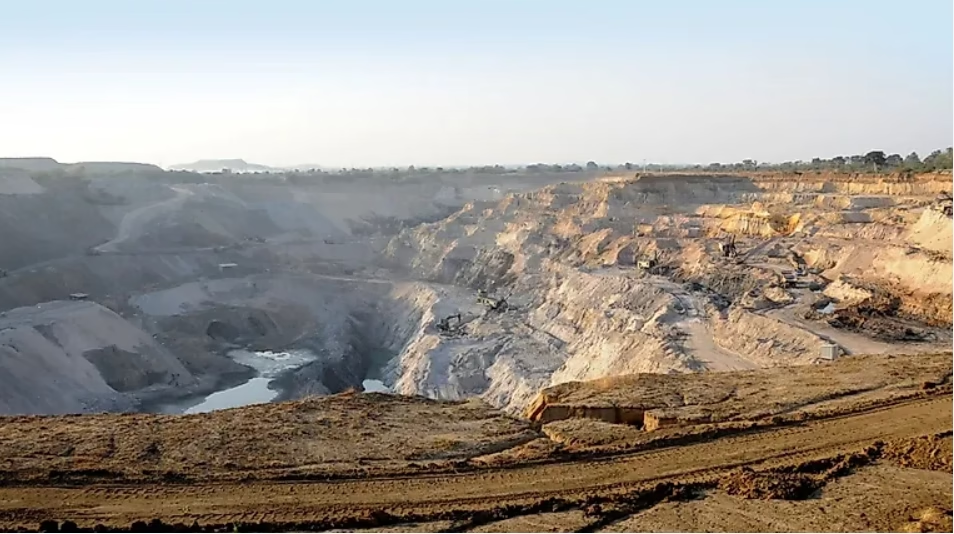
T-F-(N)TSCGEWOEU cable is purpose-engineered for this demanding opencast mining power distribution challenge. Key advantages: Dual Bending Radius Design: 6ר for fixed pit main distribution lines buried or overhead on pit benches; 10ר for mobile equipment power cables that must flex repeatedly as equipment moves. Field-Strippable Semiconducting Layer: Mining operations frequently require on-site cable modifications, connector re-termination, and length adjustments. The removable outer semiconducting layer enables these modifications without heating or special equipment—a unique feature that saves days of equipment downtime per project. Extreme Temperature Range: −40 to +80 °C operational span covers arctic pit operations (Canada, Siberia, Australia winter) to desert mining (Middle East, Australia summer), eliminating need for climate-specific cable variants. Corrosion-Resistant Tinned Copper: Pit dust from mineral extraction contains sulfides, chlorides, and other corrosive compounds. Tinned copper conductors resist oxidation and maintain conductivity where bare copper would degrade within months.

T-F-(N)TSCGEWOEU

T-F-(N)TSCGEWOEU cable is purpose-engineered for this demanding opencast mining power distribution challenge. Key advantages: Dual Bending Radius Design: 6ר for fixed pit main distribution lines buried or overhead on pit benches; 10ר for mobile equipment power cables that must flex repeatedly as equipment moves. Field-Strippable Semiconducting Layer: Mining operations frequently require on-site cable modifications, connector re-termination, and length adjustments. The removable outer semiconducting layer enables these modifications without heating or special equipment—a unique feature that saves days of equipment downtime per project. Extreme Temperature Range: −40 to +80 °C operational span covers arctic pit operations (Canada, Siberia, Australia winter) to desert mining (Middle East, Australia summer), eliminating need for climate-specific cable variants. Corrosion-Resistant Tinned Copper: Pit dust from mineral extraction contains sulfides, chlorides, and other corrosive compounds. Tinned copper conductors resist oxidation and maintain conductivity where bare copper would degrade within months.
FABER® Reelingflex Premium is a 0.6/1 kV polyurethane-sheathed, XLPE-insulated, aramid self-supporting mining reeling cable engineered by Anhui Feichun Special Cable Co., Ltd. for the most mechanically violent cable application in all of industrial engineering: powering mobile mining equipment through monospiral cable reels in underground tunnels, open-cast pits, quarries, and large-scale civil engineering operations.

FABER® Reelingflex Premium

FABER® Reelingflex Premium is a 0.6/1 kV polyurethane-sheathed, XLPE-insulated, aramid self-supporting mining reeling cable engineered by Anhui Feichun Special Cable Co., Ltd. for the most mechanically violent cable application in all of industrial engineering: powering mobile mining equipment through monospiral cable reels in underground tunnels, open-cast pits, quarries, and large-scale civil engineering operations.
Tanzania's underground gold mines — Bulyanhulu (Barrick / Twiga Minerals), North Mara (Barrick), Geita Underground (AngloGold Ashanti), New Luika (Shanta Gold) — operate fleets of Sandvik continuous miners, roadheaders, and load-haul-dump machines powered through trailing cables at 3.3/3.3kV. The portal access zone — the first 50–200 meters from the adit entrance into the underground workings — is the single most hostile environment for a trailing cable in any mine. The portal zone intersects deeply weathered, fractured rock that produces continuous rock falls: angular blocks of 0.5–50 kg dropping from heights of 2–5 meters onto the cable trail. A single impact from a 20 kg block falling 4 meters delivers ~785 joules of kinetic energy — enough to crush through a standard 3.0 mm trailing cable sheath and puncture the insulation in one event. The result is an immediate earth fault, machine shutdown, and emergency cable replacement in the most logistically difficult section of the mine. This guide provides the engineering framework for specifying a heavy-duty jacketed Type 209 3.3/3.3kV 3×50mm² trailing cable that survives portal zone rock falls, meets Sandvik OEM requirements, and complies with Tanzania Mining Commission safety regulations.

Tanzania Portal Access: Heavy-Duty Jacketing on Type 209 3.3/3.3kV 3×50mm² for African Rock FallsComplete Portal Trailing Cable Engineering Guide

Tanzania’s underground gold mines — Bulyanhulu (Barrick / Twiga Minerals), North Mara (Barrick), Geita Underground (AngloGold Ashanti), New Luika (Shanta Gold) — operate fleets of Sandvik continuous miners, roadheaders, and load-haul-dump machines powered through trailing cables at 3.3/3.3kV. The portal access zone — the first 50–200 meters from the adit entrance into the underground workings — is the single most hostile environment for a trailing cable in any mine. The portal zone intersects deeply weathered, fractured rock that produces continuous rock falls: angular blocks of 0.5–50 kg dropping from heights of 2–5 meters onto the cable trail. A single impact from a 20 kg block falling 4 meters delivers ~785 joules of kinetic energy — enough to crush through a standard 3.0 mm trailing cable sheath and puncture the insulation in one event. The result is an immediate earth fault, machine shutdown, and emergency cable replacement in the most logistically difficult section of the mine. This guide provides the engineering framework for specifying a heavy-duty jacketed Type 209 3.3/3.3kV 3×50mm² trailing cable that survives portal zone rock falls, meets Sandvik OEM requirements, and complies with Tanzania Mining Commission safety regulations.
Ghana's mechanized underground gold mines — Obuasi (AngloGold Ashanti), Tarkwa/Damang (Gold Fields), Akyem (Newmont), Bibiani (Asante Gold), Chirano (Kinross) — operate fleets of Sandvik continuous miners, bolters, and load-haul-dump (LHD) machines that were specified and commissioned by Australian contract mining companies. The OEM trailing cables on these machines are Olex (Nexans Olex) Type 241 — manufactured in Australia to AS/NZS 1802, the Australian standard for mining trailing cables. But Olex does not manufacture in Africa, has no West African distribution, and ships from Melbourne with a 18–26 week total procurement cycle. When a 200-meter trailing cable is crushed by a roof fall, sliced by a shuttle car, or degraded by months of dragging through acidic Birimian groundwater, the mine cannot wait half a year for a replacement. The mine needs an equivalent trailing cable that matches the AS/NZS 1802 Type 241 construction, meets Sandvik's OEM specifications, satisfies Ghana Minerals Commission safety requirements, and can be delivered in 8–12 weeks. This guide provides the engineering framework for that replacement.

Ghana Underground: Replacing Olex Type 241 1.1/1.1kV 3×35mm² on Sandvik Continuous MinersComplete Trailing Cable Replacement Guide

Ghana’s mechanized underground gold mines — Obuasi (AngloGold Ashanti), Tarkwa/Damang (Gold Fields), Akyem (Newmont), Bibiani (Asante Gold), Chirano (Kinross) — operate fleets of Sandvik continuous miners, bolters, and load-haul-dump (LHD) machines that were specified and commissioned by Australian contract mining companies. The OEM trailing cables on these machines are Olex (Nexans Olex) Type 241 — manufactured in Australia to AS/NZS 1802, the Australian standard for mining trailing cables. But Olex does not manufacture in Africa, has no West African distribution, and ships from Melbourne with a 18–26 week total procurement cycle. When a 200-meter trailing cable is crushed by a roof fall, sliced by a shuttle car, or degraded by months of dragging through acidic Birimian groundwater, the mine cannot wait half a year for a replacement. The mine needs an equivalent trailing cable that matches the AS/NZS 1802 Type 241 construction, meets Sandvik’s OEM specifications, satisfies Ghana Minerals Commission safety requirements, and can be delivered in 8–12 weeks. This guide provides the engineering framework for that replacement.
In underground coal mining across Australia and New Zealand, selecting between AS/NZS 1802 and AS/NZS 1972 is not a matter of personal preference or cost optimization—it is a matter of electrical safety compliance and regulatory requirement. The decision tree, however, is surprisingly straightforward once you understand the single fundamental principle that separates these two standards: whether your equipment moves while energized. 在澳大利亚和新西兰的地下煤矿电气设计中,在AS/NZS 1802和AS/NZS 1972之间选择不是个人偏好或成本优化的问题——这是电气安全合规性和监管要求的问题。然而,一旦您理解分离这两个标准的单一基本原则,决策树就会变得出奇地直接:您的设备在通电时是否移动。

AS/NZS 1802 vs AS/NZS 1972: Which Australian Standard Applies to Your Underground Mining Equipment?

In underground coal mining across Australia and New Zealand, selecting between AS/NZS 1802 and AS/NZS 1972 is not a matter of personal preference or cost optimization—it is a matter of electrical safety compliance and regulatory requirement. The decision tree, however, is surprisingly straightforward once you understand the single fundamental principle that separates these two standards: whether your equipment moves while energized. 在澳大利亚和新西兰的地下煤矿电气设计中,在AS/NZS 1802和AS/NZS 1972之间选择不是个人偏好或成本优化的问题——这是电气安全合规性和监管要求的问题。然而,一旦您理解分离这两个标准的单一基本原则,决策树就会变得出奇地直接:您的设备在通电时是否移动。
The central pilot core in an AS/NZS 1802 Type 241 6.6/6.6kV 3x120mm² cable should exhibit a measured DC resistance of approximately 0.350 to 1.050 ohms per kilometer at 20°C, depending on the pilot conductor's specific cross-sectional area (typically 16mm² or 25mm² in this cable class). For a typical 1,000-meter installation cable segment, the measured resistance across the entire pilot conductor pair (measuring between one end and the remote end, or using a calculated pro-rata method for field acceptance) should not exceed 1.050 ohms for a 16mm² pilot, or approximately 0.690 ohms for a 25mm² pilot. These resistance values serve as acceptance criteria for cable deliveries and provide a baseline against which future field testing can detect degradation caused by moisture ingress, oxidation, mechanical damage, or other environmental stress. The pilot core must demonstrate electrical continuity (resistance approaching zero would indicate an open circuit) while remaining within the specified upper bound (excessive resistance would indicate partial failure or contamination). Testing is performed using a standard digital multimeter set to resistance/ohms mode or using a dedicated cable tester with DC ohmmeter functionality, applied across the pilot conductor terminals at each cable end.

Type 241 6.6/6.6kV 3x120mm² Pilot Core Resistance Testing: Complete Continuity Verification and Field Acceptance Procedures for Underground Mining Cables

The central pilot core in an AS/NZS 1802 Type 241 6.6/6.6kV 3x120mm² cable should exhibit a measured DC resistance of approximately 0.350 to 1.050 ohms per kilometer at 20°C, depending on the pilot conductor’s specific cross-sectional area (typically 16mm² or 25mm² in this cable class). For a typical 1,000-meter installation cable segment, the measured resistance across the entire pilot conductor pair (measuring between one end and the remote end, or using a calculated pro-rata method for field acceptance) should not exceed 1.050 ohms for a 16mm² pilot, or approximately 0.690 ohms for a 25mm² pilot. These resistance values serve as acceptance criteria for cable deliveries and provide a baseline against which future field testing can detect degradation caused by moisture ingress, oxidation, mechanical damage, or other environmental stress. The pilot core must demonstrate electrical continuity (resistance approaching zero would indicate an open circuit) while remaining within the specified upper bound (excessive resistance would indicate partial failure or contamination). Testing is performed using a standard digital multimeter set to resistance/ohms mode or using a dedicated cable tester with DC ohmmeter functionality, applied across the pilot conductor terminals at each cable end.
RHEYFIRM® (S) series reeling cables with 3+3 core distributed earth design exhibit outer diameters ranging from approximately 40.0 mm (for 3×25+3×25/34 mm² configurations at 6/10 kV) to 76.0 mm or larger (for heavy-duty 3×185+3×95/35 mm² configurations at 12/20 kV). The nominal outer diameter depends on the specific conductor cross-section, voltage rating, and insulation thickness selected. For a typical medium-voltage marine and industrial application, a RHEYFIRM® (S) cable rated 3×70+3×35/32 mm² at 6/10 kV exhibits an outer diameter between 52.0 mm and 56.0 mm with approximate total cable weight of 4,300 kg/km (2,890 lbs/1000ft), while the corresponding 12/20 kV variant reaches 62.0 to 67.0 mm outer diameter with weights near 6,800 kg/km (4,570 lbs/1000ft).

RHEYFIRM® (S) 3+3 Core Design: Why Does Nexans Use Distributed Earth in the (S) Series and How Does It Affect EMC?

RHEYFIRM® (S) series reeling cables with 3+3 core distributed earth design exhibit outer diameters ranging from approximately 40.0 mm (for 3×25+3×25/34 mm² configurations at 6/10 kV) to 76.0 mm or larger (for heavy-duty 3×185+3×95/35 mm² configurations at 12/20 kV). The nominal outer diameter depends on the specific conductor cross-section, voltage rating, and insulation thickness selected. For a typical medium-voltage marine and industrial application, a RHEYFIRM® (S) cable rated 3×70+3×35/32 mm² at 6/10 kV exhibits an outer diameter between 52.0 mm and 56.0 mm with approximate total cable weight of 4,300 kg/km (2,890 lbs/1000ft), while the corresponding 12/20 kV variant reaches 62.0 to 67.0 mm outer diameter with weights near 6,800 kg/km (4,570 lbs/1000ft).
Yes, properly-specified generic (N)TSCGEWÖU 3x70+3x35/3 6/10kV cables can reliably replace Sandvik OEM cables on underground load-haul-dump loaders, with realistic cost savings of 20 to 40 percent over the cable's service life, provided that five critical verification steps are completed before installation. The generic cable must have an outer diameter not exceeding 59.1 millimeters (matching or staying within the original cable's drum clearance envelope), must feature verified anti-torsion braid rated for minimum ±25° per meter torsional resistance (preventing corkscrewing failures), must specify an outer jacket of either premium 5GM5 elastomer or polyurethane formulation confirmed for underground abrasion resistance (not standard CPE), must carry a maximum tensile load rating of at least 3,150 to 4,200 newtons (matching Sandvik's duty cycle), and must include complete technical documentation of insulation thickness and conductor stranding patterns (enabling proper splicing compatibility). Additionally, the cable supplier must provide type-test certification according to DIN VDE 0250-813 and ideally field-proven performance data from comparable underground mining installations. When these five criteria are met, field experience from underground mines across Scandinavia, North America, and Australia demonstrates that properly-specified generic cables achieve service lives of 3 to 5 years—matching or occasionally exceeding OEM cable longevity—while reducing procurement costs by $80,000 to $150,000 per cable depending on the specific LHD model and regional pricing. However, many suppliers offering cables under the "(N)TSCGEWÖU" designation do not actually meet these technical requirements. Low-cost variants that compromise on anti-torsion structure, use inadequate jacket material, or provide incomplete documentation will fail within 6 to 12 months of underground operation, creating safety hazards and erasing the cost savings through premium pricing for emergency replacement cables and associated downtime. Therefore, the straightforward answer "yes, generic cables can work" comes with an essential caveat: success requires rigorous verification of the specific generic cable specification before procurement, not blind assumption that any product bearing the (N)TSCGEWÖU designation meets the technical requirements of underground LHD operation.

Underground LHD Loaders: Replacing OEM Sandvik Cables with Generic (N)TSCGEWÖU 3×70+3×35/3

Yes, properly-specified generic (N)TSCGEWÖU 3×70+3×35/3 6/10kV cables can reliably replace Sandvik OEM cables on underground load-haul-dump loaders, with realistic cost savings of 20 to 40 percent over the cable’s service life, provided that five critical verification steps are completed before installation. The generic cable must have an outer diameter not exceeding 59.1 millimeters (matching or staying within the original cable’s drum clearance envelope), must feature verified anti-torsion braid rated for minimum ±25° per meter torsional resistance (preventing corkscrewing failures), must specify an outer jacket of either premium 5GM5 elastomer or polyurethane formulation confirmed for underground abrasion resistance (not standard CPE), must carry a maximum tensile load rating of at least 3,150 to 4,200 newtons (matching Sandvik’s duty cycle), and must include complete technical documentation of insulation thickness and conductor stranding patterns (enabling proper splicing compatibility). Additionally, the cable supplier must provide type-test certification according to DIN VDE 0250-813 and ideally field-proven performance data from comparable underground mining installations. When these five criteria are met, field experience from underground mines across Scandinavia, North America, and Australia demonstrates that properly-specified generic cables achieve service lives of 3 to 5 years—matching or occasionally exceeding OEM cable longevity—while reducing procurement costs by $80,000 to $150,000 per cable depending on the specific LHD model and regional pricing. However, many suppliers offering cables under the “(N)TSCGEWÖU” designation do not actually meet these technical requirements. Low-cost variants that compromise on anti-torsion structure, use inadequate jacket material, or provide incomplete documentation will fail within 6 to 12 months of underground operation, creating safety hazards and erasing the cost savings through premium pricing for emergency replacement cables and associated downtime. Therefore, the straightforward answer “yes, generic cables can work” comes with an essential caveat: success requires rigorous verification of the specific generic cable specification before procurement, not blind assumption that any product bearing the (N)TSCGEWÖU designation meets the technical requirements of underground LHD operation.
Before we can meaningfully compare specific cable products to industry standards, we need to establish a clear understanding of what those standards represent and why they matter. The ICEA S-75-381 standard, also published as ANSI/NEMA WC-58, stands as one of the most comprehensive and rigorous cable specifications ever developed for industrial applications. Think of this standard as the "gold standard" for cables that must operate in the most demanding environments imaginable—underground mines, surface mining operations, and similar heavy-duty industrial settings where cable failure doesn't simply mean inconvenience, but can create life-threatening situations for workers operating in confined, potentially explosive environments.[97,105,108] 在我们能够有意义地将特定电缆产品与行业标准进行比较之前,我们需要清楚地了解这些标准代表什么以及为什么它们很重要。ICEA S-75-381标准,也以ANSI/NEMA WC-58发布,是为工业应用开发的最全面和最严格的电缆规范之一。可以把这个标准想象成必须在最苛刻环境中运行的电缆的"黄金标准"。

Nexans AmerCable G-GC Tiger Brand: How Does the Insulation Thickness Compare to ICEA S-75-381 Standard Cables?

Before we can meaningfully compare specific cable products to industry standards, we need to establish a clear understanding of what those standards represent and why they matter. The ICEA S-75-381 standard, also published as ANSI/NEMA WC-58, stands as one of the most comprehensive and rigorous cable specifications ever developed for industrial applications. Think of this standard as the “gold standard” for cables that must operate in the most demanding environments imaginable—underground mines, surface mining operations, and similar heavy-duty industrial settings where cable failure doesn’t simply mean inconvenience, but can create life-threatening situations for workers operating in confined, potentially explosive environments.[97,105,108] 在我们能够有意义地将特定电缆产品与行业标准进行比较之前,我们需要清楚地了解这些标准代表什么以及为什么它们很重要。ICEA S-75-381标准,也以ANSI/NEMA WC-58发布,是为工业应用开发的最全面和最严格的电缆规范之一。可以把这个标准想象成必须在最苛刻环境中运行的电缆的”黄金标准”。
The selection of appropriate trailing cables for surface mining draglines represents a critical engineering decision that directly impacts operational efficiency, safety, and total cost of ownership. Dragline excavators, among the largest mobile land machines in operation, require specialized heavy-duty trailing cables capable of delivering high-voltage power (typically 2 kV to 35 kV) while withstanding extreme mechanical stresses including constant flexing, crushing forces, abrasion, and environmental exposure to ultraviolet radiation, temperature extremes, and moisture. This technical analysis examines the comparative merits of Nexans AmerCable's Tiger Brand premium mold-cured cables versus generic Type SHD-GC alternatives, focusing specifically on the critical importance of jacket construction technology in determining long-term performance and reliability in surface mining dragline applications.

Nexans AmerCable Tiger Brand vs. Type SHD-GC: Finding a Compatible Mold-Cured Jacket Cable for Surface Mining Draglines

The selection of appropriate trailing cables for surface mining draglines represents a critical engineering decision that directly impacts operational efficiency, safety, and total cost of ownership. Dragline excavators, among the largest mobile land machines in operation, require specialized heavy-duty trailing cables capable of delivering high-voltage power (typically 2 kV to 35 kV) while withstanding extreme mechanical stresses including constant flexing, crushing forces, abrasion, and environmental exposure to ultraviolet radiation, temperature extremes, and moisture. This technical analysis examines the comparative merits of Nexans AmerCable’s Tiger Brand premium mold-cured cables versus generic Type SHD-GC alternatives, focusing specifically on the critical importance of jacket construction technology in determining long-term performance and reliability in surface mining dragline applications.
Underground Load-Haul-Dump (LHD) loaders represent the backbone of modern underground mining operations, performing the critical function of excavating, transporting, and depositing ore within confined tunnel environments. These machines operate under extreme conditions including continuous mechanical stress from reeling and unreeling operations, exposure to abrasive rock surfaces, high humidity levels often exceeding 90% relative humidity, and temperatures ranging from -25°C to +90°C in various mining environments worldwide. 地下铲运机(LHD)装载机代表了现代地下采矿作业的核心,执行在狭窄隧道环境中挖掘、运输和卸载矿石的关键功能。这些机器在极端条件下运行,包括卷绕和展开作业产生的持续机械应力、暴露于磨蚀性岩石表面、通常超过90%相对湿度的高湿环境,以及全球各种采矿环境中从-25°C到+90°C的温度范围。

Sandvik LH517 & LH621 Loaders: Why Type 241 Cables Last Longer in Shuttle Operations

Underground Load-Haul-Dump (LHD) loaders represent the backbone of modern underground mining operations, performing the critical function of excavating, transporting, and depositing ore within confined tunnel environments. These machines operate under extreme conditions including continuous mechanical stress from reeling and unreeling operations, exposure to abrasive rock surfaces, high humidity levels often exceeding 90% relative humidity, and temperatures ranging from -25°C to +90°C in various mining environments worldwide. 地下铲运机(LHD)装载机代表了现代地下采矿作业的核心,执行在狭窄隧道环境中挖掘、运输和卸载矿石的关键功能。这些机器在极端条件下运行,包括卷绕和展开作业产生的持续机械应力、暴露于磨蚀性岩石表面、通常超过90%相对湿度的高湿环境,以及全球各种采矿环境中从-25°C到+90°C的温度范围。
Type 409 cables represent a specialized category of flexible mining cables designed specifically for demanding applications in material handling equipment, surface mining operations, and industrial environments. These cables are manufactured according to the Australian and New Zealand Standard AS/NZS 2802:2000, which establishes rigorous requirements for reeling and trailing cables used in mining and general industrial applications outside underground coal mining environments. (409型电缆是专为物料搬运设备、露天采矿作业和工业环境中的高要求应用而设计的一类特种柔性矿用电缆。这些电缆按照澳大利亚和新西兰标准AS/NZS 2802:2000制造,该标准对用于煤矿井下以外的采矿和一般工业应用的卷筒电缆和拖曳电缆制定了严格要求。)

TENAX-PUR (N)TSCGEH3S I 6 – 10 KV

TENAX-PUR is a premium medium voltage trailing cable engineered specifically for power supply to large mobile mining equipment such as shovels and draglines. The cable features an extremely robust polyurethane (PUR) outer sheath that delivers exceptional performance against abrasion and tearing, maintaining full flexibility even in extreme cold conditions down to -50°C. Available in orange, yellow, or custom colors to meet specific operational requirements. TENAX-PUR 是一种专为大型移动采矿设备(如电铲和拉斗铲)供电而设计的优质中压拖曳电缆。该电缆采用极其坚固的聚氨酯(PUR)外护套,在磨损和撕裂方面提供卓越的性能,即使在低至-50°C的极端寒冷条件下也能保持充分的柔韧性。可提供橙色、黄色或定制颜色以满足特定操作要求。
The maximum allowable pilot loop resistance for Type 450 mining cables operating with Ampcontrol earth continuity relays represents a critical electrical parameter that directly impacts mine safety and operational reliability. This comprehensive technical analysis examines the interaction between AS/NZS 2802:2000 Type 450 cable specifications and Ampcontrol relay requirements, providing mining engineers and electrical designers with authoritative guidance for proper system design and selection. 与Ampcontrol地电连续继电器配合使用的Type 450矿用电缆的最大允许导向回路电阻是一个直接影响矿山安全和运行可靠性的关键电气参数。本全面技术分析检查了AS/NZS 2802:2000 Type 450电缆规格与Ampcontrol继电器要求之间的相互作用,为矿业工程师和电气设计师提供了正确系统设计和选择的权威指导。

PROTOLON (SB) NTSCGEWOEU I 3 – 30 KV

These cables serve as power supply or connection cables for large material handling machines, such as excavators in opencast mines, subjected to extremely high mechanical stresses where abrasion and chaffing stresses are expected in trailing operation. 这些电缆用作大型物料搬运机械(如露天矿山挖掘机)的电源或连接电缆,在拖曳作业中承受极高的机械应力、磨损和摩擦应力。
The question of whether NSSHÖU cables require CE marking for European surface mining operations involves a nuanced understanding of European Union electrical equipment regulations. NSSHÖU cables, manufactured according to the German standard DIN VDE 0250 Part 812, are heavy-duty rubber-sheathed flexible cables specifically designed for mining and industrial applications where extreme mechanical stress, abrasion resistance, and environmental durability are essential operational requirements. NSSHÖU电缆在欧洲露天采矿作业中是否需要CE标志的问题涉及对欧盟电气设备法规的细致理解。NSSHÖU电缆根据德国标准DIN VDE 0250第812部分制造,是专门为采矿和工业应用设计的重型橡胶护套柔性电缆,在这些应用中,极端的机械应力、耐磨性和环境耐久性是基本的操作要求。

TUNNELFLEX-PUR HF WITHOUT ANTITWISTING PROTECTION I 1 KV

TUNNELFLEX-PUR HF represents a specialized category of halogen-free flexible power cables engineered for mobile equipment operating in mining and tunnelling environments where high mechanical damage risk is inherent. This cable variant, manufactured without antitwisting protection elements, is optimally designed for applications where cable deflection occurs predominantly in a single plane, eliminating the need for complex anti-torsion structures while maintaining robust mechanical performance and safety characteristics critical to underground operations. 该电缆为无卤柔性电力电缆,专为存在高机械损伤风险的采矿和隧道移动设备供电而设计。由于没有抗扭保护,适用于仅在单一平面内偏转的应用场合,最大运行速度为60米/分钟。
When international cable manufacturers consider entering the Colombian market, particularly for mining applications, they encounter a comprehensive regulatory framework that may initially seem complex but serves a vital purpose. The Reglamento Técnico de Instalaciones Eléctricas, universally known by its Spanish acronym RETIE, represents Colombia's mandatory technical regulation governing all electrical installations and products. 当国际电缆制造商考虑进入哥伦比亚市场时,特别是针对矿业应用,他们会遇到一个全面的监管框架 Understanding RETIE is not merely a bureaucratic exercise but rather the foundation for successfully participating in one of South America's most dynamic electrical markets.

TROMMELFLEX-M-PUR D2X11Y I 1 KV

TROMMELFLEX-M-PUR represents a specialized class of flexible low voltage reeling cables engineered specifically for underground mining and tunnelling operations. This cable features optimized dimensions and incorporates a flame retardant, halogen-free polyurethane outer sheath, making it particularly suitable for demanding industrial environments where both mechanical durability and safety are paramount. The cable’s design addresses the unique challenges encountered in mining applications, where equipment must withstand frequent dynamic loads, abrasive conditions, and the rigorous demands of continuous reeling operations on drilling machines, scoops, and load-haul-dump vehicles. 卷筒柔性电缆专为地下采矿和隧道设备设计,具有优化的尺寸和阻燃无卤聚氨酯外护套。该电缆适用于钻机、铲运机和装载设备的频繁动态负载和卷筒操作。
Variable frequency drives (VFDs) have revolutionized industrial motor control by enabling precise speed regulation and significant energy savings. However, these benefits come with a serious technical challenge that many facilities overlook until catastrophic failure occurs. When VFDs control AC motors through pulse width modulation (PWM), they create high-frequency electrical disturbances that can destroy motor bearings in a matter of months or even weeks, rather than the expected operational lifetime of years.

VFD Motor Bearing Damage: Why You Need (N)3GHSSYCY Screened Mining Cables?

Variable frequency drives (VFDs) have revolutionized industrial motor control by enabling precise speed regulation and significant energy savings. However, these benefits come with a serious technical challenge that many facilities overlook until catastrophic failure occurs. When VFDs control AC motors through pulse width modulation (PWM), they create high-frequency electrical disturbances that can destroy motor bearings in a matter of months or even weeks, rather than the expected operational lifetime of years.
Comprehensive Technical Analysis of Chlorinated Polyethylene (CPE) vs Chlorosulphonated Polyethylene (CSP) Sheath Performance Under Extreme UV Radiation in Pilbara Region Mining Operations 氯化聚乙烯(CPE)与氯磺化聚乙烯(CSP)护套在皮尔巴拉地区采矿作业极端紫外线辐射下性能的综合技术分析

UV Resistance in Type 441 Mining Cables: Does CPE Sheath Meet “Extremely High UV” Requirements of Australian Surface Mines?

Comprehensive Technical Analysis of Chlorinated Polyethylene (CPE) vs Chlorosulphonated Polyethylene (CSP) Sheath Performance Under Extreme UV Radiation in Pilbara Region Mining Operations 氯化聚乙烯(CPE)与氯磺化聚乙烯(CSP)护套在皮尔巴拉地区采矿作业极端紫外线辐射下性能的综合技术分析
In the demanding world of surface mining operations, dragline excavators and mobile material handling equipment rely on high-voltage flexible cables to deliver continuous electrical power as these massive machines traverse mining sites. The choice between Type 450 and Type 455 cables manufactured to AS/NZS 2802:2000 standards represents a critical engineering decision that directly impacts equipment reliability, operational costs, and cable service life. Both cable types are designed for voltage ratings from 3.3 kilovolts to 33 kilovolts, with operational temperatures spanning from negative 25 degrees Celsius to positive 90 degrees Celsius, making them suitable for the diverse environmental conditions encountered in Australian mining operations

Dragline Cables 22kV/33kV: Type 450 vs Type 455 — Which Design Delivers Superior Longevity for Reeling and Trailing Applications?

In the demanding world of surface mining operations, dragline excavators and mobile material handling equipment rely on high-voltage flexible cables to deliver continuous electrical power as these massive machines traverse mining sites. The choice between Type 450 and Type 455 cables manufactured to AS/NZS 2802:2000 standards represents a critical engineering decision that directly impacts equipment reliability, operational costs, and cable service life. Both cable types are designed for voltage ratings from 3.3 kilovolts to 33 kilovolts, with operational temperatures spanning from negative 25 degrees Celsius to positive 90 degrees Celsius, making them suitable for the diverse environmental conditions encountered in Australian mining operations
In surface mining and general underground mining operations excluding coal, heavy mobile equipment such as draglines, electric shovels, and drilling rigs rely on reeling cable systems to maintain continuous power delivery during movement and repositioning. These reeling drum applications subject cables to severe mechanical stresses including crushing forces as cable layers compress against each other during winding operations. The selection between Type 440 and Type 441 cables manufactured to AS/NZS 2802 standards represents a critical engineering decision that directly impacts equipment reliability, operational safety, and maintenance costs. 在不包括煤炭的露天采矿和一般地下采矿作业中,挖掘机、电铲和钻机等重型移动设备依赖卷取电缆系统在移动和重新定位期间保持连续供电。

Mining Reeling Cables: Why Type 441 with Interstitial Earth Outperforms Type 440 Under High Crushing Forces

In surface mining and general underground mining operations excluding coal, heavy mobile equipment such as draglines, electric shovels, and drilling rigs rely on reeling cable systems to maintain continuous power delivery during movement and repositioning. These reeling drum applications subject cables to severe mechanical stresses including crushing forces as cable layers compress against each other during winding operations. The selection between Type 440 and Type 441 cables manufactured to AS/NZS 2802 standards represents a critical engineering decision that directly impacts equipment reliability, operational safety, and maintenance costs. 在不包括煤炭的露天采矿和一般地下采矿作业中,挖掘机、电铲和钻机等重型移动设备依赖卷取电缆系统在移动和重新定位期间保持连续供电。
Type 241 mining cables represent a specialized category of flexible power cables designed for demanding underground mining applications, continuous miner feeders, and pump supply systems operating at voltages from 1.1kV to 11kV. These cables are manufactured to comply with AS/NZS 1802:2003 standards and incorporate sophisticated screening systems that balance electrical performance, mechanical flexibility, and safety requirements.[1] (241型矿用电缆是专为严苛的地下采矿应用、连续采矿机馈线和泵供电系统设计的柔性电力电缆,工作电压为1.1kV至11kV)

Composite Screen: How does the copper/nylon braid screen in Type 241 cables handle fault currents compared to a full metallic screen?

Type 241 mining cables represent a specialized category of flexible power cables designed for demanding underground mining applications, continuous miner feeders, and pump supply systems operating at voltages from 1.1kV to 11kV. These cables are manufactured to comply with AS/NZS 1802:2003 standards and incorporate sophisticated screening systems that balance electrical performance, mechanical flexibility, and safety requirements.[1] (241型矿用电缆是专为严苛的地下采矿应用、连续采矿机馈线和泵供电系统设计的柔性电力电缆,工作电压为1.1kV至11kV)
N3GHSSYCY cable designation represents a sophisticated medium voltage mining cable specifically engineered for hazardous underground environments. This nomenclature follows the German VDE (Verband der Elektrotechnik) standardization system, where each letter and number conveys critical information about the cable's construction and intended application. Understanding this designation system is essential for engineers, procurement specialists, and safety officers working in mining and tunneling operations. N3GHSSYCY电缆名称代表专门为危险地下环境设计的复杂中压矿用电缆。该命名法遵循德国VDE(电气工程协会)标准化系统,其中每个字母和数字都传达有关电缆结构和预期应用的关键信息。了解该命名系统对于从事采矿和隧道作业的工程师、采购专家和安全官员至关重要。

N3GHSSYCY Cable Datasheet: Technical Specification Downloads & Resources

N3GHSSYCY cable designation represents a sophisticated medium voltage mining cable specifically engineered for hazardous underground environments. This nomenclature follows the German VDE (Verband der Elektrotechnik) standardization system, where each letter and number conveys critical information about the cable’s construction and intended application. Understanding this designation system is essential for engineers, procurement specialists, and safety officers working in mining and tunneling operations. N3GHSSYCY电缆名称代表专门为危险地下环境设计的复杂中压矿用电缆。该命名法遵循德国VDE(电气工程协会)标准化系统,其中每个字母和数字都传达有关电缆结构和预期应用的关键信息。了解该命名系统对于从事采矿和隧道作业的工程师、采购专家和安全官员至关重要。
Primary HS Code for Rubber Mining Cables | 主要海关编码 HS Code: 8544.49 / 8544.60 Rubber-insulated mining cables typically fall under Chapter 85 of the Harmonized System, specifically within heading 8544, which covers insulated wire, cable, and other insulated electric conductors. The exact subheading depends on voltage specifications and whether connectors are fitted. 橡胶绝缘矿用电缆通常属于协调制度第85章,特别是8544项下,涵盖绝缘线、电缆和其他绝缘电导体。具体的子目取决于额定电压和是否配有连接器。

HS Code Classification Guide: Exporting Rubber Mining Cables to Peru & Chile

Primary HS Code for Rubber Mining Cables | 主要海关编码 HS Code: 8544.49 / 8544.60 Rubber-insulated mining cables typically fall under Chapter 85 of the Harmonized System, specifically within heading 8544, which covers insulated wire, cable, and other insulated electric conductors. The exact subheading depends on voltage specifications and whether connectors are fitted. 橡胶绝缘矿用电缆通常属于协调制度第85章,特别是8544项下,涵盖绝缘线、电缆和其他绝缘电导体。具体的子目取决于额定电压和是否配有连接器。
For a 500-meter length of Type 440 11kV mining cable, the required shipping drum dimensions are fundamentally determined by the cable's minimum bend radius and physical dimensions. Based on industry standards from AS/NZS 2802:2000 and IEC 60502-2, proper drum sizing ensures cable integrity during transportation and prevents damage to the cable's internal structure, particularly the semiconductive screens and EPR insulation critical for medium voltage applications. 对于500米长的Type 440 11kV矿用电缆,所需的运输卷筒尺寸主要由电缆的最小弯曲半径和物理尺寸决定。根据AS/NZS 2802:2000和IEC 60502-2的行业标准,正确的卷筒尺寸可确保运输过程中的电缆完整性,并防止损坏电缆的内部结构,特别是对中压应用至关重要的半导体屏蔽层和EPR绝缘层。

Drum Dimensions for Type 440 11kV Cable: Engineering Specification Guide

For a 500-meter length of Type 440 11kV mining cable, the required shipping drum dimensions are fundamentally determined by the cable’s minimum bend radius and physical dimensions. Based on industry standards from AS/NZS 2802:2000 and IEC 60502-2, proper drum sizing ensures cable integrity during transportation and prevents damage to the cable’s internal structure, particularly the semiconductive screens and EPR insulation critical for medium voltage applications. 对于500米长的Type 440 11kV矿用电缆,所需的运输卷筒尺寸主要由电缆的最小弯曲半径和物理尺寸决定。根据AS/NZS 2802:2000和IEC 60502-2的行业标准,正确的卷筒尺寸可确保运输过程中的电缆完整性,并防止损坏电缆的内部结构,特别是对中压应用至关重要的半导体屏蔽层和EPR绝缘层。
The short answer is yes, damaged Type 441 reeling cables can be spliced underground using resin joint kits that comply with AS/NZS 1747 standards, provided specific conditions are met and proper procedures are followed. However, understanding when, why, and how such repairs should be performed requires examining the cable construction, applicable standards, and field repair methodologies that govern mining cable maintenance practices across Australia, New Zealand, and similar international mining operations.

Can you splice a damaged Type 441 reeling cable underground using a Resin Joint Kit (AS/NZS 1747)?

The short answer is yes, damaged Type 441 reeling cables can be spliced underground using resin joint kits that comply with AS/NZS 1747 standards, provided specific conditions are met and proper procedures are followed. However, understanding when, why, and how such repairs should be performed requires examining the cable construction, applicable standards, and field repair methodologies that govern mining cable maintenance practices across Australia, New Zealand, and similar international mining operations.
(N)TSCGEWÖU cable designation represents a specialized category of medium-voltage flexible power cables manufactured according to the stringent requirements of German standard DIN VDE 0250-813. These cables are specifically engineered for demanding applications in underground mining operations, tunnelling projects, and heavy industrial installations where conventional power cables would fail under the combined stresses of mechanical loading, chemical exposure, and harsh environmental conditions. The nomenclature follows German cable designation conventions where "T" indicates fine-stranded conductors for maximum flexibility, "SC" denotes semiconductive screening layers, "G" represents flexible insulation compound, "E" signifies earth conductors, "W" indicates oil-resistant properties, and "Ö" confirms oil and chemical resistance of the outer sheath.

Ampacity Derating: How Much Current Can (N)TSCGEWÖU Carry When Wound in 3 Layers on a Drum?

(N)TSCGEWÖU cable designation represents a specialized category of medium-voltage flexible power cables manufactured according to the stringent requirements of German standard DIN VDE 0250-813. These cables are specifically engineered for demanding applications in underground mining operations, tunnelling projects, and heavy industrial installations where conventional power cables would fail under the combined stresses of mechanical loading, chemical exposure, and harsh environmental conditions. The nomenclature follows German cable designation conventions where “T” indicates fine-stranded conductors for maximum flexibility, “SC” denotes semiconductive screening layers, “G” represents flexible insulation compound, “E” signifies earth conductors, “W” indicates oil-resistant properties, and “Ö” confirms oil and chemical resistance of the outer sheath.
Type SHD-GC cable represents a critical component in mining and heavy industrial applications, designed specifically for environments where both flexibility and maximum protection are paramount. This shielded mining cable features Ethylene Propylene Diene Monomer (EPDM) or Ethylene Propylene Rubber (EPR) insulation, providing exceptional resistance to moisture, heat, and abrasion. The cable is commonly deployed in mobile mining equipment, continuous mining machines, longwall mining systems, and other demanding industrial settings where power reliability and safety cannot be compromised.

Minimum Bending Radius: How Tight Can You Bend a Type SHD-GC Cable Without Damaging the EPDM Insulation?

Type SHD-GC cable represents a critical component in mining and heavy industrial applications, designed specifically for environments where both flexibility and maximum protection are paramount. This shielded mining cable features Ethylene Propylene Diene Monomer (EPDM) or Ethylene Propylene Rubber (EPR) insulation, providing exceptional resistance to moisture, heat, and abrasion. The cable is commonly deployed in mobile mining equipment, continuous mining machines, longwall mining systems, and other demanding industrial settings where power reliability and safety cannot be compromised.
cable selection directly impacts equipment reliability, operational safety, and cost efficiency. While Diesel Locomotive Cable (DLO) and Type W cables share similar voltage ratings and environmental resistance, their fundamental design philosophies serve distinctly different operational requirements. This technical analysis examines why DLO cable, despite its robust construction and premium materials, is frequently rejected for dynamic mining applications involving continuous movement equipment such as shuttle cars, draglines, and continuous miners.

DLO Cable vs. Type W: Why is Diesel Locomotive Cable often rejected for dynamic mining applications?

cable selection directly impacts equipment reliability, operational safety, and cost efficiency. While Diesel Locomotive Cable (DLO) and Type W cables share similar voltage ratings and environmental resistance, their fundamental design philosophies serve distinctly different operational requirements. This technical analysis examines why DLO cable, despite its robust construction and premium materials, is frequently rejected for dynamic mining applications involving continuous movement equipment such as shuttle cars, draglines, and continuous miners.
(N)TMCGEWÖU and reeling cables designated (N)TSCGEWÖU represents more than nomenclature. These cable types embody fundamentally different engineering approaches to managing mechanical stress, electrical performance, and operational reliability. While both cables conform to DIN VDE 0250 Part 813 standards and share similar voltage ratings from 3.6/6 kV to 18/30 kV, their construction reflects distinct design philosophies optimized for specific movement patterns and stress profiles. 在中压矿用电缆应用中,(N)TMCGEWÖU拖曳电缆和(N)TSCGEWÖU卷筒电缆之间的区别不仅仅是命名差异。这些电缆类型体现了管理机械应力、电气性能和运行可靠性的根本不同的工程方法。

(N)TMCGEWÖU vs. (N)TSCGEWÖU: Can I use a Medium Voltage Trailing cable for a Reeling application?

(N)TMCGEWÖU and reeling cables designated (N)TSCGEWÖU represents more than nomenclature. These cable types embody fundamentally different engineering approaches to managing mechanical stress, electrical performance, and operational reliability. While both cables conform to DIN VDE 0250 Part 813 standards and share similar voltage ratings from 3.6/6 kV to 18/30 kV, their construction reflects distinct design philosophies optimized for specific movement patterns and stress profiles. 在中压矿用电缆应用中,(N)TMCGEWÖU拖曳电缆和(N)TSCGEWÖU卷筒电缆之间的区别不仅仅是命名差异。这些电缆类型体现了管理机械应力、电气性能和运行可靠性的根本不同的工程方法。
NTSCGEWÖU mining cables manufactured according to DIN VDE 0250-813 specifications, compliance with both testing standards proves essential. These flexible medium voltage trailing cables operate in mining environments where they may be installed individually in some areas while grouped together with other power and control cables in vertical shafts, along drift walls, or within cable trays in other locations. Understanding the distinct test procedures, pass criteria, and fire behavior mechanisms addressed by each standard enables proper cable specification and installation practices that minimize fire risk throughout mining facilities.

Flame Test Comparison: What is the difference between VDE 0482-332-1-2 (Single Wire) and VDE 0482-266-2-4 (Bunched Cable) flame tests for (N)TSCGEWÖU?

NTSCGEWÖU mining cables manufactured according to DIN VDE 0250-813 specifications, compliance with both testing standards proves essential. These flexible medium voltage trailing cables operate in mining environments where they may be installed individually in some areas while grouped together with other power and control cables in vertical shafts, along drift walls, or within cable trays in other locations. Understanding the distinct test procedures, pass criteria, and fire behavior mechanisms addressed by each standard enables proper cable specification and installation practices that minimize fire risk throughout mining facilities.
Ozone resistance represents one of the most critical yet frequently overlooked material performance requirements for elastomeric power cables operating in demanding outdoor environments. This characteristic becomes particularly important for mining cables manufactured with rubber insulation and sheathing compounds, where exposure to atmospheric ozone can initiate premature degradation mechanisms that compromise both electrical performance and mechanical integrity. The DIN VDE 0472-805 standard, titled "Testing of cables, wires and flexible cords; Ozone resistance," establishes comprehensive test procedures for evaluating whether cable materials can withstand ozone exposure without developing the characteristic surface cracking that signals material breakdown.

What is the “Ozone Resistance” test procedure defined in VDE 0472, and why is it critical for (N)TSCGEWÖU cables in open-pit mines?

Ozone resistance represents one of the most critical yet frequently overlooked material performance requirements for elastomeric power cables operating in demanding outdoor environments. This characteristic becomes particularly important for mining cables manufactured with rubber insulation and sheathing compounds, where exposure to atmospheric ozone can initiate premature degradation mechanisms that compromise both electrical performance and mechanical integrity. The DIN VDE 0472-805 standard, titled “Testing of cables, wires and flexible cords; Ozone resistance,” establishes comprehensive test procedures for evaluating whether cable materials can withstand ozone exposure without developing the characteristic surface cracking that signals material breakdown.
When specifying medium-voltage mining cables for international projects, engineers frequently encounter seemingly incompatible voltage ratings between European VDE standards and Commonwealth AS/NZS standards. A common point of confusion arises when comparing the 3.6/6kV rating found in DIN VDE 0250-813 flexible mining cables with the 3.3/3.3kV rating specified for AS/NZS 2802 Type 441 cables used extensively in Australian, New Zealand, and South African mining operations. 在为国际项目指定中压矿用电缆时,工程师经常遇到欧洲VDE标准与英联邦AS/NZS标准之间看似不兼容的电压等级。一个常见的困惑点是比较DIN VDE 0250-813柔性矿用电缆中的3.6/6kV额定电压与澳大利亚、新西兰和南非采矿作业广泛使用的AS/NZS 2802 Type 441电缆规定的3.3/3.3kV额定电压。

Voltage Rating Comparison: How Does the 3.6/6kV Rating in VDE 0250 Standards Compare to the 3.3/3.3kV Rating Used for Type 441 Cables in Commonwealth Mining?

When specifying medium-voltage mining cables for international projects, engineers frequently encounter seemingly incompatible voltage ratings between European VDE standards and Commonwealth AS/NZS standards. A common point of confusion arises when comparing the 3.6/6kV rating found in DIN VDE 0250-813 flexible mining cables with the 3.3/3.3kV rating specified for AS/NZS 2802 Type 441 cables used extensively in Australian, New Zealand, and South African mining operations. 在为国际项目指定中压矿用电缆时,工程师经常遇到欧洲VDE标准与英联邦AS/NZS标准之间看似不兼容的电压等级。一个常见的困惑点是比较DIN VDE 0250-813柔性矿用电缆中的3.6/6kV额定电压与澳大利亚、新西兰和南非采矿作业广泛使用的AS/NZS 2802 Type 441电缆规定的3.3/3.3kV额定电压。
In the design of medium voltage mining and reeling cables such as the (N)TSCGECEWÖU, the short-circuit temperature rating of the insulation material fundamentally determines the cable's fault current withstand capability. The 3GI3 EPR (Ethylene Propylene Rubber) compound specified in DIN VDE 0207 Part 20 has a maximum permissible short-circuit temperature of 250°C, which directly influences how engineers must size the metallic screen to safely conduct earth fault currents without thermal damage. 在设计诸如(N)TSCGECEWÖU等中压矿用和卷筒电缆时,绝缘材料的短路温度额定值从根本上决定了电缆的故障电流承受能力。DIN VDE 0207第20部分规定的3GI3 EPR(乙丙橡胶)化合物的最大允许短路温度为250°C,这直接影响工程师必须如何确定金属屏蔽层的尺寸,以安全传导接地故障电流而不会造成热损坏。

Short-Circuit Rating: Why is the Short-Circuit Temperature for 3GI3 EPR-Insulated VDE Cables Set at 250°C, and How Does This Impact Screen Sizing for (N)TSCGECEWÖU?

In the design of medium voltage mining and reeling cables such as the (N)TSCGECEWÖU, the short-circuit temperature rating of the insulation material fundamentally determines the cable’s fault current withstand capability. The 3GI3 EPR (Ethylene Propylene Rubber) compound specified in DIN VDE 0207 Part 20 has a maximum permissible short-circuit temperature of 250°C, which directly influences how engineers must size the metallic screen to safely conduct earth fault currents without thermal damage. 在设计诸如(N)TSCGECEWÖU等中压矿用和卷筒电缆时,绝缘材料的短路温度额定值从根本上决定了电缆的故障电流承受能力。DIN VDE 0207第20部分规定的3GI3 EPR(乙丙橡胶)化合物的最大允许短路温度为250°C,这直接影响工程师必须如何确定金属屏蔽层的尺寸,以安全传导接地故障电流而不会造成热损坏。
The (N)TSCGEWÖU cable manufactured to DIN VDE 0250-813 and the standard power cable manufactured to IEC 60502-2 serve fundamentally different purposes despite both being medium voltage cables. The most critical distinction lies in their mechanical durability design philosophy: VDE 0250 mining cables are engineered for continuous dynamic stress in mobile applications, while IEC 60502-2 cables are optimized for static fixed installations. 按照DIN VDE 0250-813标准生产的(N)TSCGEWÖU电缆与按照IEC 60502-2标准生产的标准电力电缆,尽管都是中压电缆,但其根本用途完全不同。最关键的区别在于它们的机械耐久性设计理念:VDE 0250矿用电缆是为移动应用中的持续动态应力而设计的,而IEC 60502-2电缆则针对静态固定安装进行了优化。

(N)TSCGEWÖU vs. IEC 60502-2: What is the Fundamental Difference in Mechanical Durability?

The (N)TSCGEWÖU cable manufactured to DIN VDE 0250-813 and the standard power cable manufactured to IEC 60502-2 serve fundamentally different purposes despite both being medium voltage cables. The most critical distinction lies in their mechanical durability design philosophy: VDE 0250 mining cables are engineered for continuous dynamic stress in mobile applications, while IEC 60502-2 cables are optimized for static fixed installations. 按照DIN VDE 0250-813标准生产的(N)TSCGEWÖU电缆与按照IEC 60502-2标准生产的标准电力电缆,尽管都是中压电缆,但其根本用途完全不同。最关键的区别在于它们的机械耐久性设计理念:VDE 0250矿用电缆是为移动应用中的持续动态应力而设计的,而IEC 60502-2电缆则针对静态固定安装进行了优化。