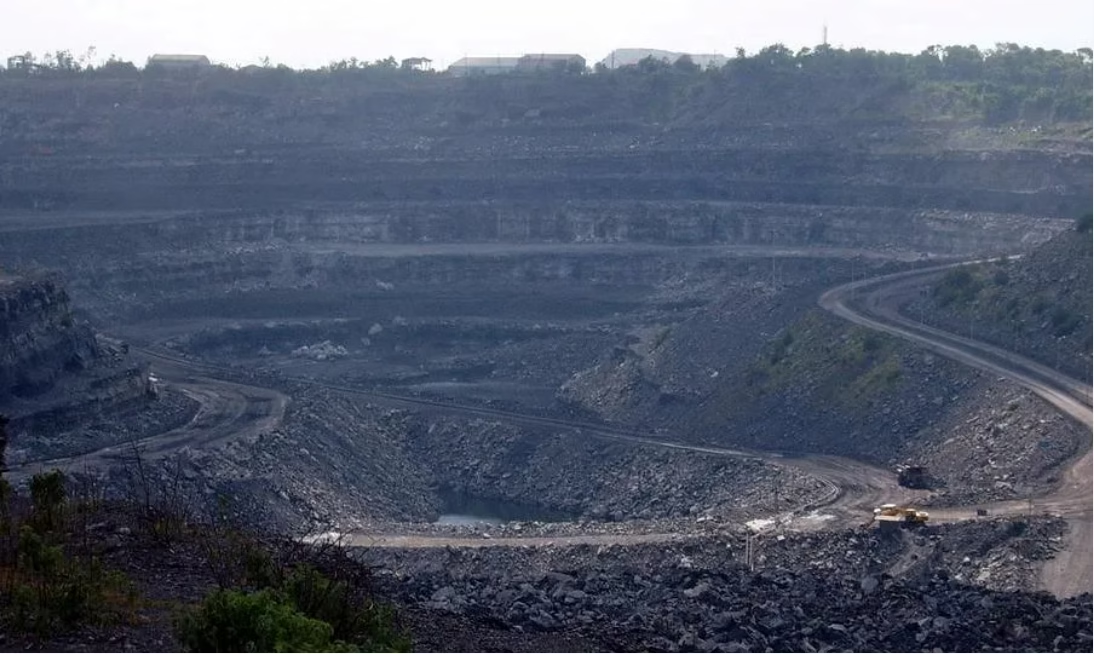
mining cable supplier

UNE 22511, published and maintained by AENOR (Asociación Española de Normalización y Certificación), is the definitive Spanish standard for heavy-duty power cables connecting underground mobile mining equipment to fixed electrical distribution networks. Operating as a specialized overlay on IEC 60502-1, it extends that base standard's electrical requirements with stringent mechanical, safety, and flame-retardancy requirements specific to enclosed underground environments. Despite its Spanish origin, UNE 22511 enjoys adoption across the major Spanish-speaking mining economies: Chile, Peru, Colombia, Bolivia, and Mexico, where AENOR-certified cables are accepted by national mining safety regulators as the primary qualification pathway for underground mobile equipment power supply cables.

飞纯矿用电缆 MYP / MC 通过俄罗斯 FSC 和欧洲 ATEX 严苛测试与认证!

矿山是电缆应用中最严苛的环境之一。井下空间狭窄,设备移动频繁,煤尘和可燃气体可能形成爆炸性环境;露天矿则可能长期遭遇低温、雨雪、泥浆、紫外线、油污和机械拖拽。电缆一旦发生护套开裂、绝缘损伤、过热、燃烧或电弧风险,影响的不只是设备停机,还可能触发人员安全、消防安全和爆炸危险控制问题。 飞纯矿用电缆 MYP / MC 的价值,正是在这种高风险场景下体现出来:它不是为普通室内布线而设计,而是面向矿山动力连接、移动设备、采煤机、掘进机、输送系统、移动变电站和高机械应力供电系统而构建的安全电缆方案。
The (N)SSHÖU designation represents a family of European rubber-insulated cables designed and manufactured to German VDE standards, specifically VDE 0250-812. The designation encodes the cable's fundamental characteristics: flexible power transmission cable suitable for mining and industrial applications. The baseline European design is optimized for 0.6/1kV operation, representing the standard voltage rating for TN earthing systems prevalent throughout Europe and North America. (N)SSHÖU代表一系列欧洲橡胶绝缘电缆,按照德国VDE标准(特别是VDE 0250-812)设计和制造。该名称编码了电缆的基本特征:适合采矿和工业应用的灵活电力传输电缆。欧洲基线设计针对0.6/1kV运行进行了优化,代表了欧洲和北美普遍存在的TN接地系统的标准电压额定值。

Insulation Thickness Differences: How AS/NZS 1.1/1.1kV Modifies (N)SSHÖU Cable Structure

The (N)SSHÖU designation represents a family of European rubber-insulated cables designed and manufactured to German VDE standards, specifically VDE 0250-812. The designation encodes the cable’s fundamental characteristics: flexible power transmission cable suitable for mining and industrial applications. The baseline European design is optimized for 0.6/1kV operation, representing the standard voltage rating for TN earthing systems prevalent throughout Europe and North America. (N)SSHÖU代表一系列欧洲橡胶绝缘电缆,按照德国VDE标准(特别是VDE 0250-812)设计和制造。该名称编码了电缆的基本特征:适合采矿和工业应用的灵活电力传输电缆。欧洲基线设计针对0.6/1kV运行进行了优化,代表了欧洲和北美普遍存在的TN接地系统的标准电压额定值。
The continuous ampacity of (N)TSCGEWÖU 3x120+3x70/3 12/20kV flexible reeling cable is 360 amperes when operating as a single conductor run in free air at the reference condition of 30°C ambient temperature and 90°C conductor operating temperature according to VDE 0250-813 and DIN VDE 0298-4 standards. For tunnel boring machine cutterhead power supply applications where the cable is installed in the constrained environment of a TBM backup gantry system—bundled alongside control cables, communication lines, and other power feeders—and subjected to frequent mechanical stress from dragging and reeling operations, the practical safe ampacity derates to approximately 260–285 amperes depending on specific installation geometry, tunnel temperature profile, and frequency of mechanical cycling. These two ampacity values represent the boundary between theoretical maximum current capacity and the practical operating limit for reliable power delivery to a 2–3 megawatt main cutterhead drive motor in a hard-rock tunneling or soft-ground excavation system. Understanding where these values come from and how they apply to specific TBM configurations is essential for preventing unexpected power loss to the cutterhead, which could force a full machine shutdown and result in schedule delays of weeks or months in confined underground construction.

TBM Cutterhead Power Supply: How to correctly size (N)TSCGEWÖU 3×120+3×70/3 12/20kV flexible reeling cable for tunnel boring machine main drive systems 

The continuous ampacity of (N)TSCGEWÖU 3×120+3×70/3 12/20kV flexible reeling cable is 360 amperes when operating as a single conductor run in free air at the reference condition of 30°C ambient temperature and 90°C conductor operating temperature according to VDE 0250-813 and DIN VDE 0298-4 standards. For tunnel boring machine cutterhead power supply applications where the cable is installed in the constrained environment of a TBM backup gantry system—bundled alongside control cables, communication lines, and other power feeders—and subjected to frequent mechanical stress from dragging and reeling operations, the practical safe ampacity derates to approximately 260–285 amperes depending on specific installation geometry, tunnel temperature profile, and frequency of mechanical cycling. These two ampacity values represent the boundary between theoretical maximum current capacity and the practical operating limit for reliable power delivery to a 2–3 megawatt main cutterhead drive motor in a hard-rock tunneling or soft-ground excavation system. Understanding where these values come from and how they apply to specific TBM configurations is essential for preventing unexpected power loss to the cutterhead, which could force a full machine shutdown and result in schedule delays of weeks or months in confined underground construction.
The nominal outer diameter of a Type SHD-GC 3/C 350 MCM 15kV flexible mining trailing cable is approximately 73 mm (2.87 inches), with a maximum permissible outer diameter of approximately 74.9 mm (2.95 inches) per ICEA S-75-381 and NEMA WC-58 standards. The approximate weight of this specific cable geometry is 10,900 kg/km (7,300 lbs/1000 ft). It features three 350 MCM (177 mm² equivalent) main power conductors rated for 435 amperes continuous operation, supplemented by two 2/0 AWG earth conductors and one 6 AWG ground-check monitoring conductor for enhanced mining safety systems. The distinction between nominal (design target) and maximum (allowable limit) outer diameter is critical for mining operations because reel systems, conduit systems, and terminal connectors are engineered based on these dimensional constraints. A cable that exceeds the maximum outer diameter will not fit into equipment designed for the nominal specification, creating logistics delays and operational disruptions that cost far more than any cable savings.

What is the Maximum Outer Diameter of Type SHD-GC 3/C 350 MCM 15kV Mining Cable?

The nominal outer diameter of a Type SHD-GC 3/C 350 MCM 15kV flexible mining trailing cable is approximately 73 mm (2.87 inches), with a maximum permissible outer diameter of approximately 74.9 mm (2.95 inches) per ICEA S-75-381 and NEMA WC-58 standards. The approximate weight of this specific cable geometry is 10,900 kg/km (7,300 lbs/1000 ft). It features three 350 MCM (177 mm² equivalent) main power conductors rated for 435 amperes continuous operation, supplemented by two 2/0 AWG earth conductors and one 6 AWG ground-check monitoring conductor for enhanced mining safety systems. The distinction between nominal (design target) and maximum (allowable limit) outer diameter is critical for mining operations because reel systems, conduit systems, and terminal connectors are engineered based on these dimensional constraints. A cable that exceeds the maximum outer diameter will not fit into equipment designed for the nominal specification, creating logistics delays and operational disruptions that cost far more than any cable savings.
Comprehensive Technical Analysis of Chlorinated Polyethylene (CPE) vs Chlorosulphonated Polyethylene (CSP) Sheath Performance Under Extreme UV Radiation in Pilbara Region Mining Operations 氯化聚乙烯(CPE)与氯磺化聚乙烯(CSP)护套在皮尔巴拉地区采矿作业极端紫外线辐射下性能的综合技术分析

PROTOLON(SB) SHD-GC I 5 – 15 KV

Shielded Heavy-Duty Ground Check Cables (SHD-GC) are specialized power supply and connection cables designed for large material handling equipment such as excavators in opencast mining operations. These cables withstand extremely high mechanical stresses and are particularly suitable for trailing operations where abrasion and chafing stresses are expected.
The selection of appropriate submersible pump cables for acidic mine water dewatering applications represents a critical engineering decision that directly impacts operational safety, equipment longevity, and maintenance costs. While Type 441 cables may appear suitable for general submersible pump applications, the harsh chemical environment of acidic mine water typically necessitates the use of specialized EPR (Ethylene Propylene Rubber) or CSP (Chlorosulfonated Polyethylene) insulated cables specifically engineered for corrosive conditions. 为酸性矿井水脱水应用选择合适的潜水泵电缆是一项关键的工程决策,直接影响运行安全、设备寿命和维护成本。虽然441型电缆可能适用于一般潜水泵应用,但酸性矿井水的恶劣化学环境通常需要使用专门设计用于腐蚀性条件的EPR(乙丙橡胶)或CSP(氯磺化聚乙烯)绝缘电缆。

TUNNELFLEX-R-PUR HF with Antitwisting Protection 1 KV

TUNNELFLEX-R-PUR HF represents a specialized category of halogen-free, flame-retardant flexible power cables engineered specifically for the demanding requirements of underground mining and tunneling operations. This cable combines advanced polyurethane (PUR) sheathing technology with integrated antitwisting protection to deliver exceptional mechanical durability, environmental resistance, and most importantly, enhanced safety through its halogen-free construction that significantly reduces toxic gas emissions during fire incidents. TUNNELFLEX-R-PUR HF电缆是专为地下采矿和隧道作业的苛刻要求而设计的无卤阻燃柔性电力电缆。该电缆结合了先进的聚氨酯护套技术和集成的防扭转保护,提供卓越的机械耐久性、环境抵抗力,以及通过无卤结构在火灾事故中显著减少有毒气体排放的增强安全性。
Type 450 cables are Australian-standard reeling and trailing cables designed specifically for mining applications. Defined under AS/NZS 1802 (formerly AS 1802), these cables feature robust construction capable of withstanding the harsh conditions of underground and surface mining environments. The "Type 450" designation indicates cables rated for 450/750V operation in mining applications.

Ampcontrol Protection Relays: Required Pilot Core Resistance for Type 450 Cables

Type 450 cables are Australian-standard reeling and trailing cables designed specifically for mining applications. Defined under AS/NZS 1802 (formerly AS 1802), these cables feature robust construction capable of withstanding the harsh conditions of underground and surface mining environments. The “Type 450” designation indicates cables rated for 450/750V operation in mining applications.
The question of whether (N)TSKCGEWÖU medium-voltage mining cables can serve as direct replacements for the original equipment manufacturer cables on Epiroc Boomer E2 face drilling rigs requires careful examination of multiple technical, operational, and warranty considerations. This analysis becomes particularly important for mining operations seeking to optimize their cable procurement strategies through alternative suppliers while maintaining equipment performance, safety compliance, and operational reliability. The Epiroc Boomer E2 represents a sophisticated two-boom hydraulic face drill designed for medium to large drift applications with coverage areas up to one hundred twelve square meters, and its electrical power supply system demands cables that can withstand the rigorous mechanical stresses of underground drilling operations. 关于(N)TSKCGEWÖU中压矿用电缆能否作为Epiroc Boomer E2掘进钻机上的原始设备制造商电缆的直接替代品的问题,需要仔细审查多个技术、操作和保修考虑因素。这一分析对于寻求通过替代供应商优化其电缆采购策略,同时保持设备性能、安全合规性和操作可靠性的采矿作业尤为重要。Epiroc Boomer E2代表了一种精密的双臂液压掘进钻机,设计用于覆盖面积达112平方米的中型到大型巷道应用,其电力供应系统需要能够承受地下钻孔作业严格机械应力的电缆。

Can (N)TSKCGEWÖU Cables Be Used as a Direct Replacement for the OEM Reeling Cable on Epiroc Boomer E2 Drill Rigs?

The question of whether (N)TSKCGEWÖU medium-voltage mining cables can serve as direct replacements for the original equipment manufacturer cables on Epiroc Boomer E2 face drilling rigs requires careful examination of multiple technical, operational, and warranty considerations. This analysis becomes particularly important for mining operations seeking to optimize their cable procurement strategies through alternative suppliers while maintaining equipment performance, safety compliance, and operational reliability. The Epiroc Boomer E2 represents a sophisticated two-boom hydraulic face drill designed for medium to large drift applications with coverage areas up to one hundred twelve square meters, and its electrical power supply system demands cables that can withstand the rigorous mechanical stresses of underground drilling operations. 关于(N)TSKCGEWÖU中压矿用电缆能否作为Epiroc Boomer E2掘进钻机上的原始设备制造商电缆的直接替代品的问题,需要仔细审查多个技术、操作和保修考虑因素。这一分析对于寻求通过替代供应商优化其电缆采购策略,同时保持设备性能、安全合规性和操作可靠性的采矿作业尤为重要。Epiroc Boomer E2代表了一种精密的双臂液压掘进钻机,设计用于覆盖面积达112平方米的中型到大型巷道应用,其电力供应系统需要能够承受地下钻孔作业严格机械应力的电缆。
Type 441 cables represent a critical category of mining power cables designed for demanding applications in surface and underground mining environments. These cables are specifically engineered to withstand extreme mechanical stress, including trailing, reeling, crushing forces, and environmental hazards encountered in heavy-duty industrial operations. The sheath hardness specification is a fundamental parameter that directly affects the cable's mechanical performance, durability, and service life under harsh operational conditions. 441型电缆是专为地表和地下采矿环境中的苛刻应用而设计的关键矿用电力电缆类别。这些电缆经过专门设计,能够承受极端的机械应力,包括拖拽、卷筒、挤压力以及在重型工业作业中遇到的环境危害。护套硬度规范是直接影响电缆在苛刻操作条件下的机械性能、耐久性和使用寿命的基本参数。

Type 441 Cable Sheath Hardness Standards

Type 441 cables represent a critical category of mining power cables designed for demanding applications in surface and underground mining environments. These cables are specifically engineered to withstand extreme mechanical stress, including trailing, reeling, crushing forces, and environmental hazards encountered in heavy-duty industrial operations. The sheath hardness specification is a fundamental parameter that directly affects the cable’s mechanical performance, durability, and service life under harsh operational conditions. 441型电缆是专为地表和地下采矿环境中的苛刻应用而设计的关键矿用电力电缆类别。这些电缆经过专门设计,能够承受极端的机械应力,包括拖拽、卷筒、挤压力以及在重型工业作业中遇到的环境危害。护套硬度规范是直接影响电缆在苛刻操作条件下的机械性能、耐久性和使用寿命的基本参数。Type 441 cables represent a critical category of mining power cables designed for demanding applications in surface and underground mining environments. These cables are specifically engineered to withstand extreme mechanical stress, including trailing, reeling, crushing forces, and environmental hazards encountered in heavy-duty industrial operations. The sheath hardness specification is a fundamental parameter that directly affects the cable’s mechanical performance, durability, and service life under harsh operational conditions. 441型电缆是专为地表和地下采矿环境中的苛刻应用而设计的关键矿用电力电缆类别。这些电缆经过专门设计,能够承受极端的机械应力,包括拖拽、卷筒、挤压力以及在重型工业作业中遇到的环境危害。护套硬度规范是直接影响电缆在苛刻操作条件下的机械性能、耐久性和使用寿命的基本参数。
The Pilbara region of Western Australia represents one of the world's most thermally challenging environments for electrical infrastructure. With ambient temperatures regularly exceeding 50°C during summer months and recorded extremes reaching 50.7°C, proper cable ampacity derating is critical for safe and reliable mining operations. This technical guide provides comprehensive methods for calculating current-carrying capacity adjustments for Type 440 cables operating under these extreme conditions, following Australian Standards AS/NZS 3008 and international standard IEC 60287.

Pilbara Heat: Calculating Ampacity Derating for Type 440 Cables in 50°C+ Ambient Temperatures

The Pilbara region of Western Australia represents one of the world’s most thermally challenging environments for electrical infrastructure. With ambient temperatures regularly exceeding 50°C during summer months and recorded extremes reaching 50.7°C, proper cable ampacity derating is critical for safe and reliable mining operations. This technical guide provides comprehensive methods for calculating current-carrying capacity adjustments for Type 440 cables operating under these extreme conditions, following Australian Standards AS/NZS 3008 and international standard IEC 60287.
Type 409 cables represent a specialized category of flexible mining cables designed specifically for demanding applications in material handling equipment, surface mining operations, and industrial environments. These cables are manufactured according to the Australian and New Zealand Standard AS/NZS 2802:2000, which establishes rigorous requirements for reeling and trailing cables used in mining and general industrial applications outside underground coal mining environments. (409型电缆是专为物料搬运设备、露天采矿作业和工业环境中的高要求应用而设计的一类特种柔性矿用电缆。这些电缆按照澳大利亚和新西兰标准AS/NZS 2802:2000制造,该标准对用于煤矿井下以外的采矿和一般工业应用的卷筒电缆和拖曳电缆制定了严格要求。)

Stacker Reclaimers: What is the Minimum Bending Radius for Type 409 Cables Used on High-Speed Stacker-Reclaimer Drums?

Type 409 cables represent a specialized category of flexible mining cables designed specifically for demanding applications in material handling equipment, surface mining operations, and industrial environments. These cables are manufactured according to the Australian and New Zealand Standard AS/NZS 2802:2000, which establishes rigorous requirements for reeling and trailing cables used in mining and general industrial applications outside underground coal mining environments. (409型电缆是专为物料搬运设备、露天采矿作业和工业环境中的高要求应用而设计的一类特种柔性矿用电缆。这些电缆按照澳大利亚和新西兰标准AS/NZS 2802:2000制造,该标准对用于煤矿井下以外的采矿和一般工业应用的卷筒电缆和拖曳电缆制定了严格要求。)
Before we dive into the technical differences between Type 241 and Type 260 cables, let's take a moment to understand shuttle cars themselves and why cable selection matters so much for these critical mining vehicles. Think of shuttle cars as the workhorses of underground coal mining operations. These are large, heavy-duty battery-electric or trailing-cable powered vehicles designed to transport coal from the continuous miner working at the coal face to either feeder breakers, mine cars, or belt conveyor systems located some distance away. The shuttle car essentially acts as a mobile bridge between the mining equipment that's actively cutting coal and the permanent conveying infrastructure that will carry that coal to the surface. 在深入了解241型和260型电缆之间的技术差异之前,让我们花点时间了解穿梭车本身,以及为什么电缆选择对这些关键采矿车辆如此重要。可以将穿梭车视为地下煤矿作业的主力。这些是大型重型电池电动或拖缆供电车辆,设计用于将煤炭从在煤层工作面工作的连续采煤机运输到位于一定距离外的给料破碎机、矿车或带式输送机系统。穿梭车本质上充当正在切割煤炭的采矿设备与将煤炭运送到地面的永久输送基础设施之间的移动桥梁。

Type 241 vs. Type 260 Mining Cables: Understanding Construction Differences and Application Selection for Shuttle Car Operations

Before we dive into the technical differences between Type 241 and Type 260 cables, let’s take a moment to understand shuttle cars themselves and why cable selection matters so much for these critical mining vehicles. Think of shuttle cars as the workhorses of underground coal mining operations. These are large, heavy-duty battery-electric or trailing-cable powered vehicles designed to transport coal from the continuous miner working at the coal face to either feeder breakers, mine cars, or belt conveyor systems located some distance away. The shuttle car essentially acts as a mobile bridge between the mining equipment that’s actively cutting coal and the permanent conveying infrastructure that will carry that coal to the surface. 在深入了解241型和260型电缆之间的技术差异之前,让我们花点时间了解穿梭车本身,以及为什么电缆选择对这些关键采矿车辆如此重要。可以将穿梭车视为地下煤矿作业的主力。这些是大型重型电池电动或拖缆供电车辆,设计用于将煤炭从在煤层工作面工作的连续采煤机运输到位于一定距离外的给料破碎机、矿车或带式输送机系统。穿梭车本质上充当正在切割煤炭的采矿设备与将煤炭运送到地面的永久输送基础设施之间的移动桥梁。
Understanding Mine Safety and Health Administration approval markings on Type W portable power cables is essential for compliance with United States underground mining regulations. The P-136-MSHA designation represents a specific manufacturer approval code combined with MSHA certification, indicating that a cable has successfully passed rigorous flame resistance testing and meets federal safety standards for underground mining applications. This comprehensive guide examines MSHA approval requirements, explains the significance of manufacturer-specific approval numbers, and clarifies when Type W cables require MSHA certification for legal underground deployment. 了解W型便携式电力电缆上的矿山安全与健康管理局(MSHA)认证标识对于符合美国地下采矿法规至关重要。P-136-MSHA标识代表特定制造商批准代码与MSHA认证的组合,表明电缆已成功通过严格的阻燃测试并符合地下采矿应用的联邦安全标准。本指南详细介绍了MSHA批准要求,解释了制造商特定批准编号的意义,并阐明了W型电缆何时需要MSHA认证才能合法地下部署。

MSHA Approval: Does Your Type W Cable Carry the P-136-MSHA Marking?

Understanding Mine Safety and Health Administration approval markings on Type W portable power cables is essential for compliance with United States underground mining regulations. The P-136-MSHA designation represents a specific manufacturer approval code combined with MSHA certification, indicating that a cable has successfully passed rigorous flame resistance testing and meets federal safety standards for underground mining applications. This comprehensive guide examines MSHA approval requirements, explains the significance of manufacturer-specific approval numbers, and clarifies when Type W cables require MSHA certification for legal underground deployment. 了解W型便携式电力电缆上的矿山安全与健康管理局(MSHA)认证标识对于符合美国地下采矿法规至关重要。P-136-MSHA标识代表特定制造商批准代码与MSHA认证的组合,表明电缆已成功通过严格的阻燃测试并符合地下采矿应用的联邦安全标准。本指南详细介绍了MSHA批准要求,解释了制造商特定批准编号的意义,并阐明了W型电缆何时需要MSHA认证才能合法地下部署。
NSSHÖU cables are designed for power supply applications in mining, quarrying, tunneling, and heavy industrial equipment where extreme mechanical stress and abrasion are expected. These cables can be installed in dry, damp, wet, and hazardous environments but are NOT suitable for drumming applications under tensile loads or for continuous robotic movement in energy chains where highly flexible cables with specific bend cycle ratings are required. NSSHÖU电缆设计用于采矿、采石、隧道和重型工业设备中的供电应用,其中预期会有极端的机械应力和磨损。这些电缆可以安装在干燥、潮湿、湿润和危险环境中,但不适合在拉力负载下的卷筒应用或需要具有特定弯曲周期额定值的高度柔性电缆的连续机器人运动的能量链中。

NSSHÖU Cable Ampacity Table: Current Rating & Correction Factors at 50°C Ambient Temperature

NSSHÖU cables are designed for power supply applications in mining, quarrying, tunneling, and heavy industrial equipment where extreme mechanical stress and abrasion are expected. These cables can be installed in dry, damp, wet, and hazardous environments but are NOT suitable for drumming applications under tensile loads or for continuous robotic movement in energy chains where highly flexible cables with specific bend cycle ratings are required. NSSHÖU电缆设计用于采矿、采石、隧道和重型工业设备中的供电应用,其中预期会有极端的机械应力和磨损。这些电缆可以安装在干燥、潮湿、湿润和危险环境中,但不适合在拉力负载下的卷筒应用或需要具有特定弯曲周期额定值的高度柔性电缆的连续机器人运动的能量链中。
When working with Type G-GC portable power cables, one of the most frequently asked questions by installers and maintenance technicians concerns the proper connection of the ground check conductor, often called the pilot wire. This seemingly simple question touches on one of the most critical safety systems in mining and heavy industrial electrical installations. Understanding not just where this wire connects, but why it exists and how it functions as part of a comprehensive ground fault protection system, is essential for anyone working with mining equipment electrical systems. 在使用Type G-GC便携式电源电缆时,安装人员和维护技术人员最常问的问题之一是关于接地检查导体(通常称为导线)的正确连接。这个看似简单的问题涉及到采矿和重工业电气安装中最关键的安全系统之一。

Connection Guide: Wiring a Type G-GC Plug – Where Does the Ground Check Wire Go?

When working with Type G-GC portable power cables, one of the most frequently asked questions by installers and maintenance technicians concerns the proper connection of the ground check conductor, often called the pilot wire. This seemingly simple question touches on one of the most critical safety systems in mining and heavy industrial electrical installations. Understanding not just where this wire connects, but why it exists and how it functions as part of a comprehensive ground fault protection system, is essential for anyone working with mining equipment electrical systems. 在使用Type G-GC便携式电源电缆时,安装人员和维护技术人员最常问的问题之一是关于接地检查导体(通常称为导线)的正确连接。这个看似简单的问题涉及到采矿和重工业电气安装中最关键的安全系统之一。
The determination of current carrying capacity (ampacity) for mining and trailing cables represents a critical engineering consideration that directly impacts operational safety and equipment performance. Two dominant international approaches govern these calculations: the German VDE 0298-4 standard applied to (N)TSCGEWÖU-type cables, and the North American NEC methodology utilizing ICEA S-75-381 (ANSI/NEMA WC-58) for Type SHD-GC cables. 矿用及拖曳电缆的载流量确定是直接影响运行安全和设备性能的关键工程考量。两种主导的国际方法管理这些计算:适用于(N)TSCGEWÖU型电缆的德国VDE 0298-4标准,以及使用ICEA S-75-381 (ANSI/NEMA WC-58)标准的北美NEC方法用于Type SHD-GC电缆。

Ampacity Calculation: How Does the Current Carrying Capacity for (N)TSCGEWÖU in VDE 0298-4 Differ from the NEC Method Used for Type SHD-GC?

The determination of current carrying capacity (ampacity) for mining and trailing cables represents a critical engineering consideration that directly impacts operational safety and equipment performance. Two dominant international approaches govern these calculations: the German VDE 0298-4 standard applied to (N)TSCGEWÖU-type cables, and the North American NEC methodology utilizing ICEA S-75-381 (ANSI/NEMA WC-58) for Type SHD-GC cables. 矿用及拖曳电缆的载流量确定是直接影响运行安全和设备性能的关键工程考量。两种主导的国际方法管理这些计算:适用于(N)TSCGEWÖU型电缆的德国VDE 0298-4标准,以及使用ICEA S-75-381 (ANSI/NEMA WC-58)标准的北美NEC方法用于Type SHD-GC电缆。
Mining, drilling, and tunnelling cables represent a specialized category of electrical cables engineered to withstand the extreme conditions found in extractive industry operations. Unlike standard industrial cables, these cables must endure continuous mechanical stress from reeling and unreeling operations, exposure to ultraviolet radiation in surface mining, salt-water submersion in offshore drilling, contact with oils and greases from machinery, and the abrasive conditions of underground environments. The demanding nature of these applications requires cables with exceptional durability, flexibility, and resistance to environmental factors that would rapidly degrade conventional cables.

What is Mining, Drilling & Tunnelling Cable? Solutions for Surface, Sub-Surface & Underground Operations

(N)3GHSSHCH – 3.6/6kV, 6/10kV, 8.7/15kV, 12/20kV (N)3GHSSYCY – 3.6/6kV, 6/10kV, 8.7/15kV, 12/20kV (N)SSCHÖU-J – 0.6/1kV (N)SHÖU O/J – 0.6/1kV NSSHÖU O/J – 0.6/1kV NSSHÖU 3E – 0.6/1kV NSSHÖU 3E + ST – 0.6/1kV (N)TMCGEWÖU – 3.6/6kV to 18/30kV (N)TSCGEWÖU – 3.6/6kV to 18/30kV (N)TSCGEWÖU ZH – 3.6/6kV to 12/20kV (N)TSCGEWÖU ATB – 3.6/6kV to 12/20kV (N)TSCGEWÖU FO – 3.6/6kV to 12/20kV (N)TSCGEWÖU Submersible – 3.6/6kV to 12/20kV (N)TSKCGEWÖU – 3.6/6kV to 18/30kV (N)TSCGECEWÖU – 3.6/6kV to 12/20kV (N)TSCGECEWÖU ATB – 3.6/6kV to 12/20kV (N)TSCGECEWÖU ATB GCC – 1.8/3kV to 12/20kV (N)TSCGECEWÖU Submersible – 3.6/6kV to 12/20kV (N)TSCGECECWÖU – 3.6/6kV to 12/20kV (N)TSCGECECWÖU ZH – 3.6/6kV to 12/20kV R-(N)TSCGEWÖU + FO – 3.6/6kV to 12/20kV
Mining, drilling, and tunnelling cables represent the most demanding category of industrial cables, designed to operate in some of the harshest environments on earth. These heavy-duty power, control, and instrumentation cables serve mine operators worldwide for both static infrastructure and dynamic equipment applications. Manufactured in accordance with international standards including IEC 60502, BS EN 60332, BS EN 60811, BS EN 60754, and VDE 0295, mining cables must withstand mechanical stress, oil and grease exposure, water immersion, and in underground applications, provide critical fire safety through reduced smoke and fume emissions.

What are Mining, Drilling & Tunnelling Cables?

NSSHÖU cable, NSSHOU cable, NSHÖU cable, NSHOU cable, NSSCHOU cable, NSHTÖU cable, NTSCGEWÖU cable, NTSCGEWOU cable, NTMCGEWÖU cable, N3GHSSYCY cable, N3GHSSHCH cable,Type 61 cable, Type 63 cable, Type 611 cable, Type 622 cable, Type 633 cable, Type 66 cable,Type 240 cable, Type 241 cable, Type 245 cable, Type 450 cable, Type 455 cable, Type 260 cable, Type 275 cable, Type 409 cable, Type 440 cable, Type 441 cable,
SINGLE CORE represents an advanced low smoke zero halogen (LSZH) power cable engineered by Anhui Feichun Special Cable Co., Ltd. for demanding industrial applications where fire safety, thermal performance, and electrical reliability are paramount. This cable series is manufactured in full compliance with Australian and New Zealand standards

What is ENVIROLEX® 110°C  SINGLE CORE?

SINGLE CORE cable is specifically engineered for applications requiring enhanced thermal performance and superior fire safety characteristics. The 110°C continuous operating temperature rating provides a significant thermal margin compared to standard 90°C rated cables, allowing for higher current density and more compact installations.
PROTOLON(M) R-(N)TSCGEWOEU represents a sophisticated class of medium voltage flexible reeling cables specifically engineered for the most demanding applications in open-cast mining and material handling operations. These cables are designed to power large mobile equipment including excavators, dumpers, mobile crushers, and bucket-wheel excavators under extreme mechanical stresses. This comprehensive technical guide examines the construction, specifications, standards compliance, applications, and operational characteristics of this specialized cable system manufactured by Anhui Feichun Special Cable Co., Ltd.

PROTOLON(M) R-(N)TSCGEWOEU 6 kV – 35 kV: The Ultimate Flexible MV Reeling Cable for Heavy Mining Equipment

ROTOLON(M) R-(N)TSCGEWOEU cable designation follows the standardized German nomenclature system established under DIN VDE 0250 Part 813, which specifically addresses medium voltage reeling cables for mining and heavy industrial applications. The designation breaks down as follows: (N) – Indicates the presence of a concentric conductor arrangement with integrated earth conductors T – Tinned copper conductors for enhanced corrosion resistance S – Semiconductive screening layers for electric field control C – Cradle separator core arrangement for structural integrity G – EPR (Ethylene Propylene Rubber) insulation compound E – EPR-based inner sheath W – Anti-torsion woven braid reinforcement O – Oil-resistant outer sheath E – Enhanced elastomer outer sheath material U – Reinforced construction for extreme mechanical loads According to industry specifications from Reeling Cable, these cables are rated for voltage ranges from 3.6/6 kV up to 18/30 kV (with some variants reaching 20/35 kV), making them suitable for a comprehensive range of mining equipment power requirements.
PROTOLON(M) F (N)TSCGEWOEU 3 kV – 30 kV

What is PROTOLON(M) F (N)TSCGEWOEU 3 kV – 30 kV Medium Voltage Reeling Cable?

PROTOLON(M) F (N)TSCGEWOEU represents an advanced class of medium voltage flexible power cables engineered specifically for demanding industrial environments. Manufactured by Anhui Feichun Special Cable Co., Ltd., this cable series delivers reliable power transmission across voltage ratings from 3.6/6 kV to 18/30 kV, making it indispensable for large-scale mining operations, conveyor systems, and heavy material handling equipment. Unlike standard reeling cables designed for high-speed dynamic applications, the “F” designation in PROTOLON(M) F indicates this series is optimized for fixed and semi-flexible installations. This makes it particularly suited for permanent laying alongside conveyor belts, shiftable mining units, connections between upper and lower machinery sections (such as excavator car bodies), and continuous submersible pump operations.
NTMCGCWOEU 1x240_25 KON, 12_20kV

What is PROTOLON(SB) NTSCGEWOEU 6 kV – 20 kV Cable for Excavators in Open-Cast Mining?

PROTOLON(SB) NTSCGEWOEU cable represents a specialized category of medium voltage trailing cables engineered specifically for the most demanding mining applications. As power supply and connection cables for large material handling machines such as excavators in open-cast mines, these cables must withstand extremely high mechanical stresses where abrasion and chaffing stresses are expected in trailing operation.
CSA C22.2 NO. 96:23 - Portable Power Cables Comprehensive Technical Analysis and Application Guide

CSA C22.2 NO. 96:23 – Portable Power Cables

CSA C22.2 NO. 96:23 represents the twelfth edition of the Canadian portable power cable standard, published as a National Standard of Canada by CSA Group under the Canadian Electrical Code, Part II. This standard supersedes all previous editions dating back to 1951, with the 2023 edition incorporating significant technical updates and expanded cable categories to address evolving industrial requirements.
ANSI/NEMA WC 58 / ICEA S-75-381: Portable and Power Feeder Cables for Mining Applications

ANSI/NEMA WC 58 / ICEA S-75-381: Portable and Power Feeder Cables for Mining Applications

ANSI/NEMA WC 58 / ICEA S-75-381 standard represents one of the most comprehensive specifications for portable and power feeder cables used in mining environments. According to industry analysis, this standard represents one of the most rigorous cable specifications ever developed, specifically addressing the unique challenges encountered in both surface and underground mining operations where equipment reliability directly impacts production efficiency and worker safety.
TYPE 409 mining cables represent a specialized category of flexible trailing cables designed to meet the rigorous demands of surface mining, underground mining operations, and general industrial applications where movable plant requires reliable electrical power supply. Manufactured in compliance with the AS/NZS 2802:2000 standard, these Class 2 heavy-duty cables feature ethylene propylene rubber (EPR) insulation, composite copper and polyester braid screening, and elastomeric sheath construction. Available in voltage ratings from 1.1 kilovolts up to 22 kilovolts, TYPE 409 cables serve as the electrical lifeline for machinery ranging from handheld drills and pumps to massive dragline excavators and shovels.

TYPE 409 1.1 to 22kV Mining Cables to AS/NZS 2802:2000

The engineering sophistication of TYPE 409 cables reflects decades of development in mining cable technology, incorporating semiconductive screening systems, central cradle separators, and interstitial pilot conductors that work together to ensure safe and reliable operation in extreme environmental conditions. The cables must withstand extraordinary mechanical stresses, continuous flexing, abrasion from dust and debris, exposure to oils and chemicals, ultraviolet radiation, and temperature extremes while maintaining electrical integrity and personnel safety.
TYPE 241 mining cables represent a specialized category of elastomer-insulated, semiconductive-screened power cables specifically engineered for the demanding operational conditions encountered in underground coal mining environments.

What is TYPE 241 1.1 to 22kV Mining Cables to AS/NZS 1802:2003?

TYPE 241 mining cables represent a specialized category of elastomer-insulated, semiconductive-screened power cables specifically engineered for the demanding operational conditions encountered in underground coal mining environments.
TYPE 240 1.1 to 11kV AS/NZS 1802:2003, AS/NZS 2802:2000 Australia Mining Cable

What is Type 240 Mining Cable ?

TYPE 240 cables serve as essential power supply conductors for critical mining equipment in underground coal mining operations. The cable’s robust construction and electrical characteristics make it particularly suitable for powering continuous miners, longwall shearer systems, hydraulic pump stations, shuttle cars, and various mobile mining machinery that operate in challenging underground environments.
MSHA Mining Cable: Comprehensive Technical Guide Professional Mining Power Cables Complying with US Mine Safety & Health Administration Standards

MSHA Mining Cable: Comprehensive Technical Guide

MSHA mining cables represent a specialized category of industrial power cables specifically designed, tested, and approved for use in mining operations under regulations established by the United States Mine Safety and Health Administration (MSHA). These cables serve critical functions in both underground and surface mining environments, delivering electrical power to mobile equipment, continuous miners, draglines, shuttle cars, and various other mining machinery while maintaining the highest standards of safety in potentially hazardous atmospheres.