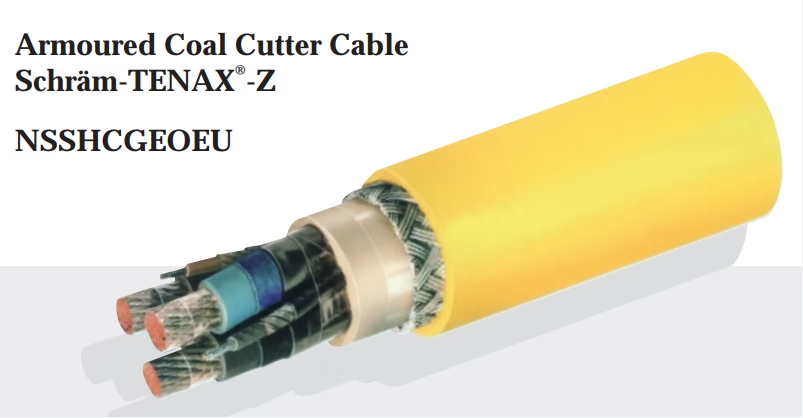
An engineering-grade technical reference for mining electrical engineers, EPC contractors, OEM equipment manufacturers, and procurement specialists selecting high-flexibility trailing cables for underground and surface mining operations in Russia and CIS markets. This document presents the structural engineering, material science, and certification architecture of Feichun’s (N)TSCGEWÖU-FO mining trailing cable — a purpose-designed construction combining extreme tensile reinforcement, multi-layer abrasion resistance, integrated fibre-optic monitoring, and dual EAC Ex / GOST-R fire certification within a single cable assembly engineered for the most demanding dragline, continuous miner, shuttle car, and longwall shearer applications operating under Russian Federal mining safety regulations.
The Type 241 1.1/1.1kV 3x95mm² underground mining trailing cable has a continuous ampacity rating of approximately 265 amperes per conductor when operating under the following standard reference conditions: an ambient (air or soil) temperature of 40°C, a maximum conductor temperature of 90°C, and typical installation methods for buried or bundled trailing cables in underground mining environments. This 265-ampere rating represents the maximum continuous current that each individual power conductor (the three 95mm² cores) can safely carry indefinitely without exceeding the insulation’s thermal limits or compromising the cable’s mechanical and electrical integrity. However, and this distinction is critically important, the 265A figure applies only when the cable operates under these precise reference conditions—when ambient temperature rises, when multiple cables are bundled together, or when installation methods change, the safe operating current must be reduced through the application of specific derating factors that reflect the real-world thermal environment.
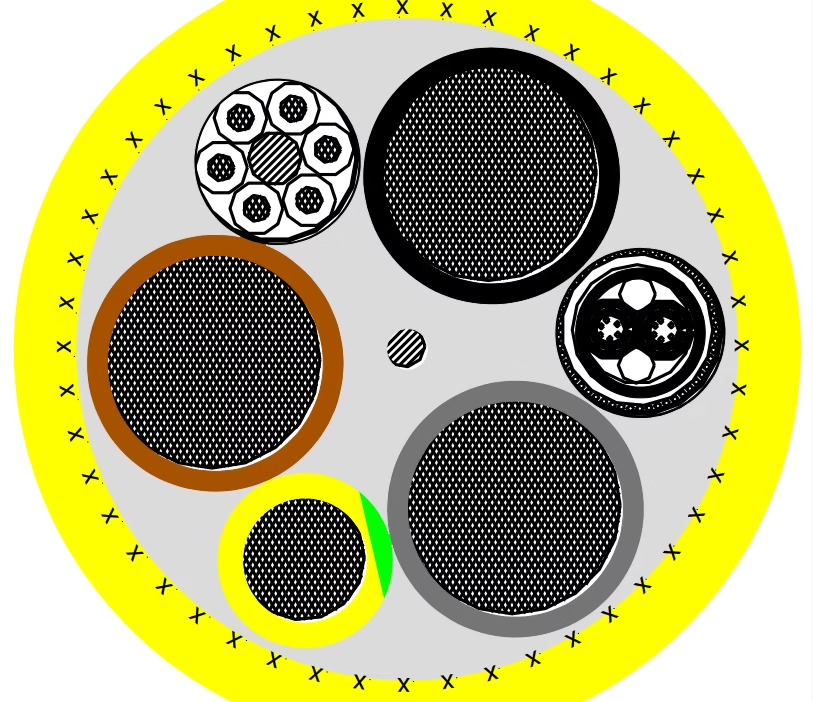
The nominal outer diameter (OD) of an AS/NZS 1802 Type 241 3.3/3.3kV 3x50mm² mining cable is 57.6 millimeters, with an acceptable manufacturing tolerance range of 55.5 millimeters (minimum) to 59.5 millimeters (maximum). This specification represents approximately 2.27 inches nominal diameter, translating to a tolerance band of ±1.5 millimeters around the nominal value. The cable includes three 50mm² power-carrying cores, three 10mm² (or optionally 16mm²) interstitial grounding conductors, and one 16mm² central extensible pilot conductor, all protected by an outer sheath of heavy-duty polychloroprene (HD-85-PCP) elastomer. At this nominal diameter, the complete cable assembly weighs approximately 5,250 kilograms per kilometer, with the copper mass contributing roughly 1,850 kilograms per kilometer of that total weight.
Underground room-and-pillar mining operations present unique challenges for trailing cables. The Komatsu Joy 12HM series continuous miners must navigate through tight corners and confined spaces while maintaining continuous power supply. The trailing cable—connecting the miner to the power distribution system—must bend around right-angle turns, withstand crushing forces from equipment run-over, and maintain electrical integrity through thousands of flexing cycles without failure.
地下房柱式采矿作业对拖缆提出了独特的挑战。小松Joy 12HM系列连续采煤机必须在保持连续供电的同时穿越紧凑的转角和狭窄空间。连接采煤机与配电系统的拖缆必须能够绑过直角弯道,承受设备碾压的压力,并在数千次弯曲循环中保持电气完整性而不发生故障。
Fermel is a recognized manufacturer of underground utility vehicles designed for mining, tunneling, and construction applications. Their utility vehicle lineup includes personnel carriers, material transporters, and multi-purpose service units that operate in confined underground environments where electrical power delivery via trailing cables is essential for safe and efficient operation.
费尔梅尔(Fermel)是地下多功能车的知名制造商,产品专为采矿、隧道和建筑应用设计。其多功能车系列包括人员运输车、物料运输车和多功能服务单元,在封闭的地下环境中运行,通过拖曳电缆供电对于安全高效运行至关重要。
ROTOLON(M) R-(N)TSCGEWOEU cable designation follows the standardized German nomenclature system established under DIN VDE 0250 Part 813, which specifically addresses medium voltage reeling cables for mining and heavy industrial applications. The designation breaks down as follows:
(N) – Indicates the presence of a concentric conductor arrangement with integrated earth conductors
T – Tinned copper conductors for enhanced corrosion resistance
S – Semiconductive screening layers for electric field control
C – Cradle separator core arrangement for structural integrity
G – EPR (Ethylene Propylene Rubber) insulation compound
E – EPR-based inner sheath
W – Anti-torsion woven braid reinforcement
O – Oil-resistant outer sheath
E – Enhanced elastomer outer sheath material
U – Reinforced construction for extreme mechanical loads
According to industry specifications from Reeling Cable, these cables are rated for voltage ranges from 3.6/6 kV up to 18/30 kV (with some variants reaching 20/35 kV), making them suitable for a comprehensive range of mining equipment power requirements.
TYPE 240 cables serve as essential power supply conductors for critical mining equipment in underground coal mining operations. The cable’s robust construction and electrical characteristics make it particularly suitable for powering continuous miners, longwall shearer systems, hydraulic pump stations, shuttle cars, and various mobile mining machinery that operate in challenging underground environments.