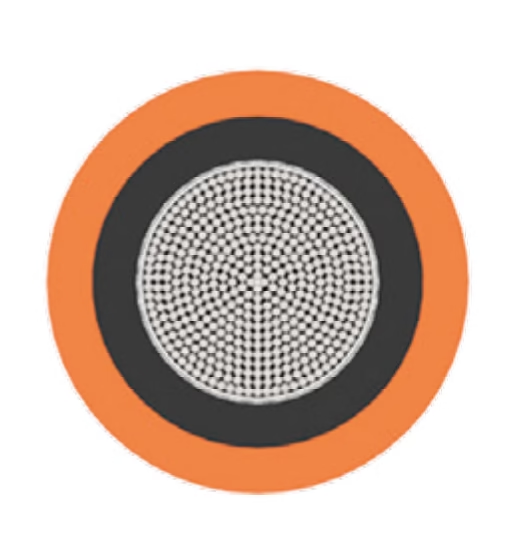
flexible copper conductor

FLEXIFESTOON® SEOOW YELLOW represents FeiChun's entry into the low-voltage festoon and temporary power market. The nomenclature requires careful explanation to distinguish this product from the high-voltage FLEXIDRUM series: FLEXIFESTOON Product Nomenclature: FLEXIFESTOON® = Product family name Flex = Flexible (emphasis on bending & handling) Festoon = Strung overhead in continuous runs (typical festoon lighting application) SEOOW = Industry-standard designation S = Service cord (temporary, not permanent installation) E = Elastomer jacket (flexible sheath) OO = Oil-resistant conductor insulation (TPE qualifies as oil-resistant) W = Weather-resistant sheath (water, ozone, UV resistant) SEOOW is defined in: UL 62 (Standard for Flexible Cords and Cables) CSA 22.2 No. 49 (Canadian equivalent) NFPA 70 National Electrical Code (NEC) Article 400 YELLOW designation: Color: RAL 1021 (traffic yellow, high visibility) Safety significance: Yellow cords attract attention in job sites Practical purpose: Easy to identify, prevent trips/entanglement Contrast with FLEXIDRUM series: FLEXIDRUM (High-Voltage MV Cable): Voltage: 3.6 kV to 20/35 kV (power distribution) Temperature: −40 to +80°C (standard industrial) Application: Mobile mining/tunneling equipment (capital-intensive) Size: Large diameter, heavy (3–12 kg/km) FLEXIFESTOON (Low-Voltage Service Cord): Voltage: 600V (light/power temporary use) Temperature: −60 to +105°C (extreme environmental range) Application: Festoon lighting, temporary site power, outdoor events Size: Small diameter, lightweight (0.05–0.3 kg/m) Cost: Consumer/contractor-grade (not specialty industrial)

(N)SHÖU для общего применения: силовой кабель 0,6/1 kV для карьеров, конвейеров, горных и тоннельных площадок

Кабель (N)SHÖU предназначен для тяжёлых условий эксплуатации: открытые горные работы, карьеры, линии рядом с конвейерными лентами, оборудование для обработки материалов, тоннельные площадки и сходные промышленные установки. Его инженерная ценность заключается в сочетании гибкой медной жилы класса 5, эластомерной изоляции 3GI3, внутренней эластомерной оболочки и тяжёлой наружной оболочки 5GM5 жёлтого или чёрного цвета.
4G16 (3 power cores + 1 earth core, 16 mm²) AWG 6 equivalent Outer diameter: 25.5-32.3 mm (nominal 26.5 mm) Copper weight: 614.4 kg/km Total weight: 1200-1380 kg/km Current carrying capacity: 82A (30°C free air) Rated voltage: 0.6/1 kV Conductor: Bare copper or tinned copper, Class 5 (flexible) Temperature range: -25°C to +80°C (mobile/flexing), -40°C to +80°C (fixed) Min bending radius: 8 × OD (about 215 mm) Materials: EPR insulation, dual-layer Neoprene sheath with anti-torsion braid Heavy-duty reeling cable for ports, mining, mobile equipment

Flame Retardant Ratings: Does NSHTÖU-J 4G16 meet IEC 60332-1-2 single wire flame tests?

4G16 (3 power cores + 1 earth core, 16 mm²) AWG 6 equivalent Outer diameter: 25.5-32.3 mm (nominal 26.5 mm) Copper weight: 614.4 kg/km Total weight: 1200-1380 kg/km Current carrying capacity: 82A (30°C free air) Rated voltage: 0.6/1 kV Conductor: Bare copper or tinned copper, Class 5 (flexible) Temperature range: -25°C to +80°C (mobile/flexing), -40°C to +80°C (fixed) Min bending radius: 8 × OD (about 215 mm) Materials: EPR insulation, dual-layer Neoprene sheath with anti-torsion braid Heavy-duty reeling cable for ports, mining, mobile equipment
The dielectric constant of the 3GI3 elastomeric insulation used in (N)3GHSSYCY 3x150+3x25/3 cable is approximately 6.2 to 6.8 at standard reference frequency of 1 kHz, with typical measured value around 6.5 for new cable material. The insulation breakdown voltage (also called dielectric strength or withstand voltage) exceeds 30 kV when measured under controlled laboratory conditions on fresh cable samples with 8 mm insulation thickness, typically achieving 32–38 kV before electrical breakdown occurs.

Dielectric Constant Specs: What is the exact dielectric constant and insulation breakdown voltage for (N)3GHSSYCY 3×150+3×25/3 medium-voltage cable in long VFD motor runs? 

The dielectric constant of the 3GI3 elastomeric insulation used in (N)3GHSSYCY 3×150+3×25/3 cable is approximately 6.2 to 6.8 at standard reference frequency of 1 kHz, with typical measured value around 6.5 for new cable material. The insulation breakdown voltage (also called dielectric strength or withstand voltage) exceeds 30 kV when measured under controlled laboratory conditions on fresh cable samples with 8 mm insulation thickness, typically achieving 32–38 kV before electrical breakdown occurs.
The continuous current carrying capacity of an (N)TSCGEWÖU 3x50+3x25/3 12/20kV cable wound in three compacted layers on a standard industrial reel is approximately 85 to 110 amperes depending on ambient temperature, mechanical stress conditions, and reel cooling characteristics. This represents a significant reduction from the cable's reference rating of 202 amperes, which is established under ideal laboratory conditions (30°C ambient, single conductor run in free air, no mechanical tension or twisting). The dramatic derating from 202 A to 85–110 A reflects the thermal constraint imposed by the compact three-layer geometry, where the inner layers of wound cable are thermally insulated by outer layers, preventing efficient dissipation of I²R resistive losses to the surrounding environment. The cable features three 50 mm² Class 2 stranded tinned copper main power conductors and a symmetrical 3×25 mm² grounding conductor architecture (the "3+3" design), weighing approximately 1,850 kg/km of copper content and 3,550–3,650 kg/km total weight, with proven torsional twist resistance to ±100°/m and maximum tensile load capability of 3,000 newtons per phase conductor.

Derating Factors: Current carrying capacity of (N)TSCGEWÖU 3×50+3×25/3 12/20kV wound in 3 layers on a reel

The continuous current carrying capacity of an (N)TSCGEWÖU 3×50+3×25/3 12/20kV cable wound in three compacted layers on a standard industrial reel is approximately 85 to 110 amperes depending on ambient temperature, mechanical stress conditions, and reel cooling characteristics. This represents a significant reduction from the cable’s reference rating of 202 amperes, which is established under ideal laboratory conditions (30°C ambient, single conductor run in free air, no mechanical tension or twisting). The dramatic derating from 202 A to 85–110 A reflects the thermal constraint imposed by the compact three-layer geometry, where the inner layers of wound cable are thermally insulated by outer layers, preventing efficient dissipation of I²R resistive losses to the surrounding environment. The cable features three 50 mm² Class 2 stranded tinned copper main power conductors and a symmetrical 3×25 mm² grounding conductor architecture (the “3+3” design), weighing approximately 1,850 kg/km of copper content and 3,550–3,650 kg/km total weight, with proven torsional twist resistance to ±100°/m and maximum tensile load capability of 3,000 newtons per phase conductor.
The nominal outer diameter of NSHTÖU-J 4G50 (four 50 mm² power conductors plus one integrated green/yellow earth conductor, five total) is approximately 42.0–48.0 mm, whereas the equivalent 4x50 configuration (four 50 mm² power conductors only, four total, no dedicated earth conductor) is nominally approximately 38.5–44.5 mm, representing an outer diameter differential of roughly 3.5–4.0 mm in nominal specification ranges. This diameter increase in the 4G50 configuration reflects the spatial and mechanical requirements necessary to integrate the additional green/yellow earth conductor into the cable cross-section while maintaining proper insulation distances between all conductors, adequate mechanical spacing to distribute stress during high-speed reeling operations, and structural integrity under the extreme tensile loads encountered in port cranes, mining draglines, and industrial lifting applications. The 4G50 configuration typically exhibits copper content of approximately 1,920 kg/km (including the earth conductor), while 4x50 exhibits approximately 1,680–1,750 kg/km (earth conductor copper excluded), and total cable weight differs by approximately 300–400 kg/km, reflecting the substantial additional material required to safely integrate the fifth conductor. Both configurations comply with DIN VDE 0250-814 requirements for heavy-duty rubber reeling cables, but they serve different grounding architecture philosophies: the 4G50 is integrated-earth design (ground circuit built into the cable cross-section), while the 4x50 typically requires external earth/ground conductors or relies on external armor or cable tray grounding, making it more suitable for installations where ground paths can be established through equipment frames or external conductors.

What is the Outer Diameter Difference Between 4G50 and 4×50 in NSHTÖU-J 0.6/1kV Cable Specifications?

The nominal outer diameter of NSHTÖU-J 4G50 (four 50 mm² power conductors plus one integrated green/yellow earth conductor, five total) is approximately 42.0–48.0 mm, whereas the equivalent 4×50 configuration (four 50 mm² power conductors only, four total, no dedicated earth conductor) is nominally approximately 38.5–44.5 mm, representing an outer diameter differential of roughly 3.5–4.0 mm in nominal specification ranges. This diameter increase in the 4G50 configuration reflects the spatial and mechanical requirements necessary to integrate the additional green/yellow earth conductor into the cable cross-section while maintaining proper insulation distances between all conductors, adequate mechanical spacing to distribute stress during high-speed reeling operations, and structural integrity under the extreme tensile loads encountered in port cranes, mining draglines, and industrial lifting applications. The 4G50 configuration typically exhibits copper content of approximately 1,920 kg/km (including the earth conductor), while 4×50 exhibits approximately 1,680–1,750 kg/km (earth conductor copper excluded), and total cable weight differs by approximately 300–400 kg/km, reflecting the substantial additional material required to safely integrate the fifth conductor. Both configurations comply with DIN VDE 0250-814 requirements for heavy-duty rubber reeling cables, but they serve different grounding architecture philosophies: the 4G50 is integrated-earth design (ground circuit built into the cable cross-section), while the 4×50 typically requires external earth/ground conductors or relies on external armor or cable tray grounding, making it more suitable for installations where ground paths can be established through equipment frames or external conductors.
Nexans RHEYFIRM (RS) 12/20kV is a premium-tier medium-voltage reeling cable specifically engineered for high-speed, high-stress port machinery and industrial heavy-load applications. The cable's design reflects Nexans' deep expertise in marine and dockside equipment, incorporating proprietary RHEYCLEAN insulation chemistry and reinforced anti-torsion braid architecture that together enable reliable operation in environments where cable flexing occurs thousands of times per day at speeds exceeding 200 meters per minute. However, RHEYFIRM cables command premium pricing that reflects both their proven field performance and Nexans' brand positioning. For procurement teams managing large cable quantities, facing extended supply lead times, or constrained by budget limitations, the search for a functionally equivalent alternative is not a search for a compromise. Rather, it is a systematic evaluation of competing engineering approaches that achieve the same electrical safety, mechanical durability, and environmental resilience through different manufacturing philosophies. This guide addresses the practical reality that excellent medium-voltage reeling cables are manufactured by multiple established European and global suppliers. Helukabel (Germany), SAB Kabel (Germany), Prysmian (Italy/France), Feichun (China), and other manufacturers produce cables that meet or exceed RHEYFIRM's performance specifications while offering cost savings between 15–35%, faster regional delivery, or better availability for Asia-Pacific projects.

Cost-Effective Replacement for Nexans RHEYFIRM (RS) 3×50+3×25/3 12/20kV

Nexans RHEYFIRM (RS) 12/20kV is a premium-tier medium-voltage reeling cable specifically engineered for high-speed, high-stress port machinery and industrial heavy-load applications. The cable’s design reflects Nexans’ deep expertise in marine and dockside equipment, incorporating proprietary RHEYCLEAN insulation chemistry and reinforced anti-torsion braid architecture that together enable reliable operation in environments where cable flexing occurs thousands of times per day at speeds exceeding 200 meters per minute. However, RHEYFIRM cables command premium pricing that reflects both their proven field performance and Nexans’ brand positioning. For procurement teams managing large cable quantities, facing extended supply lead times, or constrained by budget limitations, the search for a functionally equivalent alternative is not a search for a compromise. Rather, it is a systematic evaluation of competing engineering approaches that achieve the same electrical safety, mechanical durability, and environmental resilience through different manufacturing philosophies. This guide addresses the practical reality that excellent medium-voltage reeling cables are manufactured by multiple established European and global suppliers. Helukabel (Germany), SAB Kabel (Germany), Prysmian (Italy/France), Feichun (China), and other manufacturers produce cables that meet or exceed RHEYFIRM’s performance specifications while offering cost savings between 15–35%, faster regional delivery, or better availability for Asia-Pacific projects.
RHEYFIRM® cable series, developed by Nexans, represents the industry benchmark for high-voltage reeling cables in demanding crane and material handling applications. Within this series, the distinction between splittable earth configurations (designated with "S" variants) and standard configurations using the (N)TSKCGEWÖU designation has significant technical and operational implications. This analysis examines whether generic splittable earth reeling cables can serve as direct replacements for Nexans' proprietary "S" series cables.

RHEYFIRM® (S) Splittable vs. Standard (N)TSKCGEWÖU: Can Generic Splittable Earth Reeling Cables Replace Nexans “S” Series?

RHEYFIRM® cable series, developed by Nexans, represents the industry benchmark for high-voltage reeling cables in demanding crane and material handling applications. Within this series, the distinction between splittable earth configurations (designated with “S” variants) and standard configurations using the (N)TSKCGEWÖU designation has significant technical and operational implications. This analysis examines whether generic splittable earth reeling cables can serve as direct replacements for Nexans’ proprietary “S” series cables.
Indoor overhead cranes, gantry cranes, and material handling systems require specialized flat cables that can withstand constant flexing, bending, and mechanical stress while delivering reliable power and control signals. Unlike round cables, flat cables offer distinct advantages in space-constrained festoon systems: they allow for smaller bending radii, enable more compact stacking in cable carriers, and reduce wind resistance in moving applications. The choice between branded products like Lapp ÖLFLEX CRANE and VDE-designated generic alternatives such as (N)TSFLCGEWÖU or NGFLGÖU cables significantly impacts both initial costs and long-term operational reliability. (室内桥式起重机、龙门起重机和物料搬运系统需要专用扁平电缆,能够承受持续的弯曲、曲折和机械应力,同时提供可靠的电力和控制信号。与圆形电缆不同,扁平电缆在空间受限的滑触线系统中具有明显优势:它们允许更小的弯曲半径,能够在电缆拖链中更紧凑地堆叠,并减少移动应用中的风阻。在Lapp ÖLFLEX CRANE等品牌产品和(N)TSFLCGEWÖU或NGFLGÖU电缆等VDE指定的通用替代品之间进行选择,会显著影响初始成本和长期运营可靠性。) The German VDE (Verband der Elektrotechnik) standards provide a comprehensive framework for cable designation and performance requirements. Cables manufactured according to VDE 0250 standards for festoon and crane applications must meet stringent mechanical, electrical, and environmental specifications. Understanding the designation codes and how they compare to proprietary products is essential for making informed purchasing decisions. (德国VDE(德国电气工程师协会)标准为电缆指定和性能要求提供了全面的框架。根据VDE 0250标准制造的滑触线和起重机应用电缆必须满足严格的机械、电气和环境规格。了解指定代码以及它们与专有产品的比较对于做出明智的采购决策至关重要。)

Lapp ÖLFLEX CRANE vs. (N)TSFLCGEWÖU 

Indoor overhead cranes, gantry cranes, and material handling systems require specialized flat cables that can withstand constant flexing, bending, and mechanical stress while delivering reliable power and control signals. Unlike round cables, flat cables offer distinct advantages in space-constrained festoon systems: they allow for smaller bending radii, enable more compact stacking in cable carriers, and reduce wind resistance in moving applications. The choice between branded products like Lapp ÖLFLEX CRANE and VDE-designated generic alternatives such as (N)TSFLCGEWÖU or NGFLGÖU cables significantly impacts both initial costs and long-term operational reliability. (室内桥式起重机、龙门起重机和物料搬运系统需要专用扁平电缆,能够承受持续的弯曲、曲折和机械应力,同时提供可靠的电力和控制信号。与圆形电缆不同,扁平电缆在空间受限的滑触线系统中具有明显优势:它们允许更小的弯曲半径,能够在电缆拖链中更紧凑地堆叠,并减少移动应用中的风阻。在Lapp ÖLFLEX CRANE等品牌产品和(N)TSFLCGEWÖU或NGFLGÖU电缆等VDE指定的通用替代品之间进行选择,会显著影响初始成本和长期运营可靠性。) The German VDE (Verband der Elektrotechnik) standards provide a comprehensive framework for cable designation and performance requirements. Cables manufactured according to VDE 0250 standards for festoon and crane applications must meet stringent mechanical, electrical, and environmental specifications. Understanding the designation codes and how they compare to proprietary products is essential for making informed purchasing decisions. (德国VDE(德国电气工程师协会)标准为电缆指定和性能要求提供了全面的框架。根据VDE 0250标准制造的滑触线和起重机应用电缆必须满足严格的机械、电气和环境规格。了解指定代码以及它们与专有产品的比较对于做出明智的采购决策至关重要。)
The selection of appropriate submersible pump cables for acidic mine water dewatering applications represents a critical engineering decision that directly impacts operational safety, equipment longevity, and maintenance costs. While Type 441 cables may appear suitable for general submersible pump applications, the harsh chemical environment of acidic mine water typically necessitates the use of specialized EPR (Ethylene Propylene Rubber) or CSP (Chlorosulfonated Polyethylene) insulated cables specifically engineered for corrosive conditions. 为酸性矿井水脱水应用选择合适的潜水泵电缆是一项关键的工程决策,直接影响运行安全、设备寿命和维护成本。虽然441型电缆可能适用于一般潜水泵应用,但酸性矿井水的恶劣化学环境通常需要使用专门设计用于腐蚀性条件的EPR(乙丙橡胶)或CSP(氯磺化聚乙烯)绝缘电缆。

TUNNELFLEX-R-PUR HF with Antitwisting Protection 1 KV

TUNNELFLEX-R-PUR HF represents a specialized category of halogen-free, flame-retardant flexible power cables engineered specifically for the demanding requirements of underground mining and tunneling operations. This cable combines advanced polyurethane (PUR) sheathing technology with integrated antitwisting protection to deliver exceptional mechanical durability, environmental resistance, and most importantly, enhanced safety through its halogen-free construction that significantly reduces toxic gas emissions during fire incidents. TUNNELFLEX-R-PUR HF电缆是专为地下采矿和隧道作业的苛刻要求而设计的无卤阻燃柔性电力电缆。该电缆结合了先进的聚氨酯护套技术和集成的防扭转保护,提供卓越的机械耐久性、环境抵抗力,以及通过无卤结构在火灾事故中显著减少有毒气体排放的增强安全性。
(N)TSCGEWÖU cable series represents a category of medium voltage flexible mining, drilling and tunneling cables primarily designed to meet DIN VDE 0250-813 specifications. (N)TSCGEWÖU电缆系列代表一类中压柔性采矿、钻井和隧道电缆,主要设计满足DIN VDE 0250-813规范 These cables are widely used internationally for power distribution to heavy-duty mining equipment in surface and underground installations. However, exporting these cables to the Russian Federation and other CIS countries requires compliance with GOST-R certification standards, which operate under a distinct regulatory framework from European DIN VDE standards.

GOST-R: Do (N)TSCGEWÖU Cables Meet the GOST-R Certification Requirements for the Russian/CIS Mining Market?

(N)TSCGEWÖU cable series represents a category of medium voltage flexible mining, drilling and tunneling cables primarily designed to meet DIN VDE 0250-813 specifications. (N)TSCGEWÖU电缆系列代表一类中压柔性采矿、钻井和隧道电缆,主要设计满足DIN VDE 0250-813规范 These cables are widely used internationally for power distribution to heavy-duty mining equipment in surface and underground installations. However, exporting these cables to the Russian Federation and other CIS countries requires compliance with GOST-R certification standards, which operate under a distinct regulatory framework from European DIN VDE standards.
(N)TSCGEWÖU cable designation represents a specialized category of medium-voltage flexible power cables manufactured according to the stringent requirements of German standard DIN VDE 0250-813. These cables are specifically engineered for demanding applications in underground mining operations, tunnelling projects, and heavy industrial installations where conventional power cables would fail under the combined stresses of mechanical loading, chemical exposure, and harsh environmental conditions. The nomenclature follows German cable designation conventions where "T" indicates fine-stranded conductors for maximum flexibility, "SC" denotes semiconductive screening layers, "G" represents flexible insulation compound, "E" signifies earth conductors, "W" indicates oil-resistant properties, and "Ö" confirms oil and chemical resistance of the outer sheath.

Ampacity Derating: How Much Current Can (N)TSCGEWÖU Carry When Wound in 3 Layers on a Drum?

(N)TSCGEWÖU cable designation represents a specialized category of medium-voltage flexible power cables manufactured according to the stringent requirements of German standard DIN VDE 0250-813. These cables are specifically engineered for demanding applications in underground mining operations, tunnelling projects, and heavy industrial installations where conventional power cables would fail under the combined stresses of mechanical loading, chemical exposure, and harsh environmental conditions. The nomenclature follows German cable designation conventions where “T” indicates fine-stranded conductors for maximum flexibility, “SC” denotes semiconductive screening layers, “G” represents flexible insulation compound, “E” signifies earth conductors, “W” indicates oil-resistant properties, and “Ö” confirms oil and chemical resistance of the outer sheath.
EN 50525 cable, H07V-K cable, H07RN-F cable, H05VV-F cable, 6491X cable, 6491B cable, tri-rated cable, H07V2-K, H05V2-K, 318Y cable, 2491X cable, 2192Y cable, H07Z1-K LSZH cable, H03VV-F cable, H05RR-F cable, H07BN4-F 6381TQ, H01N2-D welding cable, H05S-K silicone cable, EN 50525-2-11, EN 50525-2-21, EN 50525-2-31, EN 50525-3-31, BS6500 replacement, CENELEC harmonized cable, low voltage cable 450/750V, European cable standard, PVC insulated cable, LSZH cable specification, elastomeric cable industrial, flexible thermoplastic cable, cable para instalación fija, cable libre de halógenos, cable de silicona alta temperatura, cable soldadura EN 50525, norma europea cables, cable armonizado CENELEC, cable baja tensión 750V, especificación cable EN 50525, cable industrial pesado H07RN-F, cable doméstico H05VV-F, cable tri-rated automotriz, EN 50525電纜, 歐洲統一電纜標準, 低壓電纜450/750V, LSZH無鹵電纜, 矽膠高溫電纜, 工業用橡膠電纜

¿Qué es el Cable EN 50525?

EN 50525 cable, H07V-K cable, H07RN-F cable, H05VV-F cable, 6491X cable, 6491B cable, tri-rated cable, H07V2-K, H05V2-K, 318Y cable, 2491X cable, 2192Y cable, H07Z1-K LSZH cable, H03VV-F cable, H05RR-F cable, H07BN4-F 6381TQ, H01N2-D welding cable, H05S-K silicone cable, EN 50525-2-11, EN 50525-2-21, EN 50525-2-31, EN 50525-3-31, BS6500 replacement, CENELEC harmonized cable, low voltage cable 450/750V, European cable standard, PVC insulated cable, LSZH cable specification, elastomeric cable industrial, flexible thermoplastic cable, cable para instalación fija, cable libre de halógenos, cable de silicona alta temperatura, cable soldadura EN 50525, norma europea cables, cable armonizado CENELEC, cable baja tensión 750V, especificación cable EN 50525, cable industrial pesado H07RN-F, cable doméstico H05VV-F, cable tri-rated automotriz, EN 50525電纜, 歐洲統一電纜標準, 低壓電纜450/750V, LSZH無鹵電纜, 矽膠高溫電纜, 工業用橡膠電纜
309xY series (3092Y, 3093Y, 3094Y, 3095Y) represents a family of heat resistant flexible cables designed for high-temperature environments. These cables serve as supply leads similar to 318-Y but are specifically engineered for applications requiring elevated thermal tolerance. They are suitable for internal wiring and supply cords to electrical apparatus, including heating appliances, pendant lamps, and central heating systems.

3092Y / 3093Y / 3094Y / 3095Y Heat Resistant Flexible Cables

309xY series (3092Y, 3093Y, 3094Y, 3095Y) represents a family of heat resistant flexible cables designed for high-temperature environments. These cables serve as supply leads similar to 318-Y but are specifically engineered for applications requiring elevated thermal tolerance. They are suitable for internal wiring and supply cords to electrical apparatus, including heating appliances, pendant lamps, and central heating systems.
Arc welding power sources, equipment and accessories manufactured in accordance with British Standard BS638, particularly Part 4, covers single-core flexible cables carrying the welding current in metal arc welding circuits. Although the British Standards BS638 has been officially withdrawn, it remains commonly referenced in the welding industry, particularly for cables connecting welding power sources to electrode holders and workpieces.

What is BS638 Part 4 Cable?

Arc welding power sources, equipment and accessories manufactured in accordance with British Standard BS638, particularly Part 4, covers single-core flexible cables carrying the welding current in metal arc welding circuits. Although the British Standards BS638 has been officially withdrawn, it remains commonly referenced in the welding industry, particularly for cables connecting welding power sources to electrode holders and workpieces.
SINGLE CORE represents an advanced low smoke zero halogen (LSZH) power cable engineered by Anhui Feichun Special Cable Co., Ltd. for demanding industrial applications where fire safety, thermal performance, and electrical reliability are paramount. This cable series is manufactured in full compliance with Australian and New Zealand standards

What is ENVIROLEX® 110°C  SINGLE CORE?

SINGLE CORE cable is specifically engineered for applications requiring enhanced thermal performance and superior fire safety characteristics. The 110°C continuous operating temperature rating provides a significant thermal margin compared to standard 90°C rated cables, allowing for higher current density and more compact installations.
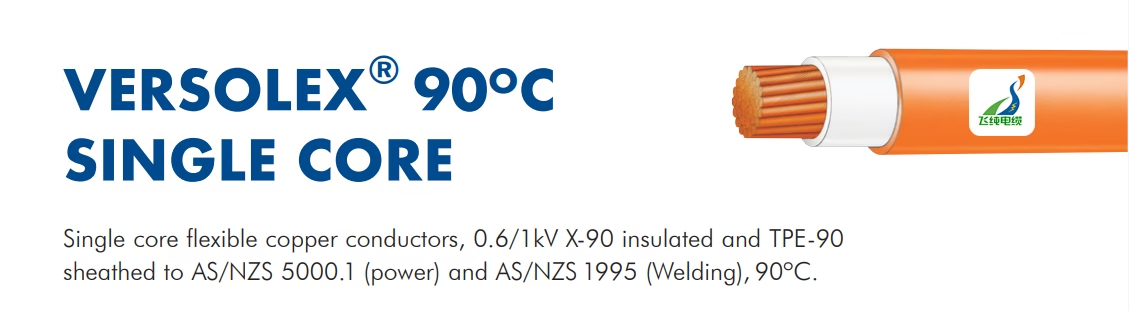
VERSOLEX 90OC, single core flexible cable, AS/NZS 5000.1, AS/NZS 1995, X-90 insulation, TPE-90 sheath, welding cable, 0.6/1kV cable, industrial power cable, flexible copper conductor, 90°C rated cable

What is VERSOLEX® 90°C Single Core Cable?

The VERSOLEX® 90OC Single Core cable represents a premium-grade flexible power cable engineered specifically for demanding industrial applications where exceptional flexibility, thermal endurance, and electrical performance are critical requirements. This specialized cable features single core flexible copper conductors rated at 0.6/1kV, utilizing X-90 (XLPE) insulation combined with TPE-90 (Thermoplastic Elastomer) sheathing to achieve superior performance characteristics across a broad range of operating conditions.
ANSI/NEMA WC 58 / ICEA S-75-381: Portable and Power Feeder Cables for Mining Applications

ANSI/NEMA WC 58 / ICEA S-75-381: Portable and Power Feeder Cables for Mining Applications

ANSI/NEMA WC 58 / ICEA S-75-381 standard represents one of the most comprehensive specifications for portable and power feeder cables used in mining environments. According to industry analysis, this standard represents one of the most rigorous cable specifications ever developed, specifically addressing the unique challenges encountered in both surface and underground mining operations where equipment reliability directly impacts production efficiency and worker safety.
TYPE 260 Heavy-Duty Mining Cable: Comprehensive Technical Analysis

TYPE 260 Heavy-Duty Mining Cable: Comprehensive Technical Analysis

TYPE 260 mining cable represents a pinnacle of engineering excellence in the domain of heavy-duty electrical power transmission for mining operations. This pliable armoured cable, designed in strict accordance with Australian and New Zealand standards AS/NZS 1802:2003 and AS/NZS 2802:2000, serves as a critical feeder cable in demanding mining environments where exceptional impact resistance and mechanical durability are paramount operational requirements.