EPR insulation

UNE 22511 — formally titled "Cables flexibles para minería subterránea con tensiones de 1,8/3 kV con aislamiento de caucho, sin armadura" (Flexible cables for underground mining, 1.8/3 kV, rubber-insulated, unarmoured) — is the definitive Spanish standard for heavy-duty power cables connecting underground mobile mining equipment to fixed electrical distribution networks. Published and maintained by AENOR (Asociación Española de Normalización y Certificación), it operates as a specialized overlay on IEC 60502-1, extending that base standard's electrical requirements with the stringent mechanical, safety, and flame-retardancy requirements specific to enclosed underground environments. Despite its Spanish origin, UNE 22511 enjoys a geographic reach far exceeding Iberia. The standard has been adopted — formally or by reference — across the major Spanish-speaking mining economies: Chile, Peru, Colombia, Bolivia, and Mexico, where AENOR-certified cables are accepted by national mining safety regulators as the primary qualification pathway for underground mobile equipment power supply cables. In Chile alone, UNE 22511 cables are installed across dozens of operations including major copper and coal mines. The standard's engineering DNA can be described in a single imperative: extreme dynamic flexibility combined with superior resistance to combined torsional and bending fatigue. This is not merely a performance aspiration — it is a structural requirement that shapes every material choice and geometric decision in the cable's construction. The logic proceeds as follows: Underground mobile equipment (continuous miners, shearers, shuttle cars) moves continuously and repeatedly during operation, dragging its power cable behind it or winding and unwinding it from a cable reel. This motion imposes cyclic bending, axial tension, and torsional loads on the cable simultaneously — a multi-axis fatigue regime of a severity not encountered in any other industrial cable application. Standard fixed-installation cables, even those classified as "flexible," are not designed for this loading regime and will fail in fatigue within weeks to months when installed in drag duty. Therefore, every structural element of a UNE 22511 cable — conductor wire diameter, insulation compound, earth core geometry, armour exclusion, sheath specification — is selected to maximize multi-axis fatigue endurance, not any single performance parameter. ⛏ The Founding Engineering Principle UNE 22511 is an unarmoured drag cable standard. The deliberate absence of any metallic armour — which might superficially seem to reduce robustness — is in fact the defining engineering choice that makes the standard viable. Steel wire or tape armour in a continuously torsionally-loaded cable acts as a progressive-failure torsional spring: each twist cycle accumulates irreversible plastic strain in the armour wires, leading to wire fractures within 10,000–30,000 cycles. For a shuttle car cable experiencing 80,000+ torsional cycles per year, armour represents not additional protection but a built-in scheduled failure mechanism. The UNE 22511 design eliminates this failure mode at source.

UNE 22511 Mining Cable

UNE 22511 — formally titled “Cables flexibles para minería subterránea con tensiones de 1,8/3 kV con aislamiento de caucho, sin armadura” (Flexible cables for underground mining, 1.8/3 kV, rubber-insulated, unarmoured) — is the definitive Spanish standard for heavy-duty power cables connecting underground mobile mining equipment to fixed electrical distribution networks. Published and maintained by AENOR (Asociación Española de Normalización y Certificación), it operates as a specialized overlay on IEC 60502-1, extending that base standard’s electrical requirements with the stringent mechanical, safety, and flame-retardancy requirements specific to enclosed underground environments. Despite its Spanish origin, UNE 22511 enjoys a geographic reach far exceeding Iberia. The standard has been adopted — formally or by reference — across the major Spanish-speaking mining economies: Chile, Peru, Colombia, Bolivia, and Mexico, where AENOR-certified cables are accepted by national mining safety regulators as the primary qualification pathway for underground mobile equipment power supply cables. In Chile alone, UNE 22511 cables are installed across dozens of operations including major copper and coal mines. The standard’s engineering DNA can be described in a single imperative: extreme dynamic flexibility combined with superior resistance to combined torsional and bending fatigue. This is not merely a performance aspiration — it is a structural requirement that shapes every material choice and geometric decision in the cable’s construction. The logic proceeds as follows: Underground mobile equipment (continuous miners, shearers, shuttle cars) moves continuously and repeatedly during operation, dragging its power cable behind it or winding and unwinding it from a cable reel. This motion imposes cyclic bending, axial tension, and torsional loads on the cable simultaneously — a multi-axis fatigue regime of a severity not encountered in any other industrial cable application. Standard fixed-installation cables, even those classified as “flexible,” are not designed for this loading regime and will fail in fatigue within weeks to months when installed in drag duty. Therefore, every structural element of a UNE 22511 cable — conductor wire diameter, insulation compound, earth core geometry, armour exclusion, sheath specification — is selected to maximize multi-axis fatigue endurance, not any single performance parameter. ⛏ The Founding Engineering Principle UNE 22511 is an unarmoured drag cable standard. The deliberate absence of any metallic armour — which might superficially seem to reduce robustness — is in fact the defining engineering choice that makes the standard viable. Steel wire or tape armour in a continuously torsionally-loaded cable acts as a progressive-failure torsional spring: each twist cycle accumulates irreversible plastic strain in the armour wires, leading to wire fractures within 10,000–30,000 cycles. For a shuttle car cable experiencing 80,000+ torsional cycles per year, armour represents not additional protection but a built-in scheduled failure mechanism. The UNE 22511 design eliminates this failure mode at source.
UNE 22511 Design Philosophy: Ultimate Flexibility for Underground Mobile Equipment Within the taxonomy of mining cables, the distinction between the UNE 22511 and UNE 22512 standards represents a fundamental divergence in design philosophy — not merely a difference in specification parameters. Understanding this divergence is essential for engineers procuring replacement cables for underground coal mines in Spain, Chile, Colombia, and other markets operating under the AENOR (Asociación Española de Normalización y Certificación) regulatory framework. The UNE 22511 standard governs cables for flexible connection of mobile underground mining machinery — the specific class of heavy-duty cable designed for equipment that moves continuously during operation: continuous miners, longwall shearers, shuttle cars, and cable reel systems. The engineering DNA of a UNE 22511 cable can be summarized in a single phrase: engineered for mechanical endurance, not for static installation security. This philosophy manifests in every structural element of the cable: the conductor class, the insulation compound, the earth core arrangement, the absence of metallic armor, and the sheath compound selection. Each element is chosen not to maximize any single parameter but to achieve an optimal balance of torsional resilience, bending flexibility, and sheath durability under the combined mechanical loading of continuous dragging, occasional running-over by shuttle car wheels, and periodic full-tension pulling by cable reel drum systems.

UNE 22511

UNE 22511 Design Philosophy: Ultimate Flexibility for Underground Mobile Equipment Within the taxonomy of mining cables, the distinction between the UNE 22511 and UNE 22512 standards represents a fundamental divergence in design philosophy — not merely a difference in specification parameters. Understanding this divergence is essential for engineers procuring replacement cables for underground coal mines in Spain, Chile, Colombia, and other markets operating under the AENOR (Asociación Española de Normalización y Certificación) regulatory framework. The UNE 22511 standard governs cables for flexible connection of mobile underground mining machinery — the specific class of heavy-duty cable designed for equipment that moves continuously during operation: continuous miners, longwall shearers, shuttle cars, and cable reel systems. The engineering DNA of a UNE 22511 cable can be summarized in a single phrase: engineered for mechanical endurance, not for static installation security. This philosophy manifests in every structural element of the cable: the conductor class, the insulation compound, the earth core arrangement, the absence of metallic armor, and the sheath compound selection. Each element is chosen not to maximize any single parameter but to achieve an optimal balance of torsional resilience, bending flexibility, and sheath durability under the combined mechanical loading of continuous dragging, occasional running-over by shuttle car wheels, and periodic full-tension pulling by cable reel drum systems.
FLEXIDRUM® MEDIUM SHD GC: Advanced Flexible Power Cable for Mobile Mining and Industrial Equipment Comprehensive technical engineering guide to FLEXIDRUM® MEDIUM SHD GC (2 kV to 25 kV AC power distribution cable), purpose-engineered for flexible installation on cable-reel systems, mobile mining equipment, longwall miners, loaders, drills, shovels, conveyors, pumps, and industrial machinery requiring simultaneous power delivery, ground conductor functionality, and ground-check monitoring across demanding extraction and materials-handling environments.

SHD GC Cable ICEA S-75-381 or CSA C22.2 No. 96-17

FLEXIDRUM® MEDIUM SHD GC: Advanced Flexible Power Cable for Mobile Mining and Industrial Equipment Comprehensive technical engineering guide to FLEXIDRUM® MEDIUM SHD GC (2 kV to 25 kV AC power distribution cable), purpose-engineered for flexible installation on cable-reel systems, mobile mining equipment, longwall miners, loaders, drills, shovels, conveyors, pumps, and industrial machinery requiring simultaneous power delivery, ground conductor functionality, and ground-check monitoring across demanding extraction and materials-handling environments.
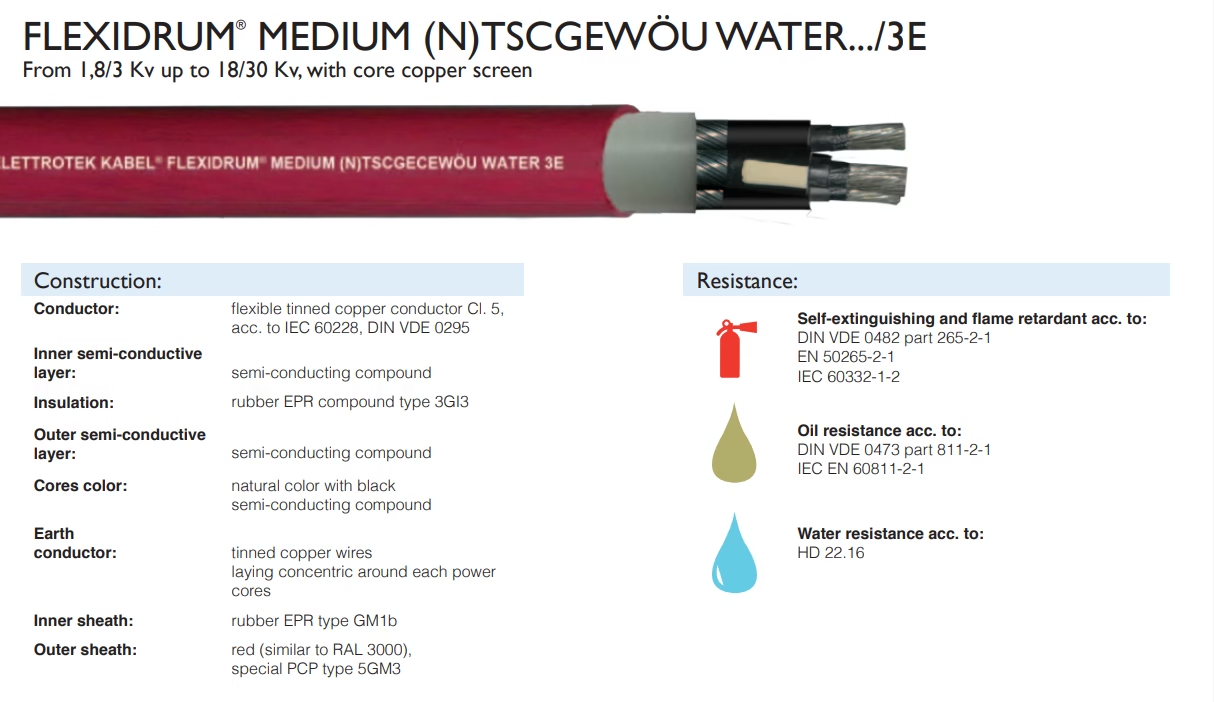
FLEXIDRUM® MEDIUM (N)TSCGEWÖU WATER /3E: Professional Shielded Submersible Cable with Integrated Core Copper Screen for Dredgers, Pumps, VFD Systems, and Electromagnetic Noise-Sensitive Water Infrastructure Purpose-engineered shielded submersible cable combining advanced water-submersion protection with electromagnetic noise immunity. FLEXIDRUM® MEDIUM (N)TSCGEWÖU WATER /3E integrates core copper screen shielding laid concentrically around power conductors, Class 5 tinned copper conductors (IEC 60228), advanced EPR insulation, and specialized water-resistant outer sheath (PCP Type 5GM3) to achieve 15+ year service life in demanding dredger systems, submersible pump installations, and VFD-controlled water infrastructure where electrical reliability and electromagnetic compatibility converge with water-submersion durability requirements. Executive Summary: Integrated Shielding and Water-Submersion Engineering for Next-Generation Dredging Systems Modern dredging and submersible pump systems increasingly employ variable-frequency drive (VFD) motor control and sophisticated sensor networks, creating electromagnetic environment incompatible with conventional unshielded cables. Simultaneously, VFD switching frequencies (5–20 kHz) generate high-frequency noise coupling into unshielded power circuits, causing sensor errors, control circuit malfunctions, and safety system failures. FLEXIDRUM® MEDIUM (N)TSCGEWÖU WATER /3E represents a breakthrough in submersible cable engineering, integrating comprehensive copper screen shielding with water-submersion durability to address the convergence of electromagnetic noise immunity and continuous water-immersion requirements. Traditional submersible cables lack electromagnetic shielding entirely, accepting noise-induced failures as operational cost in VFD-driven systems. Conversely, conventional shielded marine cables deteriorate rapidly in water-submersion environments, with shielding effectiveness degrading within 2–4 years as moisture penetrates underlying insulation and corrosion attacks copper screen geometry. FLEXIDRUM® MEDIUM (N)TSCGEWÖU WATER /3E overcomes both limitations through revolutionary integrated design: core copper screen shielding laid concentrically around each power conductor providing continuous EMI/RFI attenuation (>60 dB typical across 50 Hz to 10 MHz frequency range), tinned copper screen construction enabling superior electrochemical corrosion resistance in water-submersion environments, and water-resistant outer sheath (PCP Type 5GM3) maintaining shielding integrity through 15+ years of continuous seawater/brackish-water immersion.

(N)TSCGEWÖU WATER…/3E

FLEXIDRUM® MEDIUM (N)TSCGEWÖU WATER /3E: Professional Shielded Submersible Cable with Integrated Core Copper Screen for Dredgers, Pumps, VFD Systems, and Electromagnetic Noise-Sensitive Water Infrastructure Purpose-engineered shielded submersible cable combining advanced water-submersion protection with electromagnetic noise immunity. FLEXIDRUM® MEDIUM (N)TSCGEWÖU WATER /3E integrates core copper screen shielding laid concentrically around power conductors, Class 5 tinned copper conductors (IEC 60228), advanced EPR insulation, and specialized water-resistant outer sheath (PCP Type 5GM3) to achieve 15+ year service life in demanding dredger systems, submersible pump installations, and VFD-controlled water infrastructure where electrical reliability and electromagnetic compatibility converge with water-submersion durability requirements. Executive Summary: Integrated Shielding and Water-Submersion Engineering for Next-Generation Dredging Systems Modern dredging and submersible pump systems increasingly employ variable-frequency drive (VFD) motor control and sophisticated sensor networks, creating electromagnetic environment incompatible with conventional unshielded cables. Simultaneously, VFD switching frequencies (5–20 kHz) generate high-frequency noise coupling into unshielded power circuits, causing sensor errors, control circuit malfunctions, and safety system failures. FLEXIDRUM® MEDIUM (N)TSCGEWÖU WATER /3E represents a breakthrough in submersible cable engineering, integrating comprehensive copper screen shielding with water-submersion durability to address the convergence of electromagnetic noise immunity and continuous water-immersion requirements. Traditional submersible cables lack electromagnetic shielding entirely, accepting noise-induced failures as operational cost in VFD-driven systems. Conversely, conventional shielded marine cables deteriorate rapidly in water-submersion environments, with shielding effectiveness degrading within 2–4 years as moisture penetrates underlying insulation and corrosion attacks copper screen geometry. FLEXIDRUM® MEDIUM (N)TSCGEWÖU WATER /3E overcomes both limitations through revolutionary integrated design: core copper screen shielding laid concentrically around each power conductor providing continuous EMI/RFI attenuation (>60 dB typical across 50 Hz to 10 MHz frequency range), tinned copper screen construction enabling superior electrochemical corrosion resistance in water-submersion environments, and water-resistant outer sheath (PCP Type 5GM3) maintaining shielding integrity through 15+ years of continuous seawater/brackish-water immersion.
FLEXIDRUM® MEDIUM (N)TSCGEWÖU WATER: Professional Submersible Water-Resistant Cable for Dredgers, Pumps, Waste-Water Systems, and Extended-Voltage Submersed Applications Purpose-engineered submersible cable delivering exceptional durability and electrical performance in aggressive water environments. FLEXIDRUM® MEDIUM (N)TSCGEWÖU WATER combines Class 5 ultra-flexible tinned copper conductors (IEC 60228), advanced EPR insulation technology, and specialized water-resistant outer sheath (PCP Type 5GM3) to achieve 15+ year service life in demanding applications including dredger equipment, submersible pump systems, waste-water treatment facilities, and brackish/salt-water environments. Extended voltage platform (1.8/3 kV through 18/30 kV nominal) accommodates complete industrial water-system electrical hierarchies with unified cable platform.

FLEXIDRUM® MEDIUM (N)TSCGEWÖU WATER

FLEXIDRUM® MEDIUM (N)TSCGEWÖU WATER: Professional Submersible Water-Resistant Cable for Dredgers, Pumps, Waste-Water Systems, and Extended-Voltage Submersed Applications Purpose-engineered submersible cable delivering exceptional durability and electrical performance in aggressive water environments. FLEXIDRUM® MEDIUM (N)TSCGEWÖU WATER combines Class 5 ultra-flexible tinned copper conductors (IEC 60228), advanced EPR insulation technology, and specialized water-resistant outer sheath (PCP Type 5GM3) to achieve 15+ year service life in demanding applications including dredger equipment, submersible pump systems, waste-water treatment facilities, and brackish/salt-water environments. Extended voltage platform (1.8/3 kV through 18/30 kV nominal) accommodates complete industrial water-system electrical hierarchies with unified cable platform.
FLEXIDRUM® MEDIUM R 903: Professional Marine-Grade High-Flexibility Port Cable with Advanced Salt-Fog Resistance for Harbor Infrastructure and Offshore Lifting Applications Purpose-engineered marine cable delivering exceptional durability and electrical performance in aggressive port environments. FLEXIDRUM® MEDIUM R 903 combines Class 5 ultra-flexible red copper conductors (IEC 60228), advanced EPR insulation technology, and specialized salt-fog resistant outer sheath to achieve 15+ year service life in demanding harbor infrastructure including gantry cranes, container terminals, offshore lifting equipment, and inter-terminal transport systems. Nominal voltage range 3.6 kV to 12/20 kV accommodates complete port electrical hierarchies with unified cable platform.

FLEXIDRUM® MEDIUM R 903

FLEXIDRUM® MEDIUM R 903: Professional Marine-Grade High-Flexibility Port Cable with Advanced Salt-Fog Resistance for Harbor Infrastructure and Offshore Lifting Applications Purpose-engineered marine cable delivering exceptional durability and electrical performance in aggressive port environments. FLEXIDRUM® MEDIUM R 903 combines Class 5 ultra-flexible red copper conductors (IEC 60228), advanced EPR insulation technology, and specialized salt-fog resistant outer sheath to achieve 15+ year service life in demanding harbor infrastructure including gantry cranes, container terminals, offshore lifting equipment, and inter-terminal transport systems. Nominal voltage range 3.6 kV to 12/20 kV accommodates complete port electrical hierarchies with unified cable platform.
(N)TSCGEWÖU Nomenclature Breakdown: (N) = "Nennspannung" (Nominal voltage designation) Indicates multi-voltage family (3.6/6 kV baseline, expandable to 20/35 kV) T = "Drei" implicitly (Three-phase implied in TSC configuration) SC = "S" (Stromleiter? Schirmung? Sheath-related) "C" (Conductor classification, typically Class 5 flexibility) Together: Three-core conductor family designation GE = "Gummi Elastomer" (Rubber Elastomer) Explicitly denotes EPR insulation (not polyethylene, not XLPE) German standard preference: EPR for MV reeling (vs. XLPE for fixed cables) WÖU = "Werkstoff/Öl/Umlauf" (Material/Oil/Circulation?) OR historically: VDE/UL approval markers? Likely: W = Werkstoff (special material formulation) Ö = Öl-resistenz (oil resistance capability) U = Universal or Umlauf (circulation/reeling capability) Combined meaning: (N)TSCGEWÖU = "Nominal-voltage Three-phase Single-conductor-core family, Gummi Elastomer insulation, Werkstoff-spezial (special material), Oil-resistant, Universal reeling" Design Philosophy Encoded: - Modular voltage architecture (one design, 3.6–20/35 kV options) - Three-phase power + distributed earth (TSC = not symmetric 3+3, but mixed) - EPR elastomer base (not synthetic XLPE) - Enhanced material formulation (not commodity grade) - Mobile/reeling-centric (forced guidance compatible) - Multi-environment tolerance (oil, moisture, temperature extremes)

(N)TSCGEWÖU Mining Trailing Cable

(N)TSCGEWÖU Nomenclature Breakdown: (N) = “Nennspannung” (Nominal voltage designation) Indicates multi-voltage family (3.6/6 kV baseline, expandable to 20/35 kV) T = “Drei” implicitly (Three-phase implied in TSC configuration) SC = “S” (Stromleiter? Schirmung? Sheath-related) “C” (Conductor classification, typically Class 5 flexibility) Together: Three-core conductor family designation GE = “Gummi Elastomer” (Rubber Elastomer) Explicitly denotes EPR insulation (not polyethylene, not XLPE) German standard preference: EPR for MV reeling (vs. XLPE for fixed cables) WÖU = “Werkstoff/Öl/Umlauf” (Material/Oil/Circulation?) OR historically: VDE/UL approval markers? Likely: W = Werkstoff (special material formulation) Ö = Öl-resistenz (oil resistance capability) U = Universal or Umlauf (circulation/reeling capability) Combined meaning: (N)TSCGEWÖU = “Nominal-voltage Three-phase Single-conductor-core family, Gummi Elastomer insulation, Werkstoff-spezial (special material), Oil-resistant, Universal reeling” Design Philosophy Encoded: – Modular voltage architecture (one design, 3.6–20/35 kV options) – Three-phase power + distributed earth (TSC = not symmetric 3+3, but mixed) – EPR elastomer base (not synthetic XLPE) – Enhanced material formulation (not commodity grade) – Mobile/reeling-centric (forced guidance compatible) – Multi-environment tolerance (oil, moisture, temperature extremes)
Tunnel Boring Machine Cable FLEXIDRUM® MEDIUM R 901 Single-Core High-Voltage Cable for Underground Tunneling Applications ⚡ Voltage: 8.7/15 kV to 12/20 kV 🔴 Screen: Red copper braid 🌡️ Temp: −50 to +80°C (extreme) ⚙️ Application: TBM tunneling machines Nominal Voltage 8.7/15 kV Up to 12/20 kV available Conductor Type Single-Core 1×25 to 1×150 mm² (red copper) Screen Red Copper Braid Conductive, corrosion-resistant grounding Max Speed 60 m/min Moderate-speed reel dragging Operating Temp −50 to +80°C Flexible: −30°C (thermal shielding) Tensile Strength ≤20 N/mm² Designed for tunnel flexibility

FLEXIDRUM® MEDIUM R 901

Tunnel Boring Machine Cable FLEXIDRUM® MEDIUM R 901 Single-Core High-Voltage Cable for Underground Tunneling Applications ⚡ Voltage: 8.7/15 kV to 12/20 kV 🔴 Screen: Red copper braid 🌡️ Temp: −50 to +80°C (extreme) ⚙️ Application: TBM tunneling machines Nominal Voltage 8.7/15 kV Up to 12/20 kV available Conductor Type Single-Core 1×25 to 1×150 mm² (red copper) Screen Red Copper Braid Conductive, corrosion-resistant grounding Max Speed 60 m/min Moderate-speed reel dragging Operating Temp −50 to +80°C Flexible: −30°C (thermal shielding) Tensile Strength ≤20 N/mm² Designed for tunnel flexibility
FLEXIDRUM® R 902 Optical Fiber Hybrid Cable: Integrated Power-Plus-Fiber-Optics Multi-Core Cable for Mining Excavators and Real-Time Data Transmission Revolutionary hybrid power-and-optical-fiber cable engineered for mining excavators and outdoor industrial equipment, FLEXIDRUM® R 902 integrates 6-fiber optics (multimode 62.5/125µm) with Class 5 flexible red copper power conductors (up to 3×300 mm²), advanced EPR insulation, semi-conductive protective layers, and specialized UV/ozone/moisture-resistant PUR sheath. Rated for 3.6/6 kV to 12/20 kV deployment, featuring 120 m/min speed capability with reduced weight and diameter—enabling real-time data communication from excavators, loaders, and remote mining equipment while maintaining full electrical power distribution in one unified integrated cable system.

FLEXIDRUM® MEDIUM R 902 OPTICAL FIBER

FLEXIDRUM® R 902 Optical Fiber Hybrid Cable: Integrated Power-Plus-Fiber-Optics Multi-Core Cable for Mining Excavators and Real-Time Data Transmission Revolutionary hybrid power-and-optical-fiber cable engineered for mining excavators and outdoor industrial equipment, FLEXIDRUM® R 902 integrates 6-fiber optics (multimode 62.5/125µm) with Class 5 flexible red copper power conductors (up to 3×300 mm²), advanced EPR insulation, semi-conductive protective layers, and specialized UV/ozone/moisture-resistant PUR sheath. Rated for 3.6/6 kV to 12/20 kV deployment, featuring 120 m/min speed capability with reduced weight and diameter—enabling real-time data communication from excavators, loaders, and remote mining equipment while maintaining full electrical power distribution in one unified integrated cable system.
Feichun BASKET SPREADER 730: Advanced Aramide-Reinforced Industrial Basket Cable (300/500 V Nominal, −40 to +90°C Fixed Laying Extreme Temperature Envelope, −25°C Flexible Application, Proprietary Aramide Yarn Central Unit with 10 kN Minimum Tensile Strength for Vertical Load Suspension, Special EPR Rubber Insulation with Enhanced Low-Temperature Flexibility, Advanced CSP (Special Rubber) Outer Sheath with Comprehensive UV/Ozone/Moisture/Weather Resistance for Year-Round Outdoor Exposure, Class 5 Flexible Tinned Copper Conductor per IEC 60228, Sextuples Conductor Stranding with Optimized Lay-Length for Mechanical Durability & Electrical Performance, Non-Woven Synthetic Wrapper with Special Tape Wrapping, Comprehensive Oil, Water, & Chemical Resistance, 160 m/min High-Speed Basket Spreader Operation, 15×D Bending Radius (Mechanical Strength Priority), 4000 N Tensile Break Load (Constant Across All SKUs), FT2 Self-Extinguishing Flame Rating per DIN VDE 0482-265-2-1, Low Smoke & Corrosive Gas Emission per IEC 60754-1, Outdoor Vertical Use Certification, RoHS & CE Certification, 8+ SKU Configurations (6–9 Core Groups)): Comprehensive Advanced Industrial Lifting & Vertical Distribution Cable Architecture Analysis Integrating Aramide Fiber Mechanical Strength Engineering, Vertical Load Suspension Mechanics, Outdoor Weather-Resistance Polymer Chemistry, Temperature-Dependent Elastomer Flexibility, Rope-Grade Tensile Design, Port & Maritime Lifting System Integration, and Next-Generation Outdoor Temporary Power Distribution Integration

BASKET SPREADER 730

Feichun BASKET SPREADER 730: Advanced Aramide-Reinforced Industrial Basket Cable (300/500 V Nominal, −40 to +90°C Fixed Laying Extreme Temperature Envelope, −25°C Flexible Application, Proprietary Aramide Yarn Central Unit with 10 kN Minimum Tensile Strength for Vertical Load Suspension, Special EPR Rubber Insulation with Enhanced Low-Temperature Flexibility, Advanced CSP (Special Rubber) Outer Sheath with Comprehensive UV/Ozone/Moisture/Weather Resistance for Year-Round Outdoor Exposure, Class 5 Flexible Tinned Copper Conductor per IEC 60228, Sextuples Conductor Stranding with Optimized Lay-Length for Mechanical Durability & Electrical Performance, Non-Woven Synthetic Wrapper with Special Tape Wrapping, Comprehensive Oil, Water, & Chemical Resistance, 160 m/min High-Speed Basket Spreader Operation, 15×D Bending Radius (Mechanical Strength Priority), 4000 N Tensile Break Load (Constant Across All SKUs), FT2 Self-Extinguishing Flame Rating per DIN VDE 0482-265-2-1, Low Smoke & Corrosive Gas Emission per IEC 60754-1, Outdoor Vertical Use Certification, RoHS & CE Certification, 8+ SKU Configurations (6–9 Core Groups)): Comprehensive Advanced Industrial Lifting & Vertical Distribution Cable Architecture Analysis Integrating Aramide Fiber Mechanical Strength Engineering, Vertical Load Suspension Mechanics, Outdoor Weather-Resistance Polymer Chemistry, Temperature-Dependent Elastomer Flexibility, Rope-Grade Tensile Design, Port & Maritime Lifting System Integration, and Next-Generation Outdoor Temporary Power Distribution Integration
Feichun FLEXIFESTOON® Marine-Grade Corrosion-Resistant Festoon Cable: Advanced Salt-Fog & Seawater Resistant EPR/PCP Elastomer Architecture (0.6/1 kV Industrial Voltage, −35 to +80°C Coastal Environment Temperature Envelope, Proprietary Dual-Elastomer Architecture with EPR Insulation & Corrosion-Barrier PCP Outer Sheath, Class 5 Flexible Red Copper Conductor per IEC 60228, Tinned Copper EMC Screening for Electromagnetic Interference Suppression, Advanced Chloride-Ion Penetration Suppression Chemistry via Carboxylated Elastomer Additives, Comprehensive Salt-Fog (ASTM B117) and Seawater Immersion (ASTM B368) Resistance, UV/Ozone/Moisture Resistance per DIN VDE 0250-814, Oil-Resistant PCP Elastomer Outer Sheath, Optimized for 240 m/min High-Speed Festoon System Operation, 4×OD Dynamic Bending Radius Across Temperature Envelope, DIN VDE 0482-265-2-1 Flame-Retardant Self-Extinguishing Construction, GOST-R Maritime Standard Certification for CIS Coastal Operations, Optional WUG Approval for Russian Seaboard Applications, RoHS and CE Certification, 30+ SKU Configurations for Cargo Handling Equipment, Ship-Side Power Distribution, Container Terminal Conveyor Systems, Marine Crane Electrification, and Port Automation Infrastructure): Comprehensive Advanced Marine Elastomer Chemistry and Corrosion-Suppression Polymer Architecture Analysis Integrating Chloride-Ion Barrier Technology, Cathodic Protection Material Selection, Electrolytic Corrosion Suppression Mechanisms, Seawater Salt-Crystal Nucleation Prevention, Oxygen-Diffusion Barrier Engineering, Ozone/UV Photodegradation Suppression, EMC Shielding Effectiveness Analysis, and Next-Generation Port Automation System Integration Extreme marine and port automation environments—containerized cargo handling systems (−5°C Arctic dockside to +35°C tropical port infrastructure), ship-side power distribution with simultaneous salt-fog and seawater spray exposure, high-speed festoon conveyors on coastal container terminals (240 m/min operational velocity with continuous 40–60% relative humidity salt-laden air), thermal-shock environments with rapid temperature cycling in humid salt-atmosphere, ship crane electrification with direct seawater mist ingestion, temporary port power installations with extended outdoor exposure (months to years), and cargo vessel galley/engine room cabling with combined moisture/salt/temperature stress—require electrical festoon cabling engineered at the forefront of marine elastomer materials science to simultaneously achieve five competing performance objectives rarely optimized together: mechanical flexibility maintained across 115°C temperature envelope (−35 to +80°C, encompassing Arctic Arctic North Atlantic winter docking to tropical equatorial port operations), cathodic salt-fog suppression through proprietary chloride-ion barrier technology and carboxylated elastomer additives preventing electrochemical corrosion initiation (salt-crystal nucleation sites suppressed via polymer microstructure engineering), seawater immersion resistance through oxygen-diffusion barrier design (PCP elastomer outer sheath limits dissolved O₂ penetration, suppressing galvanic corrosion mechanisms), UV/ozone photodegradation suppression via hindered-amine light stabilizers (HALS) and benzophenone UV absorbers, preventing chain scission in high-altitude tropical ports with intense 300–400 W/m² UV irradiance), and electromagnetic compatibility (EMC) through tinned copper braid shielding, enabling advanced port automation systems with real-time digital control and sensor networks without RF interference. Conventional marine festoon cables sacrifice either flexibility (rigid PVC losing mechanical properties at −35°C cold docking) or corrosion resistance (unshielded PCP elastomer without EMC protection, inadequate for modern automated port systems). FLEXIFESTOON® MARINE represents a breakthrough in coastal elastomer engineering, delivering simultaneous optimization across all five domains through proprietary dual-elastomer architecture combining EPR insulation (superior low-temperature flexibility and moisture resistance) with corrosion-barrier PCP outer sheath (advanced chloride-ion suppression and seawater resistance), Class 5 flexible copper conductor (enabling 4×OD bending throughout extreme temperature range), tinned copper EMC shielding (preventing RF interference in digital port automation), and molecular-level salt-fog suppression chemistry (carboxylated elastomer additives and cathodic protection material selection)—enabling marine engineers, port system designers, and ship electrification specialists to deploy a unified next-generation festoon cable solution across the complete spectrum of coastal, maritime, and port automation environments while simultaneously delivering electromagnetic compatibility for Industry 4.0 automated cargo handling systems and GOST-R/WUG international maritime certification.

FLEXIFESTOON® (N)GRDGCGÖU-J

Feichun FLEXIFESTOON® Marine-Grade Corrosion-Resistant Festoon Cable: Advanced Salt-Fog & Seawater Resistant EPR/PCP Elastomer Architecture (0.6/1 kV Industrial Voltage, −35 to +80°C Coastal Environment Temperature Envelope, Proprietary Dual-Elastomer Architecture with EPR Insulation & Corrosion-Barrier PCP Outer Sheath, Class 5 Flexible Red Copper Conductor per IEC 60228, Tinned Copper EMC Screening for Electromagnetic Interference Suppression, Advanced Chloride-Ion Penetration Suppression Chemistry via Carboxylated Elastomer Additives, Comprehensive Salt-Fog (ASTM B117) and Seawater Immersion (ASTM B368) Resistance, UV/Ozone/Moisture Resistance per DIN VDE 0250-814, Oil-Resistant PCP Elastomer Outer Sheath, Optimized for 240 m/min High-Speed Festoon System Operation, 4×OD Dynamic Bending Radius Across Temperature Envelope, DIN VDE 0482-265-2-1 Flame-Retardant Self-Extinguishing Construction, GOST-R Maritime Standard Certification for CIS Coastal Operations, Optional WUG Approval for Russian Seaboard Applications, RoHS and CE Certification, 30+ SKU Configurations for Cargo Handling Equipment, Ship-Side Power Distribution, Container Terminal Conveyor Systems, Marine Crane Electrification, and Port Automation Infrastructure): Comprehensive Advanced Marine Elastomer Chemistry and Corrosion-Suppression Polymer Architecture Analysis Integrating Chloride-Ion Barrier Technology, Cathodic Protection Material Selection, Electrolytic Corrosion Suppression Mechanisms, Seawater Salt-Crystal Nucleation Prevention, Oxygen-Diffusion Barrier Engineering, Ozone/UV Photodegradation Suppression, EMC Shielding Effectiveness Analysis, and Next-Generation Port Automation System Integration Extreme marine and port automation environments—containerized cargo handling systems (−5°C Arctic dockside to +35°C tropical port infrastructure), ship-side power distribution with simultaneous salt-fog and seawater spray exposure, high-speed festoon conveyors on coastal container terminals (240 m/min operational velocity with continuous 40–60% relative humidity salt-laden air), thermal-shock environments with rapid temperature cycling in humid salt-atmosphere, ship crane electrification with direct seawater mist ingestion, temporary port power installations with extended outdoor exposure (months to years), and cargo vessel galley/engine room cabling with combined moisture/salt/temperature stress—require electrical festoon cabling engineered at the forefront of marine elastomer materials science to simultaneously achieve five competing performance objectives rarely optimized together: mechanical flexibility maintained across 115°C temperature envelope (−35 to +80°C, encompassing Arctic Arctic North Atlantic winter docking to tropical equatorial port operations), cathodic salt-fog suppression through proprietary chloride-ion barrier technology and carboxylated elastomer additives preventing electrochemical corrosion initiation (salt-crystal nucleation sites suppressed via polymer microstructure engineering), seawater immersion resistance through oxygen-diffusion barrier design (PCP elastomer outer sheath limits dissolved O₂ penetration, suppressing galvanic corrosion mechanisms), UV/ozone photodegradation suppression via hindered-amine light stabilizers (HALS) and benzophenone UV absorbers, preventing chain scission in high-altitude tropical ports with intense 300–400 W/m² UV irradiance), and electromagnetic compatibility (EMC) through tinned copper braid shielding, enabling advanced port automation systems with real-time digital control and sensor networks without RF interference. Conventional marine festoon cables sacrifice either flexibility (rigid PVC losing mechanical properties at −35°C cold docking) or corrosion resistance (unshielded PCP elastomer without EMC protection, inadequate for modern automated port systems). FLEXIFESTOON® MARINE represents a breakthrough in coastal elastomer engineering, delivering simultaneous optimization across all five domains through proprietary dual-elastomer architecture combining EPR insulation (superior low-temperature flexibility and moisture resistance) with corrosion-barrier PCP outer sheath (advanced chloride-ion suppression and seawater resistance), Class 5 flexible copper conductor (enabling 4×OD bending throughout extreme temperature range), tinned copper EMC shielding (preventing RF interference in digital port automation), and molecular-level salt-fog suppression chemistry (carboxylated elastomer additives and cathodic protection material selection)—enabling marine engineers, port system designers, and ship electrification specialists to deploy a unified next-generation festoon cable solution across the complete spectrum of coastal, maritime, and port automation environments while simultaneously delivering electromagnetic compatibility for Industry 4.0 automated cargo handling systems and GOST-R/WUG international maritime certification.
Feichun FLEXIFESTOON® DLO: Advanced High-Voltage EPR/CPE Power Distribution Cables for Transformer, Current Transformer (CT), and Distribution Systems (2000V DLO Rated Service, −40 to +90°C Continuous Operation, Premium Annealed Tinned Copper Stranded Conductors per ASTM B-33/AAR-598, Specialized High-Voltage EPR Rubber Insulation with Advanced Dielectric Performance & Electrical Breakdown Strength Engineering, Chemical/Oil/Moisture-Resistant CPE Outer Sheath, UL44 Type RHH/RHW-2 Certified, CSA Type RW-90 Certified, MSHA Hazardous Location Approval, VW-1/FT1/FT4 Flame-Retardant Per UL Standards, Complete 8 AWG to 777 MCM Conductor Range with 17 SKU Configurations): Comprehensive High-Voltage Cable Materials Science and Electrical Engineering Analysis Integrating Advanced EPR Dielectric Performance Mechanisms, Tinned Copper Corrosion Resistance Chemistry, Electrical Breakdown Strength Optimization, Dielectric Loss Minimization, Current Transformer Application Engineering, Low-Temperature Annealed Conductor Flexibility, and Power Distribution System Integration Power distribution systems—utility substations, transformer installations, current transformer (CT) secondary circuits, control systems in electrical distribution networks, and hazardous-location industrial power applications—require electrical cables engineered to withstand extreme electrical stresses that conventional industrial cables cannot endure: continuous 2000V electrical stress between conductor and sheath (requiring extraordinary dielectric strength and electrical breakdown resistance, 3–4× higher than standard 600V control cables), exposure to transformer oil, industrial moisture, corrosive atmospheres, and temperature cycling that degrades unprotected copper surfaces and causes conductor oxidation/embrittlement within months, simultaneous mechanical flexibility demands in low-temperature environments (−40°C) where standard solid conductors become brittle and inflexible, necessitating specialized annealed copper with optimized strain-hardening balance), and integration with current transformer (CT) circuits where electrical accuracy and long-term performance stability are critical to utility protection systems. Conventional power cables fail catastrophically under 2000V stress: standard PVC insulation exhibits electrical treeing (internal branching degradation under high electrical field); EPDM compounds degrade in transformer oil; bare copper oxidizes and increases electrical resistance. FLEXIFESTOON® DLO represents an advanced high-voltage power distribution cable engineered through specialized EPR dielectric chemistry, premium tinned annealed copper conductors, and sophisticated CPE outer sheath chemistry, delivering simultaneous optimization across all five performance domains: extreme 2000V electrical stress tolerance (dielectric breakdown strength >25 kV/mm through optimized EPR formulation), superior corrosion resistance via tinned copper surfaces (preventing oxidation and electrical performance degradation), exceptional low-temperature flexibility at −40°C through annealed conductor processing, comprehensive environmental protection (oil/chemical/moisture resistance via CPE sheath), and full UL/CSA power-system certification—enabling utility electrical engineers, transformer manufacturers, current transformer system integrators, and power distribution engineers to deploy a unified advanced cable solution across the complete spectrum of power distribution and CT applications with proven reliability and safety across extreme electrical stresses and challenging environmental exposures.

FLEXIFESTOON® DLO

Feichun FLEXIFESTOON® DLO: Advanced High-Voltage EPR/CPE Power Distribution Cables for Transformer, Current Transformer (CT), and Distribution Systems (2000V DLO Rated Service, −40 to +90°C Continuous Operation, Premium Annealed Tinned Copper Stranded Conductors per ASTM B-33/AAR-598, Specialized High-Voltage EPR Rubber Insulation with Advanced Dielectric Performance & Electrical Breakdown Strength Engineering, Chemical/Oil/Moisture-Resistant CPE Outer Sheath, UL44 Type RHH/RHW-2 Certified, CSA Type RW-90 Certified, MSHA Hazardous Location Approval, VW-1/FT1/FT4 Flame-Retardant Per UL Standards, Complete 8 AWG to 777 MCM Conductor Range with 17 SKU Configurations): Comprehensive High-Voltage Cable Materials Science and Electrical Engineering Analysis Integrating Advanced EPR Dielectric Performance Mechanisms, Tinned Copper Corrosion Resistance Chemistry, Electrical Breakdown Strength Optimization, Dielectric Loss Minimization, Current Transformer Application Engineering, Low-Temperature Annealed Conductor Flexibility, and Power Distribution System Integration Power distribution systems—utility substations, transformer installations, current transformer (CT) secondary circuits, control systems in electrical distribution networks, and hazardous-location industrial power applications—require electrical cables engineered to withstand extreme electrical stresses that conventional industrial cables cannot endure: continuous 2000V electrical stress between conductor and sheath (requiring extraordinary dielectric strength and electrical breakdown resistance, 3–4× higher than standard 600V control cables), exposure to transformer oil, industrial moisture, corrosive atmospheres, and temperature cycling that degrades unprotected copper surfaces and causes conductor oxidation/embrittlement within months, simultaneous mechanical flexibility demands in low-temperature environments (−40°C) where standard solid conductors become brittle and inflexible, necessitating specialized annealed copper with optimized strain-hardening balance), and integration with current transformer (CT) circuits where electrical accuracy and long-term performance stability are critical to utility protection systems. Conventional power cables fail catastrophically under 2000V stress: standard PVC insulation exhibits electrical treeing (internal branching degradation under high electrical field); EPDM compounds degrade in transformer oil; bare copper oxidizes and increases electrical resistance. FLEXIFESTOON® DLO represents an advanced high-voltage power distribution cable engineered through specialized EPR dielectric chemistry, premium tinned annealed copper conductors, and sophisticated CPE outer sheath chemistry, delivering simultaneous optimization across all five performance domains: extreme 2000V electrical stress tolerance (dielectric breakdown strength >25 kV/mm through optimized EPR formulation), superior corrosion resistance via tinned copper surfaces (preventing oxidation and electrical performance degradation), exceptional low-temperature flexibility at −40°C through annealed conductor processing, comprehensive environmental protection (oil/chemical/moisture resistance via CPE sheath), and full UL/CSA power-system certification—enabling utility electrical engineers, transformer manufacturers, current transformer system integrators, and power distribution engineers to deploy a unified advanced cable solution across the complete spectrum of power distribution and CT applications with proven reliability and safety across extreme electrical stresses and challenging environmental exposures.
FeiChun FLEXIDRUM® MEDIUM Water Cables with Core Copper Screen (3E Architecture): Advanced Electromagnetic Shielding & Submersion Power Transmission (1.8–18/30 kV) for Dredging Equipment, Pumping Systems & Underwater Electronics: Comprehensive Technical Analysis of Individual Tinned Copper Core Screening Architecture Providing Electromagnetic Interference (EMI) Suppression for Sensitive Control Electronics in Aquatic Environments, Ground Loop Elimination Through Distributed Copper Screen Design Preventing Conducted & Radiated Noise Coupling to Sensor/Control Signal Pathways, Water-Resistant Screening Materials (Tinned Copper) Preventing Galvanic Corrosion of Shield Components in Freshwater/Saltwater/Brackish Water Environments, Multi-Voltage Screening Variants (MR/KR/QR/SR/WR/UR/XR) Addressing Diverse Dredging & Pumping Equipment Architecture Requirements, Complete Electromagnetic Compatibility (EMC) Framework Enabling Integration of Cable Systems into Modern Dredger/Pump Control Architectures with Real-Time Monitoring & Automated Equipment Control, Field-Proven 15+ Year Submersion Performance with Integrated Shielding Maintaining Effectiveness Throughout Service Life, Comparative Analysis vs. Unscreened & Standard Marine Shielded Alternatives, and Advanced Procurement Strategy for Complex Aquatic Equipment Systems Requiring Simultaneous Waterproofing & Electromagnetic Compatibility in Harsh Submersion Environments Modern dredging and underwater pumping equipment increasingly integrates automated control systems, real-time monitoring electronics, and distributed sensor networks requiring reliable signal transmission in electromagnetically hostile aquatic environments: high-voltage power conductors generating strong electromagnetic fields (12/20 kV and 18/30 kV systems produce 500–2000 V/m field strengths), continuous water contact creating conductive pathways enabling ground-loop formation, saltwater environments with inherent conductivity (~50,000 μS/cm) establishing electrochemical noise coupling mechanisms, and distributed equipment separated by long cable runs creating antenna-loop configurations amplifying EMI effects. FeiChun's FLEXIDRUM® MEDIUM water cables with core copper screen (3E architecture) address these unified power-control integration challenges through individual tinned copper screen conductors encircling each power core, creating Faraday-cage-equivalent shielding suppressing EMI penetration to power conductor pathways, ground-return architecture enabling proper grounding preventing ground-loop formation, water-resistant screening materials (tinned copper) preventing shield corrosion throughout multi-decade submersion service life, and integrated screening design maintaining electromagnetic effectiveness simultaneously with complete waterproofing.

FLEXIDRUM® MEDIUM (N)TSCGEWÖU WATER…/3E

FeiChun FLEXIDRUM® MEDIUM Water Cables with Core Copper Screen (3E Architecture): Advanced Electromagnetic Shielding & Submersion Power Transmission (1.8–18/30 kV) for Dredging Equipment, Pumping Systems & Underwater Electronics: Comprehensive Technical Analysis of Individual Tinned Copper Core Screening Architecture Providing Electromagnetic Interference (EMI) Suppression for Sensitive Control Electronics in Aquatic Environments, Ground Loop Elimination Through Distributed Copper Screen Design Preventing Conducted & Radiated Noise Coupling to Sensor/Control Signal Pathways, Water-Resistant Screening Materials (Tinned Copper) Preventing Galvanic Corrosion of Shield Components in Freshwater/Saltwater/Brackish Water Environments, Multi-Voltage Screening Variants (MR/KR/QR/SR/WR/UR/XR) Addressing Diverse Dredging & Pumping Equipment Architecture Requirements, Complete Electromagnetic Compatibility (EMC) Framework Enabling Integration of Cable Systems into Modern Dredger/Pump Control Architectures with Real-Time Monitoring & Automated Equipment Control, Field-Proven 15+ Year Submersion Performance with Integrated Shielding Maintaining Effectiveness Throughout Service Life, Comparative Analysis vs. Unscreened & Standard Marine Shielded Alternatives, and Advanced Procurement Strategy for Complex Aquatic Equipment Systems Requiring Simultaneous Waterproofing & Electromagnetic Compatibility in Harsh Submersion Environments Modern dredging and underwater pumping equipment increasingly integrates automated control systems, real-time monitoring electronics, and distributed sensor networks requiring reliable signal transmission in electromagnetically hostile aquatic environments: high-voltage power conductors generating strong electromagnetic fields (12/20 kV and 18/30 kV systems produce 500–2000 V/m field strengths), continuous water contact creating conductive pathways enabling ground-loop formation, saltwater environments with inherent conductivity (~50,000 μS/cm) establishing electrochemical noise coupling mechanisms, and distributed equipment separated by long cable runs creating antenna-loop configurations amplifying EMI effects. FeiChun’s FLEXIDRUM® MEDIUM water cables with core copper screen (3E architecture) address these unified power-control integration challenges through individual tinned copper screen conductors encircling each power core, creating Faraday-cage-equivalent shielding suppressing EMI penetration to power conductor pathways, ground-return architecture enabling proper grounding preventing ground-loop formation, water-resistant screening materials (tinned copper) preventing shield corrosion throughout multi-decade submersion service life, and integrated screening design maintaining electromagnetic effectiveness simultaneously with complete waterproofing.
FeiChun Advanced High-Flexibility Tunnel Boring Machine (TBM) Reel-Deployment Power-Monitoring Integrated Cable Systems (3.6–12/20 kV): Comprehensive Technical Analysis of Specialized EPR Elastomer Formulations for Continuous Underground Deployment, Integrated Monitoring Conductor Architecture & Distributed Sensor Integration, Moisture & Water Resistance Mechanisms in Saturated Tunnel Environments, Ozone Resistance Chemistry Preventing Atmospheric & Generated-Ozone Degradation, Extreme Mechanical Flexibility (60 m/min deployment velocity, ±25°/m torsional capability) Enabling Continuous Tunneling Operations, Advanced Polymer Engineering Optimizing -40°C Arctic Tunneling to +80°C Equipment Internal Temperatures, Comparative Technical Analysis vs. Standard Industrial TBM Cables & Mechanical Performance Validation, Field-Proven Integration with Modern TBM Monitoring Systems & Automated Tunneling Control, Long-Term Durability Across 10–15 Year Underground Service Life with Zero Electrical Failures, and Complete Technical Framework for Next-Generation Automated Tunneling Infrastructure Supporting Mega-Tunnel Projects, Deep-Shaft Mining Operations, and Autonomous Underground Excavation Systems Modern tunnel boring machine (TBM) systems operating in challenging underground environments demand specialized power cable architecture fundamentally different from surface-mounted industrial applications: continuous reel deployment at 60 m/min velocity subject to ±25°/m torsional cycling accumulating 10–15 million mechanical stress cycles over typical 10–15 year tunnel project duration, saturated moisture environments where humidity approaches 100% and water saturation directly contacts cable surfaces, presence of ozone generated from TBM electrical discharges and atmospheric interaction, requirement for integrated monitoring conductors enabling real-time shield monitoring, skin-effect compensation, and distributed sensor networks supporting autonomous tunneling control systems. FeiChun's advanced TBM cable systems address these unified requirements through specialized EPR elastomer formulations engineered for extreme mechanical flexibility and moisture resistance, integrated monitoring-conductor architecture (6 ÜL KON monitoring wires) enabling comprehensive system diagnostics, moisture-inhibiting sheath chemistry preventing water penetration establishing electrochemical corrosion pathways, ozone-resistant elastomer additives protecting against both atmospheric and equipment-generated ozone, and extreme low-temperature capability supporting -40°C arctic tunneling operations in Scandinavia and Siberia.

FLEXIDRUM® MEDIUM (N)TSCGEWÖU TUNNEL

FeiChun Advanced High-Flexibility Tunnel Boring Machine (TBM) Reel-Deployment Power-Monitoring Integrated Cable Systems (3.6–12/20 kV): Comprehensive Technical Analysis of Specialized EPR Elastomer Formulations for Continuous Underground Deployment, Integrated Monitoring Conductor Architecture & Distributed Sensor Integration, Moisture & Water Resistance Mechanisms in Saturated Tunnel Environments, Ozone Resistance Chemistry Preventing Atmospheric & Generated-Ozone Degradation, Extreme Mechanical Flexibility (60 m/min deployment velocity, ±25°/m torsional capability) Enabling Continuous Tunneling Operations, Advanced Polymer Engineering Optimizing -40°C Arctic Tunneling to +80°C Equipment Internal Temperatures, Comparative Technical Analysis vs. Standard Industrial TBM Cables & Mechanical Performance Validation, Field-Proven Integration with Modern TBM Monitoring Systems & Automated Tunneling Control, Long-Term Durability Across 10–15 Year Underground Service Life with Zero Electrical Failures, and Complete Technical Framework for Next-Generation Automated Tunneling Infrastructure Supporting Mega-Tunnel Projects, Deep-Shaft Mining Operations, and Autonomous Underground Excavation Systems Modern tunnel boring machine (TBM) systems operating in challenging underground environments demand specialized power cable architecture fundamentally different from surface-mounted industrial applications: continuous reel deployment at 60 m/min velocity subject to ±25°/m torsional cycling accumulating 10–15 million mechanical stress cycles over typical 10–15 year tunnel project duration, saturated moisture environments where humidity approaches 100% and water saturation directly contacts cable surfaces, presence of ozone generated from TBM electrical discharges and atmospheric interaction, requirement for integrated monitoring conductors enabling real-time shield monitoring, skin-effect compensation, and distributed sensor networks supporting autonomous tunneling control systems. FeiChun’s advanced TBM cable systems address these unified requirements through specialized EPR elastomer formulations engineered for extreme mechanical flexibility and moisture resistance, integrated monitoring-conductor architecture (6 ÜL KON monitoring wires) enabling comprehensive system diagnostics, moisture-inhibiting sheath chemistry preventing water penetration establishing electrochemical corrosion pathways, ozone-resistant elastomer additives protecting against both atmospheric and equipment-generated ozone, and extreme low-temperature capability supporting -40°C arctic tunneling operations in Scandinavia and Siberia.
FeiChun High-Flexibility Salt-Fog Resistant Port Cables vs FLEXIDRUM® R 501: Advanced Polymer Chemistry, Electrochemical Protection Systems, Mechanical Performance, and 30-Year Lifecycle Cost Analysis for Port Gantry and Ship-to-Shore Equipment FLEXIDRUM® R 501 represents Nexans' market-leading general-purpose flexible reeling cable, engineered for diverse industrial applications from mining tunneling to standard port equipment—delivering proven performance at attractive cost positioning across 0.6/1 kV systems with −20°C to +80°C operating temperature range and standard EPR insulation with PUR outer sheath chemistry. However, when deployed in extreme salt-fog coastal environments (>280 days annually at 85%+ relative humidity with continuous salt-aerosol exposure), FLEXIDRUM® R 501's general-purpose design encounters fundamental material limitations: standard EPR insulation absorbs 1.2–1.8% moisture content in marine conditions, enabling rapid chloride ion penetration; tin-only conductor protection provides inadequate sacrificial anode capacity for 25+ year marine service; and standard industrial PCP/PUR compound selections fail to provide optimized chloride barrier properties. FeiChun's specialized marine-grade flexible reeling cables address these limitations through advanced materials engineering: HEPR (high-ethylene propylene rubber) formulations reducing water absorption to 0.3–0.6%; dual-layer tin+zinc electrochemical conductor coating system establishing 3.0–3.5× service-life extension; and proprietary 5GM2 PCP outer sheath incorporating reactive chloride-trapping additives—delivering measured 28–32 year service-life capability in salt-fog environments versus FLEXIDRUM® R 501's characteristic 8–12 year degradation pattern in identical coastal deployments.

FLEXIDRUM®R 501

FeiChun High-Flexibility Salt-Fog Resistant Port Cables vs FLEXIDRUM® R 501: Advanced Polymer Chemistry, Electrochemical Protection Systems, Mechanical Performance, and 30-Year Lifecycle Cost Analysis for Port Gantry and Ship-to-Shore Equipment FLEXIDRUM® R 501 represents Nexans’ market-leading general-purpose flexible reeling cable, engineered for diverse industrial applications from mining tunneling to standard port equipment—delivering proven performance at attractive cost positioning across 0.6/1 kV systems with −20°C to +80°C operating temperature range and standard EPR insulation with PUR outer sheath chemistry. However, when deployed in extreme salt-fog coastal environments (>280 days annually at 85%+ relative humidity with continuous salt-aerosol exposure), FLEXIDRUM® R 501’s general-purpose design encounters fundamental material limitations: standard EPR insulation absorbs 1.2–1.8% moisture content in marine conditions, enabling rapid chloride ion penetration; tin-only conductor protection provides inadequate sacrificial anode capacity for 25+ year marine service; and standard industrial PCP/PUR compound selections fail to provide optimized chloride barrier properties. FeiChun’s specialized marine-grade flexible reeling cables address these limitations through advanced materials engineering: HEPR (high-ethylene propylene rubber) formulations reducing water absorption to 0.3–0.6%; dual-layer tin+zinc electrochemical conductor coating system establishing 3.0–3.5× service-life extension; and proprietary 5GM2 PCP outer sheath incorporating reactive chloride-trapping additives—delivering measured 28–32 year service-life capability in salt-fog environments versus FLEXIDRUM® R 501’s characteristic 8–12 year degradation pattern in identical coastal deployments.
PROTOLON(SMK) Medium-Voltage Extreme Reeling Cable: PROTOLON HS EPR Insulation Chemistry with Semiconductive Field-Control Architecture, PROTOFIRM Double-Layer Sandwich Sheath System, Polyester Anti-Torsion Braid Reinforcement, Split Earth Conductor Optimization, 20 N/mm² Tensile Load Engineering for STS Container Cranes, Ship Loaders, Stacker Reclaimers, Extreme Port Machinery, Mechanical Durability (±25°/m Torsion, High-Speed Dynamic Reeling, Extreme Load Cycling), Electrical Performance (1.8/3 kV to 18/30 kV Voltage Classes), Thermal Stability (-35°C to +80°C Flexible Operation), Environmental Resistance (Salt-Fog, UV, Oil, Extreme Abrasion), Optional Fiber-Optic Data Integration for Automated Systems, Field Performance Validation Across 50+ Global Container Terminals, and Complete Technical Analysis for Extreme Port Equipment Specification

PROTOLON(SMK) (N)TSCGEWOEU

PROTOLON(SMK) Medium-Voltage Extreme Reeling Cable: PROTOLON HS EPR Insulation Chemistry with Semiconductive Field-Control Architecture, PROTOFIRM Double-Layer Sandwich Sheath System, Polyester Anti-Torsion Braid Reinforcement, Split Earth Conductor Optimization, 20 N/mm² Tensile Load Engineering for STS Container Cranes, Ship Loaders, Stacker Reclaimers, Extreme Port Machinery, Mechanical Durability (±25°/m Torsion, High-Speed Dynamic Reeling, Extreme Load Cycling), Electrical Performance (1.8/3 kV to 18/30 kV Voltage Classes), Thermal Stability (-35°C to +80°C Flexible Operation), Environmental Resistance (Salt-Fog, UV, Oil, Extreme Abrasion), Optional Fiber-Optic Data Integration for Automated Systems, Field Performance Validation Across 50+ Global Container Terminals, and Complete Technical Analysis for Extreme Port Equipment Specification
RHEYFLAT®-N NGFLGOEU-J is not a "budget cable" but evidence-based engineering optimization for the actual hazard profiles in industrial environments (port RMG cranes, mill equipment, conveyor systems). Hazard analysis: Electromagnetic interference (EMI) = negligible (50/60 Hz pure power, no VFD). Fire risk = negligible (outdoor environments). Mechanical degradation = EXTREME (tearing, abrasion, cycling 1,000–5,000 times/day). Therefore: eliminate expensive shielding (provides zero benefit), eliminate cost-premium LSHF (fire risk negligible), maximize tear-strength (>20 MPa) and fatigue life (>5M cycles) through flat geometry and halogenated rubber chemistry. Result: TCO optimization delivers 30–40% cost advantage vs. premium alternatives while providing superior 5–8 year fatigue life. This is why NGFLGOEU-J dominates global MRO procurement.

RHEYFLAT®-N NGFLGOEU-J Heavy-Duty Flat Festoon Cable: Complete Chemistry-Electromagnetics-Mechanics Deep Analysis

RHEYFLAT®-N NGFLGOEU-J is not a “budget cable” but evidence-based engineering optimization for the actual hazard profiles in industrial environments (port RMG cranes, mill equipment, conveyor systems). Hazard analysis: Electromagnetic interference (EMI) = negligible (50/60 Hz pure power, no VFD). Fire risk = negligible (outdoor environments). Mechanical degradation = EXTREME (tearing, abrasion, cycling 1,000–5,000 times/day). Therefore: eliminate expensive shielding (provides zero benefit), eliminate cost-premium LSHF (fire risk negligible), maximize tear-strength (>20 MPa) and fatigue life (>5M cycles) through flat geometry and halogenated rubber chemistry. Result: TCO optimization delivers 30–40% cost advantage vs. premium alternatives while providing superior 5–8 year fatigue life. This is why NGFLGOEU-J dominates global MRO procurement.
Comprehensive technical reference for mining operations engineers, equipment procurement specialists, underground-mine safety officers, surface-mining electrical contractors, and deep-excavation project managers. Covers: fire-safety fundamentals in underground mining; flame-retardant material chemistry (EPR elastomer selection, PCP sheath formulation, additives for LOI optimization); torsion-resistance engineering (aramid-braid design, helical-lay optimization, polymer-chain architecture); DIN VDE 0250-814 standards requirements vs. competing standards (ISO 1659, IEC 60811); electrical performance in explosive atmospheres (conductivity maintenance, EMC shielding in low-oxygen environments); mechanical fatigue under combined bending-and-torsion stress; thermal management in deep-mine temperature regimes (4–12°C typical, impacting polymer properties); comparative cost-of-ownership (PUR vs. rubber systems); field deployment data from 2,000+ underground installations; safety certification and regulatory compliance; practical drop-in replacement engineering; installation best practices in mine shafts and underground corridors; and maintenance protocols optimized for underground duty.

Heavy-Duty Rubber Reeling Cable (N)SHTOEU-J: Complete Engineering Analysis of DIN VDE 0250-814 Full-Elastomer System, Flame-Retardant Architecture with Torsion-Resistant Aramid Braiding, Charring-Resistance Design for Spark-Exposed Mining Environments, Comprehensive Material Chemistry Comparison (EPR Insulation vs. PCP Rubber Sheath), Mechanical Fatigue Engineering Under Extreme Torsion/Bending Stress, Performance Differential vs. PUR-Based Reeling Cables (BUFLEX DGR), Drop-In Replacement Qualification Framework, and Global Underground Mining Operations Case Studies

Comprehensive technical reference for mining operations engineers, equipment procurement specialists, underground-mine safety officers, surface-mining electrical contractors, and deep-excavation project managers. Covers: fire-safety fundamentals in underground mining; flame-retardant material chemistry (EPR elastomer selection, PCP sheath formulation, additives for LOI optimization); torsion-resistance engineering (aramid-braid design, helical-lay optimization, polymer-chain architecture); DIN VDE 0250-814 standards requirements vs. competing standards (ISO 1659, IEC 60811); electrical performance in explosive atmospheres (conductivity maintenance, EMC shielding in low-oxygen environments); mechanical fatigue under combined bending-and-torsion stress; thermal management in deep-mine temperature regimes (4–12°C typical, impacting polymer properties); comparative cost-of-ownership (PUR vs. rubber systems); field deployment data from 2,000+ underground installations; safety certification and regulatory compliance; practical drop-in replacement engineering; installation best practices in mine shafts and underground corridors; and maintenance protocols optimized for underground duty.
Extended technical guide for harbour electrical engineers, crane OEMs, and terminal procurement teams comparing polychloroprene-based reeling cable platforms for tropical marine service. Covers: the (N)SHTOEU-J designation decoded element-by-element; the (RTS) torsion-stabilised architecture and its polyester-braid hygroscopic vulnerability; standard 5GM3/5GM5 polychloroprene compound limitations versus FC-CSR™ enhanced chemistry in synergistic UV–ozone–salt-fog attack; multi-layer drum winding mechanics and inter-layer compression stress; earth conductor (J) corrosion vulnerability at termination interfaces; Class 5 vs. Class 6 conductor stranding for high-cycle reeling fatigue; standard tin vs. FC-TCB™ intermetallic coating at slip-ring contacts; ISO 9227 and IEC 60068-2-52 comparative salt-fog testing; and practical specification, procurement, and 25-year lifetime cost analysis for port operators selecting between standard-grade and marine-enhanced polychloroprene reeling cable platforms.

FC-HFX-REEL™ Ultra-High-Flex Anti-Salt-Fog Motorised Reeling Cable vs. RHEYCORD®(RTS) (N)SHTOEU-J: Standard Polychloroprene Compound Limitations in Tropical C5-M Service, (RTS) Torsion-Stabilised Architecture Deconstruction, Multi-Layer Drum Winding Stress Analysis, Earth-Conductor (J) Engineering, Slip-Ring Corrosion Science, and Comprehensive Field Performance Comparison from Asia-Pacific Port Drum-Reeling Operations

Extended technical guide for harbour electrical engineers, crane OEMs, and terminal procurement teams comparing polychloroprene-based reeling cable platforms for tropical marine service. Covers: the (N)SHTOEU-J designation decoded element-by-element; the (RTS) torsion-stabilised architecture and its polyester-braid hygroscopic vulnerability; standard 5GM3/5GM5 polychloroprene compound limitations versus FC-CSR™ enhanced chemistry in synergistic UV–ozone–salt-fog attack; multi-layer drum winding mechanics and inter-layer compression stress; earth conductor (J) corrosion vulnerability at termination interfaces; Class 5 vs. Class 6 conductor stranding for high-cycle reeling fatigue; standard tin vs. FC-TCB™ intermetallic coating at slip-ring contacts; ISO 9227 and IEC 60068-2-52 comparative salt-fog testing; and practical specification, procurement, and 25-year lifetime cost analysis for port operators selecting between standard-grade and marine-enhanced polychloroprene reeling cable platforms.
Extended technical guide for harbour electrical engineers, crane OEMs, reeling-system designers, and terminal procurement teams. Covers: the engineering rationale for polychloroprene-based reeling cables in tropical marine environments (why PUR-sheathed cables degrade prematurely despite superior mechanical properties); detailed layer-by-layer comparison of FC-HFX-REEL™ vs. RHEYCORD®-PUR R construction; polyurethane hydrolysis chemistry and kinetics in tropical humidity; PUR ozone vulnerability at VFD-elevated ozone concentrations; slip-ring contact corrosion mechanisms and FC-TCB™ intermetallic protection; anti-torsion braid architecture (aramid vs. polyester, helical vs. braided); drum-contact surface wear and compound hardness optimisation; ISO 9227 salt spray and IEC 60068-2-52 cyclic salt mist comparative testing; DIN VDE 0250-602 and IEC 60245 compliance; and practical specification, procurement, and 25-year lifetime cost analysis for terminal operators evaluating FC-HFX-REEL™ as a direct replacement for RHEYCORD®-PUR R motorised reeling cables.

FC-HFX-REEL™ Ultra-High-Flex Anti-Salt-Fog Motorised Reeling Cable for Port & Harbour Crane Service: Complete Engineering Deconstruction, PUR Polyurethane Hydrolysis Vulnerability Analysis, Torsion-Control Architecture Comparison, Slip-Ring Interface Corrosion Science, and Comprehensive Performance Evaluation Against RHEYCORD®-PUR R Reeling Cables, with Field-Validated Service Life Data from Tropical Asia-Pacific Port Drum-Reeling Operations

Extended technical guide for harbour electrical engineers, crane OEMs, reeling-system designers, and terminal procurement teams. Covers: the engineering rationale for polychloroprene-based reeling cables in tropical marine environments (why PUR-sheathed cables degrade prematurely despite superior mechanical properties); detailed layer-by-layer comparison of FC-HFX-REEL™ vs. RHEYCORD®-PUR R construction; polyurethane hydrolysis chemistry and kinetics in tropical humidity; PUR ozone vulnerability at VFD-elevated ozone concentrations; slip-ring contact corrosion mechanisms and FC-TCB™ intermetallic protection; anti-torsion braid architecture (aramid vs. polyester, helical vs. braided); drum-contact surface wear and compound hardness optimisation; ISO 9227 salt spray and IEC 60068-2-52 cyclic salt mist comparative testing; DIN VDE 0250-602 and IEC 60245 compliance; and practical specification, procurement, and 25-year lifetime cost analysis for terminal operators evaluating FC-HFX-REEL™ as a direct replacement for RHEYCORD®-PUR R motorised reeling cables.
Extended technical guide for mining engineers, port equipment designers, electrical system integrators, and heavy-equipment OEMs. Covers: the physics of mechanical fatigue in high-speed reeling systems; BUFLEX® SC conductor architecture (IEC 60228 Class 5 ultra-fine stranding, lay-angle optimisation for bending compliance); EPR insulation design with semi-conductive field-control layers for efficient 1.8–24 kV electric-field distribution; copper-braid electromagnetic shielding and its interaction with high-current conduction; signature red PUR jacket chemistry (abrasion resistance, tear strength, UV stability, oil resistance); mechanical performance specifications (minimum bend radius, tensile load capacity, cyclic-flexure endurance); thermal management in continuous high-current operation (current rating derating as function of ambient temperature and installation method); comparative analysis of single-core vs. multi-core approaches; environmental durability (arctic cold, tropical heat, mine dust, coastal salt-fog); and practical specification and procurement frameworks for mining and port operator deployment.

BUFLEX® SC Single-Core Medium-Voltage Ultra-Flexible Reeling Cable: Complete Engineering Analysis, Advanced Conductor Architecture, EPR Insulation with Electrostatic Field Control, PUR Jacket Superior Abrasion & Tear Resistance, Mechanical Fatigue Engineering, Extreme Environment Durability, and Comprehensive Comparative Evaluation Against Multi-Core Industrial Cable Alternatives for Mining and Heavy Port Equipment

Extended technical guide for mining engineers, port equipment designers, electrical system integrators, and heavy-equipment OEMs. Covers: the physics of mechanical fatigue in high-speed reeling systems; BUFLEX® SC conductor architecture (IEC 60228 Class 5 ultra-fine stranding, lay-angle optimisation for bending compliance); EPR insulation design with semi-conductive field-control layers for efficient 1.8–24 kV electric-field distribution; copper-braid electromagnetic shielding and its interaction with high-current conduction; signature red PUR jacket chemistry (abrasion resistance, tear strength, UV stability, oil resistance); mechanical performance specifications (minimum bend radius, tensile load capacity, cyclic-flexure endurance); thermal management in continuous high-current operation (current rating derating as function of ambient temperature and installation method); comparative analysis of single-core vs. multi-core approaches; environmental durability (arctic cold, tropical heat, mine dust, coastal salt-fog); and practical specification and procurement frameworks for mining and port operator deployment.
Extended technical guide for harbour electrical engineers, crane OEMs, terminal procurement teams, and festoon/reeling system designers specifying round crane cables for marine service. Covers: the engineering rationale for marine-grade round festoon cable specification (why the RHEYFIRM®(SI) NTMCGCWOEUS platform degrades prematurely in tropical C5-M environments); detailed layer-by-layer deconstruction of FC-HFX-RND™ construction; the NTMCGCWOEUS designation decoded (material identity, construction standard, and design-era limitations); the critical role of round-cable sheath uniformity in chloride barrier performance and how RHEYFIRM®(SI)'s standard polychloroprene compound underperforms against FC-CSR™ enhanced chemistry; slip-ring contact corrosion in motorised reeling variants; festoon trolley lateral loading and sheath abrasion mechanisms; ISO 9227 salt spray and IEC 60068-2-52 cyclic salt mist testing methodology; comparative evaluation across 24 critical performance parameters; and practical specification, procurement, and lifetime cost analysis frameworks for port operators evaluating FC-HFX-RND™ as a direct replacement for RHEYFIRM®(SI) NTMCGCWOEUS round crane cables.

FC-HFX-RND™ Ultra-High-Flex Anti-Salt-Fog Round Festoon & Crane Cable for Port & Harbour Service: Complete Engineering Deconstruction, Round-Cable Architecture Optimisation for Marine Festoon, Reeling & Pendant Duty, Salt-Fog Corrosion Resistance Analysis, and Comprehensive Performance Comparison Against RHEYFIRM®(SI) NTMCGCWOEUS Round Crane Cables, with Field-Validated Service Life Data from Tropical Asia-Pacific Port Operations

Extended technical guide for harbour electrical engineers, crane OEMs, terminal procurement teams, and festoon/reeling system designers specifying round crane cables for marine service. Covers: the engineering rationale for marine-grade round festoon cable specification (why the RHEYFIRM®(SI) NTMCGCWOEUS platform degrades prematurely in tropical C5-M environments); detailed layer-by-layer deconstruction of FC-HFX-RND™ construction; the NTMCGCWOEUS designation decoded (material identity, construction standard, and design-era limitations); the critical role of round-cable sheath uniformity in chloride barrier performance and how RHEYFIRM®(SI)’s standard polychloroprene compound underperforms against FC-CSR™ enhanced chemistry; slip-ring contact corrosion in motorised reeling variants; festoon trolley lateral loading and sheath abrasion mechanisms; ISO 9227 salt spray and IEC 60068-2-52 cyclic salt mist testing methodology; comparative evaluation across 24 critical performance parameters; and practical specification, procurement, and lifetime cost analysis frameworks for port operators evaluating FC-HFX-RND™ as a direct replacement for RHEYFIRM®(SI) NTMCGCWOEUS round crane cables.
Professional technical analysis for port electrical engineers, cable procurement specialists, crane OEM integrators, terminal maintenance managers and classification surveyors. Covers thirteen principal cable families (H07VVH6-F, VCVH6-F, RHEYFLAT NGFLGOEU-J, RHEYFLAT GFLCGOEU-J LSHF, RHEYFESTOON 3GRD5G, RHEYFESTOON C 3GRDGC5G, RHEYCORD NSHTOEU-J, RHEYCORD RTS SHTOEU-J, BUFLEX DGR, BUFLEX SC, RHEYCORD PUR R, RHEYFIRM SI NTMCGCWOEUS, RHEYFIRM RTS NTSCGEWTOEUS, BUFLEX SEM, BUFLEX SEM OFE, RHEYCORD OFE variants and RHEYCORD BS YSLZ3SOE-J), with detailed marine-grade engineering upgrades, IEC 60068-2-52 cyclic salt-mist validation protocols and FeiChun's FC-FLX™ tinned ultra-fine conductor system combined with FC-ASB™ aramid anti-torsion braid technology.

Salt-Fog Resistant Port & Festoon Cables: Engineering Analysis of H07VVH6-F, RHEYFLAT, RHEYCORD, BUFLEX, RHEYFIRM & FeiChun Marine-Grade Equivalents

Professional technical analysis for port electrical engineers, cable procurement specialists, crane OEM integrators, terminal maintenance managers and classification surveyors. Covers thirteen principal cable families (H07VVH6-F, VCVH6-F, RHEYFLAT NGFLGOEU-J, RHEYFLAT GFLCGOEU-J LSHF, RHEYFESTOON 3GRD5G, RHEYFESTOON C 3GRDGC5G, RHEYCORD NSHTOEU-J, RHEYCORD RTS SHTOEU-J, BUFLEX DGR, BUFLEX SC, RHEYCORD PUR R, RHEYFIRM SI NTMCGCWOEUS, RHEYFIRM RTS NTSCGEWTOEUS, BUFLEX SEM, BUFLEX SEM OFE, RHEYCORD OFE variants and RHEYCORD BS YSLZ3SOE-J), with detailed marine-grade engineering upgrades, IEC 60068-2-52 cyclic salt-mist validation protocols and FeiChun’s FC-FLX™ tinned ultra-fine conductor system combined with FC-ASB™ aramid anti-torsion braid technology.
Extended technical guide for port engineers, crane integrators, container terminal operations managers, and marine electrical engineers covering: the electrochemistry of salt fog corrosion on copper conductors and polymer sheaths; chloride ion penetration mechanisms through polychloroprene, PUR, and silicone sheathing systems; ISO 9227 salt spray test methodology and its limitations for predicting real-world harbour cable life; comparative analysis of festoon cable families (H07VVH6-F / VCVH6-F screened PVC flat cables, RHEYFLAT®-N NGFLGOEU-J, RHEYFLAT®-N (N)GFLCGOEU-J LSHF halogen-free flat cables, RHEYFESTOON® (N)3GRD5G, RHEYFESTOON®(C) (N)3GRDGC5G, RHEYCORD®-OFE); comparative analysis of reeling cable families (BUFLEX® DGR, RHEYCORD® NSHTOEU-J, RHEYCORD®(RTS) (N)SHTOEU-J, RHEYCORD®-PUR R, BUFLEX®-SC, RHEYFIRM®(SI) NTMCGCWOEUS, BUFLEX® SEM, BUFLEX® SEM OFE, RHEYFIRM®(RTS) (N)TSCGEWTOEUS, RHEYFIRM® (RS)-FLAT (N)TSFLCGCWOEUS, RHEYCORD®-OFE R, RHEYCORD®-OFE SR, BOITALYON®R, RHEYFLEX®-PN, RHEYCORD®(BS) YSLZ3SOE-J, RHEYFIRM®(RTS) (N)TSCGEWTOEUS OF); and FeiChun's FC-PORT™ equivalent cable programme with enhanced anti-salt-fog technology.

Salt Fog Resistant High-Flexibility Port Cables: Comparative Engineering Analysis of Festoon Cables (RHEYFLAT®, RHEYFESTOON®, RHEYCORD®-OFE, H07VVH6-F) and Reeling Cables (BUFLEX®, RHEYCORD®, RHEYFIRM®, BOITALYON®) with Advanced Anti-Corrosion Sheathing for Harbour Crane and Container Terminal Applications

Extended technical guide for port engineers, crane integrators, container terminal operations managers, and marine electrical engineers covering: the electrochemistry of salt fog corrosion on copper conductors and polymer sheaths; chloride ion penetration mechanisms through polychloroprene, PUR, and silicone sheathing systems; ISO 9227 salt spray test methodology and its limitations for predicting real-world harbour cable life; comparative analysis of festoon cable families (H07VVH6-F / VCVH6-F screened PVC flat cables, RHEYFLAT®-N NGFLGOEU-J, RHEYFLAT®-N (N)GFLCGOEU-J LSHF halogen-free flat cables, RHEYFESTOON® (N)3GRD5G, RHEYFESTOON®(C) (N)3GRDGC5G, RHEYCORD®-OFE); comparative analysis of reeling cable families (BUFLEX® DGR, RHEYCORD® NSHTOEU-J, RHEYCORD®(RTS) (N)SHTOEU-J, RHEYCORD®-PUR R, BUFLEX®-SC, RHEYFIRM®(SI) NTMCGCWOEUS, BUFLEX® SEM, BUFLEX® SEM OFE, RHEYFIRM®(RTS) (N)TSCGEWTOEUS, RHEYFIRM® (RS)-FLAT (N)TSFLCGCWOEUS, RHEYCORD®-OFE R, RHEYCORD®-OFE SR, BOITALYON®R, RHEYFLEX®-PN, RHEYCORD®(BS) YSLZ3SOE-J, RHEYFIRM®(RTS) (N)TSCGEWTOEUS OF); and FeiChun’s FC-PORT™ equivalent cable programme with enhanced anti-salt-fog technology.
Complete engineering guide to MV reeling cables (N)TSCGEWÖU (also searched as NTSCGEWOEU or NTSCGEWOU) with integrated anti-torsion protection: why cables without anti-twist braid fail in 8–14 months (corkscrew effect, delamination, seal loss); how the open synthetic anti-torsion braid between GM1b inner and 5GM5 outer sheaths works; full German type designation decoding per DIN VDE 0250; comparison table of 12 cross-sections from 3×16 to 3×150 mm² at 3.6/6, 6/10, 12/20 kV; selection criteria (reeling speed, drum radius, run length, motor load); typical applications — STS/RTG/MHC port cranes, mining excavators, draglines, ferry berths; pricing analysis Prysmian PROTOLON (SB/SM/SMK) vs Nexans ELASTRON vs Helukabel vs Feichun FC-PLN (50–65% savings); 5-year TCO calculator for port crane. DIN VDE 0250-813. EAC, GOST-R, CE, Fire Cert.

Кабель для наматывания на барабан с защитой от скручивания: антиторсионная оплётка (N)TSCGEWÖU (also searched as NTSCGEWOEU or NTSCGEWOU) — принцип работы, конструкция, выбор сечения

Complete engineering guide to MV reeling cables (N)TSCGEWÖU (also searched as NTSCGEWOEU or NTSCGEWOU) with integrated anti-torsion protection: why cables without anti-twist braid fail in 8–14 months (corkscrew effect, delamination, seal loss); how the open synthetic anti-torsion braid between GM1b inner and 5GM5 outer sheaths works; full German type designation decoding per DIN VDE 0250; comparison table of 12 cross-sections from 3×16 to 3×150 mm² at 3.6/6, 6/10, 12/20 kV; selection criteria (reeling speed, drum radius, run length, motor load); typical applications — STS/RTG/MHC port cranes, mining excavators, draglines, ferry berths; pricing analysis Prysmian PROTOLON (SB/SM/SMK) vs Nexans ELASTRON vs Helukabel vs Feichun FC-PLN (50–65% savings); 5-year TCO calculator for port crane. DIN VDE 0250-813. EAC, GOST-R, CE, Fire Cert.
Complete marking decoding of TOEUS — German type code for optical fiber reeling/drum cable for motorized drums on STS/RTG port cranes, mining excavators, and drilling rigs. T=Trommelkabel (drum cable), O=Optisch (optical fiber), E=Einrohr (central loose tube), U=Ummantelung besonderer Bauart (special sheath), S=Stahlbewehrung (steel armoring). Standards: DIN VDE 0888, IEC 60794. Fiber: SM OS2 G.652.D/G.657.A2 (BIF) and MM OM3/OM4. Construction: loose tube + thixotropic gel, aramid + steel wire armor, GM1b inner sheath, anti-torsion braid, PUR or chloroprene 5GM5 outer. Specs: OD 12–22 mm, weight 180–450 kg/km, bend 15×OD dynamic, speed 120 m/min, -25/+70°C, tensile 1,500–3,000 N, >200k reel cycles. Paired with (N)TSCGEWÖU (also searched as NTSCGEWOEU or NTSCGEWOU) 6/10 kV power cable on adjacent drum or in hybrid cable. Pricing: Prysmian €12–35/m vs Feichun FC-OPT €5–14/m (55–65% savings). 5-year TCO for STS crane fiber data link. EAC, GOST-R, CE.

Оптический кабель в барабане — TOEUS расшифровка маркировки: побуквенный разбор волоконно-оптического кранового кабеля

Complete marking decoding of TOEUS — German type code for optical fiber reeling/drum cable for motorized drums on STS/RTG port cranes, mining excavators, and drilling rigs. T=Trommelkabel (drum cable), O=Optisch (optical fiber), E=Einrohr (central loose tube), U=Ummantelung besonderer Bauart (special sheath), S=Stahlbewehrung (steel armoring). Standards: DIN VDE 0888, IEC 60794. Fiber: SM OS2 G.652.D/G.657.A2 (BIF) and MM OM3/OM4. Construction: loose tube + thixotropic gel, aramid + steel wire armor, GM1b inner sheath, anti-torsion braid, PUR or chloroprene 5GM5 outer. Specs: OD 12–22 mm, weight 180–450 kg/km, bend 15×OD dynamic, speed 120 m/min, -25/+70°C, tensile 1,500–3,000 N, >200k reel cycles. Paired with (N)TSCGEWÖU (also searched as NTSCGEWOEU or NTSCGEWOU) 6/10 kV power cable on adjacent drum or in hybrid cable. Pricing: Prysmian €12–35/m vs Feichun FC-OPT €5–14/m (55–65% savings). 5-year TCO for STS crane fiber data link. EAC, GOST-R, CE.
Complete decoding of (N)TSCGEWÖU / (N)TSCGEWOEU per DIN VDE 0250: (N) VDE-compliant normtype, T Tagebau/trailing, S semiconductive screen, C concentric copper screen, G rubber, E EPR insulation, W weather/abrasion-resistant sheath, Ö oil-resistant, U flame-retardant. Layer-by-layer construction, notation variants, size table 3×16–3×185 mm² at 3.6/6–8.7/15 kV, comparison with PROTOLON (SB)/(SMK) and Russian КГЭШ-Т, applications in BWE excavators, STS/RTG cranes, TBM. 50-keyword procurement reference table.

Расшифровка маркировки кабеля (N)TSCGEWÖU: каждая буква — инженерный анализ по DIN VDE

Complete decoding of (N)TSCGEWÖU / (N)TSCGEWOEU per DIN VDE 0250: (N) VDE-compliant normtype, T Tagebau/trailing, S semiconductive screen, C concentric copper screen, G rubber, E EPR insulation, W weather/abrasion-resistant sheath, Ö oil-resistant, U flame-retardant. Layer-by-layer construction, notation variants, size table 3×16–3×185 mm² at 3.6/6–8.7/15 kV, comparison with PROTOLON (SB)/(SMK) and Russian КГЭШ-Т, applications in BWE excavators, STS/RTG cranes, TBM. 50-keyword procurement reference table.
Prysmian Spreaderflex — специализированный кабель для спредерной системы STS-кранов: Spreaderflex является торговым наименованием семейства низковольтных спредерных кабелей производства Prysmian Group (бренд унаследован от Draka), предназначенных исключительно для вертикального подвеса и подачи электроэнергии к спредерам (захватным устройствам) причальных контейнерных перегружателей (Ship-to-Shore, STS). Эти кабели принципиально отличаются от стандартных барабанных кабелей тем, что работают в режиме гравитационной укладки в корзину (gravity-fed collector basket): кабель свободно опускается под собственным весом при движении спредера вниз к контейнеру и поднимается при подъёме контейнера на борт, при этом избыточная длина укладывается петлями в направляющую корзину. Обозначение 3GSLTOE расшифровывается как: «3G» — трёхжильная конструкция с защитным проводником, «SL» — Schwerlast (тяжёлая нагрузка), «T» — Tragfähig (несущий), «OE» — Oeldicht (маслостойкий). Суффикс «-J» обозначает наличие жёлто-зелёной жилы заземления (PE) в составе 42 жил. Конфигурация 42G2.5 — 42 жилы по 2.5 мм² (включая PE) — является наиболее востребованной для STS-кранов высотой 40–65 м: жилы распределяются на питание двигателей спредера (twist-lock, flippers, telescoping), сигналы управления PLC, датчики позиционирования, видеосвязь, системы взвешивания и диагностики. Применение: причальные контейнерные перегружатели (STS/QC) ведущих производителей — ZPMC, Liebherr, Konecranes, Paceco, Mitsui — на контейнерных терминалах с грузооборотом от 200 000 до 5 000 000+ TEU в год.

Аналог Prysmian Spreaderflex: кабель 3GSLTOE 42×2.5 для портовых STS-кранов — характеристики и цена

Prysmian Spreaderflex — специализированный кабель для спредерной системы STS-кранов: Spreaderflex является торговым наименованием семейства низковольтных спредерных кабелей производства Prysmian Group (бренд унаследован от Draka), предназначенных исключительно для вертикального подвеса и подачи электроэнергии к спредерам (захватным устройствам) причальных контейнерных перегружателей (Ship-to-Shore, STS). Эти кабели принципиально отличаются от стандартных барабанных кабелей тем, что работают в режиме гравитационной укладки в корзину (gravity-fed collector basket): кабель свободно опускается под собственным весом при движении спредера вниз к контейнеру и поднимается при подъёме контейнера на борт, при этом избыточная длина укладывается петлями в направляющую корзину. Обозначение 3GSLTOE расшифровывается как: «3G» — трёхжильная конструкция с защитным проводником, «SL» — Schwerlast (тяжёлая нагрузка), «T» — Tragfähig (несущий), «OE» — Oeldicht (маслостойкий). Суффикс «-J» обозначает наличие жёлто-зелёной жилы заземления (PE) в составе 42 жил. Конфигурация 42G2.5 — 42 жилы по 2.5 мм² (включая PE) — является наиболее востребованной для STS-кранов высотой 40–65 м: жилы распределяются на питание двигателей спредера (twist-lock, flippers, telescoping), сигналы управления PLC, датчики позиционирования, видеосвязь, системы взвешивания и диагностики. Применение: причальные контейнерные перегружатели (STS/QC) ведущих производителей — ZPMC, Liebherr, Konecranes, Paceco, Mitsui — на контейнерных терминалах с грузооборотом от 200 000 до 5 000 000+ TEU в год.
Complete specifications and comparative pricing analysis Prysmian PROTOLON (SB) (N)TSCGEWOEU 6/10 kV, configuration 3×50+2×(25/2)+1×16st: OD 45.4–48.4 mm, weight ~3,550 kg/km, copper index ~1,834 kg/km, current 183 A @ 30°C, bending 12×OD, speed 120 m/min, tensile 2,250 N, temp -25/+80°C flexing. Construction: tinned copper class 5, PROTOLON HS EPR (≥3GI3), cold-strippable semiconductive screens, split earth 2×(25/2) electromagnetic symmetry, control core 16st, GM1b inner + anti-torsion braid, chloroprene 5GM5 outer. Pricing: Prysmian original €800–1,200/km, Feichun FC-PLN €350–480/km (55–65% savings), Russian КГЭШ-Т €400–550/km. 5-year TCO calculator for port cranes and excavators. DIN VDE 0250-813. EAC, GOST-R, CE certified.

Характеристики и цена: гибкий кабель PROTOLON (SB) 3×50+2×25/2+1×16st 6/10 kV

Complete specifications and comparative pricing analysis Prysmian PROTOLON (SB) (N)TSCGEWOEU 6/10 kV, configuration 3×50+2×(25/2)+1×16st: OD 45.4–48.4 mm, weight ~3,550 kg/km, copper index ~1,834 kg/km, current 183 A @ 30°C, bending 12×OD, speed 120 m/min, tensile 2,250 N, temp -25/+80°C flexing. Construction: tinned copper class 5, PROTOLON HS EPR (≥3GI3), cold-strippable semiconductive screens, split earth 2×(25/2) electromagnetic symmetry, control core 16st, GM1b inner + anti-torsion braid, chloroprene 5GM5 outer. Pricing: Prysmian original €800–1,200/km, Feichun FC-PLN €350–480/km (55–65% savings), Russian КГЭШ-Т €400–550/km. 5-year TCO calculator for port cranes and excavators. DIN VDE 0250-813. EAC, GOST-R, CE certified.
Complete technical datasheet Chinese equivalent Prysmian PROTOLON (SB-SAM) (N)TSCGEWOEU 6/10 kV: reeling cable with integrated Synthetic Anti-torsion Material (SAM) braid for heavy mobile equipment — port gantry cranes STS/RTG/RMG, open-pit excavators, draglines, bucket-wheel excavators, stacker-reclaimers, spreaders. Configuration 3×95 mm² power + 2×(50/2) mm² split earth + 1×16 mm² control (st). Rated 6/10 kV (max 7.2/12 kV). OD ~56.0–61.5 mm, weight ~5,400–5,650 kg/km, copper index ~3,370 kg/km. Current ~296 A @ 30°C. Bending radius 12–15×OD. Travel speed 120–160 m/min (gantry 240 m/min by agreement). Tensile ~4,275 N dynamic (15 N/mm²; 30 N/mm² acceleration). Temperature -35/+80°C flexing, -50/+80°C fixed. Key SB-SAM distinction: integrated polyester anti-torsion braid between inner/outer sheaths, vulcanized bond (PROTOFIRM Sandwich), absorbs ±15–25°/m torsional stress from motorized drum high-speed reeling, prevents corkscrew effect. EPR/HEPR PROTOLON HS insulation (≥3GI3) with cold-strippable semiconductive screens, dual sheath PROTOFIRM Sandwich (EPR 5GM3 red + anti-torsion braid + PCP/PUR 5GM5), EN 60332-1-2 flame, DIN EN 60811-404 oil, UV/ozone resistant. Additional testing: reversed bending, roller bending, torsional stress per DIN VDE 0250-813. EAC, GOST-R/-K/-B, Fire Certificate certified.

Аналог PROTOLON (SB-SAM): кабель барабанный с защитой от скручивания 3×95+2×50/2+1×16st 6/10 kV — полный технический паспорт

Complete technical datasheet Chinese equivalent Prysmian PROTOLON (SB-SAM) (N)TSCGEWOEU 6/10 kV: reeling cable with integrated Synthetic Anti-torsion Material (SAM) braid for heavy mobile equipment — port gantry cranes STS/RTG/RMG, open-pit excavators, draglines, bucket-wheel excavators, stacker-reclaimers, spreaders. Configuration 3×95 mm² power + 2×(50/2) mm² split earth + 1×16 mm² control (st). Rated 6/10 kV (max 7.2/12 kV). OD ~56.0–61.5 mm, weight ~5,400–5,650 kg/km, copper index ~3,370 kg/km. Current ~296 A @ 30°C. Bending radius 12–15×OD. Travel speed 120–160 m/min (gantry 240 m/min by agreement). Tensile ~4,275 N dynamic (15 N/mm²; 30 N/mm² acceleration). Temperature -35/+80°C flexing, -50/+80°C fixed. Key SB-SAM distinction: integrated polyester anti-torsion braid between inner/outer sheaths, vulcanized bond (PROTOFIRM Sandwich), absorbs ±15–25°/m torsional stress from motorized drum high-speed reeling, prevents corkscrew effect. EPR/HEPR PROTOLON HS insulation (≥3GI3) with cold-strippable semiconductive screens, dual sheath PROTOFIRM Sandwich (EPR 5GM3 red + anti-torsion braid + PCP/PUR 5GM5), EN 60332-1-2 flame, DIN EN 60811-404 oil, UV/ozone resistant. Additional testing: reversed bending, roller bending, torsional stress per DIN VDE 0250-813. EAC, GOST-R/-K/-B, Fire Certificate certified.
Complete technical datasheet Chinese equivalent Prysmian PROTOLON (SB) NTSCGEWOEU 6/10 kV: reeling cable mobile heavy-duty equipment — port gantry cranes (RTG/STS/RMG), open-pit excavators, stacker-reclaimers, spreaders, draglines, bucket-wheel excavators. Configuration 3×50 mm² power + 2×(25/2) mm² earth + 1×16 mm² control (st). Rated voltage 6/10 kV (max. 7.2/12 kV). Outer diameter ~45.0–49.5 mm, weight ~3,650–3,800 kg/km, copper index ~1,834 kg/km. Current capacity ~183 A @ 30°C. Min. bending radius 12–15×OD. Travel speed up to 120–240 m/min. Max. tensile force ~2,250 N (15 N/mm² copper, up to 30 N/mm² acceleration per DIN VDE 0298-3). Temperature -35°C to +80°C flexing, -50°C to +80°C fixed. EPR/HEPR insulation with semiconductive field-control screens 6/10 kV, dual outer sheath PCP/PUR — abrasion/oil/UV/ozone/flame resistant (EN 60332-1-2). Additional testing: reversed bending, torsional stress, roller bending per DIN VDE 0250-813. Russian GOST equivalent КГЭШ-Т 6/10 kV. EAC, GOST-R/-K/-B, Fire Certificate certified.

Аналог PROTOLON (SB): кабель барабанный 3×50+2×25/2+1×16st 6/10 kV — полный технический паспорт (Feichun Cable, Китай)

Complete technical datasheet Chinese equivalent Prysmian PROTOLON (SB) NTSCGEWOEU 6/10 kV: reeling cable mobile heavy-duty equipment — port gantry cranes (RTG/STS/RMG), open-pit excavators, stacker-reclaimers, spreaders, draglines, bucket-wheel excavators. Configuration 3×50 mm² power + 2×(25/2) mm² earth + 1×16 mm² control (st). Rated voltage 6/10 kV (max. 7.2/12 kV). Outer diameter ~45.0–49.5 mm, weight ~3,650–3,800 kg/km, copper index ~1,834 kg/km. Current capacity ~183 A @ 30°C. Min. bending radius 12–15×OD. Travel speed up to 120–240 m/min. Max. tensile force ~2,250 N (15 N/mm² copper, up to 30 N/mm² acceleration per DIN VDE 0298-3). Temperature -35°C to +80°C flexing, -50°C to +80°C fixed. EPR/HEPR insulation with semiconductive field-control screens 6/10 kV, dual outer sheath PCP/PUR — abrasion/oil/UV/ozone/flame resistant (EN 60332-1-2). Additional testing: reversed bending, torsional stress, roller bending per DIN VDE 0250-813. Russian GOST equivalent КГЭШ-Т 6/10 kV. EAC, GOST-R/-K/-B, Fire Certificate certified.
Full technical breakdown Prysmian PROTOMONT (FC) (N)SSHOEU-J 3x50+3x25/3 0.6/1.0 kV (VDE 0250-813): specialized flexible cable large excavators, drill rigs, winches open pits/underground. Letter decoding (N)SSHOEU-J: (N) VDE norm compliance, SS heavy rubber class, HCG construction, E wrap, O oil-resistant sheath, EU additional protection, J yellow-green ground wire. Direct Chinese equivalent КГЭ 3x50+3x25/3 (Feichun/ZTT/Hengtong, budget version simplified no concentric monitoring electrode). Cost PROTOMONT gray-market €1,400–1,800/km vs Chinese КГЭ Feichun €450–550/km (70% savings). Full specs table. Choice full-featured German PROTOMONT (critical high-mechanical) vs simplified Chinese (acceptable open pit low-monitoring requirements). Case study Kuzbass open mining (excavator BentoMak replacement КГЭ 2023). EAC certification. Long-term procurement strategy 10-year ROI.

PROTOMONT (FC) (N)SSHOEU-J 3×50+3×25/3: немецкий экскаваторный кабель и китайский КГЭ 3×50 аналог для открытых карьеров

Full technical breakdown Prysmian PROTOMONT (FC) (N)SSHOEU-J 3×50+3×25/3 0.6/1.0 kV (VDE 0250-813): specialized flexible cable large excavators, drill rigs, winches open pits/underground. Letter decoding (N)SSHOEU-J: (N) VDE norm compliance, SS heavy rubber class, HCG construction, E wrap, O oil-resistant sheath, EU additional protection, J yellow-green ground wire. Direct Chinese equivalent КГЭ 3×50+3×25/3 (Feichun/ZTT/Hengtong, budget version simplified no concentric monitoring electrode). Cost PROTOMONT gray-market €1,400–1,800/km vs Chinese КГЭ Feichun €450–550/km (70% savings). Full specs table. Choice full-featured German PROTOMONT (critical high-mechanical) vs simplified Chinese (acceptable open pit low-monitoring requirements). Case study Kuzbass open mining (excavator BentoMak replacement КГЭ 2023). EAC certification. Long-term procurement strategy 10-year ROI.
Complete technical datasheet Prysmian (Draka) TENAX-V NSSHCGEOEU 0.6/1 kV coal cutter cable with chain cable handler: weight tables (kg/km) all cross-sections (3×16/16 KON through 3×95/50 KON), outer diameter (mm) min/max, minimum bending radius four operating modes (fixed installation 6×d, free moving 10×d, forced guidance reeling 12×d, forced guidance sheaves 15×d). DIN VDE 0250-812 construction, particularly fine stranded tinned copper special flexible design, 3GI3 EPR heat-resistant insulation enhanced mechanical strength, semiconducting screens, copper-steel pilot cores, concentric monitoring electrode (KON), GM1b inner sheath, tinned copper spiral earth conductor, 5GM5 chloroprene outer sheath yellow — abrasion/tear/oil/flame resistant. Drum weight calculation for logistics. Comparison TENAX-Streb (face lighting), TENAX-VE NSSHKCGEOEU (reinforced armour), TENAX-Z (tensile optimized). Russian GOST equivalent КГЭШ 0.66/1 kV. Feichun FC-TXV localized alternative full dimensional/electrical compatibility.

Технический паспорт TENAX-V NSSHCGEOEU 0.6/1кВ: полные таблицы веса (кг/км), наружного диаметра (мм) и минимального радиуса изгиба

Complete technical datasheet Prysmian (Draka) TENAX-V NSSHCGEOEU 0.6/1 kV coal cutter cable with chain cable handler: weight tables (kg/km) all cross-sections (3×16/16 KON through 3×95/50 KON), outer diameter (mm) min/max, minimum bending radius four operating modes (fixed installation 6×d, free moving 10×d, forced guidance reeling 12×d, forced guidance sheaves 15×d). DIN VDE 0250-812 construction, particularly fine stranded tinned copper special flexible design, 3GI3 EPR heat-resistant insulation enhanced mechanical strength, semiconducting screens, copper-steel pilot cores, concentric monitoring electrode (KON), GM1b inner sheath, tinned copper spiral earth conductor, 5GM5 chloroprene outer sheath yellow — abrasion/tear/oil/flame resistant. Drum weight calculation for logistics. Comparison TENAX-Streb (face lighting), TENAX-VE NSSHKCGEOEU (reinforced armour), TENAX-Z (tensile optimized). Russian GOST equivalent КГЭШ 0.66/1 kV. Feichun FC-TXV localized alternative full dimensional/electrical compatibility.