Elevator Cable

PV-FLAT H05VVH6-F/LIFT is engineered for one of the most demanding electrical environments on Earth: nuclear power plants and high-radiation medical imaging facilities. Unlike standard cables, which degrade rapidly when exposed to ionizing radiation, this cable withstands 80 mrad (80 million rads) of cumulative radiation dose—equivalent to 20+ years in a high-radiation zone. Nuclear and medical facility elevators operate in harsh radiation environments where: Gamma radiation (¹³⁷Cs, ⁶⁰Co sources)—degrades polymer chains in cable insulation, causing brittleness and electrical breakdown Neutron radiation (from reactor cores)—causes atomic transmutation in copper conductors, increasing electrical resistance X-ray radiation (medical imaging rooms, CT scanners)—accelerates polymer cross-linking, reducing mechanical flexibility Extreme temperature cycling (−40°C cryogenic zones to +80°C during equipment failure scenarios) Hydrogen generation (from reactor cooling water radiolysis)—corrosive to standard insulation compounds The PV-FLAT's parallel-core flat architecture is specifically designed for confined elevator cable routing in nuclear containment buildings and medical facility basements, where space is extremely limited and cable management is critical for safety systems.

PV-FLAT H05VVH6-F/LIFT

PV-FLAT H05VVH6-F/LIFT is engineered for one of the most demanding electrical environments on Earth: nuclear power plants and high-radiation medical imaging facilities. Unlike standard cables, which degrade rapidly when exposed to ionizing radiation, this cable withstands 80 mrad (80 million rads) of cumulative radiation dose—equivalent to 20+ years in a high-radiation zone. Nuclear and medical facility elevators operate in harsh radiation environments where: Gamma radiation (¹³⁷Cs, ⁶⁰Co sources)—degrades polymer chains in cable insulation, causing brittleness and electrical breakdown Neutron radiation (from reactor cores)—causes atomic transmutation in copper conductors, increasing electrical resistance X-ray radiation (medical imaging rooms, CT scanners)—accelerates polymer cross-linking, reducing mechanical flexibility Extreme temperature cycling (−40°C cryogenic zones to +80°C during equipment failure scenarios) Hydrogen generation (from reactor cooling water radiolysis)—corrosive to standard insulation compounds The PV-FLAT’s parallel-core flat architecture is specifically designed for confined elevator cable routing in nuclear containment buildings and medical facility basements, where space is extremely limited and cable management is critical for safety systems.
Design Comparison (LIFT-1S UL vs. LIFT-2S UL): LIFT-1S UL: Temperature: 105°C (highest rating) Steel cores: 1 (single mechanical support) Redundancy philosophy: Electrical backup (dual control circuits) Yellow sheath: No (black) Insulation: PVC only (100% pure) Mylar wrap: No Size example (8G1.5): ~21.5 mm OD Cost: Higher (premium 105°C formulation) Best for: High-temperature machine rooms, non-HVAC spaces LIFT-2S UL: Temperature: 90°C (moderate rating) Steel cores: 2 (dual mechanical support) Redundancy philosophy: Mechanical backup (if one core fails, other works) Yellow sheath: Yes (RAL 1021, safety identification) Insulation: PVC/Nylon hybrid (enhanced protection) Mylar wrap: Yes (additional conductor protection) Size example (8G1.5): ~22.7 mm OD (slightly larger due to dual cores) Cost: Moderate (balanced design) Best for: Standard elevator duty, mechanical redundancy required Philosophy difference: LIFT-1S UL approach: "Design the cable to never overheat" - Optimize for high temperature (105°C possible) - Single mechanical core (simpler, lighter) - Control circuit provides electrical safety backup - Assumes: Machine room temperature controlled (or naturally cool) - Risk: If machine room exceeds 90°C ambient, marginal safety LIFT-2S UL approach: "Design for mechanical redundancy + moderate conditions" - Accept standard 90°C temperature (sufficient for most installations) - Dual mechanical cores (if one damaged/broken, other maintains function) - Better long-term reliability (don't rely on control circuit for mechanical failure) - Assumes: Some machines rooms may exceed 80°C, but not 90°C - Benefit: Fail-safe mechanical backup (independent of electrical system) Application selection: Choose LIFT-1S UL if: ✓ Machine room is non-air-conditioned, exposed to sun ✓ Building has no climate control in elevator shaft ✓ Located in tropical climate with extreme heat ✓ Temperature analysis shows >85°C sustained possible ✓ Willing to pay premium for 105°C rating Choose LIFT-2S UL if: ✓ Standard commercial elevator in air-conditioned building ✓ Mechanical redundancy more important than temperature headroom ✓ Budget-conscious (LIFT-2S UL lower cost than LIFT-1S UL) ✓ Temperature typically

LIFT-2S UL

Design Comparison (LIFT-1S UL vs. LIFT-2S UL): LIFT-1S UL: Temperature: 105°C (highest rating) Steel cores: 1 (single mechanical support) Redundancy philosophy: Electrical backup (dual control circuits) Yellow sheath: No (black) Insulation: PVC only (100% pure) Mylar wrap: No Size example (8G1.5): ~21.5 mm OD Cost: Higher (premium 105°C formulation) Best for: High-temperature machine rooms, non-HVAC spaces LIFT-2S UL: Temperature: 90°C (moderate rating) Steel cores: 2 (dual mechanical support) Redundancy philosophy: Mechanical backup (if one core fails, other works) Yellow sheath: Yes (RAL 1021, safety identification) Insulation: PVC/Nylon hybrid (enhanced protection) Mylar wrap: Yes (additional conductor protection) Size example (8G1.5): ~22.7 mm OD (slightly larger due to dual cores) Cost: Moderate (balanced design) Best for: Standard elevator duty, mechanical redundancy required Philosophy difference: LIFT-1S UL approach: “Design the cable to never overheat” – Optimize for high temperature (105°C possible) – Single mechanical core (simpler, lighter) – Control circuit provides electrical safety backup – Assumes: Machine room temperature controlled (or naturally cool) – Risk: If machine room exceeds 90°C ambient, marginal safety LIFT-2S UL approach: “Design for mechanical redundancy + moderate conditions” – Accept standard 90°C temperature (sufficient for most installations) – Dual mechanical cores (if one damaged/broken, other maintains function) – Better long-term reliability (don’t rely on control circuit for mechanical failure) – Assumes: Some machines rooms may exceed 80°C, but not 90°C – Benefit: Fail-safe mechanical backup (independent of electrical system) Application selection: Choose LIFT-1S UL if: ✓ Machine room is non-air-conditioned, exposed to sun ✓ Building has no climate control in elevator shaft ✓ Located in tropical climate with extreme heat ✓ Temperature analysis shows >85°C sustained possible ✓ Willing to pay premium for 105°C rating Choose LIFT-2S UL if: ✓ Standard commercial elevator in air-conditioned building ✓ Mechanical redundancy more important than temperature headroom ✓ Budget-conscious (LIFT-2S UL lower cost than LIFT-1S UL) ✓ Temperature typically
H07VVH6-F 450/750V 是一種符合歐洲協調標準 EN 50214 的扁平柔性電纜,專為行車起重機、電梯、葫蘆吊和輸送系統設計。該電纜採用柔性銅導體(IEC 60228 第5類)和PVC絕緣護套,最大自由懸掛長度可達35米,移動速度高達1.6米/秒。扁平設計允許電纜在空間有限的應用中堆疊使用,彎曲半徑小於圓形電纜。

كابل H07VVH6-F 450/750 Vكابل PVC مسطح مرن للرافعات المتنقلة والرافعات الشوكية

H07VVH6-F 450/750V 是一種符合歐洲協調標準 EN 50214 的扁平柔性電纜,專為行車起重機、電梯、葫蘆吊和輸送系統設計。該電纜採用柔性銅導體(IEC 60228 第5類)和PVC絕緣護套,最大自由懸掛長度可達35米,移動速度高達1.6米/秒。扁平設計允許電纜在空間有限的應用中堆疊使用,彎曲半徑小於圓形電纜。
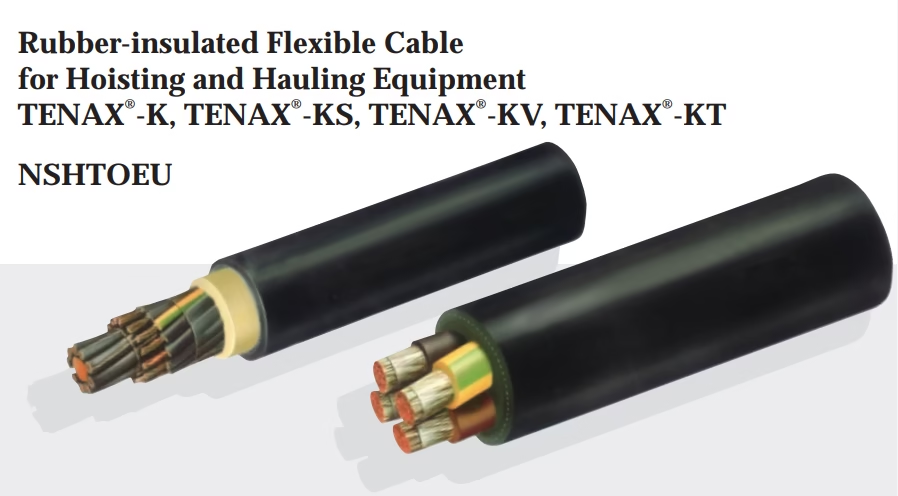
NSHTOEU (серия TENAX-K/KS/KV/KT) — это специализированные гибкие кабели с резиновой изоляцией, предназначенные для подключения подъемно-транспортных систем и аналогичного оборудования с принудительным направлением кабеля при высоких механических нагрузках. Кабели разработаны в соответствии с международным стандартом DIN VDE 0250, часть 814, который устанавливает требования к кабелям для подъемных механизмов.

Гибкий кабель с резиновой изоляцией для подъемно-транспортного оборудования

NSHTOEU (серия TENAX-K/KS/KV/KT) — это специализированные гибкие кабели с резиновой изоляцией, предназначенные для подключения подъемно-транспортных систем и аналогичного оборудования с принудительным направлением кабеля при высоких механических нагрузках. Кабели разработаны в соответствии с международным стандартом DIN VDE 0250, часть 814, который устанавливает требования к кабелям для подъемных механизмов.
Polyurethane cables, commonly abbreviated as PUR cables, represent a specialized category of industrial wiring solutions engineered with thermoplastic polyurethane sheathing materials. These cables are characterized by their halogen-free composition, exceptional flame resistance properties, and superior mechanical and chemical resistance capabilities, which collectively render them optimal for deployment in demanding industrial environments where conventional PVC or rubber-sheathed cables would experience premature degradation.

What is PUR Cable?

H05BQ-F cable, H07BQ-F cable, H05BZ5-F cable, H07BZ5-F cable, PUR-JZ cable, PUR-HF cable, Veriflex PUR cable, Powerchain PUR cable, PUR Ethernet cable, screened PUR cable, PUR trommel cable, PUR festoon cable, Mode 4 EV cable, DC EV charging cable
Crane cables represent a specialized category of heavy-duty flexible cables designed to power and control cranes, hoists, festoons, conveyors, and gantries. Used extensively across heavy industry including mining, marine ports, steel mills, and container terminals, these cables must be exceptionally robust and capable of handling both torsional (twisting) and tensile (pulling) stresses simultaneously. Unlike standard industrial cables, crane cables experience constant reeling, unreeling, and multi-directional movement, requiring specialized constructions with reinforced components and premium materials.

What are Crane Cables?

NTSCGEWÖU cable, TSCGEWÖU cable, TSKCGEWÖU cable, medium voltage crane, MV reeling cable, 6kV crane cable, 10kV crane cable, 20kV crane cable, anti-torsion cable, ATB cable, crane cable, crane power cable, hoist cable, gantry cable, lifting cable, overhead crane cable, tower crane cable, port crane cable, material handling cable, heavy duty crane cable
Harmonised Cables, commonly known as HAR cables, conform to harmonisation documents set out by CENELEC (Comité Européen de Normalisation Électrotechnique), the European Committee for Electrotechnical Standardisation. HAR cables have a single system of designation code used across all European member states, meeting the norms set out in harmonisation documents HD 361 and DIN VDE 0292. This unified coding system eliminates confusion and facilitates trade between the 33 member and 14 affiliate countries of CENELEC.

What are Harmonised Cables (HAR Cables)?

H07RN-F, H07BN4-F, H07ZZ-F, H05RR-F, H01N2-E, H01N2-D, H07V-R, H07V-U, H07Z-R, H07V-K, H05VV-F, H03VV-F, H05VVH6-F, H07Z-K, H05Z-K, H05Z1Z1-F, H07RN-F, H07RN-F cable, H07BN4-F, H07BN4-F cable, 6381TQ, H07ZZ-F, H05BN4-F, H05RR-F, 318-TRS, H05GG-F, H05RNH-F, H05RN-F, H07RN-8-F, H03RR-F, rubber flexible cable, neoprene cable, EPR cable, HOFR cable
SINGLE CORE represents an advanced low smoke zero halogen (LSZH) power cable engineered by Anhui Feichun Special Cable Co., Ltd. for demanding industrial applications where fire safety, thermal performance, and electrical reliability are paramount. This cable series is manufactured in full compliance with Australian and New Zealand standards

What is ENVIROLEX® 110°C  SINGLE CORE?

SINGLE CORE cable is specifically engineered for applications requiring enhanced thermal performance and superior fire safety characteristics. The 110°C continuous operating temperature rating provides a significant thermal margin compared to standard 90°C rated cables, allowing for higher current density and more compact installations.
The 2TC Light-SB (2PNCT-SB) crane cable represents a specialized category of industrial power transmission cables engineered specifically for demanding applications in material handling, crane systems, and mobile industrial equipment.

What is 2TC Light-SB (2PNCT-SB) Crane Cable?

The 2TC Light-SB (2PNCT-SB) crane cable represents a specialized category of industrial power transmission cables engineered specifically for demanding applications in material handling, crane systems, and mobile industrial equipment.
CEI 20-27 CENELEC HD361 Cable

What is CEI 20-27 CENELEC HD361 Cable?

CEI 20-27 CENELEC HD361 represents a standardized cable designation system developed by the European Committee for Electrotechnical Standardisation (CENELEC) to provide uniform identification and classification of harmonized power cables and cords across European markets. This systematic coding methodology enables engineers, procurement specialists, and electrical contractors to precisely identify cable specifications including voltage ratings, insulation materials, conductor types, and sheathing compounds through a structured alphanumeric designation format.
Feichun Cable

JIS C 3408 Elevator Cable Classification and Symbols Code Designation

JIS C 3408 is a Japanese Industrial Standard that specifies requirements for travelling cables for elevators, establishing comprehensive guidelines for rubber insulated cables with rated voltages up to and including 450/750V. According to the Japanese Standards Association, this standard was most recently updated in 2014 to ensure compliance with modern safety and performance requirements[1].