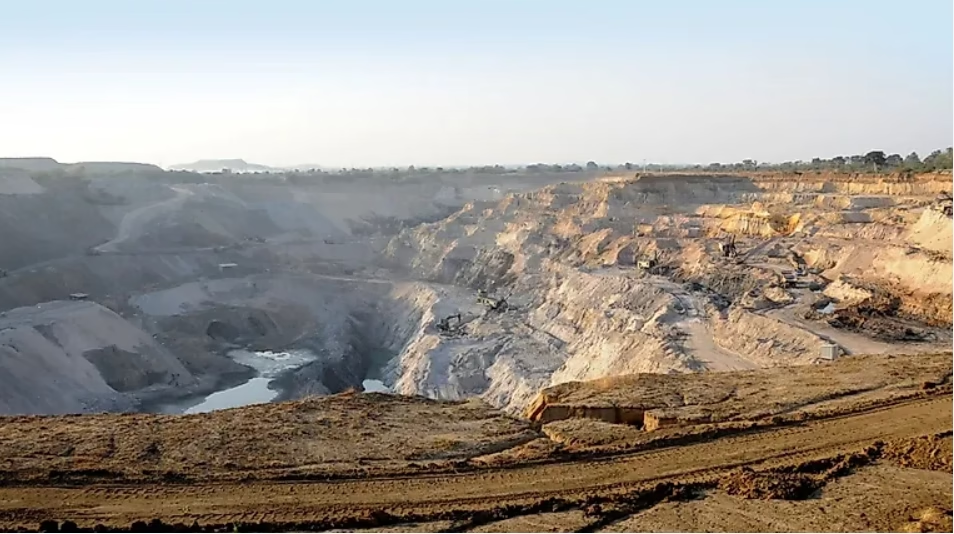
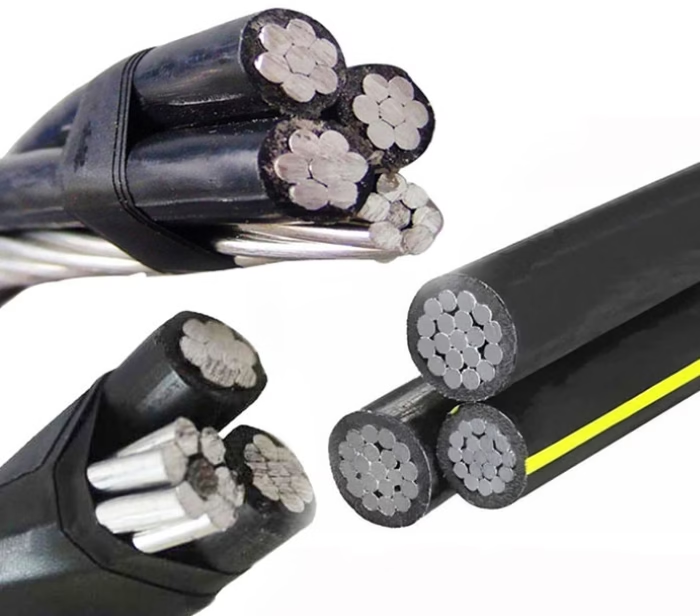
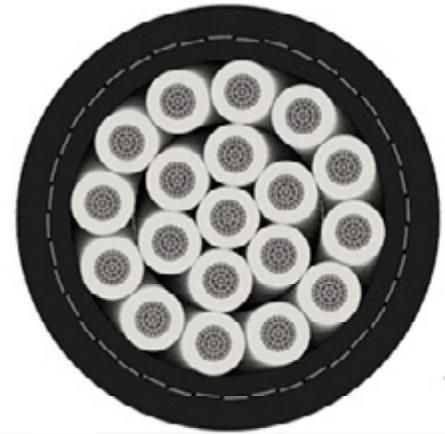
drilling rig cable

For fixed installation in petrochemical facility hydraulic oil leak zones, Type P (X110) radiation-cross-linked polyolefin cables are the superior choice and are mandated by international standards including IEEE 1580, NEK 606, and major chemical plant engineering codes. Type P cables are rated for continuous operation at 110°C conductor temperature (compared to 80°C for standard PUR), feature superior flame retardancy meeting IEEE 1202 and IEC 60332-3-22 standards with zero halogen emissions, maintain 80 to 90 percent property retention after 5 to 10 years of continuous chemical exposure compared to 40 to 60 percent for generic PUR, and provide exceptional compatibility with both mineral-based and synthetic fire-resistant hydraulic fluids including phosphate esters (Skydrol-type fluids) that cause significant swelling in standard polyurethane. Generic polyurethane (PUR) cables excel in mobile and continuously flexing applications where mechanical abrasion resistance is paramount and environmental temperatures remain moderate, but they are unsuitable for fixed installation in chemical plant hydraulic zones where thermal stability, chemical resistance, and fire safety are controlling factors. The critical distinction lies in understanding that PUR's unparalleled mechanical durability and flexibility come at the cost of reduced thermal stability, limited chemical compatibility with synthetic fluids, and combustion behavior that creates fire propagation hazards in leak-zone environments. For typical petrochemical facility power distributions, refinery hydraulic pump station cabling, and fixed deck-mounted power leads, Type P (X110) provides the material durability, regulatory compliance, and safety performance required by modern chemical plant standards. However, for mobile heavy machinery such as drag-chain robotic systems, floating platform equipment, or port machinery where the cable undergoes millions of bend cycles and mechanical stress is the primary degradation driver, high-flexibility PUR variants (or specialized hybrid formulations combining PUR's mechanical properties with enhanced chemical resistance) may provide better lifecycle economics despite shorter service life in static chemical exposure. Understanding which cable to specify depends on accurately identifying whether thermal stability and fire safety (favoring Type P) or mechanical durability and continuous flexing (favoring PUR) represent the controlling design constraint for your specific application.

Chemical Plants: Selecting Between Type P (X110) and Generic PUR Cables for Hydraulic Oil Leak Zones

For fixed installation in petrochemical facility hydraulic oil leak zones, Type P (X110) radiation-cross-linked polyolefin cables are the superior choice and are mandated by international standards including IEEE 1580, NEK 606, and major chemical plant engineering codes. Type P cables are rated for continuous operation at 110°C conductor temperature (compared to 80°C for standard PUR), feature superior flame retardancy meeting IEEE 1202 and IEC 60332-3-22 standards with zero halogen emissions, maintain 80 to 90 percent property retention after 5 to 10 years of continuous chemical exposure compared to 40 to 60 percent for generic PUR, and provide exceptional compatibility with both mineral-based and synthetic fire-resistant hydraulic fluids including phosphate esters (Skydrol-type fluids) that cause significant swelling in standard polyurethane. Generic polyurethane (PUR) cables excel in mobile and continuously flexing applications where mechanical abrasion resistance is paramount and environmental temperatures remain moderate, but they are unsuitable for fixed installation in chemical plant hydraulic zones where thermal stability, chemical resistance, and fire safety are controlling factors. The critical distinction lies in understanding that PUR’s unparalleled mechanical durability and flexibility come at the cost of reduced thermal stability, limited chemical compatibility with synthetic fluids, and combustion behavior that creates fire propagation hazards in leak-zone environments. For typical petrochemical facility power distributions, refinery hydraulic pump station cabling, and fixed deck-mounted power leads, Type P (X110) provides the material durability, regulatory compliance, and safety performance required by modern chemical plant standards. However, for mobile heavy machinery such as drag-chain robotic systems, floating platform equipment, or port machinery where the cable undergoes millions of bend cycles and mechanical stress is the primary degradation driver, high-flexibility PUR variants (or specialized hybrid formulations combining PUR’s mechanical properties with enhanced chemical resistance) may provide better lifecycle economics despite shorter service life in static chemical exposure. Understanding which cable to specify depends on accurately identifying whether thermal stability and fire safety (favoring Type P) or mechanical durability and continuous flexing (favoring PUR) represent the controlling design constraint for your specific application.
BFOU 0.6/1kV P5/P12 fire-resistant offshore power cable with 3 × 95 mm² tinned copper conductors is approximately 45 mm (1.77 inches), with a standard tolerance window of ±2.0 mm producing a permissible range of 43.0–47.0 mm. This specification is critical for cable gland selection because offshore and marine cable glands are manufactured with specific bore diameters engineered to accommodate this dimensional range. The approximate total weight of this cable is 4,950 kg/km (3,330 lbs/1000 ft), with copper content approximately 3,350 kg/km. It features three 95 mm² Class 2 tinned copper main power conductors, a halogen-free EPR insulation system, a critical mica tape fire-resistance layer rated for 830°C continuous operation (IEC 60331 certified), tinned copper wire braid armor providing mechanical protection and electromagnetic shielding, and an SHF2 halogen-free thermosetting outer sheath rated for extreme marine and subsea conditions.

Cable Gland Sizing: Finding the OD Tolerance for BFOU 0.6/1kV P5/P12 3×95 mm² Offshore Power Cable

BFOU 0.6/1kV P5/P12 fire-resistant offshore power cable with 3 × 95 mm² tinned copper conductors is approximately 45 mm (1.77 inches), with a standard tolerance window of ±2.0 mm producing a permissible range of 43.0–47.0 mm. This specification is critical for cable gland selection because offshore and marine cable glands are manufactured with specific bore diameters engineered to accommodate this dimensional range. The approximate total weight of this cable is 4,950 kg/km (3,330 lbs/1000 ft), with copper content approximately 3,350 kg/km. It features three 95 mm² Class 2 tinned copper main power conductors, a halogen-free EPR insulation system, a critical mica tape fire-resistance layer rated for 830°C continuous operation (IEC 60331 certified), tinned copper wire braid armor providing mechanical protection and electromagnetic shielding, and an SHF2 halogen-free thermosetting outer sheath rated for extreme marine and subsea conditions.
AmerCable 37-102594BS, part of the Nexans AmerCable Gexol® premium marine cable family, represents a highly engineered solution for extreme environments—drilling rigs, floating production platforms, heavy-duty ship systems, and industrial facilities where cable failure is not an option. However, procurement teams worldwide face recurring supply challenges: extended lead times, regional availability constraints, price volatility tied to raw material markets, and the need for local certification or supplier support within specific geographic jurisdictions.

Looking for an Alternative to AmerCable 37-102594BS? Marine & Offshore Power Cable Solutions Guide

AmerCable 37-102594BS, part of the Nexans AmerCable Gexol® premium marine cable family, represents a highly engineered solution for extreme environments—drilling rigs, floating production platforms, heavy-duty ship systems, and industrial facilities where cable failure is not an option. However, procurement teams worldwide face recurring supply challenges: extended lead times, regional availability constraints, price volatility tied to raw material markets, and the need for local certification or supplier support within specific geographic jurisdictions.
The designation BFOU(c) is not arbitrary—it is a highly structured labeling system derived from the NEK 606 Norwegian marine standard that encodes critical information about the cable's construction, safety properties, and intended application. By understanding what each letter represents, you gain immediate insight into the cable's fundamental characteristics and whether it is suitable for your specific marine environment. BFOU(c) 代号是从 NEK 606 挪威海洋标准派生的高度结构化标签系统,编码了电缆的关键安全特性和预期应用。

Datasheet & Specs: Technical Specifications for BFOU(c) 150/250V S4/S8 4x2x1.5 mm² Marine Instrumentation Cable

The designation BFOU(c) is not arbitrary—it is a highly structured labeling system derived from the NEK 606 Norwegian marine standard that encodes critical information about the cable’s construction, safety properties, and intended application. By understanding what each letter represents, you gain immediate insight into the cable’s fundamental characteristics and whether it is suitable for your specific marine environment. BFOU(c) 代号是从 NEK 606 挪威海洋标准派生的高度结构化标签系统,编码了电缆的关键安全特性和预期应用。
Two major cable standards dominate the offshore drilling, marine platform and demanding industrial environments: NEK 606 RFOU and IEEE 1580 Type P. Understanding which standard suits your application is critical for equipment reliability and operational safety. NEK 606 represents the European approach to zero-halogen, low-smoke construction with rigorous mud resistance requirements, while IEEE 1580 Type P emphasises extreme flexibility, mechanical durability and elevated temperature tolerance favoured in North American operations.

NEK 606 RFOU vs IEEE 1580 Type P: Which Mud Resistant Cable is Best for Top Drives?

Two major cable standards dominate the offshore drilling, marine platform and demanding industrial environments: NEK 606 RFOU and IEEE 1580 Type P. Understanding which standard suits your application is critical for equipment reliability and operational safety. NEK 606 represents the European approach to zero-halogen, low-smoke construction with rigorous mud resistance requirements, while IEEE 1580 Type P emphasises extreme flexibility, mechanical durability and elevated temperature tolerance favoured in North American operations.
The selection of appropriate submersible pump cables for acidic mine water dewatering applications represents a critical engineering decision that directly impacts operational safety, equipment longevity, and maintenance costs. While Type 441 cables may appear suitable for general submersible pump applications, the harsh chemical environment of acidic mine water typically necessitates the use of specialized EPR (Ethylene Propylene Rubber) or CSP (Chlorosulfonated Polyethylene) insulated cables specifically engineered for corrosive conditions. 为酸性矿井水脱水应用选择合适的潜水泵电缆是一项关键的工程决策,直接影响运行安全、设备寿命和维护成本。虽然441型电缆可能适用于一般潜水泵应用,但酸性矿井水的恶劣化学环境通常需要使用专门设计用于腐蚀性条件的EPR(乙丙橡胶)或CSP(氯磺化聚乙烯)绝缘电缆。

TUNNELFLEX-R-PUR HF with Antitwisting Protection 1 KV

TUNNELFLEX-R-PUR HF represents a specialized category of halogen-free, flame-retardant flexible power cables engineered specifically for the demanding requirements of underground mining and tunneling operations. This cable combines advanced polyurethane (PUR) sheathing technology with integrated antitwisting protection to deliver exceptional mechanical durability, environmental resistance, and most importantly, enhanced safety through its halogen-free construction that significantly reduces toxic gas emissions during fire incidents. TUNNELFLEX-R-PUR HF电缆是专为地下采矿和隧道作业的苛刻要求而设计的无卤阻燃柔性电力电缆。该电缆结合了先进的聚氨酯护套技术和集成的防扭转保护,提供卓越的机械耐久性、环境抵抗力,以及通过无卤结构在火灾事故中显著减少有毒气体排放的增强安全性。
Comprehensive Technical Analysis of Chlorinated Polyethylene (CPE) vs Chlorosulphonated Polyethylene (CSP) Sheath Performance Under Extreme UV Radiation in Pilbara Region Mining Operations 氯化聚乙烯(CPE)与氯磺化聚乙烯(CSP)护套在皮尔巴拉地区采矿作业极端紫外线辐射下性能的综合技术分析

UV Resistance in Type 441 Mining Cables: Does CPE Sheath Meet “Extremely High UV” Requirements of Australian Surface Mines?

Comprehensive Technical Analysis of Chlorinated Polyethylene (CPE) vs Chlorosulphonated Polyethylene (CSP) Sheath Performance Under Extreme UV Radiation in Pilbara Region Mining Operations 氯化聚乙烯(CPE)与氯磺化聚乙烯(CSP)护套在皮尔巴拉地区采矿作业极端紫外线辐射下性能的综合技术分析
In surface mining and general underground mining operations excluding coal, heavy mobile equipment such as draglines, electric shovels, and drilling rigs rely on reeling cable systems to maintain continuous power delivery during movement and repositioning. These reeling drum applications subject cables to severe mechanical stresses including crushing forces as cable layers compress against each other during winding operations. The selection between Type 440 and Type 441 cables manufactured to AS/NZS 2802 standards represents a critical engineering decision that directly impacts equipment reliability, operational safety, and maintenance costs. 在不包括煤炭的露天采矿和一般地下采矿作业中,挖掘机、电铲和钻机等重型移动设备依赖卷取电缆系统在移动和重新定位期间保持连续供电。

Mining Reeling Cables: Why Type 441 with Interstitial Earth Outperforms Type 440 Under High Crushing Forces

In surface mining and general underground mining operations excluding coal, heavy mobile equipment such as draglines, electric shovels, and drilling rigs rely on reeling cable systems to maintain continuous power delivery during movement and repositioning. These reeling drum applications subject cables to severe mechanical stresses including crushing forces as cable layers compress against each other during winding operations. The selection between Type 440 and Type 441 cables manufactured to AS/NZS 2802 standards represents a critical engineering decision that directly impacts equipment reliability, operational safety, and maintenance costs. 在不包括煤炭的露天采矿和一般地下采矿作业中,挖掘机、电铲和钻机等重型移动设备依赖卷取电缆系统在移动和重新定位期间保持连续供电。
When international cable manufacturers consider entering the Colombian market, particularly for mining applications, they encounter a comprehensive regulatory framework that may initially seem complex but serves a vital purpose. The Reglamento Técnico de Instalaciones Eléctricas, universally known by its Spanish acronym RETIE, represents Colombia's mandatory technical regulation governing all electrical installations and products. 当国际电缆制造商考虑进入哥伦比亚市场时,特别是针对矿业应用,他们会遇到一个全面的监管框架 Understanding RETIE is not merely a bureaucratic exercise but rather the foundation for successfully participating in one of South America's most dynamic electrical markets.

RETIE Compliance: Are These Mining Cables Certified for Use in Colombia (RETIE) Electrical Projects?

When international cable manufacturers consider entering the Colombian market, particularly for mining applications, they encounter a comprehensive regulatory framework that may initially seem complex but serves a vital purpose. The Reglamento Técnico de Instalaciones Eléctricas, universally known by its Spanish acronym RETIE, represents Colombia’s mandatory technical regulation governing all electrical installations and products. 当国际电缆制造商考虑进入哥伦比亚市场时,特别是针对矿业应用,他们会遇到一个全面的监管框架 Understanding RETIE is not merely a bureaucratic exercise but rather the foundation for successfully participating in one of South America’s most dynamic electrical markets.
For a 500-meter length of Type 440 11kV mining cable, the required shipping drum dimensions are fundamentally determined by the cable's minimum bend radius and physical dimensions. Based on industry standards from AS/NZS 2802:2000 and IEC 60502-2, proper drum sizing ensures cable integrity during transportation and prevents damage to the cable's internal structure, particularly the semiconductive screens and EPR insulation critical for medium voltage applications. 对于500米长的Type 440 11kV矿用电缆,所需的运输卷筒尺寸主要由电缆的最小弯曲半径和物理尺寸决定。根据AS/NZS 2802:2000和IEC 60502-2的行业标准,正确的卷筒尺寸可确保运输过程中的电缆完整性,并防止损坏电缆的内部结构,特别是对中压应用至关重要的半导体屏蔽层和EPR绝缘层。

Drum Dimensions for Type 440 11kV Cable: Engineering Specification Guide

For a 500-meter length of Type 440 11kV mining cable, the required shipping drum dimensions are fundamentally determined by the cable’s minimum bend radius and physical dimensions. Based on industry standards from AS/NZS 2802:2000 and IEC 60502-2, proper drum sizing ensures cable integrity during transportation and prevents damage to the cable’s internal structure, particularly the semiconductive screens and EPR insulation critical for medium voltage applications. 对于500米长的Type 440 11kV矿用电缆,所需的运输卷筒尺寸主要由电缆的最小弯曲半径和物理尺寸决定。根据AS/NZS 2802:2000和IEC 60502-2的行业标准,正确的卷筒尺寸可确保运输过程中的电缆完整性,并防止损坏电缆的内部结构,特别是对中压应用至关重要的半导体屏蔽层和EPR绝缘层。
Type 440 reeling cables represent a critical component in mining and industrial power distribution systems, specifically designed for flexible trailing applications according to AS/NZS 2802:2000 standards. These metal-screened power cables feature three pilot cores and operate across voltage ratings from 1.1 kilovolts to 11 kilovolts, supplying reliable electrical power to mobile mining equipment such as draglines, excavators, and materials handling machinery. Despite their robust construction with EPR insulation and high abrasion resistance, these cables remain vulnerable to a particularly destructive failure mode known as corkscrewing, which can compromise both electrical performance and mechanical integrity during operation.

How does “Corkscrewing” destroy Type 440 reeling cables, and how to prevent it during installation?

Type 440 reeling cables represent a critical component in mining and industrial power distribution systems, specifically designed for flexible trailing applications according to AS/NZS 2802:2000 standards. These metal-screened power cables feature three pilot cores and operate across voltage ratings from 1.1 kilovolts to 11 kilovolts, supplying reliable electrical power to mobile mining equipment such as draglines, excavators, and materials handling machinery. Despite their robust construction with EPR insulation and high abrasion resistance, these cables remain vulnerable to a particularly destructive failure mode known as corkscrewing, which can compromise both electrical performance and mechanical integrity during operation.
Mining operations worldwide face a critical procurement decision when selecting medium voltage reeling and trailing cables for mobile equipment such as excavators, draglines, and continuous miners. The choice between premium brand-name cables like PROTOLON and generic alternatives conforming to the same NTSCGEWÖU specification represents a significant investment decision with long-term operational and safety implications.

PROTOLON (Proprietary) vs. Generic NTSCGEWÖU: Is the Premium Price for Brand-Name Mining Cables Justified?

Mining operations worldwide face a critical procurement decision when selecting medium voltage reeling and trailing cables for mobile equipment such as excavators, draglines, and continuous miners. The choice between premium brand-name cables like PROTOLON and generic alternatives conforming to the same NTSCGEWÖU specification represents a significant investment decision with long-term operational and safety implications.
Shipwiring and offshore platform cables represent a specialized category of marine cables designed to perform reliably in the most demanding environments on earth—at sea. These cables must withstand extreme temperature variations (from Arctic cold to engine room heat), constant exposure to humidity, salt water, oils, acids, and drilling muds, while maintaining electrical integrity for power, control, signal, instrumentation, and communication applications. The primary international standards governing these cables include NEK 606 (Norwegian standard for offshore floating platforms), IEC 60092 (electrical installations in ships), BS 6883 (fixed wiring in offshore units), and BS 7917 (fire resistant cables for offshore applications).

What are Shipwiring & Offshore Platform Cables?

NEK 606 cable, BFOU cable, RFOU cable, NEK 606 BFOU, NEK 606 RFOU, offshore platform cable, MUD resistant cable, Norwegian offshore cable, floating platform cable, FPSO cable, marine cable, offshore cable, shipwiring cable, ship cable, offshore platform cable, marine power cable, ship electrical cable, naval cable, maritime cable, at-sea cable,RFOU P101, BFOU P105, RFOU S101, RFOU S102, BFOU S103, BFOU S104, UX P108, RFOU P102, RFOU P103, RFOU P104, RFOU P112, RFOU P113
EN 50288-7 instrumentation cables are multi-element metallic cables used in analogue and digital communication and control applications. Manufactured in accordance with European Standard EN 50288 (British Standard BS EN 50288), these cables are widely used in processing plants such as those found in the petrochemical industry due to their ability to withstand electromagnetic interference (EMI). They are specifically designed for the transmission of signals in instrumentation, control, and communication applications, commonly available in 300V and 500V voltage ratings.

What is EN 50288-7 Cable?

EN 50288-7 cable, BS EN 50288-7, instrumentation cable, control cable, RE-2X(st)H cable, RE-2X(st)Y cable, RE-2Y(st)Y cable, PiMF cable, TiMF cable, screened cable, petrochemical cable, XLPE instrumentation cable, LSZH instrumentation cable
British Standard BS6883 covers the specifications for elastomer insulated cables for fixed wiring in ships (shipwiring) and on mobile and fixed offshore marine units. This standard specifies the requirements and test methods for shipboard fixed wiring of lighting, power, control, instrumentation and propulsion circuits with a voltage rating of up to 8.7/15kV.

What is BS6883 Cable?

BS6883電纜, BS6883船用電纜, 船用電纜, 海上電纜, 船用佈線電纜, 船舶電纜, LSZH電纜, LSHF電纜, 低煙無鹵電纜, EPR船用電纜, 海上電力電纜, 船用電纜, 657TQ電纜, 658TQ電纜, SW4型電纜, SW3型電纜, SW2型電纜, 鎧裝船用電纜, 非鎧裝船用電纜, 鋼絲編織電纜, HOFR電纜, 無鹵電纜, 阻燃船用電纜, 勞氏船級社電纜, DNV電纜, UKOOA電纜, 600/1000V船用電纜, 船用儀表電纜, 海上平台電纜, 鑽井平台電纜, 石油平台電纜, FPSO電纜, 耐火電纜, BS7917電纜, 彈性體絕緣電纜, EPR絕緣電纜, 鍍錫銅船用電纜,BS6883, BS6883 cable, marine cable, offshore cable, shipwiring cable, ship cable, LSZH cable, LSHF cable, low smoke halogen free cable, EPR marine cable, offshore power cable, shipboard cable, 657TQ cable, 658TQ cable, Type SW4 cable, Type SW3 cable, Type SW2 cable, armoured marine cable, unarmoured marine cable, GSWB cable, steel wire braid cable, HOFR cable, halogen free cable, flame retardant marine cable
DLO TORSIONFLEX RHH/RHW-2 represents an advanced category of portable power cables specifically engineered for demanding industrial applications, including wind turbine installations where torsional flexibility and multi-environment performance are critical requirements. This cable type combines the proven durability of Diesel Locomotive (DLO) construction with enhanced torsion resistance, making it uniquely suited for wind energy systems where cables must accommodate continuous nacelle rotation while maintaining electrical integrity.

What is DLO TORSIONFLEX RHH/RHW-2 2000V Wind Turbine Cable?

DLO TORSIONFLEX RHH/RHW-2 represents an advanced category of portable power cables specifically engineered for demanding industrial applications, including wind turbine installations where torsional flexibility and multi-environment performance are critical requirements. This cable type combines the proven durability of Diesel Locomotive (DLO) construction with enhanced torsion resistance, making it uniquely suited for wind energy systems where cables must accommodate continuous nacelle rotation while maintaining electrical integrity.
PROTOMONT NSSHOEU .../3E 1 kV: Technical Guide for Tripartite Earth Conductor Mining Cables with Enhanced Ground Fault Protection for Underground Mining, Tunneling, and Quarry Applications

PROTOMONT NSSHOEU …/3E 1 kV

PROTOMONT NSSHOEU 3E cable, tripartite earth conductor, triple earth system, mining cable 3E, copper core shield cable, VDE 0118 mining cable, ground fault protection cable, underground mining power, drilling rig cable, distribution board cable
TYPE 441 mining cables represent a specialized category of heavy-duty elastomer sheathed power cables engineered specifically for the demanding environments of surface and underground mining operations. Compliant with the rigorous AS/NZS 2802:2000 standard, these cables deliver reliable electrical power at voltage ratings from 1.1 kilovolts through 11 kilovolts to mobile mining equipment such as draglines, drilling rigs, excavators, and other heavy machinery requiring continuous power during trailing and reeling operations.

TYPE 441 1.1 to 11KV Mining Cables to AS/NZS 2802:2000

TYPE 441 mining cables represent a specialized category of heavy-duty elastomer sheathed power cables engineered specifically for the demanding environments of surface and underground mining operations. Compliant with the rigorous AS/NZS 2802:2000 standard, these cables deliver reliable electrical power at voltage ratings from 1.1 kilovolts through 11 kilovolts to mobile mining equipment such as draglines, drilling rigs, excavators, and other heavy machinery requiring continuous power during trailing and reeling operations.
Polish Mining Cable

What is YHKGXSekyn, YHKGXSekFtZnyn, YHKGXSekFtyn, YHKGXSekFitlyn, YHKGXSekFoyn, and YHKGXSekFpyn Polish Mining Cable ?

Polish Mining Cable Code Designation System represents a comprehensive nomenclature standard used extensively throughout European mining operations, particularly in Poland’s extensive coal, copper, and mineral extraction industries. This systematic coding methodology enables engineers and procurement specialists to precisely specify cable configurations through alphanumeric designations that encode critical construction parameters, material specifications, and performance characteristics.