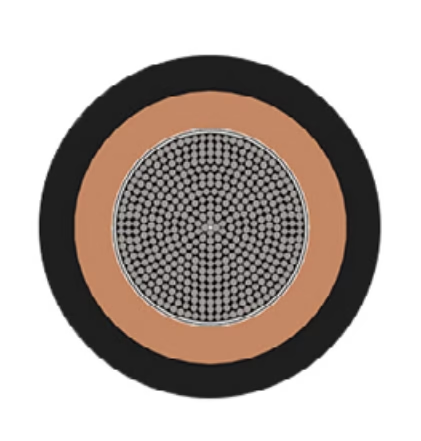
CPE sheath cable

Peru Copper Mining Geographic & Operational Profile: Peru is the second-largest global copper producer (~10% world supply, after Chile). Major TBM tunneling projects: (1) Quellaveco (Anglo American, Moquegua Region): new greenfield mine at 3,500 m elevation, massive $5.4 billion investment, TBM tunnel construction for ore access (2020–2024 development phase, now operational), (2) Toromocho (Chinalco, Junín Region): expansion underground tunneling at 4,100 m elevation, existing mine deepening via TBM for future decades, (3) La Llave (joint venture proposal, Ayacucho): potential future TBM expansion. Common challenges: (1) Extreme depth (1,500–2,500 m below surface), (2) High water inflow (Peru Andes receive 1,500–3,000 mm annual rainfall, saturated ground), (3) Long tunnel distances (5–10 km main access drifts), (4) Confined spaces (2–5 m diameter tunnels, limited ventilation), (5) Remote locations (supply chain difficulties, limited electrical infrastructure). 秘鲁是全球第二大铜生产国(~10%全球供应,仅次于智利)。主要TBM隧道项目:(1)Quellaveco (Anglo American,莫克瓜区):3,500m海拔新绿地矿山,54亿美元投资,TBM隧道矿石获取(2020-2024开发阶段,现运营)、(2)Toromocho (中铝,朱宁区):4,100m海拔地下隧道扩建,现有矿山深化,未来几十年TBM扩展、(3)La Llave(联合提案,阿亚库乔):潜在未来TBM扩建。常见挑战:(1)极端深度(地表下1,500-2,500m)、(2)高水流入(秘鲁安第斯年降雨1,500-3,000mm,饱和地面)、(3)长隧道距离(5-10 km主通道)、(4)密闭空间(2-5m直径隧道,通风有限)、(5)偏远位置(供应链困难,电气基础设施有限)。

AS/NZS 1802 Type 209 11/11kV 3x120mm² TBM Tunneling Cable for Peru Copper Mining

Peru Copper Mining Geographic & Operational Profile: Peru is the second-largest global copper producer (~10% world supply, after Chile). Major TBM tunneling projects: (1) Quellaveco (Anglo American, Moquegua Region): new greenfield mine at 3,500 m elevation, massive $5.4 billion investment, TBM tunnel construction for ore access (2020–2024 development phase, now operational), (2) Toromocho (Chinalco, Junín Region): expansion underground tunneling at 4,100 m elevation, existing mine deepening via TBM for future decades, (3) La Llave (joint venture proposal, Ayacucho): potential future TBM expansion. Common challenges: (1) Extreme depth (1,500–2,500 m below surface), (2) High water inflow (Peru Andes receive 1,500–3,000 mm annual rainfall, saturated ground), (3) Long tunnel distances (5–10 km main access drifts), (4) Confined spaces (2–5 m diameter tunnels, limited ventilation), (5) Remote locations (supply chain difficulties, limited electrical infrastructure). 秘鲁是全球第二大铜生产国(~10%全球供应,仅次于智利)。主要TBM隧道项目:(1)Quellaveco (Anglo American,莫克瓜区):3,500m海拔新绿地矿山,54亿美元投资,TBM隧道矿石获取(2020-2024开发阶段,现运营)、(2)Toromocho (中铝,朱宁区):4,100m海拔地下隧道扩建,现有矿山深化,未来几十年TBM扩展、(3)La Llave(联合提案,阿亚库乔):潜在未来TBM扩建。常见挑战:(1)极端深度(地表下1,500-2,500m)、(2)高水流入(秘鲁安第斯年降雨1,500-3,000mm,饱和地面)、(3)长隧道距离(5-10 km主通道)、(4)密闭空间(2-5m直径隧道,通风有限)、(5)偏远位置(供应链困难,电气基础设施有限)。
Yes, a highly capable cable manufacturer can absolutely engineer generic (N)TSCGEWÖU flexible reeling cables to match or even exceed the 20/35kV (36kV maximum equipment voltage) rating of Nexans' RHEYFIRM® brand premium products. However, the critical phrase here is "highly capable manufacturer"—not every cable producer has the technical depth, quality control infrastructure, and engineering expertise to successfully execute a 20/35kV design. The fundamental cable construction—Class 5 tinned copper conductors, semi-conductive rubber inner and outer layers, EPR (ethylene propylene rubber) insulation, and a heavy-duty CPE or chloroprene outer sheath—is well understood and exists within the established scope of DIN VDE 0250-813 mining cable standards. While the traditional (N)TSCGEWÖU specification typically covers voltages up to 18/30kV, the engineering principles that govern the construction are equally applicable to 20/35kV ratings. The transition from 18/30kV to 20/35kV is not a revolutionary leap requiring entirely new materials or manufacturing processes—it is an evolutionary engineering optimization that competent manufacturers have been executing for decades. What distinguishes a genuinely compliant 20/35kV generic (N)TSCGEWÖU from a merely relabeled 18/30kV cable masquerading as 20/35kV is the application of three fundamental engineering disciplines. First, the insulation thickness must be increased according to rigorous electrical stress calculations based on IEC 60502-2 high-voltage standards, accounting for the higher electrical field strength that 20/35kV imposes on the dielectric material. Second, the semi-conductive layers must be engineered with exquisite precision to control the electric field distribution and prevent partial discharge (PD) inception, which is the primary failure mechanism for high-voltage cables subjected to continuous stress. Third, the outer sheath material must be selected and formulated from premium compounds with superior mechanical durability to withstand not only the normal environmental stresses of mining operations but also any electrical stress-related damage that might be induced by the higher voltage rating. The answer, therefore, is yes—but only when manufacturers invest in the engineering rigor and quality control discipline that the 20/35kV rating genuinely demands.

RHEYFIRM® 30kV vs. Generic (N)TSCGEWÖU: Can Standard Manufacturers Match Nexans’ 20/35kV Rating?

Yes, a highly capable cable manufacturer can absolutely engineer generic (N)TSCGEWÖU flexible reeling cables to match or even exceed the 20/35kV (36kV maximum equipment voltage) rating of Nexans’ RHEYFIRM® brand premium products. However, the critical phrase here is “highly capable manufacturer”—not every cable producer has the technical depth, quality control infrastructure, and engineering expertise to successfully execute a 20/35kV design. The fundamental cable construction—Class 5 tinned copper conductors, semi-conductive rubber inner and outer layers, EPR (ethylene propylene rubber) insulation, and a heavy-duty CPE or chloroprene outer sheath—is well understood and exists within the established scope of DIN VDE 0250-813 mining cable standards. While the traditional (N)TSCGEWÖU specification typically covers voltages up to 18/30kV, the engineering principles that govern the construction are equally applicable to 20/35kV ratings. The transition from 18/30kV to 20/35kV is not a revolutionary leap requiring entirely new materials or manufacturing processes—it is an evolutionary engineering optimization that competent manufacturers have been executing for decades. What distinguishes a genuinely compliant 20/35kV generic (N)TSCGEWÖU from a merely relabeled 18/30kV cable masquerading as 20/35kV is the application of three fundamental engineering disciplines. First, the insulation thickness must be increased according to rigorous electrical stress calculations based on IEC 60502-2 high-voltage standards, accounting for the higher electrical field strength that 20/35kV imposes on the dielectric material. Second, the semi-conductive layers must be engineered with exquisite precision to control the electric field distribution and prevent partial discharge (PD) inception, which is the primary failure mechanism for high-voltage cables subjected to continuous stress. Third, the outer sheath material must be selected and formulated from premium compounds with superior mechanical durability to withstand not only the normal environmental stresses of mining operations but also any electrical stress-related damage that might be induced by the higher voltage rating. The answer, therefore, is yes—but only when manufacturers invest in the engineering rigor and quality control discipline that the 20/35kV rating genuinely demands.
The NSSHÖU-J 4G95 0.6/1kV industrial mining cable is technically rated for temporary water immersion and is commonly used in open-pit and underground mining environments, but it is not specifically qualified for permanent submersion in acidic mine water and using it in this application is classified as beyond its design envelope. While the cable's EPR insulation (3GI3) and CPE outer sheath (5GM5) provide adequate resistance to neutral water and brief acidic exposure, permanent submersion in acidic mine water with pH values of 2.0 to 4.0—typical of copper and gold mining operations—accelerates material degradation to the point where service life drops to approximately 18 to 36 months compared to 8 to 10 years in neutral water applications. The fundamental issue is not that the cable fails immediately when deployed in acidic water (it does not), but rather that the aggressive acidic environment causes progressive swelling of the jacket, penetration of H⁺ ions into the insulation layer, electrochemical corrosion of the tinned copper conductor, and cumulative electrical property loss that eventually results in insulation breakdown. This distinction between "survives temporary exposure" and "safe for permanent submersion" is critically important to understand: a cable can physically remain intact for months or even a year or more in acidic water, but the electrical properties are degrading silently, and catastrophic failure can occur suddenly when the insulation resistance drops below critical thresholds. For submersible pump applications in acidic mine water, engineers should specify cables explicitly designed for this service, such as H07RN8-F submersible pump cables with specialized halogen-free formulations, or upgrade to acidic-resistant variants of marine-grade cables rated for chemical exposure. The standard NSSHÖU-J cable can be used in acidic mine water applications only if the operational requirement is for temporary or seasonal service (less than 6 months per year), coupled with rigorous monitoring protocols and planned replacement intervals of 12 to 18 months rather than the standard 5 to 7 year intervals appropriate for neutral water service.

Submersible Pump Cable Safety: Can NSSHÖU-J 4G95 0.6/1kV Withstand Permanent Submersion in Acidic Mine Water?

The NSSHÖU-J 4G95 0.6/1kV industrial mining cable is technically rated for temporary water immersion and is commonly used in open-pit and underground mining environments, but it is not specifically qualified for permanent submersion in acidic mine water and using it in this application is classified as beyond its design envelope. While the cable’s EPR insulation (3GI3) and CPE outer sheath (5GM5) provide adequate resistance to neutral water and brief acidic exposure, permanent submersion in acidic mine water with pH values of 2.0 to 4.0—typical of copper and gold mining operations—accelerates material degradation to the point where service life drops to approximately 18 to 36 months compared to 8 to 10 years in neutral water applications. The fundamental issue is not that the cable fails immediately when deployed in acidic water (it does not), but rather that the aggressive acidic environment causes progressive swelling of the jacket, penetration of H⁺ ions into the insulation layer, electrochemical corrosion of the tinned copper conductor, and cumulative electrical property loss that eventually results in insulation breakdown. This distinction between “survives temporary exposure” and “safe for permanent submersion” is critically important to understand: a cable can physically remain intact for months or even a year or more in acidic water, but the electrical properties are degrading silently, and catastrophic failure can occur suddenly when the insulation resistance drops below critical thresholds. For submersible pump applications in acidic mine water, engineers should specify cables explicitly designed for this service, such as H07RN8-F submersible pump cables with specialized halogen-free formulations, or upgrade to acidic-resistant variants of marine-grade cables rated for chemical exposure. The standard NSSHÖU-J cable can be used in acidic mine water applications only if the operational requirement is for temporary or seasonal service (less than 6 months per year), coupled with rigorous monitoring protocols and planned replacement intervals of 12 to 18 months rather than the standard 5 to 7 year intervals appropriate for neutral water service.
Prysmian TECWATER 3x120 mm² submersible pump cable has a standardized maximum operating depth of approximately 10 meters under the VDE certification standard (DIN VDE 0298-300) in typical industrial environments. This 10-meter specification assumes normal freshwater conditions, moderate water quality without unusual corrosive properties, and water temperature not exceeding 40°C. However, in extended applications involving less corrosive water sources (such as industrial cooling water circuits, mining surface drainage, or rainwater collection systems) where inspection and maintenance requirements are relaxed, the cable can operate at depths up to 500 meters, provided all mechanical stresses are carefully managed and the cable is protected from snapping or mechanical damage during deployment. The relationship between depth and service life is non-linear and governed by hydrostatic pressure physics, material science principles regarding polymer behavior under sustained compression, and the synergistic effects of pressure and temperature on insulation degradation. Understanding the distinction between the standardized 10-meter specification and the extended 500-meter capability requires appreciation for how hydrostatic pressure actually affects cable materials, what additional engineering controls are necessary at greater depths, and what real-world scenarios justify each depth rating. A cable suitable for a 10-meter municipal wastewater pumping station is fundamentally different in its application requirements from a cable operating at 500 meters in a deep mining shaft, yet both use the same basic material formulation because the cable itself is equally capable—the difference lies in system design, installation procedures, and operational monitoring protocols.

Water Submersion Depth: Maximum Continuous Operating Depth for Prysmian TECWATER 3×120 mm² Submersible Pump Cable

Prysmian TECWATER 3×120 mm² submersible pump cable has a standardized maximum operating depth of approximately 10 meters under the VDE certification standard (DIN VDE 0298-300) in typical industrial environments. This 10-meter specification assumes normal freshwater conditions, moderate water quality without unusual corrosive properties, and water temperature not exceeding 40°C. However, in extended applications involving less corrosive water sources (such as industrial cooling water circuits, mining surface drainage, or rainwater collection systems) where inspection and maintenance requirements are relaxed, the cable can operate at depths up to 500 meters, provided all mechanical stresses are carefully managed and the cable is protected from snapping or mechanical damage during deployment. The relationship between depth and service life is non-linear and governed by hydrostatic pressure physics, material science principles regarding polymer behavior under sustained compression, and the synergistic effects of pressure and temperature on insulation degradation. Understanding the distinction between the standardized 10-meter specification and the extended 500-meter capability requires appreciation for how hydrostatic pressure actually affects cable materials, what additional engineering controls are necessary at greater depths, and what real-world scenarios justify each depth rating. A cable suitable for a 10-meter municipal wastewater pumping station is fundamentally different in its application requirements from a cable operating at 500 meters in a deep mining shaft, yet both use the same basic material formulation because the cable itself is equally capable—the difference lies in system design, installation procedures, and operational monitoring protocols.
Type 241 mining cables represent a specialized category of flexible power cables designed for demanding underground mining applications, continuous miner feeders, and pump supply systems operating at voltages from 1.1kV to 11kV. These cables are manufactured to comply with AS/NZS 1802:2003 standards and incorporate sophisticated screening systems that balance electrical performance, mechanical flexibility, and safety requirements.[1] (241型矿用电缆是专为严苛的地下采矿应用、连续采矿机馈线和泵供电系统设计的柔性电力电缆,工作电压为1.1kV至11kV)

Composite Screen: How does the copper/nylon braid screen in Type 241 cables handle fault currents compared to a full metallic screen?

Type 241 mining cables represent a specialized category of flexible power cables designed for demanding underground mining applications, continuous miner feeders, and pump supply systems operating at voltages from 1.1kV to 11kV. These cables are manufactured to comply with AS/NZS 1802:2003 standards and incorporate sophisticated screening systems that balance electrical performance, mechanical flexibility, and safety requirements.[1] (241型矿用电缆是专为严苛的地下采矿应用、连续采矿机馈线和泵供电系统设计的柔性电力电缆,工作电压为1.1kV至11kV)
MYP cables must obtain MA (煤安) certification before they can be legally used in Chinese coal mines. The MA mark, administered by the National Coal Mine Safety Mark Office (煤矿安全标志办公室), represents mandatory safety certification for all underground coal mining equipment and materials. MYP cables, as mobile power supply cables for coal mining machinery, fall under the strictly regulated product categories defined in the Mining Product Safety Sign Management Catalog and must comply with Chinese national standards MT 818 series and GB 12972.[1][2] 是的,MYP电缆在中国煤矿使用前必须获得MA(煤安)认证。由国家煤矿安全标志办公室管理的MA标志,代表了所有井下煤矿设备和材料的强制性安全认证。MYP电缆作为煤矿机械的移动电源电缆,属于《矿用产品安全标志管理目录》中严格管制的产品类别,必须符合中国国家标准MT 818系列和GB 12972。

MA Certificate: MYP Cable Certification for Chinese Coal Mines

MYP cables must obtain MA (煤安) certification before they can be legally used in Chinese coal mines. The MA mark, administered by the National Coal Mine Safety Mark Office (煤矿安全标志办公室), represents mandatory safety certification for all underground coal mining equipment and materials. MYP cables, as mobile power supply cables for coal mining machinery, fall under the strictly regulated product categories defined in the Mining Product Safety Sign Management Catalog and must comply with Chinese national standards MT 818 series and GB 12972.[1][2] 是的,MYP电缆在中国煤矿使用前必须获得MA(煤安)认证。由国家煤矿安全标志办公室管理的MA标志,代表了所有井下煤矿设备和材料的强制性安全认证。MYP电缆作为煤矿机械的移动电源电缆,属于《矿用产品安全标志管理目录》中严格管制的产品类别,必须符合中国国家标准MT 818系列和GB 12972。
PROTOMONT(VO) (N)TSKCGEWOEU 1.8/3KV is a medium-voltage coal cutter cable designed for power supply connection to mobile equipment and machines in underground mining applications. The (VO) Coal cutter cables are specifically engineered for use in cable protection chains (cable handler), which are trailed behind the machine and absorb the occurring tensile forces. Featuring finely stranded tinned copper conductors (Class FS), EPR rubber insulation (PROTOLON 3GI3), semi-conductive NBR easy-strip layer, and chlorinated polyethylene (CM/CPE) outer sheath (PROTOFIRM >5GM5), with double-concentric control/PE conductor elements in the outer interstices. Certified by GOST-R/-K/-B (Russia) and MA China.

كابل PROTOMONT(VO) (N)TSKCGEWOEU 1,8/3KVكابلات قاطعات الفحم للتشغيل بسلاسل الحماية – التعدين تحت الأرض

Used as power supply connection cable for mobile equipment and machines in underground mining applications, such as coal cutting machines, etc. (VO) Coal cutter cables are designed for use in cable protection chains (cable handler), which are trailed behind the machine and which absorb the thereby occurring tensile forces. Suitable for shearer loaders, continuous miners, loading machines, shuttle cars, and other underground coal mining mobile equipment.
كابل فستون محمي, كابل EMC متوافق, كابل دائري محمي منخفض الجهد, كابل أنظمة الفستون, كابل رافعة جسرية, كابل توافق كهرومغناطيسي, كابل شاشة نحاسية معلبة, كابل RONDO FLEX, كابل 0.6/1 كيلو فولت فستون, كابل VDE 7841

ما هو كابل RONDO FLEX المحمي لتطبيقات الفستون؟

festoon cable, festoon system cable, festoon trolley cable, festoon carrier cable, festoon track cable, cable festoon system, motor-driven carrier cable, flat festoon cable, round festoon cable, festoon power supply cable 門式起重機電纜, 大廳門式起重機, 貨架物料搬運電纜, 運輸系統電纜, 機床電纜, 靈活電機電源電纜, 工業自動化電纜 滑觸線電纜, EMC兼容電纜, 屏蔽圓形電纜, 低壓滑觸線電纜, 門式起重機電纜, 電磁兼容電纜, 鍍錫銅編織屏蔽, 0.6/1kV滑觸線電纜
كابل PROTOLON (SC) (N)TSCGEWOEU 8,7/15KV هو كابل متوسط الجهد مصمم خصيصاً لأنظمة توصيل الشاطئ عالية الجهد (HVSC)، المعروفة أيضاً باسم "Cold Ironing" أو "الطاقة الشاطئية". يُستخدم هذا الكابل على متن السفينة وعلى الشاطئ لتزويد السفن بالطاقة الكهربائية من الشاطئ، مما يسمح للسفن بإيقاف محركات الديزل الخاصة بها أثناء الرسو. يتضمن الكابل نوى تحكم وألياف بصرية للتكيف مع أنواع مختلفة من السفن، وهو مناسب للغمر الدائم في الماء. يتوافق الكابل مع المعيار الدولي IEC/ISO/IEEE 80005-1 الخاص بأنظمة توصيل الشاطئ.

ما هو كابل PROTOLON SC لأنظمة توصيل الشاطئ؟

كابل توصيل الشاطئ, كابل الطاقة الشاطئية, كابل Cold Ironing, كابل HVSC, كابل تزويد السفن بالكهرباء, كابل متوسط الجهد بحري, كابل IEC 80005, كابل الموانئ الخضراء, كابل تقليل انبعاثات السفن, كابل PROTOLON SC, كابل 8.7/15 كيلو فولت بحري
BS6195 Standard covers the requirements for insulated flexible cables and cords typically known as coil end leads. These specialized cables are engineered for permanent and direct connection to coil windings or other electrical equipment, providing the essential flexibility and durability required in demanding industrial environments where motors, generators, transformers, and circuit breakers operate.

What is BS6195 Cable?

BS6195 Standard covers the requirements for insulated flexible cables and cords typically known as coil end leads. These specialized cables are engineered for permanent and direct connection to coil windings or other electrical equipment such as motors, generators, transformers, and circuit breakers.
PROTOMONT(MSR) 2YSLGCGOEU 250/250V represents a specialized category of control, signaling, and bus cables engineered specifically for electrical and electronic equipment in mining installations. As documented in professional mining cable resources[1], these cables feature the transmission characteristics necessary for measured value processing, process data handling, and automation units in demanding open-cast mining applications.

What is PROTOMONT(MSR) 2YSLGCGOEU 250/250V Control & Signaling Cable?

PROTOMONT(MSR) 2YSLGCGOEU 250/250V represents a specialized category of control, signaling, and bus cables engineered specifically for electrical and electronic equipment in mining installations. As documented in professional mining cable resources[1], these cables feature the transmission characteristics necessary for measured value processing, process data handling, and automation units in demanding open-cast mining applications.
TYPE 209 and TYPE 210 mining cables represent critical power distribution infrastructure specifically engineered for the demanding environments of underground coal mining and surface mining operations throughout Australia and New Zealand.

TYPE 209 & TYPE 210 Australian Mining Cables

TYPE 209 and TYPE 210 mining cables represent critical power distribution infrastructure specifically engineered for the demanding environments of underground coal mining and surface mining operations throughout Australia and New Zealand.
Serbian Cable

What is Serbian Cable Standards (SRPS) Cable?

Serbian Power Engineering Standards (SRPS) represent a comprehensive framework of technical regulations governing electrical cables and conductors in Serbia and other regions that have adopted these specifications. SRPS standards are developed and maintained by the Institute for Standardization of Serbia (ISS), which operates as the national standardization body responsible for developing, publishing, and promoting technical standards across various industries.