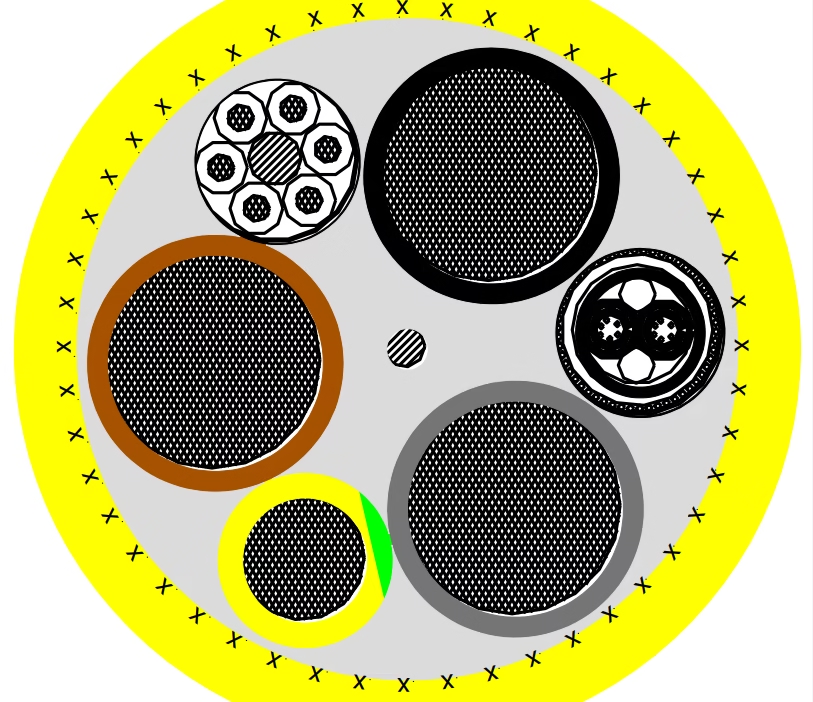
Class 6 conductor cable

To understand why the ÖLFLEX CRANE F 4G16 uses flat geometry rather than the round cross-sections we discussed in previous technical guides, let me start with a fundamental insight about space utilization and mechanical engineering. When a cable delivers electrical power through an overhead crane system—whether a gantry crane moving horizontally across a factory floor, a hoist lifting loads vertically, or an aerial work platform moving in multiple directions—the cable must be routed overhead through a confined space. Picture the challenge: the cable must travel along the length of the crane runway, then hang down to the moving load-handling equipment. This overhead routing space is precious and limited. The crane runway has architectural constraints from building structure. Weather protection enclosures limit available vertical space. Multiple independent circuits might need to be routed in parallel (one cable for hoist movement, another for load rotation, another for operator pendant communication). In this constrained space, a round cable is geometrically inefficient. A round cable with 76-ampere capacity might have a circular cross-section 30+ millimeters in diameter, requiring substantial overhead routing infrastructure and producing significant cable sag that stresses the support structure. A flat cable delivering identical 76-ampere capacity might have a rectangular cross-section of 38 millimeters wide by 13 millimeters thick—same electrical capacity, but dramatically better space utilization. The flat geometry fits within tighter vertical spaces. Multiple flat cables can be stacked side-by-side with their 38-millimeter widths taking minimal combined space. The reduced cable sag from the lighter, more compact design reduces stress on overhead support structures. This is the fundamental advantage of flat cable geometry: superior space utilization without sacrificing electrical performance. However, flat geometry introduces unique engineering challenges that round cables do not have. A round cable bends uniformly in all directions around its circular cross-section. A flat cable bends very differently depending on direction: bending along the wide dimension (38 millimeters) creates different mechanical stress than bending along the thick dimension (13 millimeters). The flat geometry creates stress concentration points at the corners where the wide flat surfaces meet the thin edges. The electrical current distribution becomes non-uniform across the flat conductor—current density is higher in the center of the flat surface and lower at the edges. Engineers must carefully design flat cables to manage these geometric-specific challenges while exploiting the space-utilization advantages. The ÖLFLEX CRANE F 4G16 represents sophisticated engineering optimization that takes advantage of flat geometry benefits while carefully addressing the unique challenges that rectangular cross-sections introduce.
Heavy Duty Festoon: Flat Cable Cross-Reference for LAPP ÖLFLEX CRANE F 4G16

To understand why the ÖLFLEX CRANE F 4G16 uses flat geometry rather than the round cross-sections we discussed in previous technical guides, let me start with a fundamental insight about space utilization and mechanical engineering. When a cable delivers electrical power through an overhead crane system—whether a gantry crane moving horizontally across a factory floor, a hoist lifting loads vertically, or an aerial work platform moving in multiple directions—the cable must be routed overhead through a confined space. Picture the challenge: the cable must travel along the length of the crane runway, then hang down to the moving load-handling equipment. This overhead routing space is precious and limited. The crane runway has architectural constraints from building structure. Weather protection enclosures limit available vertical space. Multiple independent circuits might need to be routed in parallel (one cable for hoist movement, another for load rotation, another for operator pendant communication). In this constrained space, a round cable is geometrically inefficient. A round cable with 76-ampere capacity might have a circular cross-section 30+ millimeters in diameter, requiring substantial overhead routing infrastructure and producing significant cable sag that stresses the support structure. A flat cable delivering identical 76-ampere capacity might have a rectangular cross-section of 38 millimeters wide by 13 millimeters thick—same electrical capacity, but dramatically better space utilization. The flat geometry fits within tighter vertical spaces. Multiple flat cables can be stacked side-by-side with their 38-millimeter widths taking minimal combined space. The reduced cable sag from the lighter, more compact design reduces stress on overhead support structures. This is the fundamental advantage of flat cable geometry: superior space utilization without sacrificing electrical performance. However, flat geometry introduces unique engineering challenges that round cables do not have. A round cable bends uniformly in all directions around its circular cross-section. A flat cable bends very differently depending on direction: bending along the wide dimension (38 millimeters) creates different mechanical stress than bending along the thick dimension (13 millimeters). The flat geometry creates stress concentration points at the corners where the wide flat surfaces meet the thin edges. The electrical current distribution becomes non-uniform across the flat conductor—current density is higher in the center of the flat surface and lower at the edges. Engineers must carefully design flat cables to manage these geometric-specific challenges while exploiting the space-utilization advantages. The ÖLFLEX CRANE F 4G16 represents sophisticated engineering optimization that takes advantage of flat geometry benefits while carefully addressing the unique challenges that rectangular cross-sections introduce.
A high-flex control cable is a specialized electrical cable designed to carry low-voltage control signals, sensor data, and feedback information in industrial automation equipment that requires mechanical flexibility for repeated bending and flexing. Unlike power cables that carry large amounts of electrical energy with relatively straightforward requirements, control cables face a different set of engineering challenges: they must maintain signal integrity (the accuracy and clarity of transmitted information) while navigating tight curves in drag chain systems, remain flexible enough to route through space-constrained equipment, and do so at a cost point that makes equipment economically viable for manufacturers and end users. The cost dimension is fundamentally important because control cables represent a significant portion of bill-of-materials cost in industrial automation equipment, especially when a single machine might require dozens of separate control cable runs for sensors, positioning systems, safety interlocks, and feedback mechanisms. Equipment manufacturers constantly seek cost-effective solutions that maintain necessary performance while reducing material expenses. The LAPP ÖLFLEX FD CLASSIC 810 CY 12G1 cable represents a carefully engineered balance point in this cost-performance spectrum: it delivers the essential high-flex capabilities and EMC shielding required for reliable control signal transmission while utilizing material selections and conductor geometries that keep cost significantly lower than premium servo or power cables. Understanding how to specify this cable appropriately, and how to evaluate cost-effective alternatives, enables equipment designers to reduce equipment cost without compromising reliability or performance. This is the practical reality of industrial engineering: making tradeoff decisions that deliver acceptable performance at sustainable cost. The ÖLFLEX FD CLASSIC 810 CY cable is specifically engineered to excel in this practical middle ground between maximum performance and minimum cost.

High-Flex Control Cable Alternative: Cost-Saving Replacement for LAPP ÖLFLEX FD CLASSIC 810 CY 12G1

A high-flex control cable is a specialized electrical cable designed to carry low-voltage control signals, sensor data, and feedback information in industrial automation equipment that requires mechanical flexibility for repeated bending and flexing. Unlike power cables that carry large amounts of electrical energy with relatively straightforward requirements, control cables face a different set of engineering challenges: they must maintain signal integrity (the accuracy and clarity of transmitted information) while navigating tight curves in drag chain systems, remain flexible enough to route through space-constrained equipment, and do so at a cost point that makes equipment economically viable for manufacturers and end users. The cost dimension is fundamentally important because control cables represent a significant portion of bill-of-materials cost in industrial automation equipment, especially when a single machine might require dozens of separate control cable runs for sensors, positioning systems, safety interlocks, and feedback mechanisms. Equipment manufacturers constantly seek cost-effective solutions that maintain necessary performance while reducing material expenses. The LAPP ÖLFLEX FD CLASSIC 810 CY 12G1 cable represents a carefully engineered balance point in this cost-performance spectrum: it delivers the essential high-flex capabilities and EMC shielding required for reliable control signal transmission while utilizing material selections and conductor geometries that keep cost significantly lower than premium servo or power cables. Understanding how to specify this cable appropriately, and how to evaluate cost-effective alternatives, enables equipment designers to reduce equipment cost without compromising reliability or performance. This is the practical reality of industrial engineering: making tradeoff decisions that deliver acceptable performance at sustainable cost. The ÖLFLEX FD CLASSIC 810 CY cable is specifically engineered to excel in this practical middle ground between maximum performance and minimum cost.
Indoor overhead cranes, gantry cranes, and material handling systems require specialized flat cables that can withstand constant flexing, bending, and mechanical stress while delivering reliable power and control signals. Unlike round cables, flat cables offer distinct advantages in space-constrained festoon systems: they allow for smaller bending radii, enable more compact stacking in cable carriers, and reduce wind resistance in moving applications. The choice between branded products like Lapp ÖLFLEX CRANE and VDE-designated generic alternatives such as (N)TSFLCGEWÖU or NGFLGÖU cables significantly impacts both initial costs and long-term operational reliability. (室内桥式起重机、龙门起重机和物料搬运系统需要专用扁平电缆,能够承受持续的弯曲、曲折和机械应力,同时提供可靠的电力和控制信号。与圆形电缆不同,扁平电缆在空间受限的滑触线系统中具有明显优势:它们允许更小的弯曲半径,能够在电缆拖链中更紧凑地堆叠,并减少移动应用中的风阻。在Lapp ÖLFLEX CRANE等品牌产品和(N)TSFLCGEWÖU或NGFLGÖU电缆等VDE指定的通用替代品之间进行选择,会显著影响初始成本和长期运营可靠性。) The German VDE (Verband der Elektrotechnik) standards provide a comprehensive framework for cable designation and performance requirements. Cables manufactured according to VDE 0250 standards for festoon and crane applications must meet stringent mechanical, electrical, and environmental specifications. Understanding the designation codes and how they compare to proprietary products is essential for making informed purchasing decisions. (德国VDE(德国电气工程师协会)标准为电缆指定和性能要求提供了全面的框架。根据VDE 0250标准制造的滑触线和起重机应用电缆必须满足严格的机械、电气和环境规格。了解指定代码以及它们与专有产品的比较对于做出明智的采购决策至关重要。)

Lapp ÖLFLEX CRANE vs. (N)TSFLCGEWÖU 

Indoor overhead cranes, gantry cranes, and material handling systems require specialized flat cables that can withstand constant flexing, bending, and mechanical stress while delivering reliable power and control signals. Unlike round cables, flat cables offer distinct advantages in space-constrained festoon systems: they allow for smaller bending radii, enable more compact stacking in cable carriers, and reduce wind resistance in moving applications. The choice between branded products like Lapp ÖLFLEX CRANE and VDE-designated generic alternatives such as (N)TSFLCGEWÖU or NGFLGÖU cables significantly impacts both initial costs and long-term operational reliability. (室内桥式起重机、龙门起重机和物料搬运系统需要专用扁平电缆,能够承受持续的弯曲、曲折和机械应力,同时提供可靠的电力和控制信号。与圆形电缆不同,扁平电缆在空间受限的滑触线系统中具有明显优势:它们允许更小的弯曲半径,能够在电缆拖链中更紧凑地堆叠,并减少移动应用中的风阻。在Lapp ÖLFLEX CRANE等品牌产品和(N)TSFLCGEWÖU或NGFLGÖU电缆等VDE指定的通用替代品之间进行选择,会显著影响初始成本和长期运营可靠性。) The German VDE (Verband der Elektrotechnik) standards provide a comprehensive framework for cable designation and performance requirements. Cables manufactured according to VDE 0250 standards for festoon and crane applications must meet stringent mechanical, electrical, and environmental specifications. Understanding the designation codes and how they compare to proprietary products is essential for making informed purchasing decisions. (德国VDE(德国电气工程师协会)标准为电缆指定和性能要求提供了全面的框架。根据VDE 0250标准制造的滑触线和起重机应用电缆必须满足严格的机械、电气和环境规格。了解指定代码以及它们与专有产品的比较对于做出明智的采购决策至关重要。)
The German national standard DIN VDE 0250 covers cables, wires, and flexible cords for power installations. This standard has achieved global recognition as the definitive benchmark for tough rubber-sheathed flexible cables. Germany remains the only country to have issued specialized design regulations for flexible electrical cables covering cranes, material handling equipment, and mining machinery, which explains why DIN VDE 0250 is widely accepted internationally for demanding industrial applications. (德国国家标准DIN VDE 0250涵盖电力设施用电缆、电线和软线。该标准已成为坚固橡胶护套柔性电缆的全球公认基准。德国是唯一一个为起重机、物料搬运设备和采矿机械的柔性电缆发布专门设计规范的国家,这解释了为什么DIN VDE 0250在要求苛刻的工业应用中被国际广泛接受。)

DIN VDE 0250: Part 812 (Mobile Equipment) vs Part 813 (Mining & Industry)

The German national standard DIN VDE 0250 covers cables, wires, and flexible cords for power installations. This standard has achieved global recognition as the definitive benchmark for tough rubber-sheathed flexible cables. Germany remains the only country to have issued specialized design regulations for flexible electrical cables covering cranes, material handling equipment, and mining machinery, which explains why DIN VDE 0250 is widely accepted internationally for demanding industrial applications. (德国国家标准DIN VDE 0250涵盖电力设施用电缆、电线和软线。该标准已成为坚固橡胶护套柔性电缆的全球公认基准。德国是唯一一个为起重机、物料搬运设备和采矿机械的柔性电缆发布专门设计规范的国家,这解释了为什么DIN VDE 0250在要求苛刻的工业应用中被国际广泛接受。)
PROTOLON(M) R-(N)TSCGEWOEU represents a sophisticated class of medium voltage flexible reeling cables specifically engineered for the most demanding applications in open-cast mining and material handling operations. These cables are designed to power large mobile equipment including excavators, dumpers, mobile crushers, and bucket-wheel excavators under extreme mechanical stresses. This comprehensive technical guide examines the construction, specifications, standards compliance, applications, and operational characteristics of this specialized cable system manufactured by Anhui Feichun Special Cable Co., Ltd.

PROTOLON(M) R-(N)TSCGEWOEU 6 kV – 35 kV: The Ultimate Flexible MV Reeling Cable for Heavy Mining Equipment

ROTOLON(M) R-(N)TSCGEWOEU cable designation follows the standardized German nomenclature system established under DIN VDE 0250 Part 813, which specifically addresses medium voltage reeling cables for mining and heavy industrial applications. The designation breaks down as follows: (N) – Indicates the presence of a concentric conductor arrangement with integrated earth conductors T – Tinned copper conductors for enhanced corrosion resistance S – Semiconductive screening layers for electric field control C – Cradle separator core arrangement for structural integrity G – EPR (Ethylene Propylene Rubber) insulation compound E – EPR-based inner sheath W – Anti-torsion woven braid reinforcement O – Oil-resistant outer sheath E – Enhanced elastomer outer sheath material U – Reinforced construction for extreme mechanical loads According to industry specifications from Reeling Cable, these cables are rated for voltage ranges from 3.6/6 kV up to 18/30 kV (with some variants reaching 20/35 kV), making them suitable for a comprehensive range of mining equipment power requirements.
What is 600V 2TC Light (600V 2PNCT) Crane Cable? Comprehensive Technical Analysis of 600V Ethylene Propylene Rubber Insulated Polychloroprene Rubber Sheath Cable

What is 600V 2TC Light (600V 2PNCT) Crane Cable?

The 600V 2TC Light (600V 2PNCT) crane cable represents a specialized category of flexible power cables designed specifically for low-voltage mobile equipment applications operating at rated voltages up to 600V. This cable features ethylene propylene rubber (EPR) insulation and polychloroprene rubber (CR) sheath, combining superior electrical performance with exceptional mechanical durability. Manufactured in accordance with JIS C 3327 Japanese Industrial Standard, this cable classification has established itself as the preferred solution for crane systems, reeling applications, and material handling equipment throughout industrial facilities worldwide.
CARCT (Carrier Drum Cable Type) and FFCT/FFCTB (Heat Resistant Flexible Cable) represent two specialized classifications of industrial cables designed for demanding crane and material handling applications where conventional cables prove inadequate.

What is JIS C CARCT Carrier Drum Cable & FFCT/FFCTB Heat Resistant Flexible Cable (200°C)?

CARCT (Carrier Drum Cable Type) and FFCT/FFCTB (Heat Resistant Flexible Cable) represent two specialized classifications of industrial cables designed for demanding crane and material handling applications where conventional cables prove inadequate.
FTNCT (Festoon and Chain Cable) represents a specialized classification of flexible electrical cables engineered specifically for festoon systems and chain-supported applications in material handling equipment.

What is JIS C 3327 FTNCT Festoon/Chain Cable for Container Cranes?

FTNCT (Festoon and Chain Cable) represents a specialized classification of flexible electrical cables engineered specifically for festoon systems and chain-supported applications in material handling equipment.