Other special cables

Feichun FLEXIFESTOON® C PUR: Advanced EMC-Shielded Polyurethane Industrial Festoon Cable (0.6/1 kV AC Nominal, −50 to +90°C Extreme Temperature Envelope, −40°C Flexible Application, Proprietary Tinned Copper Braided EMC Screening with 85–92% Shielding Coverage, Faraday Cage Architecture for RF Interference Suppression, Advanced Polyurethane (PUR) Elastomer Outer Sheath, Special TPE Compound Insulation with Electromagnetic-Barrier Properties, Class 5 Flexible Red Copper Conductor per IEC 60228, Shielding Effectiveness ≥40 dB Across 10 MHz–1 GHz Frequency Range, Suppression of Both Electric-Field & Magnetic-Field EMI Coupling, Central Textile Support Unit with Tinned Copper Shielding Geometry, Non-Woven Synthetic Wrapper for Friction Optimization & Conductor Protection, Minimal Outer Diameter & Reduced Cable Weight Engineering, 15 n/mm² Tensile Strength, 6×D Bending Radius, Complete Halogen-Free Compliance per DIN VDE 0482-267 & EN 50267-2-1, FT2 Self-Extinguishing Per DIN VDE 0482-265-2-1, Low Smoke & Zero Halogenated Gas Emission per IEC 60754-1, 240 m/min High-Speed Festoon Operation, Drum Reeling Capability for Automated Systems, RoHS & CE Certification, 25+ SKU Configurations for Industrial Robot Motion Control, Multi-Axis CNC Machining Automation, Precision Servo Systems, Automated Factory Control Networks, Real-Time Digital Automation, Wireless-Interference-Sensitive Applications): Comprehensive Advanced Industrial EMC Engineering & Shielded Cable Architecture Analysis Integrating Faraday Cage Shielding Theory, RF Interference Suppression Mechanisms, Electromagnetic Coupling Pathways, Signal Integrity Preservation, Tinned Copper Braid Shielding Design, Secondary Cathodic Protection via Conductive Shielding, Industrial Robot Servo Control Integration, and Next-Generation Precision Factory 4.0 Automation Architecture

Epams (TF Kable) Замена: Feichun FC-FLEX™ Супергибкие Кабели для Экстремальной Горнодобычи

Супер-детальное техническое исследование: гибкие кабели для самых жестких условий подземной горнодобычи. Полная техническая замена турецкого бренда Epams (TF Kable). 10,000+ циклов гибкости, −40°C до +150°C, масло-устойчивые, стойкие к агрессивным средам. ГОСТ 22483, ГОСТ 30471, ГОСТ 6323 сертификация. Для России, Казахстана, Беларуси. 50–65% экономия vs импортные аналоги.
GAALFLEX® CONTROL 1000 P PUR: Professional Subsea Hydrolysis-Resistant PUR Control Cable for Deepwater Underwater Environments up to 1000 Meters Depth with Comprehensive Salt-Water and Fresh-Water Durability (0.6/1 kV Nominal Voltage, 3 kV Test Voltage per DIN VDE 0281, Hydrolysis-Resistant GAALTHERM® 585 Insulation Providing Long-Term Dimensional Stability in Continuous Saltwater Immersion, Orange (RAL 2004) GAALTHERM® 630 Outer Sheath Engineered for Subsea Temperature Cycling and Pressure Resistance, Abrasion and Notch Resistance Enabling Robust Seafloor Routing Through Rocky Terrain and Pipe Clamp Integration, Low-Adhesion Surface Chemistry Preventing Biofouling and Sediment Accumulation, Microbe-Resistant Additive Technology Preventing Bacterial and Fungal Colonization During Extended Underwater Deployment, Class 5 Flexible Red Bare Copper per IEC 60228, Ultra-Compact 4×D Fixed Laying / 12.5×D Flexible Installation Bending Radius Enabling Space-Efficient Subsea Manifold Integration and Compact Umbilical Bundle Routing, Orange High-Visibility Outer Sheath Enabling Underwater Equipment Location and Identification During Remotely Operated Vehicle (ROV) Operations, UV and Ozone Resistance Supporting Surface-Deployed Cable Staging and Deck-Exposed Surface-to-Subsea Routing, Zero-Halogenated-Acid-Gas Release per IEC 60754-1, Low-Corrosive-Gas per IEC 60754-2 Preventing Electronic Equipment Corrosion in Subsea Cabinet Environments, Comprehensive Single-Core Portfolio (1×50–240 mm²) for Large Deepwater Power Distribution and Multi-Core Configurations (2–25 cores, 0.5–70 mm²) for Integrated Subsea Control and Signal Distribution, Temperature Range −40 to +90°C Fixed Installation / −25 to +80°C Flexible Deployment Optimized for Deepwater Thermocline Variations, RoHS and CE Certified, Engineered for Offshore Oil & Gas Subsea Systems, Deepwater Umbilical Integration, Subsea Manifold Control, ROV Tether Integration, Marine Infrastructure, and Deepwater Applications Where Continuous Saltwater Immersion, Hydrolysis Resistance, Abrasion Durability, and Comprehensive Subsea Environmental Resistance Are Mission-Critical Requirements)

(N)TSCGWÖU FO Замена: Feichun SHD-GC™ LED Самосвечивающиеся Кабели с Оптикой

Супер-детальное техническое исследование: шахтные кабели нового поколения с интегрированной оптической линией связи (FO — Fiber Optics) и LED самосвечиванием. Полная техническая замена немецкого стандарта (N)TSCGWÖU. EAEU сертифицирован по ГОСТ и межгосударственным стандартам. Для России, Казахстана, Беларуси. Феноменальная безопасность в подземных шахтах. 40–55% экономия vs Lapp, Prysmian. 5–15 kV напряжение питание для экскаваторов ЭКГ
Feichun FLEXIFESTOON® PUR: Advanced Polyurethane-Sheathed Industrial Festoon Cable (0.6/1 kV AC Nominal, −50 to +90°C Extreme Temperature Envelope, −40°C Flexible Application, Proprietary Polyurethane (PUR) Elastomer Outer Sheath with Advanced Oil/UV/Chemical Resistance, Special TPE Compound Insulation, Class 5 Flexible Red Copper Conductor per IEC 60228, Non-Woven Synthetic Wrapper for Friction Optimization, Central Textile Support Unit for Structural Integrity, 6×D Bending Radius Capability, Minimal Outer Diameter & Reduced Cable Weight Engineering, 15 n/mm² Tensile Strength, 240 m/min High-Speed Festoon Operation for Machine Tools & Conveyor Systems, Complete Halogen-Free Compliance per DIN VDE 0482-267 & EN 50267-2-1, Zero Halogenated Flame Retardants & Toxic Halogens, FT2 Self-Extinguishing Per DIN VDE 0482-265-2-1 & IEC 60332-1-2, Low Smoke & Corrosive Gas Emission per IEC 60754-1, RoHS & CE Certification, Drum Reeling Capability for Automated Feeder Systems, Vertical & Inclined Festoon Installation Compatible, 50+ SKU Configurations for CNC Machining Centers, Industrial Robot Motion Control, Automated Conveyor Belt Drive Systems, Printing Press Mechanics, Textile Machinery Automation, Factory Production Line Electrification): Comprehensive Advanced Industrial Elastomer Chemistry and Polyurethane Sheath Engineering Analysis Integrating Elastomer Cross-Linking Chemistry, Halogenated Flame Retardant Elimination & Low-Toxicity Stabilizer Architecture, Mechanical Stress Resistance & Abrasion Suppression, Temperature-Dependent Polymer Chain Mobility Engineering, Toxicological Profile & Worker Safety Enhancement, and Next-Generation Factory 4.0 Automation Integration

Портовые Кабели с Экстремальной Защитой от Коррозии: Feichun FC-FESTOON™ vs Мировые Стандарты

Портовая среда — это наиболее враждебная электрическая среда на Земле. Почему? Морская вода содержит 35 г/л хлорида натрия (NaCl) плюс другие соли (калий, магний, кальций). Когда морской воздух соприкасается с кабелем: Электрохимическая коррозия: Соли создают электрохимическую ячейку между медью и другими металлами. Это вызывает окисление меди на микроскопическом уровне. Эрозия изоляции: Хлориды атакуют полимеры (PVC, резина), разрыхляя их молекулярную структуру. УФ радиация + соль: Комбинация УФ света и соли ускоряет деградацию полимеров в 3–5 раз быстрее, чем просто УФ. Циклическое охлаждение/нагревание: Ночные холода + дневное солнце = микротрещины в изоляции. Бактериальная коррозия: Галофильные бактерии (Vibrio, Bacillus) питаются солью и выделяют сероводород, что вызывает коррозию меди. Результат: Традиционные кабели, которые служат 10+ лет в промышленности, выходят из строя за 2–4 года в портах.
GAALFLEX® CONTROL 600 PVC: UL/CSA Certified Multi-Core Control Cable for North American Industrial Applications with Comprehensive 2–50 Core Standardization and Complete 0.5–70 mm² Cross-Section Coverage (UL 1000V / CSA 1000V Nominal Voltage [600V Option Available], 3 kV Test Voltage per DIN VDE 0281 Part 2 + HD 21.2, Compact 4×D Fixed-Laying Bending Radius Enabling Tight Equipment Routing Through Industrial Enclosures and Control Panels, Comprehensive 2–50 Multi-Core Portfolio with 0.5–70 mm² Continuous Cross-Section Range Enabling Single-Product Specification Across All Industrial Control Applications, Flexible Class 5 Red Bare Copper per IEC 60228 and DIN VDE 0295, GAALTHERM® 521 Insulation and Grey (RAL 7001) GAALTHERM® 521 Outer Sheath Engineered for North American Industrial Environments, Oil-Resistant Chemistry per DIN EN 50290-2-22 / VDE 0819-102 TM54 Enabling Safe Deployment in Oil-Exposed Areas and Industrial Machine Environments, UL VW-1 and CSA FT1 Flame-Retardant Certification Providing Professional-Grade Fire Safety, Plus IEC 60332-1-2 and IEC 60332-3-24 Enhanced Flame Testing, Black EN 50334 Numbered Cores (2–5 Cores) or DIN VDE 0293-308 Color-Coded Cores (from 6 Cores) plus Green-Yellow Earth Protection (from 3 Cores) Enabling Standard Wiring Without Reference Documentation, Temperature Range −40 to +90°C Fixed Installation / −5 to +90°C Non-Continuously Flexible Deployment Optimized for Industrial Climate Variations, North American UL AWM Style Certification (21179 for 90°C/1000V or 105°C/1000V, or Style 2587 for 90°C/600V) Enabling Direct Acceptance in North American Equipment and Control Systems, RoHS and CE Certification, Engineered for North American Industrial Plant Electrical Distribution, Equipment Interconnection Systems, Industrial Automation Control Circuits, Heavy Manufacturing Facilities, Chemical Plant Installations, and Applications Where UL/CSA Certification, Comprehensive Multi-Core Standardization, Oil Resistance, and Professional Industrial Reliability Are Operational Requirements)

Что такое Nexans PANZERFLEX? Почему этот кабель доминирует в портах мира

Nexans PANZERFLEX** — это серия **плоских высоковольтных кабелей**, разработанная французской компанией Nexans (бывшая немецкая компания Pirelli, позже приобретена Nexans) для портовых и промышленных приложений. PANZERFLEX название произошло от немецкого слова “Panzer” (танк, броня) + “Flex” (гибкий) — что означает **гибкий, но защищенный кабель**. **Доминирование PANZERFLEX**: — Используется в более чем **70% портов мира** (Роттердам, Гамбург, Шанхай, Сингапур, Дубай, Los Angeles и т.д.) — Стандарт для **STS контейнерных кранов**, мостовых систем, портальных кранов — Признан как **”золотой стандарт”** для портовых приложений — Поддерживается всеми крупными производителями кранов (Liebherr, ZPMC, Kone, Demag и т.д.) **Причины доминирования**: — **Репутация**: Nexans — крупная международная компания, история надежности — **Доступность**: Долгое время не было реальной конкуренции — **Стандартизация**: Инженеры портов знают PANZERFLEX; они используют его по привычке — **Сертификация**: PANZERFLEX сертифицирована по всем международным стандартам
FLEXIDRUM® MEDIUM FLAT: Advanced High-Flexibility Salt-Fog Resistant Port Cable System Specialized reeling-flat power cable engineered for extreme maritime environments combining flexible tinned copper conductors (IEC 60228 Class 5), proprietary EPR insulation chemistry, hydrophobic semi-conductive interfaces, and specialized red outer-sheath PCP compound with integrated volatile-corrosion-inhibitor (VCI) technology. Designed for rapid cable-reel deployment systems in dredging, submersible pump, and floating crane applications requiring superior electrochemical corrosion immunity and compact outer-diameter efficiency across 3.6/6 kV through 8.7/15 kV voltage platforms.

NGFLGÖU: Полная Техническая Замена и Альтернативы для Систем Festoon

**NGFLGÖU** — это обозначение **немецкого плоского Festoon кабеля**, разработанного в 1970–1980х годах в Германии для портовых и промышленных подъемных приложений. Буквы расшифровываются как: — **N** = Nennspannung (номинальное напряжение) — **G** = Gummi (резина, защитный материал) — **F** = Flach (плоский — ключевая особенность) — **L** = Leitende (электропроводящий) — **G** = Gutstoff (качественный материал) — **Ö** = Ölbeständig (стойкий к маслам) — **U** = Ummantelung (внешнее покрытие) **История**: В конце 1970х портовые операторы в Германии, Нидерландах и Скандинавии столкнулись с проблемой: тяжелые **круглые кабели** для подъемных кранов занимали слишком много места на барабане развертывания, были неудобны в обращении, и требовали массивные направляющие системы. Инженеры Siemens и других немецких компаний разработали **плоскую альтернативу** — проводники расположены в одной плоскости (как ленточный кабель), а не по кругу. Результат: **на 40% меньше объема, 30% меньше веса, лучше гибкость**. **Распространение**: К 1990м NGFLGÖU стал **европейским стандартом** для портовых кранов, мостовых систем и автоматизации. Он быстро распространился в Россию через импорт немецкого портового оборудования. Сегодня, в большинстве портов России и бывшего СССР, используется NGFLGÖU для мобильных систем подъема.
GAALFLEX® VFD 600 XLPE/PVC: 600 V Low Voltage PWM Frequency Converter Motor Cable—Comprehensive Polymer Science, Electrical Engineering and Cost–Performance Analysis XLPE insulation (1–3% gel content) and PVC sheath cost-optimization strategy for North American low-voltage industrial markets; trade-off analysis versus halogen-free alternatives (LSZH, CPE, TPE); PWM inverter electromagnetic environment (1–5 kHz switching, 0.4–2 kV/μs voltage ramps, harmonic spectrum to 10 kHz, common-mode voltage transients); copper conductor skin-effect AC resistance elevation (65% increase at 5 kHz requiring 15–20% thermal derating for continuous duty); XLPE dielectric properties (frequency-dependent εᵣ, tan δ exponential growth, PDIV ~10–12 kV with 17× safety margin); PVC flame-retardancy chemistry (halogenated radical scavenging, VW-1/IEEE 1202/ICEA T-29-520 vertical propagation testing); three-phase red-copper conductors (ASTM B-3/B-8) with three-conductor earth-return grounding architecture; corrugated copper-tape screening (RFI/EMI suppression Class A/B); temperature range −40°C flexible to +90°C continuous; sixteen SKU configurations (16 AWG to 500 MCM); North American standards ecosystem (UL 44/1277, NEMA WC 57, IEEE 1202, ICEA T-29-520); MSHA approval for coal/mineral hazardous areas; life-cycle cost analysis and downtime economics; complete engineering dataset: 46+ performance tables, 19 chemical/electrical equations, 13 worked calculations.

PROTOLON (SMK)-LWL 6/10 kV: Ультримощный Портовый Кабель для Мировых Гигапортов

Выбор между 3.6/6 kV и 6/10 kV — это выбор между **средней и высокой мощностью**. Порт, который ежедневно обрабатывает 5,000–8,000 контейнеров (стандартный современный портовый терминал), может использовать 3.6/6 kV; порт, который обрабатывает 15,000–20,000 контейнеров/день (мегапорт), требует 6/10 kV. **Стандартный Портовый Терминал (3.6/6 kV)**: — 10–20 STS кранов — ~50–60 контейнеров/час за кран = 500–1,200 контейнеров/день — Типичная мощность STS: 10–12 МВ — Кабель: 3×95–120 mm² адекватен **Мегапортовый Терминал (6/10 kV)**: — 40–60+ STS кранов — ~60–80 контейнеров/час за кран = 2,400–4,800 контейнеров/день (крупные порты достигают 10,000–20,000+) — Типичная мощность мегакрана: 15–18 МВ (в некоторых случаях 20+ МВ) — Кабель: 3×240–300 mm² необходим **Почему выше напряжение?** При 6/10 kV вместо 3.6/6 kV, мощность удваивается без пропорционального увеличения тока. Например: P = U×I. При 3.6 kV потребуется I = 12 МВ/(3.6×√3) ≈ 1,930 A; при 6 kV потребуется I = 12 МВ/(6×√3) ≈ 1,150 A. **Более низкий ток означает меньший провод, меньше потерь, более эффективную передачу**. Для мегапортов это означает экономию на инфраструктуре и более низкие операционные затраты.
FLEXIDRUM® MEDIUM RS (N)TSCGEWÖU:高柔性盐雾防护港口电缆 专业级高柔性盐雾防护电源电缆,专为恶劣海洋环境设计。采用最小12×D鼓面弯曲半径、超强盐雾腐蚀防护、UV/臭氧/湿度防护,跨越3.6/6kV至12/20kV完整电压平台。专用于挖泥船、海洋泵站和港口设备,15年+服役期验证。 港口电缆技术革新:恶劣海洋环境的专业防腐蚀工程 传统电源电缆部署在盐雾海洋环境中会遭遇加速退化机制:卤化物诱导的铜导体电化学腐蚀、渗透水通过外护套微裂纹、光化学紫外线降解聚合物基质、臭氧氧化聚合物交链脆化。标准FLEXIDRUM®电缆(非专化聚合物护套)在持续港口运行的7-10年内经历~35-50%的机械抗张强度损失,导致提前更换周期和港口设备运行中的意外维护中断。 FLEXIDRUM® MEDIUM RS (N)TSCGEWÖU代表材料化学和护套架构的突破性进展,整合:(1)专化PCP外护套化合物,具有专有防盐雾化学物质(氯化钠渗透防护比标准PCP配方高2倍,符合IEC测试规程),(2)先进多层半导电屏障界面,具有疏水分子结构,防止锡铜导体上的电化学腐蚀途径,(3)集成UV/臭氧吸收添加剂,在15年以上服务周期内减少聚合物链断裂退化约60%,(4)优化柔性架构,支持12×D鼓面部署半径(相比常规专化电缆的15×D及更高),对需要跨地理分布港口设施频繁再部署的移动挖泥设备至关重要。

PROTOLON (SMK)-LWL: Многофункциональный 3.6/6 kV Оптоволоконный Портовый Кабель

Традиционно портовые краны использовали **два отдельных кабеля**: (1) силовой кабель для электроэнергии; (2) коммуникационный кабель для контроля сигналов и мониторинга данных. Это означало, что портовые системы должны управлять двумя независимыми инфраструктурами. **Проблемы раздельных кабелей**: — Двойное пространство на барабане развертывания (два кабеля занимают 2× площадь) — Двойная синхронизация при развертывании (два кабеля должны развертываться одновременно для избежания напряжения дисбалькнса) — Двойная стоимость поддержки и замены — Задержка в передаче сигналов (медный контрольный провод имеет задержку распространения ~0.5 мкс/метр; при 500 метров кабеля это становится заметно для быстрых систем мониторинга) **Решение PROTOLON (SMK)-LWL**: Интегрированное оптоволокно (от 6 до 24 волокна в одном кабеле) позволяет: — Питание (3 фазы + нейтраль + земля) — **И** одновременно передача данных (оптоволокно несет скоростные сигналы мониторинга) — Одним кабелем, одним пространством на барабане, одной синхронизацией Результат: **STS краны с полным мониторингом в реальном времени** — нагрузка, температура, напряжение, позиция — все на одном кабеле, без задержки.
GAALFLEX® VFD NYCWY: 600V/1000V European Standard Power Cable with Concentric Copper Conductor Shielding, Underground Direct-Burial Installation Capability, Frequency Converter Integration, Control Impulse & Test Data Transmission, 2–4 Cores, 10–240 mm² Solid/Stranded Red Copper, PVC DIV4 Insulation, Corrugated Copper Wire + Tape Screening, Self-Extinguishing Flame-Retardant, DIN VDE 0276/IEC 60502 Compliance, Utility Substation & Subscriber Network Deployment | European Underground Utility VFD Power Cable UL-certified European standard 600V/1000V underground direct-burial power cable with unique concentric copper conductor shielding combining solid or stranded red copper with PVC DIV4 insulation, corrugated copper wire + tape concentric shielding, and professional utility-grade grounding continuity—addressing underground direct-burial specification (subscriber networks, power stations), dual-voltage power distribution (600V/1000V), frequency converter system integration, control signal and test data transmission, utility substation infrastructure, and comprehensive European underground power distribution infrastructure simultaneously.

PROTOLON(SC): Высоковольтные Электрические Кабели для Береговых Линий Кораблей

Полное техническое руководство по PROTOLON(SC) системам береговых кабелей — IEC/ISO/IEEE 80005-1 международный стандарт, 6/10 kV береговая электроэнергия, управляющие сердечники, возможность подводной работы, индивидуально защищенные элементы, IMO 2030 условие по нулевым выбросам, экологичные портовые операции, сроки поставки 6–10 недель, техническая поддержка на русском языке.
FLEXIDRUM® MEDIUM FLAT: Advanced High-Flexibility Salt-Fog Resistant Port Cable System Specialized reeling-flat power cable engineered for extreme maritime environments combining flexible tinned copper conductors (IEC 60228 Class 5), proprietary EPR insulation chemistry, hydrophobic semi-conductive interfaces, and specialized red outer-sheath PCP compound with integrated volatile-corrosion-inhibitor (VCI) technology. Designed for rapid cable-reel deployment systems in dredging, submersible pump, and floating crane applications requiring superior electrochemical corrosion immunity and compact outer-diameter efficiency across 3.6/6 kV through 8.7/15 kV voltage platforms.

PROTOLON XPRT -50°C: Портовые Кабели для Арктических Условий

Стандартные электрические кабели, такие как обычный PROTOLON XPRT (рассчитанный на -35°C минимум), содержат материалы, которые становятся **хрупкими и ломкими** при температуре ниже -40°C. Проблемы начинаются на молекулярном уровне: **(1) Стеклование Полимеров**: При температурах ниже определенной точки (называемой температурой стеклования, Tg) полимеры, такие как ЭПР, переходят из гибкого состояния в твердое, хрупкое состояние. Стандартная ЭПР имеет Tg примерно -35 до -40°C. При -50°C она становится **как пластик при комнатной температуре, помещенный в морозилку** — она трескается при малейшем сгибании.
FLEXIDRUM® MEDIUM PLUS (N)TSCGEWÖU: Revolutionary Ultra-High-Speed Extended-Voltage Hybrid Power-Signal-Optical Cable for Next-Generation Mega-Port Automation, Offshore Mobile Lifting, and Advanced Forced-Guidance Systems Breakthrough next-generation hybrid electrical-optical cable engineered for the extreme-speed, extended-voltage, and real-time-telemetry requirements of modern mega-port gantry cranes, offshore mobile lifting platforms, and next-generation automated container-handling infrastructure. FLEXIDRUM® MEDIUM PLUS combines Class 5 ultra-flexible red copper conductors, EPR type 3GI3 thermoplastic rubber insulation, integrated 12–24 fiber-optic elements, advanced anti-twisting synthetic yarn reinforcement, and specialized salt-fog-resistant PCP outer sheath to deliver unified electrical power-signal-optical distribution at unprecedented 300 m/min maximum deployment speed (highest industry capability) across extended voltage range 3.6 kV to 18/30 kV, with proven reliability across −35 to +80°C operational envelope and comprehensive DIN VDE / EN / IEC marine and port automation certification.

PROTOLON XPRT 300 м/мин и (IQ): Революция в Портовых Умных Кабелях

PROTOLON XPRT был впервые представлен при максимальной скорости развертывания 240 м/мин для обслуживания самых современных контейнерных кранов STS 2010–2015 годов разработки. Но по мере того как портовые операции интенсифицировались дальше и операторы требовали еще более высокой производительности (операции под 60 секунд вместо 40–60), потребность в еще более быстрых кабелях стала очевидной. **PROTOLON XPRT 300 м/мин** была разработана Prysmian как предельная эволюция: максимальная скорость, достижимая в портовой операции, при сохранении надежности. Увеличение с 240 к 300 м/мин — это +25% увеличение скорости. Но в терминах механического стресса это не линейное увеличение — это **экспоненциальное**. При 300 м/мин кабель испытывает: — Инерционные нагрузки, 56% выше, чем при 240 м/мин (ускорение на 25%) — Вибрационные нагрузки на шкивах, пропорциональные v² (скорость в квадрате) — Усталостные циклы в 50+ операциях/час (против 40 при 240 м/мин) — Локальное нагревание от трения на контакте, +15–20°C выше, чем при 240 м/мин Для достижения надежности при такой скорости Prysmian внедрила несколько критических инженерных улучшений, которые мы рассмотрим в следующем разделе.
FLEXIDRUM® R 702: Advanced Salt-Spray Resistant Multi-Core Cable for Maritime Port Infrastructure and Container Handling Systems Engineered for extreme corrosive marine environments, the FLEXIDRUM® R 702 delivers proven salt-fog resistance combined with Class 5 flexible conductor technology, GAALTHERM® 630 thermoplastic insulation, and advanced anti-twisting textile reinforcement. Designed for automated container spreader bars, vertical lifting platforms, and offshore equipment exposed to continuous salt-spray cycles—meeting DIN VDE, EN, and IEC standards with reduced weight and diameter for enhanced installation flexibility in modern port automation infrastructure.

PROTOLON SMRT vs XPRT: Техническое Руководство по Выбору Кабеля

PROTOLON семейство кабелей разрабатывалось Prysmian Group на протяжении двух декад как ответ на эволюцию портового оборудования. Исторически, первые портовые краны (1980–1990) использовали более простые кабели с меньшими требованиями к скорости и гибкости. Но по мере того как портовые операции интенсифицировались и оборудование становилось быстрее (контейнерные краны STS с циклами 40–60 секунд вместо 5–10 минут), потребность в кабелях, способных выдерживать высокие скорости развертывания и динамические нагрузки, стала критической. PROTOLON SMRT (Standard Medium Reeling Technology) был введен как решение для кранов с **среднего уровня механическим напряжением**: скорость развертывания 160–200 м/мин, динамические нагрузки до 20 N/mm², типичные для портальных кранов и RTG (резиновошинных портовых краны) 1990–2010 годов разработки. PROTOLON XPRT (eXtreme Performance Reeling Technology) был введен позже (2000s–2010s) для **высокопроизводительных операций**: скорость развертывания 240 м/мин, динамические нагрузки до 25 N/mm², для самых современных STS кранов и мобильных портовых оборудований. Обе линейки соответствуют DIN VDE 0250-813, но с различными требованиями к гибкости и механической прочности проводника.
FLEXIDRUM® MEDIUM FLAT: Advanced High-Flexibility Salt-Fog Resistant Port Cable System Specialized reeling-flat power cable engineered for extreme maritime environments combining flexible tinned copper conductors (IEC 60228 Class 5), proprietary EPR insulation chemistry, hydrophobic semi-conductive interfaces, and specialized red outer-sheath PCP compound with integrated volatile-corrosion-inhibitor (VCI) technology. Designed for rapid cable-reel deployment systems in dredging, submersible pump, and floating crane applications requiring superior electrochemical corrosion immunity and compact outer-diameter efficiency across 3.6/6 kV through 8.7/15 kV voltage platforms.

Альтернатива Prysmian PROTOLON: Шахтные (N)TSCGEWÖU из Китая с Сертификатом EAC

Полное техническое руководство по замене Prysmian PROTOLON на гибкие шахтные кабели (N)TSCGEWÖU производства Feichun с полным сертификатом EAC — техническая эквивалентность, устойчивость к морской соли и влаге, 30–45% экономия затрат, сроки поставки 4–8 недель, поддержка на русском языке для российского и евразийского рынков.
FLEXIDRUM® MEDIUM RS (N)TSCGEWÖU:高柔性盐雾防护港口电缆 专业级高柔性盐雾防护电源电缆,专为恶劣海洋环境设计。采用最小12×D鼓面弯曲半径、超强盐雾腐蚀防护、UV/臭氧/湿度防护,跨越3.6/6kV至12/20kV完整电压平台。专用于挖泥船、海洋泵站和港口设备,15年+服役期验证。 港口电缆技术革新:恶劣海洋环境的专业防腐蚀工程 传统电源电缆部署在盐雾海洋环境中会遭遇加速退化机制:卤化物诱导的铜导体电化学腐蚀、渗透水通过外护套微裂纹、光化学紫外线降解聚合物基质、臭氧氧化聚合物交链脆化。标准FLEXIDRUM®电缆(非专化聚合物护套)在持续港口运行的7-10年内经历~35-50%的机械抗张强度损失,导致提前更换周期和港口设备运行中的意外维护中断。 FLEXIDRUM® MEDIUM RS (N)TSCGEWÖU代表材料化学和护套架构的突破性进展,整合:(1)专化PCP外护套化合物,具有专有防盐雾化学物质(氯化钠渗透防护比标准PCP配方高2倍,符合IEC测试规程),(2)先进多层半导电屏障界面,具有疏水分子结构,防止锡铜导体上的电化学腐蚀途径,(3)集成UV/臭氧吸收添加剂,在15年以上服务周期内减少聚合物链断裂退化约60%,(4)优化柔性架构,支持12×D鼓面部署半径(相比常规专化电缆的15×D及更高),对需要跨地理分布港口设施频繁再部署的移动挖泥设备至关重要。

Замена Nexans PANZERFLEX в России: Аналоги по ГОСТ и ТР ТС

Полное техническое руководство по замене европейских барабанных кабелей Nexans PANZERFLEX на производство Feichun — соответствие российским стандартам ГОСТ и техническим регламентам ТР ТС, сокращение сроков поставки на 50–65%, экономия затрат 30–40% от цен европейских поставщиков, логистическая гибкость и долгосрочное партнерство с российскими горнодобывающими операциями.
FLEXIDRUM® MEDIUM SHD GC: Advanced Flexible Power Cable for Mobile Mining and Industrial Equipment Comprehensive technical engineering guide to FLEXIDRUM® MEDIUM SHD GC (2 kV to 25 kV AC power distribution cable), purpose-engineered for flexible installation on cable-reel systems, mobile mining equipment, longwall miners, loaders, drills, shovels, conveyors, pumps, and industrial machinery requiring simultaneous power delivery, ground conductor functionality, and ground-check monitoring across demanding extraction and materials-handling environments.

ICEA SHD-GC Ground Check Explained: Why It Matters in Open-Pit Mining

Open-pit mining presents a unique electrical safety environment that fundamentally differs from underground mining or conventional industrial applications. A dragline or cable shovel operating in a copper pit may be deployed on 50–70 hectares of open ground, with electrical power delivered by cable that travels hundreds of meters from the power source. The cable traverses uncontrolled ground conditions: sharp rock edges, abrasive mining dust, moisture from ore washing, acidic drainage water, and mechanical stress from continuous reel movement. The electrical challenge is not transient interference (as in underground mining with VFDs) but rather catastrophic ground fault conditions. A cable that sustains a phase-to-ground fault in an industrial setting triggers protective relay operation within milliseconds, de-energizing the circuit. But in open-pit mining, a dragging cable under continuous mechanical stress may develop subtle ground faults that don’t immediately trigger protection — instead, the fault evolves slowly, heating the conductor and sheath, potentially causing catastrophic equipment damage or cable fire.
Large three-phase AC motors drove continuous-duty equipment (conveyor systems, pump stations, ventilation fans) with straightforward on/off control via contactor switches. The control circuits were simple, the equipment was robust and forgiving of electrical noise, and cable specifications focused purely on mechanical durability and basic electrical protection. Modern underground mining operations operate in a fundamentally different electrical environment. Variable frequency drives (VFDs) regulate motor speeds to match load requirements, reducing energy consumption and extending equipment life. Programmable logic controllers (PLCs) and distributed control systems (DCS) automate equipment sequencing and mine ventilation. Wireless monitoring systems track equipment health, environmental conditions, and safety parameters. The mine's electrical environment has become as electrically complex as an industrial manufacturing facility, except that everything must operate underground in the presence of conductive dust, moisture, and metallic ore particles that create unintended current paths and electromagnetic noise sources.

Understanding UNE 22513-1 (DS1N) Requirements for Underground Mines

Large three-phase AC motors drove continuous-duty equipment (conveyor systems, pump stations, ventilation fans) with straightforward on/off control via contactor switches. The control circuits were simple, the equipment was robust and forgiving of electrical noise, and cable specifications focused purely on mechanical durability and basic electrical protection. Modern underground mining operations operate in a fundamentally different electrical environment. Variable frequency drives (VFDs) regulate motor speeds to match load requirements, reducing energy consumption and extending equipment life. Programmable logic controllers (PLCs) and distributed control systems (DCS) automate equipment sequencing and mine ventilation. Wireless monitoring systems track equipment health, environmental conditions, and safety parameters. The mine’s electrical environment has become as electrically complex as an industrial manufacturing facility, except that everything must operate underground in the presence of conductive dust, moisture, and metallic ore particles that create unintended current paths and electromagnetic noise sources.
Nexans PANZERFLEX is the commercial product designation for high-flexibility mining reeling cables manufactured to German (VDE 0250-813) and international (IEC 60502-1) specifications. The product line is aimed specifically at European and Latin American underground mining operations, where it commands the market leadership position for continuous miner, shearer, and shuttle car drag cables. PANZERFLEX is not a single cable specification but rather a family of products: PANZERFLEX-R for rubber-insulated designs, PANZERFLEX-P for PUR-sheathed designs, and variants distinguished by voltage rating (0.6/1 kV, 1.8/3 kV) and core configuration. (N)TSCGEWÖU is the German VDE cable designation that describes the same functional class: a 0.6/1 kV, Class 5 flexible copper conductor, EPR insulation, unarmoured cable suitable for mobile mining equipment. The "(N)" prefix indicates "new" or "current" specification, distinguishing it from obsolete predecessors. This designation is widely used in German, Austrian, and Central European mining specifications, particularly in coal mining where German equipment vendors historically dominated the market. Technically, PANZERFLEX and (N)TSCGEWÖU are designed to satisfy identical functional requirements and electrical performance levels. Both must pass IEC 60502-1 qualification testing, both are specified for 0.6/1 kV operation, both support Class 5 conductor architecture for maximum torsional flexibility, and both employ EPR insulation for mining durability. The designations differ only in nomenclature: one is a commercial product name from a multinational manufacturer, the other is a German standards designation used in technical specifications and procurement documents.

Nexans PANZERFLEX vs. (N)TSCGEWÖU: A Comprehensive Equivalent Guide

Nexans PANZERFLEX is the commercial product designation for high-flexibility mining reeling cables manufactured to German (VDE 0250-813) and international (IEC 60502-1) specifications. The product line is aimed specifically at European and Latin American underground mining operations, where it commands the market leadership position for continuous miner, shearer, and shuttle car drag cables. PANZERFLEX is not a single cable specification but rather a family of products: PANZERFLEX-R for rubber-insulated designs, PANZERFLEX-P for PUR-sheathed designs, and variants distinguished by voltage rating (0.6/1 kV, 1.8/3 kV) and core configuration. (N)TSCGEWÖU is the German VDE cable designation that describes the same functional class: a 0.6/1 kV, Class 5 flexible copper conductor, EPR insulation, unarmoured cable suitable for mobile mining equipment. The “(N)” prefix indicates “new” or “current” specification, distinguishing it from obsolete predecessors. This designation is widely used in German, Austrian, and Central European mining specifications, particularly in coal mining where German equipment vendors historically dominated the market. Technically, PANZERFLEX and (N)TSCGEWÖU are designed to satisfy identical functional requirements and electrical performance levels. Both must pass IEC 60502-1 qualification testing, both are specified for 0.6/1 kV operation, both support Class 5 conductor architecture for maximum torsional flexibility, and both employ EPR insulation for mining durability. The designations differ only in nomenclature: one is a commercial product name from a multinational manufacturer, the other is a German standards designation used in technical specifications and procurement documents.
DM1N and 2M2N designations represent the apex of mining cable complexity — flexible armoured cables engineered for medium-voltage (1.8/3 kV, 3.6/6 kV) mobile equipment operating in the most mechanically extreme underground environments. These cables are specified for longwall coal shearers, hydraulic drill jumbos, and other continuous-operation mobile equipment that simultaneously demand ultra-high mechanical durability and medium-voltage electrical capability. The fundamental engineering challenge that defines DM1N/2M2N is this: medium-voltage cables require internal semi-conductive layers and sophisticated insulation architecture to prevent corona discharge (electrical breakdown at high voltage), but they must simultaneously maintain the extreme mechanical flexibility required for cable reel winding and equipment drag duty. This convergence is far more difficult than it might appear, because the semi-conductive layers and additional insulation walls that prevent corona also inherently reduce mechanical flexibility and increase cable stiffness.

DM1N/2M2N Flexible Armoured Mining Cable

DM1N and 2M2N designations represent the apex of mining cable complexity — flexible armoured cables engineered for medium-voltage (1.8/3 kV, 3.6/6 kV) mobile equipment operating in the most mechanically extreme underground environments. These cables are specified for longwall coal shearers, hydraulic drill jumbos, and other continuous-operation mobile equipment that simultaneously demand ultra-high mechanical durability and medium-voltage electrical capability. The fundamental engineering challenge that defines DM1N/2M2N is this: medium-voltage cables require internal semi-conductive layers and sophisticated insulation architecture to prevent corona discharge (electrical breakdown at high voltage), but they must simultaneously maintain the extreme mechanical flexibility required for cable reel winding and equipment drag duty. This convergence is far more difficult than it might appear, because the semi-conductive layers and additional insulation walls that prevent corona also inherently reduce mechanical flexibility and increase cable stiffness.
UNE 22511, published and maintained by AENOR (Asociación Española de Normalización y Certificación), is the definitive Spanish standard for heavy-duty power cables connecting underground mobile mining equipment to fixed electrical distribution networks. Operating as a specialized overlay on IEC 60502-1, it extends that base standard's electrical requirements with stringent mechanical, safety, and flame-retardancy requirements specific to enclosed underground environments. Despite its Spanish origin, UNE 22511 enjoys adoption across the major Spanish-speaking mining economies: Chile, Peru, Colombia, Bolivia, and Mexico, where AENOR-certified cables are accepted by national mining safety regulators as the primary qualification pathway for underground mobile equipment power supply cables.

UNE 22511

UNE 22511, published and maintained by AENOR (Asociación Española de Normalización y Certificación), is the definitive Spanish standard for heavy-duty power cables connecting underground mobile mining equipment to fixed electrical distribution networks. Operating as a specialized overlay on IEC 60502-1, it extends that base standard’s electrical requirements with stringent mechanical, safety, and flame-retardancy requirements specific to enclosed underground environments. Despite its Spanish origin, UNE 22511 enjoys adoption across the major Spanish-speaking mining economies: Chile, Peru, Colombia, Bolivia, and Mexico, where AENOR-certified cables are accepted by national mining safety regulators as the primary qualification pathway for underground mobile equipment power supply cables.
UNE 22511 — formally titled "Cables flexibles para minería subterránea con tensiones de 1,8/3 kV con aislamiento de caucho, sin armadura" (Flexible cables for underground mining, 1.8/3 kV, rubber-insulated, unarmoured) — is the definitive Spanish standard for heavy-duty power cables connecting underground mobile mining equipment to fixed electrical distribution networks. Published and maintained by AENOR (Asociación Española de Normalización y Certificación), it operates as a specialized overlay on IEC 60502-1, extending that base standard's electrical requirements with the stringent mechanical, safety, and flame-retardancy requirements specific to enclosed underground environments. Despite its Spanish origin, UNE 22511 enjoys a geographic reach far exceeding Iberia. The standard has been adopted — formally or by reference — across the major Spanish-speaking mining economies: Chile, Peru, Colombia, Bolivia, and Mexico, where AENOR-certified cables are accepted by national mining safety regulators as the primary qualification pathway for underground mobile equipment power supply cables. In Chile alone, UNE 22511 cables are installed across dozens of operations including major copper and coal mines. The standard's engineering DNA can be described in a single imperative: extreme dynamic flexibility combined with superior resistance to combined torsional and bending fatigue. This is not merely a performance aspiration — it is a structural requirement that shapes every material choice and geometric decision in the cable's construction. The logic proceeds as follows: Underground mobile equipment (continuous miners, shearers, shuttle cars) moves continuously and repeatedly during operation, dragging its power cable behind it or winding and unwinding it from a cable reel. This motion imposes cyclic bending, axial tension, and torsional loads on the cable simultaneously — a multi-axis fatigue regime of a severity not encountered in any other industrial cable application. Standard fixed-installation cables, even those classified as "flexible," are not designed for this loading regime and will fail in fatigue within weeks to months when installed in drag duty. Therefore, every structural element of a UNE 22511 cable — conductor wire diameter, insulation compound, earth core geometry, armour exclusion, sheath specification — is selected to maximize multi-axis fatigue endurance, not any single performance parameter. ⛏ The Founding Engineering Principle UNE 22511 is an unarmoured drag cable standard. The deliberate absence of any metallic armour — which might superficially seem to reduce robustness — is in fact the defining engineering choice that makes the standard viable. Steel wire or tape armour in a continuously torsionally-loaded cable acts as a progressive-failure torsional spring: each twist cycle accumulates irreversible plastic strain in the armour wires, leading to wire fractures within 10,000–30,000 cycles. For a shuttle car cable experiencing 80,000+ torsional cycles per year, armour represents not additional protection but a built-in scheduled failure mechanism. The UNE 22511 design eliminates this failure mode at source.

UNE 22511 Mining Cable

UNE 22511 — formally titled “Cables flexibles para minería subterránea con tensiones de 1,8/3 kV con aislamiento de caucho, sin armadura” (Flexible cables for underground mining, 1.8/3 kV, rubber-insulated, unarmoured) — is the definitive Spanish standard for heavy-duty power cables connecting underground mobile mining equipment to fixed electrical distribution networks. Published and maintained by AENOR (Asociación Española de Normalización y Certificación), it operates as a specialized overlay on IEC 60502-1, extending that base standard’s electrical requirements with the stringent mechanical, safety, and flame-retardancy requirements specific to enclosed underground environments. Despite its Spanish origin, UNE 22511 enjoys a geographic reach far exceeding Iberia. The standard has been adopted — formally or by reference — across the major Spanish-speaking mining economies: Chile, Peru, Colombia, Bolivia, and Mexico, where AENOR-certified cables are accepted by national mining safety regulators as the primary qualification pathway for underground mobile equipment power supply cables. In Chile alone, UNE 22511 cables are installed across dozens of operations including major copper and coal mines. The standard’s engineering DNA can be described in a single imperative: extreme dynamic flexibility combined with superior resistance to combined torsional and bending fatigue. This is not merely a performance aspiration — it is a structural requirement that shapes every material choice and geometric decision in the cable’s construction. The logic proceeds as follows: Underground mobile equipment (continuous miners, shearers, shuttle cars) moves continuously and repeatedly during operation, dragging its power cable behind it or winding and unwinding it from a cable reel. This motion imposes cyclic bending, axial tension, and torsional loads on the cable simultaneously — a multi-axis fatigue regime of a severity not encountered in any other industrial cable application. Standard fixed-installation cables, even those classified as “flexible,” are not designed for this loading regime and will fail in fatigue within weeks to months when installed in drag duty. Therefore, every structural element of a UNE 22511 cable — conductor wire diameter, insulation compound, earth core geometry, armour exclusion, sheath specification — is selected to maximize multi-axis fatigue endurance, not any single performance parameter. ⛏ The Founding Engineering Principle UNE 22511 is an unarmoured drag cable standard. The deliberate absence of any metallic armour — which might superficially seem to reduce robustness — is in fact the defining engineering choice that makes the standard viable. Steel wire or tape armour in a continuously torsionally-loaded cable acts as a progressive-failure torsional spring: each twist cycle accumulates irreversible plastic strain in the armour wires, leading to wire fractures within 10,000–30,000 cycles. For a shuttle car cable experiencing 80,000+ torsional cycles per year, armour represents not additional protection but a built-in scheduled failure mechanism. The UNE 22511 design eliminates this failure mode at source.
UNE 22511 Design Philosophy: Ultimate Flexibility for Underground Mobile Equipment Within the taxonomy of mining cables, the distinction between the UNE 22511 and UNE 22512 standards represents a fundamental divergence in design philosophy — not merely a difference in specification parameters. Understanding this divergence is essential for engineers procuring replacement cables for underground coal mines in Spain, Chile, Colombia, and other markets operating under the AENOR (Asociación Española de Normalización y Certificación) regulatory framework. The UNE 22511 standard governs cables for flexible connection of mobile underground mining machinery — the specific class of heavy-duty cable designed for equipment that moves continuously during operation: continuous miners, longwall shearers, shuttle cars, and cable reel systems. The engineering DNA of a UNE 22511 cable can be summarized in a single phrase: engineered for mechanical endurance, not for static installation security. This philosophy manifests in every structural element of the cable: the conductor class, the insulation compound, the earth core arrangement, the absence of metallic armor, and the sheath compound selection. Each element is chosen not to maximize any single parameter but to achieve an optimal balance of torsional resilience, bending flexibility, and sheath durability under the combined mechanical loading of continuous dragging, occasional running-over by shuttle car wheels, and periodic full-tension pulling by cable reel drum systems.

UNE 22511

UNE 22511 Design Philosophy: Ultimate Flexibility for Underground Mobile Equipment Within the taxonomy of mining cables, the distinction between the UNE 22511 and UNE 22512 standards represents a fundamental divergence in design philosophy — not merely a difference in specification parameters. Understanding this divergence is essential for engineers procuring replacement cables for underground coal mines in Spain, Chile, Colombia, and other markets operating under the AENOR (Asociación Española de Normalización y Certificación) regulatory framework. The UNE 22511 standard governs cables for flexible connection of mobile underground mining machinery — the specific class of heavy-duty cable designed for equipment that moves continuously during operation: continuous miners, longwall shearers, shuttle cars, and cable reel systems. The engineering DNA of a UNE 22511 cable can be summarized in a single phrase: engineered for mechanical endurance, not for static installation security. This philosophy manifests in every structural element of the cable: the conductor class, the insulation compound, the earth core arrangement, the absence of metallic armor, and the sheath compound selection. Each element is chosen not to maximize any single parameter but to achieve an optimal balance of torsional resilience, bending flexibility, and sheath durability under the combined mechanical loading of continuous dragging, occasional running-over by shuttle car wheels, and periodic full-tension pulling by cable reel drum systems.
Spreader Bar Cable Application: What is a spreader bar? Container crane context: Gantry crane positioned at dock Overhead hoist mechanism: Winch + trolley system Spreader bar: Attachment point below hoist Function: Grips container corners, distributes load, tilts container for placement Spreader bar structure: Framework: Steel tubes/beams forming rectangular frame Lifting points: 4 corner attachment rings (one per container corner) Electrical system: Motor-driven locks, position sensors, lighting Cables: Power supply for motors + control signals for locking mechanism Cable location (spreader bar): Vertical run (primary): From crane hoist (top) down 20–40 m to spreader bar (bottom) Function: Supply power for: - Corner lock solenoids (release container locks) - Position feedback sensors (confirm locks engaged) - Optional: Spreader bar lighting (visibility during operation) Simultaneous function: Act as partial mechanical support (share load with main hoist cable) Horizontal distribution (on spreader bar): From entry point distributed across spreader frame Supply all four corner lock motors Branching: May split into smaller branches (4× circuits to corners) Mechanical load: Cable must withstand: Static tension: Weight of container payload (20–40 tons distributed) Dynamic loads: Jerking during load acceleration, swinging in wind Thermal: Tropical port environment, direct sun, saltwater spray Abrasion: Rubbing against spreader frame during operation Cable design philosophy: Dual function (unique): Electrical function: Deliver 300/500V power for locking system Mechanical function: Share load-bearing (not primary structure, but support role) Different from: Pure electrical cables (festoon, lifting): Electrical function only Pure mechanical ropes: Mechanical function only BASKET SPREADER 730: Both functions integrated Speed specification rationale: 160 m/min (relatively slow): Container crane cycle time: ~45–60 seconds per lift Descent distance: 20–40 m Descent speed: 20–40 m ÷ 45–60 sec = 0.33–0.9 m/s = 20–54 m/min Average speed: ~30 m/min (loading) + 20 m/min (discharge) = 25 m/min 160 m/min specification: 6–8× safety margin on speed Design: Allows for fast emergency ascent if needed Why not higher speed? Mechanical load constraint: Heavy cable (4000 N = ~400 kg equivalent) Inertia: Accelerating 400 kg + spreader bar + container inertia takes time Structural: Crane frame limits acceleration rates (safety interlocks) Result: 160 m/min is practical maximum for loaded spreader bar

BASKET SPREADER 730

Spreader Bar Cable Application: What is a spreader bar? Container crane context: Gantry crane positioned at dock Overhead hoist mechanism: Winch + trolley system Spreader bar: Attachment point below hoist Function: Grips container corners, distributes load, tilts container for placement Spreader bar structure: Framework: Steel tubes/beams forming rectangular frame Lifting points: 4 corner attachment rings (one per container corner) Electrical system: Motor-driven locks, position sensors, lighting Cables: Power supply for motors + control signals for locking mechanism Cable location (spreader bar): Vertical run (primary): From crane hoist (top) down 20–40 m to spreader bar (bottom) Function: Supply power for: – Corner lock solenoids (release container locks) – Position feedback sensors (confirm locks engaged) – Optional: Spreader bar lighting (visibility during operation) Simultaneous function: Act as partial mechanical support (share load with main hoist cable) Horizontal distribution (on spreader bar): From entry point distributed across spreader frame Supply all four corner lock motors Branching: May split into smaller branches (4× circuits to corners) Mechanical load: Cable must withstand: Static tension: Weight of container payload (20–40 tons distributed) Dynamic loads: Jerking during load acceleration, swinging in wind Thermal: Tropical port environment, direct sun, saltwater spray Abrasion: Rubbing against spreader frame during operation Cable design philosophy: Dual function (unique): Electrical function: Deliver 300/500V power for locking system Mechanical function: Share load-bearing (not primary structure, but support role) Different from: Pure electrical cables (festoon, lifting): Electrical function only Pure mechanical ropes: Mechanical function only BASKET SPREADER 730: Both functions integrated Speed specification rationale: 160 m/min (relatively slow): Container crane cycle time: ~45–60 seconds per lift Descent distance: 20–40 m Descent speed: 20–40 m ÷ 45–60 sec = 0.33–0.9 m/s = 20–54 m/min Average speed: ~30 m/min (loading) + 20 m/min (discharge) = 25 m/min 160 m/min specification: 6–8× safety margin on speed Design: Allows for fast emergency ascent if needed Why not higher speed? Mechanical load constraint: Heavy cable (4000 N = ~400 kg equivalent) Inertia: Accelerating 400 kg + spreader bar + container inertia takes time Structural: Crane frame limits acceleration rates (safety interlocks) Result: 160 m/min is practical maximum for loaded spreader bar
PUR vs. Rubber Sheath Comparison: EPR/PCP rubber (traditional festoon): Base polymer: Ethylene-propylene or chloroprene rubber Density: ~1.2 g/cm³ (light) Young's modulus: ~2–8 MPa (soft, flexible) Tear strength: 15–30 kN/m (adequate) Tensile strength: 8–12 MPa (moderate) Oil resistance: Fair (EPR), Good (CPE) Cost: Low (commodity material) Typical life: 5–10 years PUR (polyurethane, FLEXIFESTOON PUR): Base polymer: Polyol + isocyanate urethane linkage Density: ~1.25 g/cm³ (slightly heavier per unit volume, but better properties) Young's modulus: ~10–15 MPa (stiffer, stronger) Tear strength: 30–50 kN/m (2–3× better than rubber) Tensile strength: 12–18 MPa (much stronger) Oil resistance: Excellent (far superior to rubber) Cost: Medium (specialty material) Typical life: 10–15 years (50–100% longer) PUR performance advantages: (1) Tear resistance: Mechanism: Urethane linkages form strong hydrogen bonds More rigid polymer network, resists crack propagation Consequence: Cable survives snagging on sharp edges Abrasion resistance 2–3× better than rubber Application: Machine tool environments (sharp metal edges, high speed) (2) Oil immersion durability: Rubber swelling in oil: 8–15% volume increase PUR swelling in oil: 2–5% volume increase (excellent stability) Result: Cable diameter remains stable, connections don't loosen No electrical performance degradation from oil ingress (3) Ozone & UV resistance: Rubber degradation rate: 10–20% strength loss per 5 years outdoor PUR degradation rate: 5–10% strength loss per 5 years outdoor Application: Outdoor machine tools, conveying systems in sunlight (4) Mechanical stress recovery: Rubber behavior: After bending, slow recovery (viscoelastic) PUR behavior: Rapid recovery, lower hysteresis loss Benefit: Lower heating during high-speed cycling 240 m/min reeling applications tolerate higher duty cycles Cost-benefit trade-off: PUR premium cost: +15–25% vs. standard rubber festoon cable Justification for premium: - 2× longer service life (10–15 years vs. 5–10 years) - Reduced maintenance/replacement downtime in industrial operations - Superior performance in aggressive environments (oil, chemicals) - Better value when cost-of-downtime is high (machine tools, production lines)

FLEXIFESTOON® PUR

PUR vs. Rubber Sheath Comparison: EPR/PCP rubber (traditional festoon): Base polymer: Ethylene-propylene or chloroprene rubber Density: ~1.2 g/cm³ (light) Young’s modulus: ~2–8 MPa (soft, flexible) Tear strength: 15–30 kN/m (adequate) Tensile strength: 8–12 MPa (moderate) Oil resistance: Fair (EPR), Good (CPE) Cost: Low (commodity material) Typical life: 5–10 years PUR (polyurethane, FLEXIFESTOON PUR): Base polymer: Polyol + isocyanate urethane linkage Density: ~1.25 g/cm³ (slightly heavier per unit volume, but better properties) Young’s modulus: ~10–15 MPa (stiffer, stronger) Tear strength: 30–50 kN/m (2–3× better than rubber) Tensile strength: 12–18 MPa (much stronger) Oil resistance: Excellent (far superior to rubber) Cost: Medium (specialty material) Typical life: 10–15 years (50–100% longer) PUR performance advantages: (1) Tear resistance: Mechanism: Urethane linkages form strong hydrogen bonds More rigid polymer network, resists crack propagation Consequence: Cable survives snagging on sharp edges Abrasion resistance 2–3× better than rubber Application: Machine tool environments (sharp metal edges, high speed) (2) Oil immersion durability: Rubber swelling in oil: 8–15% volume increase PUR swelling in oil: 2–5% volume increase (excellent stability) Result: Cable diameter remains stable, connections don’t loosen No electrical performance degradation from oil ingress (3) Ozone & UV resistance: Rubber degradation rate: 10–20% strength loss per 5 years outdoor PUR degradation rate: 5–10% strength loss per 5 years outdoor Application: Outdoor machine tools, conveying systems in sunlight (4) Mechanical stress recovery: Rubber behavior: After bending, slow recovery (viscoelastic) PUR behavior: Rapid recovery, lower hysteresis loss Benefit: Lower heating during high-speed cycling 240 m/min reeling applications tolerate higher duty cycles Cost-benefit trade-off: PUR premium cost: +15–25% vs. standard rubber festoon cable Justification for premium: – 2× longer service life (10–15 years vs. 5–10 years) – Reduced maintenance/replacement downtime in industrial operations – Superior performance in aggressive environments (oil, chemicals) – Better value when cost-of-downtime is high (machine tools, production lines)
FLEXIFESTOON® SOOW EPDM/CPE Marine-Grade: Salt-Fog Resistant Heavy-Duty Rubber Port Cable for STS Cranes, RTG/RMG Gantries, and Ship-to-Shore Power Systems Feichun's FLEXIFESTOON® SOOW EPDM/CPE Marine-Grade represents a chemistry-driven upgrade of the proven UL/CSA SOOW platform, specifically re-engineered for the corrosive salt-fog, hydrocarbon-spray, and ozone-rich microclimate of modern container terminals and quayside cargo handling. The cable consolidates four engineering imperatives into a single rubber-jacketed architecture: a marine-grade EPDM ethylene-propylene-diene insulation system providing exceptional dielectric stability under prolonged moisture immersion; a chlorinated polyethylene (CPE) outer sheath whose chlorine backbone delivers inherent halide-resistance, hydrolysis stability, and ozone immunity surpassing standard thermoplastic compounds; finely-stranded Class K bunched red copper conductors per ASTM B-174 enabling 4×D minimum bending radius and >2 million flex-cycle service in dynamic festoon and reeling applications; and full multi-jurisdictional certification including UL Standard 62, CSA 22.2 No. 49, NEC Article 400, NEC 501.140 Class I Division 1 and 2, FT2 vertical flame propagation, and MSHA P-7K-123456 mining approval — supporting global port deployment from the Port of Long Beach to Jebel Ali, Rotterdam Maasvlakte II, and Yangshan Phase IV automated terminals.

FLEXIFESTOON® SOOW

FLEXIFESTOON® SOOW EPDM/CPE Marine-Grade: Salt-Fog Resistant Heavy-Duty Rubber Port Cable for STS Cranes, RTG/RMG Gantries, and Ship-to-Shore Power Systems Feichun’s FLEXIFESTOON® SOOW EPDM/CPE Marine-Grade represents a chemistry-driven upgrade of the proven UL/CSA SOOW platform, specifically re-engineered for the corrosive salt-fog, hydrocarbon-spray, and ozone-rich microclimate of modern container terminals and quayside cargo handling. The cable consolidates four engineering imperatives into a single rubber-jacketed architecture: a marine-grade EPDM ethylene-propylene-diene insulation system providing exceptional dielectric stability under prolonged moisture immersion; a chlorinated polyethylene (CPE) outer sheath whose chlorine backbone delivers inherent halide-resistance, hydrolysis stability, and ozone immunity surpassing standard thermoplastic compounds; finely-stranded Class K bunched red copper conductors per ASTM B-174 enabling 4×D minimum bending radius and >2 million flex-cycle service in dynamic festoon and reeling applications; and full multi-jurisdictional certification including UL Standard 62, CSA 22.2 No. 49, NEC Article 400, NEC 501.140 Class I Division 1 and 2, FT2 vertical flame propagation, and MSHA P-7K-123456 mining approval — supporting global port deployment from the Port of Long Beach to Jebel Ali, Rotterdam Maasvlakte II, and Yangshan Phase IV automated terminals.
FLEXIDRUM® MEDIUM FLAT: Advanced High-Flexibility Salt-Fog Resistant Port Cable System Specialized reeling-flat power cable engineered for extreme maritime environments combining flexible tinned copper conductors (IEC 60228 Class 5), proprietary EPR insulation chemistry, hydrophobic semi-conductive interfaces, and specialized red outer-sheath PCP compound with integrated volatile-corrosion-inhibitor (VCI) technology. Designed for rapid cable-reel deployment systems in dredging, submersible pump, and floating crane applications requiring superior electrochemical corrosion immunity and compact outer-diameter efficiency across 3.6/6 kV through 8.7/15 kV voltage platforms.

FLAT (N)TSFLCGCWOEUS Reeling flat cables

FLEXIDRUM® MEDIUM FLAT: Advanced High-Flexibility Salt-Fog Resistant Port Cable System Specialized reeling-flat power cable engineered for extreme maritime environments combining flexible tinned copper conductors (IEC 60228 Class 5), proprietary EPR insulation chemistry, hydrophobic semi-conductive interfaces, and specialized red outer-sheath PCP compound with integrated volatile-corrosion-inhibitor (VCI) technology. Designed for rapid cable-reel deployment systems in dredging, submersible pump, and floating crane applications requiring superior electrochemical corrosion immunity and compact outer-diameter efficiency across 3.6/6 kV through 8.7/15 kV voltage platforms.
FLEXIDRUM® MEDIUM SHD GC: Advanced Flexible Power Cable for Mobile Mining and Industrial Equipment Comprehensive technical engineering guide to FLEXIDRUM® MEDIUM SHD GC (2 kV to 25 kV AC power distribution cable), purpose-engineered for flexible installation on cable-reel systems, mobile mining equipment, longwall miners, loaders, drills, shovels, conveyors, pumps, and industrial machinery requiring simultaneous power delivery, ground conductor functionality, and ground-check monitoring across demanding extraction and materials-handling environments.

SHD GC Cable ICEA S-75-381 or CSA C22.2 No. 96-17

FLEXIDRUM® MEDIUM SHD GC: Advanced Flexible Power Cable for Mobile Mining and Industrial Equipment Comprehensive technical engineering guide to FLEXIDRUM® MEDIUM SHD GC (2 kV to 25 kV AC power distribution cable), purpose-engineered for flexible installation on cable-reel systems, mobile mining equipment, longwall miners, loaders, drills, shovels, conveyors, pumps, and industrial machinery requiring simultaneous power delivery, ground conductor functionality, and ground-check monitoring across demanding extraction and materials-handling environments.
FLEXIDRUM® MEDIUM RS-T: Advanced Anti-Twisting Cable for Mining Excavators and Heavy-Duty Industrial Applications A comprehensive technical analysis of Feichun's purpose-engineered anti-twisting cable platform (1.8/3 kV to 18/30 kV voltage grades) featuring specialized synthetic yarn torsion protection, tinned copper conductors, EPR Type 3GI3 insulation, and tear-resistant wrapping technology—delivering exceptional mechanical durability in open-cast mining environments characterized by extreme mechanical abrasion, dynamic cable movement, and continuous torsional stress exposure.

RS-T (N)TSCGEWÖU

FLEXIDRUM® MEDIUM RS-T: Advanced Anti-Twisting Cable for Mining Excavators and Heavy-Duty Industrial Applications A comprehensive technical analysis of Feichun’s purpose-engineered anti-twisting cable platform (1.8/3 kV to 18/30 kV voltage grades) featuring specialized synthetic yarn torsion protection, tinned copper conductors, EPR Type 3GI3 insulation, and tear-resistant wrapping technology—delivering exceptional mechanical durability in open-cast mining environments characterized by extreme mechanical abrasion, dynamic cable movement, and continuous torsional stress exposure.
FLEXIDRUM® MEDIUM RS (N)TSCGEWÖU:高柔性盐雾防护港口电缆 专业级高柔性盐雾防护电源电缆,专为恶劣海洋环境设计。采用最小12×D鼓面弯曲半径、超强盐雾腐蚀防护、UV/臭氧/湿度防护,跨越3.6/6kV至12/20kV完整电压平台。专用于挖泥船、海洋泵站和港口设备,15年+服役期验证。 港口电缆技术革新:恶劣海洋环境的专业防腐蚀工程 传统电源电缆部署在盐雾海洋环境中会遭遇加速退化机制:卤化物诱导的铜导体电化学腐蚀、渗透水通过外护套微裂纹、光化学紫外线降解聚合物基质、臭氧氧化聚合物交链脆化。标准FLEXIDRUM®电缆(非专化聚合物护套)在持续港口运行的7-10年内经历~35-50%的机械抗张强度损失,导致提前更换周期和港口设备运行中的意外维护中断。 FLEXIDRUM® MEDIUM RS (N)TSCGEWÖU代表材料化学和护套架构的突破性进展,整合:(1)专化PCP外护套化合物,具有专有防盐雾化学物质(氯化钠渗透防护比标准PCP配方高2倍,符合IEC测试规程),(2)先进多层半导电屏障界面,具有疏水分子结构,防止锡铜导体上的电化学腐蚀途径,(3)集成UV/臭氧吸收添加剂,在15年以上服务周期内减少聚合物链断裂退化约60%,(4)优化柔性架构,支持12×D鼓面部署半径(相比常规专化电缆的15×D及更高),对需要跨地理分布港口设施频繁再部署的移动挖泥设备至关重要。

FLEXIDRUM® MEDIUM RS (N)TSCGEWÖU

FLEXIDRUM® MEDIUM RS (N)TSCGEWÖU:高柔性盐雾防护港口电缆 专业级高柔性盐雾防护电源电缆,专为恶劣海洋环境设计。采用最小12×D鼓面弯曲半径、超强盐雾腐蚀防护、UV/臭氧/湿度防护,跨越3.6/6kV至12/20kV完整电压平台。专用于挖泥船、海洋泵站和港口设备,15年+服役期验证。 港口电缆技术革新:恶劣海洋环境的专业防腐蚀工程 传统电源电缆部署在盐雾海洋环境中会遭遇加速退化机制:卤化物诱导的铜导体电化学腐蚀、渗透水通过外护套微裂纹、光化学紫外线降解聚合物基质、臭氧氧化聚合物交链脆化。标准FLEXIDRUM®电缆(非专化聚合物护套)在持续港口运行的7-10年内经历~35-50%的机械抗张强度损失,导致提前更换周期和港口设备运行中的意外维护中断。 FLEXIDRUM® MEDIUM RS (N)TSCGEWÖU代表材料化学和护套架构的突破性进展,整合:(1)专化PCP外护套化合物,具有专有防盐雾化学物质(氯化钠渗透防护比标准PCP配方高2倍,符合IEC测试规程),(2)先进多层半导电屏障界面,具有疏水分子结构,防止锡铜导体上的电化学腐蚀途径,(3)集成UV/臭氧吸收添加剂,在15年以上服务周期内减少聚合物链断裂退化约60%,(4)优化柔性架构,支持12×D鼓面部署半径(相比常规专化电缆的15×D及更高),对需要跨地理分布港口设施频繁再部署的移动挖泥设备至关重要。
FLEXIDRUM® MEDIUM RS (N)TSCGEWÖU: Advanced High-Flexibility Salt-Fog Resistant Port Cable Professional-grade high-flexibility submersible and overhead power cable engineered for extreme saltwater port environments, combining minimized bending radius (12×D drum deployment), superior salt-fog corrosion resistance, and UV/ozone/moisture immunity across 3.6/6 kV to 12/20 kV voltage platforms. Purpose-designed for dredgers, marine pumps, port cranes, and harbor equipment requiring proven long-service-life durability in corrosive maritime climates. Port Infrastructure Cable Evolution: Specialized Anti-Corrosion Engineering for Harsh Maritime Environments Conventional power distribution cables deployed in salt-fog maritime environments encounter accelerated degradation mechanisms: halide-induced electrochemical corrosion of copper conductor-surface oxidation states, osmotic water ingress through outer-sheath micro-fractures, photochemical UV-degradation of polymer matrix structures, and ozone-oxidation polymer cross-linking embrittlement. Standard FLEXIDRUM® cables (unspecialized polymeric sheathing) experience ~35–50% loss of mechanical tensile strength within 7–10 years of continuous port-operation exposure, necessitating premature replacement cycles and unanticipated maintenance disruptions in mission-critical dredging and port-equipment installations. The FLEXIDRUM® MEDIUM RS (N)TSCGEWÖU represents a materials-chemistry and sheath-architecture breakthrough, integrating: (1) specialized PCP outer-sheath compound incorporating proprietary salt-fog-inhibition chemistry (sodium-chloride penetration resistance rated 2× superior to standard PCP formulations per IEC testing protocols), (2) advanced multi-layer semi-conductive screen interfaces with hydrophobic molecular structure preventing electrochemical corrosion pathways on tinned copper conductors, (3) integrated UV/ozone absorption additives reducing polymer chain-scission degradation by ~60% over 15+ year service intervals, and (4) optimized flexibility architecture enabling 12×D drum deployment radius (vs. 15×D and higher for conventional specialized cables) critical for mobile dredging equipment requiring frequent redeployment across geographically distributed port facilities.

RS (N)TSCGEWÖU

FLEXIDRUM® MEDIUM RS (N)TSCGEWÖU: Advanced High-Flexibility Salt-Fog Resistant Port Cable Professional-grade high-flexibility submersible and overhead power cable engineered for extreme saltwater port environments, combining minimized bending radius (12×D drum deployment), superior salt-fog corrosion resistance, and UV/ozone/moisture immunity across 3.6/6 kV to 12/20 kV voltage platforms. Purpose-designed for dredgers, marine pumps, port cranes, and harbor equipment requiring proven long-service-life durability in corrosive maritime climates. Port Infrastructure Cable Evolution: Specialized Anti-Corrosion Engineering for Harsh Maritime Environments Conventional power distribution cables deployed in salt-fog maritime environments encounter accelerated degradation mechanisms: halide-induced electrochemical corrosion of copper conductor-surface oxidation states, osmotic water ingress through outer-sheath micro-fractures, photochemical UV-degradation of polymer matrix structures, and ozone-oxidation polymer cross-linking embrittlement. Standard FLEXIDRUM® cables (unspecialized polymeric sheathing) experience ~35–50% loss of mechanical tensile strength within 7–10 years of continuous port-operation exposure, necessitating premature replacement cycles and unanticipated maintenance disruptions in mission-critical dredging and port-equipment installations. The FLEXIDRUM® MEDIUM RS (N)TSCGEWÖU represents a materials-chemistry and sheath-architecture breakthrough, integrating: (1) specialized PCP outer-sheath compound incorporating proprietary salt-fog-inhibition chemistry (sodium-chloride penetration resistance rated 2× superior to standard PCP formulations per IEC testing protocols), (2) advanced multi-layer semi-conductive screen interfaces with hydrophobic molecular structure preventing electrochemical corrosion pathways on tinned copper conductors, (3) integrated UV/ozone absorption additives reducing polymer chain-scission degradation by ~60% over 15+ year service intervals, and (4) optimized flexibility architecture enabling 12×D drum deployment radius (vs. 15×D and higher for conventional specialized cables) critical for mobile dredging equipment requiring frequent redeployment across geographically distributed port facilities.
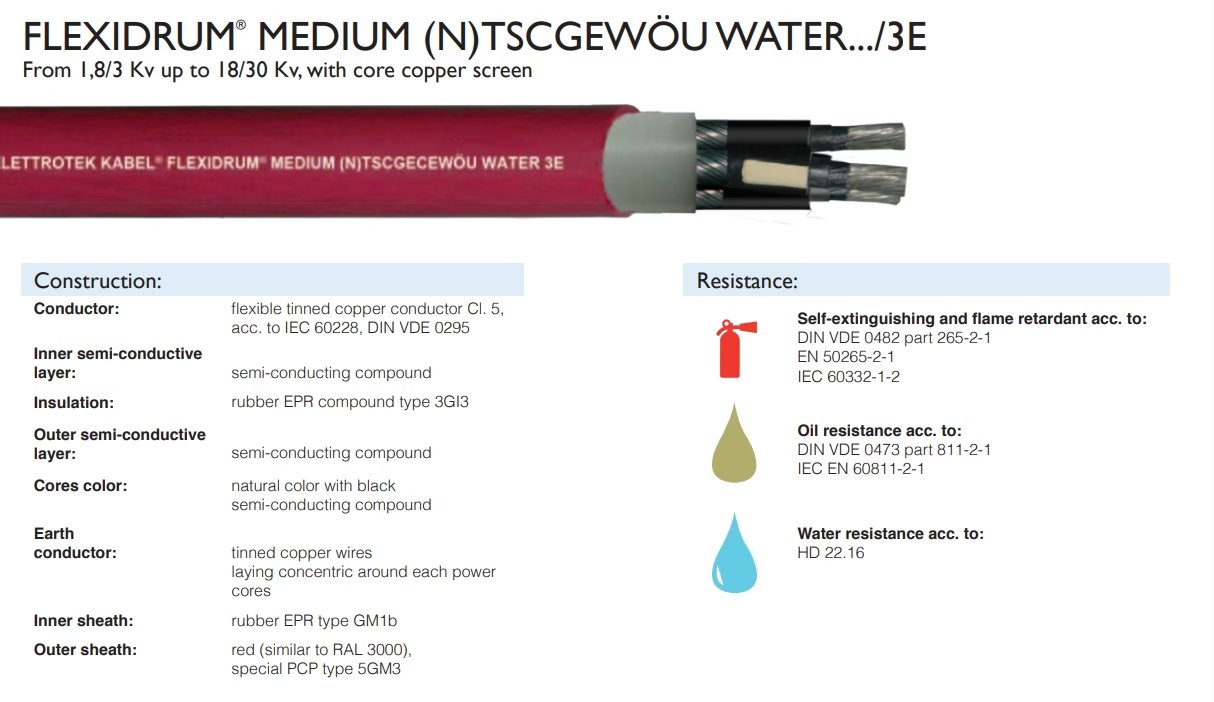
FLEXIDRUM® MEDIUM (N)TSCGEWÖU WATER /3E: Professional Shielded Submersible Cable with Integrated Core Copper Screen for Dredgers, Pumps, VFD Systems, and Electromagnetic Noise-Sensitive Water Infrastructure Purpose-engineered shielded submersible cable combining advanced water-submersion protection with electromagnetic noise immunity. FLEXIDRUM® MEDIUM (N)TSCGEWÖU WATER /3E integrates core copper screen shielding laid concentrically around power conductors, Class 5 tinned copper conductors (IEC 60228), advanced EPR insulation, and specialized water-resistant outer sheath (PCP Type 5GM3) to achieve 15+ year service life in demanding dredger systems, submersible pump installations, and VFD-controlled water infrastructure where electrical reliability and electromagnetic compatibility converge with water-submersion durability requirements. Executive Summary: Integrated Shielding and Water-Submersion Engineering for Next-Generation Dredging Systems Modern dredging and submersible pump systems increasingly employ variable-frequency drive (VFD) motor control and sophisticated sensor networks, creating electromagnetic environment incompatible with conventional unshielded cables. Simultaneously, VFD switching frequencies (5–20 kHz) generate high-frequency noise coupling into unshielded power circuits, causing sensor errors, control circuit malfunctions, and safety system failures. FLEXIDRUM® MEDIUM (N)TSCGEWÖU WATER /3E represents a breakthrough in submersible cable engineering, integrating comprehensive copper screen shielding with water-submersion durability to address the convergence of electromagnetic noise immunity and continuous water-immersion requirements. Traditional submersible cables lack electromagnetic shielding entirely, accepting noise-induced failures as operational cost in VFD-driven systems. Conversely, conventional shielded marine cables deteriorate rapidly in water-submersion environments, with shielding effectiveness degrading within 2–4 years as moisture penetrates underlying insulation and corrosion attacks copper screen geometry. FLEXIDRUM® MEDIUM (N)TSCGEWÖU WATER /3E overcomes both limitations through revolutionary integrated design: core copper screen shielding laid concentrically around each power conductor providing continuous EMI/RFI attenuation (>60 dB typical across 50 Hz to 10 MHz frequency range), tinned copper screen construction enabling superior electrochemical corrosion resistance in water-submersion environments, and water-resistant outer sheath (PCP Type 5GM3) maintaining shielding integrity through 15+ years of continuous seawater/brackish-water immersion.

(N)TSCGEWÖU WATER…/3E

FLEXIDRUM® MEDIUM (N)TSCGEWÖU WATER /3E: Professional Shielded Submersible Cable with Integrated Core Copper Screen for Dredgers, Pumps, VFD Systems, and Electromagnetic Noise-Sensitive Water Infrastructure Purpose-engineered shielded submersible cable combining advanced water-submersion protection with electromagnetic noise immunity. FLEXIDRUM® MEDIUM (N)TSCGEWÖU WATER /3E integrates core copper screen shielding laid concentrically around power conductors, Class 5 tinned copper conductors (IEC 60228), advanced EPR insulation, and specialized water-resistant outer sheath (PCP Type 5GM3) to achieve 15+ year service life in demanding dredger systems, submersible pump installations, and VFD-controlled water infrastructure where electrical reliability and electromagnetic compatibility converge with water-submersion durability requirements. Executive Summary: Integrated Shielding and Water-Submersion Engineering for Next-Generation Dredging Systems Modern dredging and submersible pump systems increasingly employ variable-frequency drive (VFD) motor control and sophisticated sensor networks, creating electromagnetic environment incompatible with conventional unshielded cables. Simultaneously, VFD switching frequencies (5–20 kHz) generate high-frequency noise coupling into unshielded power circuits, causing sensor errors, control circuit malfunctions, and safety system failures. FLEXIDRUM® MEDIUM (N)TSCGEWÖU WATER /3E represents a breakthrough in submersible cable engineering, integrating comprehensive copper screen shielding with water-submersion durability to address the convergence of electromagnetic noise immunity and continuous water-immersion requirements. Traditional submersible cables lack electromagnetic shielding entirely, accepting noise-induced failures as operational cost in VFD-driven systems. Conversely, conventional shielded marine cables deteriorate rapidly in water-submersion environments, with shielding effectiveness degrading within 2–4 years as moisture penetrates underlying insulation and corrosion attacks copper screen geometry. FLEXIDRUM® MEDIUM (N)TSCGEWÖU WATER /3E overcomes both limitations through revolutionary integrated design: core copper screen shielding laid concentrically around each power conductor providing continuous EMI/RFI attenuation (>60 dB typical across 50 Hz to 10 MHz frequency range), tinned copper screen construction enabling superior electrochemical corrosion resistance in water-submersion environments, and water-resistant outer sheath (PCP Type 5GM3) maintaining shielding integrity through 15+ years of continuous seawater/brackish-water immersion.
FLEXIDRUM® MEDIUM (N)TSCGEWÖU WATER: Professional Submersible Water-Resistant Cable for Dredgers, Pumps, Waste-Water Systems, and Extended-Voltage Submersed Applications Purpose-engineered submersible cable delivering exceptional durability and electrical performance in aggressive water environments. FLEXIDRUM® MEDIUM (N)TSCGEWÖU WATER combines Class 5 ultra-flexible tinned copper conductors (IEC 60228), advanced EPR insulation technology, and specialized water-resistant outer sheath (PCP Type 5GM3) to achieve 15+ year service life in demanding applications including dredger equipment, submersible pump systems, waste-water treatment facilities, and brackish/salt-water environments. Extended voltage platform (1.8/3 kV through 18/30 kV nominal) accommodates complete industrial water-system electrical hierarchies with unified cable platform.

FLEXIDRUM® MEDIUM (N)TSCGEWÖU WATER

FLEXIDRUM® MEDIUM (N)TSCGEWÖU WATER: Professional Submersible Water-Resistant Cable for Dredgers, Pumps, Waste-Water Systems, and Extended-Voltage Submersed Applications Purpose-engineered submersible cable delivering exceptional durability and electrical performance in aggressive water environments. FLEXIDRUM® MEDIUM (N)TSCGEWÖU WATER combines Class 5 ultra-flexible tinned copper conductors (IEC 60228), advanced EPR insulation technology, and specialized water-resistant outer sheath (PCP Type 5GM3) to achieve 15+ year service life in demanding applications including dredger equipment, submersible pump systems, waste-water treatment facilities, and brackish/salt-water environments. Extended voltage platform (1.8/3 kV through 18/30 kV nominal) accommodates complete industrial water-system electrical hierarchies with unified cable platform.
FLEXIDRUM® MEDIUM R 903: Professional Marine-Grade High-Flexibility Port Cable with Advanced Salt-Fog Resistance for Harbor Infrastructure and Offshore Lifting Applications Purpose-engineered marine cable delivering exceptional durability and electrical performance in aggressive port environments. FLEXIDRUM® MEDIUM R 903 combines Class 5 ultra-flexible red copper conductors (IEC 60228), advanced EPR insulation technology, and specialized salt-fog resistant outer sheath to achieve 15+ year service life in demanding harbor infrastructure including gantry cranes, container terminals, offshore lifting equipment, and inter-terminal transport systems. Nominal voltage range 3.6 kV to 12/20 kV accommodates complete port electrical hierarchies with unified cable platform.

FLEXIDRUM® MEDIUM R 903

FLEXIDRUM® MEDIUM R 903: Professional Marine-Grade High-Flexibility Port Cable with Advanced Salt-Fog Resistance for Harbor Infrastructure and Offshore Lifting Applications Purpose-engineered marine cable delivering exceptional durability and electrical performance in aggressive port environments. FLEXIDRUM® MEDIUM R 903 combines Class 5 ultra-flexible red copper conductors (IEC 60228), advanced EPR insulation technology, and specialized salt-fog resistant outer sheath to achieve 15+ year service life in demanding harbor infrastructure including gantry cranes, container terminals, offshore lifting equipment, and inter-terminal transport systems. Nominal voltage range 3.6 kV to 12/20 kV accommodates complete port electrical hierarchies with unified cable platform.
(N)TSCGEWÖU Nomenclature Breakdown: (N) = "Nennspannung" (Nominal voltage designation) Indicates multi-voltage family (3.6/6 kV baseline, expandable to 20/35 kV) T = "Drei" implicitly (Three-phase implied in TSC configuration) SC = "S" (Stromleiter? Schirmung? Sheath-related) "C" (Conductor classification, typically Class 5 flexibility) Together: Three-core conductor family designation GE = "Gummi Elastomer" (Rubber Elastomer) Explicitly denotes EPR insulation (not polyethylene, not XLPE) German standard preference: EPR for MV reeling (vs. XLPE for fixed cables) WÖU = "Werkstoff/Öl/Umlauf" (Material/Oil/Circulation?) OR historically: VDE/UL approval markers? Likely: W = Werkstoff (special material formulation) Ö = Öl-resistenz (oil resistance capability) U = Universal or Umlauf (circulation/reeling capability) Combined meaning: (N)TSCGEWÖU = "Nominal-voltage Three-phase Single-conductor-core family, Gummi Elastomer insulation, Werkstoff-spezial (special material), Oil-resistant, Universal reeling" Design Philosophy Encoded: - Modular voltage architecture (one design, 3.6–20/35 kV options) - Three-phase power + distributed earth (TSC = not symmetric 3+3, but mixed) - EPR elastomer base (not synthetic XLPE) - Enhanced material formulation (not commodity grade) - Mobile/reeling-centric (forced guidance compatible) - Multi-environment tolerance (oil, moisture, temperature extremes)

(N)TSCGEWÖU Mining Trailing Cable

(N)TSCGEWÖU Nomenclature Breakdown: (N) = “Nennspannung” (Nominal voltage designation) Indicates multi-voltage family (3.6/6 kV baseline, expandable to 20/35 kV) T = “Drei” implicitly (Three-phase implied in TSC configuration) SC = “S” (Stromleiter? Schirmung? Sheath-related) “C” (Conductor classification, typically Class 5 flexibility) Together: Three-core conductor family designation GE = “Gummi Elastomer” (Rubber Elastomer) Explicitly denotes EPR insulation (not polyethylene, not XLPE) German standard preference: EPR for MV reeling (vs. XLPE for fixed cables) WÖU = “Werkstoff/Öl/Umlauf” (Material/Oil/Circulation?) OR historically: VDE/UL approval markers? Likely: W = Werkstoff (special material formulation) Ö = Öl-resistenz (oil resistance capability) U = Universal or Umlauf (circulation/reeling capability) Combined meaning: (N)TSCGEWÖU = “Nominal-voltage Three-phase Single-conductor-core family, Gummi Elastomer insulation, Werkstoff-spezial (special material), Oil-resistant, Universal reeling” Design Philosophy Encoded: – Modular voltage architecture (one design, 3.6–20/35 kV options) – Three-phase power + distributed earth (TSC = not symmetric 3+3, but mixed) – EPR elastomer base (not synthetic XLPE) – Enhanced material formulation (not commodity grade) – Mobile/reeling-centric (forced guidance compatible) – Multi-environment tolerance (oil, moisture, temperature extremes)