DIN VDE 0250 Mining Cable

(N)GRDGÖU-J Nomenclature (VDE 0250 part 813): (N) = Nominal voltage prefix (0.6/1 kV implicit in designation) G = Gummiert (rubber-insulated) R = Rubber outer sheath D = Dynamisch (dynamic/flexing application) G = Gummiert inner sheath (intermediate layer) Ö = German standard designation (ö indicates European origin) U = Unarmoured (no metal sheath) J = Jacked (multi-sheath design: intermediate + outer) Full meaning: Rubber-insulated, rubber-sheathed, dynamic-rated, multi-sheath construction, unarmoured festoon cable VDE 0250 part 813 scope: Published by: VDE (Verband der Elektrotechnik, German standards body) Applies to: Flexible cables for crane installations (particularly festoon systems) Coverage: Voltage, temperature, mechanical properties, installation methods Festoon-specific requirements: - High bending flexibility (4×D minimum typical) - Fast rewind capability (240+ m/min rated speed) - Sustained torsion tolerance (±25°/1m continuous) - Extended temperature range (−50 to +80°C) - UV/ozone/moisture resistance (outdoor exposure) Alternate designations (similar cables): IEC 60811-1-1: International equivalent (less specific) DIN VDE 0298 part 3: German mechanical property standard DIN VDE 0482-265-2-1: German flame test standard EN 50265-2-1: European flame test equivalent GRDGÖU-J advantage: Combines all standards into single VDE designation Procurement simplified for European buyers

TROMMELFLEX (K) NSHTOEU:中等机械应力低压卷筒电缆的工程深度解析

TROMMELFLEX (K) NSHTOEU 是一种 0.6/1kV 柔性低压卷筒电缆,设计应用场景为 medium mechanical stresses,即中等机械应力下的 reeling operation。 与极重载矿山拖拽或超高速港口卷筒电缆相比,它更适合受控张力、受控速度、较规范卷盘路径和中等动态频率的移动供电系统。 从深度使用者角度看,这类电缆的真正价值不是“越重越好”,而是以合理重量、足够柔性、耐磨外护套、抗扭结构和标准化电气性能,解决大量中低压移动设备中最常见的卷绕、拖曳、磨耗、油污和维护问题。
GAALFLEX® VFD NYCWY: 600V/1000V European Standard Power Cable with Concentric Copper Conductor Shielding, Underground Direct-Burial Installation Capability, Frequency Converter Integration, Control Impulse & Test Data Transmission, 2–4 Cores, 10–240 mm² Solid/Stranded Red Copper, PVC DIV4 Insulation, Corrugated Copper Wire + Tape Screening, Self-Extinguishing Flame-Retardant, DIN VDE 0276/IEC 60502 Compliance, Utility Substation & Subscriber Network Deployment | European Underground Utility VFD Power Cable UL-certified European standard 600V/1000V underground direct-burial power cable with unique concentric copper conductor shielding combining solid or stranded red copper with PVC DIV4 insulation, corrugated copper wire + tape concentric shielding, and professional utility-grade grounding continuity—addressing underground direct-burial specification (subscriber networks, power stations), dual-voltage power distribution (600V/1000V), frequency converter system integration, control signal and test data transmission, utility substation infrastructure, and comprehensive European underground power distribution infrastructure simultaneously.

What is TROMMELFLEX PUR-HF D12Y11YU11Y: An In-Depth Engineering Analysis of the Halogen-Free PUR Low Voltage Reeling Cable

TROMMELFLEX PUR-HF D12Y11YU11Y-J/O is a flexible 0.6/1 kV low voltage reeling cable for high mechanical stress applications. Its engineering value is not only the voltage rating, but the combination of class 5 flexible plain copper conductors, halogen-free polyester-based insulation, a central textile carrier unit, short-length core lay, PUR inner sheath, open support braiding and black halogen-free flame-retardant polyurethane outer sheath. For port cranes, ship loaders, festoon systems, mobile machines and wet outdoor cable routes, the design targets a rare performance window: 25 N/mm² tensile load, ±50°/m torsional stress, 6×D minimum bending radius, 90°C conductor operation and permanent use in water up to 50 m diving depth.
GAALFLEX® TRAY VFD 1400: UL-Certified 1000V Standard Industrial Cable Tray Variable Frequency Drive Inverter Connection Cable for International Cable Tray Industrial Systems Using Metric Conductor Sizing (IEC 60228 Class 5 Flexible Red Copper per DIN VDE 0295), Frequency Converter Integration, Hazardous-Area Installations, and Cost-Sensitive Industrial Applications (1000 V Nominal Voltage [UL WTTC Rating], UL Type TC-ER c(UL) Type CIC FT4 Fire Classification Certification, Comprehensive Dual-Configuration Portfolio [4-Core and 3+3 Earth Conductor Versions], 1.5–240 mm² Conductor Range Enabling Complete International Tray VFD Specification from Control Circuits Through Maximum Industrial Motor Systems, Flexible Class 5 Red Copper per IEC 60228 / DIN VDE 0295, Special PVC/Nylon Insulation Providing Electrical Stability and Flame-Retardant Performance, Aluminum Tape + PETP Foil + Tinned Copper Braid + Tinned Copper Drain Wire Triple-Layer Shielding Providing Effective EMI Suppression and Signal Integrity, High-Strength Ripcord Under Outer Sheath Enabling Field Installation, Black RAL 9005 Standard PVC [Polyvinyl Chloride] Halogen-Free Outer Sheath with UV Resistance Enabling Industrial Outdoor Installation, Temperature Range −25 to +90°C [Fixed and Flexible Installation] with 6×D Minimum Bending Radius Supporting Cable Tray Routing, UL Type TC-ER Approval Enabling International Tray Installation, Oil Resistance Grade I per UL 1277, Electromagnetic Compatibility per EN 55011 / DIN VDE 0875 / EN 61800-3, Self-Extinguishing and Flame-Retardant per c(UL) FT4 Vertical Flame Propagation Testing, Optional UL 1277 60°C 600V Upgrade Available, Optional Tinned Copper Upgrade Available, MSHA [Mine Safety and Health Administration] Approval for Hazardous-Area Mining Applications, RoHS Approved, UL/CSA Standards Compliance [ASTM B-3, UL 66, UL 83, UL 1277, CSA C22.2 230/239], and Complete International VFD Infrastructure Compliance Enabling Cost-Effective OEM Tray Cable Integration and Process Automation Acceptance for Standard Industrial Environments)

PROTOLON(SC) 6/10 kV: Medium Voltage Cable for Shore-Connection Systems — An In-Depth Engineering Analysis for HVSC, Cold Ironing and Ship-to-Shore Power

PROTOLON(SC) 6/10 kV is a medium voltage flexible cable architecture for High Voltage Shore Connection Systems (HVSC), designed for both onboard vessel sections and onshore cable-handling systems. Based on DIN VDE 0250-813 and IEC/ISO/IEEE 80005-1, it combines 6/10 kV EPR-insulated power cores, semiconductive rubber field control, integrated control cores, optional fibre optics, an aramid-reinforced central support element, EPR inner sheath and an abrasion- and tear-proof CM/CPE outer sheath. Its technical role is not simply to transmit power: it must survive repetitive shore-connection handling, marine outdoor exposure, oil contamination, UV, ozone, moisture and permanent water immersion while maintaining electrical integrity, control-circuit reliability and safe operation around ships and quay equipment.
FLEXIDRUM® R 702: Advanced Salt-Spray Resistant Multi-Core Cable for Maritime Port Infrastructure and Container Handling Systems Engineered for extreme corrosive marine environments, the FLEXIDRUM® R 702 delivers proven salt-fog resistance combined with Class 5 flexible conductor technology, GAALTHERM® 630 thermoplastic insulation, and advanced anti-twisting textile reinforcement. Designed for automated container spreader bars, vertical lifting platforms, and offshore equipment exposed to continuous salt-spray cycles—meeting DIN VDE, EN, and IEC standards with reduced weight and diameter for enhanced installation flexibility in modern port automation infrastructure.

PROTOLON SMRT vs XPRT: Техническое Руководство по Выбору Кабеля

PROTOLON семейство кабелей разрабатывалось Prysmian Group на протяжении двух декад как ответ на эволюцию портового оборудования. Исторически, первые портовые краны (1980–1990) использовали более простые кабели с меньшими требованиями к скорости и гибкости. Но по мере того как портовые операции интенсифицировались и оборудование становилось быстрее (контейнерные краны STS с циклами 40–60 секунд вместо 5–10 минут), потребность в кабелях, способных выдерживать высокие скорости развертывания и динамические нагрузки, стала критической. PROTOLON SMRT (Standard Medium Reeling Technology) был введен как решение для кранов с **среднего уровня механическим напряжением**: скорость развертывания 160–200 м/мин, динамические нагрузки до 20 N/mm², типичные для портальных кранов и RTG (резиновошинных портовых краны) 1990–2010 годов разработки. PROTOLON XPRT (eXtreme Performance Reeling Technology) был введен позже (2000s–2010s) для **высокопроизводительных операций**: скорость развертывания 240 м/мин, динамические нагрузки до 25 N/mm², для самых современных STS кранов и мобильных портовых оборудований. Обе линейки соответствуют DIN VDE 0250-813, но с различными требованиями к гибкости и механической прочности проводника.
Feichun FLEXIFESTOON® Maritime Salt-Fog Resistant Cable: Next-Generation Port Control Cable (VDE 0250 Part 813, −35 to +80°C, Advanced EPR Insulation with Polymer Chain Stabilization, Copper Tinned Shielding Architecture, Comprehensive Salt-Fog/Ozone/UV/Moisture Resistance, 240 m/min Festoon Speed Rating, 4×D Dynamic Bending Radius, Flexible Copper Conductor (IEC 60228 Class 5), Yellow Visibility Outer Sheath, Self-Extinguishing Flame Retardancy, Multiple Core Configurations (1–36 cores), NSS 1000+ Hour Salt-Fog Corrosion Testing, MSHA/CE Hazardous-Location Approval, Port Crane and Container Terminal Engineering Integration): Comprehensive Advanced Polymer Materials Science and EPR Elastomer Stabilization Architecture Analysis Integrating Polymer Chain Engineering, Salt-Fog Degradation Resistance Mechanisms, Copper Shielding Electromagnetic Protection, Flexible Conductor Design, Environmental Stabilizer Chemistry, and Next-Generation Maritime Control System Integration Port automation environments—container gantry cranes (−35°C winter Arctic platforms, +80°C tropical heat), ship-to-shore electrical systems with persistent salt-fog atmosphere (NSS corrosion, ISO 12944 C5 marine rating), hazardous-location electrical distribution for dock loading/unloading systems, refrigerated container (reefer) terminal cabling with simultaneous cold exposure and salt-fog stress, festoon overhead power distribution for mobile port equipment (240 m/min speed, repetitive flexing), and maritime automation requiring electrical control cabling engineered to simultaneously achieve four competing performance objectives rarely optimized together: mechanical flexibility maintained across 115°C temperature envelope (−35 to +80°C), requiring advanced EPR insulation chemistry preventing brittleness at cryogenic port temperatures, comprehensive salt-fog corrosion resistance (NSS 1000+ hours per ASTM B117, requiring copper shielding and tinned-conductor electrochemical protection), ozone/UV environmental immunity (port dock sunlight exposure + industrial ozone from electrical switching), through molecular stabilization and phase-separated domain chemistry, and high-speed festoon dynamic service (240 m/min conductor motion, repetitive bending stress), demanding 4×D bending flexibility combined with tensile strength withstanding mechanical tension. Conventional port cables sacrifice either flexibility (rigid rubber becoming brittle at −35°C) or salt-fog resistance (unshielded copper corroding in salt atmosphere). FLEXIFESTOON® Maritime represents a breakthrough in EPR cable engineering, delivering simultaneous optimization across all four domains through proprietary advanced EPR insulation with polymer chain stabilization, copper tinned-conductor shielding providing electrochemical corrosion protection, flexible copper architecture enabling 240 m/min festoon service, and molecular-level stabilization chemistry suppressing salt-fog/ozone/UV degradation—enabling port engineers, terminal automation specialists, and maritime electrical systems integrators to deploy a unified next-generation cable solution across the complete spectrum of maritime, salt-fog, and high-speed dynamic environments while maintaining compliance with VDE 0250-813, MSHA hazardous-location, and NSS corrosion standards.

Why Do Reeling Cables Corkscrew?

“Corkscrew” is the colloquial term used by mining and construction equipment operators to describe an unwanted behavior observed when paying out cable from a reel: the cable, as it unwinds, simultaneously rotates around its own longitudinal axis — much like a corkscrew (or drill bit) boring through material. Instead of the cable exiting the reel in a straight, manageable path, it arrives at the equipment with a visible twist imparted into its structure. The phenomenon is immediately recognizable to experienced operators. A cable that corkscrews arrives at equipment with a rotational momentum imparted into its length. The cable is physically harder to straighten and route, requires more effort to lay out, and — critically — arrives at the termination point with internal torsional stress already present. This residual torsion becomes manifest as increased bending stiffness in certain directions and increased likelihood of kinking or localized crushing when the cable is coiled or temporarily stored.
Large three-phase AC motors drove continuous-duty equipment (conveyor systems, pump stations, ventilation fans) with straightforward on/off control via contactor switches. The control circuits were simple, the equipment was robust and forgiving of electrical noise, and cable specifications focused purely on mechanical durability and basic electrical protection. Modern underground mining operations operate in a fundamentally different electrical environment. Variable frequency drives (VFDs) regulate motor speeds to match load requirements, reducing energy consumption and extending equipment life. Programmable logic controllers (PLCs) and distributed control systems (DCS) automate equipment sequencing and mine ventilation. Wireless monitoring systems track equipment health, environmental conditions, and safety parameters. The mine's electrical environment has become as electrically complex as an industrial manufacturing facility, except that everything must operate underground in the presence of conductive dust, moisture, and metallic ore particles that create unintended current paths and electromagnetic noise sources.

Understanding UNE 22513-1 (DS1N) Requirements for Underground Mines

Large three-phase AC motors drove continuous-duty equipment (conveyor systems, pump stations, ventilation fans) with straightforward on/off control via contactor switches. The control circuits were simple, the equipment was robust and forgiving of electrical noise, and cable specifications focused purely on mechanical durability and basic electrical protection. Modern underground mining operations operate in a fundamentally different electrical environment. Variable frequency drives (VFDs) regulate motor speeds to match load requirements, reducing energy consumption and extending equipment life. Programmable logic controllers (PLCs) and distributed control systems (DCS) automate equipment sequencing and mine ventilation. Wireless monitoring systems track equipment health, environmental conditions, and safety parameters. The mine’s electrical environment has become as electrically complex as an industrial manufacturing facility, except that everything must operate underground in the presence of conductive dust, moisture, and metallic ore particles that create unintended current paths and electromagnetic noise sources.
Nexans PANZERFLEX is the commercial product designation for high-flexibility mining reeling cables manufactured to German (VDE 0250-813) and international (IEC 60502-1) specifications. The product line is aimed specifically at European and Latin American underground mining operations, where it commands the market leadership position for continuous miner, shearer, and shuttle car drag cables. PANZERFLEX is not a single cable specification but rather a family of products: PANZERFLEX-R for rubber-insulated designs, PANZERFLEX-P for PUR-sheathed designs, and variants distinguished by voltage rating (0.6/1 kV, 1.8/3 kV) and core configuration. (N)TSCGEWÖU is the German VDE cable designation that describes the same functional class: a 0.6/1 kV, Class 5 flexible copper conductor, EPR insulation, unarmoured cable suitable for mobile mining equipment. The "(N)" prefix indicates "new" or "current" specification, distinguishing it from obsolete predecessors. This designation is widely used in German, Austrian, and Central European mining specifications, particularly in coal mining where German equipment vendors historically dominated the market. Technically, PANZERFLEX and (N)TSCGEWÖU are designed to satisfy identical functional requirements and electrical performance levels. Both must pass IEC 60502-1 qualification testing, both are specified for 0.6/1 kV operation, both support Class 5 conductor architecture for maximum torsional flexibility, and both employ EPR insulation for mining durability. The designations differ only in nomenclature: one is a commercial product name from a multinational manufacturer, the other is a German standards designation used in technical specifications and procurement documents.

Nexans PANZERFLEX vs. (N)TSCGEWÖU: A Comprehensive Equivalent Guide

Nexans PANZERFLEX is the commercial product designation for high-flexibility mining reeling cables manufactured to German (VDE 0250-813) and international (IEC 60502-1) specifications. The product line is aimed specifically at European and Latin American underground mining operations, where it commands the market leadership position for continuous miner, shearer, and shuttle car drag cables. PANZERFLEX is not a single cable specification but rather a family of products: PANZERFLEX-R for rubber-insulated designs, PANZERFLEX-P for PUR-sheathed designs, and variants distinguished by voltage rating (0.6/1 kV, 1.8/3 kV) and core configuration. (N)TSCGEWÖU is the German VDE cable designation that describes the same functional class: a 0.6/1 kV, Class 5 flexible copper conductor, EPR insulation, unarmoured cable suitable for mobile mining equipment. The “(N)” prefix indicates “new” or “current” specification, distinguishing it from obsolete predecessors. This designation is widely used in German, Austrian, and Central European mining specifications, particularly in coal mining where German equipment vendors historically dominated the market. Technically, PANZERFLEX and (N)TSCGEWÖU are designed to satisfy identical functional requirements and electrical performance levels. Both must pass IEC 60502-1 qualification testing, both are specified for 0.6/1 kV operation, both support Class 5 conductor architecture for maximum torsional flexibility, and both employ EPR insulation for mining durability. The designations differ only in nomenclature: one is a commercial product name from a multinational manufacturer, the other is a German standards designation used in technical specifications and procurement documents.
Marine & Port Drag Cable — High-Flexibility Saltwater-Resistant System A comprehensive engineering dissection of heavy-duty marine drag cables for port equipment, container terminals, and offshore platforms — from conductor architecture and EPR insulation to steel wire armour (M2) design rationale, galvanic corrosion protection mechanisms, environmental compliance, and validated performance benchmarking against Nexans Eproneo Port and Prysmian marine systems.

UNE 22512

Marine & Port Drag Cable — High-Flexibility Saltwater-Resistant System A comprehensive engineering dissection of heavy-duty marine drag cables for port equipment, container terminals, and offshore platforms — from conductor architecture and EPR insulation to steel wire armour (M2) design rationale, galvanic corrosion protection mechanisms, environmental compliance, and validated performance benchmarking against Nexans Eproneo Port and Prysmian marine systems.
PUR vs. Rubber Sheath Comparison: EPR/PCP rubber (traditional festoon): Base polymer: Ethylene-propylene or chloroprene rubber Density: ~1.2 g/cm³ (light) Young's modulus: ~2–8 MPa (soft, flexible) Tear strength: 15–30 kN/m (adequate) Tensile strength: 8–12 MPa (moderate) Oil resistance: Fair (EPR), Good (CPE) Cost: Low (commodity material) Typical life: 5–10 years PUR (polyurethane, FLEXIFESTOON PUR): Base polymer: Polyol + isocyanate urethane linkage Density: ~1.25 g/cm³ (slightly heavier per unit volume, but better properties) Young's modulus: ~10–15 MPa (stiffer, stronger) Tear strength: 30–50 kN/m (2–3× better than rubber) Tensile strength: 12–18 MPa (much stronger) Oil resistance: Excellent (far superior to rubber) Cost: Medium (specialty material) Typical life: 10–15 years (50–100% longer) PUR performance advantages: (1) Tear resistance: Mechanism: Urethane linkages form strong hydrogen bonds More rigid polymer network, resists crack propagation Consequence: Cable survives snagging on sharp edges Abrasion resistance 2–3× better than rubber Application: Machine tool environments (sharp metal edges, high speed) (2) Oil immersion durability: Rubber swelling in oil: 8–15% volume increase PUR swelling in oil: 2–5% volume increase (excellent stability) Result: Cable diameter remains stable, connections don't loosen No electrical performance degradation from oil ingress (3) Ozone & UV resistance: Rubber degradation rate: 10–20% strength loss per 5 years outdoor PUR degradation rate: 5–10% strength loss per 5 years outdoor Application: Outdoor machine tools, conveying systems in sunlight (4) Mechanical stress recovery: Rubber behavior: After bending, slow recovery (viscoelastic) PUR behavior: Rapid recovery, lower hysteresis loss Benefit: Lower heating during high-speed cycling 240 m/min reeling applications tolerate higher duty cycles Cost-benefit trade-off: PUR premium cost: +15–25% vs. standard rubber festoon cable Justification for premium: - 2× longer service life (10–15 years vs. 5–10 years) - Reduced maintenance/replacement downtime in industrial operations - Superior performance in aggressive environments (oil, chemicals) - Better value when cost-of-downtime is high (machine tools, production lines)

FLEXIFESTOON® PUR

PUR vs. Rubber Sheath Comparison: EPR/PCP rubber (traditional festoon): Base polymer: Ethylene-propylene or chloroprene rubber Density: ~1.2 g/cm³ (light) Young’s modulus: ~2–8 MPa (soft, flexible) Tear strength: 15–30 kN/m (adequate) Tensile strength: 8–12 MPa (moderate) Oil resistance: Fair (EPR), Good (CPE) Cost: Low (commodity material) Typical life: 5–10 years PUR (polyurethane, FLEXIFESTOON PUR): Base polymer: Polyol + isocyanate urethane linkage Density: ~1.25 g/cm³ (slightly heavier per unit volume, but better properties) Young’s modulus: ~10–15 MPa (stiffer, stronger) Tear strength: 30–50 kN/m (2–3× better than rubber) Tensile strength: 12–18 MPa (much stronger) Oil resistance: Excellent (far superior to rubber) Cost: Medium (specialty material) Typical life: 10–15 years (50–100% longer) PUR performance advantages: (1) Tear resistance: Mechanism: Urethane linkages form strong hydrogen bonds More rigid polymer network, resists crack propagation Consequence: Cable survives snagging on sharp edges Abrasion resistance 2–3× better than rubber Application: Machine tool environments (sharp metal edges, high speed) (2) Oil immersion durability: Rubber swelling in oil: 8–15% volume increase PUR swelling in oil: 2–5% volume increase (excellent stability) Result: Cable diameter remains stable, connections don’t loosen No electrical performance degradation from oil ingress (3) Ozone & UV resistance: Rubber degradation rate: 10–20% strength loss per 5 years outdoor PUR degradation rate: 5–10% strength loss per 5 years outdoor Application: Outdoor machine tools, conveying systems in sunlight (4) Mechanical stress recovery: Rubber behavior: After bending, slow recovery (viscoelastic) PUR behavior: Rapid recovery, lower hysteresis loss Benefit: Lower heating during high-speed cycling 240 m/min reeling applications tolerate higher duty cycles Cost-benefit trade-off: PUR premium cost: +15–25% vs. standard rubber festoon cable Justification for premium: – 2× longer service life (10–15 years vs. 5–10 years) – Reduced maintenance/replacement downtime in industrial operations – Superior performance in aggressive environments (oil, chemicals) – Better value when cost-of-downtime is high (machine tools, production lines)
FLEXIFESTOON® SOOW EPDM/CPE Marine-Grade: Salt-Fog Resistant Heavy-Duty Rubber Port Cable for STS Cranes, RTG/RMG Gantries, and Ship-to-Shore Power Systems Feichun's FLEXIFESTOON® SOOW EPDM/CPE Marine-Grade represents a chemistry-driven upgrade of the proven UL/CSA SOOW platform, specifically re-engineered for the corrosive salt-fog, hydrocarbon-spray, and ozone-rich microclimate of modern container terminals and quayside cargo handling. The cable consolidates four engineering imperatives into a single rubber-jacketed architecture: a marine-grade EPDM ethylene-propylene-diene insulation system providing exceptional dielectric stability under prolonged moisture immersion; a chlorinated polyethylene (CPE) outer sheath whose chlorine backbone delivers inherent halide-resistance, hydrolysis stability, and ozone immunity surpassing standard thermoplastic compounds; finely-stranded Class K bunched red copper conductors per ASTM B-174 enabling 4×D minimum bending radius and >2 million flex-cycle service in dynamic festoon and reeling applications; and full multi-jurisdictional certification including UL Standard 62, CSA 22.2 No. 49, NEC Article 400, NEC 501.140 Class I Division 1 and 2, FT2 vertical flame propagation, and MSHA P-7K-123456 mining approval — supporting global port deployment from the Port of Long Beach to Jebel Ali, Rotterdam Maasvlakte II, and Yangshan Phase IV automated terminals.

FLEXIFESTOON® SOOW

FLEXIFESTOON® SOOW EPDM/CPE Marine-Grade: Salt-Fog Resistant Heavy-Duty Rubber Port Cable for STS Cranes, RTG/RMG Gantries, and Ship-to-Shore Power Systems Feichun’s FLEXIFESTOON® SOOW EPDM/CPE Marine-Grade represents a chemistry-driven upgrade of the proven UL/CSA SOOW platform, specifically re-engineered for the corrosive salt-fog, hydrocarbon-spray, and ozone-rich microclimate of modern container terminals and quayside cargo handling. The cable consolidates four engineering imperatives into a single rubber-jacketed architecture: a marine-grade EPDM ethylene-propylene-diene insulation system providing exceptional dielectric stability under prolonged moisture immersion; a chlorinated polyethylene (CPE) outer sheath whose chlorine backbone delivers inherent halide-resistance, hydrolysis stability, and ozone immunity surpassing standard thermoplastic compounds; finely-stranded Class K bunched red copper conductors per ASTM B-174 enabling 4×D minimum bending radius and >2 million flex-cycle service in dynamic festoon and reeling applications; and full multi-jurisdictional certification including UL Standard 62, CSA 22.2 No. 49, NEC Article 400, NEC 501.140 Class I Division 1 and 2, FT2 vertical flame propagation, and MSHA P-7K-123456 mining approval — supporting global port deployment from the Port of Long Beach to Jebel Ali, Rotterdam Maasvlakte II, and Yangshan Phase IV automated terminals.
FLEXIDRUM® MEDIUM FLAT: Advanced High-Flexibility Salt-Fog Resistant Port Cable System Specialized reeling-flat power cable engineered for extreme maritime environments combining flexible tinned copper conductors (IEC 60228 Class 5), proprietary EPR insulation chemistry, hydrophobic semi-conductive interfaces, and specialized red outer-sheath PCP compound with integrated volatile-corrosion-inhibitor (VCI) technology. Designed for rapid cable-reel deployment systems in dredging, submersible pump, and floating crane applications requiring superior electrochemical corrosion immunity and compact outer-diameter efficiency across 3.6/6 kV through 8.7/15 kV voltage platforms.

FLAT (N)TSFLCGCWOEUS Reeling flat cables

FLEXIDRUM® MEDIUM FLAT: Advanced High-Flexibility Salt-Fog Resistant Port Cable System Specialized reeling-flat power cable engineered for extreme maritime environments combining flexible tinned copper conductors (IEC 60228 Class 5), proprietary EPR insulation chemistry, hydrophobic semi-conductive interfaces, and specialized red outer-sheath PCP compound with integrated volatile-corrosion-inhibitor (VCI) technology. Designed for rapid cable-reel deployment systems in dredging, submersible pump, and floating crane applications requiring superior electrochemical corrosion immunity and compact outer-diameter efficiency across 3.6/6 kV through 8.7/15 kV voltage platforms.
FLEXIDRUM® MEDIUM RS-T: Advanced Anti-Twisting Cable for Mining Excavators and Heavy-Duty Industrial Applications A comprehensive technical analysis of Feichun's purpose-engineered anti-twisting cable platform (1.8/3 kV to 18/30 kV voltage grades) featuring specialized synthetic yarn torsion protection, tinned copper conductors, EPR Type 3GI3 insulation, and tear-resistant wrapping technology—delivering exceptional mechanical durability in open-cast mining environments characterized by extreme mechanical abrasion, dynamic cable movement, and continuous torsional stress exposure.

RS-T (N)TSCGEWÖU

FLEXIDRUM® MEDIUM RS-T: Advanced Anti-Twisting Cable for Mining Excavators and Heavy-Duty Industrial Applications A comprehensive technical analysis of Feichun’s purpose-engineered anti-twisting cable platform (1.8/3 kV to 18/30 kV voltage grades) featuring specialized synthetic yarn torsion protection, tinned copper conductors, EPR Type 3GI3 insulation, and tear-resistant wrapping technology—delivering exceptional mechanical durability in open-cast mining environments characterized by extreme mechanical abrasion, dynamic cable movement, and continuous torsional stress exposure.
Advanced High-Flexibility Salt-Fog Resistant Port Cable: Engineering Excellence for Extreme Maritime Environments A comprehensive technical deep-dive into Feichun's purpose-engineered high-flexibility port cable platform combining advanced electrochemical conductor protection, specialized EPR insulation, proprietary hydrophobic semi-conductive interfaces, and innovative outer-sheath chemistry—delivering extended service-life durability (12–15+ years field-validated) for demanding dredging, pumping, and floating-crane applications operating in harsh tropical and subtropical saltwater port facilities worldwide.

FLEXIDRUM® MEDIUM RS (N)TSCGEWÖU

Advanced High-Flexibility Salt-Fog Resistant Port Cable: Engineering Excellence for Extreme Maritime Environments A comprehensive technical deep-dive into Feichun’s purpose-engineered high-flexibility port cable platform combining advanced electrochemical conductor protection, specialized EPR insulation, proprietary hydrophobic semi-conductive interfaces, and innovative outer-sheath chemistry—delivering extended service-life durability (12–15+ years field-validated) for demanding dredging, pumping, and floating-crane applications operating in harsh tropical and subtropical saltwater port facilities worldwide.
现代割吸挖泥船和潜水泵系统日益采用复杂的强制导向电缆路由配置,其中电缆部署必须适应多方向偏转(水平和垂直弯曲同时)、高部署速度(150-200 m/min运行范围)、以及锚地迁移周期期间由卷轴轴旋转惯性施加的动态扭转应力。常规高柔性电缆(非专化防旋转架构)遭遇关键运行局限:电缆绞合不平衡在快速部署中产生螺旋旋转扭矩,导致电缆扭转积累和操作员控制的手动反扭转循环,中断挖泥生产力并在卷轴处理期间引入安全危害。此外,不受控制的电缆扭转诱发导体绞合中的永久微变形和绝缘压缩,加速疲劳裂纹和提前服役寿命故障。 FLEXIDRUM® MEDIUM RS防旋转变体代表对这些部署约束的专化工程响应,集合合成纤维防旋转矩阵(S-玻璃纤维或芳纶复合加强)在电缆结构内集中铺设于内部PCP护套和外部专化PCP复合体之间。这个支撑屏障架构直接解决旋转扭矩机制:合成纤维矩阵抵抗否则会产生旋转扭矩的螺旋绞合几何,维持电缆中性扭转条件贯穿部署周期。现场验证跨北海、中东和东南亚挖泥设施记录了显著运营改进:消除手动反扭转需求、20-30%锚地迁移周期时间减少,以及通过扭转诱发疲劳机制消除延长服役耐久性。

(N)TSCGEWÖU:高速强制导向挖泥船防旋转电缆

现代割吸挖泥船和潜水泵系统日益采用复杂的强制导向电缆路由配置,其中电缆部署必须适应多方向偏转(水平和垂直弯曲同时)、高部署速度(150-200 m/min运行范围)、以及锚地迁移周期期间由卷轴轴旋转惯性施加的动态扭转应力。常规高柔性电缆(非专化防旋转架构)遭遇关键运行局限:电缆绞合不平衡在快速部署中产生螺旋旋转扭矩,导致电缆扭转积累和操作员控制的手动反扭转循环,中断挖泥生产力并在卷轴处理期间引入安全危害。此外,不受控制的电缆扭转诱发导体绞合中的永久微变形和绝缘压缩,加速疲劳裂纹和提前服役寿命故障。 FLEXIDRUM® MEDIUM RS防旋转变体代表对这些部署约束的专化工程响应,集合合成纤维防旋转矩阵(S-玻璃纤维或芳纶复合加强)在电缆结构内集中铺设于内部PCP护套和外部专化PCP复合体之间。这个支撑屏障架构直接解决旋转扭矩机制:合成纤维矩阵抵抗否则会产生旋转扭矩的螺旋绞合几何,维持电缆中性扭转条件贯穿部署周期。现场验证跨北海、中东和东南亚挖泥设施记录了显著运营改进:消除手动反扭转需求、20-30%锚地迁移周期时间减少,以及通过扭转诱发疲劳机制消除延长服役耐久性。
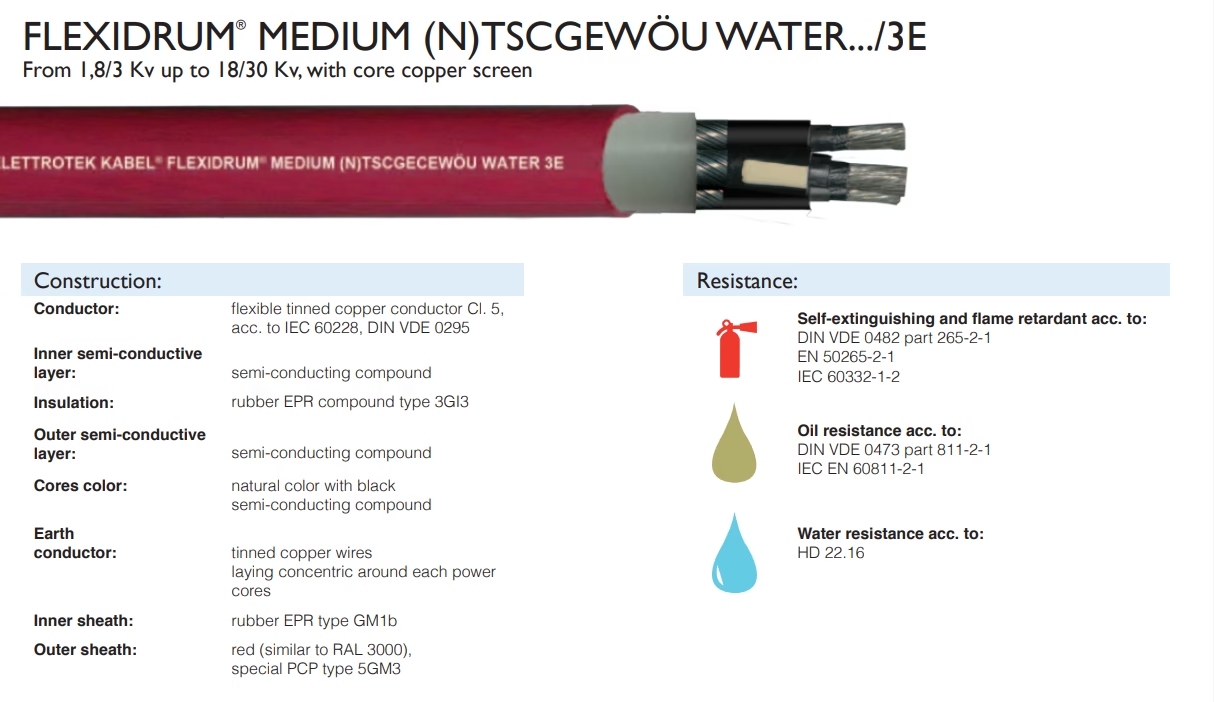
FLEXIDRUM® MEDIUM (N)TSCGEWÖU WATER /3E: Professional Shielded Submersible Cable with Integrated Core Copper Screen for Dredgers, Pumps, VFD Systems, and Electromagnetic Noise-Sensitive Water Infrastructure Purpose-engineered shielded submersible cable combining advanced water-submersion protection with electromagnetic noise immunity. FLEXIDRUM® MEDIUM (N)TSCGEWÖU WATER /3E integrates core copper screen shielding laid concentrically around power conductors, Class 5 tinned copper conductors (IEC 60228), advanced EPR insulation, and specialized water-resistant outer sheath (PCP Type 5GM3) to achieve 15+ year service life in demanding dredger systems, submersible pump installations, and VFD-controlled water infrastructure where electrical reliability and electromagnetic compatibility converge with water-submersion durability requirements. Executive Summary: Integrated Shielding and Water-Submersion Engineering for Next-Generation Dredging Systems Modern dredging and submersible pump systems increasingly employ variable-frequency drive (VFD) motor control and sophisticated sensor networks, creating electromagnetic environment incompatible with conventional unshielded cables. Simultaneously, VFD switching frequencies (5–20 kHz) generate high-frequency noise coupling into unshielded power circuits, causing sensor errors, control circuit malfunctions, and safety system failures. FLEXIDRUM® MEDIUM (N)TSCGEWÖU WATER /3E represents a breakthrough in submersible cable engineering, integrating comprehensive copper screen shielding with water-submersion durability to address the convergence of electromagnetic noise immunity and continuous water-immersion requirements. Traditional submersible cables lack electromagnetic shielding entirely, accepting noise-induced failures as operational cost in VFD-driven systems. Conversely, conventional shielded marine cables deteriorate rapidly in water-submersion environments, with shielding effectiveness degrading within 2–4 years as moisture penetrates underlying insulation and corrosion attacks copper screen geometry. FLEXIDRUM® MEDIUM (N)TSCGEWÖU WATER /3E overcomes both limitations through revolutionary integrated design: core copper screen shielding laid concentrically around each power conductor providing continuous EMI/RFI attenuation (>60 dB typical across 50 Hz to 10 MHz frequency range), tinned copper screen construction enabling superior electrochemical corrosion resistance in water-submersion environments, and water-resistant outer sheath (PCP Type 5GM3) maintaining shielding integrity through 15+ years of continuous seawater/brackish-water immersion.

(N)TSCGEWÖU WATER…/3E

FLEXIDRUM® MEDIUM (N)TSCGEWÖU WATER /3E: Professional Shielded Submersible Cable with Integrated Core Copper Screen for Dredgers, Pumps, VFD Systems, and Electromagnetic Noise-Sensitive Water Infrastructure Purpose-engineered shielded submersible cable combining advanced water-submersion protection with electromagnetic noise immunity. FLEXIDRUM® MEDIUM (N)TSCGEWÖU WATER /3E integrates core copper screen shielding laid concentrically around power conductors, Class 5 tinned copper conductors (IEC 60228), advanced EPR insulation, and specialized water-resistant outer sheath (PCP Type 5GM3) to achieve 15+ year service life in demanding dredger systems, submersible pump installations, and VFD-controlled water infrastructure where electrical reliability and electromagnetic compatibility converge with water-submersion durability requirements. Executive Summary: Integrated Shielding and Water-Submersion Engineering for Next-Generation Dredging Systems Modern dredging and submersible pump systems increasingly employ variable-frequency drive (VFD) motor control and sophisticated sensor networks, creating electromagnetic environment incompatible with conventional unshielded cables. Simultaneously, VFD switching frequencies (5–20 kHz) generate high-frequency noise coupling into unshielded power circuits, causing sensor errors, control circuit malfunctions, and safety system failures. FLEXIDRUM® MEDIUM (N)TSCGEWÖU WATER /3E represents a breakthrough in submersible cable engineering, integrating comprehensive copper screen shielding with water-submersion durability to address the convergence of electromagnetic noise immunity and continuous water-immersion requirements. Traditional submersible cables lack electromagnetic shielding entirely, accepting noise-induced failures as operational cost in VFD-driven systems. Conversely, conventional shielded marine cables deteriorate rapidly in water-submersion environments, with shielding effectiveness degrading within 2–4 years as moisture penetrates underlying insulation and corrosion attacks copper screen geometry. FLEXIDRUM® MEDIUM (N)TSCGEWÖU WATER /3E overcomes both limitations through revolutionary integrated design: core copper screen shielding laid concentrically around each power conductor providing continuous EMI/RFI attenuation (>60 dB typical across 50 Hz to 10 MHz frequency range), tinned copper screen construction enabling superior electrochemical corrosion resistance in water-submersion environments, and water-resistant outer sheath (PCP Type 5GM3) maintaining shielding integrity through 15+ years of continuous seawater/brackish-water immersion.
FLEXIDRUM® MEDIUM (N)TSCGEWÖU WATER: Professional Submersible Water-Resistant Cable for Dredgers, Pumps, Waste-Water Systems, and Extended-Voltage Submersed Applications Purpose-engineered submersible cable delivering exceptional durability and electrical performance in aggressive water environments. FLEXIDRUM® MEDIUM (N)TSCGEWÖU WATER combines Class 5 ultra-flexible tinned copper conductors (IEC 60228), advanced EPR insulation technology, and specialized water-resistant outer sheath (PCP Type 5GM3) to achieve 15+ year service life in demanding applications including dredger equipment, submersible pump systems, waste-water treatment facilities, and brackish/salt-water environments. Extended voltage platform (1.8/3 kV through 18/30 kV nominal) accommodates complete industrial water-system electrical hierarchies with unified cable platform.

FLEXIDRUM® MEDIUM (N)TSCGEWÖU WATER

FLEXIDRUM® MEDIUM (N)TSCGEWÖU WATER: Professional Submersible Water-Resistant Cable for Dredgers, Pumps, Waste-Water Systems, and Extended-Voltage Submersed Applications Purpose-engineered submersible cable delivering exceptional durability and electrical performance in aggressive water environments. FLEXIDRUM® MEDIUM (N)TSCGEWÖU WATER combines Class 5 ultra-flexible tinned copper conductors (IEC 60228), advanced EPR insulation technology, and specialized water-resistant outer sheath (PCP Type 5GM3) to achieve 15+ year service life in demanding applications including dredger equipment, submersible pump systems, waste-water treatment facilities, and brackish/salt-water environments. Extended voltage platform (1.8/3 kV through 18/30 kV nominal) accommodates complete industrial water-system electrical hierarchies with unified cable platform.
FLEXIDRUM® MEDIUM R 903: Professional Marine-Grade High-Flexibility Port Cable with Advanced Salt-Fog Resistance for Harbor Infrastructure and Offshore Lifting Applications Purpose-engineered marine cable delivering exceptional durability and electrical performance in aggressive port environments. FLEXIDRUM® MEDIUM R 903 combines Class 5 ultra-flexible red copper conductors (IEC 60228), advanced EPR insulation technology, and specialized salt-fog resistant outer sheath to achieve 15+ year service life in demanding harbor infrastructure including gantry cranes, container terminals, offshore lifting equipment, and inter-terminal transport systems. Nominal voltage range 3.6 kV to 12/20 kV accommodates complete port electrical hierarchies with unified cable platform.

FLEXIDRUM® MEDIUM R 903

FLEXIDRUM® MEDIUM R 903: Professional Marine-Grade High-Flexibility Port Cable with Advanced Salt-Fog Resistance for Harbor Infrastructure and Offshore Lifting Applications Purpose-engineered marine cable delivering exceptional durability and electrical performance in aggressive port environments. FLEXIDRUM® MEDIUM R 903 combines Class 5 ultra-flexible red copper conductors (IEC 60228), advanced EPR insulation technology, and specialized salt-fog resistant outer sheath to achieve 15+ year service life in demanding harbor infrastructure including gantry cranes, container terminals, offshore lifting equipment, and inter-terminal transport systems. Nominal voltage range 3.6 kV to 12/20 kV accommodates complete port electrical hierarchies with unified cable platform.
FLEXIDRUM® MEDIUM PLUS (N)TSCGEWÖU: Revolutionary Ultra-High-Speed Extended-Voltage Hybrid Power-Signal-Optical Cable for Next-Generation Mega-Port Automation, Offshore Mobile Lifting, and Advanced Forced-Guidance Systems Breakthrough next-generation hybrid electrical-optical cable engineered for the extreme-speed, extended-voltage, and real-time-telemetry requirements of modern mega-port gantry cranes, offshore mobile lifting platforms, and next-generation automated container-handling infrastructure. FLEXIDRUM® MEDIUM PLUS combines Class 5 ultra-flexible red copper conductors, EPR type 3GI3 thermoplastic rubber insulation, integrated 12–24 fiber-optic elements, advanced anti-twisting synthetic yarn reinforcement, and specialized salt-fog-resistant PCP outer sheath to deliver unified electrical power-signal-optical distribution at unprecedented 300 m/min maximum deployment speed (highest industry capability) across extended voltage range 3.6 kV to 18/30 kV, with proven reliability across −35 to +80°C operational envelope and comprehensive DIN VDE / EN / IEC marine and port automation certification.

FLEXIDRUM® MEDIUM PLUS (N)TSCGEWÖU OPTICAL FIBER

FLEXIDRUM® MEDIUM PLUS (N)TSCGEWÖU: Revolutionary Ultra-High-Speed Extended-Voltage Hybrid Power-Signal-Optical Cable for Next-Generation Mega-Port Automation, Offshore Mobile Lifting, and Advanced Forced-Guidance Systems Breakthrough next-generation hybrid electrical-optical cable engineered for the extreme-speed, extended-voltage, and real-time-telemetry requirements of modern mega-port gantry cranes, offshore mobile lifting platforms, and next-generation automated container-handling infrastructure. FLEXIDRUM® MEDIUM PLUS combines Class 5 ultra-flexible red copper conductors, EPR type 3GI3 thermoplastic rubber insulation, integrated 12–24 fiber-optic elements, advanced anti-twisting synthetic yarn reinforcement, and specialized salt-fog-resistant PCP outer sheath to deliver unified electrical power-signal-optical distribution at unprecedented 300 m/min maximum deployment speed (highest industry capability) across extended voltage range 3.6 kV to 18/30 kV, with proven reliability across −35 to +80°C operational envelope and comprehensive DIN VDE / EN / IEC marine and port automation certification.
FLEXIDRUM® R 902 Optical Fiber Hybrid Cable: Integrated Power-Plus-Fiber-Optics Multi-Core Cable for Mining Excavators and Real-Time Data Transmission Revolutionary hybrid power-and-optical-fiber cable engineered for mining excavators and outdoor industrial equipment, FLEXIDRUM® R 902 integrates 6-fiber optics (multimode 62.5/125µm) with Class 5 flexible red copper power conductors (up to 3×300 mm²), advanced EPR insulation, semi-conductive protective layers, and specialized UV/ozone/moisture-resistant PUR sheath. Rated for 3.6/6 kV to 12/20 kV deployment, featuring 120 m/min speed capability with reduced weight and diameter—enabling real-time data communication from excavators, loaders, and remote mining equipment while maintaining full electrical power distribution in one unified integrated cable system.

FLEXIDRUM® MEDIUM R 902 OPTICAL FIBER

FLEXIDRUM® R 902 Optical Fiber Hybrid Cable: Integrated Power-Plus-Fiber-Optics Multi-Core Cable for Mining Excavators and Real-Time Data Transmission Revolutionary hybrid power-and-optical-fiber cable engineered for mining excavators and outdoor industrial equipment, FLEXIDRUM® R 902 integrates 6-fiber optics (multimode 62.5/125µm) with Class 5 flexible red copper power conductors (up to 3×300 mm²), advanced EPR insulation, semi-conductive protective layers, and specialized UV/ozone/moisture-resistant PUR sheath. Rated for 3.6/6 kV to 12/20 kV deployment, featuring 120 m/min speed capability with reduced weight and diameter—enabling real-time data communication from excavators, loaders, and remote mining equipment while maintaining full electrical power distribution in one unified integrated cable system.
Multi-Purpose Industrial Cable FLEXIDRUM® SPECIAL R 702 Highly Flexible, Customizable Cable for Heavy Appliances & Vertical Use ⚡ Voltage: 0.6/1 kV OR 300/500 V 🔧 Speed: 120 m/min max 🎯 Configurations: 40+ SKUs, fully customizable 🌡️ Temperature: −50 to +90°C Nominal Voltage 0.6/1 kV OR 300/500 V (customer selection) Test Voltage 4 kV / 2 kV Depending on voltage class Max Speed 120 m/min Moderate-speed reeling applications Operating Temp −50 to +90°C Fixed & flexible laying (highest in class) Bending Radius 3×d to 7.5×D Depends on application mode & cable size Configurations 40+ Power, control, signal, fiber-optic integration

FLEXIDRUM® SPECIAL R 702

Multi-Purpose Industrial Cable FLEXIDRUM® SPECIAL R 702 Highly Flexible, Customizable Cable for Heavy Appliances & Vertical Use ⚡ Voltage: 0.6/1 kV OR 300/500 V 🔧 Speed: 120 m/min max 🎯 Configurations: 40+ SKUs, fully customizable 🌡️ Temperature: −50 to +90°C Nominal Voltage 0.6/1 kV OR 300/500 V (customer selection) Test Voltage 4 kV / 2 kV Depending on voltage class Max Speed 120 m/min Moderate-speed reeling applications Operating Temp −50 to +90°C Fixed & flexible laying (highest in class) Bending Radius 3×d to 7.5×D Depends on application mode & cable size Configurations 40+ Power, control, signal, fiber-optic integration
FLEXIDRUM® R 502: Advanced Heavy-Duty Industrial Cable with PUR Polyurethane Sheath and GAALTHERM® 530 Insulation for Motor Hoist, Transport Systems, and High-Mechanical-Stress Farm Equipment Engineered for extreme mechanical stress and industrial machinery applications, FLEXIDRUM® R 502 combines flexible Class 5 tinned or red copper conductor, GAALTHERM® 530 thermoplastic insulation, optional anti-twisting textile reinforcement, and advanced polyurethane (PUR) outer sheath to deliver unmatched durability in demanding heavy-duty environments. Rated for 180 m/min maximum speed (with anti-twisting protection), −40 to +90°C temperature stability, and superior UV/chemical/oil resistance across 3–42 core configurations (0.5–10 mm² cross-section range and specialized multi-core power configurations), this robust cable solution provides comprehensive protection against mechanical fatigue, thermal cycling, environmental degradation, and rapid-deployment stress for motor reel hoists, transport systems, movable motors, agricultural equipment, and specialized heavy-machinery infrastructure.

FLEXIDRUM® R 502

FLEXIDRUM® R 502: Advanced Heavy-Duty Industrial Cable with PUR Polyurethane Sheath and GAALTHERM® 530 Insulation for Motor Hoist, Transport Systems, and High-Mechanical-Stress Farm Equipment Engineered for extreme mechanical stress and industrial machinery applications, FLEXIDRUM® R 502 combines flexible Class 5 tinned or red copper conductor, GAALTHERM® 530 thermoplastic insulation, optional anti-twisting textile reinforcement, and advanced polyurethane (PUR) outer sheath to deliver unmatched durability in demanding heavy-duty environments. Rated for 180 m/min maximum speed (with anti-twisting protection), −40 to +90°C temperature stability, and superior UV/chemical/oil resistance across 3–42 core configurations (0.5–10 mm² cross-section range and specialized multi-core power configurations), this robust cable solution provides comprehensive protection against mechanical fatigue, thermal cycling, environmental degradation, and rapid-deployment stress for motor reel hoists, transport systems, movable motors, agricultural equipment, and specialized heavy-machinery infrastructure.
FLEXIDRUM® NSHTÖU (V): High-Flexibility Salt-Spray-Resistant Festoon Cable for Dynamic Port Terminal Applications Engineered for continuous rapid-deployment and high-cycling harbour equipment, FLEXIDRUM® NSHTÖU (V) combines tinned Class 5 flexible copper conductor, Kevlar central reinforcement, fire-resistant EPR insulation, and oil-resistant rubber outer sheath to deliver unmatched reliability in extreme salt-spray marine environments. Rated for 180 m/min maximum deployment speed, −25 to +90°C temperature stability, and 0.6/1 kV nominal specifications across 3–44 core configurations (0.5–10 mm² cross-section range), this advanced festoon solution provides comprehensive protection against corrosion, thermal cycling, mechanical flex-fatigue, and rapid-reeling stress for harbour cranes, container-handling spreader systems, dock-automation equipment, and specialized port terminal infrastructure.

NSHTÖU (V)

FLEXIDRUM® NSHTÖU (V): High-Flexibility Salt-Spray-Resistant Festoon Cable for Dynamic Port Terminal Applications Engineered for continuous rapid-deployment and high-cycling harbour equipment, FLEXIDRUM® NSHTÖU (V) combines tinned Class 5 flexible copper conductor, Kevlar central reinforcement, fire-resistant EPR insulation, and oil-resistant rubber outer sheath to deliver unmatched reliability in extreme salt-spray marine environments. Rated for 180 m/min maximum deployment speed, −25 to +90°C temperature stability, and 0.6/1 kV nominal specifications across 3–44 core configurations (0.5–10 mm² cross-section range), this advanced festoon solution provides comprehensive protection against corrosion, thermal cycling, mechanical flex-fatigue, and rapid-reeling stress for harbour cranes, container-handling spreader systems, dock-automation equipment, and specialized port terminal infrastructure.
GAALFLEX® CONTROL 600 MTW: Type MTW Industrial Machinery Multi-Core Control Cable for North American Manufacturing Environments (UL 600V [CSA 1000V Option] Nominal Voltage, 4 kV Test Voltage, Comprehensive 3–50 Multi-Core Portfolio with 1–35 mm² Continuous Cross-Section Range Enabling Complete Machinery Control Specification Without Product Fragmentation, Cable-Tray-Rated Flexible Architecture Enabling Overhead Routing in Industrial Facilities and Manufacturing Floors, Impact and Crushing Resistance per UL 1277 Supporting Machinery Vibration Environments and Equipment Mechanical Stress, NFPA 79 Industrial Machinery Certification Enabling Direct Integration into Manufacturing Equipment OEM Systems, Small 4×D Fixed-Laying Bending Radius Enabling Tight Equipment Room and Machinery Routing, Special PVC/Nylon Compound Insulation Optimized for Industrial Durability and Oil Resistance, Grey (RAL 7001) Outer Sheath, Black EN 50334 Numbered Cores (2–5 Cores) or DIN VDE 0293-308 Color-Coded Cores (from 6 Cores) plus Green-Yellow Earth Protection (from 3 Cores), Layered Stranding Architecture Supporting Mechanical Flexibility and Durability, UL VW-1 and CSA FT1-FT2 Flame-Retardant Certification, Temperature Range −40 to +90°C Fixed Installation / −25 to +90°C Flexible Deployment Optimized for North American Climate Variations, Complete North American Industrial Compliance Enabling Machinery OEM Acceptance, UL AWM Style 2587/21216 Certification, RoHS and CE Certification, Engineered for North American Industrial Machinery Electrical Distribution, Cable-Tray Installations, Manufacturing Equipment Interconnection, Industrial Plant Control Systems, Heavy Equipment Operations, and Applications Where Type MTW Certification, Cable-Tray Rating, Complete Multi-Core Standardization, Impact and Crushing Durability, NFPA 79 Industrial Machinery Compliance, and Professional Industrial Machinery Reliability Are Mission-Critical Requirements)

GAALFLEX® CONTROL 600 MTW CY Lean

GAALFLEX® CONTROL 600 MTW: Type MTW Industrial Machinery Multi-Core Control Cable for North American Manufacturing Environments (UL 600V [CSA 1000V Option] Nominal Voltage, 4 kV Test Voltage, Comprehensive 3–50 Multi-Core Portfolio with 1–35 mm² Continuous Cross-Section Range Enabling Complete Machinery Control Specification Without Product Fragmentation, Cable-Tray-Rated Flexible Architecture Enabling Overhead Routing in Industrial Facilities and Manufacturing Floors, Impact and Crushing Resistance per UL 1277 Supporting Machinery Vibration Environments and Equipment Mechanical Stress, NFPA 79 Industrial Machinery Certification Enabling Direct Integration into Manufacturing Equipment OEM Systems, Small 4×D Fixed-Laying Bending Radius Enabling Tight Equipment Room and Machinery Routing, Special PVC/Nylon Compound Insulation Optimized for Industrial Durability and Oil Resistance, Grey (RAL 7001) Outer Sheath, Black EN 50334 Numbered Cores (2–5 Cores) or DIN VDE 0293-308 Color-Coded Cores (from 6 Cores) plus Green-Yellow Earth Protection (from 3 Cores), Layered Stranding Architecture Supporting Mechanical Flexibility and Durability, UL VW-1 and CSA FT1-FT2 Flame-Retardant Certification, Temperature Range −40 to +90°C Fixed Installation / −25 to +90°C Flexible Deployment Optimized for North American Climate Variations, Complete North American Industrial Compliance Enabling Machinery OEM Acceptance, UL AWM Style 2587/21216 Certification, RoHS and CE Certification, Engineered for North American Industrial Machinery Electrical Distribution, Cable-Tray Installations, Manufacturing Equipment Interconnection, Industrial Plant Control Systems, Heavy Equipment Operations, and Applications Where Type MTW Certification, Cable-Tray Rating, Complete Multi-Core Standardization, Impact and Crushing Durability, NFPA 79 Industrial Machinery Compliance, and Professional Industrial Machinery Reliability Are Mission-Critical Requirements)
GAALFLEX® CONTROL 1000 P PUR: Professional Subsea Hydrolysis-Resistant PUR Control Cable for Deepwater Underwater Environments up to 1000 Meters Depth with Comprehensive Salt-Water and Fresh-Water Durability (0.6/1 kV Nominal Voltage, 3 kV Test Voltage per DIN VDE 0281, Hydrolysis-Resistant GAALTHERM® 585 Insulation Providing Long-Term Dimensional Stability in Continuous Saltwater Immersion, Orange (RAL 2004) GAALTHERM® 630 Outer Sheath Engineered for Subsea Temperature Cycling and Pressure Resistance, Abrasion and Notch Resistance Enabling Robust Seafloor Routing Through Rocky Terrain and Pipe Clamp Integration, Low-Adhesion Surface Chemistry Preventing Biofouling and Sediment Accumulation, Microbe-Resistant Additive Technology Preventing Bacterial and Fungal Colonization During Extended Underwater Deployment, Class 5 Flexible Red Bare Copper per IEC 60228, Ultra-Compact 4×D Fixed Laying / 12.5×D Flexible Installation Bending Radius Enabling Space-Efficient Subsea Manifold Integration and Compact Umbilical Bundle Routing, Orange High-Visibility Outer Sheath Enabling Underwater Equipment Location and Identification During Remotely Operated Vehicle (ROV) Operations, UV and Ozone Resistance Supporting Surface-Deployed Cable Staging and Deck-Exposed Surface-to-Subsea Routing, Zero-Halogenated-Acid-Gas Release per IEC 60754-1, Low-Corrosive-Gas per IEC 60754-2 Preventing Electronic Equipment Corrosion in Subsea Cabinet Environments, Comprehensive Single-Core Portfolio (1×50–240 mm²) for Large Deepwater Power Distribution and Multi-Core Configurations (2–25 cores, 0.5–70 mm²) for Integrated Subsea Control and Signal Distribution, Temperature Range −40 to +90°C Fixed Installation / −25 to +80°C Flexible Deployment Optimized for Deepwater Thermocline Variations, RoHS and CE Certified, Engineered for Offshore Oil & Gas Subsea Systems, Deepwater Umbilical Integration, Subsea Manifold Control, ROV Tether Integration, Marine Infrastructure, and Deepwater Applications Where Continuous Saltwater Immersion, Hydrolysis Resistance, Abrasion Durability, and Comprehensive Subsea Environmental Resistance Are Mission-Critical Requirements)

GAALFLEX® CONTROL 1000 P

GAALFLEX® CONTROL 1000 P PUR: Professional Subsea Hydrolysis-Resistant PUR Control Cable for Deepwater Underwater Environments up to 1000 Meters Depth with Comprehensive Salt-Water and Fresh-Water Durability (0.6/1 kV Nominal Voltage, 3 kV Test Voltage per DIN VDE 0281, Hydrolysis-Resistant GAALTHERM® 585 Insulation Providing Long-Term Dimensional Stability in Continuous Saltwater Immersion, Orange (RAL 2004) GAALTHERM® 630 Outer Sheath Engineered for Subsea Temperature Cycling and Pressure Resistance, Abrasion and Notch Resistance Enabling Robust Seafloor Routing Through Rocky Terrain and Pipe Clamp Integration, Low-Adhesion Surface Chemistry Preventing Biofouling and Sediment Accumulation, Microbe-Resistant Additive Technology Preventing Bacterial and Fungal Colonization During Extended Underwater Deployment, Class 5 Flexible Red Bare Copper per IEC 60228, Ultra-Compact 4×D Fixed Laying / 12.5×D Flexible Installation Bending Radius Enabling Space-Efficient Subsea Manifold Integration and Compact Umbilical Bundle Routing, Orange High-Visibility Outer Sheath Enabling Underwater Equipment Location and Identification During Remotely Operated Vehicle (ROV) Operations, UV and Ozone Resistance Supporting Surface-Deployed Cable Staging and Deck-Exposed Surface-to-Subsea Routing, Zero-Halogenated-Acid-Gas Release per IEC 60754-1, Low-Corrosive-Gas per IEC 60754-2 Preventing Electronic Equipment Corrosion in Subsea Cabinet Environments, Comprehensive Single-Core Portfolio (1×50–240 mm²) for Large Deepwater Power Distribution and Multi-Core Configurations (2–25 cores, 0.5–70 mm²) for Integrated Subsea Control and Signal Distribution, Temperature Range −40 to +90°C Fixed Installation / −25 to +80°C Flexible Deployment Optimized for Deepwater Thermocline Variations, RoHS and CE Certified, Engineered for Offshore Oil & Gas Subsea Systems, Deepwater Umbilical Integration, Subsea Manifold Control, ROV Tether Integration, Marine Infrastructure, and Deepwater Applications Where Continuous Saltwater Immersion, Hydrolysis Resistance, Abrasion Durability, and Comprehensive Subsea Environmental Resistance Are Mission-Critical Requirements)
GAALFLEX® CONTROL 750 BCY Lean: Cost-Optimized Ultra-Compact Industrial EMI-Suppressed Multi-Core Control Cable for Factory Automation and Control Panel Integration (450/750 V Nominal Voltage, 4 kV Test Voltage per DIN VDE 0281, Class 5 Flexible Red Bare Copper per IEC 60228 and DIN VDE 0295, PVC Type TI1 Core Insulation, Ultra-Compact 7.5×D Minimum Bending Radius Enabling 30–50% Space Savings in Control Panel Routing Compared to Standard 10–15×D Competitors, Tinned Copper Wire Braid Overall Screen Achieving ≥80 dB EMI Attenuation Across Industrial 10 Hz–1 MHz Frequency Spectrum, Oil-Resistant PVC Type TM2 Grey (RAL 7001) Outer Sheath, DIN VDE 0293 Color-Coded Core Identification per HD 308 S2 Standard with Green-Yellow Earth Protection Conductors from 3 Cores, Flame-Retardant and Self-Extinguishing per DIN VDE 0482 EN 50265-2-1 and IEC 60332-1-2, Unprecedented Standardized SKU Portfolio Spanning 2 to 61 Core Configurations with Cross-Section Range from 0.5 mm² to 95 mm² per Core Enabling Single-Product Standardization Across Complete Industrial Machinery and Factory Automation Electrical Distribution Systems, RoHS and CE Certified, Engineered for Factory Automation Equipment, Control Panel Electrical Integration, Industrial Machinery Control Harnesses, Distributed Motor Drive Systems, Proportional Valve Control Circuits, PLC and Distributed I/O Integration, Manufacturing Process Control Systems, and Cost-Sensitive Industrial Applications Requiring Electromagnetic-Interference Suppression, Color-Coded Identification, Compact Routing, and Production-Scale Standardization)

GAALFLEX® CONTROL 750 BCY Lean

GAALFLEX® CONTROL 750 BCY Lean: Cost-Optimized Ultra-Compact Industrial EMI-Suppressed Multi-Core Control Cable for Factory Automation and Control Panel Integration (450/750 V Nominal Voltage, 4 kV Test Voltage per DIN VDE 0281, Class 5 Flexible Red Bare Copper per IEC 60228 and DIN VDE 0295, PVC Type TI1 Core Insulation, Ultra-Compact 7.5×D Minimum Bending Radius Enabling 30–50% Space Savings in Control Panel Routing Compared to Standard 10–15×D Competitors, Tinned Copper Wire Braid Overall Screen Achieving ≥80 dB EMI Attenuation Across Industrial 10 Hz–1 MHz Frequency Spectrum, Oil-Resistant PVC Type TM2 Grey (RAL 7001) Outer Sheath, DIN VDE 0293 Color-Coded Core Identification per HD 308 S2 Standard with Green-Yellow Earth Protection Conductors from 3 Cores, Flame-Retardant and Self-Extinguishing per DIN VDE 0482 EN 50265-2-1 and IEC 60332-1-2, Unprecedented Standardized SKU Portfolio Spanning 2 to 61 Core Configurations with Cross-Section Range from 0.5 mm² to 95 mm² per Core Enabling Single-Product Standardization Across Complete Industrial Machinery and Factory Automation Electrical Distribution Systems, RoHS and CE Certified, Engineered for Factory Automation Equipment, Control Panel Electrical Integration, Industrial Machinery Control Harnesses, Distributed Motor Drive Systems, Proportional Valve Control Circuits, PLC and Distributed I/O Integration, Manufacturing Process Control Systems, and Cost-Sensitive Industrial Applications Requiring Electromagnetic-Interference Suppression, Color-Coded Identification, Compact Routing, and Production-Scale Standardization)
RHEYFESTOON® (N)3GRD5G's missing "(C)" (concentric shielding in VDE 0250-812 nomenclature) is not cost-cutting, but precision engineering optimization. Shielding adds material cost (USD 0.8–1.5/meter), weight (+20–35%), and flexibility constraints. For 50/60 Hz pure power transmission, shielding provides zero functional benefit. Load currents (100–600 A) and voltage drops (

RHEYFESTOON® (N)3GRD5G: Chemistry-Electromagnetics-Mechanics Deep Analysis

RHEYFESTOON® (N)3GRD5G’s missing “(C)” (concentric shielding in VDE 0250-812 nomenclature) is not cost-cutting, but precision engineering optimization. Shielding adds material cost (USD 0.8–1.5/meter), weight (+20–35%), and flexibility constraints. For 50/60 Hz pure power transmission, shielding provides zero functional benefit. Load currents (100–600 A) and voltage drops (
Кабель RHEYFIRM®(SI) NTMCGCWOEUS представляет собой современное решение в области гибких однопроводных кабелей высокого напряжения. Данный кабель разработан специально для применений, требующих гибкости, надежности и стойкости к внешним воздействиям. Основная область применения — коротких соединений между высоковольтными выключателями и мобильными трансформаторами в энергетических системах, промышленных установках и распределительных сетях. Исторически кабели этого класса использовались в европейской электроэнергетике и зарекомендовали себя как надежные системы, способные обеспечить безопасность при передаче высокого напряжения. RHEYFIRM кабель продолжает эту традицию, добавляя инновационные материалы и конструкции, которые повышают производительность и безопасность. Компания Anhui Feichun Special Cable Co., Ltd. предлагает данный кабель в соответствии со всеми международными и немецкими стандартами DIN VDE, обеспечивая высокое качество и надежность каждого производимого изделия.

RHEYFIRM®(SI) NTMCGCWOEUS

Кабель RHEYFIRM®(SI) NTMCGCWOEUS представляет собой современное решение в области гибких однопроводных кабелей высокого напряжения. Данный кабель разработан специально для применений, требующих гибкости, надежности и стойкости к внешним воздействиям. Основная область применения — коротких соединений между высоковольтными выключателями и мобильными трансформаторами в энергетических системах, промышленных установках и распределительных сетях. Исторически кабели этого класса использовались в европейской электроэнергетике и зарекомендовали себя как надежные системы, способные обеспечить безопасность при передаче высокого напряжения. RHEYFIRM кабель продолжает эту традицию, добавляя инновационные материалы и конструкции, которые повышают производительность и безопасность. Компания Anhui Feichun Special Cable Co., Ltd. предлагает данный кабель в соответствии со всеми международными и немецкими стандартами DIN VDE, обеспечивая высокое качество и надежность каждого производимого изделия.
HKIV Wire Architecture & Equipment Wiring Design Strategy Purpose & Application Scope: HKIV (Heat-resistant Flexible Vinyl Insulated wire) represents the engineered solution for electrical wiring inside appliances, equipment, and control circuits where compact size, heat resistance, and flexibility enable practical integration within device enclosures. Unlike power distribution cables designed for external installation, HKIV wires are specifically engineered for internal equipment routing where space constraints require compact conductor sizing, heat generation from nearby components demands superior temperature tolerance, and moisture/chemical exposure creates durability requirements. Core Engineering Philosophy: HKIV wire design emphasizes compact size, heat tolerance, and internal equipment integration rather than power transmission capacity. Class 5 ultra-flexible stranding enables routing through tortuous paths within appliance enclosures without mechanical damage. Heat-resistant PVC formulation maintains electrical and mechanical properties during sustained 90°C operation near heat-generating components (motors, transformers, resistive elements). Moisture and abrasion-resistant PVC enables reliable operation in humid appliance environments (kitchens, bathrooms, laundry) and within industrial equipment exposed to fluid splash and mechanical stress. Market Position & Regulatory Compliance: HKIV wires comply with K 60227 IEC 08 international standard specifications, equivalent to IEC 60227-2-4 standards addressing flexible cords for appliances and portable equipment. The 450/750V rating addresses internal equipment voltages up to 400V AC three-phase or approximately 230V single-phase—standard industrial and appliance supply voltages worldwide. Appliance manufacturing standards in most jurisdictions mandate heat-resistant wire for internal equipment wiring where sustained elevated temperatures could compromise insulation of conventional materials.

K 60227 IEC 08 (HKIV) 450/750V Heat-Resistant Flexible Single-Core Wire

HKIV Wire Architecture & Equipment Wiring Design Strategy Purpose & Application Scope: HKIV (Heat-resistant Flexible Vinyl Insulated wire) represents the engineered solution for electrical wiring inside appliances, equipment, and control circuits where compact size, heat resistance, and flexibility enable practical integration within device enclosures. Unlike power distribution cables designed for external installation, HKIV wires are specifically engineered for internal equipment routing where space constraints require compact conductor sizing, heat generation from nearby components demands superior temperature tolerance, and moisture/chemical exposure creates durability requirements. Core Engineering Philosophy: HKIV wire design emphasizes compact size, heat tolerance, and internal equipment integration rather than power transmission capacity. Class 5 ultra-flexible stranding enables routing through tortuous paths within appliance enclosures without mechanical damage. Heat-resistant PVC formulation maintains electrical and mechanical properties during sustained 90°C operation near heat-generating components (motors, transformers, resistive elements). Moisture and abrasion-resistant PVC enables reliable operation in humid appliance environments (kitchens, bathrooms, laundry) and within industrial equipment exposed to fluid splash and mechanical stress. Market Position & Regulatory Compliance: HKIV wires comply with K 60227 IEC 08 international standard specifications, equivalent to IEC 60227-2-4 standards addressing flexible cords for appliances and portable equipment. The 450/750V rating addresses internal equipment voltages up to 400V AC three-phase or approximately 230V single-phase—standard industrial and appliance supply voltages worldwide. Appliance manufacturing standards in most jurisdictions mandate heat-resistant wire for internal equipment wiring where sustained elevated temperatures could compromise insulation of conventional materials.
Ethylene Propylene Rubber (EPR) insulated cables represent the professional approach to flexible electrical distribution—cables engineered to accommodate dynamic deployment, repetitive coiling/uncoiling, temperature variation, and mechanical stress inherent in portable and industrial equipment applications. Unlike fixed-installation cables optimized for stationary performance, EPR cables balance electrical performance, mechanical flexibility, environmental durability, and cost-effectiveness required for equipment requiring frequent relocation or deployment flexibility. Fundamental Design Philosophy: EPR cables employ elastomeric insulation material (ethylene propylene rubber) selected specifically for flexibility maintenance across wide temperature range. This material provides sustained flexibility even at cold temperatures (−40°C minimum), maintains electrical properties across elevated temperature range (continuous operation to +100°C), and demonstrates superior resistance to ozone, UV radiation, and environmental contamination characteristic of portable equipment deployment. Conductor Architecture for Flexibility: Rather than single-strand conductors (rigid, prone to breaking under flex stress), EPR cables employ multi-strand conductor design—typically 7, 19, 37, or 61 individual wires woven together. This multi-strand architecture enables smooth bending without conductor fracture, distributes mechanical stress across multiple strands preventing single-point failure, and maintains consistent electrical performance through tens of thousands of flex cycles. Voltage Rating & Safety Margin: Standard 0.6/1KV rating provides nominal 600V operating margin with 1000V safety ceiling—appropriate for most industrial equipment, portable power systems, and temporary installations. The dual rating nomenclature indicates 0.6KV continuous operating voltage with 1KV maximum transient voltage tolerance, providing balanced safety margin against impulse transients and surge events.

Ethylene Propylene Rubber (EPR) Insulated Cable Family

Ethylene Propylene Rubber (EPR) insulated cables represent the professional approach to flexible electrical distribution—cables engineered to accommodate dynamic deployment, repetitive coiling/uncoiling, temperature variation, and mechanical stress inherent in portable and industrial equipment applications. Unlike fixed-installation cables optimized for stationary performance, EPR cables balance electrical performance, mechanical flexibility, environmental durability, and cost-effectiveness required for equipment requiring frequent relocation or deployment flexibility. Fundamental Design Philosophy: EPR cables employ elastomeric insulation material (ethylene propylene rubber) selected specifically for flexibility maintenance across wide temperature range. This material provides sustained flexibility even at cold temperatures (−40°C minimum), maintains electrical properties across elevated temperature range (continuous operation to +100°C), and demonstrates superior resistance to ozone, UV radiation, and environmental contamination characteristic of portable equipment deployment. Conductor Architecture for Flexibility: Rather than single-strand conductors (rigid, prone to breaking under flex stress), EPR cables employ multi-strand conductor design—typically 7, 19, 37, or 61 individual wires woven together. This multi-strand architecture enables smooth bending without conductor fracture, distributes mechanical stress across multiple strands preventing single-point failure, and maintains consistent electrical performance through tens of thousands of flex cycles. Voltage Rating & Safety Margin: Standard 0.6/1KV rating provides nominal 600V operating margin with 1000V safety ceiling—appropriate for most industrial equipment, portable power systems, and temporary installations. The dual rating nomenclature indicates 0.6KV continuous operating voltage with 1KV maximum transient voltage tolerance, providing balanced safety margin against impulse transients and surge events.
PNCT-R high-voltage reel cables represent an advanced evolution in portable power distribution—engineered specifically for container cranes, ship unloaders, cargo handling systems, and bulk terminal equipment where electrical power must be delivered dynamically through mechanically spooled cable reels. Unlike stationary cable installations with fixed routing and stress patterns, reel-deployed cables experience continuous repetitive flex-cycling, abrupt acceleration/deceleration forces, and environmental exposure across multiple geographic locations and climate conditions. Fundamental Design Challenge: Traditional high-voltage cables designed for fixed installations fail catastrophically when deployed on mechanical reels. The repetitive flex-cycling—where individual cable cross-sections bend and straighten thousands of times per shift—creates progressive internal stress concentration and insulation degradation. External mechanical stresses from reel spooling, retraction, equipment vibration, and wind loading accelerate conductor separation and sheath cracking. Standard copper braiding provides insufficient tensile support for repeated dynamic loads. Engineering Solution — Kevlar-Reinforced Architecture: PNCT-R cables integrate specialized Kevlar aramid fiber reinforcement layers—a material system engineered to absorb mechanical stress and prevent internal conductor displacement during dynamic cycling. Rather than relying solely on copper or aluminum tensile components, Kevlar fibers provide sustained tensile support through tens of thousands of flex cycles, maintaining conductor geometry integrity and preventing the progressive insulation failure characteristic of standard high-voltage cables deployed on reels. Feichun engineers have developed proprietary Kevlar weaving methodologies that integrate the reinforcement material within the cable architecture—not as external wrapping (which adds excessive weight), but as strategically positioned internal tensile layers coordinated with specialized sheath formulations. This integrated architecture enables PNCT-R cables to withstand 2+ million repetitive flex cycles at full operational stress without performance degradation.

PNCT-R High-Voltage Reel Cable Family

PNCT-R high-voltage reel cables represent an advanced evolution in portable power distribution—engineered specifically for container cranes, ship unloaders, cargo handling systems, and bulk terminal equipment where electrical power must be delivered dynamically through mechanically spooled cable reels. Unlike stationary cable installations with fixed routing and stress patterns, reel-deployed cables experience continuous repetitive flex-cycling, abrupt acceleration/deceleration forces, and environmental exposure across multiple geographic locations and climate conditions. Fundamental Design Challenge: Traditional high-voltage cables designed for fixed installations fail catastrophically when deployed on mechanical reels. The repetitive flex-cycling—where individual cable cross-sections bend and straighten thousands of times per shift—creates progressive internal stress concentration and insulation degradation. External mechanical stresses from reel spooling, retraction, equipment vibration, and wind loading accelerate conductor separation and sheath cracking. Standard copper braiding provides insufficient tensile support for repeated dynamic loads. Engineering Solution — Kevlar-Reinforced Architecture: PNCT-R cables integrate specialized Kevlar aramid fiber reinforcement layers—a material system engineered to absorb mechanical stress and prevent internal conductor displacement during dynamic cycling. Rather than relying solely on copper or aluminum tensile components, Kevlar fibers provide sustained tensile support through tens of thousands of flex cycles, maintaining conductor geometry integrity and preventing the progressive insulation failure characteristic of standard high-voltage cables deployed on reels. Feichun engineers have developed proprietary Kevlar weaving methodologies that integrate the reinforcement material within the cable architecture—not as external wrapping (which adds excessive weight), but as strategically positioned internal tensile layers coordinated with specialized sheath formulations. This integrated architecture enables PNCT-R cables to withstand 2+ million repetitive flex cycles at full operational stress without performance degradation.
HT-PNCT cable family represents a comprehensive, professional ecosystem of high-tension power distribution cables engineered to serve the complete spectrum of port equipment applications. Rather than a single cable type, HT-PNCT encompasses a carefully developed family of variants, each optimized for specific application requirements, electrical loads, environmental conditions, and operational constraints. The family architecture is organized around five core cable types: 1. HT-PNCT-RF — Reinforced Festoon variant with large conductor sizes (240–300 sq mm) and flexible sheath options (1.5, 2.5, 4.0 mm). Optimized for extended-span festoon applications with demanding tensile and environmental requirements. 2. HT-PNCT (Standard) — Non-shielded multi-core configuration (3–30 conductor cores) with optimized conductor size and sheath thickness combinations. Base specification for equipment without sensitive electronics or electromagnetic sensitivity. 3. HT-PNCT(S) — Shielded variant of standard cable featuring tinned copper braid shield. Engineered for equipment with variable frequency drive (VFD) motors, crane controls, and sensitive automation electronics requiring electromagnetic interference (EMI) attenuation. 4. HT-PNCT-R — Reinforced non-shielded variant with enhanced mechanical strength and extended tensile capacity. For applications requiring maximum tensile strength without electromagnetic protection needs. 5. HT-PNCT(S)-R — Premium reinforced-shielded variant combining maximum tensile strength with full electromagnetic protection. For next-generation high-power equipment with VFD systems and extreme service life requirements. This family structure enables terminal operators to select the optimal cable for each specific application—balancing performance, cost, environmental requirements, and operational constraints. The shared engineering platform across family members ensures interoperability and simplifies spare cable management.

Complete HT-PNCT High Tension Cable Family

HT-PNCT cable family represents a comprehensive, professional ecosystem of high-tension power distribution cables engineered to serve the complete spectrum of port equipment applications. Rather than a single cable type, HT-PNCT encompasses a carefully developed family of variants, each optimized for specific application requirements, electrical loads, environmental conditions, and operational constraints. The family architecture is organized around five core cable types: 1. HT-PNCT-RF — Reinforced Festoon variant with large conductor sizes (240–300 sq mm) and flexible sheath options (1.5, 2.5, 4.0 mm). Optimized for extended-span festoon applications with demanding tensile and environmental requirements. 2. HT-PNCT (Standard) — Non-shielded multi-core configuration (3–30 conductor cores) with optimized conductor size and sheath thickness combinations. Base specification for equipment without sensitive electronics or electromagnetic sensitivity. 3. HT-PNCT(S) — Shielded variant of standard cable featuring tinned copper braid shield. Engineered for equipment with variable frequency drive (VFD) motors, crane controls, and sensitive automation electronics requiring electromagnetic interference (EMI) attenuation. 4. HT-PNCT-R — Reinforced non-shielded variant with enhanced mechanical strength and extended tensile capacity. For applications requiring maximum tensile strength without electromagnetic protection needs. 5. HT-PNCT(S)-R — Premium reinforced-shielded variant combining maximum tensile strength with full electromagnetic protection. For next-generation high-power equipment with VFD systems and extreme service life requirements. This family structure enables terminal operators to select the optimal cable for each specific application—balancing performance, cost, environmental requirements, and operational constraints. The shared engineering platform across family members ensures interoperability and simplifies spare cable management.