VFD cable

FLEXIFESTOON® HF-FLAT CY: Advanced Screened Halogen-Free Flat Cable System for Industrial Automation, Variable Frequency Drives, and EMI-Critical Control Systems 0.6/1 kV Shielded Power and Control Cable | Red Copper Braid EMI/RFI Protection | Electromagnetic Signal Integrity | Low Smoke Emission | Nuclear Plant Certified Electromagnetic Shielding Halogen-Free Extended Temperature Signal Integrity Modern industrial automation environments are under siege from electromagnetic interference (EMI). Variable frequency drives (VFDs), inverters, switched-mode power supplies, and wireless control systems generate broadband electromagnetic noise creating a hostile environment for signal integrity and cable performance. Conventional unshielded festoon cables, adequate for simple motor-contactor systems, fail catastrophically when deployed in VFD-driven installations—electromagnetic coupling generates false signals, nuisance equipment trips, and progressive insulation degradation. Feichun's FLEXIFESTOON® HF-FLAT CY introduces revolutionary screened flat cable architecture combining comprehensive red copper braid electromagnetic shielding, halogen-free safety chemistry, and parallel core stranding optimized for electromagnetic signal protection in industrial automation systems. This technical examination explores electromagnetic interference mechanisms, shielding design principles, VFD compatibility architecture, and operational deployment advantages of the industry's most comprehensive EMI-protected flat festoon cable platform.

FLEXIFESTOON® HF-FLAT CY

FLEXIFESTOON® HF-FLAT CY: Advanced Screened Halogen-Free Flat Cable System for Industrial Automation, Variable Frequency Drives, and EMI-Critical Control Systems 0.6/1 kV Shielded Power and Control Cable | Red Copper Braid EMI/RFI Protection | Electromagnetic Signal Integrity | Low Smoke Emission | Nuclear Plant Certified Electromagnetic Shielding Halogen-Free Extended Temperature Signal Integrity Modern industrial automation environments are under siege from electromagnetic interference (EMI). Variable frequency drives (VFDs), inverters, switched-mode power supplies, and wireless control systems generate broadband electromagnetic noise creating a hostile environment for signal integrity and cable performance. Conventional unshielded festoon cables, adequate for simple motor-contactor systems, fail catastrophically when deployed in VFD-driven installations—electromagnetic coupling generates false signals, nuisance equipment trips, and progressive insulation degradation. Feichun’s FLEXIFESTOON® HF-FLAT CY introduces revolutionary screened flat cable architecture combining comprehensive red copper braid electromagnetic shielding, halogen-free safety chemistry, and parallel core stranding optimized for electromagnetic signal protection in industrial automation systems. This technical examination explores electromagnetic interference mechanisms, shielding design principles, VFD compatibility architecture, and operational deployment advantages of the industry’s most comprehensive EMI-protected flat festoon cable platform.
GAALFLEX® Complete 53-Product Cable Selection Guide: Deep Comparison Across 7 Product Families for Industrial, Marine, Mining, Automation, and VFD Applications A comprehensive engineering reference comparing all 53 GAALFLEX® cable products across voltage rating, insulation technology, shielding architecture, temperature range, certification standards, application environment, and core configuration — enabling engineers to select the optimal cable for any industrial scenario from a single unified portfolio.

Deep Comparison Across 7 Cables Families for Industrial, Marine, Mining, Automation, and VFD Applications

GAALFLEX® Complete 53-Product Cable Selection Guide: Deep Comparison Across 7 Product Families for Industrial, Marine, Mining, Automation, and VFD Applications A comprehensive engineering reference comparing all 53 GAALFLEX® cable products across voltage rating, insulation technology, shielding architecture, temperature range, certification standards, application environment, and core configuration — enabling engineers to select the optimal cable for any industrial scenario from a single unified portfolio.
GAALFLEX® CONTROL 501 CY (H05VVC4V5-K): Advanced European DIN VDE 0281-13 EMC-Shielded Flexible PVC Multi-Conductor Control Cable System (300/500 V Nominal, 2 kV Dielectric Proof, −40 to +60°C Fixed Laying / +5 to +60°C Flexible Application, Tinned Copper Braid EMC Screen with Inner Sheath Architecture, EN 50334 Sequential Black-Numbered Core Identification with Green/Yellow Protective Earth from 3 Cores Onward, Class 5 Flexible Bare Red Copper Conductor per IEC 60228 / DIN VDE 0295, Grey RAL 7001 Halogen-Free Outer Sheath PVC Type TM5, Layered Stranding with Oil-Resistant PVC Formulation, 8×D Flexible Application Bending Radius, 80+ Standardized SKU Configurations Spanning 2–61 Conductor Cores at 0.5–2.5 mm² Cross-Sections, DIN VDE 0281 Part 1 + HD 21.1 Compliance, Flame-Retardant per DIN VDE 0482 / IEC 60332-1-2, Oil-Resistant per IEC EN 60811-2-1, RoHS and CE Approved): Comprehensive Advanced EMC-Protected Flexible Industrial Control Cable Architecture Analysis Integrating Tinned Copper Braid Shielding, Electromagnetic Interference Suppression Engineering, Inner Sheath EMC Isolation, Numbered Core Identification, Flexible Installation Design, Oil-Resistant PVC Formulation, VFD/Servo System Protection, Industrial Noise Environment Mitigation, and Next-Generation EMC-Protected European Flexible Control Electrical Distribution

Type H05VVC4V5-K GAALFLEX® CONTROL 501 CY

GAALFLEX® CONTROL 501 CY (H05VVC4V5-K): Advanced European DIN VDE 0281-13 EMC-Shielded Flexible PVC Multi-Conductor Control Cable System (300/500 V Nominal, 2 kV Dielectric Proof, −40 to +60°C Fixed Laying / +5 to +60°C Flexible Application, Tinned Copper Braid EMC Screen with Inner Sheath Architecture, EN 50334 Sequential Black-Numbered Core Identification with Green/Yellow Protective Earth from 3 Cores Onward, Class 5 Flexible Bare Red Copper Conductor per IEC 60228 / DIN VDE 0295, Grey RAL 7001 Halogen-Free Outer Sheath PVC Type TM5, Layered Stranding with Oil-Resistant PVC Formulation, 8×D Flexible Application Bending Radius, 80+ Standardized SKU Configurations Spanning 2–61 Conductor Cores at 0.5–2.5 mm² Cross-Sections, DIN VDE 0281 Part 1 + HD 21.1 Compliance, Flame-Retardant per DIN VDE 0482 / IEC 60332-1-2, Oil-Resistant per IEC EN 60811-2-1, RoHS and CE Approved): Comprehensive Advanced EMC-Protected Flexible Industrial Control Cable Architecture Analysis Integrating Tinned Copper Braid Shielding, Electromagnetic Interference Suppression Engineering, Inner Sheath EMC Isolation, Numbered Core Identification, Flexible Installation Design, Oil-Resistant PVC Formulation, VFD/Servo System Protection, Industrial Noise Environment Mitigation, and Next-Generation EMC-Protected European Flexible Control Electrical Distribution
GAALFLEX® CONTROL 500 CY Lean: Advanced European CPR EN 50575 Eca EMC-Shielded Multi-Conductor Control Cable System (300/500 V Nominal, 3 kV Dielectric Proof per DIN VDE 0281/HD 21.1, −40 to +80°C Fixed Laying / −5 to +70°C Flexible Application, Eca Fire Classification per EN 13501-6, Integrated Tinned Copper Braid Screen with PETP Foil Wrapping for Superior Electromagnetic Compatibility, Class 5 Flexible Bare Red Copper Conductor per IEC 60228 / DIN VDE 0295, PVC Type TI1 Insulation, Grey Outer Sheath RAL 7001 Standard, EN 50334 Sequential Black-Numbered Cores with Green/Yellow Protective Earth from 3 Cores Onward, Layered Stranding with Integrated Shielding, Dual Bending-Radius Specification: 6×D Fixed Laying / 20×D Flexible Application, Oil-Resistant per DIN EN 50290-2-22 / VDE 0819-102 TM54, 50+ Standardized SKU Configurations Spanning 2–61 Conductor Cores at 0.5–4.0 mm² Cross-Sections, CPR UE 305/11 Certification Compliant, RoHS and CE Approved): Comprehensive Advanced European Industrial EMC-Control Cable Architecture Analysis Integrating Tinned Copper Braid Screening Technology, PETP Foil Electromagnetic Shielding, VFD and Servo-Motor Interference Suppression, Industrial Control System EMC Requirements, EN 50575 Low-Smoke Chemistry, Eca Fire-Reaction Compliance, Multi-Conductor Shielded Stranding Engineering, Oil-Resistant PVC Formulation, and Next-Generation EMC-Critical Industrial Control Distribution

GAALFLEX® CONTROL 500 CY Lean

GAALFLEX® CONTROL 500 CY Lean: Advanced European CPR EN 50575 Eca EMC-Shielded Multi-Conductor Control Cable System (300/500 V Nominal, 3 kV Dielectric Proof per DIN VDE 0281/HD 21.1, −40 to +80°C Fixed Laying / −5 to +70°C Flexible Application, Eca Fire Classification per EN 13501-6, Integrated Tinned Copper Braid Screen with PETP Foil Wrapping for Superior Electromagnetic Compatibility, Class 5 Flexible Bare Red Copper Conductor per IEC 60228 / DIN VDE 0295, PVC Type TI1 Insulation, Grey Outer Sheath RAL 7001 Standard, EN 50334 Sequential Black-Numbered Cores with Green/Yellow Protective Earth from 3 Cores Onward, Layered Stranding with Integrated Shielding, Dual Bending-Radius Specification: 6×D Fixed Laying / 20×D Flexible Application, Oil-Resistant per DIN EN 50290-2-22 / VDE 0819-102 TM54, 50+ Standardized SKU Configurations Spanning 2–61 Conductor Cores at 0.5–4.0 mm² Cross-Sections, CPR UE 305/11 Certification Compliant, RoHS and CE Approved): Comprehensive Advanced European Industrial EMC-Control Cable Architecture Analysis Integrating Tinned Copper Braid Screening Technology, PETP Foil Electromagnetic Shielding, VFD and Servo-Motor Interference Suppression, Industrial Control System EMC Requirements, EN 50575 Low-Smoke Chemistry, Eca Fire-Reaction Compliance, Multi-Conductor Shielded Stranding Engineering, Oil-Resistant PVC Formulation, and Next-Generation EMC-Critical Industrial Control Distribution
Feichun's comprehensive port equipment cable portfolio encompasses two primary cable family streams engineered for fundamentally different equipment operating environments, each with multiple reinforcement, shielding, and configuration variants optimized for specific applications. Design Philosophy: Rather than attempting to create a single universal cable for all port applications, Feichun engineers cables within two distinct families, each optimized for its operational environment. High-tension cables prioritize tensile strength and mechanical robustness for reel-mounted applications. Festoon cables prioritize bending flexibility and environmental durability for suspended overhead systems. Within each family, reinforcement, shielding, and configuration options address specialized requirements. Two Core Cable Families: 1. High-Tension Reel Cables (HT-PNCT Family) — Engineered for equipment where cables wind onto rotating reels including ship unloaders, stackers, reclaimers, and mobile cranes. Optimized for extreme tensile stress, intensive bending cycles, and long unsupported spans. 2. Festoon Suspended Cables (FC-PNCT Family) — Engineered for equipment with suspended overhead power distribution including container cranes, gantry cranes, and overhead bridge systems. Optimized for gentle bending, environmental durability, and multi-circuit power distribution. Within each family, variants address specialized requirements through reinforcement (enhanced tensile strength and service life), electromagnetic shielding (protection for VFD systems and automation electronics), and flexible configuration options (3–30 conductor cores, three conductor sizes).

Feichun Port Equipment Cable Portfolio

Feichun’s comprehensive port equipment cable portfolio encompasses two primary cable family streams engineered for fundamentally different equipment operating environments, each with multiple reinforcement, shielding, and configuration variants optimized for specific applications. Design Philosophy: Rather than attempting to create a single universal cable for all port applications, Feichun engineers cables within two distinct families, each optimized for its operational environment. High-tension cables prioritize tensile strength and mechanical robustness for reel-mounted applications. Festoon cables prioritize bending flexibility and environmental durability for suspended overhead systems. Within each family, reinforcement, shielding, and configuration options address specialized requirements. Two Core Cable Families: 1. High-Tension Reel Cables (HT-PNCT Family) — Engineered for equipment where cables wind onto rotating reels including ship unloaders, stackers, reclaimers, and mobile cranes. Optimized for extreme tensile stress, intensive bending cycles, and long unsupported spans. 2. Festoon Suspended Cables (FC-PNCT Family) — Engineered for equipment with suspended overhead power distribution including container cranes, gantry cranes, and overhead bridge systems. Optimized for gentle bending, environmental durability, and multi-circuit power distribution. Within each family, variants address specialized requirements through reinforcement (enhanced tensile strength and service life), electromagnetic shielding (protection for VFD systems and automation electronics), and flexible configuration options (3–30 conductor cores, three conductor sizes).
HT-PNCT cable family represents a comprehensive, professional ecosystem of high-tension power distribution cables engineered to serve the complete spectrum of port equipment applications. Rather than a single cable type, HT-PNCT encompasses a carefully developed family of variants, each optimized for specific application requirements, electrical loads, environmental conditions, and operational constraints. The family architecture is organized around five core cable types: 1. HT-PNCT-RF — Reinforced Festoon variant with large conductor sizes (240–300 sq mm) and flexible sheath options (1.5, 2.5, 4.0 mm). Optimized for extended-span festoon applications with demanding tensile and environmental requirements. 2. HT-PNCT (Standard) — Non-shielded multi-core configuration (3–30 conductor cores) with optimized conductor size and sheath thickness combinations. Base specification for equipment without sensitive electronics or electromagnetic sensitivity. 3. HT-PNCT(S) — Shielded variant of standard cable featuring tinned copper braid shield. Engineered for equipment with variable frequency drive (VFD) motors, crane controls, and sensitive automation electronics requiring electromagnetic interference (EMI) attenuation. 4. HT-PNCT-R — Reinforced non-shielded variant with enhanced mechanical strength and extended tensile capacity. For applications requiring maximum tensile strength without electromagnetic protection needs. 5. HT-PNCT(S)-R — Premium reinforced-shielded variant combining maximum tensile strength with full electromagnetic protection. For next-generation high-power equipment with VFD systems and extreme service life requirements. This family structure enables terminal operators to select the optimal cable for each specific application—balancing performance, cost, environmental requirements, and operational constraints. The shared engineering platform across family members ensures interoperability and simplifies spare cable management.

Complete HT-PNCT High Tension Cable Family

HT-PNCT cable family represents a comprehensive, professional ecosystem of high-tension power distribution cables engineered to serve the complete spectrum of port equipment applications. Rather than a single cable type, HT-PNCT encompasses a carefully developed family of variants, each optimized for specific application requirements, electrical loads, environmental conditions, and operational constraints. The family architecture is organized around five core cable types: 1. HT-PNCT-RF — Reinforced Festoon variant with large conductor sizes (240–300 sq mm) and flexible sheath options (1.5, 2.5, 4.0 mm). Optimized for extended-span festoon applications with demanding tensile and environmental requirements. 2. HT-PNCT (Standard) — Non-shielded multi-core configuration (3–30 conductor cores) with optimized conductor size and sheath thickness combinations. Base specification for equipment without sensitive electronics or electromagnetic sensitivity. 3. HT-PNCT(S) — Shielded variant of standard cable featuring tinned copper braid shield. Engineered for equipment with variable frequency drive (VFD) motors, crane controls, and sensitive automation electronics requiring electromagnetic interference (EMI) attenuation. 4. HT-PNCT-R — Reinforced non-shielded variant with enhanced mechanical strength and extended tensile capacity. For applications requiring maximum tensile strength without electromagnetic protection needs. 5. HT-PNCT(S)-R — Premium reinforced-shielded variant combining maximum tensile strength with full electromagnetic protection. For next-generation high-power equipment with VFD systems and extreme service life requirements. This family structure enables terminal operators to select the optimal cable for each specific application—balancing performance, cost, environmental requirements, and operational constraints. The shared engineering platform across family members ensures interoperability and simplifies spare cable management.
HT-PNCT-F cable, Korean standard cable, high tension cable, port equipment cable, festoon-reel cable, unloader cable, stacker cable, reclaimer cable, gantry crane cable, tape braid reinforcement, 0.6/1KV cable, KSC 3317, IEC 60502-1, tape reinforcement, braid reinforcement, cable architecture, layer structure, synthetic tape, polyester tape, polypropylene tape, braid layer, glass-fiber reinforced nylon, hybrid reinforcement, tape-braid hybrid, load-carrying mechanism, copper conductor, Class 2 stranding, EP rubber insulation, chloroprene sheath, outer diameter, cable weight, conductor resistance, insulation resistance, test voltage, dielectric strength, tensile strength, flex-cycle endurance, impact resistance, bending flexibility, reelability, environmental durability, saltwater resistance, UV resistance, thermal cycling, flame retardance, operational temperature, 3-core configuration, 4-core configuration, conductor size range, ship unloader, gantry crane, stacker reclaimer, mobile harbour crane, conveyor drive system, reel preparation, minimum bend radius, cable winding, slip ring termination, preventive maintenance, insulation resistance test, quality assurance, electrical testing, mechanical testing, reinforcement layer testing, environmental testing, reel-specific testing, ASTM B117, IEC 60811, ISO 12947, IEC 60331-1, Feichun HT-PNCT-F, HT-PNCT-F-S shielded, HT-PNCT-F-EX enhanced braid, HT-PNCT-F-SX full premium, VFD cable, EMI shielding, port terminal, Busan port, Korean Industrial Standard, festoon power supply, reel-mounted equipment

HT-PNCT-F Korean Standard High Tension Cables

HT-PNCT-F cable, Korean standard cable, high tension cable, port equipment cable, festoon-reel cable, unloader cable, stacker cable, reclaimer cable, gantry crane cable, tape braid reinforcement, 0.6/1KV cable, KSC 3317, IEC 60502-1, tape reinforcement, braid reinforcement, cable architecture, layer structure, synthetic tape, polyester tape, polypropylene tape, braid layer, glass-fiber reinforced nylon, hybrid reinforcement, tape-braid hybrid, load-carrying mechanism, copper conductor, Class 2 stranding, EP rubber insulation, chloroprene sheath, outer diameter, cable weight, conductor resistance, insulation resistance, test voltage, dielectric strength, tensile strength, flex-cycle endurance, impact resistance, bending flexibility, reelability, environmental durability, saltwater resistance, UV resistance, thermal cycling, flame retardance, operational temperature, 3-core configuration, 4-core configuration, conductor size range, ship unloader, gantry crane, stacker reclaimer, mobile harbour crane, conveyor drive system, reel preparation, minimum bend radius, cable winding, slip ring termination, preventive maintenance, insulation resistance test, quality assurance, electrical testing, mechanical testing, reinforcement layer testing, environmental testing, reel-specific testing, ASTM B117, IEC 60811, ISO 12947, IEC 60331-1, Feichun HT-PNCT-F, HT-PNCT-F-S shielded, HT-PNCT-F-EX enhanced braid, HT-PNCT-F-SX full premium, VFD cable, EMI shielding, port terminal, Busan port, Korean Industrial Standard, festoon power supply, reel-mounted equipment
Japanese Standard High Tension (HT) cables with Kevlar® reinforcement represent the pinnacle of specialized power distribution technology for demanding marine port applications. Engineered to conform to Japanese Industrial Standards (JIS C 3317, JIS C 3350), these cables incorporate integrated aramid reinforced layers that dramatically enhance tensile strength while maintaining the flexibility required for reel-mounted equipment operation. The term "high tension" in Japanese maritime engineering refers specifically to the mechanical tension and longitudinal stress experienced by cables subjected to extreme operational demands—including extended unsupported spans, repetitive reel cycling, heavy dynamic loading, and sustained exposure to marine environments. Unlike standard port cables, Japanese Standard HT cables with Kevlar® reinforcement are engineered for applications where: • Unsupported cable spans exceed 40–60 meters between ship and shore equipment or between reel stations • Combined electrical load and mechanical tension create dual stress conditions requiring advanced material science • Long service life expectancy (7–10+ years) justifies premium reinforcement material investment • Environmental exposure to saltwater aerosol, UV radiation, and thermal cycling demands superior polymer formulation • High-availability terminal operations cannot tolerate premature cable failure and operational downtime The integration of Kevlar® aramid reinforcement layers represents a fundamental departure from conventional cable design. Rather than relying solely on rubber insulation and polymer sheathing to provide mechanical strength, Kevlar-reinforced cables employ a specialized tension layer that carries a portion of the cable's weight and operational stress, thereby reducing stress on the insulation and extending overall cable service life by 40–60% compared to unreinforced designs.

Japanese Standard High Tension Cables with Kevlar® Reinforcement

Japanese Standard High Tension (HT) cables with Kevlar® reinforcement represent the pinnacle of specialized power distribution technology for demanding marine port applications. Engineered to conform to Japanese Industrial Standards (JIS C 3317, JIS C 3350), these cables incorporate integrated aramid reinforced layers that dramatically enhance tensile strength while maintaining the flexibility required for reel-mounted equipment operation. The term “high tension” in Japanese maritime engineering refers specifically to the mechanical tension and longitudinal stress experienced by cables subjected to extreme operational demands—including extended unsupported spans, repetitive reel cycling, heavy dynamic loading, and sustained exposure to marine environments. Unlike standard port cables, Japanese Standard HT cables with Kevlar® reinforcement are engineered for applications where: • Unsupported cable spans exceed 40–60 meters between ship and shore equipment or between reel stations • Combined electrical load and mechanical tension create dual stress conditions requiring advanced material science • Long service life expectancy (7–10+ years) justifies premium reinforcement material investment • Environmental exposure to saltwater aerosol, UV radiation, and thermal cycling demands superior polymer formulation • High-availability terminal operations cannot tolerate premature cable failure and operational downtime The integration of Kevlar® aramid reinforcement layers represents a fundamental departure from conventional cable design. Rather than relying solely on rubber insulation and polymer sheathing to provide mechanical strength, Kevlar-reinforced cables employ a specialized tension layer that carries a portion of the cable’s weight and operational stress, thereby reducing stress on the insulation and extending overall cable service life by 40–60% compared to unreinforced designs.
High Tension (HT) cables are specialized power distribution cables designed for reel-mounted applications in port equipment—primarily unloaders, stackers, reclaimers, and gantry cranes. The term "high tension" does not refer to electrical voltage (HT cables are 0.6/1 kV, standard port equipment voltage); instead, it refers to the mechanical tension and stress that these cables experience when wound on reels and unwound during equipment operation. HT-PNCT cables serve as the primary power supply line running from the equipment's fixed power source (shore power or generator) to the reel-mounted slip ring assembly on moving equipment. During operation, these cables are repeatedly wound onto and unwound from rotating reels, experiencing: • Tensile stress from the cable's own weight as it hangs from the reel to the equipment • Bending stress each time the cable wraps around the reel drum • Mechanical abrasion from friction against the reel surface and cable guides • Environmental exposure to saltwater spray, UV radiation, and thermal cycling Standard festoon cables (like FC-PNCT) are optimized for relatively stationary installations. HT-PNCT cables are engineered specifically for reel-wound, dynamic applications where these mechanical stresses dominate the cable's service life.

HT-PNCT High Tension Cables

High Tension (HT) cables are specialized power distribution cables designed for reel-mounted applications in port equipment—primarily unloaders, stackers, reclaimers, and gantry cranes. The term “high tension” does not refer to electrical voltage (HT cables are 0.6/1 kV, standard port equipment voltage); instead, it refers to the mechanical tension and stress that these cables experience when wound on reels and unwound during equipment operation. HT-PNCT cables serve as the primary power supply line running from the equipment’s fixed power source (shore power or generator) to the reel-mounted slip ring assembly on moving equipment. During operation, these cables are repeatedly wound onto and unwound from rotating reels, experiencing: • Tensile stress from the cable’s own weight as it hangs from the reel to the equipment • Bending stress each time the cable wraps around the reel drum • Mechanical abrasion from friction against the reel surface and cable guides • Environmental exposure to saltwater spray, UV radiation, and thermal cycling Standard festoon cables (like FC-PNCT) are optimized for relatively stationary installations. HT-PNCT cables are engineered specifically for reel-wound, dynamic applications where these mechanical stresses dominate the cable’s service life.
PNCT-F designation identifies cables with a flat profile cross-section, as opposed to the standard round profile. While round cables are universal and flexible, flat cables offer specific advantages for certain port crane applications: Compact Storage and Handling: Flat cables pack more efficiently on drums and spools. A flat cable occupies approximately 15–20% less volume than a round cable of equivalent conductor area, reducing storage footprint and shipping volume. Improved Thermal Dissipation: The flat geometry increases surface area relative to volume, enabling better heat dissipation from the conductor. In high-current applications (large hoist motors), flat cables run cooler than round cables, reducing insulation aging and extending service life. Easier Cable Management: Flat cables lay flatter in cable troughs and festoon routes, reducing twisting and tangling. This property is particularly valuable in complex multi-cable installations where space is constrained. Lower Profile Aesthetics: For applications where cable profile affects equipment appearance or port terminal aesthetics, flat cables provide a lower-profile alternative.

PNCT-F Flat Type Cables & Cable Specification System

PNCT-F designation identifies cables with a flat profile cross-section, as opposed to the standard round profile. While round cables are universal and flexible, flat cables offer specific advantages for certain port crane applications: Compact Storage and Handling: Flat cables pack more efficiently on drums and spools. A flat cable occupies approximately 15–20% less volume than a round cable of equivalent conductor area, reducing storage footprint and shipping volume. Improved Thermal Dissipation: The flat geometry increases surface area relative to volume, enabling better heat dissipation from the conductor. In high-current applications (large hoist motors), flat cables run cooler than round cables, reducing insulation aging and extending service life. Easier Cable Management: Flat cables lay flatter in cable troughs and festoon routes, reducing twisting and tangling. This property is particularly valuable in complex multi-cable installations where space is constrained. Lower Profile Aesthetics: For applications where cable profile affects equipment appearance or port terminal aesthetics, flat cables provide a lower-profile alternative.
Prysmian TECWATER 3x120 mm² submersible pump cable has a standardized maximum operating depth of approximately 10 meters under the VDE certification standard (DIN VDE 0298-300) in typical industrial environments. This 10-meter specification assumes normal freshwater conditions, moderate water quality without unusual corrosive properties, and water temperature not exceeding 40°C. However, in extended applications involving less corrosive water sources (such as industrial cooling water circuits, mining surface drainage, or rainwater collection systems) where inspection and maintenance requirements are relaxed, the cable can operate at depths up to 500 meters, provided all mechanical stresses are carefully managed and the cable is protected from snapping or mechanical damage during deployment. The relationship between depth and service life is non-linear and governed by hydrostatic pressure physics, material science principles regarding polymer behavior under sustained compression, and the synergistic effects of pressure and temperature on insulation degradation. Understanding the distinction between the standardized 10-meter specification and the extended 500-meter capability requires appreciation for how hydrostatic pressure actually affects cable materials, what additional engineering controls are necessary at greater depths, and what real-world scenarios justify each depth rating. A cable suitable for a 10-meter municipal wastewater pumping station is fundamentally different in its application requirements from a cable operating at 500 meters in a deep mining shaft, yet both use the same basic material formulation because the cable itself is equally capable—the difference lies in system design, installation procedures, and operational monitoring protocols.

Water Submersion Depth: Maximum Continuous Operating Depth for Prysmian TECWATER 3×120 mm² Submersible Pump Cable

Prysmian TECWATER 3×120 mm² submersible pump cable has a standardized maximum operating depth of approximately 10 meters under the VDE certification standard (DIN VDE 0298-300) in typical industrial environments. This 10-meter specification assumes normal freshwater conditions, moderate water quality without unusual corrosive properties, and water temperature not exceeding 40°C. However, in extended applications involving less corrosive water sources (such as industrial cooling water circuits, mining surface drainage, or rainwater collection systems) where inspection and maintenance requirements are relaxed, the cable can operate at depths up to 500 meters, provided all mechanical stresses are carefully managed and the cable is protected from snapping or mechanical damage during deployment. The relationship between depth and service life is non-linear and governed by hydrostatic pressure physics, material science principles regarding polymer behavior under sustained compression, and the synergistic effects of pressure and temperature on insulation degradation. Understanding the distinction between the standardized 10-meter specification and the extended 500-meter capability requires appreciation for how hydrostatic pressure actually affects cable materials, what additional engineering controls are necessary at greater depths, and what real-world scenarios justify each depth rating. A cable suitable for a 10-meter municipal wastewater pumping station is fundamentally different in its application requirements from a cable operating at 500 meters in a deep mining shaft, yet both use the same basic material formulation because the cable itself is equally capable—the difference lies in system design, installation procedures, and operational monitoring protocols.
AmerCable 37-105319BS cable, which typically represents a three-conductor configuration of approximately 1/0 AWG (53.5 mm²) per conductor in the GEXOL® Type P series, has a maximum continuous ampacity of approximately 199 amperes under IEEE 45-2002 marine standards. This rating assumes the reference ambient condition of 45°C (113°F) in free air installation and assumes the conductors operate at the maximum allowable continuous temperature of 100°C (212°F). The "319" component of the model designation represents an internal AmerCable size code that corresponds to this 1/0 AWG conductor configuration, though the exact cross-sectional area may vary slightly depending on stranding geometry and manufacturing tolerances. The "BS" suffix designates the bronze sheath armor, a copper-based braided layer that provides exceptional corrosion resistance in marine, coastal, and underground environments while also offering superior grounding and electromagnetic shielding properties compared to steel-armored alternatives. The cable achieves its advantageous 100°C conductor rating through the use of GEXOL®, a cross-linked polyolefin insulation material engineered specifically for marine applications, providing superior thermal stability, flame resistance, and chemical resistance compared to conventional rubber or PVC insulation. The 199-ampere continuous rating represents the maximum safe sustained current the cable can carry indefinitely under the specified reference conditions without exceeding the insulation's thermal design limit. Understanding how this ampacity rating is derived from first principles and how it changes under different installation conditions is essential for electrical engineers designing marine power distribution systems and procurement specialists evaluating cable choices for offshore drilling, port operations, and industrial power applications.

Maximum Continuous Ampacity: What is the Ampacity for AmerCable 37-105319BS Under IEEE 45 Standards?

AmerCable 37-105319BS cable, which typically represents a three-conductor configuration of approximately 1/0 AWG (53.5 mm²) per conductor in the GEXOL® Type P series, has a maximum continuous ampacity of approximately 199 amperes under IEEE 45-2002 marine standards. This rating assumes the reference ambient condition of 45°C (113°F) in free air installation and assumes the conductors operate at the maximum allowable continuous temperature of 100°C (212°F). The “319” component of the model designation represents an internal AmerCable size code that corresponds to this 1/0 AWG conductor configuration, though the exact cross-sectional area may vary slightly depending on stranding geometry and manufacturing tolerances. The “BS” suffix designates the bronze sheath armor, a copper-based braided layer that provides exceptional corrosion resistance in marine, coastal, and underground environments while also offering superior grounding and electromagnetic shielding properties compared to steel-armored alternatives. The cable achieves its advantageous 100°C conductor rating through the use of GEXOL®, a cross-linked polyolefin insulation material engineered specifically for marine applications, providing superior thermal stability, flame resistance, and chemical resistance compared to conventional rubber or PVC insulation. The 199-ampere continuous rating represents the maximum safe sustained current the cable can carry indefinitely under the specified reference conditions without exceeding the insulation’s thermal design limit. Understanding how this ampacity rating is derived from first principles and how it changes under different installation conditions is essential for electrical engineers designing marine power distribution systems and procurement specialists evaluating cable choices for offshore drilling, port operations, and industrial power applications.
Offshore drilling mud pumps represent some of the most mission-critical equipment on modern drilling platforms. These pumps are driven by variable frequency drive (VFD) systems that optimize power consumption and equipment performance through sophisticated electronic switching, yet this advanced power control technology introduces an insidious threat: VFD-induced electrical discharge machining (EDM) damage to motor bearings, known as fluting. When mud pumps experience unexpected bearing failure due to EDM fluting, unplanned downtime costs platform operators hundreds of thousands of dollars per day in lost production capacity.

Type MMV-VFD (15kV): Managing High-Frequency EMI in Medium Voltage Offshore Drives

Offshore drilling mud pumps represent some of the most mission-critical equipment on modern drilling platforms. These pumps are driven by variable frequency drive (VFD) systems that optimize power consumption and equipment performance through sophisticated electronic switching, yet this advanced power control technology introduces an insidious threat: VFD-induced electrical discharge machining (EDM) damage to motor bearings, known as fluting. When mud pumps experience unexpected bearing failure due to EDM fluting, unplanned downtime costs platform operators hundreds of thousands of dollars per day in lost production capacity.

2kV Type P VFD Cables: Preventing Motor Bearing Damage on Offshore Mud Pumps

Offshore drilling mud pumps represent some of the most mission-critical equipment on modern drilling platforms. These pumps are driven by variable frequency drive (VFD) systems that optimize power consumption and equipment performance through sophisticated electronic switching, yet this advanced power control technology introduces an insidious threat: VFD-induced electrical discharge machining (EDM) damage to motor bearings, known as fluting. When mud pumps experience unexpected bearing failure due to EDM fluting, unplanned downtime costs platform operators hundreds of thousands of dollars per day in lost production capacity.
Variable frequency drives represent critical components in modern industrial automation systems, enabling precise control of AC motor speed and torque through pulse width modulation technology. According to research from Nexans, VFD systems inherently create challenging operating conditions including high voltage spikes, electromagnetic interference, and radio frequency noise that standard power cables cannot adequately manage.[1] The selection of appropriate VFD-rated cables becomes essential for system reliability and longevity. 变频驱动器是现代工业自动化系统中的关键部件,通过脉宽调制技术实现对交流电机转速和扭矩的精确控制。根据耐克森公司的研究,变频系统固有地产生具有挑战性的运行条件,包括高电压尖峰、电磁干扰和射频噪声,标准电力电缆无法充分管理。选择合适的变频额定电缆对系统可靠性和使用寿命至关重要。

VFD Cable Compatibility Analysis

Variable frequency drives represent critical components in modern industrial automation systems, enabling precise control of AC motor speed and torque through pulse width modulation technology. According to research from Nexans, VFD systems inherently create challenging operating conditions including high voltage spikes, electromagnetic interference, and radio frequency noise that standard power cables cannot adequately manage.[1] The selection of appropriate VFD-rated cables becomes essential for system reliability and longevity. 变频驱动器是现代工业自动化系统中的关键部件,通过脉宽调制技术实现对交流电机转速和扭矩的精确控制。根据耐克森公司的研究,变频系统固有地产生具有挑战性的运行条件,包括高电压尖峰、电磁干扰和射频噪声,标准电力电缆无法充分管理。选择合适的变频额定电缆对系统可靠性和使用寿命至关重要。
As mining operations become increasingly automated, the reliable transmission of control signals and sensor data has become critical to operational safety and efficiency. Modern mining automation systems integrate programmable logic controllers, variable frequency drives, instrumentation sensors, and digital communication networks that must function reliably in electrically hostile underground environments. The electromagnetic interference generated by high-power mining equipment poses a significant threat to these sensitive systems, making proper cable shielding essential for signal integrity and system reliability.1 随着采矿作业变得越来越自动化,控制信号和传感器数据的可靠传输对运营安全和效率变得至关重要。现代采矿自动化系统集成了可编程逻辑控制器、变频驱动器、仪表传感器和数字通信网络,这些必须在电气恶劣的地下环境中可靠运行。

(N)TSCGECEWÖU: Individual Copper Screening for Sensitive Mining Automation Equipment

As mining operations become increasingly automated, the reliable transmission of control signals and sensor data has become critical to operational safety and efficiency. Modern mining automation systems integrate programmable logic controllers, variable frequency drives, instrumentation sensors, and digital communication networks that must function reliably in electrically hostile underground environments. The electromagnetic interference generated by high-power mining equipment poses a significant threat to these sensitive systems, making proper cable shielding essential for signal integrity and system reliability.1 随着采矿作业变得越来越自动化,控制信号和传感器数据的可靠传输对运营安全和效率变得至关重要。现代采矿自动化系统集成了可编程逻辑控制器、变频驱动器、仪表传感器和数字通信网络,这些必须在电气恶劣的地下环境中可靠运行。
Shielding is one of the most critical structural elements in medium and high voltage mining cables, performing multiple vital functions that extend far beyond electromagnetic interference (EMI) protection. According to the U.S. Mine Safety and Health Administration (MSHA) regulations and IEC 60502 standards, shielding forms the first line of defense against ground faults, current leakage, and electromagnetic interference in harsh industrial environments. The letter "C" in German cable designations (such as NTSCGEWÖU) indicates the presence of a copper wire braided screen, while "CY" refers to compact copper shielding that provides 85% to 95% surface coverage, ensuring maximum protection in critical applications. In mining environments where equipment operates with variable frequency drives (VFDs), high-power motors, and sensitive monitoring systems, proper shielding is essential for both electrical safety and operational reliability. The IEEE 1580 standard for marine cables and ICEA S-75-381 for mining cables both specify detailed requirements for shielding construction and performance.

ما وظيفة التدريع في كابلات التعدين ومتى يكون تدريع CY ضرورياً؟

mining cable shielding, CY shielding, copper wire braid screen, EMI protection, MSHA cable, IEC 60502, DIN VDE 0250, ground fault protection, semiconductive layer, partial discharge, underground mining cable, trailing cable, VFD cable shielded, كابلات التعدين المدرعة, 礦用電纜屏蔽, electromagnetic interference, NTSCGEWÖU, NTMCGEWÖU, shield grounding
Mining, drilling, and tunnelling cables represent a specialized category of electrical cables engineered to withstand the extreme conditions found in extractive industry operations. Unlike standard industrial cables, these cables must endure continuous mechanical stress from reeling and unreeling operations, exposure to ultraviolet radiation in surface mining, salt-water submersion in offshore drilling, contact with oils and greases from machinery, and the abrasive conditions of underground environments. The demanding nature of these applications requires cables with exceptional durability, flexibility, and resistance to environmental factors that would rapidly degrade conventional cables.

What is Mining, Drilling & Tunnelling Cable? Solutions for Surface, Sub-Surface & Underground Operations

(N)3GHSSHCH – 3.6/6kV, 6/10kV, 8.7/15kV, 12/20kV (N)3GHSSYCY – 3.6/6kV, 6/10kV, 8.7/15kV, 12/20kV (N)SSCHÖU-J – 0.6/1kV (N)SHÖU O/J – 0.6/1kV NSSHÖU O/J – 0.6/1kV NSSHÖU 3E – 0.6/1kV NSSHÖU 3E + ST – 0.6/1kV (N)TMCGEWÖU – 3.6/6kV to 18/30kV (N)TSCGEWÖU – 3.6/6kV to 18/30kV (N)TSCGEWÖU ZH – 3.6/6kV to 12/20kV (N)TSCGEWÖU ATB – 3.6/6kV to 12/20kV (N)TSCGEWÖU FO – 3.6/6kV to 12/20kV (N)TSCGEWÖU Submersible – 3.6/6kV to 12/20kV (N)TSKCGEWÖU – 3.6/6kV to 18/30kV (N)TSCGECEWÖU – 3.6/6kV to 12/20kV (N)TSCGECEWÖU ATB – 3.6/6kV to 12/20kV (N)TSCGECEWÖU ATB GCC – 1.8/3kV to 12/20kV (N)TSCGECEWÖU Submersible – 3.6/6kV to 12/20kV (N)TSCGECECWÖU – 3.6/6kV to 12/20kV (N)TSCGECECWÖU ZH – 3.6/6kV to 12/20kV R-(N)TSCGEWÖU + FO – 3.6/6kV to 12/20kV
GEXOL®-331HF Five Conductor Power Cable represents the most comprehensive multi-conductor solution in the GEXOL fire-resistant cable family, engineered specifically for complex five-phase power applications and advanced electrical systems in demanding offshore and marine environments worldwide. This five-conductor design maintains circuit integrity during fire conditions while providing maximum flexibility for sophisticated power distribution requirements. The cable features a Black-White-Red-Green-Orange color coding system for easy phase identification, with sizes 1/0 AWG and larger utilizing printed phase identification on the insulation. Available in 13 conductor sizes from 18 AWG to 4/0 AWG, this cable delivers complete five-conductor power solutions for emergency lighting, fire detection/suppression systems, alarm networks, and critical process control applications.

GEXOL®-331HF Power Cable

GEXOL-331HF, GEXOL-331HF five conductor, GEXOL 331HF 5 conductor cable, GEXOL-331HF fire resistant cable, GEXOL-331HF 0.6/1kV cable, GEXOL-331HF five core cable, GEXOL-331HF power cable, AmerCable GEXOL-331HF, Nexans AmerCable GEXOL, GEXOL-HF insulation, 耐火電纜, 五芯電纜, 五芯電力電纜, 五相電纜, 低煙無鹵電纜, 低煙無鹵五芯電纜, 船用電纜, 船用五芯電纜, 離岸電纜, 海洋電纜, 0.6/1kV電纜, 600V/1000V電纜, 90度額定電纜, 阻燃電纜, 鎧裝電纜, 青銅鎧裝, 鍍錫銅導體, 交聯聚烯烴, 緊急照明電纜, 消防系統電纜, 消防泵電纜, 多芯電機電纜, 危險區域電纜, 船級社認證, DNV認證電纜, ABS認證電纜, IEEE 1580標準, IEC 60331標準, 黑白紅綠橙色碼, 相位識別, 三相加中性線加接地, 變頻驅動器電纜, 過程控制電纜, 安徽飛純特種電纜
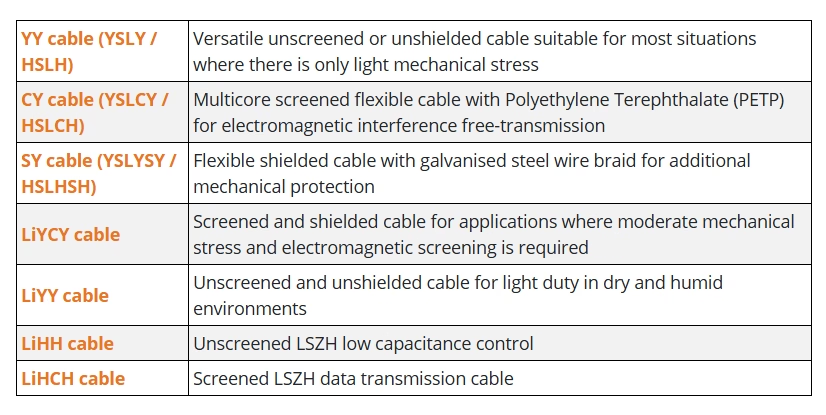
Control Flex cables are specialized multi-core cables designed for measuring, monitoring, and controlling machinery in industrial environments. These cables are essential components in manufacturing facilities, engineering installations, power stations, heating/air conditioning systems, and various electrical control applications. The three main types offered—CY (Copper-Screened), SY (Steel-Braided), and YY (Unscreened)—each provide distinct advantages depending on the application requirements for electromagnetic interference (EMI) protection, mechanical protection, or cost-effective basic control functionality.

Complete Guide to CY, SY & YY Control Flex Cables

P2CY cable, P3CY cable, P4CY cable, P5CY cable, P7CY cable, P3SY cable, P4SY cable, P5SY cable, P2YY cable, P3YY cable, P4YY cable, P5YY cable, P7YY cable, P12YY cable, CY control cable, SY control cable, YY control cable, CY screened cable, SY steel braided cable, YY unscreened cable, copper braid screen, galvanised steel braid, BS EN 50525-2-11, IEC 60332-1, IEC 60228, VDE 0293, screened control cable, shielded control cable, EMI shielding cable, RFI protection cable, signal transmission cable, data transmission cable, manufacturing control cable, industrial control cable, machinery monitoring cable, HVAC control cable, power station cable, PLC cable, automation cable, instrumentation cable, multicore control cable, fine stranded copper, 300/500V cable, flame retardant cable, mechanical protection cable, abrasion resistant cable, 2 core control, 3 core control, 4 core control, 5 core control, 7 core control, 12 core control, 0.75mm control cable, 1.5mm control cable, 2.5mm control cable, 控制電纜, 銅屏蔽電纜, 鋼絲編織電纜, 工業控制電纜, 安徽飛純電纜
What is PROTOMONT EMV-FC (N)SSHCOEU 1 kV for Variable Frequency Converter? Complete technical guide to EMC-optimized motor power supply cables for frequency converter controlled drives in mining, construction, and industrial applications | Anhui Feichun Special Cable Co., Ltd. (安徽飞纯特种电缆有限公司)

What is PROTOMONT EMV-FC (N)SSHCOEU (-45°C) 1 kV for Variable Frequency Converter?

PROTOMONT EMV-FC (N)SSHCOEU represents a specialized category of EMC-optimized rubber-sheathed flexible cables engineered specifically for motor power supply applications in Variable Frequency Drive (VFD) controlled systems. These cables address one of the most significant challenges in modern industrial power distribution: electromagnetic compatibility in high-frequency switching environments. Variable Frequency Drives have revolutionized motor control in mining, construction, and industrial applications by providing precise speed regulation and energy efficiency. However, VFDs also introduce unique electrical challenges. As noted by cable engineering specialists, VFDs require specialized cabling to ensure reliable operation, minimize electromagnetic interference, and maintain safety for the system as a whole, because selecting the right cables and proper installation directly impact performance and equipment longevity (source: KEB America). The PROTOMONT EMV-FC series specifically addresses these challenges through its EMC-optimized concentric braid screen design, making it the ideal choice for frequency converter controlled drives in the mining industry, on construction sites, and similar applications with heavy mechanical stresses.
What is PROTOMONT EMV-FC (N)SSHCOEU 1 kV for Variable Frequency Converter? Complete technical guide to EMC-optimized motor power supply cables for frequency converter controlled drives in mining, construction, and industrial applications | Anhui Feichun Special Cable Co., Ltd. (安徽飞纯特种电缆有限公司)

What is PROTOMONT EMV-FC (N)SSHCOEU 1 kV for Variable Frequency Converter?

PROTOMONT EMV-FC (N)SSHCOEU represents a specialized category of EMC-optimized rubber-sheathed flexible cables engineered specifically for motor power supply applications in Variable Frequency Drive (VFD) controlled systems. These cables address one of the most significant challenges in modern industrial power distribution: electromagnetic compatibility in high-frequency switching environments. Variable Frequency Drives have revolutionized motor control in mining, construction, and industrial applications by providing precise speed regulation and energy efficiency. However, VFDs also introduce unique electrical challenges. As noted by cable engineering specialists, VFDs require specialized cabling to ensure reliable operation, minimize electromagnetic interference, and maintain safety for the system as a whole, because selecting the right cables and proper installation directly impact performance and equipment longevity (source: KEB America). The PROTOMONT EMV-FC series specifically addresses these challenges through its EMC-optimized concentric braid screen design, making it the ideal choice for frequency converter controlled drives in the mining industry, on construction sites, and similar applications with heavy mechanical stresses.
CEI 20-27 CENELEC HD361 Cable

What is CEI 20-27 CENELEC HD361 Cable?

CEI 20-27 CENELEC HD361 represents a standardized cable designation system developed by the European Committee for Electrotechnical Standardisation (CENELEC) to provide uniform identification and classification of harmonized power cables and cords across European markets. This systematic coding methodology enables engineers, procurement specialists, and electrical contractors to precisely identify cable specifications including voltage ratings, insulation materials, conductor types, and sheathing compounds through a structured alphanumeric designation format.