thermoplastic elastomer cable

Extended technical guide for port electrical engineers, fire safety officers, crane OEMs, and terminal procurement teams covering: the fire safety rationale for halogen-free construction in enclosed port environments — hydrogen chloride toxicity, electronic equipment corrosion, and smoke obscuration during fire events; complete nomenclature decoding of the YSLZ3SOE-J designation per German VDE convention; TPE (thermoplastic elastomer) insulation and sheathing compound chemistry and why it differs fundamentally from thermoset rubber (EPR, EPDM, CR) used in standard reeling cables; mechanical performance analysis of TPE versus EPDM in dynamic reeling applications — flex-cycle endurance, tensile strength, tear resistance, and cold-temperature flexibility; vertical free-fall basket operation mechanics — catenary stress, coiling geometry, impact loading, and why basket spreader cables require different engineering than drum-wound reeling cables; IEC 60332-3 (flame propagation in bunched cables), IEC 61034 (smoke density measurement), and IEC 60754-2 (gas acidity by pH and conductivity) compliance analysis; salt fog performance limitations of TPE compounds (400–700 hours per ISO 9227) versus polychloroprene alternatives (800–1,500 hours); comparative evaluation against RHEYCORD® NSHTOEU-J (standard CR reeling), RHEYCORD®(RTS) (N)SHTOEU-J (premium CR reeling), RHEYCORD®-OFE SR (oil-resistant CR spreader), and CORDAFLEX® SMK-V (aramid-core vertical spreader); and FeiChun FC-RHEYCORD-BS marine-grade halogen-free equivalent with enhanced moisture barrier, FC-FLX™ tinned conductors, and aramid strength member for coastal service.

RHEYCORD®(BS) YSLZ3SOE-J — The Halogen-Free Basket Spreader Reeling Cable for Fire-Regulated Port Environments: TPE Construction Analysis, Vertical Free-Fall Basket Engineering, IEC 60332-3 / IEC 61034 / IEC 60754-2 Fire Safety Compliance, Salt Fog Performance Trade-Offs in Harbour Service, and Comparative Evaluation Against RHEYCORD® NSHTOEU-J, RHEYCORD®(RTS), RHEYCORD®-OFE SR, and CORDAFLEX® SMK-V with FeiChun FC-RHEYCORD-BS Marine-Grade Enhanced Equivalent

Extended technical guide for port electrical engineers, fire safety officers, crane OEMs, and terminal procurement teams covering: the fire safety rationale for halogen-free construction in enclosed port environments — hydrogen chloride toxicity, electronic equipment corrosion, and smoke obscuration during fire events; complete nomenclature decoding of the YSLZ3SOE-J designation per German VDE convention; TPE (thermoplastic elastomer) insulation and sheathing compound chemistry and why it differs fundamentally from thermoset rubber (EPR, EPDM, CR) used in standard reeling cables; mechanical performance analysis of TPE versus EPDM in dynamic reeling applications — flex-cycle endurance, tensile strength, tear resistance, and cold-temperature flexibility; vertical free-fall basket operation mechanics — catenary stress, coiling geometry, impact loading, and why basket spreader cables require different engineering than drum-wound reeling cables; IEC 60332-3 (flame propagation in bunched cables), IEC 61034 (smoke density measurement), and IEC 60754-2 (gas acidity by pH and conductivity) compliance analysis; salt fog performance limitations of TPE compounds (400–700 hours per ISO 9227) versus polychloroprene alternatives (800–1,500 hours); comparative evaluation against RHEYCORD® NSHTOEU-J (standard CR reeling), RHEYCORD®(RTS) (N)SHTOEU-J (premium CR reeling), RHEYCORD®-OFE SR (oil-resistant CR spreader), and CORDAFLEX® SMK-V (aramid-core vertical spreader); and FeiChun FC-RHEYCORD-BS marine-grade halogen-free equivalent with enhanced moisture barrier, FC-FLX™ tinned conductors, and aramid strength member for coastal service.
VERSOLEX 90OC, single core flexible cable, AS/NZS 5000.1, AS/NZS 1995, X-90 insulation, TPE-90 sheath, welding cable, 0.6/1kV cable, industrial power cable, flexible copper conductor, 90°C rated cable

What is VERSOLEX® 90°C Single Core Cable?

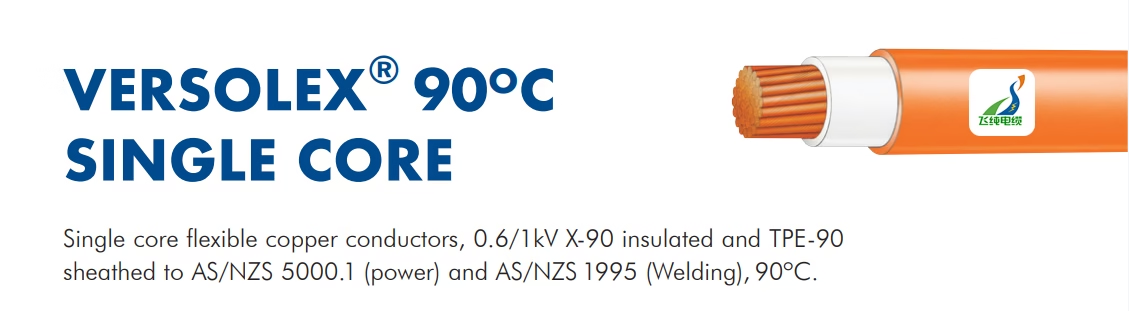
The VERSOLEX® 90OC Single Core cable represents a premium-grade flexible power cable engineered specifically for demanding industrial applications where exceptional flexibility, thermal endurance, and electrical performance are critical requirements. This specialized cable features single core flexible copper conductors rated at 0.6/1kV, utilizing X-90 (XLPE) insulation combined with TPE-90 (Thermoplastic Elastomer) sheathing to achieve superior performance characteristics across a broad range of operating conditions.
Reeling Drum Cables for Port Cranes and Material Handling: Complete Engineering Guide Understanding NSHTÖU, TSCGEWÖU, and PUR Polyurethane Cables - Technical Specifications, Standards Compliance, Selection Criteria, and GB/T 5013 Limitations

Reeling Drum Cables for Port Cranes and Material Handling: Complete Engineering Guide

Reeling Drum Cables for Port Cranes and Material Handling: Complete Engineering Guide Understanding NSHTÖU, TSCGEWÖU, and PUR Polyurethane Cables – Technical Specifications, Standards Compliance, Selection Criteria, and GB/T 5013 Limitations
CSA C22.2 NO. 96:23 - Portable Power Cables Comprehensive Technical Analysis and Application Guide

CSA C22.2 NO. 96:23 – Portable Power Cables

CSA C22.2 NO. 96:23 represents the twelfth edition of the Canadian portable power cable standard, published as a National Standard of Canada by CSA Group under the Canadian Electrical Code, Part II. This standard supersedes all previous editions dating back to 1951, with the 2023 edition incorporating significant technical updates and expanded cable categories to address evolving industrial requirements.
NEC Article 400, Table 400.4 Cable

Understanding NEC Article 400, Table 400.4: Complete Technical Guide to Flexible Cord and Cable Specifications

National Electrical Code (NEC) Article 400 establishes comprehensive requirements for flexible cords and flexible cables used in electrical installations throughout North America. According to the National Fire Protection Association (NFPA), Article 400 specifically covers general requirements, applications, and construction specifications for flexible cords and flexible cables rated up to 600 volts maximum, with special provisions for electric vehicle cables rated up to 1000 volts maximum.