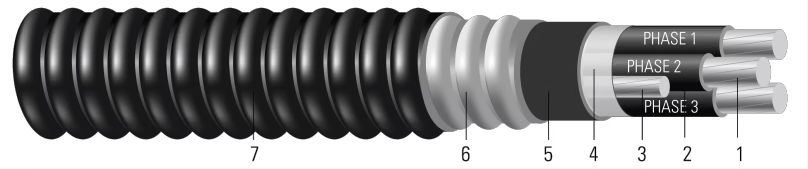
steel mill cable

FLEXIFESTOON® SPECIAL NE-FLAT: Advanced High-Temperature Flat Cable for Steel Mills, Petrochemical Plants, Renewable Energy Systems, and Extreme-Environment Industrial Control Feichun's revolutionary FLEXIFESTOON® SPECIAL NE-FLAT high-temperature cable platform delivers extreme thermal resilience (+135°C continuous flexible application with GAALTHERM® 533 insulation, or +90°C with XLPE), combined with halogen-free environmental compliance, 50 Mrad radiation hardening, and ultra-flexible parallel-core architecture enabling deployment in the world's most thermally demanding industrial environments—steel production, petrochemical processing, renewable energy infrastructure, and advanced thermal management systems.

FLEXIFESTOON® SPECIAL NE-FLAT

FLEXIFESTOON® SPECIAL NE-FLAT: Advanced High-Temperature Flat Cable for Steel Mills, Petrochemical Plants, Renewable Energy Systems, and Extreme-Environment Industrial Control Feichun’s revolutionary FLEXIFESTOON® SPECIAL NE-FLAT high-temperature cable platform delivers extreme thermal resilience (+135°C continuous flexible application with GAALTHERM® 533 insulation, or +90°C with XLPE), combined with halogen-free environmental compliance, 50 Mrad radiation hardening, and ultra-flexible parallel-core architecture enabling deployment in the world’s most thermally demanding industrial environments—steel production, petrochemical processing, renewable energy infrastructure, and advanced thermal management systems.
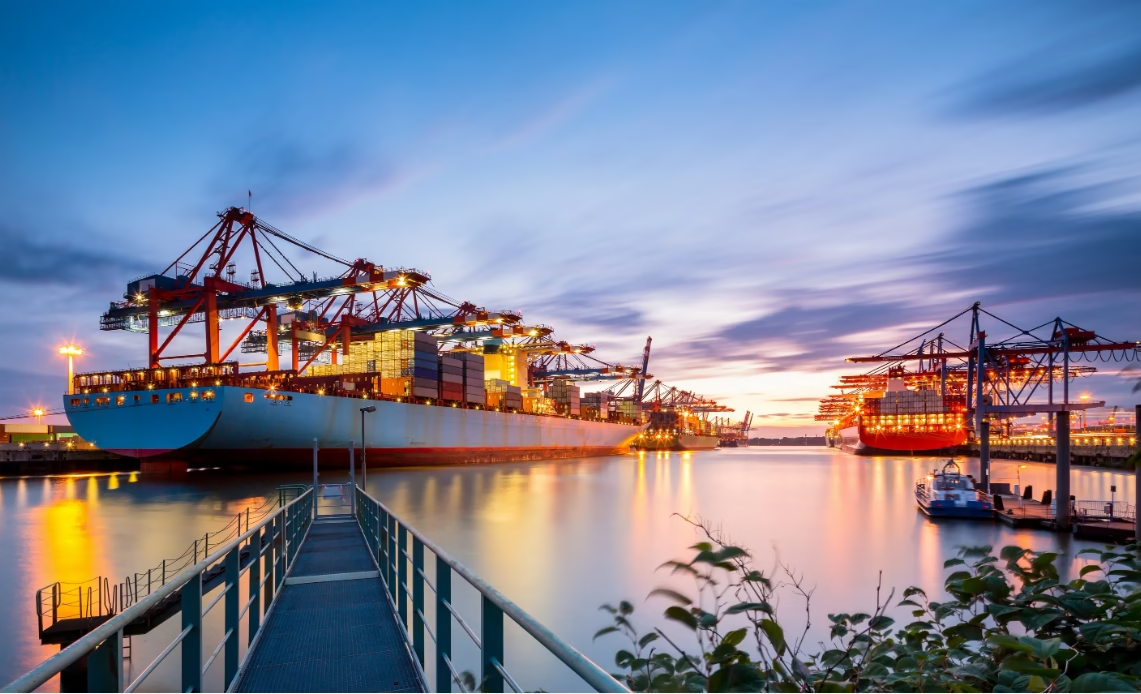
For cables deployed in the extreme radiant heat environment near steel mill slag transfer cars, where surface temperatures frequently reach 120°C to 150°C and occasionally exceed 160°C, the LAPP ÖLFLEX HEAT 180 silicone cable is substantially better suited than the standard (N)GRXGöu rubber cable, provided appropriate thermal monitoring and distance spacing are maintained. The LAPP ÖLFLEX HEAT 180, with its continuous operating temperature rating of 180°C (short-term to 200°C), provides a practical safety margin that allows reliable operation even when cable surface temperatures approach 150°C, whereas the (N)GRXGöu, rated for 90°C continuous operation (or 120°C for specialized high-temperature variants), begins to experience unacceptable material degradation at surface temperatures above 100°C to 110°C. However, the critical distinction that engineers often overlook is that a cable rated for 180°C continuous operation is not automatically safe when placed near a radiant heat source at 150°C surface temperature. The actual service life and reliability depend on multiple factors beyond the simple temperature comparison: the duration of exposure, whether the radiant heat exposure is continuous or intermittent, thermal cycling between high and low temperatures, the specific material composition and thermal cycling resistance of the insulation, cable routing distance from the heat source, and implementation of heat shielding or protective conduit. In actual steel mill deployments at integrated steelworks and open-hearth facilities, cables properly routed with 1 to 2 meters clearance from slag cars and protected with ceramic or reflective heat shielding can achieve 3 to 5 years of reliable service using LAPP ÖLFLEX HEAT 180, compared to approximately 6 to 12 months of acceptable service for standard (N)GRXGöu in the same thermal environment. The premium cost of LAPP ÖLFLEX HEAT 180—typically 40 to 60 percent higher than standard (N)GRXGöu—is economically justified in steel mill applications primarily because the extended service life and reduced replacement frequency far outweigh the higher initial cable cost, and secondarily because unplanned cable failures in integrated steelworks can cause production shutdowns costing tens of thousands of euros per hour.

High-Temperature Cable Selection: Can (N)GRXGöu or LAPP ÖLFLEX HEAT 180 Survive Radiant Heat Near Steel Mill Slag Transfer Cars?

For cables deployed in the extreme radiant heat environment near steel mill slag transfer cars, where surface temperatures frequently reach 120°C to 150°C and occasionally exceed 160°C, the LAPP ÖLFLEX HEAT 180 silicone cable is substantially better suited than the standard (N)GRXGöu rubber cable, provided appropriate thermal monitoring and distance spacing are maintained. The LAPP ÖLFLEX HEAT 180, with its continuous operating temperature rating of 180°C (short-term to 200°C), provides a practical safety margin that allows reliable operation even when cable surface temperatures approach 150°C, whereas the (N)GRXGöu, rated for 90°C continuous operation (or 120°C for specialized high-temperature variants), begins to experience unacceptable material degradation at surface temperatures above 100°C to 110°C. However, the critical distinction that engineers often overlook is that a cable rated for 180°C continuous operation is not automatically safe when placed near a radiant heat source at 150°C surface temperature. The actual service life and reliability depend on multiple factors beyond the simple temperature comparison: the duration of exposure, whether the radiant heat exposure is continuous or intermittent, thermal cycling between high and low temperatures, the specific material composition and thermal cycling resistance of the insulation, cable routing distance from the heat source, and implementation of heat shielding or protective conduit. In actual steel mill deployments at integrated steelworks and open-hearth facilities, cables properly routed with 1 to 2 meters clearance from slag cars and protected with ceramic or reflective heat shielding can achieve 3 to 5 years of reliable service using LAPP ÖLFLEX HEAT 180, compared to approximately 6 to 12 months of acceptable service for standard (N)GRXGöu in the same thermal environment. The premium cost of LAPP ÖLFLEX HEAT 180—typically 40 to 60 percent higher than standard (N)GRXGöu—is economically justified in steel mill applications primarily because the extended service life and reduced replacement frequency far outweigh the higher initial cable cost, and secondarily because unplanned cable failures in integrated steelworks can cause production shutdowns costing tens of thousands of euros per hour.
Festoon systems are critical components in industrial applications where power, control, and data cables must travel with moving equipment such as overhead cranes, gantry cranes, automated storage and retrieval systems (AS/RS), and material handling equipment. The selection of appropriate flat cables for these systems directly impacts operational reliability, maintenance costs, and system longevity.

Draka Buflex vs. (N)TSFLCGEWÖU: Which Flat Cable is Best for Festoon Systems?

Festoon systems are critical components in industrial applications where power, control, and data cables must travel with moving equipment such as overhead cranes, gantry cranes, automated storage and retrieval systems (AS/RS), and material handling equipment. The selection of appropriate flat cables for these systems directly impacts operational reliability, maintenance costs, and system longevity.
To understand why Type 450-FO composite cables represent such a significant advancement for stacker-reclaimer applications, we first need to appreciate what makes these cables different from traditional power or communication cables. Think of a Type 450-FO composite cable as a sophisticated integration of two fundamentally different technologies working together in harmony within a single protective structure. The designation "450-FO" tells us important information about this cable's design: the "450" typically indicates the voltage rating in volts for the power conductors, while "FO" stands for Fiber Optic, signaling that optical fibers are integrated within the same cable assembly alongside the copper power conductors. 要理解为什么Type 450-FO复合电缆代表了堆取料机应用的重大进步,我们首先需要了解是什么使这些电缆与传统的电力或通信电缆不同。将Type 450-FO复合电缆想象为两种根本不同技术的复杂集成,在单个保护结构内和谐地协同工作。"450-FO"名称告诉我们有关这种电缆设计的重要信息:"450"通常表示电力导体的额定电压(以伏特为单位),而"FO"代表光纤,表示光纤与铜电力导体一起集成在同一电缆组件中。

Integrated Fiber Optics: Advantages of Type 450-FO Composite Cables for Remote-Controlled Stacker-Reclaimers

To understand why Type 450-FO composite cables represent such a significant advancement for stacker-reclaimer applications, we first need to appreciate what makes these cables different from traditional power or communication cables. Think of a Type 450-FO composite cable as a sophisticated integration of two fundamentally different technologies working together in harmony within a single protective structure. The designation “450-FO” tells us important information about this cable’s design: the “450” typically indicates the voltage rating in volts for the power conductors, while “FO” stands for Fiber Optic, signaling that optical fibers are integrated within the same cable assembly alongside the copper power conductors. 要理解为什么Type 450-FO复合电缆代表了堆取料机应用的重大进步,我们首先需要了解是什么使这些电缆与传统的电力或通信电缆不同。将Type 450-FO复合电缆想象为两种根本不同技术的复杂集成,在单个保护结构内和谐地协同工作。”450-FO”名称告诉我们有关这种电缆设计的重要信息:”450″通常表示电力导体的额定电压(以伏特为单位),而”FO”代表光纤,表示光纤与铜电力导体一起集成在同一电缆组件中。
The German DIN VDE cable designation system provides engineers and procurement specialists with a comprehensive coding methodology that communicates essential cable characteristics through standardized letter and number sequences. Within this system, the symbol Ö (pronounced "Oe" in romanized form) represents one of the most critical performance indicators for cables deployed in demanding industrial applications.[1][2] 德国DIN VDE电缆标识系统为工程师和采购专家提供了一套全面的编码方法,通过标准化的字母和数字序列传达电缆的基本特性。在该系统中,符号"Ö"(罗马化读作"Oe")代表在苛刻工业应用中部署的电缆最关键的性能指标之一。

What is the Meaning of the Symbol “Ö” (or “Oe”) in VDE Cable Codes, and Why is it Critical for Industrial Environments?

The German DIN VDE cable designation system provides engineers and procurement specialists with a comprehensive coding methodology that communicates essential cable characteristics through standardized letter and number sequences. Within this system, the symbol Ö (pronounced “Oe” in romanized form) represents one of the most critical performance indicators for cables deployed in demanding industrial applications.[1][2] 德国DIN VDE电缆标识系统为工程师和采购专家提供了一套全面的编码方法,通过标准化的字母和数字序列传达电缆的基本特性。在该系统中,符号”Ö”(罗马化读作”Oe”)代表在苛刻工业应用中部署的电缆最关键的性能指标之一。
FESTOONFLEX-LX 0,6/1 kV is a premium instrumentation and control cable engineered for mining operations and bulk material handling applications. This cable is specifically designed for festoon systems and connecting movable parts of machine tools where fast movement, strong acceleration, and frequent bending during operation are critical requirements.

FESTOONFLEX-LX 0,6/1 kV Instrumentation & Control Cable

FESTOONFLEX-LX, FESTOONFLEX-LX 0.6/1kV, instrumentation cable, control cable, mining control cable, festoon cable, IEC 60228 Class 5, DIN VDE 0298, screened pairs cable, EPR insulation, polychloroprene sheath, UV resistant cable, oil resistant cable, crushproof cable, 90°C rated cable, -30°C low temperature, mining equipment cable, crane control cable, conveyor instrumentation, bulk material handling, high flex cable, torsion resistant cable, EMI shielded cable, 80% screen coverage, 4G control cable, 5G control cable, multi-core cable, Anhui Feichun cable, 礦用控制電纜, 儀表電纜, 懸掛電纜, 屏蔽對電纜, 特種電纜
The 600V 2TC-RB crane cable represents a specialized category of rubber-insulated flexible cables engineered specifically for mobile machinery applications in demanding industrial environments. The designation "2TC-RB" identifies this as a Class 2 conductor construction featuring tin-coated copper strands, ethylene propylene rubber (EPR) insulation, and a robust polychloroprene rubber (also known as neoprene) outer sheath.

What is 600V 2TC-RB Crane Cable?

The 600V 2TC-RB crane cable represents a specialized category of rubber-insulated flexible cables engineered specifically for mobile machinery applications in demanding industrial environments. The designation “2TC-RB” identifies this as a Class 2 conductor construction featuring tin-coated copper strands, ethylene propylene rubber (EPR) insulation, and a robust polychloroprene rubber (also known as neoprene) outer sheath.