NEK 606 cable

For fixed installation in petrochemical facility hydraulic oil leak zones, Type P (X110) radiation-cross-linked polyolefin cables are the superior choice and are mandated by international standards including IEEE 1580, NEK 606, and major chemical plant engineering codes. Type P cables are rated for continuous operation at 110°C conductor temperature (compared to 80°C for standard PUR), feature superior flame retardancy meeting IEEE 1202 and IEC 60332-3-22 standards with zero halogen emissions, maintain 80 to 90 percent property retention after 5 to 10 years of continuous chemical exposure compared to 40 to 60 percent for generic PUR, and provide exceptional compatibility with both mineral-based and synthetic fire-resistant hydraulic fluids including phosphate esters (Skydrol-type fluids) that cause significant swelling in standard polyurethane. Generic polyurethane (PUR) cables excel in mobile and continuously flexing applications where mechanical abrasion resistance is paramount and environmental temperatures remain moderate, but they are unsuitable for fixed installation in chemical plant hydraulic zones where thermal stability, chemical resistance, and fire safety are controlling factors. The critical distinction lies in understanding that PUR's unparalleled mechanical durability and flexibility come at the cost of reduced thermal stability, limited chemical compatibility with synthetic fluids, and combustion behavior that creates fire propagation hazards in leak-zone environments. For typical petrochemical facility power distributions, refinery hydraulic pump station cabling, and fixed deck-mounted power leads, Type P (X110) provides the material durability, regulatory compliance, and safety performance required by modern chemical plant standards. However, for mobile heavy machinery such as drag-chain robotic systems, floating platform equipment, or port machinery where the cable undergoes millions of bend cycles and mechanical stress is the primary degradation driver, high-flexibility PUR variants (or specialized hybrid formulations combining PUR's mechanical properties with enhanced chemical resistance) may provide better lifecycle economics despite shorter service life in static chemical exposure. Understanding which cable to specify depends on accurately identifying whether thermal stability and fire safety (favoring Type P) or mechanical durability and continuous flexing (favoring PUR) represent the controlling design constraint for your specific application.

Chemical Plants: Selecting Between Type P (X110) and Generic PUR Cables for Hydraulic Oil Leak Zones

For fixed installation in petrochemical facility hydraulic oil leak zones, Type P (X110) radiation-cross-linked polyolefin cables are the superior choice and are mandated by international standards including IEEE 1580, NEK 606, and major chemical plant engineering codes. Type P cables are rated for continuous operation at 110°C conductor temperature (compared to 80°C for standard PUR), feature superior flame retardancy meeting IEEE 1202 and IEC 60332-3-22 standards with zero halogen emissions, maintain 80 to 90 percent property retention after 5 to 10 years of continuous chemical exposure compared to 40 to 60 percent for generic PUR, and provide exceptional compatibility with both mineral-based and synthetic fire-resistant hydraulic fluids including phosphate esters (Skydrol-type fluids) that cause significant swelling in standard polyurethane. Generic polyurethane (PUR) cables excel in mobile and continuously flexing applications where mechanical abrasion resistance is paramount and environmental temperatures remain moderate, but they are unsuitable for fixed installation in chemical plant hydraulic zones where thermal stability, chemical resistance, and fire safety are controlling factors. The critical distinction lies in understanding that PUR’s unparalleled mechanical durability and flexibility come at the cost of reduced thermal stability, limited chemical compatibility with synthetic fluids, and combustion behavior that creates fire propagation hazards in leak-zone environments. For typical petrochemical facility power distributions, refinery hydraulic pump station cabling, and fixed deck-mounted power leads, Type P (X110) provides the material durability, regulatory compliance, and safety performance required by modern chemical plant standards. However, for mobile heavy machinery such as drag-chain robotic systems, floating platform equipment, or port machinery where the cable undergoes millions of bend cycles and mechanical stress is the primary degradation driver, high-flexibility PUR variants (or specialized hybrid formulations combining PUR’s mechanical properties with enhanced chemical resistance) may provide better lifecycle economics despite shorter service life in static chemical exposure. Understanding which cable to specify depends on accurately identifying whether thermal stability and fire safety (favoring Type P) or mechanical durability and continuous flexing (favoring PUR) represent the controlling design constraint for your specific application.
NEK 606 RFOU 0.6/1kV P1/P8 cable is specifically designed with mud-resistant SHF2 MUD heat-set thermoset outer sheath and is rated to withstand prolonged exposure to ester-based drilling mud, making it suitable for continuous mud-zone service typically lasting 5 to 7 years before material property degradation requires cable replacement or service assessment. The cable's heat-set thermoset formulation provides superior resistance to synthetic ester drilling fluids compared to standard elastomeric jackets, as the cross-linked polymer structure exhibits swelling rates of approximately 20 to 35 percent in typical ester-based drilling muds, compared to 50 to 80 percent swelling in non-resistant elastomers. However, the term "mud resistant" represents a carefully defined performance envelope, not unlimited exposure—the cable is qualified for service in drilling mud zones where the cable may be splashed, partially immersed, or in periodic contact with mud over operational periods measured in years, but not for continuous full immersion in mud-filled drilling riser pipes or mud tanks where exposure conditions exceed the design assumptions underlying the material formulation. In such extreme immersion scenarios, service life may be reduced to 2 to 4 years depending on temperature, pressure, and the specific chemical composition of the drilling mud system. Understanding the distinction between standard mud-zone service (where the cable experiences periodic mud contact in the operational envelope for which P1/P8 is certified) and extreme continuous immersion scenarios (where cable selection must be upgraded or enhanced) is critical to avoiding premature field failures. For typical offshore drilling platforms, FPSO systems, and subsea support vessel applications operating in the North Sea, Southeast Asia, or West African waters, the NEK 606 RFOU P1/P8 provides reliable, field-proven performance that meets or exceeds the mud-zone cable specifications of major offshore operators including DNV GL, Lloyds Register, and the American Petroleum Institute.

Mud Resistance of NEK 606 RFOU 0.6/1kV P1/P8: Can This Offshore Cable Withstand Prolonged Exposure to Ester-Based Drilling Mud?

NEK 606 RFOU 0.6/1kV P1/P8 cable is specifically designed with mud-resistant SHF2 MUD heat-set thermoset outer sheath and is rated to withstand prolonged exposure to ester-based drilling mud, making it suitable for continuous mud-zone service typically lasting 5 to 7 years before material property degradation requires cable replacement or service assessment. The cable’s heat-set thermoset formulation provides superior resistance to synthetic ester drilling fluids compared to standard elastomeric jackets, as the cross-linked polymer structure exhibits swelling rates of approximately 20 to 35 percent in typical ester-based drilling muds, compared to 50 to 80 percent swelling in non-resistant elastomers. However, the term “mud resistant” represents a carefully defined performance envelope, not unlimited exposure—the cable is qualified for service in drilling mud zones where the cable may be splashed, partially immersed, or in periodic contact with mud over operational periods measured in years, but not for continuous full immersion in mud-filled drilling riser pipes or mud tanks where exposure conditions exceed the design assumptions underlying the material formulation. In such extreme immersion scenarios, service life may be reduced to 2 to 4 years depending on temperature, pressure, and the specific chemical composition of the drilling mud system. Understanding the distinction between standard mud-zone service (where the cable experiences periodic mud contact in the operational envelope for which P1/P8 is certified) and extreme continuous immersion scenarios (where cable selection must be upgraded or enhanced) is critical to avoiding premature field failures. For typical offshore drilling platforms, FPSO systems, and subsea support vessel applications operating in the North Sea, Southeast Asia, or West African waters, the NEK 606 RFOU P1/P8 provides reliable, field-proven performance that meets or exceeds the mud-zone cable specifications of major offshore operators including DNV GL, Lloyds Register, and the American Petroleum Institute.
Type MMV 15kV 3/C 4/0 AWG marine medium voltage cable has a base continuous ampacity of 270 amperes when the conductor temperature reaches 90°C under standard ambient conditions of 45°C (113°F) in free air. This rating follows IEEE 45-2002 and IEEE 1580 marine standards and represents the maximum sustained current the cable can safely carry without exceeding the EPR insulation thermal limit. The cable features three 4/0 AWG (107.2 mm²) main power conductors of Class 5 highly flexible tinned copper stranding, supplemented by symmetrical grounding and shielding geometry optimized for maritime power distribution in offshore drilling units (MODUs), floating production storage offloading (FPSO) vessels, and port machinery applications. Approximate copper weight is 3,345 kg/km, and total cable weight is approximately 5,950 kg/km (unarmored) or 6,400 kg/km (bronze-braided armored variant).

Ampacity Chart: How Much Current Can Type MMV 15kV 3/C 4/0 AWG Marine Cable Carry at 90°C?

Understanding ampacity for marine cables differs fundamentally from standard industrial land-based cables because marine environments present unique thermal challenges. Shipboard cable routing often passes through engine rooms, boiler compartments, and tropical climates where ambient air temperatures routinely exceed the standard reference condition of 45°C. Additionally, marine cables must account for the physical constraints of vessel design—cables are bundled in trays, enclosed in cable trunking, and subjected to continuous vibration from engine operation and heavy sea state conditions. These factors necessitate precise ampacity derating calculations to ensure the cable operates safely throughout its design life without insulation degradation.
The ampacity of NEK 606 RFOU 0.6/1kV 4G120 mm² cable in free air at the NEK 606 standard reference condition (45°C ambient, 90°C conductor temperature) is approximately 260 amperes for a single cable installed on an open support structure with unrestricted air circulation. When this same cable is installed in a two-tier (double-banked) configuration where one 4G120 cable sits directly above another with minimal vertical spacing (typical spacing 50–100 mm between outer sheaths), the ampacity of each cable must be derated to approximately 200–215 amperes, representing a derating factor of about 0.78–0.82 or roughly an 18–22% reduction from the free-air rating. When three cables are stacked vertically (three-tier configuration), the derating becomes more severe: the bottom cable sees approximately 0.68–0.72 factor (177–187 A), the middle cable experiences approximately 0.70–0.74 factor (182–192 A), and the top cable maintains approximately 0.80–0.85 factor (208–221 A). The fundamental reason for these derating reductions is that vertically stacked cables cannot dissipate heat as effectively as cables in free air because the upper cables partially shield the lower cables from direct air circulation, creating a thermally interactive system where the waste heat from upper cables warms the ambient environment around lower cables, reducing their cooling effectiveness and thereby their safe operating current capacity.

Double-Banked Cable Trays: What is the ampacity derating factor for NEK 606 RFOU 0.6/1kV 4G120 mm² cables installed in vertically stacked (double-banked) offshore platform configurations?

The ampacity of NEK 606 RFOU 0.6/1kV 4G120 mm² cable in free air at the NEK 606 standard reference condition (45°C ambient, 90°C conductor temperature) is approximately 260 amperes for a single cable installed on an open support structure with unrestricted air circulation. When this same cable is installed in a two-tier (double-banked) configuration where one 4G120 cable sits directly above another with minimal vertical spacing (typical spacing 50–100 mm between outer sheaths), the ampacity of each cable must be derated to approximately 200–215 amperes, representing a derating factor of about 0.78–0.82 or roughly an 18–22% reduction from the free-air rating. When three cables are stacked vertically (three-tier configuration), the derating becomes more severe: the bottom cable sees approximately 0.68–0.72 factor (177–187 A), the middle cable experiences approximately 0.70–0.74 factor (182–192 A), and the top cable maintains approximately 0.80–0.85 factor (208–221 A). The fundamental reason for these derating reductions is that vertically stacked cables cannot dissipate heat as effectively as cables in free air because the upper cables partially shield the lower cables from direct air circulation, creating a thermally interactive system where the waste heat from upper cables warms the ambient environment around lower cables, reducing their cooling effectiveness and thereby their safe operating current capacity.
NEK 606 UX/UX(I) Technical Specifications Table The comprehensive specifications table below presents the complete range of commercially available conductor sizes for NEK 606 cables. This data encompasses the critical parameters that electrical engineers require when conducting load calculations, short-circuit analysis, and installation planning for offshore electrical systems. All ampacity values reference the baseline condition of 45°C ambient temperature in free air, single conductor installation per IEC 60092-352 standards.

Troubleshooting NEK 606 UX/UX(I) Mud-Resistant Grounding Cables on Offshore Platforms

NEK 606 UX/UX(I) Technical Specifications Table The comprehensive specifications table below presents the complete range of commercially available conductor sizes for NEK 606 cables. This data encompasses the critical parameters that electrical engineers require when conducting load calculations, short-circuit analysis, and installation planning for offshore electrical systems. All ampacity values reference the baseline condition of 45°C ambient temperature in free air, single conductor installation per IEC 60092-352 standards.
The European and American approaches to cable engineering reflect fundamentally different environmental threat models. BFOU cables manufactured to NEK 606 specifications incorporate halogen-free insulation, SHF2 H-M compound sheathing, and mica glass tape (MGT) as a fire barrier, enabling uninterrupted power delivery during fire situations in accordance with IEC 60331-21. This design prioritizes survival of critical systems during extreme thermal events—a recognized hazard in confined spaces such as engine rooms and living quarters aboard offshore vessels.

Why Your BFOU Cable Needs a Type N Jacket Upgrade?

The European and American approaches to cable engineering reflect fundamentally different environmental threat models. BFOU cables manufactured to NEK 606 specifications incorporate halogen-free insulation, SHF2 H-M compound sheathing, and mica glass tape (MGT) as a fire barrier, enabling uninterrupted power delivery during fire situations in accordance with IEC 60331-21. This design prioritizes survival of critical systems during extreme thermal events—a recognized hazard in confined spaces such as engine rooms and living quarters aboard offshore vessels.
Shipwiring and offshore platform cables represent a specialized category of marine cables designed to perform reliably in the most demanding environments on earth—at sea. These cables must withstand extreme temperature variations (from Arctic cold to engine room heat), constant exposure to humidity, salt water, oils, acids, and drilling muds, while maintaining electrical integrity for power, control, signal, instrumentation, and communication applications. The primary international standards governing these cables include NEK 606 (Norwegian standard for offshore floating platforms), IEC 60092 (electrical installations in ships), BS 6883 (fixed wiring in offshore units), and BS 7917 (fire resistant cables for offshore applications).

What are Shipwiring & Offshore Platform Cables?

NEK 606 cable, BFOU cable, RFOU cable, NEK 606 BFOU, NEK 606 RFOU, offshore platform cable, MUD resistant cable, Norwegian offshore cable, floating platform cable, FPSO cable, marine cable, offshore cable, shipwiring cable, ship cable, offshore platform cable, marine power cable, ship electrical cable, naval cable, maritime cable, at-sea cable,RFOU P101, BFOU P105, RFOU S101, RFOU S102, BFOU S103, BFOU S104, UX P108, RFOU P102, RFOU P103, RFOU P104, RFOU P112, RFOU P113
NEK TS 606 is the Norwegian offshore industry technical specification (TS) covering a range of power, instrumentation and earth cables that are halogen free and/or MUD resistant, protecting them against the type of hydrocarbon-laden drilling liquid used in drilling operations which can have an adverse effect on cable sheathing materials. Originally published in 1993 by the Norwegian Electrotechnical Committee (NEK) as a successor to the 'Recommended Practice for Specification of Cables' of the Norwegian Oil Industry Association, NEK 606 has evolved to become an internationally accepted standard for offshore cable applications.

What is NEK 606 Cable?

NEK 606, NEK TS 606, NEK 606 cable, offshore cable, BFOU cable, RFOU cable, Norwegian offshore standard, oil gas cable, mud resistant cable, fire resistant cable, halogen free cable, offshore power cable, offshore instrumentation cable, marine cable
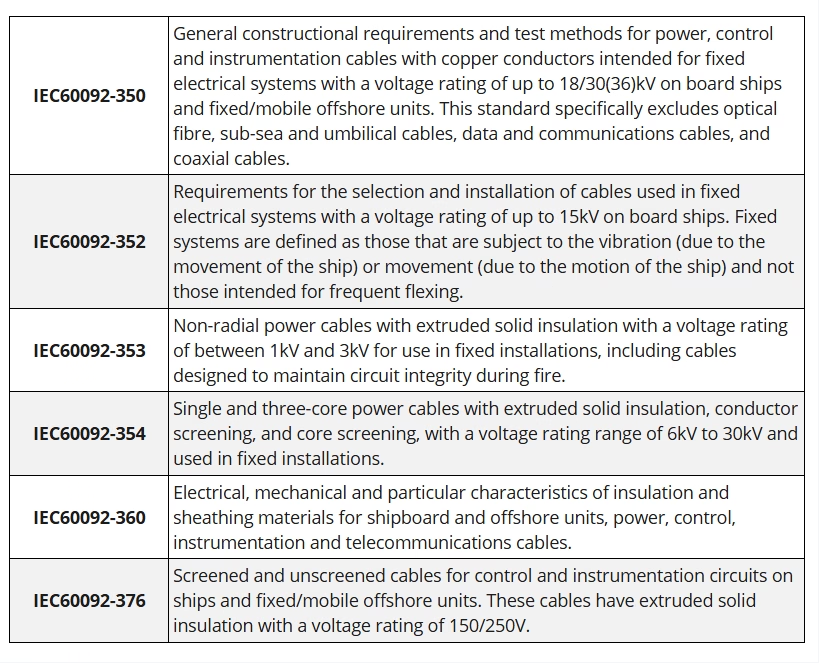
IEC 60092 is the international standard for electrical installations in ships and fixed/mobile marine applications. Ship wiring is covered by various national standards such as BS 6883 (British) and NEK 606 (Norwegian), and subject to third-party accreditations including Lloyd's Register, DNV (Det Norske Veritas), and ABS (American Bureau of Shipping). As an international standard, IEC 60092 covers power and instrumentation cables for use on ships and in mobile marine environments.

What is IEC 60092 Cable?

IEC 60092 cable, marine cable, shipboard cable, offshore cable, BS 6883 cable, NEK 606 cable, BFOU cable, RFOU cable, 657TQ cable, 658TQ cable, fire resistant marine cable, flame retardant cable, ship wiring, offshore platform cable, Lloyd’s Register approved, DNV certified, halogen free cable, LSZH marine cable, MUD resistant cable, IEC 60092-353, IEC 60092-354, IEC 60092-376, SW4 cable, EPR insulated, TCWB armoured, instrumentation cable, control cable, emergency power cable, oil rig cable, Feichun cable
DNV (Det Norske Veritas) is an international accredited registrar and classification society headquartered in Høvik, Norway. As one of the world's leading classification societies, DNV provides certification, verification, and risk management services for the maritime, oil & gas, renewable energy, and other industries. DNV approved cables are electrical cables that have been tested, verified, and certified by DNV to meet stringent safety, quality, and performance standards for use in marine and offshore applications.

What is DNV Approved Cable?

offshore platform cable, drilling platform cable, oil rig cable, FPSO cable, jackup rig cable, semi-submersible cable, drillship cable, offshore wind farm cable, wind turbine cable, subsea cable, underwater cable, shipboard wiring cable, ship electrical cable, naval vessel cable, cruise ship cable, ferry cable, offshore substation cable, offshore power distribution, marine electrical installation
Feichun Cable

NEK TS 606:2009 Cable Code Designation

NEK TS 606:2009 represents the Norwegian offshore industry technical specification (TS) that has become a globally recognized standard for cables used in marine and offshore oil and gas installations. This specification covers a comprehensive range of power, instrumentation, and earth cables that are specifically designed to be halogen-free and mud-resistant, providing critical protection against hydrocarbon-laden drilling liquids commonly encountered in offshore drilling operations. The Norwegian Electrotechnical Committee (NEK), founded in 1912, manages this specification and serves as an independent organization championing electrotechnical standardization. NEK became the 21st member of the International Electrotechnical Commission (IEC) and is recognized as the national body responsible for standardization in the electrotechnical field. The organizational structure of NEK mirrors that of the IEC in the standardization domain, ensuring international compatibility and recognition.
Marine Cable

What is NEK TS 606:2025 Cable Code Designation?

NEK TS 606:2025 represents the most comprehensive technical specification for offshore and marine cables, developed by the Norwegian Electrotechnical Committee (NEK) to address the extreme demands of the oil and gas industry, offshore platforms, and marine vessels. This specification has become the global benchmark for cable performance in harsh offshore environments, superseding many regional standards through its rigorous requirements for fire resistance, halogen-free construction, and mud resistance.