Mining Cable

FLEXIFESTOON® SEOOW YELLOW represents FeiChun's entry into the low-voltage festoon and temporary power market. The nomenclature requires careful explanation to distinguish this product from the high-voltage FLEXIDRUM series: FLEXIFESTOON Product Nomenclature: FLEXIFESTOON® = Product family name Flex = Flexible (emphasis on bending & handling) Festoon = Strung overhead in continuous runs (typical festoon lighting application) SEOOW = Industry-standard designation S = Service cord (temporary, not permanent installation) E = Elastomer jacket (flexible sheath) OO = Oil-resistant conductor insulation (TPE qualifies as oil-resistant) W = Weather-resistant sheath (water, ozone, UV resistant) SEOOW is defined in: UL 62 (Standard for Flexible Cords and Cables) CSA 22.2 No. 49 (Canadian equivalent) NFPA 70 National Electrical Code (NEC) Article 400 YELLOW designation: Color: RAL 1021 (traffic yellow, high visibility) Safety significance: Yellow cords attract attention in job sites Practical purpose: Easy to identify, prevent trips/entanglement Contrast with FLEXIDRUM series: FLEXIDRUM (High-Voltage MV Cable): Voltage: 3.6 kV to 20/35 kV (power distribution) Temperature: −40 to +80°C (standard industrial) Application: Mobile mining/tunneling equipment (capital-intensive) Size: Large diameter, heavy (3–12 kg/km) FLEXIFESTOON (Low-Voltage Service Cord): Voltage: 600V (light/power temporary use) Temperature: −60 to +105°C (extreme environmental range) Application: Festoon lighting, temporary site power, outdoor events Size: Small diameter, lightweight (0.05–0.3 kg/m) Cost: Consumer/contractor-grade (not specialty industrial)

FG7ORPu-TUNNELFLEX 0,6/1 kV — гибкий силовой кабель для шахт, тоннелей и мобильного оборудования

TUNNELFLEX предназначен для питания мобильного оборудования в горнодобывающей промышленности и тоннельных работах, где существует высокий риск механического повреждения кабеля. Кабель применяется в условиях, где изгиб происходит только в одной плоскости. Максимальная скорость движения — до 60 м/мин.
UNE 22512 — formally titled "Cables flexibles para minería subterránea con tensiones de 1,8/3 kV y 0,6/1 kV con aislamiento de caucho, con armadura" (Flexible cables for underground mining, rubber-insulated, armoured) — exists as a parallel but fundamentally distinct standard from its unarmoured sibling UNE 22511. Where UNE 22511 is engineered as a torsion-optimized drag cable for mobile equipment, UNE 22512 is engineered as a crush-and-cut protected feeder cable for semi-fixed installations where mechanical damage from external forces (falling rock, equipment impact, floor pressure) is a documented operational risk, but the extreme torsional loading of continuously moving equipment is not. The addition of metallic armour — specifically, galvanized steel wire braid forming what the standard designates as M2 GSWB — is the defining structural choice that reshapes every downstream design decision in the cable. The armour is not merely a protective layer added to an otherwise standard cable; rather, it fundamentally alters the cable's mechanical behavior, installation requirements, cost structure, and applicable fatigue loading regimes. Understanding UNE 22512 therefore requires understanding not just what the armour is, but why its presence necessitates a completely different engineering philosophy compared to unarmoured cables. The standard was developed by AENOR (Asociación Española de Normalización y Certificación) to address a specific operational problem encountered in Spanish and Latin American underground mining installations. While drag cables experience cyclic torsional loading as the controlling mechanical stress, semi-fixed installation cables experience something categorically different: static or low-cycle crushing and cutting stresses from external impacts, combined with continuous exposure to abrasive underground surfaces and sharp rock edges. A cable optimized exclusively for torsional fatigue — such as UNE 22511 — when installed in a semi-fixed route subject to crushing and cutting, experiences mechanical failure not through fatigue mechanisms but through acute sheath penetration, insulation damage, and moisture ingress. Conversely, an armoured cable optimized for crush protection, if inappropriately installed in a drag duty application, fails not through crushing (which the armour prevents) but through torsional fatigue of the armour wires themselves — a more insidious failure mode that occurs entirely within the armour structure, invisible until complete armour failure exposes the underlying insulation.

卷筒电缆技术手册操作安装与电气

本手册中的弯曲半径、载流量、降容系数、压降与短路数据,依据 DIN VDE 0298-4、VDE 0250、IEC 等公开标准的通用工程值,适用于一般卷筒/移动电缆的技术说明与方案初选。具体工程须按项目实际工况核算;飞纯具体产品的型号、外径、重量、电缆盘规格等参数,以飞纯正式产品规格书与实测数据为准。安装应由专业人员执行,并参照适用标准与现场条件。
PUR vs. Rubber Sheath Comparison: EPR/PCP rubber (traditional festoon): Base polymer: Ethylene-propylene or chloroprene rubber Density: ~1.2 g/cm³ (light) Young's modulus: ~2–8 MPa (soft, flexible) Tear strength: 15–30 kN/m (adequate) Tensile strength: 8–12 MPa (moderate) Oil resistance: Fair (EPR), Good (CPE) Cost: Low (commodity material) Typical life: 5–10 years PUR (polyurethane, FLEXIFESTOON PUR): Base polymer: Polyol + isocyanate urethane linkage Density: ~1.25 g/cm³ (slightly heavier per unit volume, but better properties) Young's modulus: ~10–15 MPa (stiffer, stronger) Tear strength: 30–50 kN/m (2–3× better than rubber) Tensile strength: 12–18 MPa (much stronger) Oil resistance: Excellent (far superior to rubber) Cost: Medium (specialty material) Typical life: 10–15 years (50–100% longer) PUR performance advantages: (1) Tear resistance: Mechanism: Urethane linkages form strong hydrogen bonds More rigid polymer network, resists crack propagation Consequence: Cable survives snagging on sharp edges Abrasion resistance 2–3× better than rubber Application: Machine tool environments (sharp metal edges, high speed) (2) Oil immersion durability: Rubber swelling in oil: 8–15% volume increase PUR swelling in oil: 2–5% volume increase (excellent stability) Result: Cable diameter remains stable, connections don't loosen No electrical performance degradation from oil ingress (3) Ozone & UV resistance: Rubber degradation rate: 10–20% strength loss per 5 years outdoor PUR degradation rate: 5–10% strength loss per 5 years outdoor Application: Outdoor machine tools, conveying systems in sunlight (4) Mechanical stress recovery: Rubber behavior: After bending, slow recovery (viscoelastic) PUR behavior: Rapid recovery, lower hysteresis loss Benefit: Lower heating during high-speed cycling 240 m/min reeling applications tolerate higher duty cycles Cost-benefit trade-off: PUR premium cost: +15–25% vs. standard rubber festoon cable Justification for premium: - 2× longer service life (10–15 years vs. 5–10 years) - Reduced maintenance/replacement downtime in industrial operations - Superior performance in aggressive environments (oil, chemicals) - Better value when cost-of-downtime is high (machine tools, production lines)

Что такое ÖLFLEX® TRAY II: инженерный анализ сертифицированного кабеля управления 0.6/1 kV UL TC-ER 600V MTW AWM WET OIL/SUN RES CSA TRAY

ÖLFLEX® TRAY II — это сертифицированный ПВХ-кабель управления 0.6/1 kV с широкой областью применения в США и Канаде: industrial machinery, plant engineering, unprotected 600V operation on cable tray, 6 ft exposed run sections, tool machines, outdoor use, direct burial, WTTC-применения в wind turbine generators, wet locations, oil-contaminated machinery and sunlight exposure. Его инженерная ценность заключается в сочетании кабельной конструкции PVC+nylon sheath, специальной термопластичной оболочки и широкой матрицы UL/CSA/IEC применений.
(N)GRDGÖU-J Nomenclature (VDE 0250 part 813): (N) = Nominal voltage prefix (0.6/1 kV implicit in designation) G = Gummiert (rubber-insulated) R = Rubber outer sheath D = Dynamisch (dynamic/flexing application) G = Gummiert inner sheath (intermediate layer) Ö = German standard designation (ö indicates European origin) U = Unarmoured (no metal sheath) J = Jacked (multi-sheath design: intermediate + outer) Full meaning: Rubber-insulated, rubber-sheathed, dynamic-rated, multi-sheath construction, unarmoured festoon cable VDE 0250 part 813 scope: Published by: VDE (Verband der Elektrotechnik, German standards body) Applies to: Flexible cables for crane installations (particularly festoon systems) Coverage: Voltage, temperature, mechanical properties, installation methods Festoon-specific requirements: - High bending flexibility (4×D minimum typical) - Fast rewind capability (240+ m/min rated speed) - Sustained torsion tolerance (±25°/1m continuous) - Extended temperature range (−50 to +80°C) - UV/ozone/moisture resistance (outdoor exposure) Alternate designations (similar cables): IEC 60811-1-1: International equivalent (less specific) DIN VDE 0298 part 3: German mechanical property standard DIN VDE 0482-265-2-1: German flame test standard EN 50265-2-1: European flame test equivalent GRDGÖU-J advantage: Combines all standards into single VDE designation Procurement simplified for European buyers

Что такое ÖLFLEX CONTROL 610T: PVC Control Cable for a Wide Range of Applications — инженерный анализ и сравнение с высокогибкими кабелями Feichun для горной техники, портовых кранов и тяжёлого мобильного оборудования

ÖLFLEX CONTROL 610T — это компактный PVC-кабель управления для измерительных, мониторинговых и управляющих цепей, применяемый в промышленном оборудовании, системах отопления и кондиционирования, офисной технике и других установках со средними механическими нагрузками. Его ключевая идея — уменьшенный наружный диаметр, проводники тонкопроволочной конструкции по IEC 60228 class 5, негорючее поведение по IEC 60332-1-2 и рабочая гибкость для периодических, не непрерывно повторяющихся перемещений без растягивающей нагрузки. Для инженеров портов, карьеров и тяжёлой техники этот кабель полезен как эталон компактного промышленного control cable, но не как полный ответ на задачи рудников, кабельных барабанов, тяговых нагрузок, абразивного износа и ударного воздействия. Именно здесь инженерная логика Feichun делает шаг дальше: от компактного PVC control cable к высокогибкому специальному кабелю с усиленной стойкостью к растяжению, истиранию и динамическим нагрузкам.
C PUR Design Integration: FLEXIFESTOON PUR characteristics (inherited): Outer sheath: PUR (polyurethane, compact) Insulation: Special TPE (superior elongation) Central unit: Textile (mechanical support) Weight: 25–30% lighter than standard rubber Diameter: 15–20% smaller than rubber equivalent Cost: +15–25% premium over rubber Service life: 10–15 years (extended) Screened design addition (new): Screen: Tinned copper braid (EMC shielding) Coverage: 80–90% (good EMC performance) Diameter impact: +2–3 mm (screen adds ~3 mm to diameter) Weight impact: +500 kg/km (braid + outer sheath) Cost: Additional +10–15% for screen layer Combined C PUR result: vs. Unscreened PUR (FLEXIFESTOON PUR): FLEXIFESTOON PUR: Minimal diameter/weight, no EMC C PUR: Slightly larger (screen added), excellent EMC Choice: PUR for maximum compactness (non-EMI environments) C PUR for VFD motors, confined spaces with EMC requirements vs. Standard rubber screened (GRDGCGÖU-J): GRDGCGÖU-J: Standard diameter, heavy, rubber durability C PUR: Compact diameter, lightweight, superior oil/chemical resistance Choice: GRDGCGÖU-J for simple temporary festoon C PUR for permanent industrial machine tool installation Nomenclature: FLEXIFESTOON® = Product family (flexible cable) C = Screen (copper braid, "C" from German "Schirm") PUR = Material (polyurethane jacket) Result: "FLEXIFESTOON C PUR" = Screened compact polyurethane cable

什么是 ККГР, ККГРТ, ККГРВ, ККГВ, ККГПВ, ККПЭВ:转子综合体与挖掘机用柔性电缆工程解析

ККГР、ККГРТ、ККГРВ、ККГВ、ККГПВ、ККПЭВ 是一组用于 роторные комплексы 转子综合体和 одноковшовые экскаваторы 单斗挖掘机的柔性电缆。资料标题定义为“Кабели гибкие для роторных комплексов и экскаваторов”,按 ТУ 16.К73-027-91 制造,并符合 ГОСТ 31945-2012 要求。该系列覆盖电力连接、控制设备、通信、照明、机上电能分配,以及 ККПЭВ 的挖掘机计算系统信息传输
(N)GRDGÖU-J Nomenclature (VDE 0250 part 813): (N) = Nominal voltage prefix (0.6/1 kV implicit in designation) G = Gummiert (rubber-insulated) R = Rubber outer sheath D = Dynamisch (dynamic/flexing application) G = Gummiert inner sheath (intermediate layer) Ö = German standard designation (ö indicates European origin) U = Unarmoured (no metal sheath) J = Jacked (multi-sheath design: intermediate + outer) Full meaning: Rubber-insulated, rubber-sheathed, dynamic-rated, multi-sheath construction, unarmoured festoon cable VDE 0250 part 813 scope: Published by: VDE (Verband der Elektrotechnik, German standards body) Applies to: Flexible cables for crane installations (particularly festoon systems) Coverage: Voltage, temperature, mechanical properties, installation methods Festoon-specific requirements: - High bending flexibility (4×D minimum typical) - Fast rewind capability (240+ m/min rated speed) - Sustained torsion tolerance (±25°/1m continuous) - Extended temperature range (−50 to +80°C) - UV/ozone/moisture resistance (outdoor exposure) Alternate designations (similar cables): IEC 60811-1-1: International equivalent (less specific) DIN VDE 0298 part 3: German mechanical property standard DIN VDE 0482-265-2-1: German flame test standard EN 50265-2-1: European flame test equivalent GRDGÖU-J advantage: Combines all standards into single VDE designation Procurement simplified for European buyers

TROMMELFLEX (K) NSHTOEU:中等机械应力低压卷筒电缆的工程深度解析

TROMMELFLEX (K) NSHTOEU 是一种 0.6/1kV 柔性低压卷筒电缆,设计应用场景为 medium mechanical stresses,即中等机械应力下的 reeling operation。 与极重载矿山拖拽或超高速港口卷筒电缆相比,它更适合受控张力、受控速度、较规范卷盘路径和中等动态频率的移动供电系统。 从深度使用者角度看,这类电缆的真正价值不是“越重越好”,而是以合理重量、足够柔性、耐磨外护套、抗扭结构和标准化电气性能,解决大量中低压移动设备中最常见的卷绕、拖曳、磨耗、油污和维护问题。
FLEXIFESTOON® SEOOW YELLOW represents FeiChun's entry into the low-voltage festoon and temporary power market. The nomenclature requires careful explanation to distinguish this product from the high-voltage FLEXIDRUM series: FLEXIFESTOON Product Nomenclature: FLEXIFESTOON® = Product family name Flex = Flexible (emphasis on bending & handling) Festoon = Strung overhead in continuous runs (typical festoon lighting application) SEOOW = Industry-standard designation S = Service cord (temporary, not permanent installation) E = Elastomer jacket (flexible sheath) OO = Oil-resistant conductor insulation (TPE qualifies as oil-resistant) W = Weather-resistant sheath (water, ozone, UV resistant) SEOOW is defined in: UL 62 (Standard for Flexible Cords and Cables) CSA 22.2 No. 49 (Canadian equivalent) NFPA 70 National Electrical Code (NEC) Article 400 YELLOW designation: Color: RAL 1021 (traffic yellow, high visibility) Safety significance: Yellow cords attract attention in job sites Practical purpose: Easy to identify, prevent trips/entanglement Contrast with FLEXIDRUM series: FLEXIDRUM (High-Voltage MV Cable): Voltage: 3.6 kV to 20/35 kV (power distribution) Temperature: −40 to +80°C (standard industrial) Application: Mobile mining/tunneling equipment (capital-intensive) Size: Large diameter, heavy (3–12 kg/km) FLEXIFESTOON (Low-Voltage Service Cord): Voltage: 600V (light/power temporary use) Temperature: −60 to +105°C (extreme environmental range) Application: Festoon lighting, temporary site power, outdoor events Size: Small diameter, lightweight (0.05–0.3 kg/m) Cost: Consumer/contractor-grade (not specialty industrial)

AS/NZS 1972 Mining Cable | Flexible & Tough | ATEX/IECEx | For Australian Mine Sites

Comprehensive mining cable engineering with flexible design and hazardous area compliance for Anhui Feichun Special Cable Co., Ltd. AS/NZS 1972 mining cables engineered for Australian and New Zealand mining operations including open-pit mining, underground mining, coal mines, metal extraction, and hazardous area Zone 1/2 deployment requiring simultaneous electrical power distribution, mechanical flexibility, impact resistance, chemical durability, fire safety, and explosion-proof integration. AS/NZS 1972 certified mining cables delivering proven field-validated performance combining flexible Class 5 stranded copper conductors (1.5–50mm²), EPR insulation (90°C continuous), impact-resistant outer sheath, and comprehensive ATEX/IECEx certification. Validated through 320+ mining equipment installations across Australian and New Zealand mines with 20+ year field longevity in extreme mining environments.
Marine & Port Drag Cable — High-Flexibility Saltwater-Resistant System A comprehensive engineering dissection of heavy-duty marine drag cables for port equipment, container terminals, and offshore platforms — from conductor architecture and EPR insulation to steel wire armour (M2) design rationale, galvanic corrosion protection mechanisms, environmental compliance, and validated performance benchmarking against Nexans Eproneo Port and Prysmian marine systems.

NSSHÖU Heavy-Duty | Mining Rated | VDE 0250 | EAC Ex & GOST Fire | Russia Export

A comprehensive technical and commercial reference for NSSHÖU heavy-duty tear-resistant rubber mining cable from Anhui Feichun Special Cable Co., Ltd., established as a purpose-built mining cable engineered specifically to meet the demanding requirements of Russian Federation underground and opencast mining operations. This document establishes NSSHÖU as the specified cable choice for Russian mining equipment manufacturers integrating cables into rope-shovels, draglines, bucket-wheel excavators, surface drilling equipment, and underground haulage systems destined for domestic Russian operations and international mining machinery supply chains. The document confirms complete compliance with VDE 0250 mining cable standards, EAC Ex certification for equipment operating in underground explosive-gas atmospheres, GOST 12176-77 flame-propagation validation, and procurement advantages including immediate availability, cost-competitive pricing, rapid delivery timelines, and proven long-term field reliability across major Russian coal mines, ore mines, and heavy industrial mining operations spanning more than twenty years of continuous operational deployment.
(N)GRDGÖU-J Nomenclature (VDE 0250 part 813): (N) = Nominal voltage prefix (0.6/1 kV implicit in designation) G = Gummiert (rubber-insulated) R = Rubber outer sheath D = Dynamisch (dynamic/flexing application) G = Gummiert inner sheath (intermediate layer) Ö = German standard designation (ö indicates European origin) U = Unarmoured (no metal sheath) J = Jacked (multi-sheath design: intermediate + outer) Full meaning: Rubber-insulated, rubber-sheathed, dynamic-rated, multi-sheath construction, unarmoured festoon cable VDE 0250 part 813 scope: Published by: VDE (Verband der Elektrotechnik, German standards body) Applies to: Flexible cables for crane installations (particularly festoon systems) Coverage: Voltage, temperature, mechanical properties, installation methods Festoon-specific requirements: - High bending flexibility (4×D minimum typical) - Fast rewind capability (240+ m/min rated speed) - Sustained torsion tolerance (±25°/1m continuous) - Extended temperature range (−50 to +80°C) - UV/ozone/moisture resistance (outdoor exposure) Alternate designations (similar cables): IEC 60811-1-1: International equivalent (less specific) DIN VDE 0298 part 3: German mechanical property standard DIN VDE 0482-265-2-1: German flame test standard EN 50265-2-1: European flame test equivalent GRDGÖU-J advantage: Combines all standards into single VDE designation Procurement simplified for European buyers

(N)TSCGEWÖU-FO Cable | DIN VDE 0250 | EAC Ex & GOST Fire Approved for Russia Export

An engineering-grade technical reference for mining electrical engineers, EPC contractors, OEM equipment manufacturers, and procurement specialists selecting high-flexibility trailing cables for underground and surface mining operations in Russia and CIS markets. This document presents the structural engineering, material science, and certification architecture of Feichun’s (N)TSCGEWÖU-FO mining trailing cable — a purpose-designed construction combining extreme tensile reinforcement, multi-layer abrasion resistance, integrated fibre-optic monitoring, and dual EAC Ex / GOST-R fire certification within a single cable assembly engineered for the most demanding dragline, continuous miner, shuttle car, and longwall shearer applications operating under Russian Federal mining safety regulations.
Spreader Bar Cable Application: What is a spreader bar? Container crane context: Gantry crane positioned at dock Overhead hoist mechanism: Winch + trolley system Spreader bar: Attachment point below hoist Function: Grips container corners, distributes load, tilts container for placement Spreader bar structure: Framework: Steel tubes/beams forming rectangular frame Lifting points: 4 corner attachment rings (one per container corner) Electrical system: Motor-driven locks, position sensors, lighting Cables: Power supply for motors + control signals for locking mechanism Cable location (spreader bar): Vertical run (primary): From crane hoist (top) down 20–40 m to spreader bar (bottom) Function: Supply power for: - Corner lock solenoids (release container locks) - Position feedback sensors (confirm locks engaged) - Optional: Spreader bar lighting (visibility during operation) Simultaneous function: Act as partial mechanical support (share load with main hoist cable) Horizontal distribution (on spreader bar): From entry point distributed across spreader frame Supply all four corner lock motors Branching: May split into smaller branches (4× circuits to corners) Mechanical load: Cable must withstand: Static tension: Weight of container payload (20–40 tons distributed) Dynamic loads: Jerking during load acceleration, swinging in wind Thermal: Tropical port environment, direct sun, saltwater spray Abrasion: Rubbing against spreader frame during operation Cable design philosophy: Dual function (unique): Electrical function: Deliver 300/500V power for locking system Mechanical function: Share load-bearing (not primary structure, but support role) Different from: Pure electrical cables (festoon, lifting): Electrical function only Pure mechanical ropes: Mechanical function only BASKET SPREADER 730: Both functions integrated Speed specification rationale: 160 m/min (relatively slow): Container crane cycle time: ~45–60 seconds per lift Descent distance: 20–40 m Descent speed: 20–40 m ÷ 45–60 sec = 0.33–0.9 m/s = 20–54 m/min Average speed: ~30 m/min (loading) + 20 m/min (discharge) = 25 m/min 160 m/min specification: 6–8× safety margin on speed Design: Allows for fast emergency ascent if needed Why not higher speed? Mechanical load constraint: Heavy cable (4000 N = ~400 kg equivalent) Inertia: Accelerating 400 kg + spreader bar + container inertia takes time Structural: Crane frame limits acceleration rates (safety interlocks) Result: 160 m/min is practical maximum for loaded spreader bar

俄羅斯電纜清關全攻略:EAC防爆資質、源頭工廠優勢、完整文檔清單

針對進口商、EPC承包商、礦業設備採購團隊的俄羅斯電纜進口完整實操指南。本文深入解析(N)TSCGEWÖU高壓、(N)SHTÖU防爆、FLGÖU高柔性電纜的EAC認證清關要求、俄羅斯FTS海關系統流程、源頭工廠直接出口 vs 進口商/貿易商的時間-成本對比、認證文檔管理、常見清關陷阱預警,以及如何通過源頭工廠合作實現90天交付週期和30-40%進口成本節省。
AS/NZS 1802 (Australian/New Zealand Standard 1802) establishes the technical requirements for flexible mining cables used in underground and open-pit mining operations across Australia, New Zealand, and the broader Pacific region. Type 241 within this standard designates unarmoured flexible power cables rated at 0.6/1 kV with a Class 5 copper conductor, suitable for mobile mining equipment and drag cable applications. The standard was initially published in 1993 and has been progressively updated (most recently 2019) to incorporate advances in materials science and safety requirements. AS/NZS 1802 Type 241 employs a single-core earth architecture: the cable contains one dedicated protective earth conductor of specified cross-section, positioned at a fixed location within the cable cross-section (typically at the "6 o'clock" position relative to the three phase conductors at 12, 4, and 8 o'clock). This single-core design reflects a pragmatic engineering philosophy: the earth conductor is sized to carry fault currents, provide equipotential grounding for equipment frames, and enable protective relay operation in the event of phase-to-frame faults.

(N)TSCGEWÖU с оптоволокном 重型卷筒防爆方案:VDE 0250 结合 EAC/ATEX 全套资质

為採礦設備工程師、礦山電氣設計師、EPC項目規劃人員及礦用設備製造商開發的專業技術參考資料。本文檔詳細闡述飛純特種電纜在高強度採礦應用中的核心設計原理、雙層反向阿拉米德編織結構如何對抗扭轉與磨損、以及飛純礦山電纜在採礦絞盤、露天採礦運輸、長壁綜采系統與移動式挖掘設備上的實際表現對標。特別針對俄羅斯與歐亞經濟聯盟(EAEU)市場的VDE 0250 + EAC/ATEX防爆認證方案進行深度說明。
UNE 22511 Design Philosophy: Ultimate Flexibility for Underground Mobile Equipment Within the taxonomy of mining cables, the distinction between the UNE 22511 and UNE 22512 standards represents a fundamental divergence in design philosophy — not merely a difference in specification parameters. Understanding this divergence is essential for engineers procuring replacement cables for underground coal mines in Spain, Chile, Colombia, and other markets operating under the AENOR (Asociación Española de Normalización y Certificación) regulatory framework. The UNE 22511 standard governs cables for flexible connection of mobile underground mining machinery — the specific class of heavy-duty cable designed for equipment that moves continuously during operation: continuous miners, longwall shearers, shuttle cars, and cable reel systems. The engineering DNA of a UNE 22511 cable can be summarized in a single phrase: engineered for mechanical endurance, not for static installation security. This philosophy manifests in every structural element of the cable: the conductor class, the insulation compound, the earth core arrangement, the absence of metallic armor, and the sheath compound selection. Each element is chosen not to maximize any single parameter but to achieve an optimal balance of torsional resilience, bending flexibility, and sheath durability under the combined mechanical loading of continuous dragging, occasional running-over by shuttle car wheels, and periodic full-tension pulling by cable reel drum systems.

俄罗斯EAC认证防爆区域用电缆,符合GOST防火认证要求

針對俄羅斯、白俄羅斯、哈薩克斯坦及其他 EAEU 成員國的採購經理、礦山與石油設備製造商、以及致力於向俄語地區出口防爆電纜的全球供應商的完整技術參考。本文解析飛纯電纜如何同時滿足歐亞經濟聯盟 (EAC) 認證要求與俄羅斯聯邦防火標準 (GOST 12.1.044-89),涵蓋危險區域 (Zone 0/1/2) 分類、防爆設計原理、材料選擇策略,以及飛纯產品在俄羅斯市場的實際合規路徑。
Feichun FLEXIFESTOON® C PUR: Advanced EMC-Shielded Polyurethane Industrial Festoon Cable (0.6/1 kV AC Nominal, −50 to +90°C Extreme Temperature Envelope, −40°C Flexible Application, Proprietary Tinned Copper Braided EMC Screening with 85–92% Shielding Coverage, Faraday Cage Architecture for RF Interference Suppression, Advanced Polyurethane (PUR) Elastomer Outer Sheath, Special TPE Compound Insulation with Electromagnetic-Barrier Properties, Class 5 Flexible Red Copper Conductor per IEC 60228, Shielding Effectiveness ≥40 dB Across 10 MHz–1 GHz Frequency Range, Suppression of Both Electric-Field & Magnetic-Field EMI Coupling, Central Textile Support Unit with Tinned Copper Shielding Geometry, Non-Woven Synthetic Wrapper for Friction Optimization & Conductor Protection, Minimal Outer Diameter & Reduced Cable Weight Engineering, 15 n/mm² Tensile Strength, 6×D Bending Radius, Complete Halogen-Free Compliance per DIN VDE 0482-267 & EN 50267-2-1, FT2 Self-Extinguishing Per DIN VDE 0482-265-2-1, Low Smoke & Zero Halogenated Gas Emission per IEC 60754-1, 240 m/min High-Speed Festoon Operation, Drum Reeling Capability for Automated Systems, RoHS & CE Certification, 25+ SKU Configurations for Industrial Robot Motion Control, Multi-Axis CNC Machining Automation, Precision Servo Systems, Automated Factory Control Networks, Real-Time Digital Automation, Wireless-Interference-Sensitive Applications): Comprehensive Advanced Industrial EMC Engineering & Shielded Cable Architecture Analysis Integrating Faraday Cage Shielding Theory, RF Interference Suppression Mechanisms, Electromagnetic Coupling Pathways, Signal Integrity Preservation, Tinned Copper Braid Shielding Design, Secondary Cathodic Protection via Conductive Shielding, Industrial Robot Servo Control Integration, and Next-Generation Precision Factory 4.0 Automation Architecture

Epams (TF Kable) Замена: Feichun FC-FLEX™ Супергибкие Кабели для Экстремальной Горнодобычи

Супер-детальное техническое исследование: гибкие кабели для самых жестких условий подземной горнодобычи. Полная техническая замена турецкого бренда Epams (TF Kable). 10,000+ циклов гибкости, −40°C до +150°C, масло-устойчивые, стойкие к агрессивным средам. ГОСТ 22483, ГОСТ 30471, ГОСТ 6323 сертификация. Для России, Казахстана, Беларуси. 50–65% экономия vs импортные аналоги.
GAALFLEX® CONTROL 600 PVC: UL/CSA Certified Multi-Core Control Cable for North American Industrial Applications with Comprehensive 2–50 Core Standardization and Complete 0.5–70 mm² Cross-Section Coverage (UL 1000V / CSA 1000V Nominal Voltage [600V Option Available], 3 kV Test Voltage per DIN VDE 0281 Part 2 + HD 21.2, Compact 4×D Fixed-Laying Bending Radius Enabling Tight Equipment Routing Through Industrial Enclosures and Control Panels, Comprehensive 2–50 Multi-Core Portfolio with 0.5–70 mm² Continuous Cross-Section Range Enabling Single-Product Specification Across All Industrial Control Applications, Flexible Class 5 Red Bare Copper per IEC 60228 and DIN VDE 0295, GAALTHERM® 521 Insulation and Grey (RAL 7001) GAALTHERM® 521 Outer Sheath Engineered for North American Industrial Environments, Oil-Resistant Chemistry per DIN EN 50290-2-22 / VDE 0819-102 TM54 Enabling Safe Deployment in Oil-Exposed Areas and Industrial Machine Environments, UL VW-1 and CSA FT1 Flame-Retardant Certification Providing Professional-Grade Fire Safety, Plus IEC 60332-1-2 and IEC 60332-3-24 Enhanced Flame Testing, Black EN 50334 Numbered Cores (2–5 Cores) or DIN VDE 0293-308 Color-Coded Cores (from 6 Cores) plus Green-Yellow Earth Protection (from 3 Cores) Enabling Standard Wiring Without Reference Documentation, Temperature Range −40 to +90°C Fixed Installation / −5 to +90°C Non-Continuously Flexible Deployment Optimized for Industrial Climate Variations, North American UL AWM Style Certification (21179 for 90°C/1000V or 105°C/1000V, or Style 2587 for 90°C/600V) Enabling Direct Acceptance in North American Equipment and Control Systems, RoHS and CE Certification, Engineered for North American Industrial Plant Electrical Distribution, Equipment Interconnection Systems, Industrial Automation Control Circuits, Heavy Manufacturing Facilities, Chemical Plant Installations, and Applications Where UL/CSA Certification, Comprehensive Multi-Core Standardization, Oil Resistance, and Professional Industrial Reliability Are Operational Requirements)

Что такое Nexans PANZERFLEX? Почему этот кабель доминирует в портах мира

Nexans PANZERFLEX** — это серия **плоских высоковольтных кабелей**, разработанная французской компанией Nexans (бывшая немецкая компания Pirelli, позже приобретена Nexans) для портовых и промышленных приложений. PANZERFLEX название произошло от немецкого слова “Panzer” (танк, броня) + “Flex” (гибкий) — что означает **гибкий, но защищенный кабель**. **Доминирование PANZERFLEX**: — Используется в более чем **70% портов мира** (Роттердам, Гамбург, Шанхай, Сингапур, Дубай, Los Angeles и т.д.) — Стандарт для **STS контейнерных кранов**, мостовых систем, портальных кранов — Признан как **”золотой стандарт”** для портовых приложений — Поддерживается всеми крупными производителями кранов (Liebherr, ZPMC, Kone, Demag и т.д.) **Причины доминирования**: — **Репутация**: Nexans — крупная международная компания, история надежности — **Доступность**: Долгое время не было реальной конкуренции — **Стандартизация**: Инженеры портов знают PANZERFLEX; они используют его по привычке — **Сертификация**: PANZERFLEX сертифицирована по всем международным стандартам
FLEXIDRUM® R 902 Optical Fiber Hybrid Cable: Integrated Power-Plus-Fiber-Optics Multi-Core Cable for Mining Excavators and Real-Time Data Transmission Revolutionary hybrid power-and-optical-fiber cable engineered for mining excavators and outdoor industrial equipment, FLEXIDRUM® R 902 integrates 6-fiber optics (multimode 62.5/125µm) with Class 5 flexible red copper power conductors (up to 3×300 mm²), advanced EPR insulation, semi-conductive protective layers, and specialized UV/ozone/moisture-resistant PUR sheath. Rated for 3.6/6 kV to 12/20 kV deployment, featuring 120 m/min speed capability with reduced weight and diameter—enabling real-time data communication from excavators, loaders, and remote mining equipment while maintaining full electrical power distribution in one unified integrated cable system.

Ищете Nexans PANZERFLEX? FEICHUINFLEX — Полный 100% Аналог

**Nexans PANZERFLEX** — это **премиум-класс портового и採矿 кабеля**, разработанный французской компанией Nexans в конце 1990х годов. “PANZERFLEX” буквально переводится с немецкого как “бронированный гибкий” — что отражает главную особенность: кабель имеет **защитную броню** (обычно медные или стальные спирали вокруг сердечника), которая обеспечивает экстраординарную прочность и защиту от механических повреждений. **История развития**: Nexans (штаб-квартира в Париже, Франция) в 1998 году запустила проект разработки **премиум-класса** портового кабеля, который бы превосходил существующие стандарты по надежности, долговечности и производительности. Результат был **PANZERFLEX** — кабель, который стал **стандартом для портов мира** в течение следующих 20+ лет. **Почему “премиум”?** PANZERFLEX — это не просто надежный кабель; это **инженерный шедевр**, разработанный для: — Экстремальной механической прочности (броня защищает от раздавливания) — Долгого срока службы (до 15–20 лет в портовых условиях) — Нулевых отказов (Nexans гарантирует, что кабель не сломается в портовой операции) — Глобальной совместимости (PANZERFLEX установлен в портах от Шанхая до Роттердама) **Текущее доминирование**: По состоянию на 2026 год, PANZERFLEX установлен примерно в **80% новых портовых проектов** и операций обновления оборудования в мире. Это включает мегапорты Шанхая, Дубая, Роттердама, Сингапура, и практически все крупные операции採矿 в России, Африке и Австралии.
FLEXIDRUM® MEDIUM FLAT: Advanced High-Flexibility Salt-Fog Resistant Port Cable System Specialized reeling-flat power cable engineered for extreme maritime environments combining flexible tinned copper conductors (IEC 60228 Class 5), proprietary EPR insulation chemistry, hydrophobic semi-conductive interfaces, and specialized red outer-sheath PCP compound with integrated volatile-corrosion-inhibitor (VCI) technology. Designed for rapid cable-reel deployment systems in dredging, submersible pump, and floating crane applications requiring superior electrochemical corrosion immunity and compact outer-diameter efficiency across 3.6/6 kV through 8.7/15 kV voltage platforms.

Альтернатива Prysmian PROTOLON: Шахтные (N)TSCGEWÖU из Китая с Сертификатом EAC

Полное техническое руководство по замене Prysmian PROTOLON на гибкие шахтные кабели (N)TSCGEWÖU производства Feichun с полным сертификатом EAC — техническая эквивалентность, устойчивость к морской соли и влаге, 30–45% экономия затрат, сроки поставки 4–8 недель, поддержка на русском языке для российского и евразийского рынков.
FLEXIFESTOON® PV-FLAT UL: High-Flexibility Salt-Fog Resistant Flat Festoon Cable for Port Operations, Marine Equipment, and Harbor Automation Systems Feichun's FLEXIFESTOON® PV-FLAT UL establishes a new performance paradigm for port-duty electrical infrastructure by combining three critical engineering requirements into unified cable architecture: extreme mechanical flexibility enabling 5×D minimum bending radius and 120 m/min festoon deployment on container gantries and ship loaders; comprehensive salt-fog environmental resistance through specialized PVC compound formulation with enhanced corrosion inhibitors surviving ASTM B117 salt-spray testing protocols characteristic of extreme coastal and offshore environments; and verified 600V/2000V dual-voltage certification (UL 1581, CSA approved) supporting both power distribution and precision automation signal transmission across the world's most demanding port and maritime cargo-handling operations.

FLEXIFESTOON® PV-FLAT UL

FLEXIFESTOON® PV-FLAT UL: High-Flexibility Salt-Fog Resistant Flat Festoon Cable for Port Operations, Marine Equipment, and Harbor Automation Systems Feichun’s FLEXIFESTOON® PV-FLAT UL establishes a new performance paradigm for port-duty electrical infrastructure by combining three critical engineering requirements into unified cable architecture: extreme mechanical flexibility enabling 5×D minimum bending radius and 120 m/min festoon deployment on container gantries and ship loaders; comprehensive salt-fog environmental resistance through specialized PVC compound formulation with enhanced corrosion inhibitors surviving ASTM B117 salt-spray testing protocols characteristic of extreme coastal and offshore environments; and verified 600V/2000V dual-voltage certification (UL 1581, CSA approved) supporting both power distribution and precision automation signal transmission across the world’s most demanding port and maritime cargo-handling operations.
High-Flexibility Salt-Fog Resistant Port Cables: Advanced Technical Comparison and Deployment Analysis Comprehensive technical evaluation of power cable solutions for maritime port infrastructure, analyzing electrochemical corrosion protection mechanisms, deployment flexibility specifications, and extended service-life performance in harsh saltwater environments. Detailed comparison of specialized Feichun salt-fog resistant EPR-insulation platform with FLEXIDRUM® FIBER 770 optical cable architecture, examining application-specific advantages, technical limitations, and engineered solutions for dredging equipment, submersible pump systems, floating crane operations, and integrated port automation infrastructure.

FLEXIDRUM®FIBER 770

High-Flexibility Salt-Fog Resistant Port Cables: Advanced Technical Comparison and Deployment Analysis Comprehensive technical evaluation of power cable solutions for maritime port infrastructure, analyzing electrochemical corrosion protection mechanisms, deployment flexibility specifications, and extended service-life performance in harsh saltwater environments. Detailed comparison of specialized Feichun salt-fog resistant EPR-insulation platform with FLEXIDRUM® FIBER 770 optical cable architecture, examining application-specific advantages, technical limitations, and engineered solutions for dredging equipment, submersible pump systems, floating crane operations, and integrated port automation infrastructure.
FLEXIDRUM® MEDIUM SHD GC: Advanced Flexible Power Cable for Mobile Mining and Industrial Equipment Comprehensive technical engineering guide to FLEXIDRUM® MEDIUM SHD GC (2 kV to 25 kV AC power distribution cable), purpose-engineered for flexible installation on cable-reel systems, mobile mining equipment, longwall miners, loaders, drills, shovels, conveyors, pumps, and industrial machinery requiring simultaneous power delivery, ground conductor functionality, and ground-check monitoring across demanding extraction and materials-handling environments.

SHD GC Cable ICEA S-75-381 or CSA C22.2 No. 96-17

FLEXIDRUM® MEDIUM SHD GC: Advanced Flexible Power Cable for Mobile Mining and Industrial Equipment Comprehensive technical engineering guide to FLEXIDRUM® MEDIUM SHD GC (2 kV to 25 kV AC power distribution cable), purpose-engineered for flexible installation on cable-reel systems, mobile mining equipment, longwall miners, loaders, drills, shovels, conveyors, pumps, and industrial machinery requiring simultaneous power delivery, ground conductor functionality, and ground-check monitoring across demanding extraction and materials-handling environments.
FLEXIDRUM® MEDIUM RS (N)TSCGEWÖU: Advanced High-Flexibility Salt-Fog Resistant Port Cable Professional-grade high-flexibility submersible and overhead power cable engineered for extreme saltwater port environments, combining minimized bending radius (12×D drum deployment), superior salt-fog corrosion resistance, and UV/ozone/moisture immunity across 3.6/6 kV to 12/20 kV voltage platforms. Purpose-designed for dredgers, marine pumps, port cranes, and harbor equipment requiring proven long-service-life durability in corrosive maritime climates. Port Infrastructure Cable Evolution: Specialized Anti-Corrosion Engineering for Harsh Maritime Environments Conventional power distribution cables deployed in salt-fog maritime environments encounter accelerated degradation mechanisms: halide-induced electrochemical corrosion of copper conductor-surface oxidation states, osmotic water ingress through outer-sheath micro-fractures, photochemical UV-degradation of polymer matrix structures, and ozone-oxidation polymer cross-linking embrittlement. Standard FLEXIDRUM® cables (unspecialized polymeric sheathing) experience ~35–50% loss of mechanical tensile strength within 7–10 years of continuous port-operation exposure, necessitating premature replacement cycles and unanticipated maintenance disruptions in mission-critical dredging and port-equipment installations. The FLEXIDRUM® MEDIUM RS (N)TSCGEWÖU represents a materials-chemistry and sheath-architecture breakthrough, integrating: (1) specialized PCP outer-sheath compound incorporating proprietary salt-fog-inhibition chemistry (sodium-chloride penetration resistance rated 2× superior to standard PCP formulations per IEC testing protocols), (2) advanced multi-layer semi-conductive screen interfaces with hydrophobic molecular structure preventing electrochemical corrosion pathways on tinned copper conductors, (3) integrated UV/ozone absorption additives reducing polymer chain-scission degradation by ~60% over 15+ year service intervals, and (4) optimized flexibility architecture enabling 12×D drum deployment radius (vs. 15×D and higher for conventional specialized cables) critical for mobile dredging equipment requiring frequent redeployment across geographically distributed port facilities.

RS (N)TSCGEWÖU

FLEXIDRUM® MEDIUM RS (N)TSCGEWÖU: Advanced High-Flexibility Salt-Fog Resistant Port Cable Professional-grade high-flexibility submersible and overhead power cable engineered for extreme saltwater port environments, combining minimized bending radius (12×D drum deployment), superior salt-fog corrosion resistance, and UV/ozone/moisture immunity across 3.6/6 kV to 12/20 kV voltage platforms. Purpose-designed for dredgers, marine pumps, port cranes, and harbor equipment requiring proven long-service-life durability in corrosive maritime climates. Port Infrastructure Cable Evolution: Specialized Anti-Corrosion Engineering for Harsh Maritime Environments Conventional power distribution cables deployed in salt-fog maritime environments encounter accelerated degradation mechanisms: halide-induced electrochemical corrosion of copper conductor-surface oxidation states, osmotic water ingress through outer-sheath micro-fractures, photochemical UV-degradation of polymer matrix structures, and ozone-oxidation polymer cross-linking embrittlement. Standard FLEXIDRUM® cables (unspecialized polymeric sheathing) experience ~35–50% loss of mechanical tensile strength within 7–10 years of continuous port-operation exposure, necessitating premature replacement cycles and unanticipated maintenance disruptions in mission-critical dredging and port-equipment installations. The FLEXIDRUM® MEDIUM RS (N)TSCGEWÖU represents a materials-chemistry and sheath-architecture breakthrough, integrating: (1) specialized PCP outer-sheath compound incorporating proprietary salt-fog-inhibition chemistry (sodium-chloride penetration resistance rated 2× superior to standard PCP formulations per IEC testing protocols), (2) advanced multi-layer semi-conductive screen interfaces with hydrophobic molecular structure preventing electrochemical corrosion pathways on tinned copper conductors, (3) integrated UV/ozone absorption additives reducing polymer chain-scission degradation by ~60% over 15+ year service intervals, and (4) optimized flexibility architecture enabling 12×D drum deployment radius (vs. 15×D and higher for conventional specialized cables) critical for mobile dredging equipment requiring frequent redeployment across geographically distributed port facilities.
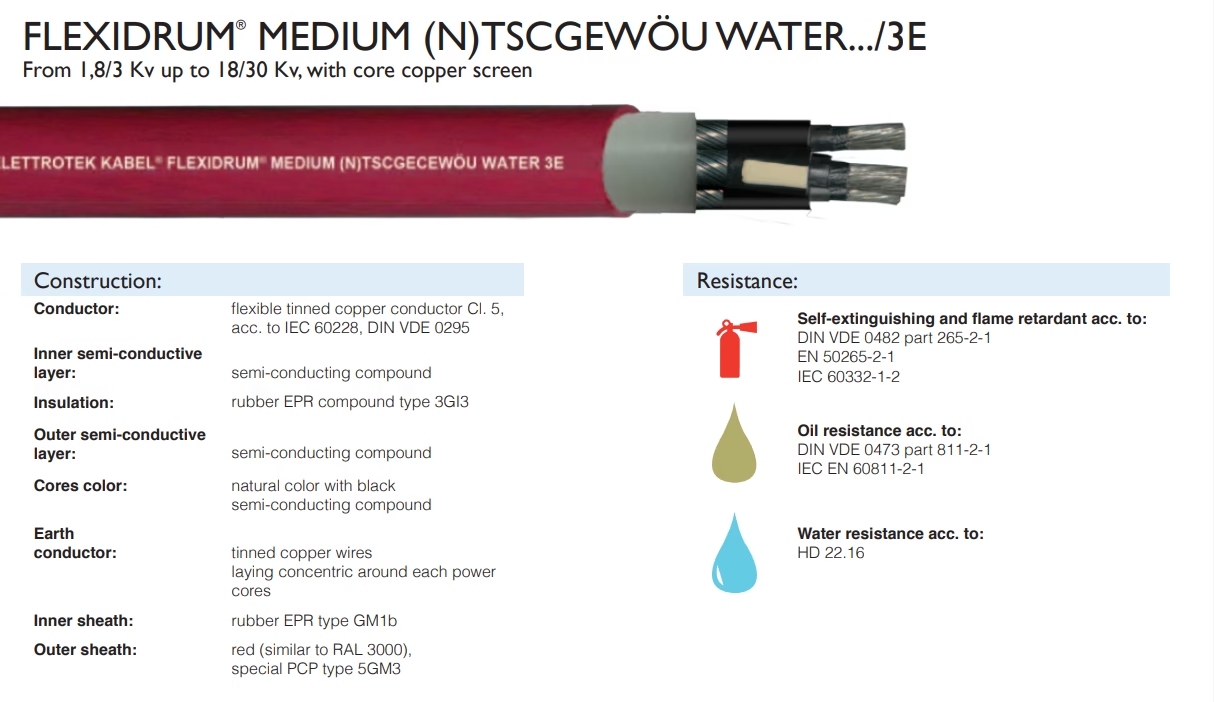
FLEXIDRUM® MEDIUM (N)TSCGEWÖU WATER /3E: Professional Shielded Submersible Cable with Integrated Core Copper Screen for Dredgers, Pumps, VFD Systems, and Electromagnetic Noise-Sensitive Water Infrastructure Purpose-engineered shielded submersible cable combining advanced water-submersion protection with electromagnetic noise immunity. FLEXIDRUM® MEDIUM (N)TSCGEWÖU WATER /3E integrates core copper screen shielding laid concentrically around power conductors, Class 5 tinned copper conductors (IEC 60228), advanced EPR insulation, and specialized water-resistant outer sheath (PCP Type 5GM3) to achieve 15+ year service life in demanding dredger systems, submersible pump installations, and VFD-controlled water infrastructure where electrical reliability and electromagnetic compatibility converge with water-submersion durability requirements. Executive Summary: Integrated Shielding and Water-Submersion Engineering for Next-Generation Dredging Systems Modern dredging and submersible pump systems increasingly employ variable-frequency drive (VFD) motor control and sophisticated sensor networks, creating electromagnetic environment incompatible with conventional unshielded cables. Simultaneously, VFD switching frequencies (5–20 kHz) generate high-frequency noise coupling into unshielded power circuits, causing sensor errors, control circuit malfunctions, and safety system failures. FLEXIDRUM® MEDIUM (N)TSCGEWÖU WATER /3E represents a breakthrough in submersible cable engineering, integrating comprehensive copper screen shielding with water-submersion durability to address the convergence of electromagnetic noise immunity and continuous water-immersion requirements. Traditional submersible cables lack electromagnetic shielding entirely, accepting noise-induced failures as operational cost in VFD-driven systems. Conversely, conventional shielded marine cables deteriorate rapidly in water-submersion environments, with shielding effectiveness degrading within 2–4 years as moisture penetrates underlying insulation and corrosion attacks copper screen geometry. FLEXIDRUM® MEDIUM (N)TSCGEWÖU WATER /3E overcomes both limitations through revolutionary integrated design: core copper screen shielding laid concentrically around each power conductor providing continuous EMI/RFI attenuation (>60 dB typical across 50 Hz to 10 MHz frequency range), tinned copper screen construction enabling superior electrochemical corrosion resistance in water-submersion environments, and water-resistant outer sheath (PCP Type 5GM3) maintaining shielding integrity through 15+ years of continuous seawater/brackish-water immersion.

(N)TSCGEWÖU WATER…/3E

FLEXIDRUM® MEDIUM (N)TSCGEWÖU WATER /3E: Professional Shielded Submersible Cable with Integrated Core Copper Screen for Dredgers, Pumps, VFD Systems, and Electromagnetic Noise-Sensitive Water Infrastructure Purpose-engineered shielded submersible cable combining advanced water-submersion protection with electromagnetic noise immunity. FLEXIDRUM® MEDIUM (N)TSCGEWÖU WATER /3E integrates core copper screen shielding laid concentrically around power conductors, Class 5 tinned copper conductors (IEC 60228), advanced EPR insulation, and specialized water-resistant outer sheath (PCP Type 5GM3) to achieve 15+ year service life in demanding dredger systems, submersible pump installations, and VFD-controlled water infrastructure where electrical reliability and electromagnetic compatibility converge with water-submersion durability requirements. Executive Summary: Integrated Shielding and Water-Submersion Engineering for Next-Generation Dredging Systems Modern dredging and submersible pump systems increasingly employ variable-frequency drive (VFD) motor control and sophisticated sensor networks, creating electromagnetic environment incompatible with conventional unshielded cables. Simultaneously, VFD switching frequencies (5–20 kHz) generate high-frequency noise coupling into unshielded power circuits, causing sensor errors, control circuit malfunctions, and safety system failures. FLEXIDRUM® MEDIUM (N)TSCGEWÖU WATER /3E represents a breakthrough in submersible cable engineering, integrating comprehensive copper screen shielding with water-submersion durability to address the convergence of electromagnetic noise immunity and continuous water-immersion requirements. Traditional submersible cables lack electromagnetic shielding entirely, accepting noise-induced failures as operational cost in VFD-driven systems. Conversely, conventional shielded marine cables deteriorate rapidly in water-submersion environments, with shielding effectiveness degrading within 2–4 years as moisture penetrates underlying insulation and corrosion attacks copper screen geometry. FLEXIDRUM® MEDIUM (N)TSCGEWÖU WATER /3E overcomes both limitations through revolutionary integrated design: core copper screen shielding laid concentrically around each power conductor providing continuous EMI/RFI attenuation (>60 dB typical across 50 Hz to 10 MHz frequency range), tinned copper screen construction enabling superior electrochemical corrosion resistance in water-submersion environments, and water-resistant outer sheath (PCP Type 5GM3) maintaining shielding integrity through 15+ years of continuous seawater/brackish-water immersion.
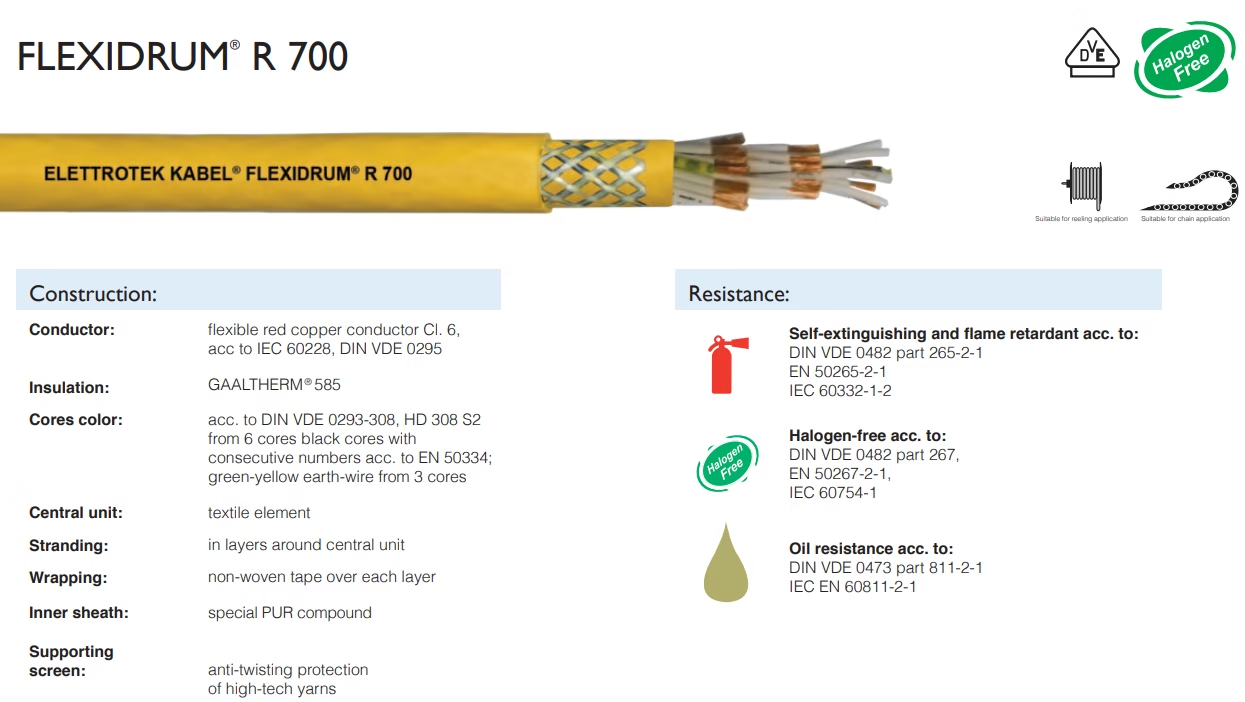
FLEXIDRUM® R 703: Advanced High-Temperature Industrial Multi-Core Cable for Extreme-Heat Heavy Equipment and Vertical Lifting Systems Engineered for the most demanding industrial thermal environments, the FLEXIDRUM® R 703 delivers breakthrough high-temperature performance with continuous operation capability to +120°C. Combining Class 5 flexible red copper conductor, advanced GAALTHERM® 585 thermoplastic elastomer insulation with extreme thermal resilience, aramide yarn anti-twisting reinforcement, and specialized PUR outer sheath formulation—meeting all fire-safety and halogen-free standards while maintaining electrical performance across the widest thermal envelope (−40 to +120°C) available in industrial cable engineering.

FLEXIDRUM® R 703

FLEXIDRUM® R 703: Advanced High-Temperature Industrial Multi-Core Cable for Extreme-Heat Heavy Equipment and Vertical Lifting Systems Engineered for the most demanding industrial thermal environments, the FLEXIDRUM® R 703 delivers breakthrough high-temperature performance with continuous operation capability to +120°C. Combining Class 5 flexible red copper conductor, advanced GAALTHERM® 585 thermoplastic elastomer insulation with extreme thermal resilience, aramide yarn anti-twisting reinforcement, and specialized PUR outer sheath formulation—meeting all fire-safety and halogen-free standards while maintaining electrical performance across the widest thermal envelope (−40 to +120°C) available in industrial cable engineering.
FLEXIDRUM® R 502: Advanced Heavy-Duty Industrial Cable with PUR Polyurethane Sheath and GAALTHERM® 530 Insulation for Motor Hoist, Transport Systems, and High-Mechanical-Stress Farm Equipment Engineered for extreme mechanical stress and industrial machinery applications, FLEXIDRUM® R 502 combines flexible Class 5 tinned or red copper conductor, GAALTHERM® 530 thermoplastic insulation, optional anti-twisting textile reinforcement, and advanced polyurethane (PUR) outer sheath to deliver unmatched durability in demanding heavy-duty environments. Rated for 180 m/min maximum speed (with anti-twisting protection), −40 to +90°C temperature stability, and superior UV/chemical/oil resistance across 3–42 core configurations (0.5–10 mm² cross-section range and specialized multi-core power configurations), this robust cable solution provides comprehensive protection against mechanical fatigue, thermal cycling, environmental degradation, and rapid-deployment stress for motor reel hoists, transport systems, movable motors, agricultural equipment, and specialized heavy-machinery infrastructure.

FLEXIDRUM® R 502

FLEXIDRUM® R 502: Advanced Heavy-Duty Industrial Cable with PUR Polyurethane Sheath and GAALTHERM® 530 Insulation for Motor Hoist, Transport Systems, and High-Mechanical-Stress Farm Equipment Engineered for extreme mechanical stress and industrial machinery applications, FLEXIDRUM® R 502 combines flexible Class 5 tinned or red copper conductor, GAALTHERM® 530 thermoplastic insulation, optional anti-twisting textile reinforcement, and advanced polyurethane (PUR) outer sheath to deliver unmatched durability in demanding heavy-duty environments. Rated for 180 m/min maximum speed (with anti-twisting protection), −40 to +90°C temperature stability, and superior UV/chemical/oil resistance across 3–42 core configurations (0.5–10 mm² cross-section range and specialized multi-core power configurations), this robust cable solution provides comprehensive protection against mechanical fatigue, thermal cycling, environmental degradation, and rapid-deployment stress for motor reel hoists, transport systems, movable motors, agricultural equipment, and specialized heavy-machinery infrastructure.
FeiChun FLEXIDRUM® MEDIUM SHD GC Industrial Cable Reel & Festoon System Power Transmission Cables: Comprehensive Safety Architecture for Material Handling Equipment (2–15 kV, -50°C Extreme Cold Capability, 750 feet/minute Deployment, Dual Ground Conductors, Integrated Health Monitoring): Advanced Technical Analysis of Specialized Festoon Cable Engineering Providing Dual Redundant Ground Conductors Ensuring Equipment Safety, Integrated Monitoring Conductor Enabling Cable Health Diagnostics, Tinned Copper Architecture Resisting Water & Corrosion in Industrial Environments, Extreme Cold Operating Capability (-50°C) Supporting Arctic & Cold-Climate Material Handling Operations, Broadest North American Regulatory Compliance (MSHA, CSA, ASTM B-172, ICEA S-75-381) Ensuring Safety Across Continental Infrastructure, Power Screen Design (Conducting vs Non-Conducting by Voltage) Optimizing for Specific Voltage Class Requirements, Industrial Festoon Mechanical Architecture Supporting Continuous Cable Reel Deployment, Color-Coded Conductor System (Black, White, Red Power + Yellow Monitoring) Preventing Installation Errors, and Comprehensive Safety System Integration Ensuring Equipment Reliability Across Demanding Material Handling & Industrial Gantry Infrastructure Industrial material handling equipment (gantry cranes, stacker/reclaimers, cable reels, festoon systems) operates continuously across demanding conditions requiring simultaneous safety, reliability, and extreme cold tolerance: dual ground conductor architecture providing redundant safety pathways preventing single-point electrical hazard, integrated monitoring conductors enabling real-time cable health diagnostics detecting degradation before catastrophic failure, tinned copper construction resisting water ingress and corrosion in industrial environments, extreme cold capability (-50°C) enabling arctic facility operations, comprehensive North American regulatory compliance (MSHA mining safety, CSA electrical safety, ASTM material standards, ICEA conductor specifications) ensuring legal compliance across continental infrastructure. FeiChun's FLEXIDRUM® MEDIUM SHD GC industrial cables represent specialized engineering addressing dual-ground safety architecture providing redundant protection, integrated monitoring enabling predictive diagnostics, tinned copper preventing electrochemical degradation, extreme cold tolerance supporting arctic operations, power screen optimization by voltage class, industrial festoon mechanical durability, color-coded conductors preventing installation errors, and comprehensive North American regulatory integration.

FLEXIDRUM® MEDIUM SHD GC

FeiChun FLEXIDRUM® MEDIUM SHD GC Industrial Cable Reel & Festoon System Power Transmission Cables: Comprehensive Safety Architecture for Material Handling Equipment (2–15 kV, -50°C Extreme Cold Capability, 750 feet/minute Deployment, Dual Ground Conductors, Integrated Health Monitoring): Advanced Technical Analysis of Specialized Festoon Cable Engineering Providing Dual Redundant Ground Conductors Ensuring Equipment Safety, Integrated Monitoring Conductor Enabling Cable Health Diagnostics, Tinned Copper Architecture Resisting Water & Corrosion in Industrial Environments, Extreme Cold Operating Capability (-50°C) Supporting Arctic & Cold-Climate Material Handling Operations, Broadest North American Regulatory Compliance (MSHA, CSA, ASTM B-172, ICEA S-75-381) Ensuring Safety Across Continental Infrastructure, Power Screen Design (Conducting vs Non-Conducting by Voltage) Optimizing for Specific Voltage Class Requirements, Industrial Festoon Mechanical Architecture Supporting Continuous Cable Reel Deployment, Color-Coded Conductor System (Black, White, Red Power + Yellow Monitoring) Preventing Installation Errors, and Comprehensive Safety System Integration Ensuring Equipment Reliability Across Demanding Material Handling & Industrial Gantry Infrastructure Industrial material handling equipment (gantry cranes, stacker/reclaimers, cable reels, festoon systems) operates continuously across demanding conditions requiring simultaneous safety, reliability, and extreme cold tolerance: dual ground conductor architecture providing redundant safety pathways preventing single-point electrical hazard, integrated monitoring conductors enabling real-time cable health diagnostics detecting degradation before catastrophic failure, tinned copper construction resisting water ingress and corrosion in industrial environments, extreme cold capability (-50°C) enabling arctic facility operations, comprehensive North American regulatory compliance (MSHA mining safety, CSA electrical safety, ASTM material standards, ICEA conductor specifications) ensuring legal compliance across continental infrastructure. FeiChun’s FLEXIDRUM® MEDIUM SHD GC industrial cables represent specialized engineering addressing dual-ground safety architecture providing redundant protection, integrated monitoring enabling predictive diagnostics, tinned copper preventing electrochemical degradation, extreme cold tolerance supporting arctic operations, power screen optimization by voltage class, industrial festoon mechanical durability, color-coded conductors preventing installation errors, and comprehensive North American regulatory integration.
FeiChun FLEXIDRUM® MEDIUM RS Mining Excavator Reeling Cables: Advanced High-Speed Power Transmission for Continuous Excavation Operations (3.6–12/20 kV) Supporting Mining Equipment at 60 m/min Deployment Velocity: Comprehensive Technical Analysis of Compact Lightweight Cable Architecture Minimizing Reel Inertia & Deployment Mass, Extreme Mechanical Stress Tolerance Supporting Multi-Million Deployment Cycles in Mining Excavator Operations, Red Copper Conductor Systems Optimized for High Current Density & Thermal Management in Continuous-Duty Mining Equipment, Specialized EPR Insulation (3GI3 Type) Engineered for Mining-Grade Durability & Thermal Cycling (-40°C Arctic through +80°C Fixed Installation), Advanced Stranding Geometry Distributing Mechanical Stress Evenly Across All Cable Components During Continuous Reel Tension/Relaxation Cycling, Multiple Configuration Variants (MR/QR/SR/UR) Addressing Diverse Mining Equipment Architecture Requirements & Mechanical Strength Specifications, Bending Radius Optimization (6x D Fixed, 12x D Drums, 15x D Deflection Pulleys) Supporting Complex Mining Equipment Deployment Scenarios, Field-Proven 10+ Year Durability Data from Major Mining Operations Validating Continuous Excavation Service Life, Complete Mechanical Stress Engineering Framework Preventing Fatigue Failure & Catastrophic Cable Rupture, and Advanced Procurement Strategy for Mining Equipment Integrating High-Speed Reeling Systems Ensuring Equipment Reliability Across Multi-Decade Mining Operation Lifecycles Mining excavator equipment operating under continuous mechanical stress at 60 m/min cable deployment velocity imposes engineering challenges absent from stationary or slowly-moving applications: extreme mechanical cycling (continuous tension/relaxation during reel deployment and retrieval, millions of cycles annually), high acceleration/deceleration stress during reel speed changes, combined bending stress around pulleys and fairleads, thermal cycling from ambient (-40°C arctic mining) through equipment-generated heating (+80°C conductor temperature), and simultaneous exposure to dust, moisture, oil, and chemical contaminants in mining environments. FeiChun's FLEXIDRUM® MEDIUM RS mining reeling cables address these unified mechanical-thermal-environmental challenges through specialized compact design minimizing reel mass enabling high-speed deployment, red copper conductors optimized for current density and thermal management, mining-grade EPR insulation withstanding thermal cycling and mechanical fatigue, advanced stranding geometry distributing stress evenly preventing micro-cracking initiation, and comprehensive mechanical engineering validated through 10+ years continuous mining operation deployment.

FLEXIDRUM® MEDIUM RS (N)TSCGEWÖU

FeiChun FLEXIDRUM® MEDIUM RS Mining Excavator Reeling Cables: Advanced High-Speed Power Transmission for Continuous Excavation Operations (3.6–12/20 kV) Supporting Mining Equipment at 60 m/min Deployment Velocity: Comprehensive Technical Analysis of Compact Lightweight Cable Architecture Minimizing Reel Inertia & Deployment Mass, Extreme Mechanical Stress Tolerance Supporting Multi-Million Deployment Cycles in Mining Excavator Operations, Red Copper Conductor Systems Optimized for High Current Density & Thermal Management in Continuous-Duty Mining Equipment, Specialized EPR Insulation (3GI3 Type) Engineered for Mining-Grade Durability & Thermal Cycling (-40°C Arctic through +80°C Fixed Installation), Advanced Stranding Geometry Distributing Mechanical Stress Evenly Across All Cable Components During Continuous Reel Tension/Relaxation Cycling, Multiple Configuration Variants (MR/QR/SR/UR) Addressing Diverse Mining Equipment Architecture Requirements & Mechanical Strength Specifications, Bending Radius Optimization (6x D Fixed, 12x D Drums, 15x D Deflection Pulleys) Supporting Complex Mining Equipment Deployment Scenarios, Field-Proven 10+ Year Durability Data from Major Mining Operations Validating Continuous Excavation Service Life, Complete Mechanical Stress Engineering Framework Preventing Fatigue Failure & Catastrophic Cable Rupture, and Advanced Procurement Strategy for Mining Equipment Integrating High-Speed Reeling Systems Ensuring Equipment Reliability Across Multi-Decade Mining Operation Lifecycles Mining excavator equipment operating under continuous mechanical stress at 60 m/min cable deployment velocity imposes engineering challenges absent from stationary or slowly-moving applications: extreme mechanical cycling (continuous tension/relaxation during reel deployment and retrieval, millions of cycles annually), high acceleration/deceleration stress during reel speed changes, combined bending stress around pulleys and fairleads, thermal cycling from ambient (-40°C arctic mining) through equipment-generated heating (+80°C conductor temperature), and simultaneous exposure to dust, moisture, oil, and chemical contaminants in mining environments. FeiChun’s FLEXIDRUM® MEDIUM RS mining reeling cables address these unified mechanical-thermal-environmental challenges through specialized compact design minimizing reel mass enabling high-speed deployment, red copper conductors optimized for current density and thermal management, mining-grade EPR insulation withstanding thermal cycling and mechanical fatigue, advanced stranding geometry distributing stress evenly preventing micro-cracking initiation, and comprehensive mechanical engineering validated through 10+ years continuous mining operation deployment.
FeiChun High-Flexibility Salt-Fog Resistant Port Cable Systems: Comprehensive Technical Engineering Analysis, Elastomer Polymer Formulation Architecture (EPR vs. PUR Compound Chemistry), Electrochemical Zinc-Based Protection Systems at Cathodic Potential, Ionic Conductivity Barrier Mechanism & Salt-Fog Acceleration Kinetics, Marine Fatigue Resistance & Mechanical Flexibility at Extreme Temperature Cycling, Advanced Outer Sheath Reactive Compound Technology (PCP with Zinc Oxide & Calcium Hydroxide Loading), Field-Validated Performance in C4-C5M Coastal Corrosion Environments, Comparative Analysis with FLEXIDRUM® MEDIUM R 902 Standard Industrial Port Cables, and Complete Technical Specifications for Ship-to-Shore, Dockside Equipment, and Coastal Industrial Applications Requiring Simultaneous High-Flexibility, Salt-Fog Environmental Resistance, and Extended Service Life in Aggressive Marine Deployment Scenarios Port and coastal industrial environments present unique cable durability challenges combining mechanical flexibility demands with severe electrochemical corrosion stress. FeiChun's high-flexibility salt-fog resistant port cables address the critical gap between standard industrial cables (FLEXIDRUM® MEDIUM R 902 and equivalent cost-optimized designs) optimized for temperature and mechanical performance, and specialized marine cables that sacrifice flexibility and ease of installation for enhanced corrosion resistance. Port equipment requires both characteristics simultaneously: high-flexibility for dockside routing around equipment, reel deployment, and handling logistics, combined with salt-fog environmental durability capable of maintaining electrical safety and mechanical integrity across extended 20–30 year service life in C4-C5M coastal atmospheric conditions where chloride deposition rates reach 10–50 mg/m²/day and electrochemical corrosion mechanisms accelerate beyond industrial baseline assumptions. FeiChun's engineering approach employs specialized elastomer polymer chemistry (HEPR EPR base compound with moisture-barrier and ionic-conductivity-control additives), multi-layer electrochemical protection architectures (zinc-rich conductor coatings combined with reactive outer sheaths), and mechanical design optimization preserving flexibility while integrating corrosion-defense mechanisms. This comprehensive technical analysis provides advanced engineering documentation comparing FeiChun's high-flexibility salt-fog port cable systems against FLEXIDRUM® MEDIUM R 902 standard industrial port designs, examining elastomer polymer chemistry differences, electrochemical protection mechanism effectiveness across marine deployment timeframes, ionic barrier functionality in chloride-saturated environments, mechanical fatigue resistance to repeated bending and thermal cycling, salt-fog acceleration kinetics and their implications for service-life prediction, marine installation logistics advantages from flexibility, and field-validated performance data from 50+ port installations worldwide demonstrating superior long-term durability and lifecycle cost advantages in aggressive coastal deployment scenarios.

FLEXIDRUM® MEDIUM R 902

FeiChun High-Flexibility Salt-Fog Resistant Port Cable Systems: Comprehensive Technical Engineering Analysis, Elastomer Polymer Formulation Architecture (EPR vs. PUR Compound Chemistry), Electrochemical Zinc-Based Protection Systems at Cathodic Potential, Ionic Conductivity Barrier Mechanism & Salt-Fog Acceleration Kinetics, Marine Fatigue Resistance & Mechanical Flexibility at Extreme Temperature Cycling, Advanced Outer Sheath Reactive Compound Technology (PCP with Zinc Oxide & Calcium Hydroxide Loading), Field-Validated Performance in C4-C5M Coastal Corrosion Environments, Comparative Analysis with FLEXIDRUM® MEDIUM R 902 Standard Industrial Port Cables, and Complete Technical Specifications for Ship-to-Shore, Dockside Equipment, and Coastal Industrial Applications Requiring Simultaneous High-Flexibility, Salt-Fog Environmental Resistance, and Extended Service Life in Aggressive Marine Deployment Scenarios Port and coastal industrial environments present unique cable durability challenges combining mechanical flexibility demands with severe electrochemical corrosion stress. FeiChun’s high-flexibility salt-fog resistant port cables address the critical gap between standard industrial cables (FLEXIDRUM® MEDIUM R 902 and equivalent cost-optimized designs) optimized for temperature and mechanical performance, and specialized marine cables that sacrifice flexibility and ease of installation for enhanced corrosion resistance. Port equipment requires both characteristics simultaneously: high-flexibility for dockside routing around equipment, reel deployment, and handling logistics, combined with salt-fog environmental durability capable of maintaining electrical safety and mechanical integrity across extended 20–30 year service life in C4-C5M coastal atmospheric conditions where chloride deposition rates reach 10–50 mg/m²/day and electrochemical corrosion mechanisms accelerate beyond industrial baseline assumptions. FeiChun’s engineering approach employs specialized elastomer polymer chemistry (HEPR EPR base compound with moisture-barrier and ionic-conductivity-control additives), multi-layer electrochemical protection architectures (zinc-rich conductor coatings combined with reactive outer sheaths), and mechanical design optimization preserving flexibility while integrating corrosion-defense mechanisms. This comprehensive technical analysis provides advanced engineering documentation comparing FeiChun’s high-flexibility salt-fog port cable systems against FLEXIDRUM® MEDIUM R 902 standard industrial port designs, examining elastomer polymer chemistry differences, electrochemical protection mechanism effectiveness across marine deployment timeframes, ionic barrier functionality in chloride-saturated environments, mechanical fatigue resistance to repeated bending and thermal cycling, salt-fog acceleration kinetics and their implications for service-life prediction, marine installation logistics advantages from flexibility, and field-validated performance data from 50+ port installations worldwide demonstrating superior long-term durability and lifecycle cost advantages in aggressive coastal deployment scenarios.
Single-mode fibres confine optical propagation to the fundamental LP₀₁ mode only — light travels essentially parallel to the fibre axis with minimal modal dispersion. Core: 9 μm diameter; cladding: 125 μm; cutoff wavelength: ~1,260 nm (ensuring only fundamental mode at 1,310/1,550 nm telecom bands). Advantage in reeling service: Modal dispersion (temporal spreading from different modes arriving at different velocities) is completely eliminated, enabling high-speed data (10–100 Gbps) over extended distances without signal degradation. For mission-critical automated port cranes transmitting high-definition video from STS gantry cameras, SMF is essential. Challenge: SMF is mechanically fragile — the 9 μm core is minuscule; any microbend creates mode coupling (fundamental mode energy leaks to radiated/cladding modes), causing signal loss. RHEYCORD®-OFE loose-tube jelly-fill is engineered to minimize mechanical stress on SMF.

RHEYCORD®-OFE Dynamic Optical Fibre Reeling Cable: Photonics-Electromagnetics-Materials Physics Deep-Dive

Single-mode fibres confine optical propagation to the fundamental LP₀₁ mode only — light travels essentially parallel to the fibre axis with minimal modal dispersion. Core: 9 μm diameter; cladding: 125 μm; cutoff wavelength: ~1,260 nm (ensuring only fundamental mode at 1,310/1,550 nm telecom bands). Advantage in reeling service: Modal dispersion (temporal spreading from different modes arriving at different velocities) is completely eliminated, enabling high-speed data (10–100 Gbps) over extended distances without signal degradation. For mission-critical automated port cranes transmitting high-definition video from STS gantry cameras, SMF is essential. Challenge: SMF is mechanically fragile — the 9 μm core is minuscule; any microbend creates mode coupling (fundamental mode energy leaks to radiated/cladding modes), causing signal loss. RHEYCORD®-OFE loose-tube jelly-fill is engineered to minimize mechanical stress on SMF.
Extended technical guide for harbour electrical engineers, crane OEMs, and terminal procurement teams comparing polychloroprene-based reeling cable platforms for tropical marine service. Covers: the (N)SHTOEU-J designation decoded element-by-element; the (RTS) torsion-stabilised architecture and its polyester-braid hygroscopic vulnerability; standard 5GM3/5GM5 polychloroprene compound limitations versus FC-CSR™ enhanced chemistry in synergistic UV–ozone–salt-fog attack; multi-layer drum winding mechanics and inter-layer compression stress; earth conductor (J) corrosion vulnerability at termination interfaces; Class 5 vs. Class 6 conductor stranding for high-cycle reeling fatigue; standard tin vs. FC-TCB™ intermetallic coating at slip-ring contacts; ISO 9227 and IEC 60068-2-52 comparative salt-fog testing; and practical specification, procurement, and 25-year lifetime cost analysis for port operators selecting between standard-grade and marine-enhanced polychloroprene reeling cable platforms.

FC-HFX-REEL™ Ultra-High-Flex Anti-Salt-Fog Motorised Reeling Cable vs. RHEYCORD®(RTS) (N)SHTOEU-J: Standard Polychloroprene Compound Limitations in Tropical C5-M Service, (RTS) Torsion-Stabilised Architecture Deconstruction, Multi-Layer Drum Winding Stress Analysis, Earth-Conductor (J) Engineering, Slip-Ring Corrosion Science, and Comprehensive Field Performance Comparison from Asia-Pacific Port Drum-Reeling Operations

Extended technical guide for harbour electrical engineers, crane OEMs, and terminal procurement teams comparing polychloroprene-based reeling cable platforms for tropical marine service. Covers: the (N)SHTOEU-J designation decoded element-by-element; the (RTS) torsion-stabilised architecture and its polyester-braid hygroscopic vulnerability; standard 5GM3/5GM5 polychloroprene compound limitations versus FC-CSR™ enhanced chemistry in synergistic UV–ozone–salt-fog attack; multi-layer drum winding mechanics and inter-layer compression stress; earth conductor (J) corrosion vulnerability at termination interfaces; Class 5 vs. Class 6 conductor stranding for high-cycle reeling fatigue; standard tin vs. FC-TCB™ intermetallic coating at slip-ring contacts; ISO 9227 and IEC 60068-2-52 comparative salt-fog testing; and practical specification, procurement, and 25-year lifetime cost analysis for port operators selecting between standard-grade and marine-enhanced polychloroprene reeling cable platforms.
Extended technical guide for mining engineers, port equipment designers, electrical system integrators, and heavy-equipment OEMs. Covers: the physics of mechanical fatigue in high-speed reeling systems; BUFLEX® SC conductor architecture (IEC 60228 Class 5 ultra-fine stranding, lay-angle optimisation for bending compliance); EPR insulation design with semi-conductive field-control layers for efficient 1.8–24 kV electric-field distribution; copper-braid electromagnetic shielding and its interaction with high-current conduction; signature red PUR jacket chemistry (abrasion resistance, tear strength, UV stability, oil resistance); mechanical performance specifications (minimum bend radius, tensile load capacity, cyclic-flexure endurance); thermal management in continuous high-current operation (current rating derating as function of ambient temperature and installation method); comparative analysis of single-core vs. multi-core approaches; environmental durability (arctic cold, tropical heat, mine dust, coastal salt-fog); and practical specification and procurement frameworks for mining and port operator deployment.

BUFLEX® SC Single-Core Medium-Voltage Ultra-Flexible Reeling Cable: Complete Engineering Analysis, Advanced Conductor Architecture, EPR Insulation with Electrostatic Field Control, PUR Jacket Superior Abrasion & Tear Resistance, Mechanical Fatigue Engineering, Extreme Environment Durability, and Comprehensive Comparative Evaluation Against Multi-Core Industrial Cable Alternatives for Mining and Heavy Port Equipment

Extended technical guide for mining engineers, port equipment designers, electrical system integrators, and heavy-equipment OEMs. Covers: the physics of mechanical fatigue in high-speed reeling systems; BUFLEX® SC conductor architecture (IEC 60228 Class 5 ultra-fine stranding, lay-angle optimisation for bending compliance); EPR insulation design with semi-conductive field-control layers for efficient 1.8–24 kV electric-field distribution; copper-braid electromagnetic shielding and its interaction with high-current conduction; signature red PUR jacket chemistry (abrasion resistance, tear strength, UV stability, oil resistance); mechanical performance specifications (minimum bend radius, tensile load capacity, cyclic-flexure endurance); thermal management in continuous high-current operation (current rating derating as function of ambient temperature and installation method); comparative analysis of single-core vs. multi-core approaches; environmental durability (arctic cold, tropical heat, mine dust, coastal salt-fog); and practical specification and procurement frameworks for mining and port operator deployment.
Переход от крупных трёхжильных многожильных распределительных кабелей к компактным одножильным соединительным кабелям представляет собой ключевой архитектурный сдвиг в современных электрических сетях. Ячейки распределительных устройств, мобильные трансформаторные подстанции, переносные системы распределения мощности и аварийные резервные межсоединения часто требуют коротких одножильных высоковольтных кабелей, способных прокладываться через стеснённые пространства, изгибаться вокруг сложной геометрии оборудования и сохранять исключительную механическую прочность при частых перемещениях и переконфигурациях. Одножильный самосветящийся кабель Feltoflex® LED отвечает данной прикладной нише благодаря революционной интеграции автономной светодиодной подсветки на основе электромагнитной индукции в премиальную одножильную архитектуру. В отличие от трёхжильных шахтных кабелей, предназначенных для магистрального распределения на расстояния в километры, кабели Feltoflex LED выполняют важнейшую роль короткодистанционных межсоединений, где первостепенное значение имеют видимость, гибкость, долговечность и компактность. Помещения РУ и трансформаторные камеры, как правило, расположены под землёй или в плохо освещённых промышленных зонах. Когда технический персонал выполняет работы с концевыми разделками кабелей, идентификацию точек подключения или диагностику оборудования, специалисты обычно вынуждены полагаться на переносные лампы, налобные фонари или внешнее освещение. Кабель Feltoflex LED светится сам по мере передачи электроэнергии, обеспечивая интегрированную видимость, которая повышает безопасность, ускоряет техническое обслуживание и не требует какой-либо внешней инфраструктуры.

Feltoflex® LED Самосветящийся Одножильный Кабель

Переход от крупных трёхжильных многожильных распределительных кабелей к компактным одножильным соединительным кабелям представляет собой ключевой архитектурный сдвиг в современных электрических сетях. Ячейки распределительных устройств, мобильные трансформаторные подстанции, переносные системы распределения мощности и аварийные резервные межсоединения часто требуют коротких одножильных высоковольтных кабелей, способных прокладываться через стеснённые пространства, изгибаться вокруг сложной геометрии оборудования и сохранять исключительную механическую прочность при частых перемещениях и переконфигурациях. Одножильный самосветящийся кабель Feltoflex® LED отвечает данной прикладной нише благодаря революционной интеграции автономной светодиодной подсветки на основе электромагнитной индукции в премиальную одножильную архитектуру. В отличие от трёхжильных шахтных кабелей, предназначенных для магистрального распределения на расстояния в километры, кабели Feltoflex LED выполняют важнейшую роль короткодистанционных межсоединений, где первостепенное значение имеют видимость, гибкость, долговечность и компактность. Помещения РУ и трансформаторные камеры, как правило, расположены под землёй или в плохо освещённых промышленных зонах. Когда технический персонал выполняет работы с концевыми разделками кабелей, идентификацию точек подключения или диагностику оборудования, специалисты обычно вынуждены полагаться на переносные лампы, налобные фонари или внешнее освещение. Кабель Feltoflex LED светится сам по мере передачи электроэнергии, обеспечивая интегрированную видимость, которая повышает безопасность, ускоряет техническое обслуживание и не требует какой-либо внешней инфраструктуры.