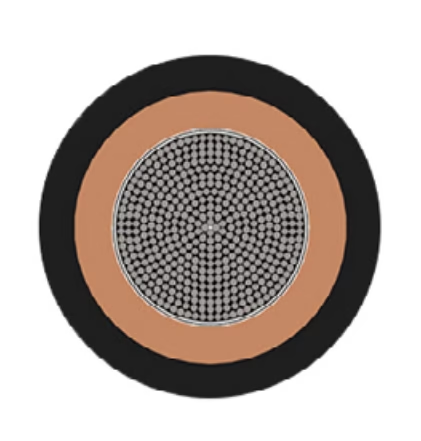
medium voltage flexible cable

Full technical breakdown Aristoncavi PANZERFLEX-VS 3×95+3×16/3 6/10 kV: premium Italian trailing cable for heavy mining excavators (200–800 tons), designed for constant dragging over sharp rock. "VS" (Very Special / reinforced) denotes super-tough red outer sheath with enhanced tear/abrasion resistance — Aristoncavi signature. Construction: 3×95 mm² tinned copper class 5 + split earth 3×16 mm² (48 mm² total, standard earthing for 95 mm² phases), symmetrically placed in interphase space for 6/10 kV EM field suppression. Insulation: special micro-filtered EPR compound (no micro-inclusions, dielectric strength >22 kV/mm). Screening: extruded semiconducting layers (inner + outer). OD 55–59.5 mm. Weight ~5,300–5,650 kg/km. Current ~296 A (30°C open air). SC ~13.5 kA (1s). Min bend radius 10× OD (dynamic/trailing). Temp -35°C to +80°C (versions to -40°C). Two replacement paths: (1) Anhui Feichun — drop-in FC-PANZERFLEX-VS with CCV vulcanization and red abrasion-resistant sheath; (2) Russian КГЭ-ХЛ 3×95+1×25+1×10 6 kV — GOST equivalent with non-split earth and cold rating to -60°C (engineering compromise).

Замена кабеля PANZERFLEX-VS: 6/10kV 3×95+3×16/3 для тяжёлых карьерных экскаваторов — импортозамещение FeiChun Cable и КГЭ-ХЛ

Full technical breakdown Aristoncavi PANZERFLEX-VS 3×95+3×16/3 6/10 kV: premium Italian trailing cable for heavy mining excavators (200–800 tons), designed for constant dragging over sharp rock. “VS” (Very Special / reinforced) denotes super-tough red outer sheath with enhanced tear/abrasion resistance — Aristoncavi signature. Construction: 3×95 mm² tinned copper class 5 + split earth 3×16 mm² (48 mm² total, standard earthing for 95 mm² phases), symmetrically placed in interphase space for 6/10 kV EM field suppression. Insulation: special micro-filtered EPR compound (no micro-inclusions, dielectric strength >22 kV/mm). Screening: extruded semiconducting layers (inner + outer). OD 55–59.5 mm. Weight ~5,300–5,650 kg/km. Current ~296 A (30°C open air). SC ~13.5 kA (1s). Min bend radius 10× OD (dynamic/trailing). Temp -35°C to +80°C (versions to -40°C). Two replacement paths: (1) Anhui Feichun — drop-in FC-PANZERFLEX-VS with CCV vulcanization and red abrasion-resistant sheath; (2) Russian КГЭ-ХЛ 3×95+1×25+1×10 6 kV — GOST equivalent with non-split earth and cold rating to -60°C (engineering compromise).
Complete technical breakdown flexible medium-voltage excavator cable EpN 79 configuration 3×70+2×25+16 mm² rated 3.6/6 kV (max 7.2 kV). Designed heavy excavators, rotary crushers, conveyor transfer bridges, drill rigs in open-pit and underground mining. Construction: 3 power phases (70 mm² tinned copper Class 5 stranded) → EPR insulation GM1b (max conductor temp 90°C) → 2 separate earth conductors (25 mm²) → 1 integrated pilot/monitoring core (16 mm², blue marking) for real-time cable condition monitoring → outer sheath heavy-duty polychloroprene rubber (Neoprene), resistant to abrasion, tear, mine water, oil, UV. Test voltage 15 kV/5 min. EpN 79 standard evolution from EpN 78, upgraded GM1b compound and optimized core geometry. Historical use: Eastern Europe (Czech, Slovakia, Poland), Middle East, CIS (Russia, Kazakhstan, Uzbekistan). Russian GOST equivalent КГЭШ 3.6/6 kV. Chinese equivalent Anhui Feichun Special Cable—full constructive copy with EAC/IEC certification. Cost European original €1,400–1,800/km vs Feichun €480–620/km (55–65% savings). Lead time Feichun 8–12 weeks vs European 16–24 weeks.

Кабель EpN 79 3×70+2×25+16мм² 3.6/6кВ: технические характеристики, конструкция и китайские аналоги шахтного экскаваторного кабеля

Complete technical breakdown flexible medium-voltage excavator cable EpN 79 configuration 3×70+2×25+16 mm² rated 3.6/6 kV (max 7.2 kV). Designed heavy excavators, rotary crushers, conveyor transfer bridges, drill rigs in open-pit and underground mining. Construction: 3 power phases (70 mm² tinned copper Class 5 stranded) → EPR insulation GM1b (max conductor temp 90°C) → 2 separate earth conductors (25 mm²) → 1 integrated pilot/monitoring core (16 mm², blue marking) for real-time cable condition monitoring → outer sheath heavy-duty polychloroprene rubber (Neoprene), resistant to abrasion, tear, mine water, oil, UV. Test voltage 15 kV/5 min. EpN 79 standard evolution from EpN 78, upgraded GM1b compound and optimized core geometry. Historical use: Eastern Europe (Czech, Slovakia, Poland), Middle East, CIS (Russia, Kazakhstan, Uzbekistan). Russian GOST equivalent КГЭШ 3.6/6 kV. Chinese equivalent Anhui Feichun Special Cable—full constructive copy with EAC/IEC certification. Cost European original €1,400–1,800/km vs Feichun €480–620/km (55–65% savings). Lead time Feichun 8–12 weeks vs European 16–24 weeks.
Complete specifications and comparative pricing analysis (N)TSCGEWÖU 3×50+3×25 mm² (also searched as NTSCGEWOEU, NTSCGEWOU, N TSCGEWOU) 6/10 kV: OD 44–48 mm, weight ~3,250 kg/km, copper index ~2,750 kg/km, current 183 A base @ 30°C, copper class 5, EPR 3GI3 insulation, neoprene 5GM5 outer (black, oil/UV/flame resistant, -40°C Arctic), bending 10×OD flexing, temp -25/+80°C flexing, -40/+80°C fixed. Applications: draglines, bucket-wheel excavators, drill rigs, mobile substations, underground mines. Pricing: Prysmian PROTOMONT/Nexans RHEYFIRM original €450–650/km, Feichun FC-NTSC €220–320/km (50–60% savings). Designation decoding: letter-by-letter German marking breakdown. Russian analog КГЭ-ХЛ 6кВ (Kamkabel, Elektrokabel, Tomskcable). DIN VDE 0250-813. EAC, GOST-R, CE, ATEX certified. TCO calculator for excavator fleets and mining complexes.

Характеристики и цена: (N)TSCGEWÖU 3×50+3×25 mm² 6/10 kV — гибкий силовой кабель для экскаваторов, буровых установок и подземных рудников

Complete specifications and comparative pricing analysis (N)TSCGEWÖU 3×50+3×25 mm² (also searched as NTSCGEWOEU, NTSCGEWOU, N TSCGEWOU) 6/10 kV: OD 44–48 mm, weight ~3,250 kg/km, copper index ~2,750 kg/km, current 183 A base @ 30°C, copper class 5, EPR 3GI3 insulation, neoprene 5GM5 outer (black, oil/UV/flame resistant, -40°C Arctic), bending 10×OD flexing, temp -25/+80°C flexing, -40/+80°C fixed. Applications: draglines, bucket-wheel excavators, drill rigs, mobile substations, underground mines. Pricing: Prysmian PROTOMONT/Nexans RHEYFIRM original €450–650/km, Feichun FC-NTSC €220–320/km (50–60% savings). Designation decoding: letter-by-letter German marking breakdown. Russian analog КГЭ-ХЛ 6кВ (Kamkabel, Elektrokabel, Tomskcable). DIN VDE 0250-813. EAC, GOST-R, CE, ATEX certified. TCO calculator for excavator fleets and mining complexes.
Complete letter-by-letter designation decoding, specifications and comparative pricing for MV trailing/excavator cable type (N)TSCGEWÖU (also searched as NTSCGEWOEU or NTSCGEWOU) configuration 3×50+3×(25/3) 6/10 kV: OD 44–48 mm, weight ~3,200–3,350 kg/km, copper index ~1,680 kg/km, current 183 A @ 30°C, bending 10×OD dynamic, tensile 2,250 N, temp -25/+80°C flexing. Tinned copper class 5, EPR 3GI3, cold-strippable screens, 3-way split earth for EM symmetry, GM1b inner + anti-torsion braid, chloroprene 5GM5. Pricing: Prysmian/Nexans €750–1,100/km, Feichun FC-MRE €320–460/km (55–65% savings). DIN VDE 0250-813. EAC, GOST-R, CE certified.

Характеристики и цена: (N)TSCGEWOEU 3×50+3×25/3 6/10 kV — полная расшифровка маркировки

Complete letter-by-letter designation decoding, specifications and comparative pricing for MV trailing/excavator cable type (N)TSCGEWÖU (also searched as NTSCGEWOEU or NTSCGEWOU) configuration 3×50+3×(25/3) 6/10 kV: OD 44–48 mm, weight ~3,200–3,350 kg/km, copper index ~1,680 kg/km, current 183 A @ 30°C, bending 10×OD dynamic, tensile 2,250 N, temp -25/+80°C flexing. Tinned copper class 5, EPR 3GI3, cold-strippable screens, 3-way split earth for EM symmetry, GM1b inner + anti-torsion braid, chloroprene 5GM5. Pricing: Prysmian/Nexans €750–1,100/km, Feichun FC-MRE €320–460/km (55–65% savings). DIN VDE 0250-813. EAC, GOST-R, CE certified.
Complete decoding of (N)TSCGEWÖU / (N)TSCGEWOEU per DIN VDE 0250: (N) VDE-compliant normtype, T Tagebau/trailing, S semiconductive screen, C concentric copper screen, G rubber, E EPR insulation, W weather/abrasion-resistant sheath, Ö oil-resistant, U flame-retardant. Layer-by-layer construction, notation variants, size table 3×16–3×185 mm² at 3.6/6–8.7/15 kV, comparison with PROTOLON (SB)/(SMK) and Russian КГЭШ-Т, applications in BWE excavators, STS/RTG cranes, TBM. 50-keyword procurement reference table.

Расшифровка маркировки кабеля (N)TSCGEWÖU: каждая буква — инженерный анализ по DIN VDE

Complete decoding of (N)TSCGEWÖU / (N)TSCGEWOEU per DIN VDE 0250: (N) VDE-compliant normtype, T Tagebau/trailing, S semiconductive screen, C concentric copper screen, G rubber, E EPR insulation, W weather/abrasion-resistant sheath, Ö oil-resistant, U flame-retardant. Layer-by-layer construction, notation variants, size table 3×16–3×185 mm² at 3.6/6–8.7/15 kV, comparison with PROTOLON (SB)/(SMK) and Russian КГЭШ-Т, applications in BWE excavators, STS/RTG cranes, TBM. 50-keyword procurement reference table.
Complete specifications and comparative pricing analysis Prysmian PROTOLON (SB) (N)TSCGEWOEU 6/10 kV, configuration 3×50+2×(25/2)+1×16st: OD 45.4–48.4 mm, weight ~3,550 kg/km, copper index ~1,834 kg/km, current 183 A @ 30°C, bending 12×OD, speed 120 m/min, tensile 2,250 N, temp -25/+80°C flexing. Construction: tinned copper class 5, PROTOLON HS EPR (≥3GI3), cold-strippable semiconductive screens, split earth 2×(25/2) electromagnetic symmetry, control core 16st, GM1b inner + anti-torsion braid, chloroprene 5GM5 outer. Pricing: Prysmian original €800–1,200/km, Feichun FC-PLN €350–480/km (55–65% savings), Russian КГЭШ-Т €400–550/km. 5-year TCO calculator for port cranes and excavators. DIN VDE 0250-813. EAC, GOST-R, CE certified.

Характеристики и цена: гибкий кабель PROTOLON (SB) 3×50+2×25/2+1×16st 6/10 kV

Complete specifications and comparative pricing analysis Prysmian PROTOLON (SB) (N)TSCGEWOEU 6/10 kV, configuration 3×50+2×(25/2)+1×16st: OD 45.4–48.4 mm, weight ~3,550 kg/km, copper index ~1,834 kg/km, current 183 A @ 30°C, bending 12×OD, speed 120 m/min, tensile 2,250 N, temp -25/+80°C flexing. Construction: tinned copper class 5, PROTOLON HS EPR (≥3GI3), cold-strippable semiconductive screens, split earth 2×(25/2) electromagnetic symmetry, control core 16st, GM1b inner + anti-torsion braid, chloroprene 5GM5 outer. Pricing: Prysmian original €800–1,200/km, Feichun FC-PLN €350–480/km (55–65% savings), Russian КГЭШ-Т €400–550/km. 5-year TCO calculator for port cranes and excavators. DIN VDE 0250-813. EAC, GOST-R, CE certified.
Complete technical datasheet Chinese equivalent Prysmian PROTOLON (SB-SAM) (N)TSCGEWOEU 6/10 kV: reeling cable with integrated Synthetic Anti-torsion Material (SAM) braid for heavy mobile equipment — port gantry cranes STS/RTG/RMG, open-pit excavators, draglines, bucket-wheel excavators, stacker-reclaimers, spreaders. Configuration 3×95 mm² power + 2×(50/2) mm² split earth + 1×16 mm² control (st). Rated 6/10 kV (max 7.2/12 kV). OD ~56.0–61.5 mm, weight ~5,400–5,650 kg/km, copper index ~3,370 kg/km. Current ~296 A @ 30°C. Bending radius 12–15×OD. Travel speed 120–160 m/min (gantry 240 m/min by agreement). Tensile ~4,275 N dynamic (15 N/mm²; 30 N/mm² acceleration). Temperature -35/+80°C flexing, -50/+80°C fixed. Key SB-SAM distinction: integrated polyester anti-torsion braid between inner/outer sheaths, vulcanized bond (PROTOFIRM Sandwich), absorbs ±15–25°/m torsional stress from motorized drum high-speed reeling, prevents corkscrew effect. EPR/HEPR PROTOLON HS insulation (≥3GI3) with cold-strippable semiconductive screens, dual sheath PROTOFIRM Sandwich (EPR 5GM3 red + anti-torsion braid + PCP/PUR 5GM5), EN 60332-1-2 flame, DIN EN 60811-404 oil, UV/ozone resistant. Additional testing: reversed bending, roller bending, torsional stress per DIN VDE 0250-813. EAC, GOST-R/-K/-B, Fire Certificate certified.

Аналог PROTOLON (SB-SAM): кабель барабанный с защитой от скручивания 3×95+2×50/2+1×16st 6/10 kV — полный технический паспорт

Complete technical datasheet Chinese equivalent Prysmian PROTOLON (SB-SAM) (N)TSCGEWOEU 6/10 kV: reeling cable with integrated Synthetic Anti-torsion Material (SAM) braid for heavy mobile equipment — port gantry cranes STS/RTG/RMG, open-pit excavators, draglines, bucket-wheel excavators, stacker-reclaimers, spreaders. Configuration 3×95 mm² power + 2×(50/2) mm² split earth + 1×16 mm² control (st). Rated 6/10 kV (max 7.2/12 kV). OD ~56.0–61.5 mm, weight ~5,400–5,650 kg/km, copper index ~3,370 kg/km. Current ~296 A @ 30°C. Bending radius 12–15×OD. Travel speed 120–160 m/min (gantry 240 m/min by agreement). Tensile ~4,275 N dynamic (15 N/mm²; 30 N/mm² acceleration). Temperature -35/+80°C flexing, -50/+80°C fixed. Key SB-SAM distinction: integrated polyester anti-torsion braid between inner/outer sheaths, vulcanized bond (PROTOFIRM Sandwich), absorbs ±15–25°/m torsional stress from motorized drum high-speed reeling, prevents corkscrew effect. EPR/HEPR PROTOLON HS insulation (≥3GI3) with cold-strippable semiconductive screens, dual sheath PROTOFIRM Sandwich (EPR 5GM3 red + anti-torsion braid + PCP/PUR 5GM5), EN 60332-1-2 flame, DIN EN 60811-404 oil, UV/ozone resistant. Additional testing: reversed bending, roller bending, torsional stress per DIN VDE 0250-813. EAC, GOST-R/-K/-B, Fire Certificate certified.
Много менеджеров и неэлектрических инженеров попадают в эту ловушку, потому что номинальное напряжение кабеля кажется подходящим: GOST 6kV — это номинальное напряжение сети, а VDE 3.6/6kV имеет 6kV в обозначении. Вывод кажется логичным: "6kV = 6kV, подходит". Это смертельная ошибка. Причина ошибки в системе двойной номинации VDE (U₀/U): • VDE 3.6/6kV означает: U₀ = 3,6 кВ (напряжение фаза-земля), U = 6,0 кВ (напряжение фаза-фаза) • Изоляция кабеля рассчитана на U₀ = 3,6 кВ • GOST 6kV означает: номинальное напряжение сети 6,0 кВ фаза-фаза • В системе IT (изолированная нейтраль) при однофазном КЗ: напряжение неповреждённых фаз мгновенно переходит из 3,6 кВ в 6,0 кВ • Кабель получает 6,0 кВ на изоляцию, рассчитанную на 3,6 кВ → ПРОБОЙ

Voltage Matching Trap: Why VDE 3.6/6kV Cables Fail Catastrophically on GOST 6kV IT Mining GridsA Critical Insulation Breakdown Risk Analysis

Много менеджеров и неэлектрических инженеров попадают в эту ловушку, потому что номинальное напряжение кабеля кажется подходящим: GOST 6kV — это номинальное напряжение сети, а VDE 3.6/6kV имеет 6kV в обозначении. Вывод кажется логичным: “6kV = 6kV, подходит”. Это смертельная ошибка. Причина ошибки в системе двойной номинации VDE (U₀/U): • VDE 3.6/6kV означает: U₀ = 3,6 кВ (напряжение фаза-земля), U = 6,0 кВ (напряжение фаза-фаза) • Изоляция кабеля рассчитана на U₀ = 3,6 кВ • GOST 6kV означает: номинальное напряжение сети 6,0 кВ фаза-фаза • В системе IT (изолированная нейтраль) при однофазном КЗ: напряжение неповреждённых фаз мгновенно переходит из 3,6 кВ в 6,0 кВ • Кабель получает 6,0 кВ на изоляцию, рассчитанную на 3,6 кВ → ПРОБОЙ
Mining Operation Electrical Engineering Process: A PNG mining operation (Lihir, Porgera, Ok Tedi) procuring mobile substation power cables follows this sequence: (1) Electrical load study determines voltage (6.6 kV chosen), current requirement (220+ A), cable length (500–2,000 m), (2) Cable type selection (Type 241 6.6/6.6kV chosen for high-humidity environment), (3) Core size selection (3×70mm² determined from ampacity analysis), (4) Supplier RFQ (Request for Quotation), (5) Factory Acceptance Testing (FAT), (6) Shipment + customs clearance, (7) Site Acceptance Testing (SAT), (8) Installation, (9) In-service monitoring. This document addresses procurement stages (4)–(11). Supplier Qualification Checklist: Before issuing an RFQ, mining procurement teams verify: (1) ISO 9001 manufacturing certification, (2) AS/NZS 1802 Type 241 production experience (minimum 3 mines, 10+ years), (3) Moisture-resistant CPE formulation proprietary design (not commodity standard CPE), (4) In-house WVTR testing lab (ASTM G65 + IEC 60811-3-1), (5) High-voltage termination support (6.6 kV potted joint design), (6) Geographical proximity to PNG (supply lead time 70), (8) Insurance coverage (product liability $10M+ limit).

Type 241 6.6/6.6kV 3x70mm² Procurement Specification: Moisture-Resistant Cable Engineering Guide for PNG Mining

Mining Operation Electrical Engineering Process: A PNG mining operation (Lihir, Porgera, Ok Tedi) procuring mobile substation power cables follows this sequence: (1) Electrical load study determines voltage (6.6 kV chosen), current requirement (220+ A), cable length (500–2,000 m), (2) Cable type selection (Type 241 6.6/6.6kV chosen for high-humidity environment), (3) Core size selection (3×70mm² determined from ampacity analysis), (4) Supplier RFQ (Request for Quotation), (5) Factory Acceptance Testing (FAT), (6) Shipment + customs clearance, (7) Site Acceptance Testing (SAT), (8) Installation, (9) In-service monitoring. This document addresses procurement stages (4)–(11). Supplier Qualification Checklist: Before issuing an RFQ, mining procurement teams verify: (1) ISO 9001 manufacturing certification, (2) AS/NZS 1802 Type 241 production experience (minimum 3 mines, 10+ years), (3) Moisture-resistant CPE formulation proprietary design (not commodity standard CPE), (4) In-house WVTR testing lab (ASTM G65 + IEC 60811-3-1), (5) High-voltage termination support (6.6 kV potted joint design), (6) Geographical proximity to PNG (supply lead time 70), (8) Insurance coverage (product liability $10M+ limit).
Geography & Climate Extremes: Lihir Island (Newcrest Mining) sits in the Bismarck Sea off PNG coast. Porgera (Barrick Gold / Sumitomo) operates in PNG's central highlands. Both share identical climatic curse: (1) Annual rainfall 3,000–5,000 mm (Lihir) to 10,000+ mm (Porgera), (2) Year-round relative humidity 95–100%, (3) Perpetual ground saturation and standing water in pits and underground, (4) Tropical air temperature 25–40°C year-round (no winter relief), (5) Seasonal monsoons (Nov–May) with downpours exceeding 500 mm/day. Lihir岛(纽克瑞斯特矿业)位于PNG外海的俾斯麦海。Porgera(巴里克黄金/住友)运营于PNG中部高地。两者共同面临相同的气候诅咒:(1)年降水量3,000-5,000 mm(Lihir)至10,000+ mm(Porgera),(2)全年相对湿度95-100%,(3)永久地面饱和和坑道及地下积水,(4)热带空气温度全年25-40°C(无冬季缓解),(5)季风季节(11月-5月),降雨量/天>500 mm。

Type 241 6.6/6.6kV 3x70mm² Individually Screened Cores for Lihir Porgera PNG Mining

Geography & Climate Extremes: Lihir Island (Newcrest Mining) sits in the Bismarck Sea off PNG coast. Porgera (Barrick Gold / Sumitomo) operates in PNG’s central highlands. Both share identical climatic curse: (1) Annual rainfall 3,000–5,000 mm (Lihir) to 10,000+ mm (Porgera), (2) Year-round relative humidity 95–100%, (3) Perpetual ground saturation and standing water in pits and underground, (4) Tropical air temperature 25–40°C year-round (no winter relief), (5) Seasonal monsoons (Nov–May) with downpours exceeding 500 mm/day. Lihir岛(纽克瑞斯特矿业)位于PNG外海的俾斯麦海。Porgera(巴里克黄金/住友)运营于PNG中部高地。两者共同面临相同的气候诅咒:(1)年降水量3,000-5,000 mm(Lihir)至10,000+ mm(Porgera),(2)全年相对湿度95-100%,(3)永久地面饱和和坑道及地下积水,(4)热带空气温度全年25-40°C(无冬季缓解),(5)季风季节(11月-5月),降雨量/天>500 mm。
Major Projects and Players: Central Asia's copper mining sector includes massive operations: (1) KAZ Minerals' Bozshakol, Saryshagan, and Aktogay projects in Kazakhstan, (2) Uzbek Copper's operations in Uzbekistan, (3) International consortium projects (Rio Tinto, Sumitomo, Japanese/European partnerships). These operations are characterized by: modern infrastructure, international EPC (Engineering-Procurement-Construction) contractor involvement, and explicit AS/NZS 1802 compliance requirements in RFQ specifications. 中亚铜矿项目包括大规模运营:(1)哈萨克斯坦KAZ矿物公司的Bozshakol、Saryshagan和Aktogay项目,(2)乌兹别克斯坦铜矿公司的运营,(3)国际联合体项目(Rio Tinto、住友、日本/欧洲合作)。这些运营的特点是:现代基础设施、国际EPC承包商参与、RFQ规范中明确的AS/NZS 1802合规要求。 RFQ Specification Trend: Central Asian buyers increasingly specify AS/NZS 1802 Type 241 cables rather than simply "equivalent" designs, because they understand the cable is for long-term (15–20 year) asset life and international operational continuity. Unlike developing-market buyers who may accept price-optimized designs, Central Asian EPC contractors demand proven, certified-equivalent cables that can be serviced anywhere globally. Sourcing Challenge for Asian Manufacturers: Most Australian cable manufacturers cannot meet the 12–18 month continuous order volumes that Central Asian projects demand (often 500–2,000 km of cable total). This creates a market opportunity: Chinese and Indian manufacturers can undercut Australian prices by 25–40% while maintaining AS/NZS compliance—IF they can credibly prove factory-direct equivalence.

Central Asia Mining RFQ: Factory-Direct Equivalent to Australian Type 241 Cables for Copper Projects

Major Projects and Players: Central Asia’s copper mining sector includes massive operations: (1) KAZ Minerals’ Bozshakol, Saryshagan, and Aktogay projects in Kazakhstan, (2) Uzbek Copper’s operations in Uzbekistan, (3) International consortium projects (Rio Tinto, Sumitomo, Japanese/European partnerships). These operations are characterized by: modern infrastructure, international EPC (Engineering-Procurement-Construction) contractor involvement, and explicit AS/NZS 1802 compliance requirements in RFQ specifications. 中亚铜矿项目包括大规模运营:(1)哈萨克斯坦KAZ矿物公司的Bozshakol、Saryshagan和Aktogay项目,(2)乌兹别克斯坦铜矿公司的运营,(3)国际联合体项目(Rio Tinto、住友、日本/欧洲合作)。这些运营的特点是:现代基础设施、国际EPC承包商参与、RFQ规范中明确的AS/NZS 1802合规要求。 RFQ Specification Trend: Central Asian buyers increasingly specify AS/NZS 1802 Type 241 cables rather than simply “equivalent” designs, because they understand the cable is for long-term (15–20 year) asset life and international operational continuity. Unlike developing-market buyers who may accept price-optimized designs, Central Asian EPC contractors demand proven, certified-equivalent cables that can be serviced anywhere globally. Sourcing Challenge for Asian Manufacturers: Most Australian cable manufacturers cannot meet the 12–18 month continuous order volumes that Central Asian projects demand (often 500–2,000 km of cable total). This creates a market opportunity: Chinese and Indian manufacturers can undercut Australian prices by 25–40% while maintaining AS/NZS compliance—IF they can credibly prove factory-direct equivalence.
Type 7S is a single-core, flexible mining machine cable designed for direct connection to motor terminals and equipment in high-vibration underground environments. When a specification calls for "Type 7S 3.3kV 3x70mm²," it refers to three separate, individual single-core cables (each one being 1x70mm² in cross-section), which are installed in trefoil formation (arranged in a triangular pattern) to create a complete three-phase power system for a conveyor drive motor. Each single core has its own 360-degree copper screening layer, Class 5 extra-flexible stranded conductors, and a signature glass fiber braid reinforcement layer that provides superior vibration and thermal resistance. This combination makes Type 7S the preferred cable choice for main conveyor systems in underground coal mines, where the motor is subject to continuous high-frequency vibration, the terminal space is confined, and flexibility is essential for reliable long-term operation.

Conveyor Belt Power: Specifying Type 7S 3.3kV 3x70mm² for Underground Coal Conveyors

Type 7S is a single-core, flexible mining machine cable designed for direct connection to motor terminals and equipment in high-vibration underground environments. When a specification calls for “Type 7S 3.3kV 3x70mm²,” it refers to three separate, individual single-core cables (each one being 1x70mm² in cross-section), which are installed in trefoil formation (arranged in a triangular pattern) to create a complete three-phase power system for a conveyor drive motor. Each single core has its own 360-degree copper screening layer, Class 5 extra-flexible stranded conductors, and a signature glass fiber braid reinforcement layer that provides superior vibration and thermal resistance. This combination makes Type 7S the preferred cable choice for main conveyor systems in underground coal mines, where the motor is subject to continuous high-frequency vibration, the terminal space is confined, and flexibility is essential for reliable long-term operation.
For New Zealand TBM (Tunnel Boring Machine) and underground infrastructure projects, specifying cables presents a critical engineering decision: use European VDE-standard cables (readily available from major suppliers like Prysmian, Nexans) or specify local AS/NZS-compliant equivalents. The (N)TSCGECEWÖU 3x50+3x25/3 6.6/6.6kV cable from German manufacturers represents excellent European engineering, but direct application in New Zealand requires technical translation to local regulatory standards. 对于新西兰盾构机(TBM)和地下基础设施项目,规范电缆规格呈现关键工程决策:使用欧洲VDE标准电缆(易从Prysmian、Nexans等主要供应商获得)或规范本地AS/NZS兼容等效品。德国制造商的(N)TSCGECEWÖU 3x50+3x25/3 6.6/6.6kV电缆代表卓越的欧洲工程,但在新西兰的直接应用需要技术转化为当地监管标准。

New Zealand TBMs: Equivalent Specs for (N)TSCGECEWÖU 3×50+3×25/3 6.6/6.6kV Tunneling Cable

For New Zealand TBM (Tunnel Boring Machine) and underground infrastructure projects, specifying cables presents a critical engineering decision: use European VDE-standard cables (readily available from major suppliers like Prysmian, Nexans) or specify local AS/NZS-compliant equivalents. The (N)TSCGECEWÖU 3×50+3×25/3 6.6/6.6kV cable from German manufacturers represents excellent European engineering, but direct application in New Zealand requires technical translation to local regulatory standards. 对于新西兰盾构机(TBM)和地下基础设施项目,规范电缆规格呈现关键工程决策:使用欧洲VDE标准电缆(易从Prysmian、Nexans等主要供应商获得)或规范本地AS/NZS兼容等效品。德国制造商的(N)TSCGECEWÖU 3×50+3×25/3 6.6/6.6kV电缆代表卓越的欧洲工程,但在新西兰的直接应用需要技术转化为当地监管标准。
When German-manufactured mining equipment—whether a dragline excavator, tunnel boring machine (TBM), or electric shovel—arrives in Australia, it typically specifies power cable ratings according to German VDE standards, most commonly the (N)TSCGEWÖU 12/20kV trailing cable per DIN VDE 0250-813. However, Australian mining networks typically operate at 11/11kV (in IT earthing—isolated or high-impedance grounded neutral systems). This apparent voltage mismatch—12/20kV German specification versus 11/11kV Australian network—creates immediate questions: Can German 12/20kV cables be used directly on Australian 11/11kV systems? What is the technical equivalence? How are AS/NZS 2802 Type 241 and Type 275 cables related to German specifications? 当德国制造的采矿设备——无论是挖掘机、隧道掘进机(TBM)还是电动铲斗——抵达澳洲时,它通常根据德国VDE标准规定电源电缆等级,最常见的是DIN VDE 0250-813的(N)TSCGEWÖU 12/20kV拖曳电缆。然而,澳洲采矿网络通常在11/11kV下运行(在IT接地——隔离或高阻接地中性系统中)。这种表面上的电压不匹配——12/20kV德国规范与11/11kV澳洲网络——立即引发问题:德国12/20kV电缆是否可以直接在澳洲11/11kV系统上使用?技术等效性是什么?AS/NZS 2802 Type 241和Type 275电缆与德国规范有什么关系?

European Machinery in Australia: Sourcing 11/11kV Equivalents for 12/20kV German Trailing Cables

When German-manufactured mining equipment—whether a dragline excavator, tunnel boring machine (TBM), or electric shovel—arrives in Australia, it typically specifies power cable ratings according to German VDE standards, most commonly the (N)TSCGEWÖU 12/20kV trailing cable per DIN VDE 0250-813. However, Australian mining networks typically operate at 11/11kV (in IT earthing—isolated or high-impedance grounded neutral systems). This apparent voltage mismatch—12/20kV German specification versus 11/11kV Australian network—creates immediate questions: Can German 12/20kV cables be used directly on Australian 11/11kV systems? What is the technical equivalence? How are AS/NZS 2802 Type 241 and Type 275 cables related to German specifications? 当德国制造的采矿设备——无论是挖掘机、隧道掘进机(TBM)还是电动铲斗——抵达澳洲时,它通常根据德国VDE标准规定电源电缆等级,最常见的是DIN VDE 0250-813的(N)TSCGEWÖU 12/20kV拖曳电缆。然而,澳洲采矿网络通常在11/11kV下运行(在IT接地——隔离或高阻接地中性系统中)。这种表面上的电压不匹配——12/20kV德国规范与11/11kV澳洲网络——立即引发问题:德国12/20kV电缆是否可以直接在澳洲11/11kV系统上使用?技术等效性是什么?AS/NZS 2802 Type 241和Type 275电缆与德国规范有什么关系?
Yes, a highly capable cable manufacturer can absolutely engineer generic (N)TSCGEWÖU flexible reeling cables to match or even exceed the 20/35kV (36kV maximum equipment voltage) rating of Nexans' RHEYFIRM® brand premium products. However, the critical phrase here is "highly capable manufacturer"—not every cable producer has the technical depth, quality control infrastructure, and engineering expertise to successfully execute a 20/35kV design. The fundamental cable construction—Class 5 tinned copper conductors, semi-conductive rubber inner and outer layers, EPR (ethylene propylene rubber) insulation, and a heavy-duty CPE or chloroprene outer sheath—is well understood and exists within the established scope of DIN VDE 0250-813 mining cable standards. While the traditional (N)TSCGEWÖU specification typically covers voltages up to 18/30kV, the engineering principles that govern the construction are equally applicable to 20/35kV ratings. The transition from 18/30kV to 20/35kV is not a revolutionary leap requiring entirely new materials or manufacturing processes—it is an evolutionary engineering optimization that competent manufacturers have been executing for decades. What distinguishes a genuinely compliant 20/35kV generic (N)TSCGEWÖU from a merely relabeled 18/30kV cable masquerading as 20/35kV is the application of three fundamental engineering disciplines. First, the insulation thickness must be increased according to rigorous electrical stress calculations based on IEC 60502-2 high-voltage standards, accounting for the higher electrical field strength that 20/35kV imposes on the dielectric material. Second, the semi-conductive layers must be engineered with exquisite precision to control the electric field distribution and prevent partial discharge (PD) inception, which is the primary failure mechanism for high-voltage cables subjected to continuous stress. Third, the outer sheath material must be selected and formulated from premium compounds with superior mechanical durability to withstand not only the normal environmental stresses of mining operations but also any electrical stress-related damage that might be induced by the higher voltage rating. The answer, therefore, is yes—but only when manufacturers invest in the engineering rigor and quality control discipline that the 20/35kV rating genuinely demands.

RHEYFIRM® 30kV vs. Generic (N)TSCGEWÖU: Can Standard Manufacturers Match Nexans’ 20/35kV Rating?

Yes, a highly capable cable manufacturer can absolutely engineer generic (N)TSCGEWÖU flexible reeling cables to match or even exceed the 20/35kV (36kV maximum equipment voltage) rating of Nexans’ RHEYFIRM® brand premium products. However, the critical phrase here is “highly capable manufacturer”—not every cable producer has the technical depth, quality control infrastructure, and engineering expertise to successfully execute a 20/35kV design. The fundamental cable construction—Class 5 tinned copper conductors, semi-conductive rubber inner and outer layers, EPR (ethylene propylene rubber) insulation, and a heavy-duty CPE or chloroprene outer sheath—is well understood and exists within the established scope of DIN VDE 0250-813 mining cable standards. While the traditional (N)TSCGEWÖU specification typically covers voltages up to 18/30kV, the engineering principles that govern the construction are equally applicable to 20/35kV ratings. The transition from 18/30kV to 20/35kV is not a revolutionary leap requiring entirely new materials or manufacturing processes—it is an evolutionary engineering optimization that competent manufacturers have been executing for decades. What distinguishes a genuinely compliant 20/35kV generic (N)TSCGEWÖU from a merely relabeled 18/30kV cable masquerading as 20/35kV is the application of three fundamental engineering disciplines. First, the insulation thickness must be increased according to rigorous electrical stress calculations based on IEC 60502-2 high-voltage standards, accounting for the higher electrical field strength that 20/35kV imposes on the dielectric material. Second, the semi-conductive layers must be engineered with exquisite precision to control the electric field distribution and prevent partial discharge (PD) inception, which is the primary failure mechanism for high-voltage cables subjected to continuous stress. Third, the outer sheath material must be selected and formulated from premium compounds with superior mechanical durability to withstand not only the normal environmental stresses of mining operations but also any electrical stress-related damage that might be induced by the higher voltage rating. The answer, therefore, is yes—but only when manufacturers invest in the engineering rigor and quality control discipline that the 20/35kV rating genuinely demands.
(N)TSCGEWÖU 3x120+3x70/3 12/20kV cable is the correct choice for most tunnel boring machine main cutterhead power supplies operating at medium voltage with cutterhead thrust loads in the range of 8,000 to 12,000 kilonewtons, featuring three 120 mm² phase conductors providing approximately 350 to 380 amperes current capacity in free-air installation at 30°C ambient and 90°C conductor operating temperature. The cable's nominal outer diameter is 73 to 81 millimeters, with total weight of approximately 9,800 to 10,500 kilograms per kilometer, making it manageable for most standard cable spools while still providing sufficient conductor cross-section to limit voltage drop to acceptable levels over tunnel distances extending several kilometers. The cable features Class 5 tinned copper conductors engineered for fatigue resistance in continuously flexing applications, EPR insulation maintaining exceptional thermal stability even when subjected to the 90°C conductor temperature that results from high-current excavation duty, semi-conductive shielding layers that uniformly distribute electric stress and prevent partial discharge initiation in the high-voltage environment, and a heavy-duty CPE jacket providing abrasion resistance in the confined underground spaces where the cable is routed. However, the critical distinction between simply selecting a cable model and properly sizing a cable for your specific tunnel boring installation lies in understanding the difference between the cable's theoretical free-air current capacity and its actual safe operating current when coiled on a cable drum—a difference that can reduce safe current by 30 to 50 percent depending on the spooling configuration. For tunnel boring machines operating in continental European or Asian tunneling projects with tunnel lengths of 5 to 15 kilometers and cutterhead thrust loads in the moderate to high range, the 3x120+3x70/3 12/20kV cable provides excellent balance between current capacity, voltage drop performance, mechanical durability, and cost. However, for shorter tunnels where voltage drop is not a concern, smaller conductor sizes (such as 3x95 mm²) may provide adequate performance at lower material cost, while for exceptionally long tunnels or extremely high thrust conditions, larger sizes (such as 3x150 mm² or 3x185 mm²) become necessary to maintain safe operating currents and acceptable voltage drop. Proper cable sizing requires engineering analysis specific to your tunnel length, expected cutterhead current demand, acceptable voltage drop limits, available cable drum diameters, and operational duty cycle.

Tunnel Boring Machines (TBM): Sizing (N)TSCGEWÖU 3×120+3×70/3 12/20kV for the Main Cutterhead Power Supply

(N)TSCGEWÖU 3×120+3×70/3 12/20kV cable is the correct choice for most tunnel boring machine main cutterhead power supplies operating at medium voltage with cutterhead thrust loads in the range of 8,000 to 12,000 kilonewtons, featuring three 120 mm² phase conductors providing approximately 350 to 380 amperes current capacity in free-air installation at 30°C ambient and 90°C conductor operating temperature. The cable’s nominal outer diameter is 73 to 81 millimeters, with total weight of approximately 9,800 to 10,500 kilograms per kilometer, making it manageable for most standard cable spools while still providing sufficient conductor cross-section to limit voltage drop to acceptable levels over tunnel distances extending several kilometers. The cable features Class 5 tinned copper conductors engineered for fatigue resistance in continuously flexing applications, EPR insulation maintaining exceptional thermal stability even when subjected to the 90°C conductor temperature that results from high-current excavation duty, semi-conductive shielding layers that uniformly distribute electric stress and prevent partial discharge initiation in the high-voltage environment, and a heavy-duty CPE jacket providing abrasion resistance in the confined underground spaces where the cable is routed. However, the critical distinction between simply selecting a cable model and properly sizing a cable for your specific tunnel boring installation lies in understanding the difference between the cable’s theoretical free-air current capacity and its actual safe operating current when coiled on a cable drum—a difference that can reduce safe current by 30 to 50 percent depending on the spooling configuration. For tunnel boring machines operating in continental European or Asian tunneling projects with tunnel lengths of 5 to 15 kilometers and cutterhead thrust loads in the moderate to high range, the 3×120+3×70/3 12/20kV cable provides excellent balance between current capacity, voltage drop performance, mechanical durability, and cost. However, for shorter tunnels where voltage drop is not a concern, smaller conductor sizes (such as 3×95 mm²) may provide adequate performance at lower material cost, while for exceptionally long tunnels or extremely high thrust conditions, larger sizes (such as 3×150 mm² or 3×185 mm²) become necessary to maintain safe operating currents and acceptable voltage drop. Proper cable sizing requires engineering analysis specific to your tunnel length, expected cutterhead current demand, acceptable voltage drop limits, available cable drum diameters, and operational duty cycle.
Type SHD-GC 3/C #1 AWG 8kV trailing cable has a DC resistance of approximately 0.161 ohms per kilometer measured at the reference temperature of 20°C (68°F). This DC resistance value represents the pure ohmic resistance of the copper conductor when direct current flows through it—a condition that occurs in short-circuit analysis and DC testing procedures. However, when this same cable carries the alternating current typical of mining equipment operations (at the standard operating temperature of 90°C), the AC resistance increases to approximately 0.363 ohms per kilometer due to the combined effects of temperature rise and skin effect phenomena. The substantial difference between 0.161 Ω/km (DC, 20°C) and 0.363 Ω/km (AC, 90°C)—more than a 2.25 times increase—demonstrates a critical principle that engineers must account for in real-world voltage drop calculations: laboratory DC resistance values are not directly applicable to field voltage drop analysis. The cable features three 107.2 mm² (1 AWG equivalent) phase conductors of Class 5 tinned copper, with an additional ground-check conductor for continuous monitoring of cable integrity during operation, an outer diameter of approximately 53–58 mm, and a total weight of approximately 6,200–6,800 kg/km. Understanding both the DC baseline resistance and the elevated AC resistance at operating temperature is essential for accurately predicting voltage drop over long cable runs in open-pit mining operations where power distribution distances frequently exceed 500 meters.

Voltage Drop Calculation: Resistance (Ohms/km) for Type SHD-GC 3/C #1 AWG 8kV Trailing Cable

Type SHD-GC 3/C #1 AWG 8kV trailing cable has a DC resistance of approximately 0.161 ohms per kilometer measured at the reference temperature of 20°C (68°F). This DC resistance value represents the pure ohmic resistance of the copper conductor when direct current flows through it—a condition that occurs in short-circuit analysis and DC testing procedures. However, when this same cable carries the alternating current typical of mining equipment operations (at the standard operating temperature of 90°C), the AC resistance increases to approximately 0.363 ohms per kilometer due to the combined effects of temperature rise and skin effect phenomena. The substantial difference between 0.161 Ω/km (DC, 20°C) and 0.363 Ω/km (AC, 90°C)—more than a 2.25 times increase—demonstrates a critical principle that engineers must account for in real-world voltage drop calculations: laboratory DC resistance values are not directly applicable to field voltage drop analysis. The cable features three 107.2 mm² (1 AWG equivalent) phase conductors of Class 5 tinned copper, with an additional ground-check conductor for continuous monitoring of cable integrity during operation, an outer diameter of approximately 53–58 mm, and a total weight of approximately 6,200–6,800 kg/km. Understanding both the DC baseline resistance and the elevated AC resistance at operating temperature is essential for accurately predicting voltage drop over long cable runs in open-pit mining operations where power distribution distances frequently exceed 500 meters.
The shield transfer impedance (STI) for (N)TSCGECEWÖU 12/20kV cables with individual concentric copper screens is approximately 0.005–0.012 Ω/m at 50/60 Hz power frequency, representing the electrical impedance that coupling currents encounter as they attempt to penetrate the copper screen and reach the main conductor. At higher frequencies relevant to VFD variable switching (around 10 kHz), the STI increases slightly to approximately 0.008–0.015 Ω/m due to skin-effect limitations in the copper conductors. At even higher frequencies extending into the megahertz range (1–10 MHz) where harmonic emissions and EMI are most problematic, the STI rises further to approximately 0.02–0.08 Ω/m depending on the copper screen material properties and frequency-dependent conductor resistance. The shielding effectiveness, measured as the attenuation in decibels (dB) of external electromagnetic fields trying to couple energy into the cable conductors, is typically 60–80 dB at 100 kHz and remains above 40 dB even at 1 MHz, demonstrating excellent EMI rejection across the industrial frequency range. These metrics establish that individual concentric copper screens provide substantially superior EMC performance compared to traditional overall braided screens, particularly in reducing conducted emissions in VFD-driven machinery where rapid voltage switching and harmonic currents create severe electromagnetic stress on nearby control cables and sensitive electronic systems.

Shield Transfer Impedance: What are the exact EMC performance parameters and screening effectiveness metrics for (N)TSCGECEWÖU 12/20kV individually screened medium-voltage flexible cables in industrial and VFD applications? 

The shield transfer impedance (STI) for (N)TSCGECEWÖU 12/20kV cables with individual concentric copper screens is approximately 0.005–0.012 Ω/m at 50/60 Hz power frequency, representing the electrical impedance that coupling currents encounter as they attempt to penetrate the copper screen and reach the main conductor. At higher frequencies relevant to VFD variable switching (around 10 kHz), the STI increases slightly to approximately 0.008–0.015 Ω/m due to skin-effect limitations in the copper conductors. At even higher frequencies extending into the megahertz range (1–10 MHz) where harmonic emissions and EMI are most problematic, the STI rises further to approximately 0.02–0.08 Ω/m depending on the copper screen material properties and frequency-dependent conductor resistance. The shielding effectiveness, measured as the attenuation in decibels (dB) of external electromagnetic fields trying to couple energy into the cable conductors, is typically 60–80 dB at 100 kHz and remains above 40 dB even at 1 MHz, demonstrating excellent EMI rejection across the industrial frequency range. These metrics establish that individual concentric copper screens provide substantially superior EMC performance compared to traditional overall braided screens, particularly in reducing conducted emissions in VFD-driven machinery where rapid voltage switching and harmonic currents create severe electromagnetic stress on nearby control cables and sensitive electronic systems.
The dielectric constant of the 3GI3 elastomeric insulation used in (N)3GHSSYCY 3x150+3x25/3 cable is approximately 6.2 to 6.8 at standard reference frequency of 1 kHz, with typical measured value around 6.5 for new cable material. The insulation breakdown voltage (also called dielectric strength or withstand voltage) exceeds 30 kV when measured under controlled laboratory conditions on fresh cable samples with 8 mm insulation thickness, typically achieving 32–38 kV before electrical breakdown occurs.

Dielectric Constant Specs: What is the exact dielectric constant and insulation breakdown voltage for (N)3GHSSYCY 3×150+3×25/3 medium-voltage cable in long VFD motor runs? 

The dielectric constant of the 3GI3 elastomeric insulation used in (N)3GHSSYCY 3×150+3×25/3 cable is approximately 6.2 to 6.8 at standard reference frequency of 1 kHz, with typical measured value around 6.5 for new cable material. The insulation breakdown voltage (also called dielectric strength or withstand voltage) exceeds 30 kV when measured under controlled laboratory conditions on fresh cable samples with 8 mm insulation thickness, typically achieving 32–38 kV before electrical breakdown occurs.
The continuous current carrying capacity of an (N)TSCGEWÖU 3x50+3x25/3 12/20kV cable wound in three compacted layers on a standard industrial reel is approximately 85 to 110 amperes depending on ambient temperature, mechanical stress conditions, and reel cooling characteristics. This represents a significant reduction from the cable's reference rating of 202 amperes, which is established under ideal laboratory conditions (30°C ambient, single conductor run in free air, no mechanical tension or twisting). The dramatic derating from 202 A to 85–110 A reflects the thermal constraint imposed by the compact three-layer geometry, where the inner layers of wound cable are thermally insulated by outer layers, preventing efficient dissipation of I²R resistive losses to the surrounding environment. The cable features three 50 mm² Class 2 stranded tinned copper main power conductors and a symmetrical 3×25 mm² grounding conductor architecture (the "3+3" design), weighing approximately 1,850 kg/km of copper content and 3,550–3,650 kg/km total weight, with proven torsional twist resistance to ±100°/m and maximum tensile load capability of 3,000 newtons per phase conductor.

Derating Factors: Current carrying capacity of (N)TSCGEWÖU 3×50+3×25/3 12/20kV wound in 3 layers on a reel

The continuous current carrying capacity of an (N)TSCGEWÖU 3×50+3×25/3 12/20kV cable wound in three compacted layers on a standard industrial reel is approximately 85 to 110 amperes depending on ambient temperature, mechanical stress conditions, and reel cooling characteristics. This represents a significant reduction from the cable’s reference rating of 202 amperes, which is established under ideal laboratory conditions (30°C ambient, single conductor run in free air, no mechanical tension or twisting). The dramatic derating from 202 A to 85–110 A reflects the thermal constraint imposed by the compact three-layer geometry, where the inner layers of wound cable are thermally insulated by outer layers, preventing efficient dissipation of I²R resistive losses to the surrounding environment. The cable features three 50 mm² Class 2 stranded tinned copper main power conductors and a symmetrical 3×25 mm² grounding conductor architecture (the “3+3” design), weighing approximately 1,850 kg/km of copper content and 3,550–3,650 kg/km total weight, with proven torsional twist resistance to ±100°/m and maximum tensile load capability of 3,000 newtons per phase conductor.
In port machinery, material handling equipment, stacker-reclaimers, festoon systems, and industrial cranes operating at speeds up to 240 meters per minute, trailing cables experience a distinctive and punishing stress pattern called reverse S-bending. The cable is not simply bent in one direction — it repeatedly curves left, then right, then left again, following the path of the equipment as it traverses an S-shaped trajectory or as cable spools alternately bend the cable in opposite directions during reeling and unreeling cycles. This reverse bending motion is fundamentally different from the static or single-direction bending challenges faced by underground mining cables or fixed installations. The cable experiences rapid alternation between tensile and compressive stress on its individual conductors, combined with torsional (twisting) forces that attempt to unwind the cable's spiral structure. For a standard cable, this combination of stresses creates a perfect recipe for premature fatigue failure, conductor breakage, and insulation degradation.

S-Bend Fatigue: Why (N)TSKCGEWÖU Lasts Longer in High-Speed Applications

In port machinery, material handling equipment, stacker-reclaimers, festoon systems, and industrial cranes operating at speeds up to 240 meters per minute, trailing cables experience a distinctive and punishing stress pattern called reverse S-bending. The cable is not simply bent in one direction — it repeatedly curves left, then right, then left again, following the path of the equipment as it traverses an S-shaped trajectory or as cable spools alternately bend the cable in opposite directions during reeling and unreeling cycles. This reverse bending motion is fundamentally different from the static or single-direction bending challenges faced by underground mining cables or fixed installations. The cable experiences rapid alternation between tensile and compressive stress on its individual conductors, combined with torsional (twisting) forces that attempt to unwind the cable’s spiral structure. For a standard cable, this combination of stresses creates a perfect recipe for premature fatigue failure, conductor breakage, and insulation degradation.
(N)TMCGEH3S矿用电缆介绍 The (N)TMCGEH3S represents a sophisticated medium voltage trailing cable specifically engineered for demanding open-pit mining operations. Developed in accordance with DIN VDE 0250 Part 813 standards and Nexans specifications, this polyurethane-sheathed cable combines exceptional mechanical durability with advanced electrical performance characteristics. The integration of self-illuminating LED visual monitoring technology transforms this cable into an intelligent power transmission solution that provides real-time operational status indication. (N)TMCGEH3S是一种专为苛刻露天采矿作业设计的复杂中压拖曳电缆。该电缆按照DIN VDE 0250第813部分标准和Nexans规范开发,聚氨酯护套电缆将卓越的机械耐久性与先进的电气性能特性相结合。集成自发光LED视觉监测技术使该电缆成为能够提供实时运行状态指示的智能电力传输解决方案。

(N)TMCGEH3S Self-Illuminating Mining Cable: Can LED Brightness Indicate Voltage Level or Load Status?

(N)TMCGEH3S represents a sophisticated medium voltage trailing cable specifically engineered for demanding open-pit mining operations. Developed in accordance with DIN VDE 0250 Part 813 standards and Nexans specifications, this polyurethane-sheathed cable combines exceptional mechanical durability with advanced electrical performance characteristics. The integration of self-illuminating LED visual monitoring technology transforms this cable into an intelligent power transmission solution that provides real-time operational status indication. (N)TMCGEH3S是一种专为苛刻露天采矿作业设计的复杂中压拖曳电缆。该电缆按照DIN VDE 0250第813部分标准和Nexans规范开发,聚氨酯护套电缆将卓越的机械耐久性与先进的电气性能特性相结合。集成自发光LED视觉监测技术使该电缆成为能够提供实时运行状态指示的智能电力传输解决方案。
Type 409 cables represent a specialized category of flexible mining cables designed specifically for demanding applications in material handling equipment, surface mining operations, and industrial environments. These cables are manufactured according to the Australian and New Zealand Standard AS/NZS 2802:2000, which establishes rigorous requirements for reeling and trailing cables used in mining and general industrial applications outside underground coal mining environments. (409型电缆是专为物料搬运设备、露天采矿作业和工业环境中的高要求应用而设计的一类特种柔性矿用电缆。这些电缆按照澳大利亚和新西兰标准AS/NZS 2802:2000制造,该标准对用于煤矿井下以外的采矿和一般工业应用的卷筒电缆和拖曳电缆制定了严格要求。)

TENAX-PUR (N)TSCGEH3S I 6 – 10 KV

TENAX-PUR is a premium medium voltage trailing cable engineered specifically for power supply to large mobile mining equipment such as shovels and draglines. The cable features an extremely robust polyurethane (PUR) outer sheath that delivers exceptional performance against abrasion and tearing, maintaining full flexibility even in extreme cold conditions down to -50°C. Available in orange, yellow, or custom colors to meet specific operational requirements. TENAX-PUR 是一种专为大型移动采矿设备(如电铲和拉斗铲)供电而设计的优质中压拖曳电缆。该电缆采用极其坚固的聚氨酯(PUR)外护套,在磨损和撕裂方面提供卓越的性能,即使在低至-50°C的极端寒冷条件下也能保持充分的柔韧性。可提供橙色、黄色或定制颜色以满足特定操作要求。
(N)TSCGEWÖU cable series represents a category of medium voltage flexible mining, drilling and tunneling cables primarily designed to meet DIN VDE 0250-813 specifications. (N)TSCGEWÖU电缆系列代表一类中压柔性采矿、钻井和隧道电缆,主要设计满足DIN VDE 0250-813规范 These cables are widely used internationally for power distribution to heavy-duty mining equipment in surface and underground installations. However, exporting these cables to the Russian Federation and other CIS countries requires compliance with GOST-R certification standards, which operate under a distinct regulatory framework from European DIN VDE standards.

GOST-R: Do (N)TSCGEWÖU Cables Meet the GOST-R Certification Requirements for the Russian/CIS Mining Market?

(N)TSCGEWÖU cable series represents a category of medium voltage flexible mining, drilling and tunneling cables primarily designed to meet DIN VDE 0250-813 specifications. (N)TSCGEWÖU电缆系列代表一类中压柔性采矿、钻井和隧道电缆,主要设计满足DIN VDE 0250-813规范 These cables are widely used internationally for power distribution to heavy-duty mining equipment in surface and underground installations. However, exporting these cables to the Russian Federation and other CIS countries requires compliance with GOST-R certification standards, which operate under a distinct regulatory framework from European DIN VDE standards.
(N)TSCGEWÖU 3x185+3x35/3 medium voltage flexible mining cable typically weighs between 8,500 and 10,200 kilograms per kilometer, depending on the specific construction variant, insulation thickness, sheathing materials, and whether additional features such as anti-torsion braiding or fiber optic cores are incorporated. This weight range represents the complete cable assembly including all conductors, insulation layers, screening, inner and outer sheaths, and structural elements required for demanding mining and industrial applications. (N)TSCGEWÖU 3x185+3x35/3中压柔性采矿电缆的重量通常在每公里8,500至10,200千克之间,具体取决于特定的结构变型、绝缘厚度、护套材料,以及是否包含防扭转编织或光纤芯等附加功能。

Weight Calculator: What is the Approximate Weight per Meter (kg/km) of (N)TSCGEWÖU 3×185+3×35/3?

(N)TSCGEWÖU 3×185+3×35/3 medium voltage flexible mining cable typically weighs between 8,500 and 10,200 kilograms per kilometer, depending on the specific construction variant, insulation thickness, sheathing materials, and whether additional features such as anti-torsion braiding or fiber optic cores are incorporated. This weight range represents the complete cable assembly including all conductors, insulation layers, screening, inner and outer sheaths, and structural elements required for demanding mining and industrial applications. (N)TSCGEWÖU 3×185+3×35/3中压柔性采矿电缆的重量通常在每公里8,500至10,200千克之间,具体取决于特定的结构变型、绝缘厚度、护套材料,以及是否包含防扭转编织或光纤芯等附加功能。
The (N)TSCGEWÖU cable, designed specifically for demanding reeling and unreeling operations in mining and heavy industry, must demonstrate exceptional flex endurance to ensure reliable power transmission throughout its service life. This technical document examines how the standardized two-pulley flexing test according to BS EN 50396 and IEC 60245 standards accurately simulates real-world cable life cycles and validates the mechanical durability of these critical power transmission components.

Flexing Test: How the “Two-Pulley Flexing Test” Simulates the Life Cycle of a (N)TSCGEWÖU Reeling Cable

The (N)TSCGEWÖU cable, designed specifically for demanding reeling and unreeling operations in mining and heavy industry, must demonstrate exceptional flex endurance to ensure reliable power transmission throughout its service life. This technical document examines how the standardized two-pulley flexing test according to BS EN 50396 and IEC 60245 standards accurately simulates real-world cable life cycles and validates the mechanical durability of these critical power transmission components.
In the international cable industry, the letter "N" at the beginning of a cable designation carries significant technical and regulatory meaning. However, many engineers encounter confusion when comparing cables marked with N (without brackets) versus (N) (with brackets). This distinction is fundamental to understanding whether a cable is manufactured to German national standards or European harmonised standards. 在国际电缆行业中,电缆型号开头的字母"N"具有重要的技术和法规含义。然而,许多工程师在比较标有N(不带括号)和(N)(带括号)的电缆时会感到困惑。这种区别对于理解电缆是按照德国国家标准还是欧洲协调标准制造的至关重要。

What Does the Letter “(N)” in Brackets Signify in Cables Like (N)TSCGEWÖU Compared to Cables Without Brackets “N”?

In the international cable industry, the letter “N” at the beginning of a cable designation carries significant technical and regulatory meaning. However, many engineers encounter confusion when comparing cables marked with N (without brackets) versus (N) (with brackets). This distinction is fundamental to understanding whether a cable is manufactured to German national standards or European harmonised standards. 在国际电缆行业中,电缆型号开头的字母”N”具有重要的技术和法规含义。然而,许多工程师在比较标有N(不带括号)和(N)(带括号)的电缆时会感到困惑。这种区别对于理解电缆是按照德国国家标准还是欧洲协调标准制造的至关重要。
(N)TSCGEWOEU es un cable de enrollado de media tensión especializado, diseñado para equipos móviles que operan bajo estrés mecánico alto a extremo. Este cable está diseñado para soportar las exigentes condiciones operativas encontradas en maquinaria portuaria, equipos de minería y aplicaciones industriales a gran escala.

Reelkab MS (N)TSCGEWOEU

Reelkab MS NTSCGEWOEU, Reelkab MS (N)TSCGEWOEU cable, NTSCGEWOEU medium voltage cable, Reelkab reeling cable, MS NTSCGEWOEU specifications, Reelkab cable datasheet, Reelkab 6/10 kV cable, Reelkab 12/20 kV cable
RS-(N)TSCGEWOEU TUNNELFLEX-TTX is a specialized medium voltage flexible power cable series available in four voltage ratings from 3.6/6 kV to 12/20 kV. These cables are engineered specifically for tunneling applications, providing reliable power supply to mobile equipment operating in harsh underground environments where there is a high risk of mechanical damage. The cable designation follows German DIN VDE nomenclature, with (N) indicating compliance with German national standards.

What is RS-(N)TSCGEWOEU TUNNELFLEX-TTX 3.6/6 to 12/20 kV Cable?

RS-(N)TSCGEWOEU cable, TUNNELFLEX-TTX cable, TUNNELFLEX-TTX 3.6/6kV, TUNNELFLEX-TTX 6/10kV, TUNNELFLEX-TTX 8.7/15kV, TUNNELFLEX-TTX 12/20kV, medium voltage tunneling cable, MV tunnel cable, DIN VDE 0295 Class 5, HEPR-MV insulation, 3GI3 classification, semi-conducting screen, PCP sheath cable, polychloroprene cable, anti-twisting braid, synthetic mesh cable, red sheath cable, tunnel boring machine cable, TBM power cable, underground mining cable, metro tunneling cable, railway tunnel cable, hydropower tunnel cable, Class 5 flexible conductor, 90°C conductor, short circuit rating, current carrying capacity, extruded screen cable, double sheath cable, mobile equipment cable, 3×25+3×25/3, 3×50+3×25/3, 3×95+3×50/3, 3×120+3×70/3, 3×185+3×95/3, 3×240+3×120/3, IEC 60502-2 cable, HD 620 cable, EPR medium voltage, micro-filtered insulation, TUNNELFLEX-TTX電纜, 中壓隧道電纜, 中壓柔性電纜, 隧道掘進機電纜, TBM電纜, HEPR-MV絕緣, 半導體屏蔽電纜, PCP護套電纜, 防扭電纜, 紅色護套電纜, 5類導體電纜, 地下採礦電纜, DIN VDE標準電纜, Anhui Feichun cable, Feichun Special Cable, 安徽飛純電纜
BS6195 Standard covers the requirements for insulated flexible cables and cords typically known as coil end leads. These specialized cables are engineered for permanent and direct connection to coil windings or other electrical equipment, providing the essential flexibility and durability required in demanding industrial environments where motors, generators, transformers, and circuit breakers operate.

What is BS6195 Cable?

BS6195 Standard covers the requirements for insulated flexible cables and cords typically known as coil end leads. These specialized cables are engineered for permanent and direct connection to coil windings or other electrical equipment such as motors, generators, transformers, and circuit breakers.
FELTOFLEX NTMCWOEU 3.6/6KV represents a revolutionary advancement in medium voltage cable technology, engineered specifically for applications requiring extreme flexibility and minimal bending radius. As documented in industry technical resources[1], these ultra-bendable single-core cables constitute highly flexible connections for switchgear, transformers, generators, and motors in the medium voltage range.

What is FELTOFLEX NTMCWOEU 3.6/6KV Ultra-Bendable Single Core MV Cable?

FELTOFLEX NTMCWOEU 3.6/6KV represents a revolutionary advancement in medium voltage cable technology, engineered specifically for applications requiring extreme flexibility and minimal bending radius. As documented in industry technical resources[1], these ultra-bendable single-core cables constitute highly flexible connections for switchgear, transformers, generators, and motors in the medium voltage range.
PROTOLON (M) F-(N)TSCGEWOEU 6/10KV is a medium voltage flexible cable engineered for semi-flexible installation in demanding mining and tunneling applications. This cable represents the pinnacle of German engineering excellence, designed specifically for environments where mechanical stress, chemical exposure, and continuous operation are standard operating conditions.

What is PROTOLON (M) F-(N)TSCGEWOEU 6/10KV Mining & Tunneling Semi-flexible Cable?

PROTOLON (M) F-(N)TSCGEWOEU 6/10KV is a medium voltage flexible cable engineered for semi-flexible installation in demanding mining and tunneling applications. This cable represents the pinnacle of German engineering excellence, designed specifically for environments where mechanical stress, chemical exposure, and continuous operation are standard operating conditions.