mechanical protection cable

The ÖLFLEX CLASSIC 115 CY 4G1.5 cable represents a precision-engineered control cable where every dimensional and electrical specification has been optimized through extensive testing and field validation across diverse industrial applications. The 8.2-millimeter outer diameter establishes the space requirements for cable routing in panel layouts, cable trays, and conduit systems. To understand this specification in practical terms, consider that 8.2 millimeters is approximately the width of a standard pencil—this compact size enables routing through narrow spaces between equipment, through small penetrations in enclosure walls, and through dense cable bundles where space is precious. The 4G1.5 designation specifies that the cable contains four conductors, each with a 1.5 square millimeter cross-sectional area, meaning each conductor is composed of fine copper wire strands twisted together in a flexible Class 5 stranding pattern. One of these four conductors is the distinctive green-yellow (dual-color) protective earth/ground conductor, while the other three are typically color-coded according to VDE 0293-308 standards (often black, brown, and grey for three-phase applications, or black, brown, and blue for single-phase applications). The current carrying capacity is approximately 18 amperes under standard conditions (30°C ambient air temperature, cables routed in free air rather than enclosed in conduit or cable trays), establishing the maximum safe electrical load for any single conductor. The voltage rating of 300/500V classifies this as a control-voltage cable rather than a high-voltage power cable, appropriate for control circuits, instrumentation systems, and signaling applications rather than main power distribution.

VDE Cross-Reference: Drop-in Alternative for ÖLFLEX CLASSIC 115 CY 4G1.5 VDE 0250

The ÖLFLEX CLASSIC 115 CY 4G1.5 cable represents a precision-engineered control cable where every dimensional and electrical specification has been optimized through extensive testing and field validation across diverse industrial applications. The 8.2-millimeter outer diameter establishes the space requirements for cable routing in panel layouts, cable trays, and conduit systems. To understand this specification in practical terms, consider that 8.2 millimeters is approximately the width of a standard pencil—this compact size enables routing through narrow spaces between equipment, through small penetrations in enclosure walls, and through dense cable bundles where space is precious. The 4G1.5 designation specifies that the cable contains four conductors, each with a 1.5 square millimeter cross-sectional area, meaning each conductor is composed of fine copper wire strands twisted together in a flexible Class 5 stranding pattern. One of these four conductors is the distinctive green-yellow (dual-color) protective earth/ground conductor, while the other three are typically color-coded according to VDE 0293-308 standards (often black, brown, and grey for three-phase applications, or black, brown, and blue for single-phase applications). The current carrying capacity is approximately 18 amperes under standard conditions (30°C ambient air temperature, cables routed in free air rather than enclosed in conduit or cable trays), establishing the maximum safe electrical load for any single conductor. The voltage rating of 300/500V classifies this as a control-voltage cable rather than a high-voltage power cable, appropriate for control circuits, instrumentation systems, and signaling applications rather than main power distribution.

The nominal overall diameter (O.D.) of a Nexans AmerCable 37-102594BS 2/C #4 AWG 600/1000V bronze armored and sheathed marine power cable is approximately 28.45 mm (1.120 inches), with a standard tolerance window of ±1.0–1.5 mm producing a permissible range of 26.95–29.95 mm. The cable features two parallel Class 5 tinned copper main power conductors each rated for 4 AWG (approximately 21.2 mm² cross-section), with a Gexol® XLPO (cross-linked polyolefin) insulation system providing superior low-frequency and high-frequency electrical integrity for 600/1000V marine applications. The outer protective architecture comprises a high-density bronze wire braid armor layer (approximately 1.5–2.0 mm thickness) specifically engineered to resist saltwater corrosion and mechanical abuse, overlaid with an arctic-grade halogen-free thermosetting rubber jacket (approximately 2.0–2.5 mm thickness) providing extreme durability in harsh offshore, subsea, and deep-freeze industrial environments. The approximate total weight is ~1,380 kg/km (927 lbs/1000 ft), with pure copper content approximately 380 kg/km. This cable achieves IEEE 1580 Type P certification, meeting or exceeding all critical flame-retardance, electrical stress distribution, and mechanical protection requirements for offshore drilling platforms, large vessel power systems, subsea equipment power distribution, and Class I Division 1 hazardous zone installations where conventional industrial cables cannot operate safely.

What is the Overall Diameter (O.D.) of AmerCable 37-102594BS 2/C #4 AWG Bronze Armored Cable?

The nominal overall diameter (O.D.) of a Nexans AmerCable 37-102594BS 2/C #4 AWG 600/1000V bronze armored and sheathed marine power cable is approximately 28.45 mm (1.120 inches), with a standard tolerance window of ±1.0–1.5 mm producing a permissible range of 26.95–29.95 mm. The cable features two parallel Class 5 tinned copper main power conductors each rated for 4 AWG (approximately 21.2 mm² cross-section), with a Gexol® XLPO (cross-linked polyolefin) insulation system providing superior low-frequency and high-frequency electrical integrity for 600/1000V marine applications. The outer protective architecture comprises a high-density bronze wire braid armor layer (approximately 1.5–2.0 mm thickness) specifically engineered to resist saltwater corrosion and mechanical abuse, overlaid with an arctic-grade halogen-free thermosetting rubber jacket (approximately 2.0–2.5 mm thickness) providing extreme durability in harsh offshore, subsea, and deep-freeze industrial environments. The approximate total weight is ~1,380 kg/km (927 lbs/1000 ft), with pure copper content approximately 380 kg/km. This cable achieves IEEE 1580 Type P certification, meeting or exceeding all critical flame-retardance, electrical stress distribution, and mechanical protection requirements for offshore drilling platforms, large vessel power systems, subsea equipment power distribution, and Class I Division 1 hazardous zone installations where conventional industrial cables cannot operate safely.
Mining operations depend on extensive underground cable networks to distribute power, transmit control signals, and maintain communication systems across vast subterranean infrastructure. These buried cable installations face unique environmental challenges that differ significantly from surface installations, and among the most destructive threats are biological attacks from termites and rodents. While these creatures evolved to consume natural materials, modern cable construction using synthetic polymers can inadvertently attract or fail to deter these persistent pests, leading to catastrophic system failures that jeopardize both operational continuity and worker safety.

Termite & Rodent Proof Mining Cables: Nylon Sheath vs. Steel Tape Armor Options

Mining operations depend on extensive underground cable networks to distribute power, transmit control signals, and maintain communication systems across vast subterranean infrastructure. These buried cable installations face unique environmental challenges that differ significantly from surface installations, and among the most destructive threats are biological attacks from termites and rodents. While these creatures evolved to consume natural materials, modern cable construction using synthetic polymers can inadvertently attract or fail to deter these persistent pests, leading to catastrophic system failures that jeopardize both operational continuity and worker safety.
Before we dive into the technical differences between Type 241 and Type 260 cables, let's take a moment to understand shuttle cars themselves and why cable selection matters so much for these critical mining vehicles. Think of shuttle cars as the workhorses of underground coal mining operations. These are large, heavy-duty battery-electric or trailing-cable powered vehicles designed to transport coal from the continuous miner working at the coal face to either feeder breakers, mine cars, or belt conveyor systems located some distance away. The shuttle car essentially acts as a mobile bridge between the mining equipment that's actively cutting coal and the permanent conveying infrastructure that will carry that coal to the surface. 在深入了解241型和260型电缆之间的技术差异之前,让我们花点时间了解穿梭车本身,以及为什么电缆选择对这些关键采矿车辆如此重要。可以将穿梭车视为地下煤矿作业的主力。这些是大型重型电池电动或拖缆供电车辆,设计用于将煤炭从在煤层工作面工作的连续采煤机运输到位于一定距离外的给料破碎机、矿车或带式输送机系统。穿梭车本质上充当正在切割煤炭的采矿设备与将煤炭运送到地面的永久输送基础设施之间的移动桥梁。

Type 241 vs. Type 260 Mining Cables: Understanding Construction Differences and Application Selection for Shuttle Car Operations

Before we dive into the technical differences between Type 241 and Type 260 cables, let’s take a moment to understand shuttle cars themselves and why cable selection matters so much for these critical mining vehicles. Think of shuttle cars as the workhorses of underground coal mining operations. These are large, heavy-duty battery-electric or trailing-cable powered vehicles designed to transport coal from the continuous miner working at the coal face to either feeder breakers, mine cars, or belt conveyor systems located some distance away. The shuttle car essentially acts as a mobile bridge between the mining equipment that’s actively cutting coal and the permanent conveying infrastructure that will carry that coal to the surface. 在深入了解241型和260型电缆之间的技术差异之前,让我们花点时间了解穿梭车本身,以及为什么电缆选择对这些关键采矿车辆如此重要。可以将穿梭车视为地下煤矿作业的主力。这些是大型重型电池电动或拖缆供电车辆,设计用于将煤炭从在煤层工作面工作的连续采煤机运输到位于一定距离外的给料破碎机、矿车或带式输送机系统。穿梭车本质上充当正在切割煤炭的采矿设备与将煤炭运送到地面的永久输送基础设施之间的移动桥梁。
Shipwiring and offshore platform cables represent a specialized category of marine cables designed to perform reliably in the most demanding environments on earth—at sea. These cables must withstand extreme temperature variations (from Arctic cold to engine room heat), constant exposure to humidity, salt water, oils, acids, and drilling muds, while maintaining electrical integrity for power, control, signal, instrumentation, and communication applications. The primary international standards governing these cables include NEK 606 (Norwegian standard for offshore floating platforms), IEC 60092 (electrical installations in ships), BS 6883 (fixed wiring in offshore units), and BS 7917 (fire resistant cables for offshore applications).

What are Shipwiring & Offshore Platform Cables?

NEK 606 cable, BFOU cable, RFOU cable, NEK 606 BFOU, NEK 606 RFOU, offshore platform cable, MUD resistant cable, Norwegian offshore cable, floating platform cable, FPSO cable, marine cable, offshore cable, shipwiring cable, ship cable, offshore platform cable, marine power cable, ship electrical cable, naval cable, maritime cable, at-sea cable,RFOU P101, BFOU P105, RFOU S101, RFOU S102, BFOU S103, BFOU S104, UX P108, RFOU P102, RFOU P103, RFOU P104, RFOU P112, RFOU P113
Control Flex cables are specialized multi-core cables designed for measuring, monitoring, and controlling machinery in industrial environments. These cables are essential components in manufacturing facilities, engineering installations, power stations, heating/air conditioning systems, and various electrical control applications. The three main types offered—CY (Copper-Screened), SY (Steel-Braided), and YY (Unscreened)—each provide distinct advantages depending on the application requirements for electromagnetic interference (EMI) protection, mechanical protection, or cost-effective basic control functionality.

Complete Guide to CY, SY & YY Control Flex Cables

P2CY cable, P3CY cable, P4CY cable, P5CY cable, P7CY cable, P3SY cable, P4SY cable, P5SY cable, P2YY cable, P3YY cable, P4YY cable, P5YY cable, P7YY cable, P12YY cable, CY control cable, SY control cable, YY control cable, CY screened cable, SY steel braided cable, YY unscreened cable, copper braid screen, galvanised steel braid, BS EN 50525-2-11, IEC 60332-1, IEC 60228, VDE 0293, screened control cable, shielded control cable, EMI shielding cable, RFI protection cable, signal transmission cable, data transmission cable, manufacturing control cable, industrial control cable, machinery monitoring cable, HVAC control cable, power station cable, PLC cable, automation cable, instrumentation cable, multicore control cable, fine stranded copper, 300/500V cable, flame retardant cable, mechanical protection cable, abrasion resistant cable, 2 core control, 3 core control, 4 core control, 5 core control, 7 core control, 12 core control, 0.75mm control cable, 1.5mm control cable, 2.5mm control cable, 控制電纜, 銅屏蔽電纜, 鋼絲編織電纜, 工業控制電纜, 安徽飛純電纜
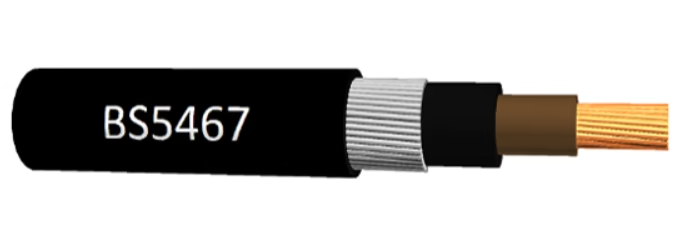
British Standard BS5467 specifies the requirements for low voltage armoured cables with thermosetting insulation rated at 600/1000V for fixed installations. These cables feature galvanised steel wire armour (SWA) for multi-core configurations and non-magnetic aluminium wire armour (AWA) for single-core applications. The standard encompasses cables with 1 to 48 cores, utilizing either plain annealed stranded copper (Class 2) or solid aluminium (Class 1) conductors per BS 6360/IEC 60228. The cross-linked polyethylene (XLPE) insulation ensures stable operation at maximum conductor temperatures of 90°C continuous and 250°C during short-circuit conditions.

What is BS5467 Cable?

BS5467 cable, BS5467 armoured cable, BS5467 SWA cable, SWA power cable, XLPE armoured cable, 0.6/1kV cable, low voltage armoured cable, steel wire armoured cable, AWA cable, underground burial cable, direct burial power cable, industrial power cable, British Standard cable, IEC 60502-1, BASEC approved, thermosetting insulation cable, PVC sheathed cable, UV resistant cable, mechanical protection cable, mains distribution cable, 3 core armoured cable, 4 core armoured cable, multi-core power cable, copper conductor cable, BS5467 cable specifications, BS5467 current rating, cable for mining, construction site cable, infrastructure cable, outdoor installation cable, BS5467電纜, 鋼絲鎧裝電纜, XLPE電纜, 低壓電力電纜, 直埋電纜, 工業電纜, 安徽飛純電纜, 特種電纜
TYPE 412 1.1kV Mining Cables to AS/NZS 2802:2000

TYPE 412 1.1kV Mining Cables to AS/NZS 2802:2000

TYPE 412 1.1kV mining cable represents a specialized category of heavy-duty armoured power cable engineered specifically for demanding mining operations where maximum mechanical protection and high impact resistance are paramount. Manufactured in strict compliance with the AS/NZS 2802:2000 standard, these cables serve as feeder conductors in applications where equipment damage from external impacts, crushing forces, and severe environmental conditions poses significant operational risks.
TYPE 240 1.1 to 11kV AS/NZS 1802:2003, AS/NZS 2802:2000 Australia Mining Cable

What is Type 240 Mining Cable ?

TYPE 240 cables serve as essential power supply conductors for critical mining equipment in underground coal mining operations. The cable’s robust construction and electrical characteristics make it particularly suitable for powering continuous miners, longwall shearer systems, hydraulic pump stations, shuttle cars, and various mobile mining machinery that operate in challenging underground environments.
SANS 1520 Feichun Cable

CU/XLPE/LSZH/SWA/LSZH-SANS 1507 0.6/1KVBlack Sheath with White Strip Cable

The CU/XLPE/LSZH/SWA/LSZH-SANS 1507 0.6/1KV cable with black sheath and white identification strip represents a significant advancement in industrial power transmission technology. This specialized cable combines the robust mechanical protection of steel wire armour (SWA) with the critical safety features of Low Smoke Zero Halogen (LSZH) materials, making it an optimal choice for demanding applications in mining operations, petrochemical facilities, and infrastructure projects across South Africa and internationally.