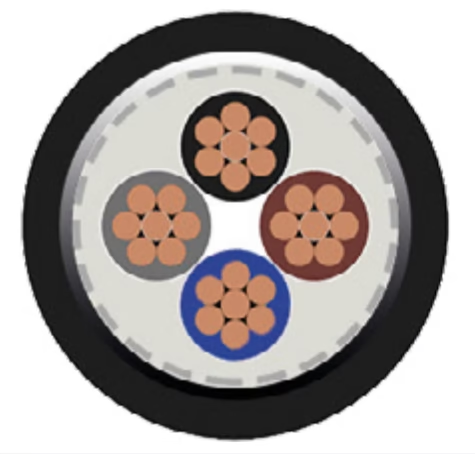
low voltage cable

Modern industrial lifting and material handling equipment operates under increasingly stringent design constraints. Gantry cranes in container yards must span wider distances with reduced structural weight. Ship-to-shore (STS) cranes must achieve higher transfer speeds without exceeding motor power budgets. Mining draglines must extend to greater heights while maintaining cable reeling capacity within physically constrained drum widths. In each of these scenarios, the reeling cable becomes a critical design bottleneck. The cable must simultaneously deliver high electrical current (high ampacity), fit within limited spatial envelopes (constrained outer diameter), maintain mechanical strength for decades of cyclic loading, and remain cost-competitive against alternative designs. These competing requirements have historically forced engineers into uncomfortable compromises: oversizing conductors to achieve required ampacity while accepting larger outer diameters and additional weight, or accepting reduced ampacity and undersizing equipment performance. XLPE (cross-linked polyethylene) insulated cable technology breaks this compromise by fundamentally altering the physics of electrical insulation, enabling smaller outer diameters and higher ampacity at equivalent mechanical performance levels. Understanding when this technology delivers genuine advantage versus when traditional elastomeric designs remain optimal requires careful analysis of the underlying physics and realistic comparison of total system performance.

(N)GRXGöu vs. NSHTÖU: When to Use XLPE-Insulated Reeling Cables Over Standard EPR Insulation for Higher Ampacity

Modern industrial lifting and material handling equipment operates under increasingly stringent design constraints. Gantry cranes in container yards must span wider distances with reduced structural weight. Ship-to-shore (STS) cranes must achieve higher transfer speeds without exceeding motor power budgets. Mining draglines must extend to greater heights while maintaining cable reeling capacity within physically constrained drum widths. In each of these scenarios, the reeling cable becomes a critical design bottleneck. The cable must simultaneously deliver high electrical current (high ampacity), fit within limited spatial envelopes (constrained outer diameter), maintain mechanical strength for decades of cyclic loading, and remain cost-competitive against alternative designs. These competing requirements have historically forced engineers into uncomfortable compromises: oversizing conductors to achieve required ampacity while accepting larger outer diameters and additional weight, or accepting reduced ampacity and undersizing equipment performance. XLPE (cross-linked polyethylene) insulated cable technology breaks this compromise by fundamentally altering the physics of electrical insulation, enabling smaller outer diameters and higher ampacity at equivalent mechanical performance levels. Understanding when this technology delivers genuine advantage versus when traditional elastomeric designs remain optimal requires careful analysis of the underlying physics and realistic comparison of total system performance.
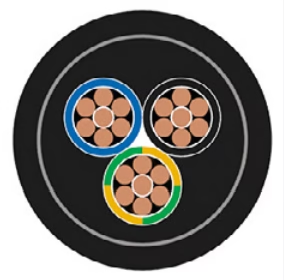
In the global cable manufacturing industry, voltage ratings represent a fundamental specification that determines a cable's safe operating parameters and application suitability. When examining low-voltage mining cables, a notable discrepancy emerges between international standards and those used in Australia and New Zealand. While the International Electrotechnical Commission (IEC) designates low-voltage power cables with a rating of 0.6/1kV under IEC 60502-1, Australian mining standards specify a 1.1/1.1kV rating for equivalent applications. This distinction is not arbitrary but reflects careful consideration of mining-specific operational requirements, safety margins, and the unique characteristics of Australia's mining infrastructure. 在全球电缆制造行业中,电压等级是决定电缆安全运行参数和应用适用性的基本规格。在研究低压矿用电缆时,国际标准与澳大利亚和新西兰使用的标准之间存在明显差异。国际电工委员会(IEC)根据IEC 60502-1标准将低压电力电缆的额定值指定为0.6/1kV,而澳大利亚矿用标准对于同等应用规定了1.1/1.1kV的额定值。这种区别并非随意,而是反映了对矿山特定运行要求、安全裕度以及澳大利亚矿业基础设施独特特征的仔细考虑。

Voltage Rating: Why Australian Standards Use 1.1/1.1kV Rating for LV Mining Cables Instead of the IEC Standard 0.6/1kV?

In the global cable manufacturing industry, voltage ratings represent a fundamental specification that determines a cable’s safe operating parameters and application suitability. When examining low-voltage mining cables, a notable discrepancy emerges between international standards and those used in Australia and New Zealand. While the International Electrotechnical Commission (IEC) designates low-voltage power cables with a rating of 0.6/1kV under IEC 60502-1, Australian mining standards specify a 1.1/1.1kV rating for equivalent applications. This distinction is not arbitrary but reflects careful consideration of mining-specific operational requirements, safety margins, and the unique characteristics of Australia’s mining infrastructure. 在全球电缆制造行业中,电压等级是决定电缆安全运行参数和应用适用性的基本规格。在研究低压矿用电缆时,国际标准与澳大利亚和新西兰使用的标准之间存在明显差异。国际电工委员会(IEC)根据IEC 60502-1标准将低压电力电缆的额定值指定为0.6/1kV,而澳大利亚矿用标准对于同等应用规定了1.1/1.1kV的额定值。这种区别并非随意,而是反映了对矿山特定运行要求、安全裕度以及澳大利亚矿业基础设施独特特征的仔细考虑。
KEMA approval is recognised as the key independent Dutch third-party accreditation for electrical cables, particularly important when working on low voltage installation projects in the Netherlands and across Europe. KEMA approvals are issued by KEMA Labs, based in Arnhem, The Netherlands. KEMA Labs' parent company is CESI (Centro Elettrotecnico Sperimentale Italiano), the Italian independent testing and laboratories business, having acquired the testing division from DNV GL Energy in 2019.

What are KEMA Approved Cables?

KEMA approved cable, KEMA certification, KEMA Labs, KEMA certified, KEMA approval, Dutch cable certification, Netherlands cable standard, third-party certified cable, independent cable certification KEMA认证电缆, KEMA認證電纜, 荷兰标准电缆, 荷蘭標準電纜, 低烟无卤电缆, 低煙無鹵電纜, 数据中心电缆, 數據中心電纜, 荷兰认证, 荷蘭認證
NF C32-322 is a French national standard (Norme Française) that specifies requirements for armoured low voltage power cables. These cables, commonly designated as U-1000 RVFV (copper conductor) and U-1000 ARVFV (aluminium conductor), are widely used rigid industrial cables designed for installations requiring mechanical protection. They represent the armoured equivalent of the NF C32-321 unarmoured cables.

What is NF C32-322 Cable?

NF C32-322, U-1000 RVFV, U-1000 ARVFV, U-1000 XAV, NF C32 322, RVFV cable, ARVFV cable, French standard armoured cable, 0.6/1kV cable, 1kV armoured cable, 600/1000V cable, low voltage armoured cable, LV power cable, 1000V industrial cable, NF C32-322 standard, NF C32-070 C2, IEC 60502-1, IEC 60228, IEC 60332-1-2, French cable standard, Norme Française cable, AFNOR cable standard, flame retardant cable,低压电缆, 低壓電纜, 铠装电缆, 鎧裝電纜, 交联聚乙烯电缆, 交聯聚乙烯電纜, 钢带铠装, 鋼帶鎧裝, 法国标准电缆, 法國標準電纜, 工业电缆, 工業電纜, 直埋电缆, 直埋電纜
The International Electrotechnical Commission (IEC) is the world's leading independent non-profit international standard-setting organization for electrical, electronic, and related technologies. Founded in 1906 with British Scientist Lord Kelvin as its first president, the IEC has over a century of expertise in developing international standards that form the basis for national and international standardization. All IEC standards are consensus-based and represent the needs of key stakeholders, with every member country having an equal vote.

What is IEC Cable?

IEC cable, IEC standard cable, IEC power cable, International Electrotechnical Commission cable, IEC 60228, IEC 60502, IEC 60331, IEC 60332, IEC cable standards, IEC compliant cable, international standard cable, IEC certified cable, IEC 60228, IEC 60228:2023, IEC 60228 conductor, IEC 60228 class 1, IEC 60228 class 2, IEC 60228 class 5, IEC 60228 class 6, IEC 60502, IEC 60502-1, IEC 60502-2, IEC 60502-4, IEC 60502-1:2021, IEC 60331, IEC 60331-1, IEC 60331-2, IEC 60331-21, IEC 60331-31, IEC 60332, IEC 60332-1, IEC 60332-1-2, IEC 60332-2, IEC 60332-3, IEC 60332-3-22, IEC 60332-3-23, IEC 60332-3-24, IEC 60332-3-25, IEC 61034, IEC 60754, IEC 60754-1, IEC 60754-2, IEC 60092, IEC 60702, IEC 60811, IEC 61158, IEC 60840
IEC 60502 is an international standard published by the International Electrotechnical Commission (IEC) that sets out the specification for power cables with extruded insulation. The standard covers cables with voltage ratings from 1 kV (Um = 1.2 kV) up to 30 kV (Um = 36 kV), designed for fixed installations such as distribution networks and industrial installations. This widely recognized standard serves as a primary reference for cable manufacturers worldwide and forms the basis for numerous national and regional cable standards.

What is IEC 60502 Cable?

IEC 60502 對導體類型、絕緣材料和護套化合物提供了詳細規格。絕緣材料包括 PVC(最高溫度 70°C)、XLPE、EPR 和 HEPR(均為最高 90°C)。導體類別包括第 1 類(實心)、第 2 類(絞合)和第 5 類(柔性),尺寸範圍從 1.5 mm² 到 1600 mm²。護套化合物包括 PVC、PE 和用於防火敏感區域的無鹵素材料。XLPE 絕緣的標稱厚度從 0.6/1 kV 的 1.0 mm 到 18/30 kV 的 8.0 mm 不等。
British Standard BS7870 Part 3 covers low voltage cables used for the provision of an electricity supply from a distribution main. These cables are manufactured in accordance with BS7870 Parts 3.11, 3.12, 3.20, and 3.22 for use by distribution and generation utilities. They are generally buried underground to connect individual houses or commercial properties to the grid by transmission, distribution, and power generation networks.

What is BS7870 Part 3 Cable?

BS7870 Part 3 cable, BS7870-3.11, BS7870-3.12, BS7870-3.21, BS7870-3.22, BS7870-3.40, BS7870-3.50, XLPE insulated cable, concentric cable, split concentric cable, waveform cable, 0.6/1kV cable, low voltage cable, PVC sheath cable, LSZH cable, low smoke zero halogen, copper conductor cable, aluminium conductor cable, underground distribution cable, service entrance cable, British Standard cable, UK power cable, CNE cable, combined neutral earth, utility distribution cable, BS7671 compliant, IEC 60228, Class 2 conductor, Class 1 conductor, residential power cable, commercial distribution, TN-S system, TN-C-S PME system, fixed installation cable, three-phase cable, single core cable, multi-core cable, power generation cable, transmission distribution cable, BS7870電纜, 低壓配電電纜, XLPE絕緣電纜, 同心電纜, 分裂同心電纜, 低煙無鹵電纜, 英國標準電纜, Anhui Feichun cable, Feichun Special Cable, 安徽飛純電纜
BS6724 is a British Standard specification for thermosetting insulated, armoured cables with rated voltages of 600/1000V and 1900/3300V, specifically designed to have low emission of smoke and corrosive gases when affected by fire. This standard is widely adopted in the UK and internationally for applications where fire safety is critical.

What is BS6724 Cable?

BS6724, BS 6724, BS6724 cable, BS6724 standard, BS 6724 cable specification, BS6724 LSZH cable, BS6724 SWA cable, BS6724 AWA cable, 600/1000V cable, 1900/3300V cable, 0.6/1kV cable, 1.9/3.3kV cable, low voltage cable BS6724,BS6724電纜, 低煙無鹵電纜, LSZH電纜, 低壓電纜, 鎧裝電纜, 鋼絲鎧裝電纜, 鋁絲鎧裝電纜, 阻燃電纜, 防火電纜, 公共建築電纜, 醫院電纜, 機場電纜, 隧道電纜, 數據中心電纜, 特種電纜, 電力電纜
600V 3TC-RB (600V 3PNCT) Crane Cable Class 3 600V Ethylene Propylene Rubber-Insulated Polychloroprene Rubber Sheath Cable

600V 3TC-RB (600V 3PNCT) Crane Cable

The 600V 3TC-RB cable, also known as 600V 3PNCT, represents a specialized class of flexible power cables engineered specifically for demanding industrial applications. This cable system is designed for mobile machinery operations where continuous flexing, environmental resistance, and electrical reliability are paramount. The designation “3TC-RB” indicates a Class 3 stranded conductor configuration with ethylene propylene rubber insulation and polychloroprene rubber sheath construction.
EN 50525-2-31 Cable

UK and Harmonized CENELEC Coding Cross References: BS 6004 vs EN 50525-2-31 Cable

The transition from traditional UK cable coding systems to harmonized European CENELEC standards represents a significant evolution in electrical cable specifications. The British Standard BS 6004, which has long governed PVC-insulated cables for voltages up to 300/500V in the United Kingdom, has been progressively superseded by the harmonized European standard EN 50525-2-31. This comprehensive technical guide examines the cross-references between these standards, providing detailed analysis of cable designations, specifications, applications, and compliance requirements essential for electrical engineers, contractors, and procurement professionals.
CEI 20-27 CENELEC HD361 Cable

What is CEI 20-27 CENELEC HD361 Cable?

CEI 20-27 CENELEC HD361 represents a standardized cable designation system developed by the European Committee for Electrotechnical Standardisation (CENELEC) to provide uniform identification and classification of harmonized power cables and cords across European markets. This systematic coding methodology enables engineers, procurement specialists, and electrical contractors to precisely identify cable specifications including voltage ratings, insulation materials, conductor types, and sheathing compounds through a structured alphanumeric designation format.