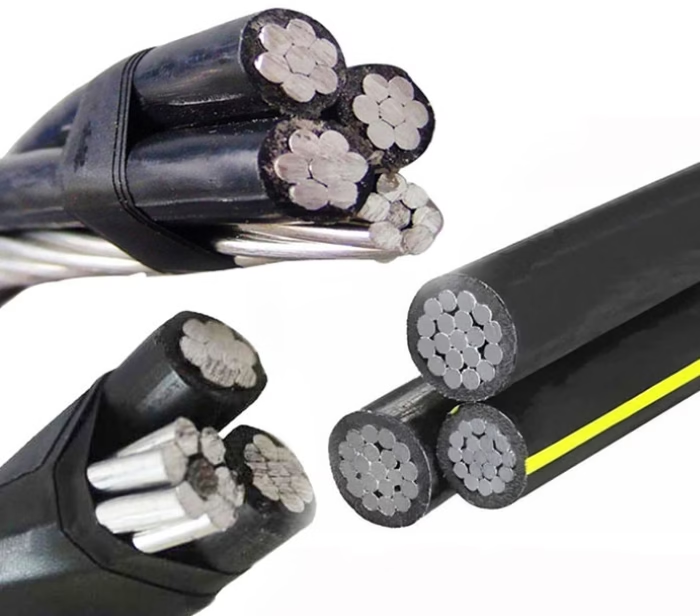
instrumentation cable

What Are UNE 22560 and UNE 22561? Scope, Definitions, and Core Purpose The UNE 22560 and UNE 22561 standards represent the final and often most underestimated element of the Spanish and Latin American underground mining cable ecosystem. Where UNE 22511 and UNE 22512 govern the power distribution cables that energize mining equipment, the 22560 and 22561 standards govern the signal, control, and interlock cables that command and protect that equipment. These are the "nervous system" cables of a mine — the communication network that tells a continuous miner when to advance and when to halt, that triggers emergency stops, that monitors hoisting rope tension on shaft equipment, that controls conveyor sequencing, and that enables the protective interlocking that prevents a piece of equipment from operating unless all safety preconditions are met. UNE 22560 formally defines flexible multi-core cables for underground mining with voltage ratings up to 500 V or 0.6/1 kV, with no metallic armour protection — designed for installation within equipment enclosures, along protected cable trays in main gate roads, or in areas where mechanical damage risk is minimal. UNE 22561 is its armoured sister standard, incorporating steel wire braid or steel tape protection, specified for installation in rough terrain areas where mechanical damage from rock fall, equipment collision, or floor contact is a credible risk. Both standards mandate that the cable be designed as a multi-core concentric stranded bundle — not the parallel-laid three or four conductors common in power cables, but rather seven, twelve, nineteen, or more individually insulated cores twisted concentrically around a central axis, allowing compact packaging of numerous independent control circuits within a single cable jacket. The distinction between these standards is not merely mechanical armour presence or absence. Control cables are tested against an entirely different set of safety criteria than power cables because their failure mode is fundamentally different. A power cable failure results in loss of energy to equipment — dangerous but localized. A control cable failure can disable the interlock system that prevents a continuous miner from advancing into unsafe ground, or can disable the emergency stop circuit that should halt a conveyor if a worker falls into it. A control cable fire, burning in a tightly bundled cable tray with other control cables, must not spread flame between cables because control cables are typically routed in shared ducts and cable carriers where one cable's ignition could cascade to adjacent circuits. Therefore, control cables are tested for bundle flame propagation (EN 60332-3) rather than single-cable flame propagation tests — a more stringent requirement that demands careful attention to outer sheath formulation and cable spacing in bundle installation.

Что такое PANZERFLEX-L 0,6/1 kV – Instrumentation and Control: инженерный обзор гибкого кабеля управления для Mining, Reeling и Festoon Systems

PANZERFLEX-L 0,6/1 kV – Instrumentation and Control — это многожильный гибкий кабель для цепей управления, приборных линий, вспомогательного питания и сигнализации на подвижных частях машин, горнодобывающего оборудования и material handling systems. Он предназначен для кабельных барабанов и festoon systems, где кабель постоянно изгибается, частично скручивается, ускоряется и работает под механическим натяжением. Его ключевые признаки — лужёная медная жила class 5 IEC 60228, HEPR crushproof insulation, короткая скрутка ≤7,5× диаметра укладки, чёрные жилы с печатной нумерацией, опциональная зелёно-жёлтая жила, полихлоропреновые оболочки и антискручивающие синтетические нити между внутренней и наружной оболочкой.
GAALFLEX® Complete 53-Product Cable Selection Guide: Deep Comparison Across 7 Product Families for Industrial, Marine, Mining, Automation, and VFD Applications A comprehensive engineering reference comparing all 53 GAALFLEX® cable products across voltage rating, insulation technology, shielding architecture, temperature range, certification standards, application environment, and core configuration — enabling engineers to select the optimal cable for any industrial scenario from a single unified portfolio.

Deep Comparison Across 7 Cables Families for Industrial, Marine, Mining, Automation, and VFD Applications

GAALFLEX® Complete 53-Product Cable Selection Guide: Deep Comparison Across 7 Product Families for Industrial, Marine, Mining, Automation, and VFD Applications A comprehensive engineering reference comparing all 53 GAALFLEX® cable products across voltage rating, insulation technology, shielding architecture, temperature range, certification standards, application environment, and core configuration — enabling engineers to select the optimal cable for any industrial scenario from a single unified portfolio.
Full technical breakdown Lapp ÖLFLEX CLASSIC 110 CY 300/500V: shielded multi-core control cable for CNC machine tools, conveyor systems, automation panels. Characteristic transparent PVC outer sheath allows visual inspection of tinned copper braid shield integrity. "CY" designates copper shield (copperScreen) protecting low-voltage control signals from electromagnetic interference (EMC) from nearby power cables, frequency converters, welding equipment, RF sources. Standard configurations: 2–100 cores, 0.5–35 mm² sections with digital marking (black cores + white numbers) + yellow-green earth. Conductor class 5 per VDE 0295 (maximum flexibility), min. bending radius 20× OD in mobile applications. Special PVC insulation (Lapp composition) provides -5°C to +70°C (mobile) / -40°C to +80°C (fixed). Flame retardant IEC 60332-1-2 (self-extinguishing). Tinned copper braid shield density ~85%, effective EMI suppression 50 Hz to several MHz. Transparent sheath is Lapp trademark — allows visual shield inspection without cutting. Russian alternatives: КГВВЭ (usually black/grey sheath, color-coded cores), МКЭШВ (small sections). European standard YSLYCY-JZ from Helukabel, TKD, Faber. FeiChun YSLYCY-JZ — full drop-in equivalent with transparent PVC, digital marking, 85%+ copper braid.

ÖLFLEX CLASSIC 110 CY Экранированный контрольный кабель: прозрачная ПВХ и медная оплётка для защиты от ЭМС — FeiChun YSLYCY-JZ, аналоги Lapp

Full technical breakdown Lapp ÖLFLEX CLASSIC 110 CY 300/500V: shielded multi-core control cable for CNC machine tools, conveyor systems, automation panels. Characteristic transparent PVC outer sheath allows visual inspection of tinned copper braid shield integrity. “CY” designates copper shield (copperScreen) protecting low-voltage control signals from electromagnetic interference (EMC) from nearby power cables, frequency converters, welding equipment, RF sources. Standard configurations: 2–100 cores, 0.5–35 mm² sections with digital marking (black cores + white numbers) + yellow-green earth. Conductor class 5 per VDE 0295 (maximum flexibility), min. bending radius 20× OD in mobile applications. Special PVC insulation (Lapp composition) provides -5°C to +70°C (mobile) / -40°C to +80°C (fixed). Flame retardant IEC 60332-1-2 (self-extinguishing). Tinned copper braid shield density ~85%, effective EMI suppression 50 Hz to several MHz. Transparent sheath is Lapp trademark — allows visual shield inspection without cutting. Russian alternatives: КГВВЭ (usually black/grey sheath, color-coded cores), МКЭШВ (small sections). European standard YSLYCY-JZ from Helukabel, TKD, Faber. FeiChun YSLYCY-JZ — full drop-in equivalent with transparent PVC, digital marking, 85%+ copper braid.
The nominal outer diameter (OD) of a LAPP ÖLFLEX CLASSIC 115 CY 4G1.5 VDE 0250 four-conductor shielded control cable (Article number 1136304) is precisely 8.2 millimeters (0.323 inches), representing one of the most compact shielded multi-conductor control cables available in the industrial market. This exceptionally small diameter represents the deliberate design philosophy behind the CLASSIC 115 series: eliminating the inner protective sheath layer found in many competing control cables, thereby minimizing overall cable diameter while maintaining complete EMC shielding through a high-coverage tinned copper braided shield. The cable contains exactly four conductors, each with a 1.5 square millimeter cross-sectional area (the 4G1.5 designation), with one conductor specifically designated as the green-yellow protective earth/ground conductor per VDE 0293-308 color coding standards. The total copper conductor mass is approximately 100 kilograms per kilometer, while the complete assembled cable including PVC insulation, outer sheath, and braided copper shield weighs only approximately 135 kilograms per kilometer—among the lightest shielded four-conductor cables available for control applications. This compact, lightweight design makes the ÖLFLEX CLASSIC 115 CY ideally suited for space-constrained installations such as densely wired control panels, measurement and control technology systems, data processing equipment, and industrial machinery where cable routing must navigate tight spaces and equipment enclosure penetrations with minimal material volume.

VDE Cross-Reference: Drop-in Alternative for ÖLFLEX CLASSIC 115 CY 4G1.5 VDE 0250

The nominal outer diameter (OD) of a LAPP ÖLFLEX CLASSIC 115 CY 4G1.5 VDE 0250 four-conductor shielded control cable (Article number 1136304) is precisely 8.2 millimeters (0.323 inches), representing one of the most compact shielded multi-conductor control cables available in the industrial market. This exceptionally small diameter represents the deliberate design philosophy behind the CLASSIC 115 series: eliminating the inner protective sheath layer found in many competing control cables, thereby minimizing overall cable diameter while maintaining complete EMC shielding through a high-coverage tinned copper braided shield. The cable contains exactly four conductors, each with a 1.5 square millimeter cross-sectional area (the 4G1.5 designation), with one conductor specifically designated as the green-yellow protective earth/ground conductor per VDE 0293-308 color coding standards. The total copper conductor mass is approximately 100 kilograms per kilometer, while the complete assembled cable including PVC insulation, outer sheath, and braided copper shield weighs only approximately 135 kilograms per kilometer—among the lightest shielded four-conductor cables available for control applications. This compact, lightweight design makes the ÖLFLEX CLASSIC 115 CY ideally suited for space-constrained installations such as densely wired control panels, measurement and control technology systems, data processing equipment, and industrial machinery where cable routing must navigate tight spaces and equipment enclosure penetrations with minimal material volume.
The nominal outer diameter (OD) of a Lapp ÖLFLEX CLASSIC 110 CY 12G1.5 shielded multi-conductor control cable is approximately 14.8 millimeters (0.583 inches). This specification represents a 12-core cable where each core has a nominal cross-section of 1.5 square millimeters, with one of those cores designated as a green-yellow (dual-color) protective earth/ground conductor in compliance with VDE 0293-334 color coding standards. The cable contains a high-coverage tinned copper braid shield surrounding the insulated conductors, providing exceptional electromagnetic interference (EMC) mitigation with a transfer impedance specification of maximum 250 Ω/km at 30 MHz. The total copper weight (conductor mass) is approximately 280 kilograms per kilometer, while the complete cable (including PVC insulation, outer sheath, and metallic shield) weighs approximately 393 kilograms per kilometer. This cable is designed specifically for control and signal applications in industrial automation environments where electrical noise immunity and mechanical reliability are critical performance requirements.

Direct Equivalent: Cost-Effective Replacement for ÖLFLEX CLASSIC 110 CY 12G1.5 Shielded Cable

The nominal outer diameter (OD) of a Lapp ÖLFLEX CLASSIC 110 CY 12G1.5 shielded multi-conductor control cable is approximately 14.8 millimeters (0.583 inches). This specification represents a 12-core cable where each core has a nominal cross-section of 1.5 square millimeters, with one of those cores designated as a green-yellow (dual-color) protective earth/ground conductor in compliance with VDE 0293-334 color coding standards. The cable contains a high-coverage tinned copper braid shield surrounding the insulated conductors, providing exceptional electromagnetic interference (EMC) mitigation with a transfer impedance specification of maximum 250 Ω/km at 30 MHz. The total copper weight (conductor mass) is approximately 280 kilograms per kilometer, while the complete cable (including PVC insulation, outer sheath, and metallic shield) weighs approximately 393 kilograms per kilometer. This cable is designed specifically for control and signal applications in industrial automation environments where electrical noise immunity and mechanical reliability are critical performance requirements.
The selection of industrial power cables represents one of the most critical engineering decisions in drilling operations, whether on land or offshore. Two cable types dominate this application space: the Type SHD-GC (重型屏蔽接地检查电缆), designed primarily for mobile mining and terrestrial drilling equipment, and the Type P (海洋平台电缆), engineered specifically for harsh offshore and fixed platform environments. Though both cables operate at similar voltage ratings, they embody fundamentally different design philosophies that reflect the distinct mechanical, electrical, and safety demands of their respective application domains.

Type SHD-GC vs. Type P: Selecting the Right Trailing Cable for Land and Offshore Drilling 

The selection of industrial power cables represents one of the most critical engineering decisions in drilling operations, whether on land or offshore. Two cable types dominate this application space: the Type SHD-GC (重型屏蔽接地检查电缆), designed primarily for mobile mining and terrestrial drilling equipment, and the Type P (海洋平台电缆), engineered specifically for harsh offshore and fixed platform environments. Though both cables operate at similar voltage ratings, they embody fundamentally different design philosophies that reflect the distinct mechanical, electrical, and safety demands of their respective application domains.
The European and American approaches to cable engineering reflect fundamentally different environmental threat models. BFOU cables manufactured to NEK 606 specifications incorporate halogen-free insulation, SHF2 H-M compound sheathing, and mica glass tape (MGT) as a fire barrier, enabling uninterrupted power delivery during fire situations in accordance with IEC 60331-21. This design prioritizes survival of critical systems during extreme thermal events—a recognized hazard in confined spaces such as engine rooms and living quarters aboard offshore vessels.

Why Your BFOU Cable Needs a Type N Jacket Upgrade?

The European and American approaches to cable engineering reflect fundamentally different environmental threat models. BFOU cables manufactured to NEK 606 specifications incorporate halogen-free insulation, SHF2 H-M compound sheathing, and mica glass tape (MGT) as a fire barrier, enabling uninterrupted power delivery during fire situations in accordance with IEC 60331-21. This design prioritizes survival of critical systems during extreme thermal events—a recognized hazard in confined spaces such as engine rooms and living quarters aboard offshore vessels.
As mining operations become increasingly automated, the reliable transmission of control signals and sensor data has become critical to operational safety and efficiency. Modern mining automation systems integrate programmable logic controllers, variable frequency drives, instrumentation sensors, and digital communication networks that must function reliably in electrically hostile underground environments. The electromagnetic interference generated by high-power mining equipment poses a significant threat to these sensitive systems, making proper cable shielding essential for signal integrity and system reliability.1 随着采矿作业变得越来越自动化,控制信号和传感器数据的可靠传输对运营安全和效率变得至关重要。现代采矿自动化系统集成了可编程逻辑控制器、变频驱动器、仪表传感器和数字通信网络,这些必须在电气恶劣的地下环境中可靠运行。

(N)TSCGECEWÖU: Individual Copper Screening for Sensitive Mining Automation Equipment

As mining operations become increasingly automated, the reliable transmission of control signals and sensor data has become critical to operational safety and efficiency. Modern mining automation systems integrate programmable logic controllers, variable frequency drives, instrumentation sensors, and digital communication networks that must function reliably in electrically hostile underground environments. The electromagnetic interference generated by high-power mining equipment poses a significant threat to these sensitive systems, making proper cable shielding essential for signal integrity and system reliability.1 随着采矿作业变得越来越自动化,控制信号和传感器数据的可靠传输对运营安全和效率变得至关重要。现代采矿自动化系统集成了可编程逻辑控制器、变频驱动器、仪表传感器和数字通信网络,这些必须在电气恶劣的地下环境中可靠运行。
When you look at a cable from the outside, you see a smooth, round cylinder. This simple appearance conceals a complex engineering challenge. Inside that cylindrical exterior are multiple insulated conductors of various sizes arranged together. Without proper design, these internal components would naturally create an irregular, lumpy cross-section rather than the uniform circular shape we expect from a professional cable. This is where rubber fillers play their essential role, and understanding their function requires us to think about the geometric and mechanical realities of cable construction.

Rubber Filler Role: Understanding How Fillers Maintain Cylindrical Shape in NSSHÖU Cables Under Crushing Loads

When you look at a cable from the outside, you see a smooth, round cylinder. This simple appearance conceals a complex engineering challenge. Inside that cylindrical exterior are multiple insulated conductors of various sizes arranged together. Without proper design, these internal components would naturally create an irregular, lumpy cross-section rather than the uniform circular shape we expect from a professional cable. This is where rubber fillers play their essential role, and understanding their function requires us to think about the geometric and mechanical realities of cable construction.
High-speed, high-quality end-to-end data transmission cables for communication technology applications including data transfer, sound and video communications, signalling and instrumentation. Our range covers EIA-232, EIA-422, EIA-423 and EIA-485 standards with LSF, LSZH, PE and PVC sheathing options offering superior performance characteristics.

Belden and Alternative / Equivalent Cables

Belden 9841, Belden 9842, Belden 9843, Belden 9844, Belden 8723, Belden 8728, Belden 8777, Belden 8778, Belden 9501, Belden 9502, Belden 9503, Belden 9504, Belden 9506, Belden 9508, Belden 9510, Belden 8760, Belden 8761, Belden 8762, Belden 8102, Belden 8103, Belden 8104, Belden 8105, Belden 8106, Belden 8162, Belden 8163, Belden 1502R, Belden 8770, Belden 9927, Belden 9929, Belden 9934, Belden 9936
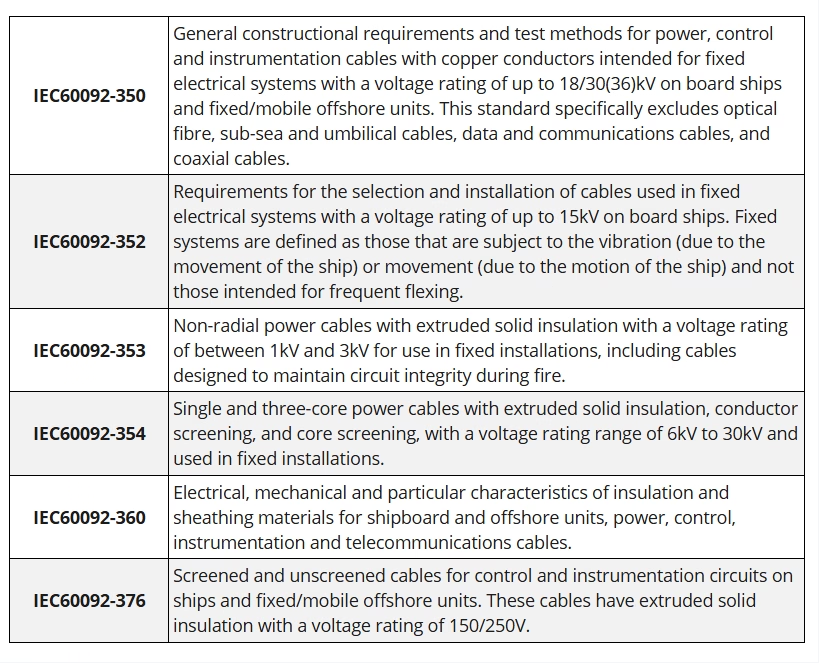
IEC 60092 is the international standard for electrical installations in ships and fixed/mobile marine applications. Ship wiring is covered by various national standards such as BS 6883 (British) and NEK 606 (Norwegian), and subject to third-party accreditations including Lloyd's Register, DNV (Det Norske Veritas), and ABS (American Bureau of Shipping). As an international standard, IEC 60092 covers power and instrumentation cables for use on ships and in mobile marine environments.

What is IEC 60092 Cable?

IEC 60092 cable, marine cable, shipboard cable, offshore cable, BS 6883 cable, NEK 606 cable, BFOU cable, RFOU cable, 657TQ cable, 658TQ cable, fire resistant marine cable, flame retardant cable, ship wiring, offshore platform cable, Lloyd’s Register approved, DNV certified, halogen free cable, LSZH marine cable, MUD resistant cable, IEC 60092-353, IEC 60092-354, IEC 60092-376, SW4 cable, EPR insulated, TCWB armoured, instrumentation cable, control cable, emergency power cable, oil rig cable, Feichun cable
EN 50288-7 instrumentation cables are multi-element metallic cables used in analogue and digital communication and control applications. Manufactured in accordance with European Standard EN 50288 (British Standard BS EN 50288), these cables are widely used in processing plants such as those found in the petrochemical industry due to their ability to withstand electromagnetic interference (EMI). They are specifically designed for the transmission of signals in instrumentation, control, and communication applications, commonly available in 300V and 500V voltage ratings.

What is EN 50288-7 Cable?

EN 50288-7 cable, BS EN 50288-7, instrumentation cable, control cable, RE-2X(st)H cable, RE-2X(st)Y cable, RE-2Y(st)Y cable, PiMF cable, TiMF cable, screened cable, petrochemical cable, XLPE instrumentation cable, LSZH instrumentation cable
DIN VDE 0812 is a German national standard issued in 1988 that contains specifications for equipment wires and stranded equipment wires used within telecommunications and data processing systems. The standard covers flexible, multi-conductor cables designed for electronic control system connections, voice frequency transmission, and signal communications in fixed installations. These cables represent popular European alternatives to American-style data and control cables, featuring cores twisted into pairs to reduce crosstalk and electromagnetic interference.

What is DIN VDE 0812 Cable?

DIN VDE 0812 cables are designed for electronic control system connections, voice frequency transmission, and signal communications in fixed installations. They are widely used across various industries where reliable data and signal transmission is required in environments requiring flexibility and compact cable routing.
GEXOL®-331HF Five Conductor Power Cable represents the most comprehensive multi-conductor solution in the GEXOL fire-resistant cable family, engineered specifically for complex five-phase power applications and advanced electrical systems in demanding offshore and marine environments worldwide. This five-conductor design maintains circuit integrity during fire conditions while providing maximum flexibility for sophisticated power distribution requirements. The cable features a Black-White-Red-Green-Orange color coding system for easy phase identification, with sizes 1/0 AWG and larger utilizing printed phase identification on the insulation. Available in 13 conductor sizes from 18 AWG to 4/0 AWG, this cable delivers complete five-conductor power solutions for emergency lighting, fire detection/suppression systems, alarm networks, and critical process control applications.

GEXOL®-331HF Power Cable

GEXOL-331HF, GEXOL-331HF five conductor, GEXOL 331HF 5 conductor cable, GEXOL-331HF fire resistant cable, GEXOL-331HF 0.6/1kV cable, GEXOL-331HF five core cable, GEXOL-331HF power cable, AmerCable GEXOL-331HF, Nexans AmerCable GEXOL, GEXOL-HF insulation, 耐火電纜, 五芯電纜, 五芯電力電纜, 五相電纜, 低煙無鹵電纜, 低煙無鹵五芯電纜, 船用電纜, 船用五芯電纜, 離岸電纜, 海洋電纜, 0.6/1kV電纜, 600V/1000V電纜, 90度額定電纜, 阻燃電纜, 鎧裝電纜, 青銅鎧裝, 鍍錫銅導體, 交聯聚烯烴, 緊急照明電纜, 消防系統電纜, 消防泵電纜, 多芯電機電纜, 危險區域電纜, 船級社認證, DNV認證電纜, ABS認證電纜, IEEE 1580標準, IEC 60331標準, 黑白紅綠橙色碼, 相位識別, 三相加中性線加接地, 變頻驅動器電纜, 過程控制電纜, 安徽飛純特種電纜
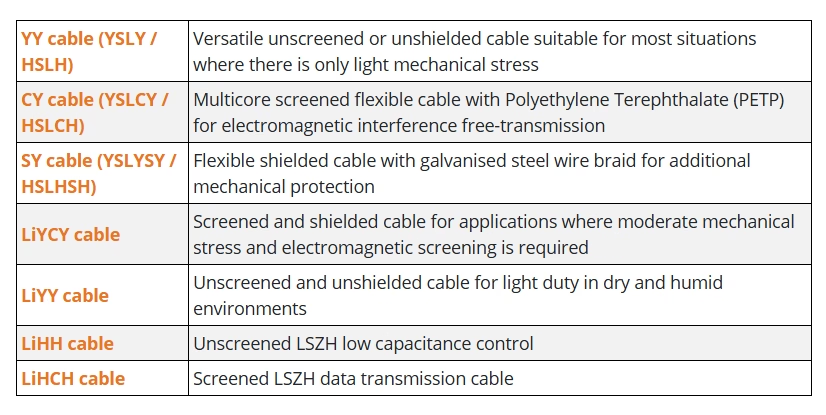
Control Flex cables are specialized multi-core cables designed for measuring, monitoring, and controlling machinery in industrial environments. These cables are essential components in manufacturing facilities, engineering installations, power stations, heating/air conditioning systems, and various electrical control applications. The three main types offered—CY (Copper-Screened), SY (Steel-Braided), and YY (Unscreened)—each provide distinct advantages depending on the application requirements for electromagnetic interference (EMI) protection, mechanical protection, or cost-effective basic control functionality.

Complete Guide to CY, SY & YY Control Flex Cables

P2CY cable, P3CY cable, P4CY cable, P5CY cable, P7CY cable, P3SY cable, P4SY cable, P5SY cable, P2YY cable, P3YY cable, P4YY cable, P5YY cable, P7YY cable, P12YY cable, CY control cable, SY control cable, YY control cable, CY screened cable, SY steel braided cable, YY unscreened cable, copper braid screen, galvanised steel braid, BS EN 50525-2-11, IEC 60332-1, IEC 60228, VDE 0293, screened control cable, shielded control cable, EMI shielding cable, RFI protection cable, signal transmission cable, data transmission cable, manufacturing control cable, industrial control cable, machinery monitoring cable, HVAC control cable, power station cable, PLC cable, automation cable, instrumentation cable, multicore control cable, fine stranded copper, 300/500V cable, flame retardant cable, mechanical protection cable, abrasion resistant cable, 2 core control, 3 core control, 4 core control, 5 core control, 7 core control, 12 core control, 0.75mm control cable, 1.5mm control cable, 2.5mm control cable, 控制電纜, 銅屏蔽電纜, 鋼絲編織電纜, 工業控制電纜, 安徽飛純電纜
FESTOONFLEX-LX 0,6/1 kV is a premium instrumentation and control cable engineered for mining operations and bulk material handling applications. This cable is specifically designed for festoon systems and connecting movable parts of machine tools where fast movement, strong acceleration, and frequent bending during operation are critical requirements.

FESTOONFLEX-LX 0,6/1 kV Instrumentation & Control Cable

FESTOONFLEX-LX, FESTOONFLEX-LX 0.6/1kV, instrumentation cable, control cable, mining control cable, festoon cable, IEC 60228 Class 5, DIN VDE 0298, screened pairs cable, EPR insulation, polychloroprene sheath, UV resistant cable, oil resistant cable, crushproof cable, 90°C rated cable, -30°C low temperature, mining equipment cable, crane control cable, conveyor instrumentation, bulk material handling, high flex cable, torsion resistant cable, EMI shielded cable, 80% screen coverage, 4G control cable, 5G control cable, multi-core cable, Anhui Feichun cable, 礦用控制電纜, 儀表電纜, 懸掛電纜, 屏蔽對電纜, 特種電纜
CEI 20-27 CENELEC HD361 Cable

What is CEI 20-27 CENELEC HD361 Cable?

CEI 20-27 CENELEC HD361 represents a standardized cable designation system developed by the European Committee for Electrotechnical Standardisation (CENELEC) to provide uniform identification and classification of harmonized power cables and cords across European markets. This systematic coding methodology enables engineers, procurement specialists, and electrical contractors to precisely identify cable specifications including voltage ratings, insulation materials, conductor types, and sheathing compounds through a structured alphanumeric designation format.