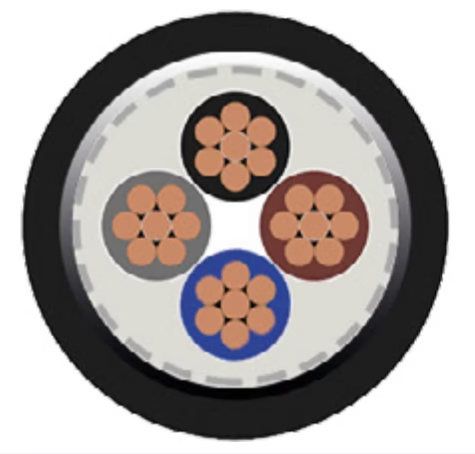
IEC 60502-4

PV-FLAT H05VVH6-F/LIFT is engineered for one of the most demanding electrical environments on Earth: nuclear power plants and high-radiation medical imaging facilities. Unlike standard cables, which degrade rapidly when exposed to ionizing radiation, this cable withstands 80 mrad (80 million rads) of cumulative radiation dose—equivalent to 20+ years in a high-radiation zone. Nuclear and medical facility elevators operate in harsh radiation environments where: Gamma radiation (¹³⁷Cs, ⁶⁰Co sources)—degrades polymer chains in cable insulation, causing brittleness and electrical breakdown Neutron radiation (from reactor cores)—causes atomic transmutation in copper conductors, increasing electrical resistance X-ray radiation (medical imaging rooms, CT scanners)—accelerates polymer cross-linking, reducing mechanical flexibility Extreme temperature cycling (−40°C cryogenic zones to +80°C during equipment failure scenarios) Hydrogen generation (from reactor cooling water radiolysis)—corrosive to standard insulation compounds The PV-FLAT's parallel-core flat architecture is specifically designed for confined elevator cable routing in nuclear containment buildings and medical facility basements, where space is extremely limited and cable management is critical for safety systems.

(N)TSCGEWÖU-FO High Voltage & Data Composite Cable | VDE 0250 | EAC Ex & GOST Fire | Russia Energy

An engineering-grade technical reference for Russian Federation energy infrastructure, electrical power transmission and distribution systems, oil and gas operational control networks, renewable energy installations, and SCADA (Supervisory Control and Data Acquisition) telemetry systems requiring simultaneous high-voltage power delivery and real-time monitoring data transmission across extended geographic distances. This document explains the hybrid high-voltage copper-conductor and single-mode optical-fiber composite architecture that enables simultaneous delivery of multi-megawatt electrical power through primary high-voltage cores while transmitting continuous streams of remote monitoring, metering, and safety-critical control data through integrated optical fibers that are completely immune to the electromagnetic noise present in high-voltage utility environments. The document establishes performance specifications and certification compliance for 6–35 kV rated voltage operation across Russian Federation energy sector infrastructure, and provides field integration guidance for seamless deployment into utility-scale power systems and distributed energy networks.
FLEXIFESTOON® PV-FLAT UL: High-Flexibility Salt-Fog Resistant Flat Festoon Cable for Port Operations, Marine Equipment, and Harbor Automation Systems Feichun's FLEXIFESTOON® PV-FLAT UL establishes a new performance paradigm for port-duty electrical infrastructure by combining three critical engineering requirements into unified cable architecture: extreme mechanical flexibility enabling 5×D minimum bending radius and 120 m/min festoon deployment on container gantries and ship loaders; comprehensive salt-fog environmental resistance through specialized PVC compound formulation with enhanced corrosion inhibitors surviving ASTM B117 salt-spray testing protocols characteristic of extreme coastal and offshore environments; and verified 600V/2000V dual-voltage certification (UL 1581, CSA approved) supporting both power distribution and precision automation signal transmission across the world's most demanding port and maritime cargo-handling operations.

NSSHÖU Heavy-Duty Mining Cable | VDE 0250 | Pre-Certified EAC & GOST | Smooth Russia Project Delivery

An engineering-grade technical reference for mining equipment OEMs, rope shovel and dragline manufacturers, mining project engineers, and equipment procurement specialists selecting robust trailing cables for underground and surface mining operations in the Russian Federation and EAEU member states. This document explains the structural and material engineering behind NSSHÖU heavy-duty construction, compares performance against conventional mining cables and international alternatives, and details the pre-certification path for Russian regulatory compliance and seamless project delivery.
GAALFLEX® VFD 2YSLCYK-J: CPR-Compliant (EU 305/2011 + EN 50575:2014+A1:2016, Eca Classification) Variable Frequency Drive Inverter Connection Cable for North American Industrial Motor Power Supply, Mining Applications, and Outdoor Frequency Converter Systems (0.6/1 kV Nominal Voltage, 4 kV Test Voltage, Comprehensive Dual-Configuration Portfolio [4-Core and 3+3 Earth Conductor Versions], 1.5–300 mm² Conductor Range Enabling Complete VFD Specification from Servo Drives Through Industrial Motors, Flexible Class 5 Red Copper per IEC 60228, PE Special Insulation Compound Providing Electrical Stability, Aluminum Tape + PETP Foil + Tinned Copper Braid Triple-Layer Shielding, Low Mutual Capacitance [70–410 nF/km], Low Coupling Resistance [Max 250 Ω/km], Black RAL 9005 PVC Outer Sheath with UV Resistance Enabling Outdoor Mining and Industrial Installation Without Degradation, Temperature Range −40 to +70°C [Fixed] or −5 to +70°C [Flexible Application] with +90°C Conductor and +250°C Short-Circuit Capability, Hazardous-Area Installation per DIN VDE 0250, Electromagnetic Compatibility per EN 55011 / DIN VDE 0875 / EN 61800-3, Self-Extinguishing and Flame-Retardant per DIN VDE 0482-265-2-1, CPR Fire Classification Eca [EN 13501-1] Enabling European Regulatory Compliance, Optional XLPE Halogen-Free Version [2XSLCHK-J] per IEC 60502-4 with Eca-Rated Black SHF1 Sheath, Suitable for Mining Machinery, Outdoor Industrial Systems, Automotive and Food Automation with Environmental Exposure, and Complete International VFD Infrastructure Compliance with Regulatory Mandates)

Type 2YSLCYK-J GAALFLEX® VFD

GAALFLEX® VFD 2YSLCYK-J: CPR-Compliant (EU 305/2011 + EN 50575:2014+A1:2016, Eca Classification) Variable Frequency Drive Inverter Connection Cable for North American Industrial Motor Power Supply, Mining Applications, and Outdoor Frequency Converter Systems (0.6/1 kV Nominal Voltage, 4 kV Test Voltage, Comprehensive Dual-Configuration Portfolio [4-Core and 3+3 Earth Conductor Versions], 1.5–300 mm² Conductor Range Enabling Complete VFD Specification from Servo Drives Through Industrial Motors, Flexible Class 5 Red Copper per IEC 60228, PE Special Insulation Compound Providing Electrical Stability, Aluminum Tape + PETP Foil + Tinned Copper Braid Triple-Layer Shielding, Low Mutual Capacitance [70–410 nF/km], Low Coupling Resistance [Max 250 Ω/km], Black RAL 9005 PVC Outer Sheath with UV Resistance Enabling Outdoor Mining and Industrial Installation Without Degradation, Temperature Range −40 to +70°C [Fixed] or −5 to +70°C [Flexible Application] with +90°C Conductor and +250°C Short-Circuit Capability, Hazardous-Area Installation per DIN VDE 0250, Electromagnetic Compatibility per EN 55011 / DIN VDE 0875 / EN 61800-3, Self-Extinguishing and Flame-Retardant per DIN VDE 0482-265-2-1, CPR Fire Classification Eca [EN 13501-1] Enabling European Regulatory Compliance, Optional XLPE Halogen-Free Version [2XSLCHK-J] per IEC 60502-4 with Eca-Rated Black SHF1 Sheath, Suitable for Mining Machinery, Outdoor Industrial Systems, Automotive and Food Automation with Environmental Exposure, and Complete International VFD Infrastructure Compliance with Regulatory Mandates)
The International Electrotechnical Commission (IEC) is the world's leading independent non-profit international standard-setting organization for electrical, electronic, and related technologies. Founded in 1906 with British Scientist Lord Kelvin as its first president, the IEC has over a century of expertise in developing international standards that form the basis for national and international standardization. All IEC standards are consensus-based and represent the needs of key stakeholders, with every member country having an equal vote.

What is IEC Cable?

IEC cable, IEC standard cable, IEC power cable, International Electrotechnical Commission cable, IEC 60228, IEC 60502, IEC 60331, IEC 60332, IEC cable standards, IEC compliant cable, international standard cable, IEC certified cable, IEC 60228, IEC 60228:2023, IEC 60228 conductor, IEC 60228 class 1, IEC 60228 class 2, IEC 60228 class 5, IEC 60228 class 6, IEC 60502, IEC 60502-1, IEC 60502-2, IEC 60502-4, IEC 60502-1:2021, IEC 60331, IEC 60331-1, IEC 60331-2, IEC 60331-21, IEC 60331-31, IEC 60332, IEC 60332-1, IEC 60332-1-2, IEC 60332-2, IEC 60332-3, IEC 60332-3-22, IEC 60332-3-23, IEC 60332-3-24, IEC 60332-3-25, IEC 61034, IEC 60754, IEC 60754-1, IEC 60754-2, IEC 60092, IEC 60702, IEC 60811, IEC 61158, IEC 60840
IEC 60502 is an international standard published by the International Electrotechnical Commission (IEC) that sets out the specification for power cables with extruded insulation. The standard covers cables with voltage ratings from 1 kV (Um = 1.2 kV) up to 30 kV (Um = 36 kV), designed for fixed installations such as distribution networks and industrial installations. This widely recognized standard serves as a primary reference for cable manufacturers worldwide and forms the basis for numerous national and regional cable standards.

What is IEC 60502 Cable?

IEC 60502 對導體類型、絕緣材料和護套化合物提供了詳細規格。絕緣材料包括 PVC(最高溫度 70°C)、XLPE、EPR 和 HEPR(均為最高 90°C)。導體類別包括第 1 類(實心)、第 2 類(絞合)和第 5 類(柔性),尺寸範圍從 1.5 mm² 到 1600 mm²。護套化合物包括 PVC、PE 和用於防火敏感區域的無鹵素材料。XLPE 絕緣的標稱厚度從 0.6/1 kV 的 1.0 mm 到 18/30 kV 的 8.0 mm 不等。
DIN VDE 0250 German Standard Flexible Power Reeling Cable

What is DIN VDE 0250 Reeling Cables?

DIN VDE 0250 represents the globally recognized German standard for flexible electrical cables designed specifically for cranes, material handling equipment, and mobile machinery applications. As Germany remains the only country to have issued special design regulations for flexible electrical cables covering cranes and material handling equipment, this standard has achieved worldwide acceptance as the ultimate benchmark for tough rubber-sheathed flexible reeling cables.
DIN VDE Standard Cable

What is DIN VDE 0271/0272/0273/0276 Standard Cable?

DIN VDE standard series represents a comprehensive framework of German technical specifications for electrical cables and power distribution systems. Developed jointly by the German Institute for Standardization (Deutsches Institut für Normung, DIN) and the Association for Electrical, Electronic and Information Technologies (Verband der Elektrotechnik, Elektronik und Informationstechnik, VDE), these standards ensure safety, reliability, and compatibility across electrical installations throughout Europe and internationally.