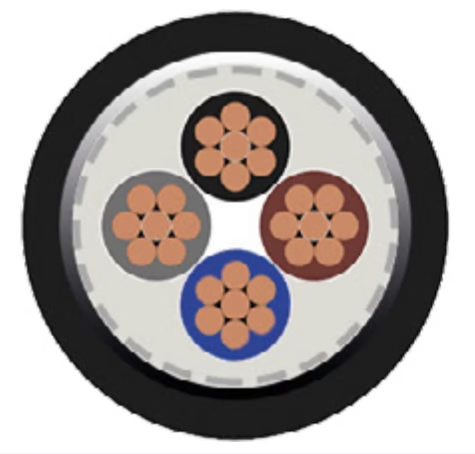
extruded insulation cable

When you look at a cable from the outside, you see a smooth, round cylinder. This simple appearance conceals a complex engineering challenge. Inside that cylindrical exterior are multiple insulated conductors of various sizes arranged together. Without proper design, these internal components would naturally create an irregular, lumpy cross-section rather than the uniform circular shape we expect from a professional cable. This is where rubber fillers play their essential role, and understanding their function requires us to think about the geometric and mechanical realities of cable construction.

Rubber Filler Role: Understanding How Fillers Maintain Cylindrical Shape in NSSHÖU Cables Under Crushing Loads

When you look at a cable from the outside, you see a smooth, round cylinder. This simple appearance conceals a complex engineering challenge. Inside that cylindrical exterior are multiple insulated conductors of various sizes arranged together. Without proper design, these internal components would naturally create an irregular, lumpy cross-section rather than the uniform circular shape we expect from a professional cable. This is where rubber fillers play their essential role, and understanding their function requires us to think about the geometric and mechanical realities of cable construction.
(N)TSKCGEWÖU specifications. This protective layer serves multiple critical functions within the cable assembly, with mechanical stress redistribution being among its most important roles. According to research published by Sibelco, the bedding compound is defined as the material applied around insulated conductors to maintain their position and provide bedding for protective armoring.[1] This layer functions as an intermediary component positioned between the laid-up cores and the metallic armor, creating what cable engineers describe as a separation sheath that fundamentally alters how mechanical forces are distributed throughout the cable structure.

Inner Sheath Function: Mechanical Stress Redistribution in (N)TSKCGEWÖU Cables

(N)TSKCGEWÖU specifications. This protective layer serves multiple critical functions within the cable assembly, with mechanical stress redistribution being among its most important roles. According to research published by Sibelco, the bedding compound is defined as the material applied around insulated conductors to maintain their position and provide bedding for protective armoring.[1] This layer functions as an intermediary component positioned between the laid-up cores and the metallic armor, creating what cable engineers describe as a separation sheath that fundamentally alters how mechanical forces are distributed throughout the cable structure.
High Voltage (HV) cables are the critical infrastructure for primary power transmission and distribution, operating at voltage levels from 45kV to 132kV and beyond. Unlike medium voltage distribution cables, HV cables are designed for bulk power transfer over long distances with minimal losses, connecting generating stations to primary substations and forming the backbone of national and regional power grids. Manufactured to IEC 60840 (Power cables with extruded insulation for rated voltages above 30kV up to 150kV), these cables utilize XLPE (cross-linked polyethylene) insulation for its exceptional electrical properties, thermal stability, and long service life. The German VDE designation system (2XS(F)2Y, etc.) has become the international standard for specifying HV cable construction.

What are High Voltage Cables?

2XS(F)2Y cable, 2XS(FL)2Y cable, A2XS(F)2Y cable, A2XS(FL)2Y cable, 2XSFL2Y, A2XSFL2Y, 2XSF2Y, A2XSF2Y, VDE cable designation, German cable standard, high voltage cable, HV cable, high tension cable, power transmission cable, underground HV cable, buried HV cable, transmission cable, EHV cable, extra high voltage
The International Electrotechnical Commission (IEC) is the world's leading independent non-profit international standard-setting organization for electrical, electronic, and related technologies. Founded in 1906 with British Scientist Lord Kelvin as its first president, the IEC has over a century of expertise in developing international standards that form the basis for national and international standardization. All IEC standards are consensus-based and represent the needs of key stakeholders, with every member country having an equal vote.

What is IEC Cable?

IEC cable, IEC standard cable, IEC power cable, International Electrotechnical Commission cable, IEC 60228, IEC 60502, IEC 60331, IEC 60332, IEC cable standards, IEC compliant cable, international standard cable, IEC certified cable, IEC 60228, IEC 60228:2023, IEC 60228 conductor, IEC 60228 class 1, IEC 60228 class 2, IEC 60228 class 5, IEC 60228 class 6, IEC 60502, IEC 60502-1, IEC 60502-2, IEC 60502-4, IEC 60502-1:2021, IEC 60331, IEC 60331-1, IEC 60331-2, IEC 60331-21, IEC 60331-31, IEC 60332, IEC 60332-1, IEC 60332-1-2, IEC 60332-2, IEC 60332-3, IEC 60332-3-22, IEC 60332-3-23, IEC 60332-3-24, IEC 60332-3-25, IEC 61034, IEC 60754, IEC 60754-1, IEC 60754-2, IEC 60092, IEC 60702, IEC 60811, IEC 61158, IEC 60840
IEC 60840 is an internationally recognized standard developed by the International Electrotechnical Commission (IEC) that defines the test methods and performance requirements for high-voltage power cable systems with extruded insulation. The standard applies to systems designed for rated voltages above 30 kV (Um = 36 kV) up to and including 150 kV (Um = 170 kV), making it the essential reference for cables used in power transmission infrastructure, grid interconnections, and large-scale industrial energy networks.

What is IEC 60840 Cable?

IEC 60840 is an internationally recognized standard developed by the International Electrotechnical Commission (IEC) that defines the test methods and performance requirements for high-voltage power cable systems with extruded insulation. The standard applies to systems designed for rated voltages above 30 kV (Um = 36 kV) up to and including 150 kV (Um = 170 kV), making it the essential reference for cables used in power transmission infrastructure, grid interconnections, and large-scale industrial energy networks.
IEC 60502 is an international standard published by the International Electrotechnical Commission (IEC) that sets out the specification for power cables with extruded insulation. The standard covers cables with voltage ratings from 1 kV (Um = 1.2 kV) up to 30 kV (Um = 36 kV), designed for fixed installations such as distribution networks and industrial installations. This widely recognized standard serves as a primary reference for cable manufacturers worldwide and forms the basis for numerous national and regional cable standards.

What is IEC 60502 Cable?

IEC 60502 對導體類型、絕緣材料和護套化合物提供了詳細規格。絕緣材料包括 PVC(最高溫度 70°C)、XLPE、EPR 和 HEPR(均為最高 90°C)。導體類別包括第 1 類(實心)、第 2 類(絞合)和第 5 類(柔性),尺寸範圍從 1.5 mm² 到 1600 mm²。護套化合物包括 PVC、PE 和用於防火敏感區域的無鹵素材料。XLPE 絕緣的標稱厚度從 0.6/1 kV 的 1.0 mm 到 18/30 kV 的 8.0 mm 不等。
British Standard BS7870-4.10 specifies requirements for medium voltage (MV) polymeric insulated cables manufactured specifically for use by distribution and generation utility industry sectors. These single core cables are designed for primary power distribution, connecting sub-mains to local networks where the final connection occurs. They form the foundation of electricity supply from distribution mains worldwide.

What is BS7870-4.10 Cable?

BS7870-4.10電纜, BS7870電纜, 中壓電纜, MV電纜, 11kV電纜, 33kV電纜, 22kV電纜, XLPE電纜, 配電電纜, 公用事業電纜, DNO電纜, 一次配電電纜, 單芯中壓電纜, 聚合物絕緣電纜, 電力配電電纜, 電網電纜, 地下電纜, MDPE護套電纜, LSZH中壓電纜, 銅中壓電纜, 鋁中壓電纜, 三芯絞合電纜, 無鎧裝中壓電纜, 屏蔽中壓電纜 BS7870-4.10, BS7870 cable, medium voltage cable, MV cable, 11kV cable, 33kV cable, 22kV cable, XLPE cable, distribution cable, utility cable, DNO cable, primary distribution cable, single core MV cable, polymeric insulated cable, power distribution cable, grid cable, underground cable, MDPE sheath cable
BS 6622 cable, XLPE insulation, AWA armour, SWA cable, medium voltage cable, 11kV cable, 33kV power cable, underground cable, direct burial cable

What is BS 7870-4.10 TRIPLEX Cable?

BS 7870-4.10 TRIPLEX cable represents a specialized category of medium voltage power distribution cables designed specifically for utility and industrial applications. According to the British Standards Institution, BS 7870-4.10 specifies requirements for distribution cables with extruded insulation rated from 11 kV to 33 kV. The TRIPLEX formation consists of three single-core cables laid together, providing a more efficient installation solution compared to individually pulled single-core cables.