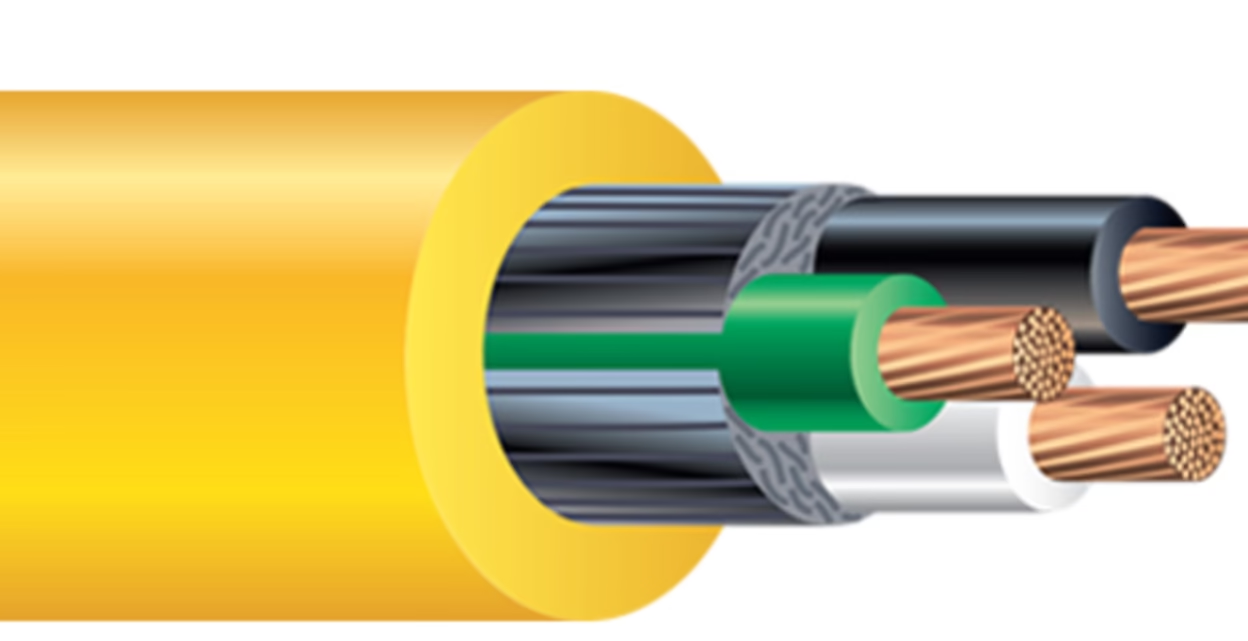
extreme temperature cable

FLEXIFESTOON® SPECIAL NE-FLAT: Advanced High-Temperature Flat Cable for Steel Mills, Petrochemical Plants, Renewable Energy Systems, and Extreme-Environment Industrial Control Feichun's revolutionary FLEXIFESTOON® SPECIAL NE-FLAT high-temperature cable platform delivers extreme thermal resilience (+135°C continuous flexible application with GAALTHERM® 533 insulation, or +90°C with XLPE), combined with halogen-free environmental compliance, 50 Mrad radiation hardening, and ultra-flexible parallel-core architecture enabling deployment in the world's most thermally demanding industrial environments—steel production, petrochemical processing, renewable energy infrastructure, and advanced thermal management systems.

FLEXIFESTOON® SPECIAL NE-FLAT

FLEXIFESTOON® SPECIAL NE-FLAT: Advanced High-Temperature Flat Cable for Steel Mills, Petrochemical Plants, Renewable Energy Systems, and Extreme-Environment Industrial Control Feichun’s revolutionary FLEXIFESTOON® SPECIAL NE-FLAT high-temperature cable platform delivers extreme thermal resilience (+135°C continuous flexible application with GAALTHERM® 533 insulation, or +90°C with XLPE), combined with halogen-free environmental compliance, 50 Mrad radiation hardening, and ultra-flexible parallel-core architecture enabling deployment in the world’s most thermally demanding industrial environments—steel production, petrochemical processing, renewable energy infrastructure, and advanced thermal management systems.
КГ-ХЛ (Кабель Гибкий, исполнение ХЛ — flexible cable, cold-rated variant) per GOST 24334-80 is Russia's ubiquitous heavy-duty flexible rubber-sheathed cable, deployed across every sector of Russian heavy industry from mining to oil & gas to port operations. The ХЛ suffix designates the cold-rated compound formulation, enabling dynamic operation down to −60°C — a specification born from the operational reality of Murmansk, Norilsk, Dudinka, and Vladivostok. In its intended application — powering portable industrial equipment via manual cable handling or simple festoon systems — КГ-ХЛ performs admirably. But on the motorized reeling drums of portal cranes, ship-to-shore (STS) cranes, rail-mounted gantry (RMG) cranes, and rubber-tyred gantry (RTG) cranes, КГ-ХЛ fails prematurely and catastrophically through a specific mechanism: corkscrewing — the progressive helical deformation of the cable caused by core migration under combined axial tension and cyclic bending. Typical service life of КГ-ХЛ on a portal crane drum: 4–8 months. Typical service life of NSHTÖU-J on the same drum: 18–36 months. The difference is the anti-torsion braid — a single structural layer that КГ-ХЛ does not have and cannot be retrofitted with.

Reeling Cable Upgrade: Swapping КГ-ХЛ (KG-HL) for VDE 0250 NSHTÖU-J on Russian Portal CranesComplete Engineering & Procurement Guide

КГ-ХЛ (Кабель Гибкий, исполнение ХЛ — flexible cable, cold-rated variant) per GOST 24334-80 is Russia’s ubiquitous heavy-duty flexible rubber-sheathed cable, deployed across every sector of Russian heavy industry from mining to oil & gas to port operations. The ХЛ suffix designates the cold-rated compound formulation, enabling dynamic operation down to −60°C — a specification born from the operational reality of Murmansk, Norilsk, Dudinka, and Vladivostok. In its intended application — powering portable industrial equipment via manual cable handling or simple festoon systems — КГ-ХЛ performs admirably. But on the motorized reeling drums of portal cranes, ship-to-shore (STS) cranes, rail-mounted gantry (RMG) cranes, and rubber-tyred gantry (RTG) cranes, КГ-ХЛ fails prematurely and catastrophically through a specific mechanism: corkscrewing — the progressive helical deformation of the cable caused by core migration under combined axial tension and cyclic bending. Typical service life of КГ-ХЛ on a portal crane drum: 4–8 months. Typical service life of NSHTÖU-J on the same drum: 18–36 months. The difference is the anti-torsion braid — a single structural layer that КГ-ХЛ does not have and cannot be retrofitted with.
To understand bending radius in the context of electrical cables, imagine a cable being bent around a curved path. The bending radius is the radius of curvature of that path—specifically, it measures the distance from the center point of the curve to the centerline of the cable as it follows the curve. For a cable being routed around a small pulley or through a tight corner in a power chain, the bending radius is the radius of the pulley or corner curve. The reason bending radius matters profoundly is that when a cable bends, the material on the inside of the curve is compressed and the material on the outside is stretched. This creates mechanical stress throughout the cable's cross-section. The conductors on the inside of the bend are under compressive stress, while those on the outside are under tensile stress. The insulation around the conductors experiences similar stress. If the bending is too tight—if the radius of curvature is too small—the mechanical stress exceeds what the conductor strands and insulation materials can tolerate, leading to permanent deformation, cracking of the insulation, or even breaking of individual conductor strands. Over time, repeated bending at excessive stress levels leads to progressive damage accumulation and eventual cable failure. The specified minimum bending radius is the tightest curve the cable can safely navigate repeatedly without suffering mechanical damage. Understanding this distinction is essential for mechanical and electrical engineers designing cable routing systems for moving equipment.

Bending Radius Guide: How Tight Can You Bend ÖLFLEX FD 855 P 18G1.5 Continuous Flex Cable?

To understand bending radius in the context of electrical cables, imagine a cable being bent around a curved path. The bending radius is the radius of curvature of that path—specifically, it measures the distance from the center point of the curve to the centerline of the cable as it follows the curve. For a cable being routed around a small pulley or through a tight corner in a power chain, the bending radius is the radius of the pulley or corner curve. The reason bending radius matters profoundly is that when a cable bends, the material on the inside of the curve is compressed and the material on the outside is stretched. This creates mechanical stress throughout the cable’s cross-section. The conductors on the inside of the bend are under compressive stress, while those on the outside are under tensile stress. The insulation around the conductors experiences similar stress. If the bending is too tight—if the radius of curvature is too small—the mechanical stress exceeds what the conductor strands and insulation materials can tolerate, leading to permanent deformation, cracking of the insulation, or even breaking of individual conductor strands. Over time, repeated bending at excessive stress levels leads to progressive damage accumulation and eventual cable failure. The specified minimum bending radius is the tightest curve the cable can safely navigate repeatedly without suffering mechanical damage. Understanding this distinction is essential for mechanical and electrical engineers designing cable routing systems for moving equipment.
The Type W 4/C 2/0 AWG 2000V cable features a heavy-duty thermoset CPE (chlorinated polyethylene) jacket that is specifically formulated with UV stabilizers and ozone-resistant additives, providing robust protection against continuous direct sunlight and high ozone concentrations found in desert port environments. The cable is rated to withstand prolonged outdoor exposure in desert conditions, typically maintaining 80 to 90 percent of its physical properties after 5 to 10 years of continuous unshaded sunlight exposure, compared to standard elastomeric jackets that degrade to 50 to 70 percent property retention under identical conditions. The nominal outer diameter of this cable is 46.8 to 49.1 mm (1.845 to 1.935 inches), with approximate weight of 4,390 to 5,133 kg per kilometer. The cable features 259-strand rope-lay copper conductors (2/0 AWG per core), four 67.4 mm² cores, EPDM insulation rated for 90°C conductor temperature, and current carrying capacity of 237 amperes (based on 30°C ambient, 90°C conductor temperature). However, the critical distinction that separates viable long-term desert service from premature field failures lies in understanding the difference between a cable jacket that merely resists UV degradation and a comprehensively designed system where all exposed components—including terminal connections, stripped insulation, and mechanical attachment points—receive appropriate protection from direct sunlight. In actual desert port applications, failures are as frequently caused by UV damage at unprotected termination points as by jacket degradation itself, making installation and maintenance procedures as important as material selection. For typical desert port power systems, RTG (rubber-tired gantry) crane power leads, shore-to-ship power cables, and fixed deck-mounted power distribution systems operating in Middle Eastern, North African, and Australian port environments, the Type W 4/C 2/0 AWG cable with standard CPE jacket provides reliable field-proven performance when properly installed and maintained, but premium UV-resistant cable variants should be considered for applications where service life extension beyond 7 to 10 years is critical or where inspection and maintenance infrastructure is limited.

UV & Ozone Resistance of Type W 4/C 2/0 AWG 2000V: Is the CPE Jacket Durable Enough for Constant Direct Sunlight in Desert Ports?

The Type W 4/C 2/0 AWG 2000V cable features a heavy-duty thermoset CPE (chlorinated polyethylene) jacket that is specifically formulated with UV stabilizers and ozone-resistant additives, providing robust protection against continuous direct sunlight and high ozone concentrations found in desert port environments. The cable is rated to withstand prolonged outdoor exposure in desert conditions, typically maintaining 80 to 90 percent of its physical properties after 5 to 10 years of continuous unshaded sunlight exposure, compared to standard elastomeric jackets that degrade to 50 to 70 percent property retention under identical conditions. The nominal outer diameter of this cable is 46.8 to 49.1 mm (1.845 to 1.935 inches), with approximate weight of 4,390 to 5,133 kg per kilometer. The cable features 259-strand rope-lay copper conductors (2/0 AWG per core), four 67.4 mm² cores, EPDM insulation rated for 90°C conductor temperature, and current carrying capacity of 237 amperes (based on 30°C ambient, 90°C conductor temperature). However, the critical distinction that separates viable long-term desert service from premature field failures lies in understanding the difference between a cable jacket that merely resists UV degradation and a comprehensively designed system where all exposed components—including terminal connections, stripped insulation, and mechanical attachment points—receive appropriate protection from direct sunlight. In actual desert port applications, failures are as frequently caused by UV damage at unprotected termination points as by jacket degradation itself, making installation and maintenance procedures as important as material selection. For typical desert port power systems, RTG (rubber-tired gantry) crane power leads, shore-to-ship power cables, and fixed deck-mounted power distribution systems operating in Middle Eastern, North African, and Australian port environments, the Type W 4/C 2/0 AWG cable with standard CPE jacket provides reliable field-proven performance when properly installed and maintained, but premium UV-resistant cable variants should be considered for applications where service life extension beyond 7 to 10 years is critical or where inspection and maintenance infrastructure is limited.
The shield transfer impedance (STI) for (N)TSCGECEWÖU 12/20kV cables with individual concentric copper screens is approximately 0.005–0.012 Ω/m at 50/60 Hz power frequency, representing the electrical impedance that coupling currents encounter as they attempt to penetrate the copper screen and reach the main conductor. At higher frequencies relevant to VFD variable switching (around 10 kHz), the STI increases slightly to approximately 0.008–0.015 Ω/m due to skin-effect limitations in the copper conductors. At even higher frequencies extending into the megahertz range (1–10 MHz) where harmonic emissions and EMI are most problematic, the STI rises further to approximately 0.02–0.08 Ω/m depending on the copper screen material properties and frequency-dependent conductor resistance. The shielding effectiveness, measured as the attenuation in decibels (dB) of external electromagnetic fields trying to couple energy into the cable conductors, is typically 60–80 dB at 100 kHz and remains above 40 dB even at 1 MHz, demonstrating excellent EMI rejection across the industrial frequency range. These metrics establish that individual concentric copper screens provide substantially superior EMC performance compared to traditional overall braided screens, particularly in reducing conducted emissions in VFD-driven machinery where rapid voltage switching and harmonic currents create severe electromagnetic stress on nearby control cables and sensitive electronic systems.

Shield Transfer Impedance: What are the exact EMC performance parameters and screening effectiveness metrics for (N)TSCGECEWÖU 12/20kV individually screened medium-voltage flexible cables in industrial and VFD applications? 

The shield transfer impedance (STI) for (N)TSCGECEWÖU 12/20kV cables with individual concentric copper screens is approximately 0.005–0.012 Ω/m at 50/60 Hz power frequency, representing the electrical impedance that coupling currents encounter as they attempt to penetrate the copper screen and reach the main conductor. At higher frequencies relevant to VFD variable switching (around 10 kHz), the STI increases slightly to approximately 0.008–0.015 Ω/m due to skin-effect limitations in the copper conductors. At even higher frequencies extending into the megahertz range (1–10 MHz) where harmonic emissions and EMI are most problematic, the STI rises further to approximately 0.02–0.08 Ω/m depending on the copper screen material properties and frequency-dependent conductor resistance. The shielding effectiveness, measured as the attenuation in decibels (dB) of external electromagnetic fields trying to couple energy into the cable conductors, is typically 60–80 dB at 100 kHz and remains above 40 dB even at 1 MHz, demonstrating excellent EMI rejection across the industrial frequency range. These metrics establish that individual concentric copper screens provide substantially superior EMC performance compared to traditional overall braided screens, particularly in reducing conducted emissions in VFD-driven machinery where rapid voltage switching and harmonic currents create severe electromagnetic stress on nearby control cables and sensitive electronic systems.
The maximum allowable pilot loop resistance for Type 450 mining cables operating with Ampcontrol earth continuity relays represents a critical electrical parameter that directly impacts mine safety and operational reliability. This comprehensive technical analysis examines the interaction between AS/NZS 2802:2000 Type 450 cable specifications and Ampcontrol relay requirements, providing mining engineers and electrical designers with authoritative guidance for proper system design and selection. 与Ampcontrol地电连续继电器配合使用的Type 450矿用电缆的最大允许导向回路电阻是一个直接影响矿山安全和运行可靠性的关键电气参数。本全面技术分析检查了AS/NZS 2802:2000 Type 450电缆规格与Ampcontrol继电器要求之间的相互作用,为矿业工程师和电气设计师提供了正确系统设计和选择的权威指导。

PROTOLON (SB) NTSCGEWOEU I 3 – 30 KV

These cables serve as power supply or connection cables for large material handling machines, such as excavators in opencast mines, subjected to extremely high mechanical stresses where abrasion and chaffing stresses are expected in trailing operation. 这些电缆用作大型物料搬运机械(如露天矿山挖掘机)的电源或连接电缆,在拖曳作业中承受极高的机械应力、磨损和摩擦应力。
Festoon systems are critical components in industrial applications where power, control, and data cables must travel with moving equipment such as overhead cranes, gantry cranes, automated storage and retrieval systems (AS/RS), and material handling equipment. The selection of appropriate flat cables for these systems directly impacts operational reliability, maintenance costs, and system longevity.

Draka Buflex vs. (N)TSFLCGEWÖU: Which Flat Cable is Best for Festoon Systems?

Festoon systems are critical components in industrial applications where power, control, and data cables must travel with moving equipment such as overhead cranes, gantry cranes, automated storage and retrieval systems (AS/RS), and material handling equipment. The selection of appropriate flat cables for these systems directly impacts operational reliability, maintenance costs, and system longevity.
Comprehensive Technical Analysis of Chlorinated Polyethylene (CPE) vs Chlorosulphonated Polyethylene (CSP) Sheath Performance Under Extreme UV Radiation in Pilbara Region Mining Operations 氯化聚乙烯(CPE)与氯磺化聚乙烯(CSP)护套在皮尔巴拉地区采矿作业极端紫外线辐射下性能的综合技术分析

UV Resistance in Type 441 Mining Cables: Does CPE Sheath Meet “Extremely High UV” Requirements of Australian Surface Mines?

Comprehensive Technical Analysis of Chlorinated Polyethylene (CPE) vs Chlorosulphonated Polyethylene (CSP) Sheath Performance Under Extreme UV Radiation in Pilbara Region Mining Operations 氯化聚乙烯(CPE)与氯磺化聚乙烯(CSP)护套在皮尔巴拉地区采矿作业极端紫外线辐射下性能的综合技术分析
318x series represents a comprehensive family of multi-core round flexible cables designed for diverse domestic, commercial, and specialized applications. This series includes standard PVC-insulated cables (Y suffix), Low Smoke Zero Halogen cables (B suffix), and special-purpose variants including Arctic Grade, Rubber, Butyl, and Pond cables. All cables in this series feature fine-stranded copper conductors for enhanced flexibility and are manufactured to meet stringent British and European standards including BS EN 50525-2-11, BS EN 50525-3-11, and BS EN 50525-2-21.

Complete Guide to 318xY & 318xB Flexible Cable Series

3182B cable, 3182Y cable, 3183B cable, 3183P cable, 3183TQ cable, 3183TRS cable, 3183Y cable, 3183YA cable, 3184B cable, 3184Y cable, 3185B cable, 3185Y cable, LSZH cable, low smoke zero halogen, BS EN 50525-2-11, BS EN 50525-3-11, BS EN 50525-2-21, HAR certified cable, BASEC approved cable, round flexible cable, PVC flexible cable, rubber flexible cable, butyl rubber cable, arctic grade cable, pond cable, weather resistant cable, household appliance cable, washing machine cable, refrigerator cable, heating control cable, immersion heater cable, garden pond cable, caravan cable, boat cable, cold storage cable, 300/500V cable, fine stranded copper, tinned copper conductor, oil resistant cable, fire safety cable, Class 2 cable, multi-core flexible cable, 2 core flexible, 3 core flexible, 4 core flexible, 5 core flexible, H05RN-F, H07RN-F, H05BN4-F, H05RR-F, BS 7919, 柔性電纜, 低煙無鹵電纜, 北極級電纜, 安徽飛純電纜
TENAX-HTT (N)TSCGEWOEU 10 kV – 30 kV: Technical Guide for Extreme Duty High-Voltage Mining Cables for Underground Transformers and Tunneling Equipment

TENAX-HTT (N)TSCGEWOEU 10 kV – 30 kV

TENAX-HTT TSCGEWOEU, 10kV 30kV mining cable, high voltage underground cable, extreme duty mining cable, slow reeling cable, transformer connection cable, hazardous environment cable, VDE 0250-813, tunneling MV cable
PROTOLON(M) R-(N)TSCGEWOEU represents a sophisticated class of medium voltage flexible reeling cables specifically engineered for the most demanding applications in open-cast mining and material handling operations. These cables are designed to power large mobile equipment including excavators, dumpers, mobile crushers, and bucket-wheel excavators under extreme mechanical stresses. This comprehensive technical guide examines the construction, specifications, standards compliance, applications, and operational characteristics of this specialized cable system manufactured by Anhui Feichun Special Cable Co., Ltd.

PROTOLON(M) R-(N)TSCGEWOEU 6 kV – 35 kV: The Ultimate Flexible MV Reeling Cable for Heavy Mining Equipment

ROTOLON(M) R-(N)TSCGEWOEU cable designation follows the standardized German nomenclature system established under DIN VDE 0250 Part 813, which specifically addresses medium voltage reeling cables for mining and heavy industrial applications. The designation breaks down as follows: (N) – Indicates the presence of a concentric conductor arrangement with integrated earth conductors T – Tinned copper conductors for enhanced corrosion resistance S – Semiconductive screening layers for electric field control C – Cradle separator core arrangement for structural integrity G – EPR (Ethylene Propylene Rubber) insulation compound E – EPR-based inner sheath W – Anti-torsion woven braid reinforcement O – Oil-resistant outer sheath E – Enhanced elastomer outer sheath material U – Reinforced construction for extreme mechanical loads According to industry specifications from Reeling Cable, these cables are rated for voltage ranges from 3.6/6 kV up to 18/30 kV (with some variants reaching 20/35 kV), making them suitable for a comprehensive range of mining equipment power requirements.
NTMCGCWOEU 1x240_25 KON, 12_20kV

What is PROTOLON(SB) NTSCGEWOEU 6 kV – 20 kV Cable for Excavators in Open-Cast Mining?

PROTOLON(SB) NTSCGEWOEU cable represents a specialized category of medium voltage trailing cables engineered specifically for the most demanding mining applications. As power supply and connection cables for large material handling machines such as excavators in open-cast mines, these cables must withstand extremely high mechanical stresses where abrasion and chaffing stresses are expected in trailing operation.
What is MV Cable for Trailing Applications Cold Flexible to -50°C TENAX-SAS NTSCGEWOEU 6kV – 20kV?

What is MV Cable for Trailing Applications Cold Flexible to -50°C TENAX-SAS NTSCGEWOEU 6kV – 20kV?

TENAX-SAS NTSCGEWOEU series represents a specialized category of medium voltage flexible trailing cables engineered specifically for the demanding operational environments found in open-pit mining operations. These cables are designed to power large mobile mining equipment including draglines, electric rope shovels, excavators, and material handling machinery operating under extreme mechanical stress and harsh environmental conditions.
CSA C22.2 NO. 96:23 - Portable Power Cables Comprehensive Technical Analysis and Application Guide

CSA C22.2 NO. 96:23 – Portable Power Cables

CSA C22.2 NO. 96:23 represents the twelfth edition of the Canadian portable power cable standard, published as a National Standard of Canada by CSA Group under the Canadian Electrical Code, Part II. This standard supersedes all previous editions dating back to 1951, with the 2023 edition incorporating significant technical updates and expanded cable categories to address evolving industrial requirements.
TYPE 409 mining cables represent a specialized category of flexible trailing cables designed to meet the rigorous demands of surface mining, underground mining operations, and general industrial applications where movable plant requires reliable electrical power supply. Manufactured in compliance with the AS/NZS 2802:2000 standard, these Class 2 heavy-duty cables feature ethylene propylene rubber (EPR) insulation, composite copper and polyester braid screening, and elastomeric sheath construction. Available in voltage ratings from 1.1 kilovolts up to 22 kilovolts, TYPE 409 cables serve as the electrical lifeline for machinery ranging from handheld drills and pumps to massive dragline excavators and shovels.

TYPE 409 1.1 to 22kV Mining Cables to AS/NZS 2802:2000

The engineering sophistication of TYPE 409 cables reflects decades of development in mining cable technology, incorporating semiconductive screening systems, central cradle separators, and interstitial pilot conductors that work together to ensure safe and reliable operation in extreme environmental conditions. The cables must withstand extraordinary mechanical stresses, continuous flexing, abrasion from dust and debris, exposure to oils and chemicals, ultraviolet radiation, and temperature extremes while maintaining electrical integrity and personnel safety.
Class 3 6600V Ethylene Propylene Rubber Insulated Polychloroprene Rubber Sheath Cable - JIS C 4353 Standard

What is 6600V 3PNCT Crane Cable? 

The 6600V 3PNCT crane cable represents a specialized class of high-voltage power cables specifically engineered for demanding industrial applications where continuous flexing, high mechanical stress, and environmental exposure are constant operational realities. This cable designation indicates a Class 3 flexible conductor construction rated for 6600 volts AC, featuring ethylene propylene rubber insulation and a polychloroprene rubber outer sheath, manufactured in accordance with the rigorous requirements of JIS C 4353 Japanese Industrial Standard.