Submersible Pump Cable Safety: Can NSSHÖU-J 4G95 0.6/1kV Withstand Permanent Submersion in Acidic Mine Water?
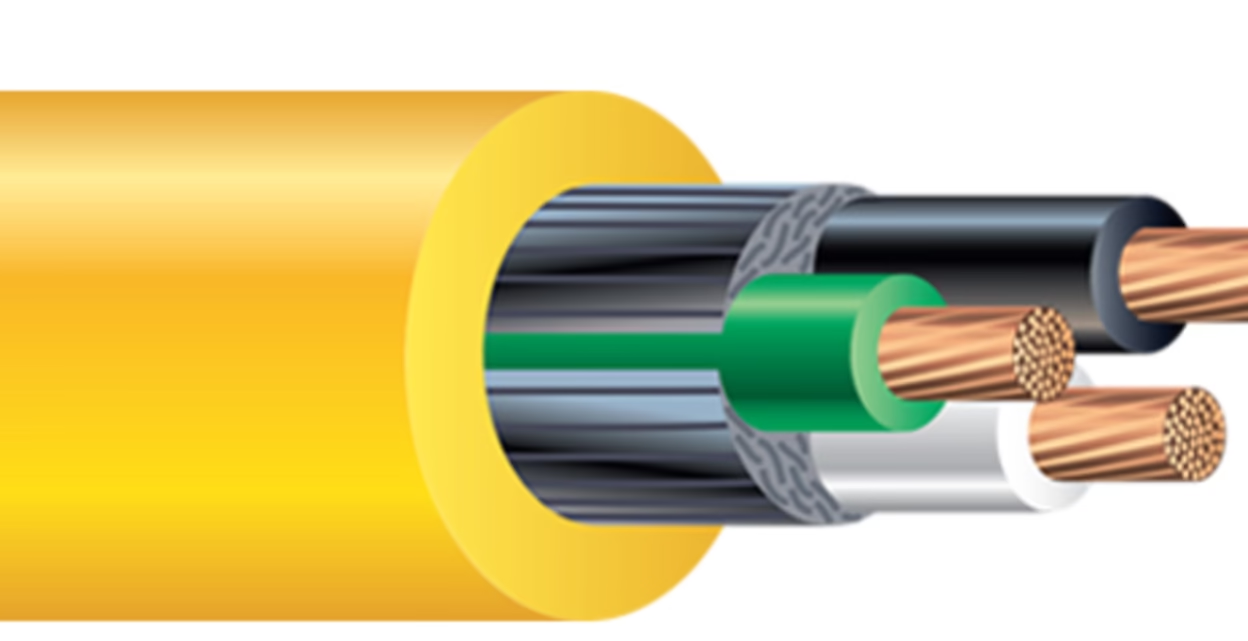
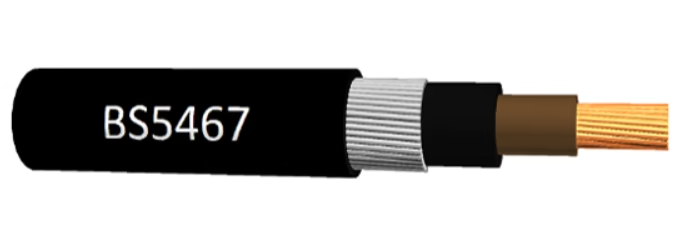
The NSSHÖU-J 4G95 0.6/1kV industrial mining cable is technically rated for temporary water immersion and is commonly used in open-pit and underground mining environments, but it is not specifically qualified for permanent submersion in acidic mine water and using it in this application is classified as beyond its design envelope. While the cable’s EPR insulation (3GI3) and CPE outer sheath (5GM5) provide adequate resistance to neutral water and brief acidic exposure, permanent submersion in acidic mine water with pH values of 2.0 to 4.0—typical of copper and gold mining operations—accelerates material degradation to the point where service life drops to approximately 18 to 36 months compared to 8 to 10 years in neutral water applications. The fundamental issue is not that the cable fails immediately when deployed in acidic water (it does not), but rather that the aggressive acidic environment causes progressive swelling of the jacket, penetration of H⁺ ions into the insulation layer, electrochemical corrosion of the tinned copper conductor, and cumulative electrical property loss that eventually results in insulation breakdown. This distinction between “survives temporary exposure” and “safe for permanent submersion” is critically important to understand: a cable can physically remain intact for months or even a year or more in acidic water, but the electrical properties are degrading silently, and catastrophic failure can occur suddenly when the insulation resistance drops below critical thresholds. For submersible pump applications in acidic mine water, engineers should specify cables explicitly designed for this service, such as H07RN8-F submersible pump cables with specialized halogen-free formulations, or upgrade to acidic-resistant variants of marine-grade cables rated for chemical exposure. The standard NSSHÖU-J cable can be used in acidic mine water applications only if the operational requirement is for temporary or seasonal service (less than 6 months per year), coupled with rigorous monitoring protocols and planned replacement intervals of 12 to 18 months rather than the standard 5 to 7 year intervals appropriate for neutral water service.

![(N)TSKCGEWÖU specifications. This protective layer serves multiple critical functions within the cable assembly, with mechanical stress redistribution being among its most important roles. According to research published by Sibelco, the bedding compound is defined as the material applied around insulated conductors to maintain their position and provide bedding for protective armoring.[1] This layer functions as an intermediary component positioned between the laid-up cores and the metallic armor, creating what cable engineers describe as a separation sheath that fundamentally alters how mechanical forces are distributed throughout the cable structure.](https://feichuncables.com/blog/wp-content/uploads/image-596.avif "Inner Sheath Function: Mechanical Stress Redistribution in (N)TSKCGEWÖU Cables 4")