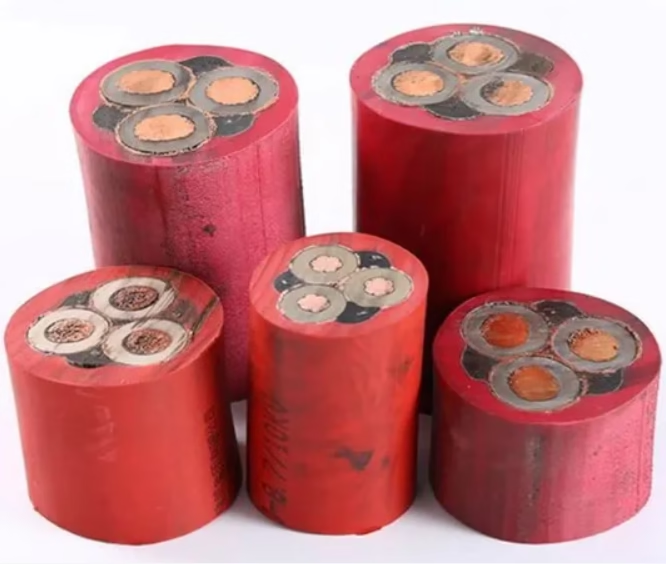
Cold Resistant Cable

Complete technical datasheet Chinese equivalent Prysmian PROTOLON (SB) NTSCGEWOEU 6/10 kV: reeling cable mobile heavy-duty equipment — port gantry cranes (RTG/STS/RMG), open-pit excavators, stacker-reclaimers, spreaders, draglines, bucket-wheel excavators. Configuration 3×50 mm² power + 2×(25/2) mm² earth + 1×16 mm² control (st). Rated voltage 6/10 kV (max. 7.2/12 kV). Outer diameter ~45.0–49.5 mm, weight ~3,650–3,800 kg/km, copper index ~1,834 kg/km. Current capacity ~183 A @ 30°C. Min. bending radius 12–15×OD. Travel speed up to 120–240 m/min. Max. tensile force ~2,250 N (15 N/mm² copper, up to 30 N/mm² acceleration per DIN VDE 0298-3). Temperature -35°C to +80°C flexing, -50°C to +80°C fixed. EPR/HEPR insulation with semiconductive field-control screens 6/10 kV, dual outer sheath PCP/PUR — abrasion/oil/UV/ozone/flame resistant (EN 60332-1-2). Additional testing: reversed bending, torsional stress, roller bending per DIN VDE 0250-813. Russian GOST equivalent КГЭШ-Т 6/10 kV. EAC, GOST-R/-K/-B, Fire Certificate certified.

Аналог PROTOLON (SB): кабель барабанный 3×50+2×25/2+1×16st 6/10 kV — полный технический паспорт (Feichun Cable, Китай)

Complete technical datasheet Chinese equivalent Prysmian PROTOLON (SB) NTSCGEWOEU 6/10 kV: reeling cable mobile heavy-duty equipment — port gantry cranes (RTG/STS/RMG), open-pit excavators, stacker-reclaimers, spreaders, draglines, bucket-wheel excavators. Configuration 3×50 mm² power + 2×(25/2) mm² earth + 1×16 mm² control (st). Rated voltage 6/10 kV (max. 7.2/12 kV). Outer diameter ~45.0–49.5 mm, weight ~3,650–3,800 kg/km, copper index ~1,834 kg/km. Current capacity ~183 A @ 30°C. Min. bending radius 12–15×OD. Travel speed up to 120–240 m/min. Max. tensile force ~2,250 N (15 N/mm² copper, up to 30 N/mm² acceleration per DIN VDE 0298-3). Temperature -35°C to +80°C flexing, -50°C to +80°C fixed. EPR/HEPR insulation with semiconductive field-control screens 6/10 kV, dual outer sheath PCP/PUR — abrasion/oil/UV/ozone/flame resistant (EN 60332-1-2). Additional testing: reversed bending, torsional stress, roller bending per DIN VDE 0250-813. Russian GOST equivalent КГЭШ-Т 6/10 kV. EAC, GOST-R/-K/-B, Fire Certificate certified.
To understand bending radius in the context of electrical cables, imagine a cable being bent around a curved path. The bending radius is the radius of curvature of that path—specifically, it measures the distance from the center point of the curve to the centerline of the cable as it follows the curve. For a cable being routed around a small pulley or through a tight corner in a power chain, the bending radius is the radius of the pulley or corner curve. The reason bending radius matters profoundly is that when a cable bends, the material on the inside of the curve is compressed and the material on the outside is stretched. This creates mechanical stress throughout the cable's cross-section. The conductors on the inside of the bend are under compressive stress, while those on the outside are under tensile stress. The insulation around the conductors experiences similar stress. If the bending is too tight—if the radius of curvature is too small—the mechanical stress exceeds what the conductor strands and insulation materials can tolerate, leading to permanent deformation, cracking of the insulation, or even breaking of individual conductor strands. Over time, repeated bending at excessive stress levels leads to progressive damage accumulation and eventual cable failure. The specified minimum bending radius is the tightest curve the cable can safely navigate repeatedly without suffering mechanical damage. Understanding this distinction is essential for mechanical and electrical engineers designing cable routing systems for moving equipment.

Bending Radius Guide: How Tight Can You Bend ÖLFLEX FD 855 P 18G1.5 Continuous Flex Cable?

To understand bending radius in the context of electrical cables, imagine a cable being bent around a curved path. The bending radius is the radius of curvature of that path—specifically, it measures the distance from the center point of the curve to the centerline of the cable as it follows the curve. For a cable being routed around a small pulley or through a tight corner in a power chain, the bending radius is the radius of the pulley or corner curve. The reason bending radius matters profoundly is that when a cable bends, the material on the inside of the curve is compressed and the material on the outside is stretched. This creates mechanical stress throughout the cable’s cross-section. The conductors on the inside of the bend are under compressive stress, while those on the outside are under tensile stress. The insulation around the conductors experiences similar stress. If the bending is too tight—if the radius of curvature is too small—the mechanical stress exceeds what the conductor strands and insulation materials can tolerate, leading to permanent deformation, cracking of the insulation, or even breaking of individual conductor strands. Over time, repeated bending at excessive stress levels leads to progressive damage accumulation and eventual cable failure. The specified minimum bending radius is the tightest curve the cable can safely navigate repeatedly without suffering mechanical damage. Understanding this distinction is essential for mechanical and electrical engineers designing cable routing systems for moving equipment.
Scrap metal recycling yards represent one of the most mechanically punishing environments for industrial electrical cables. Unlike controlled manufacturing facilities or even mining operations where equipment operates within defined parameters and spaces, scrap yards combine continuous mechanical abuse, unpredictable sharp debris, contamination with oils and cutting fluids, and the psychological pressure of near-zero downtime expectations. An electromagnet suspended from a reeling cable must lift payloads of 20 to 40 metric tons repeatedly throughout the day, while the cable itself is dragged across jagged metal shards, torn aluminum siding, concrete floors embedded with sharp steel fragments, and rusted edge conditions that would immediately puncture or notch a conventional rubber sheath. When a notch forms on a neoprene (CR) cable—which happens within weeks in aggressive scrap environments—the material's inherent brittleness means that continued mechanical flexing and abrasion at that point of weakness leads to catastrophic tearing and complete cable failure. Polyurethane (PUR) cables like LAPP ÖLFLEX® CRANE PUR were specifically engineered to resist this exact failure mode through fundamentally different material physics.

LAPP ÖLFLEX® CRANE PUR vs. Neoprene (CR): Is Polyurethane Really Superior for Scrap Yard Lifting Magnet Cables?

Scrap metal recycling yards represent one of the most mechanically punishing environments for industrial electrical cables. Unlike controlled manufacturing facilities or even mining operations where equipment operates within defined parameters and spaces, scrap yards combine continuous mechanical abuse, unpredictable sharp debris, contamination with oils and cutting fluids, and the psychological pressure of near-zero downtime expectations. An electromagnet suspended from a reeling cable must lift payloads of 20 to 40 metric tons repeatedly throughout the day, while the cable itself is dragged across jagged metal shards, torn aluminum siding, concrete floors embedded with sharp steel fragments, and rusted edge conditions that would immediately puncture or notch a conventional rubber sheath. When a notch forms on a neoprene (CR) cable—which happens within weeks in aggressive scrap environments—the material’s inherent brittleness means that continued mechanical flexing and abrasion at that point of weakness leads to catastrophic tearing and complete cable failure. Polyurethane (PUR) cables like LAPP ÖLFLEX® CRANE PUR were specifically engineered to resist this exact failure mode through fundamentally different material physics.
When electrical engineers and equipment operators discuss the capacity of a dragline or shovel reeling cable, they often refer to a specification that seems disconnected from the typical electrical characteristics — the maximum permissible tensile load, expressed in units of pounds per thousand circular mills (lbs/mcm). This specification is fundamentally different from ampacity (which measures the cable's ability to safely carry electrical current) or voltage rating (which specifies the insulation quality). Instead, tensile load capacity describes the maximum mechanical force that the cable can withstand before the metallic conductors themselves begin to yield, stretch, or break. For a reeling cable used on heavy dragline or shovel equipment, this mechanical specification is often more critical to equipment safety and service life than the electrical specifications, because the cable is typically exposed to enormous pulling forces that can exceed the weight of the equipment being supported.

Type SHD-GC (Reeling): Maximum Permissible Tensile Load for Heavy-Duty Dragline Cable Reels

When electrical engineers and equipment operators discuss the capacity of a dragline or shovel reeling cable, they often refer to a specification that seems disconnected from the typical electrical characteristics — the maximum permissible tensile load, expressed in units of pounds per thousand circular mills (lbs/mcm). This specification is fundamentally different from ampacity (which measures the cable’s ability to safely carry electrical current) or voltage rating (which specifies the insulation quality). Instead, tensile load capacity describes the maximum mechanical force that the cable can withstand before the metallic conductors themselves begin to yield, stretch, or break. For a reeling cable used on heavy dragline or shovel equipment, this mechanical specification is often more critical to equipment safety and service life than the electrical specifications, because the cable is typically exposed to enormous pulling forces that can exceed the weight of the equipment being supported.
Type 409 cables represent a specialized category of flexible mining cables designed specifically for demanding applications in material handling equipment, surface mining operations, and industrial environments. These cables are manufactured according to the Australian and New Zealand Standard AS/NZS 2802:2000, which establishes rigorous requirements for reeling and trailing cables used in mining and general industrial applications outside underground coal mining environments. (409型电缆是专为物料搬运设备、露天采矿作业和工业环境中的高要求应用而设计的一类特种柔性矿用电缆。这些电缆按照澳大利亚和新西兰标准AS/NZS 2802:2000制造,该标准对用于煤矿井下以外的采矿和一般工业应用的卷筒电缆和拖曳电缆制定了严格要求。)

TENAX-PUR (N)TSCGEH3S I 6 – 10 KV

TENAX-PUR is a premium medium voltage trailing cable engineered specifically for power supply to large mobile mining equipment such as shovels and draglines. The cable features an extremely robust polyurethane (PUR) outer sheath that delivers exceptional performance against abrasion and tearing, maintaining full flexibility even in extreme cold conditions down to -50°C. Available in orange, yellow, or custom colors to meet specific operational requirements. TENAX-PUR 是一种专为大型移动采矿设备(如电铲和拉斗铲)供电而设计的优质中压拖曳电缆。该电缆采用极其坚固的聚氨酯(PUR)外护套,在磨损和撕裂方面提供卓越的性能,即使在低至-50°C的极端寒冷条件下也能保持充分的柔韧性。可提供橙色、黄色或定制颜色以满足特定操作要求。
The tunnelling and underground mining industries have traditionally relied on heavy-duty rubber-sheathed cables manufactured according to DIN VDE 0250 standards. However, a significant shift is occurring as polyurethane (PUR) sheathed cables, designated with the VDE code "11Y" and "12Y" (for TPE-E variants), are increasingly specified for demanding tunnel boring machine (TBM) applications and underground operations. 隧道和地下采矿行业传统上依赖于按照DIN VDE 0250标准生产的重型橡胶护套电缆。然而,随着聚氨酯(PUR)护套电缆(VDE代码为"11Y",TPE-E变体为"12Y")在隧道掘进机(TBM)和地下作业等高要求应用中越来越多被指定使用,一个重大转变正在发生。

Why Are Polyurethane (PUR) Sheathed Cables Becoming Popular Alternatives to Standard VDE Rubber Cables in Tunnelling?

The tunnelling and underground mining industries have traditionally relied on heavy-duty rubber-sheathed cables manufactured according to DIN VDE 0250 standards. However, a significant shift is occurring as polyurethane (PUR) sheathed cables, designated with the VDE code “11Y” and “12Y” (for TPE-E variants), are increasingly specified for demanding tunnel boring machine (TBM) applications and underground operations. 隧道和地下采矿行业传统上依赖于按照DIN VDE 0250标准生产的重型橡胶护套电缆。然而,随着聚氨酯(PUR)护套电缆(VDE代码为”11Y”,TPE-E变体为”12Y”)在隧道掘进机(TBM)和地下作业等高要求应用中越来越多被指定使用,一个重大转变正在发生。
Кабель H07RN-F / A07RN-F имеет сложную многослойную конструкцию, разработанную для максимальной долговечности и электрических характеристик. Проводник состоит из тонкоскрученных медных проволок (лужёных для сечений до 10мм²), соответствующих требованиям гибкости класса 5 по IEC 60228. Изоляционный слой выполнен из этиленпропиленовой резиновой смеси класса EI4 — в частности, наша запатентованная формула TENAX®-O — обеспечивает исключительную озоностойкость, УФ-стабильность и устраняет необходимость дополнительной защиты жил в точках подключения.

Что такое гибкий кабель с резиновой изоляцией гармонизированной конструкции TENAX®-O H07RN-F A07RN-F?

Кабель H07RN-F / A07RN-F имеет сложную многослойную конструкцию, разработанную для максимальной долговечности и электрических характеристик. Проводник состоит из тонкоскрученных медных проволок (лужёных для сечений до 10мм²), соответствующих требованиям гибкости класса 5 по IEC 60228. Изоляционный слой выполнен из этиленпропиленовой резиновой смеси класса EI4 — в частности, наша запатентованная формула TENAX®-O — обеспечивает исключительную озоностойкость, УФ-стабильность и устраняет необходимость дополнительной защиты жил в точках подключения.
Кабель силовой шахтный и экскаваторный необходим для подключения горнодобывающего оборудования, экскаваторов и другого землеройного оборудования, электроинструментов, а также для проведения горных взрывных работ. Шахтные кабели используют для всех типов шахт: угольные, соляные, сланцевые, а также подходят для открытых карьерных разработок. Кабели эксплуатируются на напряжении переменного тока 660, 1140, 6000 В.

What is Кабель для шахт?

КГЭШ, КГЭШ-1140, КГЭ, КГЭ-6, КГЭ-Т, КГЭ-ХЛ, КГЭ-ХЛ-6, КГЭС, КГЭТ, КГВШ, КГРШ, КШВГТ, ЭВБВ, ЭВБВ-6, ЭВТ-1140, ЭВТ-6000, кабель КГЭШ, кабель КГЭ, кабель ЭВБВ, шахтный кабель КГЭШ, экскаваторный кабель, mining cable KGESH, excavator cable KGE, KGESH cable, KGE cable, EVBV cable
318x series represents a comprehensive family of multi-core round flexible cables designed for diverse domestic, commercial, and specialized applications. This series includes standard PVC-insulated cables (Y suffix), Low Smoke Zero Halogen cables (B suffix), and special-purpose variants including Arctic Grade, Rubber, Butyl, and Pond cables. All cables in this series feature fine-stranded copper conductors for enhanced flexibility and are manufactured to meet stringent British and European standards including BS EN 50525-2-11, BS EN 50525-3-11, and BS EN 50525-2-21.

Complete Guide to 318xY & 318xB Flexible Cable Series

3182B cable, 3182Y cable, 3183B cable, 3183P cable, 3183TQ cable, 3183TRS cable, 3183Y cable, 3183YA cable, 3184B cable, 3184Y cable, 3185B cable, 3185Y cable, LSZH cable, low smoke zero halogen, BS EN 50525-2-11, BS EN 50525-3-11, BS EN 50525-2-21, HAR certified cable, BASEC approved cable, round flexible cable, PVC flexible cable, rubber flexible cable, butyl rubber cable, arctic grade cable, pond cable, weather resistant cable, household appliance cable, washing machine cable, refrigerator cable, heating control cable, immersion heater cable, garden pond cable, caravan cable, boat cable, cold storage cable, 300/500V cable, fine stranded copper, tinned copper conductor, oil resistant cable, fire safety cable, Class 2 cable, multi-core flexible cable, 2 core flexible, 3 core flexible, 4 core flexible, 5 core flexible, H05RN-F, H07RN-F, H05BN4-F, H05RR-F, BS 7919, 柔性電纜, 低煙無鹵電纜, 北極級電纜, 安徽飛純電纜
NSHTÖU Standard Reeling Cable General-purpose low voltage reeling cable for RTG main power distribution and RMG trolley festoon applications. Features robust chloroprene rubber (CR) outer sheath providing excellent weather, oil, and abrasion resistance for outdoor port environments.

Gantry Crane Cable Systems: Complete Technical Guide for RTG and RMG Container Terminals

Beyond mechanical flexibility, EPR demonstrates superior resistance to thermal aging compared to PVC alternatives. Spreader cables, hanging vertically in outdoor service, experience continuous UV radiation exposure along their entire suspended length. EPR compounds formulated for outdoor cable service incorporate carbon black and antioxidant additives that protect against UV-induced degradation, maintaining insulation integrity and mechanical properties over decades of exposure. The material also resists ozone attack, another common degradation mechanism for elastomeric materials in outdoor industrial environments where electrical equipment generates ozone as a byproduct of corona discharge and sparking.
600V 3TC-RB (600V 3PNCT) Crane Cable Class 3 600V Ethylene Propylene Rubber-Insulated Polychloroprene Rubber Sheath Cable

600V 3TC-RB (600V 3PNCT) Crane Cable

The 600V 3TC-RB cable, also known as 600V 3PNCT, represents a specialized class of flexible power cables engineered specifically for demanding industrial applications. This cable system is designed for mobile machinery operations where continuous flexing, environmental resistance, and electrical reliability are paramount. The designation “3TC-RB” indicates a Class 3 stranded conductor configuration with ethylene propylene rubber insulation and polychloroprene rubber sheath construction.
What is 600V 2TC Light (600V 2PNCT) Crane Cable? Comprehensive Technical Analysis of 600V Ethylene Propylene Rubber Insulated Polychloroprene Rubber Sheath Cable

What is 600V 2TC Light (600V 2PNCT) Crane Cable?

The 600V 2TC Light (600V 2PNCT) crane cable represents a specialized category of flexible power cables designed specifically for low-voltage mobile equipment applications operating at rated voltages up to 600V. This cable features ethylene propylene rubber (EPR) insulation and polychloroprene rubber (CR) sheath, combining superior electrical performance with exceptional mechanical durability. Manufactured in accordance with JIS C 3327 Japanese Industrial Standard, this cable classification has established itself as the preferred solution for crane systems, reeling applications, and material handling equipment throughout industrial facilities worldwide.
DIN VDE 0250 German Standard Flexible Power Reeling Cable

What is DIN VDE 0250 Reeling Cables?

DIN VDE 0250 represents the globally recognized German standard for flexible electrical cables designed specifically for cranes, material handling equipment, and mobile machinery applications. As Germany remains the only country to have issued special design regulations for flexible electrical cables covering cranes and material handling equipment, this standard has achieved worldwide acceptance as the ultimate benchmark for tough rubber-sheathed flexible reeling cables.