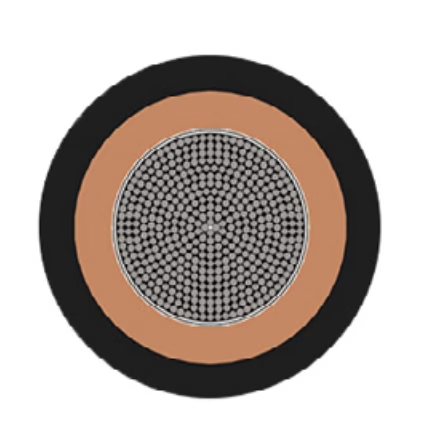
cement plant cable

To understand why Type 450-FO composite cables represent such a significant advancement for stacker-reclaimer applications, we first need to appreciate what makes these cables different from traditional power or communication cables. Think of a Type 450-FO composite cable as a sophisticated integration of two fundamentally different technologies working together in harmony within a single protective structure. The designation "450-FO" tells us important information about this cable's design: the "450" typically indicates the voltage rating in volts for the power conductors, while "FO" stands for Fiber Optic, signaling that optical fibers are integrated within the same cable assembly alongside the copper power conductors. 要理解为什么Type 450-FO复合电缆代表了堆取料机应用的重大进步,我们首先需要了解是什么使这些电缆与传统的电力或通信电缆不同。将Type 450-FO复合电缆想象为两种根本不同技术的复杂集成,在单个保护结构内和谐地协同工作。"450-FO"名称告诉我们有关这种电缆设计的重要信息:"450"通常表示电力导体的额定电压(以伏特为单位),而"FO"代表光纤,表示光纤与铜电力导体一起集成在同一电缆组件中。

Integrated Fiber Optics: Advantages of Type 450-FO Composite Cables for Remote-Controlled Stacker-Reclaimers

To understand why Type 450-FO composite cables represent such a significant advancement for stacker-reclaimer applications, we first need to appreciate what makes these cables different from traditional power or communication cables. Think of a Type 450-FO composite cable as a sophisticated integration of two fundamentally different technologies working together in harmony within a single protective structure. The designation “450-FO” tells us important information about this cable’s design: the “450” typically indicates the voltage rating in volts for the power conductors, while “FO” stands for Fiber Optic, signaling that optical fibers are integrated within the same cable assembly alongside the copper power conductors. 要理解为什么Type 450-FO复合电缆代表了堆取料机应用的重大进步,我们首先需要了解是什么使这些电缆与传统的电力或通信电缆不同。将Type 450-FO复合电缆想象为两种根本不同技术的复杂集成,在单个保护结构内和谐地协同工作。”450-FO”名称告诉我们有关这种电缆设计的重要信息:”450″通常表示电力导体的额定电压(以伏特为单位),而”FO”代表光纤,表示光纤与铜电力导体一起集成在同一电缆组件中。
The maximum conductor operating temperature is a critical parameter that determines a cable's current-carrying capacity, service life, and application suitability. For VDE-certified cables, EPR (Ethylene Propylene Rubber) insulation permits a continuous conductor operating temperature of 90°C, representing a significant advancement over older rubber insulation technologies which were typically limited to 60°C–70°C.[1][2] 最高导体工作温度是决定电缆载流量、使用寿命和应用适用性的关键参数。对于VDE认证电缆,EPR(乙丙橡胶)绝缘允许90°C的连续导体工作温度,相比传统橡胶绝缘(60°C–70°C)有显著提升。

What is the Maximum Conductor Operating Temperature Allowed for VDE Cables Insulated with EPR (90°C) vs. Older Rubber Types?

The maximum conductor operating temperature is a critical parameter that determines a cable’s current-carrying capacity, service life, and application suitability. For VDE-certified cables, EPR (Ethylene Propylene Rubber) insulation permits a continuous conductor operating temperature of 90°C, representing a significant advancement over older rubber insulation technologies which were typically limited to 60°C–70°C.[1][2] 最高导体工作温度是决定电缆载流量、使用寿命和应用适用性的关键参数。对于VDE认证电缆,EPR(乙丙橡胶)绝缘允许90°C的连续导体工作温度,相比传统橡胶绝缘(60°C–70°C)有显著提升。
The RHEYFIRM(RTS) R-(N)TSCGEWTOEUS represents the pinnacle of medium-voltage reeling cable technology, engineered specifically for demanding industrial applications where power transmission, control signals, and fiber optic communication must be integrated into a single, highly flexible cable assembly. Manufactured in strict compliance with DIN VDE 0250 Part 813, this cable series delivers reliable performance at voltage ratings from 8.7/15 kV up to 18/30 kV, with travel speeds reaching 180 m/min on modern cable reeling systems. The designation follows the German VDE nomenclature where "RHEYFIRM" indicates the manufacturer's product line, "(RTS)" denotes the reinforced tensile system, and the alphanumeric string describes the complete cable construction including screening, insulation type, and special features.

What is RHEYFIRM(RTS) R-(N)TSCGEWTOEUS Cable?

The RHEYFIRM(RTS) R-(N)TSCGEWTOEUS represents the pinnacle of medium-voltage reeling cable technology, engineered specifically for demanding industrial applications where power transmission, control signals, and fiber optic communication must be integrated into a single, highly flexible cable assembly. Manufactured in strict compliance with DIN VDE 0250 Part 813, this cable series delivers reliable performance at voltage ratings from 8.7/15 kV up to 18/30 kV, with travel speeds reaching 180 m/min on modern cable reeling systems. The designation follows the German VDE nomenclature where “RHEYFIRM” indicates the manufacturer’s product line, “(RTS)” denotes the reinforced tensile system, and the alphanumeric string describes the complete cable construction including screening, insulation type, and special features.
FESTOONFLEX-LX 0,6/1 kV is a premium instrumentation and control cable engineered for mining operations and bulk material handling applications. This cable is specifically designed for festoon systems and connecting movable parts of machine tools where fast movement, strong acceleration, and frequent bending during operation are critical requirements.

FESTOONFLEX-LX 0,6/1 kV Instrumentation & Control Cable

FESTOONFLEX-LX, FESTOONFLEX-LX 0.6/1kV, instrumentation cable, control cable, mining control cable, festoon cable, IEC 60228 Class 5, DIN VDE 0298, screened pairs cable, EPR insulation, polychloroprene sheath, UV resistant cable, oil resistant cable, crushproof cable, 90°C rated cable, -30°C low temperature, mining equipment cable, crane control cable, conveyor instrumentation, bulk material handling, high flex cable, torsion resistant cable, EMI shielded cable, 80% screen coverage, 4G control cable, 5G control cable, multi-core cable, Anhui Feichun cable, 礦用控制電纜, 儀表電纜, 懸掛電纜, 屏蔽對電纜, 特種電纜
BS6195 Standard covers the requirements for insulated flexible cables and cords typically known as coil end leads. These specialized cables are engineered for permanent and direct connection to coil windings or other electrical equipment, providing the essential flexibility and durability required in demanding industrial environments where motors, generators, transformers, and circuit breakers operate.

What is BS6195 Cable?

BS6195 Standard covers the requirements for insulated flexible cables and cords typically known as coil end leads. These specialized cables are engineered for permanent and direct connection to coil windings or other electrical equipment such as motors, generators, transformers, and circuit breakers.
TYPE 455 mining cables represent an optimized category of Class 2 heavy-duty elastomer-sheathed cables specifically engineered for applications demanding minimal cable diameter and reduced weight per meter while maintaining comprehensive electrical protection. Manufactured in strict accordance with AS/NZS 2802:2000 standards, these cables are designed for voltage ratings from 1.1 kilovolts to 11 kilovolts, with a construction philosophy emphasizing reduced insulation thickness and elimination of cradle separators to achieve lower overall mass and diameter. The incorporation of two earth conductors and one pilot conductor positioned in outer interstices, combined with EPR insulation and semiconductive screening systems, makes these cables particularly well-suited for stacker reclaimer installations, dragline operations, and other slow reeling applications where cable weight directly impacts equipment performance and operational efficiency. The design represents a strategic balance between electrical performance requirements and mechanical handling considerations, offering mining operations a purpose-built solution for specific application scenarios where traditional heavier cable constructions would impose unacceptable operational constraints.

What is TYPE 455 1.1 to 11kV Mining Cables to AS/NZS 2802:2000?

TYPE 455 mining cables represent an optimized category of Class 2 heavy-duty elastomer-sheathed cables specifically engineered for applications demanding minimal cable diameter and reduced weight per meter while maintaining comprehensive electrical protection. Manufactured in strict accordance with AS/NZS 2802:2000 standards, these cables are designed for voltage ratings from 1.1 kilovolts to 11 kilovolts, with a construction philosophy emphasizing reduced insulation thickness and elimination of cradle separators to achieve lower overall mass and diameter. The incorporation of two earth conductors and one pilot conductor positioned in outer interstices, combined with EPR insulation and semiconductive screening systems, makes these cables particularly well-suited for stacker reclaimer installations, dragline operations, and other slow reeling applications where cable weight directly impacts equipment performance and operational efficiency. The design represents a strategic balance between electrical performance requirements and mechanical handling considerations, offering mining operations a purpose-built solution for specific application scenarios where traditional heavier cable constructions would impose unacceptable operational constraints.