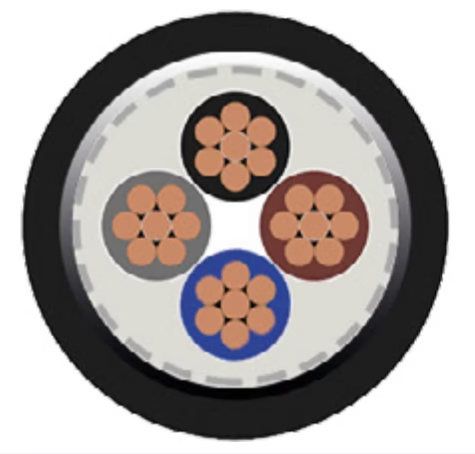
cable de media tensión

Extended technical guide for mining engineers, port equipment designers, electrical system integrators, and heavy-equipment OEMs. Covers: the physics of mechanical fatigue in high-speed reeling systems; BUFLEX® SC conductor architecture (IEC 60228 Class 5 ultra-fine stranding, lay-angle optimisation for bending compliance); EPR insulation design with semi-conductive field-control layers for efficient 1.8–24 kV electric-field distribution; copper-braid electromagnetic shielding and its interaction with high-current conduction; signature red PUR jacket chemistry (abrasion resistance, tear strength, UV stability, oil resistance); mechanical performance specifications (minimum bend radius, tensile load capacity, cyclic-flexure endurance); thermal management in continuous high-current operation (current rating derating as function of ambient temperature and installation method); comparative analysis of single-core vs. multi-core approaches; environmental durability (arctic cold, tropical heat, mine dust, coastal salt-fog); and practical specification and procurement frameworks for mining and port operator deployment.

BUFLEX® SC Single-Core Medium-Voltage Ultra-Flexible Reeling Cable: Complete Engineering Analysis, Advanced Conductor Architecture, EPR Insulation with Electrostatic Field Control, PUR Jacket Superior Abrasion & Tear Resistance, Mechanical Fatigue Engineering, Extreme Environment Durability, and Comprehensive Comparative Evaluation Against Multi-Core Industrial Cable Alternatives for Mining and Heavy Port Equipment

Extended technical guide for mining engineers, port equipment designers, electrical system integrators, and heavy-equipment OEMs. Covers: the physics of mechanical fatigue in high-speed reeling systems; BUFLEX® SC conductor architecture (IEC 60228 Class 5 ultra-fine stranding, lay-angle optimisation for bending compliance); EPR insulation design with semi-conductive field-control layers for efficient 1.8–24 kV electric-field distribution; copper-braid electromagnetic shielding and its interaction with high-current conduction; signature red PUR jacket chemistry (abrasion resistance, tear strength, UV stability, oil resistance); mechanical performance specifications (minimum bend radius, tensile load capacity, cyclic-flexure endurance); thermal management in continuous high-current operation (current rating derating as function of ambient temperature and installation method); comparative analysis of single-core vs. multi-core approaches; environmental durability (arctic cold, tropical heat, mine dust, coastal salt-fog); and practical specification and procurement frameworks for mining and port operator deployment.
A practical reference for engineers responsible for maintaining and replacing port cable infrastructure, covering: the forensic mindset for cable failure investigation; the six primary failure signatures observed in marine reeling and festoon service; sheath, insulation, conductor, braid and termination failure modes with diagnostic photographs of each pattern; the bathtub curve as applied to industrial cable populations and how to recognise infant mortality, random failure and wear-out regimes; Weibull analysis of installed cable populations as a quantitative reliability tool; root-cause analysis using the five-whys methodology adapted for cable systems; field inspection protocols for active reeling and festoon installations; the replacement decision framework that distinguishes like-for-like substitution from upgrade specifications; and the FeiChun marine-grade port cable programme as the engineering response to the most frequently observed field-failure modes across the Nexans cable catalogue.

Reading the Failure: A Diagnostic Engineer’s Guide to Port Cable Forensics, Reliability Analysis and Replacement Specification — Field-Failure Patterns Across the Nexans RHEYCORD®, RHEYFLAT®, RHEYFESTOON®, BUFLEX® and RHEYFIRM® Catalogue

A practical reference for engineers responsible for maintaining and replacing port cable infrastructure, covering: the forensic mindset for cable failure investigation; the six primary failure signatures observed in marine reeling and festoon service; sheath, insulation, conductor, braid and termination failure modes with diagnostic photographs of each pattern; the bathtub curve as applied to industrial cable populations and how to recognise infant mortality, random failure and wear-out regimes; Weibull analysis of installed cable populations as a quantitative reliability tool; root-cause analysis using the five-whys methodology adapted for cable systems; field inspection protocols for active reeling and festoon installations; the replacement decision framework that distinguishes like-for-like substitution from upgrade specifications; and the FeiChun marine-grade port cable programme as the engineering response to the most frequently observed field-failure modes across the Nexans cable catalogue.
Protolon(SC)® (N)TSKWOEU is a 0.6/1 kV shore connection cable engineered by Anhui Feichun Special Cable Co., Ltd. for the single most important new cable application in the global maritime industry: cold ironing—the practice of connecting berthed ships to shore-side electrical power so they can shut down their diesel auxiliary engines during port stays, eliminating the thousands of tonnes of SOx, NOx, CO₂, and particulate matter that ships currently emit while sitting at berth.

Industrial Reeling Cable Supply Chain Resilience and Import Substitution Economics: A Business-Technical Framework for Sustainable Procurement Decisions in Port, Mining, and Heavy Equipment Operations

Comprehensive supply chain and procurement analysis covering: European supplier concentration risk quantification, documented supply disruption case studies (2023–2026), geopolitical risk factors (trade tensions, sanctions, tariff exposure), lead time economics and working capital impact, total cost of ownership (TCO) modelling framework, technical equivalence validation protocols for VDE/IEC-certified alternatives, quality assurance procedures for non-OEM suppliers, contract risk allocation strategies, inventory management optimization, production planning with extended lead times, currency and forex hedging considerations, regulatory compliance frameworks for import substitution in different jurisdictions, and practical implementation roadmap with realistic transition timelines.
A comprehensive technical reference for port electrical engineers, terminal maintenance managers, crane OEM integrators, classification surveyors and procurement specialists, covering: the dual mechanical regimes of festoon and drum reeling and how they impose different cable failure modes; the electrochemistry of salt-fog corrosion in tinned-copper conductors and why bare-copper variants fall short in coastal service; the FC-FLX™ ultra-fine N₂-annealed tinned conductor system built on Tongling Cu-CATH-1 cathode copper; the FC-ASB™ aramid anti-torsion braid as a structural alternative to conventional polyester textile braids found in RHEYCORD®(RTS) and RHEYFIRM®(RTS); marine-grade EPR 3GI3 insulation and 5GM5 polychloroprene sheath chemistry per DIN VDE 0207-21; PUR variants positioned against BUFLEX® DGR and RHEYCORD®-PUR R; halogen-free LSHF construction equivalent to RHEYFLAT®-N (N)GFLCGOEU-J LSHF; medium voltage screened reeling cables benchmarked against RHEYFIRM®(SI) NTMCGCWOEUS, BUFLEX® SEM and RHEYFIRM®(RTS) (N)TSCGEWTOEUS; optical-hybrid variants paralleling RHEYCORD®-OFE M / R / SR and BUFLEX® SEM OFE; speciality cables including BOITALYON®R pendant, RHEYFLEX®-PN strength-member control and RHEYCORD®(BS) YSLZ3SOE-J basket spreader cable; PVC flat festoon products H07VVH6-F and VCVH6-F; IEC 60068-2-52 cyclic salt-mist validation methodology; and full application guidance for STS, RTG, RMG, ship unloader, stacker-reclaimer and shore-power deployments.

Salt-Fog Resistant Festoon and Reeling Cables for Coastal Port Cranes: A Comparative Technical Study of FeiChun’s Marine-Grade Programme Against the Nexans RHEYCORD®, RHEYFLAT®, RHEYFESTOON®, BUFLEX® and RHEYFIRM® Catalogue

A comprehensive technical reference for port electrical engineers, terminal maintenance managers, crane OEM integrators, classification surveyors and procurement specialists, covering: the dual mechanical regimes of festoon and drum reeling and how they impose different cable failure modes; the electrochemistry of salt-fog corrosion in tinned-copper conductors and why bare-copper variants fall short in coastal service; the FC-FLX™ ultra-fine N₂-annealed tinned conductor system built on Tongling Cu-CATH-1 cathode copper; the FC-ASB™ aramid anti-torsion braid as a structural alternative to conventional polyester textile braids found in RHEYCORD®(RTS) and RHEYFIRM®(RTS); marine-grade EPR 3GI3 insulation and 5GM5 polychloroprene sheath chemistry per DIN VDE 0207-21; PUR variants positioned against BUFLEX® DGR and RHEYCORD®-PUR R; halogen-free LSHF construction equivalent to RHEYFLAT®-N (N)GFLCGOEU-J LSHF; medium voltage screened reeling cables benchmarked against RHEYFIRM®(SI) NTMCGCWOEUS, BUFLEX® SEM and RHEYFIRM®(RTS) (N)TSCGEWTOEUS; optical-hybrid variants paralleling RHEYCORD®-OFE M / R / SR and BUFLEX® SEM OFE; speciality cables including BOITALYON®R pendant, RHEYFLEX®-PN strength-member control and RHEYCORD®(BS) YSLZ3SOE-J basket spreader cable; PVC flat festoon products H07VVH6-F and VCVH6-F; IEC 60068-2-52 cyclic salt-mist validation methodology; and full application guidance for STS, RTG, RMG, ship unloader, stacker-reclaimer and shore-power deployments.
The international nature of power infrastructure means that MV cables are specified using various national nomenclatures and standards. While the German DIN VDE nomenclature (such as N2XSY, NA2XSH) has become widely recognized across Europe, British Standards (BS6622, BS7835, BS7870), French (NF C 33-226), Spanish (RHZ1), Portuguese (XHIOE, LXHIOV), and other national specifications remain essential for projects in their respective regions.

What is Medium Voltage Cable?

(N)TSCGEWÖU cable, (N)TMCGEWÖU cable, (N)TSCGECECWÖU cable, (N)3GHSSHCH cable, (N)3GHSSYCY cable, N2XSY cable, N2XSH cable, NA2XSY cable, NA2XSH cable, N2XS2Y cable, N2XS(F)2Y cable, N2XS(FL)2Y cable, NA2XS2Y cable, NA2XS(F)2Y cable, NA2XS(FL)2Y cable, N2XSEY cable, NA2XSEY cable, N2XS(F)H cable, N2XS(FL)H cable, NA2XS(F)H cable, NA2XS(FL)H cable
Armoured cables, commonly referred to as SWA (Steel Wire Armoured) or AWA (Aluminium Wire Armoured) cables, are robust power cables designed with metallic armour protection for demanding installation environments. The armour provides mechanical protection where physical stress could damage the cable, such as direct burial underground, outdoor installations, or industrial environments. These cables are manufactured in accordance with British, European, and International standards including BS 5467, BS 6724, BS 6622, BS 7835, and IEC 60502.

What are Armoured Cables SWA & AWA?

SWA cable, AWA cable, armoured cable, steel wire armoured, aluminium wire armoured, BS 5467, BS 6724, BS 6622, BS 7835, IEC 60502, BASEC approved, XLPE cable, LSZH cable, underground cable, 0.6/1kV, 11kV cable, 33kV cable, N2XRY, NYFGBY, power cable, industrial cable, direct burial, 鎧裝電纜, 鋼絲鎧裝, cable blindado
IEC 60502 is an international standard published by the International Electrotechnical Commission (IEC) that sets out the specification for power cables with extruded insulation. The standard covers cables with voltage ratings from 1 kV (Um = 1.2 kV) up to 30 kV (Um = 36 kV), designed for fixed installations such as distribution networks and industrial installations. This widely recognized standard serves as a primary reference for cable manufacturers worldwide and forms the basis for numerous national and regional cable standards.

What is IEC 60502 Cable?

IEC 60502 對導體類型、絕緣材料和護套化合物提供了詳細規格。絕緣材料包括 PVC(最高溫度 70°C)、XLPE、EPR 和 HEPR(均為最高 90°C)。導體類別包括第 1 類(實心)、第 2 類(絞合)和第 5 類(柔性),尺寸範圍從 1.5 mm² 到 1600 mm²。護套化合物包括 PVC、PE 和用於防火敏感區域的無鹵素材料。XLPE 絕緣的標稱厚度從 0.6/1 kV 的 1.0 mm 到 18/30 kV 的 8.0 mm 不等。
HD 620 is commonly linked to the German national standard DIN VDE 0276 Part 620 and is harmonized with international standard IEC 60502-2. The standard establishes comprehensive construction requirements, dimensional specifications, and test methods that exceed the baseline requirements of IEC 60502-2. Both HD 620 and IEC 60502-2 require compulsory conductor and insulation screening, typically applied through a triple extrusion process with the insulation layer. The test methodology for compliance is set out in HD 605 subclause 2.1.1 for insulation material and HD 605 subclause 2.1.2 for sheath material.

What is HD620 Standard Cable?

HD 620 cables are designed for power distribution networks, industrial installations, and infrastructure applications. These medium voltage cables are suitable for permanent installation in various environments including underground, outdoor, and cable ducting installations.