automation cable

Feichun's comprehensive port equipment cable portfolio encompasses two primary cable family streams engineered for fundamentally different equipment operating environments, each with multiple reinforcement, shielding, and configuration variants optimized for specific applications. Design Philosophy: Rather than attempting to create a single universal cable for all port applications, Feichun engineers cables within two distinct families, each optimized for its operational environment. High-tension cables prioritize tensile strength and mechanical robustness for reel-mounted applications. Festoon cables prioritize bending flexibility and environmental durability for suspended overhead systems. Within each family, reinforcement, shielding, and configuration options address specialized requirements. Two Core Cable Families: 1. High-Tension Reel Cables (HT-PNCT Family) — Engineered for equipment where cables wind onto rotating reels including ship unloaders, stackers, reclaimers, and mobile cranes. Optimized for extreme tensile stress, intensive bending cycles, and long unsupported spans. 2. Festoon Suspended Cables (FC-PNCT Family) — Engineered for equipment with suspended overhead power distribution including container cranes, gantry cranes, and overhead bridge systems. Optimized for gentle bending, environmental durability, and multi-circuit power distribution. Within each family, variants address specialized requirements through reinforcement (enhanced tensile strength and service life), electromagnetic shielding (protection for VFD systems and automation electronics), and flexible configuration options (3–30 conductor cores, three conductor sizes).

Feichun Port Equipment Cable Portfolio

Feichun’s comprehensive port equipment cable portfolio encompasses two primary cable family streams engineered for fundamentally different equipment operating environments, each with multiple reinforcement, shielding, and configuration variants optimized for specific applications. Design Philosophy: Rather than attempting to create a single universal cable for all port applications, Feichun engineers cables within two distinct families, each optimized for its operational environment. High-tension cables prioritize tensile strength and mechanical robustness for reel-mounted applications. Festoon cables prioritize bending flexibility and environmental durability for suspended overhead systems. Within each family, reinforcement, shielding, and configuration options address specialized requirements. Two Core Cable Families: 1. High-Tension Reel Cables (HT-PNCT Family) — Engineered for equipment where cables wind onto rotating reels including ship unloaders, stackers, reclaimers, and mobile cranes. Optimized for extreme tensile stress, intensive bending cycles, and long unsupported spans. 2. Festoon Suspended Cables (FC-PNCT Family) — Engineered for equipment with suspended overhead power distribution including container cranes, gantry cranes, and overhead bridge systems. Optimized for gentle bending, environmental durability, and multi-circuit power distribution. Within each family, variants address specialized requirements through reinforcement (enhanced tensile strength and service life), electromagnetic shielding (protection for VFD systems and automation electronics), and flexible configuration options (3–30 conductor cores, three conductor sizes).
The ÖLFLEX CLASSIC 115 CY 4G1.5 cable represents a precision-engineered control cable where every dimensional and electrical specification has been optimized through extensive testing and field validation across diverse industrial applications. The 8.2-millimeter outer diameter establishes the space requirements for cable routing in panel layouts, cable trays, and conduit systems. To understand this specification in practical terms, consider that 8.2 millimeters is approximately the width of a standard pencil—this compact size enables routing through narrow spaces between equipment, through small penetrations in enclosure walls, and through dense cable bundles where space is precious. The 4G1.5 designation specifies that the cable contains four conductors, each with a 1.5 square millimeter cross-sectional area, meaning each conductor is composed of fine copper wire strands twisted together in a flexible Class 5 stranding pattern. One of these four conductors is the distinctive green-yellow (dual-color) protective earth/ground conductor, while the other three are typically color-coded according to VDE 0293-308 standards (often black, brown, and grey for three-phase applications, or black, brown, and blue for single-phase applications). The current carrying capacity is approximately 18 amperes under standard conditions (30°C ambient air temperature, cables routed in free air rather than enclosed in conduit or cable trays), establishing the maximum safe electrical load for any single conductor. The voltage rating of 300/500V classifies this as a control-voltage cable rather than a high-voltage power cable, appropriate for control circuits, instrumentation systems, and signaling applications rather than main power distribution.

VDE Cross-Reference: Drop-in Alternative for ÖLFLEX CLASSIC 115 CY 4G1.5 VDE 0250

The ÖLFLEX CLASSIC 115 CY 4G1.5 cable represents a precision-engineered control cable where every dimensional and electrical specification has been optimized through extensive testing and field validation across diverse industrial applications. The 8.2-millimeter outer diameter establishes the space requirements for cable routing in panel layouts, cable trays, and conduit systems. To understand this specification in practical terms, consider that 8.2 millimeters is approximately the width of a standard pencil—this compact size enables routing through narrow spaces between equipment, through small penetrations in enclosure walls, and through dense cable bundles where space is precious. The 4G1.5 designation specifies that the cable contains four conductors, each with a 1.5 square millimeter cross-sectional area, meaning each conductor is composed of fine copper wire strands twisted together in a flexible Class 5 stranding pattern. One of these four conductors is the distinctive green-yellow (dual-color) protective earth/ground conductor, while the other three are typically color-coded according to VDE 0293-308 standards (often black, brown, and grey for three-phase applications, or black, brown, and blue for single-phase applications). The current carrying capacity is approximately 18 amperes under standard conditions (30°C ambient air temperature, cables routed in free air rather than enclosed in conduit or cable trays), establishing the maximum safe electrical load for any single conductor. The voltage rating of 300/500V classifies this as a control-voltage cable rather than a high-voltage power cable, appropriate for control circuits, instrumentation systems, and signaling applications rather than main power distribution.
In industrial cable applications involving continuous reeling and unreeling operations, cable integrity under mechanical stress is paramount. One critical structural element that ensures operational reliability is the anti-torsion braid, also known as an embedded textile mesh, positioned within the cable sheath. This technical component plays a vital role in maintaining cable performance in demanding environments such as crane systems, hoists, conveyor belts, and mobile machinery. 在涉及连续收卷和放卷操作的工业电缆应用中,机械应力下的电缆完整性至关重要。确保操作可靠性的一个关键结构元件是反扭转编织层,也称为嵌入式纺织网,位于电缆护套内。该技术组件在起重机系统、提升机、传送带和移动机械等苛刻环境中维护电缆性能方面起着至关重要的作用。

How Does the Anti-Torsion Braid Prevent Cable Twisting During Reeling?

In industrial cable applications involving continuous reeling and unreeling operations, cable integrity under mechanical stress is paramount. One critical structural element that ensures operational reliability is the anti-torsion braid, also known as an embedded textile mesh, positioned within the cable sheath. This technical component plays a vital role in maintaining cable performance in demanding environments such as crane systems, hoists, conveyor belts, and mobile machinery. 在涉及连续收卷和放卷操作的工业电缆应用中,机械应力下的电缆完整性至关重要。确保操作可靠性的一个关键结构元件是反扭转编织层,也称为嵌入式纺织网,位于电缆护套内。该技术组件在起重机系统、提升机、传送带和移动机械等苛刻环境中维护电缆性能方面起着至关重要的作用。
High-speed, high-quality end-to-end data transmission cables for communication technology applications including data transfer, sound and video communications, signalling and instrumentation. Our range covers EIA-232, EIA-422, EIA-423 and EIA-485 standards with LSF, LSZH, PE and PVC sheathing options offering superior performance characteristics.

Belden and Alternative / Equivalent Cables

Belden 9841, Belden 9842, Belden 9843, Belden 9844, Belden 8723, Belden 8728, Belden 8777, Belden 8778, Belden 9501, Belden 9502, Belden 9503, Belden 9504, Belden 9506, Belden 9508, Belden 9510, Belden 8760, Belden 8761, Belden 8762, Belden 8102, Belden 8103, Belden 8104, Belden 8105, Belden 8106, Belden 8162, Belden 8163, Belden 1502R, Belden 8770, Belden 9927, Belden 9929, Belden 9934, Belden 9936
Polyurethane cables, commonly abbreviated as PUR cables, represent a specialized category of industrial wiring solutions engineered with thermoplastic polyurethane sheathing materials. These cables are characterized by their halogen-free composition, exceptional flame resistance properties, and superior mechanical and chemical resistance capabilities, which collectively render them optimal for deployment in demanding industrial environments where conventional PVC or rubber-sheathed cables would experience premature degradation.

What is PUR Cable?

H05BQ-F cable, H07BQ-F cable, H05BZ5-F cable, H07BZ5-F cable, PUR-JZ cable, PUR-HF cable, Veriflex PUR cable, Powerchain PUR cable, PUR Ethernet cable, screened PUR cable, PUR trommel cable, PUR festoon cable, Mode 4 EV cable, DC EV charging cable
DIN VDE 0812 is a German national standard issued in 1988 that contains specifications for equipment wires and stranded equipment wires used within telecommunications and data processing systems. The standard covers flexible, multi-conductor cables designed for electronic control system connections, voice frequency transmission, and signal communications in fixed installations. These cables represent popular European alternatives to American-style data and control cables, featuring cores twisted into pairs to reduce crosstalk and electromagnetic interference.

What is DIN VDE 0812 Cable?

DIN VDE 0812 cables are designed for electronic control system connections, voice frequency transmission, and signal communications in fixed installations. They are widely used across various industries where reliable data and signal transmission is required in environments requiring flexibility and compact cable routing.
El GAALFLEX® CONTROL 600 es un cable de control multiconductor de PVC altamente flexible, diseñado para aplicaciones industriales exigentes que requieren certificación dual según normas europeas (IEC/DIN VDE) y norteamericanas (UL/CSA). Este cable combina la robustez de los estándares alemanes VDE con la versatilidad de las certificaciones UL AWM, haciéndolo ideal para mercados globales y maquinaria de exportación.

¿Qué es GAALFLEX® CONTROL 600?

CONTROL 600 cable, PVC control cable, flexible control cable, multi-conductor control cable, IEC 60228 Class 5, DIN VDE 0281, UL AWM 2587, 600V control cable, 450/750V cable, industrial control cable, machine tool cable, IEC 60228, DIN VDE 0295, DIN VDE 0281, UL 1581, CSA AWM, HD 21.1, HD 21.2, EN 50334, EN 50265-2-1, IEC 60332-1-2, IEC 60332-3C, DIN EN 50290-2-22, VDE 0819-102,UL AWM 2587, UL AWM Style 2587, AWM style 21179, AWM style 21216, 90°C 600V cable, 105°C cable, CSA AWM I/II A/B, UL recognized cable, cUL listed cable
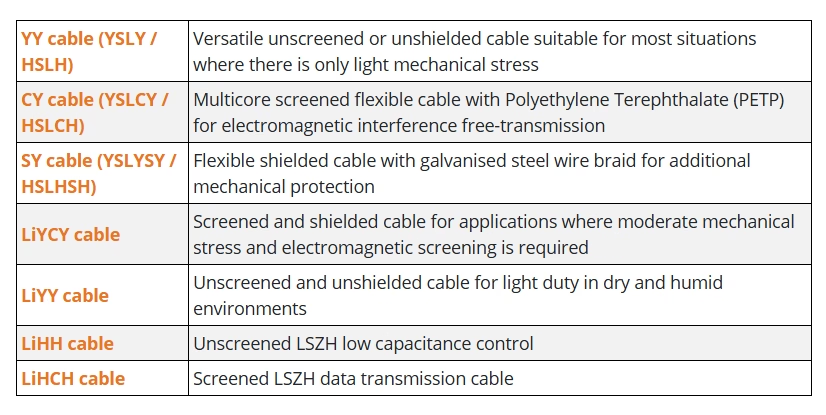
Control Flex cables are specialized multi-core cables designed for measuring, monitoring, and controlling machinery in industrial environments. These cables are essential components in manufacturing facilities, engineering installations, power stations, heating/air conditioning systems, and various electrical control applications. The three main types offered—CY (Copper-Screened), SY (Steel-Braided), and YY (Unscreened)—each provide distinct advantages depending on the application requirements for electromagnetic interference (EMI) protection, mechanical protection, or cost-effective basic control functionality.

Complete Guide to CY, SY & YY Control Flex Cables

P2CY cable, P3CY cable, P4CY cable, P5CY cable, P7CY cable, P3SY cable, P4SY cable, P5SY cable, P2YY cable, P3YY cable, P4YY cable, P5YY cable, P7YY cable, P12YY cable, CY control cable, SY control cable, YY control cable, CY screened cable, SY steel braided cable, YY unscreened cable, copper braid screen, galvanised steel braid, BS EN 50525-2-11, IEC 60332-1, IEC 60228, VDE 0293, screened control cable, shielded control cable, EMI shielding cable, RFI protection cable, signal transmission cable, data transmission cable, manufacturing control cable, industrial control cable, machinery monitoring cable, HVAC control cable, power station cable, PLC cable, automation cable, instrumentation cable, multicore control cable, fine stranded copper, 300/500V cable, flame retardant cable, mechanical protection cable, abrasion resistant cable, 2 core control, 3 core control, 4 core control, 5 core control, 7 core control, 12 core control, 0.75mm control cable, 1.5mm control cable, 2.5mm control cable, 控制電纜, 銅屏蔽電纜, 鋼絲編織電纜, 工業控制電纜, 安徽飛純電纜
While circular cables have served the industry for decades, flat cable technology has emerged as a superior solution for specific applications where space constraints, frequent bending, and compact cable management systems are paramount. This comprehensive technical guide examines two of the most widely specified flat cable types in modern crane installations: the YFFB cable (nitrile rubber compound insulation and sheath) and the YVFB cable (PVC insulation with nitrile-PVC composite sheath).

YFFB & YVFB Flat Crane Cables: Comprehensive Engineering Guide for Festoon Systems

While circular cables have served the industry for decades, flat cable technology has emerged as a superior solution for specific applications where space constraints, frequent bending, and compact cable management systems are paramount. This comprehensive technical guide examines two of the most widely specified flat cable types in modern crane installations: the YFFB cable (nitrile rubber compound insulation and sheath) and the YVFB cable (PVC insulation with nitrile-PVC composite sheath).
The 2TC Light-SB (2PNCT-SB) crane cable represents a specialized category of industrial power transmission cables engineered specifically for demanding applications in material handling, crane systems, and mobile industrial equipment.

What is 2TC Light-SB (2PNCT-SB) Crane Cable?

The 2TC Light-SB (2PNCT-SB) crane cable represents a specialized category of industrial power transmission cables engineered specifically for demanding applications in material handling, crane systems, and mobile industrial equipment.
CEI 20-27 CENELEC HD361 Cable

What is CEI 20-27 CENELEC HD361 Cable?

CEI 20-27 CENELEC HD361 represents a standardized cable designation system developed by the European Committee for Electrotechnical Standardisation (CENELEC) to provide uniform identification and classification of harmonized power cables and cords across European markets. This systematic coding methodology enables engineers, procurement specialists, and electrical contractors to precisely identify cable specifications including voltage ratings, insulation materials, conductor types, and sheathing compounds through a structured alphanumeric designation format.