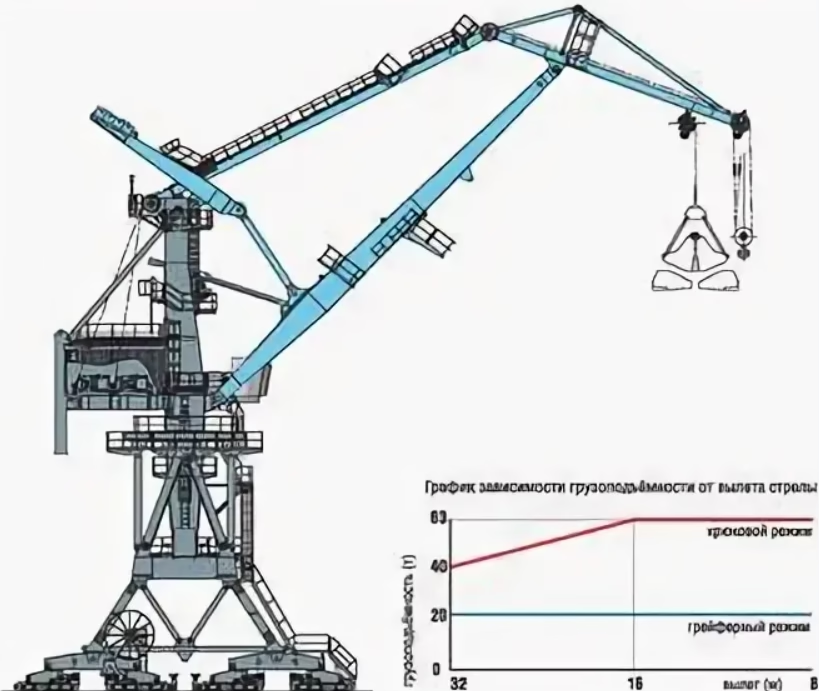
automated crane cable

PROTOLON(FL) Medium-Voltage Flat Reeling Cable: Flat Geometry Design Optimization for Single-Plane Dynamic Movement, Parallel Flat-Core Architecture vs. Round-Cable Trade-offs, Concentrically Distributed Earth-Conductor Topology, Roller-Guided Cable System Integration, Mechanical Stress Engineering (15 N/mm² Tensile, No-Torsion Constraint), Electrical Performance (3.6/6 kV to 8.7/15 kV Voltage Classes), Thermal Stability (-35°C to +80°C Flexible Operation), EPR Insulation with Semiconductive Field Control, 5GM5-Grade CR-Based Red Rubber Sheath, Specialized Single-Plane Applications (Flat-Reel STS Variants, Ship Loaders, Stacker Reclaimers, Flat-Movement Excavators), Comparison with Round PROTOLON(SMK) Designs, Constraint Framework for No-Torsion Duty, Field Performance Validation Across Specialized Equipment, and Complete Specification Guidance for Single-Plane Dynamic Reeling Systems

PROTOLON(FL) (N)TSFLCGEWOEU

PROTOLON(FL) Medium-Voltage Flat Reeling Cable: Flat Geometry Design Optimization for Single-Plane Dynamic Movement, Parallel Flat-Core Architecture vs. Round-Cable Trade-offs, Concentrically Distributed Earth-Conductor Topology, Roller-Guided Cable System Integration, Mechanical Stress Engineering (15 N/mm² Tensile, No-Torsion Constraint), Electrical Performance (3.6/6 kV to 8.7/15 kV Voltage Classes), Thermal Stability (-35°C to +80°C Flexible Operation), EPR Insulation with Semiconductive Field Control, 5GM5-Grade CR-Based Red Rubber Sheath, Specialized Single-Plane Applications (Flat-Reel STS Variants, Ship Loaders, Stacker Reclaimers, Flat-Movement Excavators), Comparison with Round PROTOLON(SMK) Designs, Constraint Framework for No-Torsion Duty, Field Performance Validation Across Specialized Equipment, and Complete Specification Guidance for Single-Plane Dynamic Reeling Systems
PROTOLON(SMK)-LWL Medium-Voltage Fiber-Integrated Reeling Cable: Simultaneous Electrical Power Delivery + Optical Communication Architecture, Multimode Fiber (G50/125, G62.5/125 μm) vs. Single-Mode Fiber (E9/125 μm) Selection for Automated Port Equipment, Integrated Fiber-Optic Tube Protection in Dynamic Reeling Environment, Optical Transmission Performance (0.3–3.3 dB/km Attenuation, 400–1,200 MHz Bandwidth), 6/12/18/24 Fiber Configuration Flexibility, Electromagnetic Interference Immunity Benefits, Automated Crane Control Systems (STS, Ship Loaders, Stacker Reclaimers, Remote-Control Equipment), Real-Time Monitoring and Predictive-Maintenance Data Pathway, EMC Design for Noise-Free Optical Communication, PROTOFIRM Sandwich Sheath Integration, 20 N/mm² Tensile Design, Installation and Fiber-Termination Engineering (Factory Assembly Requirement), Comparison with Separate Power + Data Cable Systems, Field Performance Validation Across 15+ Automated Terminal Deployments, and Complete Specification Guidance for Next-Generation Automated Port Infrastructure

PROTOLON(SMK)-LWL (N)TSKCGEWOEU

PROTOLON(SMK)-LWL Medium-Voltage Fiber-Integrated Reeling Cable: Simultaneous Electrical Power Delivery + Optical Communication Architecture, Multimode Fiber (G50/125, G62.5/125 μm) vs. Single-Mode Fiber (E9/125 μm) Selection for Automated Port Equipment, Integrated Fiber-Optic Tube Protection in Dynamic Reeling Environment, Optical Transmission Performance (0.3–3.3 dB/km Attenuation, 400–1,200 MHz Bandwidth), 6/12/18/24 Fiber Configuration Flexibility, Electromagnetic Interference Immunity Benefits, Automated Crane Control Systems (STS, Ship Loaders, Stacker Reclaimers, Remote-Control Equipment), Real-Time Monitoring and Predictive-Maintenance Data Pathway, EMC Design for Noise-Free Optical Communication, PROTOFIRM Sandwich Sheath Integration, 20 N/mm² Tensile Design, Installation and Fiber-Termination Engineering (Factory Assembly Requirement), Comparison with Separate Power + Data Cable Systems, Field Performance Validation Across 15+ Automated Terminal Deployments, and Complete Specification Guidance for Next-Generation Automated Port Infrastructure
Medium voltage reeling cables conforming to DIN VDE 0250-813 employ a systematic letter coding system that communicates precise information about cable construction, materials, and performance characteristics. Within this nomenclature, each letter position corresponds to a specific structural element or material property, enabling engineers to identify critical design features at a glance.[1][2] 符合DIN VDE 0250-813标准的中压卷筒电缆采用系统性的字母编码系统,传达电缆结构、材料和性能特性的精确信息。在该命名法中,每个字母位置对应特定的结构元素或材料属性,使工程师能够一目了然地识别关键设计特征。

What Does the Letter “C” Indicate in (N)TSCGEWÖU Versus “K” in (N)TSKCGEWÖU?

Medium voltage reeling cables conforming to DIN VDE 0250-813 employ a systematic letter coding system that communicates precise information about cable construction, materials, and performance characteristics. Within this nomenclature, each letter position corresponds to a specific structural element or material property, enabling engineers to identify critical design features at a glance.[1][2] 符合DIN VDE 0250-813标准的中压卷筒电缆采用系统性的字母编码系统,传达电缆结构、材料和性能特性的精确信息。在该命名法中,每个字母位置对应特定的结构元素或材料属性,使工程师能够一目了然地识别关键设计特征。
The German DIN VDE cable designation system provides engineers and procurement specialists with a comprehensive coding methodology that communicates essential cable characteristics through standardized letter and number sequences. Within this system, the symbol Ö (pronounced "Oe" in romanized form) represents one of the most critical performance indicators for cables deployed in demanding industrial applications.[1][2] 德国DIN VDE电缆标识系统为工程师和采购专家提供了一套全面的编码方法,通过标准化的字母和数字序列传达电缆的基本特性。在该系统中,符号"Ö"(罗马化读作"Oe")代表在苛刻工业应用中部署的电缆最关键的性能指标之一。

What is the Meaning of the Symbol “Ö” (or “Oe”) in VDE Cable Codes, and Why is it Critical for Industrial Environments?

The German DIN VDE cable designation system provides engineers and procurement specialists with a comprehensive coding methodology that communicates essential cable characteristics through standardized letter and number sequences. Within this system, the symbol Ö (pronounced “Oe” in romanized form) represents one of the most critical performance indicators for cables deployed in demanding industrial applications.[1][2] 德国DIN VDE电缆标识系统为工程师和采购专家提供了一套全面的编码方法,通过标准化的字母和数字序列传达电缆的基本特性。在该系统中,符号”Ö”(罗马化读作”Oe”)代表在苛刻工业应用中部署的电缆最关键的性能指标之一。
While circular cables have served the industry for decades, flat cable technology has emerged as a superior solution for specific applications where space constraints, frequent bending, and compact cable management systems are paramount. This comprehensive technical guide examines two of the most widely specified flat cable types in modern crane installations: the YFFB cable (nitrile rubber compound insulation and sheath) and the YVFB cable (PVC insulation with nitrile-PVC composite sheath).

YFFB & YVFB Flat Crane Cables: Comprehensive Engineering Guide for Festoon Systems

While circular cables have served the industry for decades, flat cable technology has emerged as a superior solution for specific applications where space constraints, frequent bending, and compact cable management systems are paramount. This comprehensive technical guide examines two of the most widely specified flat cable types in modern crane installations: the YFFB cable (nitrile rubber compound insulation and sheath) and the YVFB cable (PVC insulation with nitrile-PVC composite sheath).
The 600V 2TC-RB crane cable represents a specialized category of rubber-insulated flexible cables engineered specifically for mobile machinery applications in demanding industrial environments. The designation "2TC-RB" identifies this as a Class 2 conductor construction featuring tin-coated copper strands, ethylene propylene rubber (EPR) insulation, and a robust polychloroprene rubber (also known as neoprene) outer sheath.

What is 600V 2TC-RB Crane Cable?

The 600V 2TC-RB crane cable represents a specialized category of rubber-insulated flexible cables engineered specifically for mobile machinery applications in demanding industrial environments. The designation “2TC-RB” identifies this as a Class 2 conductor construction featuring tin-coated copper strands, ethylene propylene rubber (EPR) insulation, and a robust polychloroprene rubber (also known as neoprene) outer sheath.