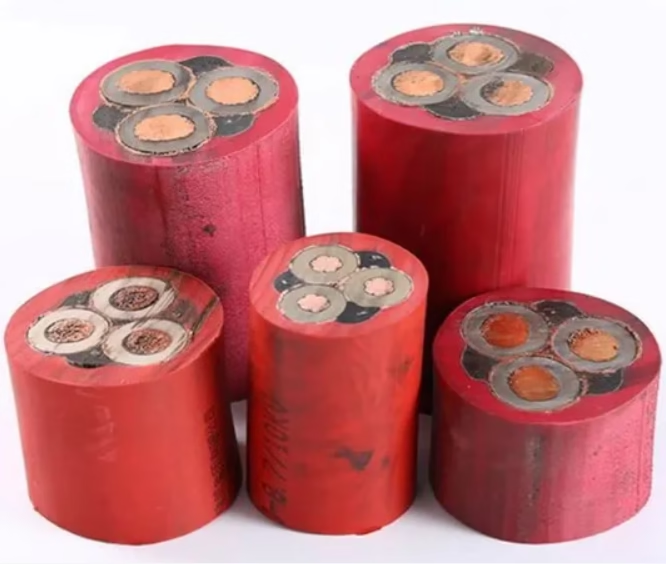
6kV mining cable

If your Central Asian underground coal mining project operates within an engineering and procurement ecosystem dominated by Australian consulting firms, English-language design specifications, AS/NZS standards documentation, and requires compatibility with continuous mining equipment protected by pilot-core-dependent relays, then Type 241 (AS/NZS 1802) is your correct choice. Type 241 provides the electrical architecture, pilot conductor continuity, and protective logic integration that Australian mining engineers expect. If your project operates in Kazakhstan, Mongolia, Uzbekistan, or Kyrgyzstan with Russian or Russian-influenced technical standards, local certification bodies that recognize GOST compliance, local maintenance teams trained on GOST equipment, Russian-language technical documentation, and primary focus on cost-effective 6kV power delivery in extreme cold environments, then КГЭ-ХЛ (GOST 31945-2012) is likely the more practical choice. КГЭ-ХЛ integrates seamlessly into Russian-standard electrical systems and is purpose-engineered for the minus forty to minus sixty degree Celsius temperatures endemic to Central Asian winters. 如果您的中亚地下煤矿项目由澳洲咨询公司主导、英文设计规范、AS/NZS标准文件和对连续采煤机保护逻辑兼容性有特殊要求,那么 Type 241(AS/NZS 1802)是正确选择。如果您的项目在哈萨克斯坦、蒙古、乌兹别克斯坦或吉尔吉斯斯坦,采用俄标或俄标影响的技术体系,本地认证机构认可GOST合规,本地维护团队熟悉GOST设备,主要关注极寒下的成本有效6kV供电,那么КГЭ-ХЛ(ГОСТ 31945-2012)是更实用的选择。

AS/NZS Type 241 vs. GOST КГЭ-ХЛ: Choosing the Right Standard for Underground Coal Mines in Central Asia

If your Central Asian underground coal mining project operates within an engineering and procurement ecosystem dominated by Australian consulting firms, English-language design specifications, AS/NZS standards documentation, and requires compatibility with continuous mining equipment protected by pilot-core-dependent relays, then Type 241 (AS/NZS 1802) is your correct choice. Type 241 provides the electrical architecture, pilot conductor continuity, and protective logic integration that Australian mining engineers expect. If your project operates in Kazakhstan, Mongolia, Uzbekistan, or Kyrgyzstan with Russian or Russian-influenced technical standards, local certification bodies that recognize GOST compliance, local maintenance teams trained on GOST equipment, Russian-language technical documentation, and primary focus on cost-effective 6kV power delivery in extreme cold environments, then КГЭ-ХЛ (GOST 31945-2012) is likely the more practical choice. КГЭ-ХЛ integrates seamlessly into Russian-standard electrical systems and is purpose-engineered for the minus forty to minus sixty degree Celsius temperatures endemic to Central Asian winters. 如果您的中亚地下煤矿项目由澳洲咨询公司主导、英文设计规范、AS/NZS标准文件和对连续采煤机保护逻辑兼容性有特殊要求,那么 Type 241(AS/NZS 1802)是正确选择。如果您的项目在哈萨克斯坦、蒙古、乌兹别克斯坦或吉尔吉斯斯坦,采用俄标或俄标影响的技术体系,本地认证机构认可GOST合规,本地维护团队熟悉GOST设备,主要关注极寒下的成本有效6kV供电,那么КГЭ-ХЛ(ГОСТ 31945-2012)是更实用的选择。
(N)TSKCGEWÖU 3x150+3x25/3 3.6/6kV cable with split three-part earth conductor is approximately 65 mm (2.56 inches), with a standard tolerance window of ±3.0 mm producing a permissible range of 62.0–68.0 mm. The inner jacket (the intermediate protective layer between the insulation and outer sheath) typically has a nominal thickness of approximately 0.8–1.0 mm, contributing to overall diameter build-up but not typically measured as a separate "inner diameter" in engineering specifications because the inner jacket is not a defined outer boundary—it is a layer embedded within the cable structure. The outer jacket (the final thermosetting rubber compound layer) has a nominal thickness of approximately 2.5–3.0 mm, providing the cable's mechanical interface with the environment. The approximate total weight of this cable is 8,200 kg/km (5,510 lbs/1000 ft), with copper content approximately 4,560 kg/km. It features three 150 mm² Class 5 tinned copper main phase conductors, three strategically distributed 25/3 mm² split earth conductors for electromagnetic symmetry, a 3GI3 high-dielectric EPR insulation system rated for continuous 90°C operation, an anti-torsion braid reinforcement layer, and a 5GM5 thermosetting halogen-free outer sheath providing extreme abrasion and tear resistance.

What is the Inner and Outer Jacket Diameter of (N)TSKCGEWÖU 3×150+3×25/3 3.6/6kV Splittable Earth Cable?

(N)TSKCGEWÖU 3×150+3×25/3 3.6/6kV cable with split three-part earth conductor is approximately 65 mm (2.56 inches), with a standard tolerance window of ±3.0 mm producing a permissible range of 62.0–68.0 mm. The inner jacket (the intermediate protective layer between the insulation and outer sheath) typically has a nominal thickness of approximately 0.8–1.0 mm, contributing to overall diameter build-up but not typically measured as a separate “inner diameter” in engineering specifications because the inner jacket is not a defined outer boundary—it is a layer embedded within the cable structure. The outer jacket (the final thermosetting rubber compound layer) has a nominal thickness of approximately 2.5–3.0 mm, providing the cable’s mechanical interface with the environment. The approximate total weight of this cable is 8,200 kg/km (5,510 lbs/1000 ft), with copper content approximately 4,560 kg/km. It features three 150 mm² Class 5 tinned copper main phase conductors, three strategically distributed 25/3 mm² split earth conductors for electromagnetic symmetry, a 3GI3 high-dielectric EPR insulation system rated for continuous 90°C operation, an anti-torsion braid reinforcement layer, and a 5GM5 thermosetting halogen-free outer sheath providing extreme abrasion and tear resistance.
(N)TMCGEH3S矿用电缆介绍 The (N)TMCGEH3S represents a sophisticated medium voltage trailing cable specifically engineered for demanding open-pit mining operations. Developed in accordance with DIN VDE 0250 Part 813 standards and Nexans specifications, this polyurethane-sheathed cable combines exceptional mechanical durability with advanced electrical performance characteristics. The integration of self-illuminating LED visual monitoring technology transforms this cable into an intelligent power transmission solution that provides real-time operational status indication. (N)TMCGEH3S是一种专为苛刻露天采矿作业设计的复杂中压拖曳电缆。该电缆按照DIN VDE 0250第813部分标准和Nexans规范开发,聚氨酯护套电缆将卓越的机械耐久性与先进的电气性能特性相结合。集成自发光LED视觉监测技术使该电缆成为能够提供实时运行状态指示的智能电力传输解决方案。

(N)TMCGEH3S Self-Illuminating Mining Cable: Can LED Brightness Indicate Voltage Level or Load Status?

(N)TMCGEH3S represents a sophisticated medium voltage trailing cable specifically engineered for demanding open-pit mining operations. Developed in accordance with DIN VDE 0250 Part 813 standards and Nexans specifications, this polyurethane-sheathed cable combines exceptional mechanical durability with advanced electrical performance characteristics. The integration of self-illuminating LED visual monitoring technology transforms this cable into an intelligent power transmission solution that provides real-time operational status indication. (N)TMCGEH3S是一种专为苛刻露天采矿作业设计的复杂中压拖曳电缆。该电缆按照DIN VDE 0250第813部分标准和Nexans规范开发,聚氨酯护套电缆将卓越的机械耐久性与先进的电气性能特性相结合。集成自发光LED视觉监测技术使该电缆成为能够提供实时运行状态指示的智能电力传输解决方案。
Determining the appropriate cable size for the main reel power supply of a Sandvik DD421 Development Jumbo requires a comprehensive analysis of the equipment's electrical power requirements, operational characteristics, and the specific technical parameters of German mining cable standards. The Sandvik DD421 is a two-boom electro-hydraulic development drill designed for fast and accurate drilling in tunneling and drifting operations covering cross-sectional areas from eight to sixty square meters. Understanding the relationship between this equipment's power consumption profile and the current-carrying capacity of (N)TSCGEWÖU medium-voltage trailing cables is essential for ensuring safe, reliable, and efficient operation in demanding underground mining environments.

Sandvik DD421: Which (N)TSCGEWÖU Cable Size is Suitable for the Main Reel of a Sandvik DD421 Development Jumbo?

Determining the appropriate cable size for the main reel power supply of a Sandvik DD421 Development Jumbo requires a comprehensive analysis of the equipment’s electrical power requirements, operational characteristics, and the specific technical parameters of German mining cable standards. The Sandvik DD421 is a two-boom electro-hydraulic development drill designed for fast and accurate drilling in tunneling and drifting operations covering cross-sectional areas from eight to sixty square meters. Understanding the relationship between this equipment’s power consumption profile and the current-carrying capacity of (N)TSCGEWÖU medium-voltage trailing cables is essential for ensuring safe, reliable, and efficient operation in demanding underground mining environments.
Primary HS Code for Rubber Mining Cables | 主要海关编码 HS Code: 8544.49 / 8544.60 Rubber-insulated mining cables typically fall under Chapter 85 of the Harmonized System, specifically within heading 8544, which covers insulated wire, cable, and other insulated electric conductors. The exact subheading depends on voltage specifications and whether connectors are fitted. 橡胶绝缘矿用电缆通常属于协调制度第85章,特别是8544项下,涵盖绝缘线、电缆和其他绝缘电导体。具体的子目取决于额定电压和是否配有连接器。

HS Code Classification Guide: Exporting Rubber Mining Cables to Peru & Chile

Primary HS Code for Rubber Mining Cables | 主要海关编码 HS Code: 8544.49 / 8544.60 Rubber-insulated mining cables typically fall under Chapter 85 of the Harmonized System, specifically within heading 8544, which covers insulated wire, cable, and other insulated electric conductors. The exact subheading depends on voltage specifications and whether connectors are fitted. 橡胶绝缘矿用电缆通常属于协调制度第85章,特别是8544项下,涵盖绝缘线、电缆和其他绝缘电导体。具体的子目取决于额定电压和是否配有连接器。
Ozone resistance represents one of the most critical yet frequently overlooked material performance requirements for elastomeric power cables operating in demanding outdoor environments. This characteristic becomes particularly important for mining cables manufactured with rubber insulation and sheathing compounds, where exposure to atmospheric ozone can initiate premature degradation mechanisms that compromise both electrical performance and mechanical integrity. The DIN VDE 0472-805 standard, titled "Testing of cables, wires and flexible cords; Ozone resistance," establishes comprehensive test procedures for evaluating whether cable materials can withstand ozone exposure without developing the characteristic surface cracking that signals material breakdown.

What is the “Ozone Resistance” test procedure defined in VDE 0472, and why is it critical for (N)TSCGEWÖU cables in open-pit mines?

Ozone resistance represents one of the most critical yet frequently overlooked material performance requirements for elastomeric power cables operating in demanding outdoor environments. This characteristic becomes particularly important for mining cables manufactured with rubber insulation and sheathing compounds, where exposure to atmospheric ozone can initiate premature degradation mechanisms that compromise both electrical performance and mechanical integrity. The DIN VDE 0472-805 standard, titled “Testing of cables, wires and flexible cords; Ozone resistance,” establishes comprehensive test procedures for evaluating whether cable materials can withstand ozone exposure without developing the characteristic surface cracking that signals material breakdown.
Высоковольтный гибкий кабель с мониторинговым экраном TENAX-H/HP NTSCGECWOEU NTSCGECCWOEU | DIN VDE 0250-813 | 高壓監控屏蔽拖曳電纜 | High-voltage Trailing Cable

Высоковольтный гибкий кабель с мониторинговым экраном

NTSCGECWOEU (TENAX-H) и NTSCGECCWOEU (TENAX-HP) — это специализированные высоковольтные гибкие кабели с мониторинговым экраном, предназначенные для подключения электрооборудования в шахтах и подземных выработках с опасной средой при особо высоких механических нагрузках. Кабели разработаны в соответствии с международным стандартом DIN VDE 0250, часть 813, который устанавливает требования к высоковольтным кабелям для горнодобывающей промышленности.
Кабель силовой шахтный и экскаваторный необходим для подключения горнодобывающего оборудования, экскаваторов и другого землеройного оборудования, электроинструментов, а также для проведения горных взрывных работ. Шахтные кабели используют для всех типов шахт: угольные, соляные, сланцевые, а также подходят для открытых карьерных разработок. Кабели эксплуатируются на напряжении переменного тока 660, 1140, 6000 В.

What is Кабель для шахт?

КГЭШ, КГЭШ-1140, КГЭ, КГЭ-6, КГЭ-Т, КГЭ-ХЛ, КГЭ-ХЛ-6, КГЭС, КГЭТ, КГВШ, КГРШ, КШВГТ, ЭВБВ, ЭВБВ-6, ЭВТ-1140, ЭВТ-6000, кабель КГЭШ, кабель КГЭ, кабель ЭВБВ, шахтный кабель КГЭШ, экскаваторный кабель, mining cable KGESH, excavator cable KGE, KGESH cable, KGE cable, EVBV cable
Mining, drilling, and tunnelling cables represent the most demanding category of industrial cables, designed to operate in some of the harshest environments on earth. These heavy-duty power, control, and instrumentation cables serve mine operators worldwide for both static infrastructure and dynamic equipment applications. Manufactured in accordance with international standards including IEC 60502, BS EN 60332, BS EN 60811, BS EN 60754, and VDE 0295, mining cables must withstand mechanical stress, oil and grease exposure, water immersion, and in underground applications, provide critical fire safety through reduced smoke and fume emissions.

What are Mining, Drilling & Tunnelling Cables?

NSSHÖU cable, NSSHOU cable, NSHÖU cable, NSHOU cable, NSSCHOU cable, NSHTÖU cable, NTSCGEWÖU cable, NTSCGEWOU cable, NTMCGEWÖU cable, N3GHSSYCY cable, N3GHSSHCH cable,Type 61 cable, Type 63 cable, Type 611 cable, Type 622 cable, Type 633 cable, Type 66 cable,Type 240 cable, Type 241 cable, Type 245 cable, Type 450 cable, Type 455 cable, Type 260 cable, Type 275 cable, Type 409 cable, Type 440 cable, Type 441 cable,
EPN 78 3,6/6 kV is a medium voltage (MV) flexible reeling cable specifically engineered for open-cast mining operations. This cable features a three-core design with three protective-earth conductors positioned in the outer interstices, providing reliable grounding protection for heavy mobile equipment. The designation "EPN 78" follows the Serbian/Yugoslav cable designation system (SRPS N.C5.374), indicating its robust construction for demanding mining environments.

What is EPN 78 3,6/6 kV Mining & Tunneling MV Flexible Reeling Cable?

EPN 78 3,6/6 kV is a medium voltage (MV) flexible reeling cable specifically engineered for open-cast mining operations. This cable features a three-core design with three protective-earth conductors positioned in the outer interstices, providing reliable grounding protection for heavy mobile equipment. The designation “EPN 78” follows the Serbian/Yugoslav cable designation system (SRPS N.C5.374), indicating its robust construction for demanding mining environments.
PROTOMONT (V) NTSKCGECWOEU series cables are specifically engineered for power supply connections to mobile equipment and machinery in underground mining applications, particularly coal cutting machines. These cables are designed for deployment in cable protection chains (cable handlers) that trail behind mining machines, engineered to absorb substantial tensile forces during operation.

PROTOMONT (V) NTSKCGECWOEU 3.6/6KV

PROTOMONT (V) NTSKCGECWOEU series cables are specifically engineered for power supply connections to mobile equipment and machinery in underground mining applications, particularly coal cutting machines. These cables are designed for deployment in cable protection chains (cable handlers) that trail behind mining machines, engineered to absorb substantial tensile forces during operation.
SUPROMONT (N)3GHSSYCY 6 kV – 30 kV Medium Voltage Mining Cable: Technical Guide for Transformer and Shiftable Equipment Applications

SUPROMONT (N)3GHSSYCY 6 kV – 30 kV

The evolution of underground mining operations toward increasingly mechanized production methods and deeper extraction depths has driven corresponding evolution in electrical infrastructure requirements, progressively expanding from early kilowatt-scale low voltage systems toward modern megawatt-scale installations requiring medium voltage power distribution. The fundamental electrical engineering principle underlying this evolution recognizes that power transmission capacity equals voltage multiplied by current, enabling equivalent power delivery at substantially reduced current levels through voltage increase from conventional low voltage levels of six hundred sixty to one thousand one hundred forty volts to medium voltage levels ranging from three point six kilovolts to thirty kilovolts. This current reduction delivers multiple operational advantages including proportional reduction in conductor cross-sectional area requirements decreasing cable weight and installation cost, reduced resistive losses improving energy efficiency and decreasing cooling requirements, and enhanced power quality through reduced voltage drop across transmission distances extending hundreds of meters or kilometers in modern mining operations.
PROTOLON(M) R-(N)TSCGEWOEU represents a sophisticated class of medium voltage flexible reeling cables specifically engineered for the most demanding applications in open-cast mining and material handling operations. These cables are designed to power large mobile equipment including excavators, dumpers, mobile crushers, and bucket-wheel excavators under extreme mechanical stresses. This comprehensive technical guide examines the construction, specifications, standards compliance, applications, and operational characteristics of this specialized cable system manufactured by Anhui Feichun Special Cable Co., Ltd.

PROTOLON(M) R-(N)TSCGEWOEU 6 kV – 35 kV: The Ultimate Flexible MV Reeling Cable for Heavy Mining Equipment

ROTOLON(M) R-(N)TSCGEWOEU cable designation follows the standardized German nomenclature system established under DIN VDE 0250 Part 813, which specifically addresses medium voltage reeling cables for mining and heavy industrial applications. The designation breaks down as follows: (N) – Indicates the presence of a concentric conductor arrangement with integrated earth conductors T – Tinned copper conductors for enhanced corrosion resistance S – Semiconductive screening layers for electric field control C – Cradle separator core arrangement for structural integrity G – EPR (Ethylene Propylene Rubber) insulation compound E – EPR-based inner sheath W – Anti-torsion woven braid reinforcement O – Oil-resistant outer sheath E – Enhanced elastomer outer sheath material U – Reinforced construction for extreme mechanical loads According to industry specifications from Reeling Cable, these cables are rated for voltage ranges from 3.6/6 kV up to 18/30 kV (with some variants reaching 20/35 kV), making them suitable for a comprehensive range of mining equipment power requirements.
TENAX-LUMEN (N)TSCGEH3S 6 kV – 10 kV for Trailing Application

What is Luminescent Power Cable TENAX-LUMEN (N)TSCGEH3S 6 kV – 10 kV for Trailing Application?

TENAX-LUMEN (N)TSCGEH3S represents a significant advancement in mining cable technology, combining robust electrical performance with innovative safety features. This medium-voltage trailing cable is specifically engineered for the demanding environments of open-pit mining operations, where large mobile equipment such as draglines and electric rope shovels require reliable power supply combined with enhanced visibility for personnel safety.
NTMCGCWOEU 1x240_25 KON, 12_20kV

What is PROTOLON(SB) NTSCGEWOEU 6 kV – 20 kV Cable for Excavators in Open-Cast Mining?

PROTOLON(SB) NTSCGEWOEU cable represents a specialized category of medium voltage trailing cables engineered specifically for the most demanding mining applications. As power supply and connection cables for large material handling machines such as excavators in open-cast mines, these cables must withstand extremely high mechanical stresses where abrasion and chaffing stresses are expected in trailing operation.